

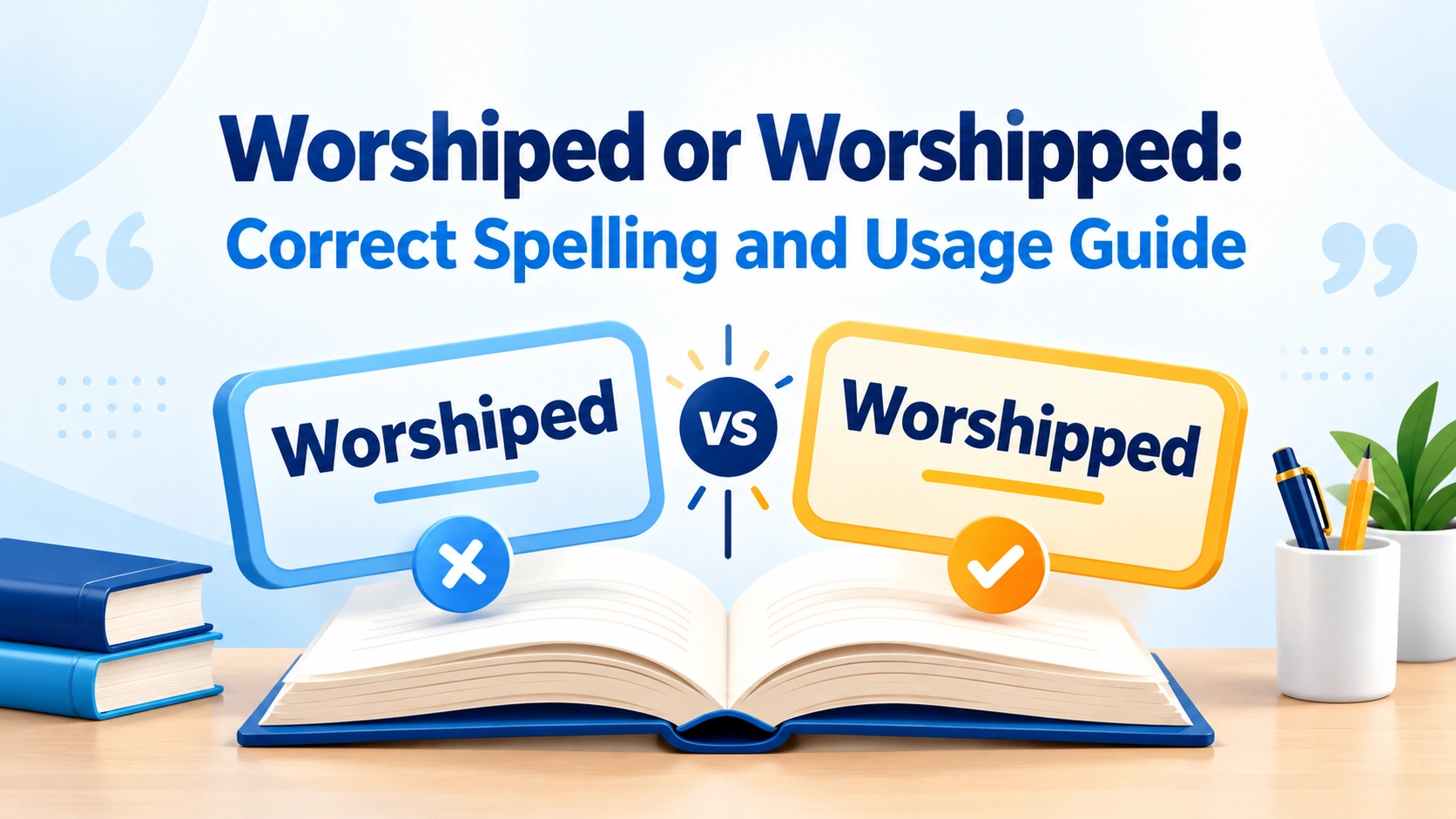
Worshiped or worshipped—which spelling should you use? If the extra p makes one version look British and the other American, your instinct is pointing in the right direction, but there is more to the story. Both spellings are established English forms, and they have the same meaning and pronunciation. The main difference is spelling convention and regional preference. In general, worshiped is associated with North American English, while worshipped is the more traditional form in British English. However, major dictionaries recognize both forms, so context and consistency matter more than declaring one universally wrong.
The confusion becomes especially interesting because the same pattern appears in the related forms worshiping/worshipping and worshiper/worshipper. A writer can therefore encounter several apparently different spellings of the same word family without any change in meaning. Oxford lists worshipped as the main form and worshiped as a North American alternative, while Collins explicitly distinguishes its British and American entries. Merriam-Webster, meanwhile, lists worshipped as worshiped and worshipping also worshiping, demonstrating that the boundary is not absolute.
This guide explains why the spelling varies, how the past tense and past participle work, when each form is most appropriate, and why the familiar “one P equals American, two Ps equals British” rule needs a little qualification. You will also see real sentence examples, verb-form comparisons, common mistakes, dictionary evidence, and a practical decision guide. By the end, choosing between worshiped and worshipped should be a matter of editorial judgment rather than guesswork.
Quick Answer: Is It Worshiped or Worshipped?
Both worshiped and worshipped are correct. They are two spelling variants of the past tense and past participle of worship.
The simplest practical distinction is:
- worshiped — commonly associated with American and North American English
- worshipped — commonly associated with British English
- worshiping — the corresponding single-p form
- worshipping — the corresponding double-p form
Oxford’s American English dictionary gives worshiped as the past form and notes worshipped as a Canadian English form. Its broader learner dictionary lists worshipped and identifies worshiped as a North American alternative.
Merriam-Webster takes an even more useful approach for modern writers: its current entry gives worshipped also worshiped and worshipping also worshiping. In other words, the double-p form should not automatically be treated as a British-only spelling or the single-p form as an American-only spelling.
Bottom line: If you are following a conventional American style, worshiped is a safe choice. If you are following British English, worshipped is the natural choice. If your style guide or publication uses another established convention, follow it consistently.
Worshiped vs Worshipped: The Difference at a Glance
| Feature | Worshiped | Worshipped |
| Base verb | worship | worship |
| Grammatical form | Past tense / past participle | Past tense / past participle |
| Meaning | Same | Same |
| Pronunciation | Same | Same |
| Common association | North American English | British English |
| Related -ing form | worshiping | worshipping |
| Related noun | worshiper | worshipper |
| Is it a legitimate spelling? | Yes | Yes |
| Main issue | Regional/editorial preference | Regional/editorial preference |
The important word in that table is the same. Adding another p does not create a different verb, a different tense, or a different meaning.
The practical rule
If you need a quick decision:
American English → worshiped
British English → worshipped
That is a useful starting point, not an absolute law of English spelling.
What Does “Worship” Mean?
Before deciding how to spell its past tense, it helps to understand what worship actually means.
As a verb, worship can mean to show reverence or devotion toward a deity or supernatural power. It can also mean participating in a religious act or service. In a broader, nonreligious sense, someone can worship a person or thing when they admire or adore it excessively.
For example:
- “The community worshiped at the temple.”
- “The ancient people worshipped several deities.”
- “Fans worshiped the famous singer.”
- “She worshipped her grandmother and treasured her advice.”
The context can therefore be religious or figurative.
As a noun, worship refers to reverence or devotion itself, a religious practice, or an act of expressing such reverence. Merriam-Webster also records a broader meaning involving extravagant admiration or devotion.
Worship is not limited to one religious context
The word appears in writing about:
- Christianity
- Judaism
- Islam
- Hinduism
- ancient religions
- temples and sacred sites
- religious ceremonies
- cultural history
- mythology
- figurative admiration
The spelling question remains the same regardless of the context.
Why Is It Worshiped in One Place but Worshipped in Another?
The difference comes from English spelling conventions, not from a difference in meaning.
English developed multiple standardized spelling traditions. British and American English often handle consonant doubling differently when suffixes such as -ed and -ing are added.
Compare:
| American-style spelling | British-style spelling |
| worshiped | worshipped |
| worshiping | worshipping |
| traveled | travelled |
| canceled | cancelled |
| labeled | labelled |
This comparison helps explain why worship can feel inconsistent to someone who is accustomed to only one variety of English.
But there is an important qualification: English spelling rules are conventions, not mathematical formulas. Individual words can have established spellings that do not behave exactly as a simplified rule predicts.
That is one reason reputable dictionaries are more useful than trying to derive every spelling from a single consonant-doubling rule.
Why Does “Worshipped” Have Two Ps?
The spelling worshipped reflects a convention in which the final consonant is doubled before adding an inflectional ending.
The same pattern is visible in the related forms:
- worship → worshipped
- worship → worshipping
In a single-p convention:
- worship → worshiped
- worship → worshiping
The underlying verb remains worship.
Don’t turn the spelling pattern into an inflexible rule
A common mistake is to memorize a rule such as “British English always doubles the final consonant” or “American English never doubles it.”
Neither statement is reliable enough.
English has many exceptions and lexical conventions. Kidnapped/kidnaped, for example, demonstrates why individual words cannot always be predicted perfectly from a broad spelling principle. Established dictionary forms and the style being followed are better guides than mechanical rules.
Expert tip: When a spelling rule and a dictionary disagree, do not force the word into the rule. Check how reputable dictionaries actually record the word.
Worshiped vs Worshipped in American English
If your publication follows American English, worshiped is a straightforward choice.
Oxford’s Advanced American Dictionary lists:
- past simple: worshiped
- past participle: worshiped
- -ing form: worshiping
It also notes that Canadian English commonly uses the doubled forms.
Examples:
- “The ancient civilization worshiped several gods.”
- “The congregation worshiped together.”
- “She worshiped her favorite musician.”
- “The deity had been worshiped for centuries.”
However, it would be inaccurate to claim that worshipped is impossible or incorrect in American English. Merriam-Webster, an American dictionary, explicitly recognizes worshipped and worshipping.
That distinction matters for writers who want an accurate explanation rather than an oversimplified regional rule.
Worshiped vs Worshipped in British English
For British English, worshipped is the conventional form.
Oxford’s general learner dictionary gives:
- past simple: worshipped
- past participle: worshipped
- -ing form: worshipping
It then identifies worshiped and worshiping as North American alternatives.
Examples:
- “The villagers worshipped at the shrine.”
- “The community worshipped together.”
- “The goddess was worshipped for generations.”
- “They were worshipping in the church.”
Cambridge likewise treats worshipped as the past simple and past participle of worship, with examples showing ordinary modern usage.
Is Worshipped Wrong in American English?
No.
This is one of the most useful corrections to the usual “US versus UK” explanation.
Although worshiped is the conventional North American form in many references, worshipped is also an established spelling and appears in American dictionaries and American publications.
Merriam-Webster, for example, lists:
worshipped also worshiped
That ordering tells you that both forms belong to the dictionary’s recognized vocabulary.
So the following statement is too strong:
“Americans must write worshiped, and worshipped is wrong.”
A better statement is:
“Worshiped is a common North American form, while worshipped is especially associated with British English; both spellings are established.”
That wording is more accurate and reflects current dictionary evidence.
Is Worshiped Wrong in British English?
Again, not necessarily.
In a British-English document, worshipped is normally the more natural choice because it fits the conventional spelling system. But worshiped is recognized as a North American variant by major dictionaries.
The key distinction is between preferred for a particular style and universally incorrect.
Professional editors make this distinction constantly. A spelling can be less appropriate for a particular house style without being an invalid English word.
Worshiped and Worshipped Have the Same Pronunciation
The extra p does not normally change pronunciation.
Both forms are pronounced essentially the same way.
That means reading the word aloud will not solve the spelling problem. The issue is orthography—the written representation of the word—not pronunciation.
This is similar to other regional spelling pairs such as:
- traveled / travelled
- modeled / modelled
- labeled / labelled
The pronunciation remains unchanged while the written form varies.
Complete Verb Forms of Worship
Understanding the entire verb family makes the spelling difference easier to remember.
| Verb form | North American convention | British convention |
| Base form | worship | worship |
| Third-person singular | worships | worships |
| Past tense | worshiped | worshipped |
| Past participle | worshiped | worshipped |
| Present participle | worshiping | worshipping |
The base form never changes between these conventions.
Only certain inflected forms display the spelling difference.
Examples in context
Present:
“Many people worship in different ways.”
Third person:
“She worships at the local church.”
American-style past tense:
“They worshiped at the temple.”
British-style past tense:
“They worshipped at the temple.”
American-style participle:
“They were worshiping together.”
British-style participle:
“They were worshipping together.”
Worshiped vs Worshipped in Real Sentences
Religious use
“The community worshiped at the temple every week.”
“The community worshipped at the temple every week.”
Both sentences communicate the same idea.
Historical writing
“The civilization worshiped the sun as a powerful deity.”
“The civilization worshipped the sun as a powerful deity.”
Again, the spelling changes; the historical claim does not.
Figurative use
Worship does not have to describe literal religious devotion.
“The fans worshiped the actor as a cultural icon.”
“The fans worshipped the actor as a cultural icon.”
Here, worship means something closer to adoration or admiration intensely. Major dictionaries explicitly recognize this figurative sense.
Academic writing
A historian, theologian, anthropologist, or cultural researcher may encounter either form depending on the publication’s editorial system.
The important question is not:
“Which spelling looks more scholarly?”
It is:
“Which spelling system does this publication follow?”
Worshiped or Worshipped in Bible Writing
Bible-related writing deserves a little extra care because readers may assume there is one universal biblical spelling.
There is not necessarily one spelling convention across all Bible translations, editions, publishers, and English varieties.
For example, an American publication may naturally use:
“They worshiped God.”
A British publication may use:
“They worshipped God.”
When quoting a particular Bible translation or historical text, the safest editorial practice is to preserve the wording of the source rather than silently changing its spelling.
This is especially important in academic, theological, and historical writing, where the exact wording of a cited edition can matter.
Worship vs Praise: Are They the Same?
Not quite.
The words overlap in religious contexts, but they emphasize different ideas.
| Word | Central idea | Typical emphasis |
| Worship | Reverence and devotion | Honoring or revering a deity |
| Praise | Expression of approval or admiration | Celebrating qualities, actions, or achievements |
| Adoration | Intense love or admiration | Deep affection or devotion |
| Veneration | Profound respect | Honor or reverence, often in a formal or religious context |
Someone may praise a deity without every use of praise meaning exactly the same thing as worship. Likewise, worship can include prayer, music, ritual, reverence, and other practices depending on the religious tradition.
So replacing worship with praise merely to avoid the spelling issue can subtly change the meaning.
Worship vs Veneration vs Idolatry
These terms are related but should not be treated as perfect synonyms.
Worship
Worship generally refers to reverence, devotion, or religious practice directed toward a deity or sacred object. It can also have a figurative sense of extreme admiration.
Veneration
Veneration usually emphasizes profound respect or honor. In some religious traditions, it has a more specific theological meaning.
Idolatry
Idolatry is a more specific theological concept involving the worship of idols or false gods, depending on the religious framework being discussed.
That distinction matters in academic or religious writing. A thesaurus may group these words together, but their meanings are not interchangeable in every sentence.
Common Mistakes With Worshiped and Worshipped
Mistake 1: Calling one spelling “wrong” everywhere
This is the biggest mistake.
Both forms are recognized by reputable dictionaries.
Better approach: identify the English variety and editorial context.
Mistake 2: Assuming two Ps always means British English
It is a useful shortcut, but not an absolute rule.
American dictionaries such as Merriam-Webster recognize worshipped.
Mistake 3: Assuming one P always means American English
Likewise, worshiped can appear outside the United States, particularly in writing influenced by North American spelling.
Mistake 4: Mixing the related forms
A document that uses:
- worshiped
- worshipping
- worshiper
may look inconsistent if the writer intended a single regional spelling system.
A more consistent set is:
North American style: worshiped, worshiping, worshiper
British style: worshipped, worshipping, worshipper
These are useful conventions, although dictionary evidence shows that real-world usage has overlap.
Mistake 5: Thinking the spelling changes the meaning
It does not.
Worshiped and worshipped are forms of the same verb.
What About Worshiper vs Worshipper?
The same spelling variation appears in the noun describing a person who worships.
| Form | Common association |
| worshiper | North American English |
| worshipper | British English |
| worshiper/worshipper | Both are recognized |
Merriam-Webster lists worshipper and describes worshiper as less common, while Oxford’s broader entry uses worshipper and recognizes worshiper as North American.
This is a useful reminder that the spelling difference is not isolated to the past tense.
The broader word family includes several forms whose spelling can vary according to English variety and editorial preference.
How Major Dictionaries Treat Worshiped and Worshipped
Dictionary evidence is particularly valuable here because simplistic grammar rules can give the wrong impression.
| Dictionary/reference | Treatment of the forms |
| Merriam-Webster | Lists worshipped also worshiped and worshipping also worshiping |
| Oxford Advanced Learner’s Dictionary | Lists worshipped, with worshiped as a North American form |
| Oxford Advanced American Dictionary | Lists worshiped, noting Canadian worshipped |
| Collins | Uses regional notes distinguishing British and American forms |
| Cambridge | Recognizes worshipped as the past form and provides usage examples |
This evidence supports an important conclusion: there is no good reason to label either spelling an outright mistake in every context.
Instead, professional writing depends on audience, regional variety, publication style, and consistency.
Which Spelling Should You Use?
Use this decision guide when proofreading.
| Your situation | Recommended choice |
| Writing in conventional American English | worshiped |
| Writing in conventional British English | worshipped |
| Following a US publisher’s style | Follow its house style |
| Following a UK publisher’s style | Follow its house style |
| Academic writing | Match the required style and English variety |
| Quoting a source | Preserve the source’s spelling |
| Writing for a mixed international audience | Choose one convention and stay consistent |
| Editing someone else’s work | Don’t change the form without a stylistic reason |
A professional editor’s approach
Suppose you are editing an article that otherwise uses:
- color
- organize
- traveled
- labeled
Then worshiped will usually fit the American pattern.
If the article uses:
- colour
- organise
- travelled
- labelled
then worshipped will usually fit the British pattern.
This is a more reliable editorial clue than looking at the single word in isolation.
Editing principle: Consistency across the document is usually more valuable than trying to declare one variant universally superior.
A Simple Memory Trick
If you want a quick way to remember the conventional distinction:
US-style:
worship → worshiped → worshiping → worshiper
British-style:
worship → worshipped → worshipping → worshipper
Think of the British-style family as the double-P family.
Just remember that this is a usage shortcut, not an absolute statement about every English-speaking writer or publication.
Is There a Difference in Meaning?
No.
Consider these pairs:
“The people worshiped the deity.”
“The people worshipped the deity.”
The sentences mean the same thing.
Likewise:
“She worshiped her favorite singer.”
“She worshipped her favorite singer.”
The spelling does not alter the figurative meaning.
The only meaningful distinction is which spelling convention the writer or publication chooses to follow.
Why Dictionary Evidence Matters More Than a Simple Spelling Rule
Spelling advice often becomes unreliable when it starts with a broad rule and assumes every word must obey it.
A dictionary does something different: it records actual established forms.
Merriam-Webster currently recognizes both worshipped and worshiped, while Oxford explicitly distinguishes the North American form within its verb-form information. Collins likewise records regional variation.
That is why an expert explanation should not simply say:
“Double P is British; single P is American.”
That statement is useful as a beginner’s shortcut, but it leaves out the overlap found in real English.
A better conclusion is:
Worshiped and worshipped are established variants, with worshiped strongly associated with North American English and worshipped strongly associated with British English.
That is both practical and defensible.
Quick Proofreading Checklist
Before publishing, check these five things:
- Identify the English variety. Is the document primarily American or British?
- Check related spellings. Look at words such as travelled/traveled and labelled/labeled.
- Keep the word family consistent. Consider worshiped/worshipped, worshiping/worshipping, and worshiper/worshipper together.
- Follow the publication’s style guide. A house style takes priority over personal preference.
- Preserve quotations. Don’t silently alter the spelling of a quoted source unless your editorial policy requires it.
This approach eliminates most spelling uncertainty without memorizing complicated rules.
Conclusion
Worshiped and worshipped are both correct, but the best choice depends on the English variety and editorial context. Worshiped is the conventional North American form, while worshipped is the conventional British form; importantly, reputable dictionaries recognize overlap, so neither should be dismissed as universally wrong.One final actionable tip: look at the spelling system used by the rest of your document. If it consistently uses American forms such as color and traveled, worshiped will usually fit. If it uses British forms such as colour and travelled, choose worshipped.A common mistake to avoid is treating regional preference as an absolute grammar rule. English is more flexible than that. Choose the convention that suits your audience, apply it consistently, and let clarity and editorial consistency settle the spelling question.
FAQs
Q1. Is “worshiped” or “worshipped” the correct spelling?
Both worshiped and worshipped are established spellings of the past tense and past participle of worship. Worshiped is commonly associated with North American English, while worshipped is especially common in British English.
Q2. Is “worshipped” an American spelling?
Yes. Although worshipped is strongly associated with British English, it is also recognized in American dictionaries. Merriam-Webster lists worshipped also worshiped, so it would be inaccurate to describe the double-p spelling as exclusively British.
Q3. Which is preferred in American English: worshiped or worshipped?
Worshiped is the conventional North American form in references such as Oxford’s Advanced American Dictionary. However, worshipped is also established in American usage. For a US publication, follow its specific style guide when one exists.
Q4. Which is preferred in British English: worshiped or worshipped?
Worshipped is the conventional British form. Oxford lists it as the standard past form and identifies worshiped as a North American alternative. Therefore, British-oriented writing will normally use worshipped.
Q5. Are worshiped and worshipped pronounced differently?
No. The two spellings normally have the same pronunciation and meaning. The extra p is a written spelling difference rather than a change in the spoken word. Your choice should therefore be based on English variety and editorial consistency, not pronunciation.