

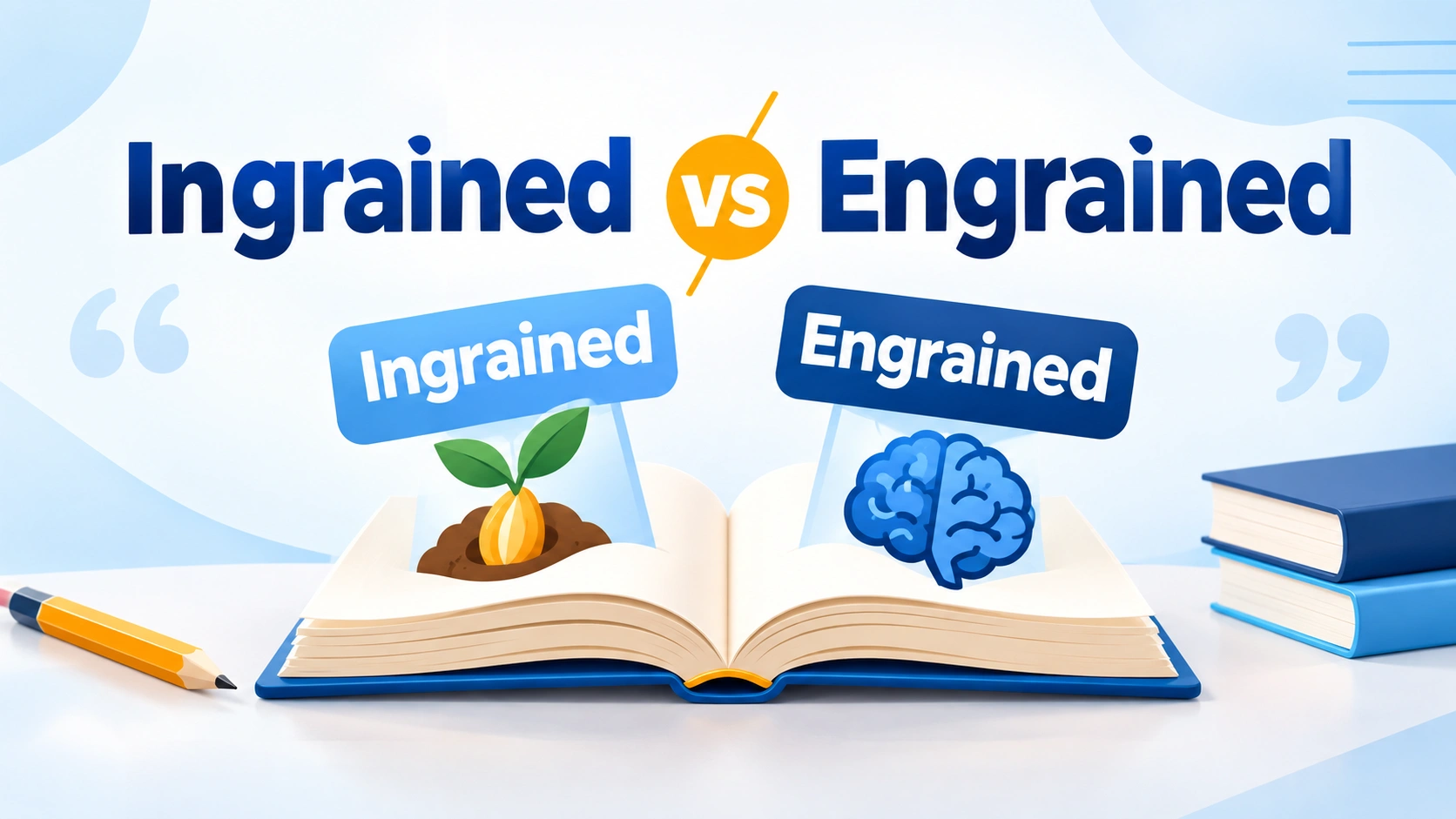
Ingrained vs engrained is a spelling question that causes more confusion than you might expect. Both forms appear in dictionaries and real-world writing, and both can describe something that has become deeply established. However, they are not equally common. In modern standard English, ingrained is the form you will see most often and the one editors generally recommend for ordinary formal, academic, professional, and everyday writing. Engrained is a recognized alternative, but it is much less common. That distinction matters because a word can be legitimate without being the best choice in every context.
The meaning is straightforward: ingrained describes a habit, belief, attitude, behavior, tradition, or characteristic that has become firmly established and is therefore difficult to change. It can also describe something physically worked into a material, such as dirt embedded in fabric. The word has a long history connected with ingrain, while engrain is also an established historical verb form. Major dictionaries, including Merriam-Webster, Oxford, Cambridge, and Collins, recognize the relationship between the two spellings, although they differ slightly in how they present the variant.
So, which should you actually write? In most situations, choose ingrained. You do not need to switch to engrained for British English, American English, academic writing, or professional communication. At the same time, calling engrained simply “wrong” misses an important piece of English history and dictionary usage. This guide explains what ingrained means, where it came from, why engrained exists, how the two forms differ in modern usage, which phrases sound natural, and how to choose the right word without second-guessing yourself.
The Quick Answer: Ingrained or Engrained?
If you need the answer while writing an email, essay, article, report, or social post, use ingrained.
Preferred: The habit was deeply ingrained in her from childhood.
Also recognized: The habit was deeply ingrained in her from childhood.
The second sentence is understandable and supported as a variant by major dictionaries, but ingrained is the safer and more conventional modern choice. Merriam-Webster lists engrained as a less common variant, while Oxford lists engrained as an alternative form of ingrained.
| Point of comparison | Ingrained | Engrained |
| Modern status | Standard, widely used | Recognized alternative/variant |
| Meaning | Deeply established or embedded | Essentially the same |
| Commonness | Much more common | Less common |
| Formal writing | Recommended | Usually avoid when choosing between the two |
| Academic writing | Recommended | Understandable but unnecessary |
| British English | Standard choice | Recognized alternative |
| American English | Standard choice | Recognized alternative |
| Best practical choice | Use this | Use only when preserving a source’s wording or for a specific stylistic reason |
The important point is that this is not a case like “affect” versus “effect,” where the words have different functions and meanings. Ingrained and engrained generally carry the same meaning. The real issue is usage frequency and editorial preference.
What Does “Ingrained” Mean?
Ingrained is an adjective describing something that has become deeply fixed, established, or embedded.
It is particularly common when talking about things that develop gradually through repetition, experience, culture, or long-standing practice.
For example:
- She has an ingrained habit of checking her work twice.
- The belief is deeply ingrained in the community.
- His fear of failure became ingrained over many years.
- The tradition is ingrained in the school’s culture.
- The dirt was ingrained in the fabric.
Cambridge defines ingrained in relation to beliefs as something held so firmly that it is unlikely to change, while it also uses the word for dirt that has gotten beneath a surface and is difficult to remove.
Ingrained Can Describe Ideas, Behavior, and Physical Material
One useful distinction is that ingrained has both figurative and literal/material applications.
Figurative:
Respect for elders was deeply ingrained in his upbringing.
Here, respect is not physically inside anything. The word means that the attitude became deeply established.
Physical:
Years of dust had become ingrained in the carpet.
Here, the material really has penetrated or become worked into the fibers.
That two-part meaning helps explain why the word can appear in very different kinds of writing.
Common Collocations With Ingrained
Some combinations occur so naturally that they are worth learning as complete phrases:
- deeply ingrained
- ingrained habit
- ingrained belief
- ingrained attitude
- ingrained behavior
- ingrained prejudice
- ingrained tradition
- ingrained instinct
- ingrained culture
- ingrained pattern
- ingrained assumption
- ingrained in society
- ingrained in the culture
- ingrained in someone’s thinking
Among these, deeply ingrained is particularly common. Oxford specifically lists deeply among the adverbs commonly associated with ingrained.
Why Does “Engrained” Look So Natural?
The spelling engrained does not look like a random mistake. There are good linguistic reasons why English speakers might produce it.
The word contains grain, and English already has many words beginning with en- that mean something like “put into,” “make,” or “cause to be.” A speaker who thinks of something as being placed deeply into a material may naturally reconstruct the word as engrained.
There is another complication: engrain is itself an established historical verb. Etymological sources trace ingrain and engrain back to medieval forms associated with dyeing fabric, rather than the modern everyday sense of putting something into cereal grain.
So the spelling confusion is understandable.
The mistake is assuming that because engrained looks logically formed, it must therefore be the preferred modern spelling. English spelling is shaped by history and usage, not by perfectly consistent modern logic.
Where Does “Ingrained” Come From?
The history of ingrained is more interesting than the spelling suggests.
From Dyeing Fabric to Deeply Fixed Ideas
According to etymological evidence, ingrain originally referred to dyeing fabric with a fast color. The word is connected with an old French expression involving graine, associated with the material used to produce certain dyes. Over time, the word became associated with grain as the fiber or structure of a material.
That led naturally to the idea of something being worked deeply into the material.
Eventually, the meaning became figurative:
something worked deeply into a material
became
something fixed deeply in a person’s mind, character, habits, or culture.
The figurative sense is therefore not an arbitrary modern metaphor. It developed from the older physical sense.
When Did the Figurative Meaning Appear?
Etymological records are ingrained in the late sixteenth century and show the figurative sense developing later. Etymonline dates the adjective to the 1590s and notes the figurative sense relating to habits, principles, and prejudices from the nineteenth century.
That history explains why ingrained works particularly well for things that seem to have become part of the underlying structure of something.
What About “Engrained”?
This is where the answer needs a little more nuance than “engrained is incorrect.”
Is “Engrained” a Real Word?
Yes.
Engrained is a recognized variant of ingrained, not merely a meaningless spelling invented by people who cannot spell ingrained. Oxford lists engrained as an alternative form, and Merriam-Webster describes it as a less common variant.
Collins likewise presents engrained as an alternative form of ingrained.
That means the most accurate explanation is:
Ingrained is the preferred modern form; engrained is a recognized but less common variant.
This is more precise than saying “engrained is always wrong.”
Why Is “Engrained” Less Common?
English often retains competing forms for centuries before one becomes dominant.
In this case, ingrain and engrain have both existed historically. The two forms therefore have a legitimate linguistic relationship rather than being completely unrelated inventions.
Modern dictionaries preserve evidence of that variation, but contemporary writers generally encounter ingrained far more often.
That creates an important editorial principle:
Dictionary recognition and preferred usage are not always the same thing.
A dictionary may document a word because it exists in English. An editor still has to decide which form is clearest and most conventional for the audience.
For most modern writing, that form is ingrained.
Ingrain vs. Engrain: The Verbs Behind the Adjectives
Understanding the verbs makes the spelling issue easier to untangle.
What Does “Ingrain” Mean?
Ingrain means to establish something deeply or firmly, particularly through repeated experience or influence.
For example:
The teacher’s routines ingrained a strong sense of organization in the students.
It can also refer to working something into a material.
The adjective ingrained comes naturally from this verb:
The habit was ingrained over many years.
What Does “Engrain” Mean?
Engrain is also attested as a verb and has historically been associated with the same general family of meanings. Dictionaries that include engrained therefore are not treating it as a completely unrelated construction.
However, knowing that engrain exists does not mean you need to prefer engrained.
For contemporary readers, the simplest and most recognizable pairing is:
ingrain → ingrained
That is the form to reach for unless you have a reason to reproduce an alternative form.
Ingrained vs. Engrained in Modern English
The practical difference is mostly about frequency, familiarity, and editorial choice, not meaning.
Oxford gives both forms for the adjective, while Merriam-Webster explicitly identifies engrained as the less common variant.
A Useful Decision Matrix
| If you are writing… | Best choice | Why |
| A school assignment | Ingrained | Most conventional |
| An academic paper | Ingrained | Clear and standard |
| A business report | Ingrained | Familiar to a broad audience |
| A news article | Ingrained | Conventional editorial choice |
| A website or blog | Ingrained | Most recognizable |
| Everyday conversation | Ingrained | Natural and familiar |
| British English | Ingrained | No need to switch forms |
| American English | Ingrained | Standard practical choice |
| Quoting an original source | Preserve the source | Accuracy takes priority |
| Discussing historical language | Either, depending on evidence | Context may require the variant |
Is “Engrained” British English?
Not in the sense of being a specifically British spelling.
This is an important misconception.
There are genuine British-American spelling differences such as colour/color, centre/center, and organise/organize. Ingrained versus engrained does not work that way.
British dictionaries recognize both forms, but ingrained remains the straightforward choice for polished British English. Oxford’s entry presents engrained as an alternative rather than as a specifically British replacement for ingrained.
So don’t reason:
“I’m writing for a British audience, so I should use engrained.”
That is unnecessary.
Write:
The attitude is deeply ingrained in British culture.
The same practical advice applies to American and international English.
When to Use “Ingrained” in Real Writing
The strongest way to understand the word is to see what it does in different contexts.
Habits
Her habit of proofreading every email before sending it is deeply ingrained.
Here, ingrained suggests that the behavior has become automatic through repetition.
Beliefs
The belief that success requires constant competition is deeply ingrained in the organization.
This emphasizes a long-established way of thinking.
Cultural Practices
The custom is ingrained in the community and has been passed down for generations.
The word highlights the practice’s deep roots rather than simply saying that it exists.
Attitudes
His distrust of unfamiliar systems was so ingrained that he resisted every proposed change.
This example also shows an important nuance: something ingrained is often difficult to change.
Physical Material
The grease was so ingrained in the fabric that ordinary washing did not remove it.
This is the literal/material sense.
Institutions and Systems
The procedure had become ingrained in the company’s daily operations.
This use is increasingly useful in professional writing because ingrained can describe not only individual behavior but also organizational patterns.
✅Ingrained vs. Similar Words: Which One Is More Precise?
“Ingrained” has several close synonyms, but they are not interchangeable in every sentence.
| Word | Main idea | Example |
| Ingrained | Deeply established through experience, repetition, or influence | an ingrained habit |
| Deep-rooted | Having strong and longstanding origins | a deep-rooted tradition |
| Entrenched | Firmly established and resistant to change | entrenched interests |
| Embedded | Placed or incorporated deeply within something | embedded assumptions |
| Inherent | Naturally belonging to something | inherent risks |
| Habitual | Done regularly or repeatedly | habitual behavior |
| Internalized | Absorbed into one’s thinking or beliefs | internalized expectations |
| Established | Accepted or settled over time | an established practice |
Ingrained vs. Inherent
This distinction is especially useful.
Inherent means something is naturally part of the nature or character of something.
Ingrained suggests that something became deeply established.
Compare:
Risk is inherent in the activity.
The risk naturally belongs to the activity.
Fear of the activity became ingrained after several bad experiences.
The fear developed and became deeply fixed.
Ingrained vs. Entrenched
These words overlap, but entrenched often carries a stronger sense of resistance to change.
She has an ingrained habit of arriving early.
This sounds neutral.
The organization has entrenched bureaucratic practices.
This suggests a system that is firmly established and difficult to reform.
Common Mistakes With Ingrained and Engrained
Mistake 1: Assuming Engrained Is Always Wrong
This is too absolute.
Major dictionaries recognize engrained as an alternative or less common form.
The better rule is:
Recognized does not necessarily mean preferred.
If you’re choosing a form yourself, ingrained is the better default.
Mistake 2: Treating It as a British-American Difference
It isn’t a straightforward regional spelling pair.
If you are writing for a British audience, you do not need to replace ingrained with engrained.
Mistake 3: Confusing Ingrained With Engraved
These words sound somewhat similar but describe different things.
Engraved means something has been cut, carved, or marked into a surface.
Ingrained means something has become deeply established or embedded.
Compare:
Her initials were engraved on the plaque.
The tradition was ingrained in the community.
Mistake 4: Using Ingrained When You Mean Inherent
As noted above, ingrained usually suggests development or establishment over time.
If you mean something is naturally part of the thing itself, inherent may be more accurate.
Mistake 5: Automatically Writing “Deeply Engrained”
The phrase deeply ingrained is the conventional choice.
If you’re proofreading your own work and see it deeply engrained, changing it to deeply ingrained will usually make the sentence more conventional without changing its meaning.
Is “Ingrained in” or “Ingrained into” Correct?
Both constructions can occur, but ingrained in is especially natural when describing something already deeply established within a person, group, culture, system, or material.
Common examples include:
The practice is ingrained in the culture.
The belief is ingrained in his thinking.
The habit became ingrained in her routine.
Oxford specifically gives ingrained in somebody/something as a common construction.
Into can make sense when the sentence emphasizes the process of putting or working something into something else:
The experience was gradually ingrained into his understanding of the subject.
However, don’t force yourself simply because you are thinking about physical movement. In many everyday sentences, ingrained in is the more natural construction.
A Simple Memory Trick for Ingrained vs. Engrained
If you regularly hesitate over the spelling, don’t try to memorize a complicated historical rule.
Use this:
When in doubt, choose INGrained.
Think of the familiar pairing:
ingrain → ingrained
Then associate the word with its main idea:
Ingrained = deeply fixed.
That covers habits, attitudes, beliefs, traditions, behaviors, and many physical-material uses.
The trick is not meant to prove that engrained cannot exist. It simply gives you the best default for modern writing.
Editor’s tip: If you’re writing from scratch, use ingrained. If you’re editing someone else’s work, don’t automatically label it as nonsense; first consider whether the context is preserving historical, quoted, or variant usage.
Quick Reference: Ingrained vs. Engrained
| Question | Answer |
| Which spelling should I normally use? | Ingrained |
| Is engrained a word? | Yes, it is a recognized alternative/variant |
| Do the two forms usually have different meanings? | No |
| Is engrained specifically British? | No |
| Is ingrained acceptable in American English? | Yes |
| Is ingrained acceptable in British English? | Yes |
| What does ingrained mean? | Deeply established, fixed, or embedded |
| What phrase is most natural? | Deeply ingrained |
| What is the verb? | Ingrain |
| Can ingrained describe physical material? | Yes |
| Is ingrained more common in modern writing? | Yes |
| What should students and professionals use? | Ingrained |
Conclusion:
When you’re deciding between ingrained vs. engrained, the practical answer is simple: use ingrained in your own modern English writing. It is the familiar, conventional form for deeply established habits, beliefs, attitudes, behaviors, traditions, and physical material. Engrained is not merely a meaningless typo—it is a recognized alternative form documented by major dictionaries—but its lower frequency makes it an unnecessary choice in most situations.One final actionable tip: when proofreading, replace deeply engrained with deeply ingrained unless you have a specific reason to preserve the variant. A common mistake to avoid is treating this as a strict British-versus-American spelling difference. It isn’t. For schoolwork, professional communication, publishing, and general-purpose writing, ingrained is the clear default. Once you connect ingrain with ingrained, the spelling becomes much easier to remember—and the confusion largely disappears.
FAQs
Q1. Is “Ingrained” the Correct Spelling?
Yes. Ingrained is the standard and most widely used modern form. It means deeply established, fixed, or embedded. Major dictionaries recognize engrained as an alternative, but if you are choosing a spelling for an essay, report, article, or professional document, ingrained is the safest choice.
Q2. Is “Engrained” a Correct Word?
Yes, although it is less common than ingrained. Oxford lists engrained as an alternative form, and Merriam-Webster describes it as a less common variant. Therefore, calling it completely incorrect is overly simplistic. In normal modern writing, however, ingrained remains the preferred form.
Q3. Should I Write “Deeply Ingrained” or “Deeply Engrained”?
Use deeply ingrained. This is the conventional modern expression and is particularly common when discussing beliefs, attitudes, habits, traditions, and behaviors. For example: “The practice is deeply ingrained in the organization’s culture.” Deeply engrained can be understood, but it is not the form most writers should deliberately choose.
Q4. What Is the Difference Between Ingrain and Engrain?
Ingrain and engrain are historically related verb forms, and their participles help explain why both ingrained and engrained exist. In modern writing, however, ingrain → ingrained is the more familiar pairing. If you’re choosing a word rather than reproducing historical wording, ingrain is the practical choice.
Q5. Is “Ingrained” the Same as “Inherent”?
Not quite. Ingrained means something has become deeply established, often through repetition, experience, or influence. Inherent means something naturally belongs to the nature of a person or thing. An ingrained habit develops over time; an inherent characteristic is present as part of the thing itself.