

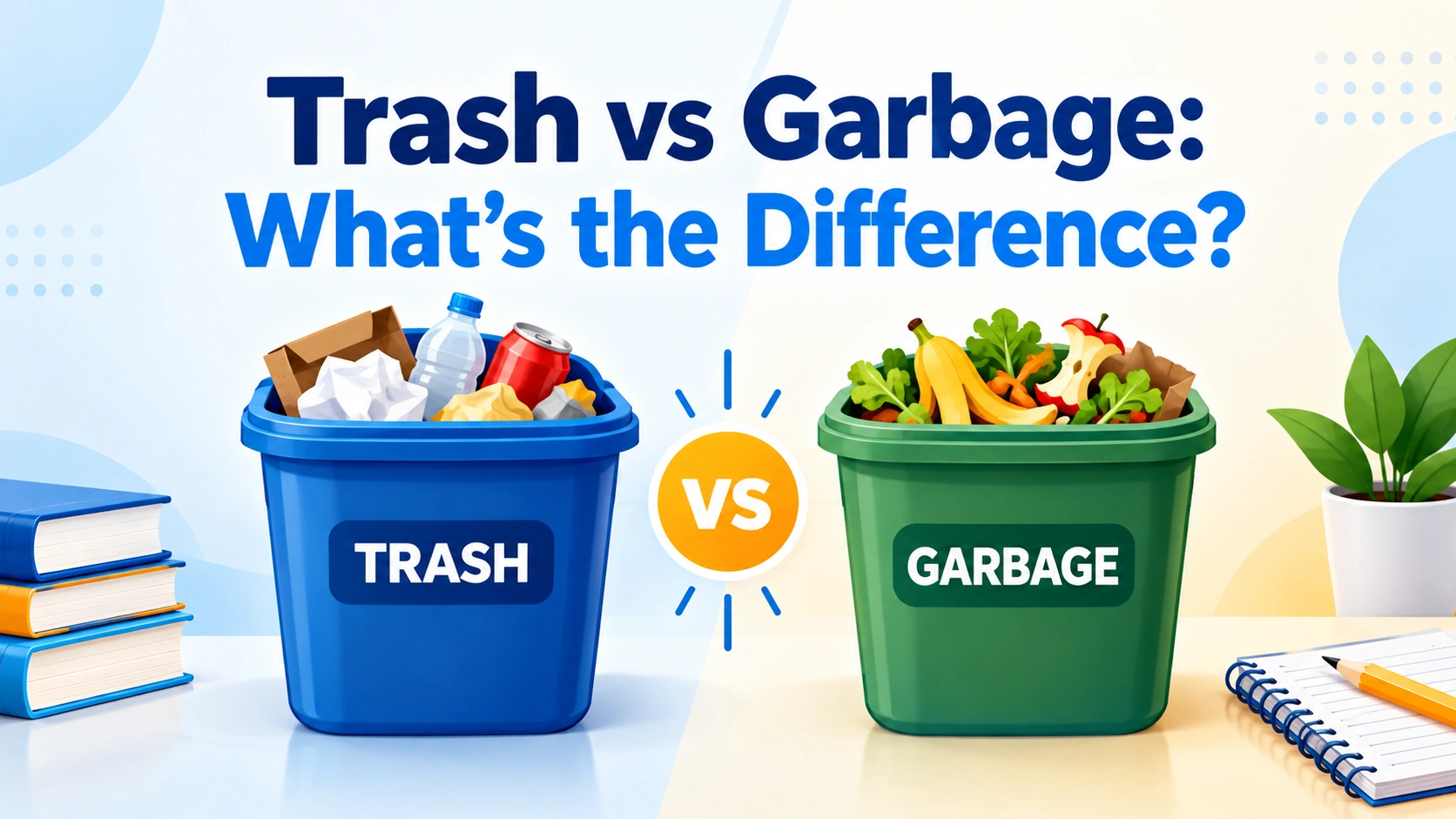
Trash vs garbage is one of those English-language comparisons where the apparent difference is much sharper than the actual one. In everyday American English, trash and garbage are usually interchangeable: both can mean unwanted material that people throw away. The interesting part is that garbage has a more specific traditional association with food and kitchen waste, while trash often suggests discarded material more generally. Neither distinction is absolute, however. Regional English, household habits, and context all influence the word people choose. If you are wondering which term is correct, the answer depends less on grammar than on meaning, audience, and situation.
The difference becomes clearer when you look beyond the two words themselves. In the United States, someone may say “take out the trash” or “take out the garbage” without making any meaningful distinction between them. In Britain, the natural everyday word is more often rubbish, while waste works well in formal or technical contexts. Even the containers reflect this variation: trash can, garbage can, rubbish bin, and waste bin can all refer to broadly similar objects. Understanding these patterns helps you sound natural rather than simply memorizing a supposedly universal rule.
There is also an important distinction between everyday vocabulary and waste-management terminology. A person can casually call something trash or garbage, but a recycling program may classify it as paper, glass, organics, hazardous waste, or another specific material stream. That is why choosing the right word sometimes matters—and sometimes does not. This guide explains the meanings of trash and garbage, their regional differences, related terms such as rubbish, waste, and refuse, common expressions, and the situations in which a more precise term is actually necessary.
Trash vs. Garbage: The Main Difference
The simplest answer is that trash and garbage usually mean the same thing in ordinary American English: unwanted material that is thrown away.
There is, however, a useful traditional distinction:
- Trash can refer broadly to unwanted or discarded material.
- Garbage has historically been associated more closely with food scraps, kitchen refuse, and other household waste.
- In modern everyday speech, garbage is also used broadly, so it can include paper, packaging, containers, and other unwanted items.
- In British English, rubbish is generally the more natural everyday term for what Americans call trash or garbage.
Cambridge explicitly lists trash and garbage as U.S. terms for waste material, while identifying rubbish as the usual British equivalent. Its American definition of garbage also notes a particular association with unwanted food.
So the best rule is not:
“Trash means X, while garbage always means Y.”
A better rule is:
Trash and garbage overlap in everyday use; garbage can have a stronger food-waste association, but context and regional usage determine the natural choice.
Trash vs. Garbage at a Glance
| Point | Trash | Garbage |
| Basic meaning | Unwanted or discarded material | Unwanted or discarded material |
| Common U.S. usage | Very broad | Very broad |
| Traditional association | General discarded material | Food and kitchen waste |
| Food scraps | Yes | Especially natural |
| Packaging and paper | Very common | Also possible |
| British everyday equivalent | Usually rubbish | Usually rubbish |
| Technical waste category | Not normally a precise classification | Not normally a precise classification |
The key takeaway is that neither word creates a universal technical boundary.
What Does “Trash” Mean?
Trash is a common noun for things that are unwanted and thrown away. In American English, it can describe everything from a used wrapper to a pile of unwanted household objects.
Cambridge defines it as waste material or things that are no longer wanted or needed and labels this waste sense as primarily U.S. English.
Trash as a General Word for Waste
The word is especially useful when the speaker does not care—or does not need—to identify the precise material involved.
For example:
- “Please put the wrapper in the trash.”
- “The trash is overflowing.”
- “We need to take the trash outside.”
- “There was a lot of trash left after the event.”
In each case, trash works as a broad label.
It can cover paper, packaging, disposable products, broken household items, and other unwanted materials. That broadness is one reason it is so useful in ordinary conversation.
“Trash” Can Mean More Than Physical Waste
The noun trash also has figurative meanings. Someone can describe poor-quality entertainment as “trash,” for example.
The word also functions as a verb. To trash something can mean to throw it away, damage it badly, or severely criticize it, depending on context.
That means a sentence such as “They trashed the room” does not mean they threw the room into a garbage truck. The verb has developed meanings that are separate from the noun’s basic waste sense.
What Does “Garbage” Mean?
Garbage is another common word for discarded material, particularly in American English. It can refer to general household waste, but it has a stronger traditional connection with unwanted food and kitchen waste than trash does.
Cambridge’s American dictionary specifically describes garbage as waste material, especially unwanted food, or a container in which waste is kept.
Garbage and Food Waste
Consider:
“She threw the spoiled vegetables in the garbage.”
Here, garbage is especially natural because the material is food waste.
But the word is not restricted to food:
“The garbage truck comes every Tuesday.”
The truck may collect a mixture of household waste rather than food alone.
That broader use is why it would be misleading to tell learners that garbage always means food waste.
Garbage Can Mean Nonsense, Too
Like trash, garbage has a figurative meaning.
For example:
“That claim is garbage.”
Here, garbage means something worthless, nonsensical, or very poor—not physical waste. Cambridge records this figurative sense as well.
The surrounding context therefore matters.
Why Are Trash and Garbage Often Used Interchangeably?
The two words have developed substantial semantic overlap. In ordinary conversation, speakers usually care about getting rid of something, not classifying the discarded material according to a historical vocabulary distinction.
If someone says:
“Could you take out the garbage?”
the listener generally understands the practical instruction immediately.
If the same person says:
“Could you take out the trash?”
The intended action is essentially the same.
This overlap is reflected in dictionary treatment. Cambridge lists trash as a U.S. term corresponding to garbage and lists garbage as a U.S. term corresponding to trash.
The Traditional Distinction Still Helps
The older distinction is not useless. It explains why garbage can sound particularly natural when talking about food scraps or kitchen waste.
For instance:
- “Put the banana peel in the garbage.”
- “The garbage smells terrible.”
- “Take the trash from the garage to the curb.”
These preferences are natural tendencies, not grammatical laws.
Why You Should Not Force the Distinction
Trying to assign every discarded object permanently to either category creates problems.
A cardboard box might be called trash by one speaker and garbage by another. A household waste collection may be called garbage collection even though the collected material includes far more than food.
Natural English does not require speakers to maintain a strict trash-versus-garbage classification system.
Trash vs. Garbage in American English
American English uses both terms extensively.
When Americans Say “Trash”
Trash is particularly natural for general discarded material:
- trash can
- trash bag
- trash pickup
- trash collection
- take out the trash
- throw it in the trash
For example:
“There are too many boxes in the garage. We need to get rid of some of this trash.”
The word does not imply that the boxes are food waste.
When Americans Say “Garbage”
Garbage is also broad, but its food-related association remains noticeable:
- garbage can
- garbage bag
- garbage truck
- garbage collection
- garbage disposal
- take out the garbage
For example:
“Put the coffee grounds in the garbage.”
Here, garbage feels especially natural because the item is kitchen waste.
But:
“The garbage truck picked up the bags.”
does not imply that the bags contained food.
Which Is More Natural?
There is no universal winner.
A speaker might consistently say trash, while another prefers garbage. Both are normal American English.
The safest approach is to follow the vocabulary already established in your context. If a workplace calls its containers “trash cans,” suddenly labeling them “garbage cans” is unnecessary. Consistency often matters more than choosing between two accepted synonyms.
Trash vs. Garbage in British English
The regional difference becomes more noticeable outside North America.
In British English, rubbish is the ordinary word for unwanted material that is thrown away. Cambridge identifies rubbish as a U.K. term and gives garbage and trash as U.S. equivalents.
So a British speaker is more likely to say:
“Can you take the rubbish out?”
rather than:
“Can you take the trash out?”
That does not mean British speakers cannot understand trash or garbage. They can. The issue is natural regional vocabulary, not whether the words are comprehensible.
What About Canada, Australia, and New Zealand?
English varieties do not divide neatly into two boxes.
Canadian English has substantial overlap with American English but also its own regional preferences. Australian and New Zealand English commonly use rubbish as well.
For international writing, therefore, it is better to avoid statements such as:
“Americans say trash, and everyone else says rubbish.”
Real-world usage is more complicated.
Regional Preference Summary
| Variety of English | Common everyday term(s) |
| U.S. English | trash, garbage |
| Canadian English | trash, garbage, with regional variation |
| British English | rubbish |
| Australian English | rubbish |
| New Zealand English | rubbish |
| Formal/international contexts | waste often works well |
The important distinction is preference, not strict correctness.
Trash vs. Garbage vs. Rubbish vs. Waste
Once rubbish and waste enter the comparison, the vocabulary becomes easier to understand as a system rather than as isolated synonyms.
| Word | Typical meaning | Register/region |
| Trash | Unwanted discarded material | Common U.S. everyday English |
| Garbage | Discarded material, often with a food-waste association | Common U.S. everyday English |
| Rubbish | Unwanted discarded material | Common British English |
| Waste | Broad term for material that is discarded or no longer useful | Widely used; often more formal/technical |
| Refuse | Discarded material or waste | More formal/official |
Is “Waste” More Formal?
Often, yes—but waste is not exclusively formal.
It appears naturally in everyday expressions such as:
- food waste
- waste paper
- household waste
- waste bin
It becomes particularly useful when precision matters.
For example, an environmental report might distinguish between organic waste, recyclable materials, hazardous waste, and municipal solid waste rather than simply calling everything trash.
Is “Rubbish” Just the British Version of “Trash”?
For broad everyday purposes, it is a very useful equivalent. Cambridge explicitly identifies U.K. rubbish with U.S. garbage and trash.
But regional equivalents are rarely perfect in every expression. A British writer should generally use the vocabulary natural to British English rather than mechanically replacing every occurrence of trash with rubbish.
Trash Can vs. Garbage Can vs. Rubbish Bin
The noun for the waste often influences the noun used for its container.
Common Combinations
| Expression | Where it is especially natural |
| trash can | U.S. English |
| garbage can | U.S. English |
| rubbish bin | British English |
| waste bin | Broad/international and formal contexts |
| trash bin | Also used, particularly in some contexts outside ordinary household speech |
Both trash can and garbage can are correct American expressions.
Neither container has to contain a special type of waste.
If someone says:
“The garbage can is full of paper.”
There is no contradiction. The word garbage is being used in its broad modern sense.
Trash vs. Garbage in Waste Management
This is where everyday vocabulary and professional terminology need to be separated.
A waste-management professional cannot rely on whether a resident calls something “trash” or “garbage.” Collection, recycling, treatment, and disposal systems require material categories.
The U.S. Environmental Protection Agency uses the broader category municipal solid waste (MSW) for everyday materials generated by homes and other sources. Its examples include packaging, food scraps, furniture, clothing, bottles and cans, appliances, and other materials.
That is much more precise than saying all of those items are simply “trash.”
Why Technical Classification Matters
Suppose a household has:
- a cardboard box
- a banana peel
- an old battery
- a glass bottle
- a broken electronic device
A person might casually call all five trash.
A waste-management system may need to treat them very differently.
The relevant questions become:
- Is the material recyclable?
- Is it compostable or organic?
- Is it hazardous?
- Does the local collection program accept it?
- Does it require a special drop-off location?
- Which waste stream should receive it?
That is why local disposal instructions matter more than the everyday label.
Expert tip: If you are deciding where an item belongs, do not rely on whether you personally call it trash or garbage. Check the disposal rules for your local collection system.
Garbage Disposal vs. Trash Disposal
One expression deserves special attention: garbage disposal.
In American English, a garbage disposal commonly refers to the kitchen appliance installed beneath a sink that processes food waste.
That meaning is different from simply saying “garbage disposal” as a general description of throwing waste away.
This creates an important vocabulary distinction:
- garbage = discarded material
- garbage disposal = commonly, the kitchen appliance
- waste disposal = the broader process or system of handling waste
The context determines which meaning the listener hears.
If someone says, “The garbage disposal is making a strange noise,” they are almost certainly talking about the appliance, not the municipal garbage collection service.
Examples: When Should You Say “Trash” or “Garbage”?
The easiest way to understand the overlap is to see how the words behave in real situations.
General Household Waste
Both work:
“The trash is full.”
“The garbage is full.”
There is no important difference in meaning here.
Food Scraps
Garbage can sound particularly natural:
“Put the vegetable scraps in the garbage.”
But trash can still be understood and used depending on the household or local vocabulary.
Paper and Packaging
Trash is especially natural in many American contexts:
“Throw the receipt in the trash.”
But garbage may also be used broadly.
British English
A British speaker would commonly use rubbish:
“Put the receipt in the rubbish.”
Formal Environmental Writing
A more precise term is usually better:
“Food waste should be separated from recyclable materials.”
That sentence communicates a classification rather than relying on a broad everyday label.
When the Difference Actually Matters
For ordinary conversation, very little is at stake. But there are situations where vocabulary precision becomes important.
1. Recycling Instructions
A recycling guide should identify accepted materials rather than merely telling people to separate “trash” from “garbage.”
2. Municipal Collection
Local governments may define their collection categories differently. A bin labeled for a particular waste stream should be interpreted according to the local program.
3. Environmental Research
Researchers and regulators use defined categories such as municipal solid waste, rather than depending on casual vocabulary.
4. Technical or Legal Documents
Formal documents may distinguish among solid waste, hazardous waste, recyclable materials, organic waste, and other regulated categories.
5. International Communication
If your audience includes speakers from several English-speaking countries, waste is often a more neutral choice than trash, garbage, or rubbish.
Common Mistakes About Trash and Garbage
Mistake 1: “Garbage Always Means Food”
Not necessarily.
Food and kitchen waste are strongly associated with garbage, and dictionaries preserve that association. But modern American English also uses garbage broadly for household waste.
Mistake 2: “Trash and Garbage Are Completely Different”
That is too rigid.
In ordinary American English, the meanings overlap extensively. Treating them as mutually exclusive categories will produce rules that native speakers do not consistently follow.
Mistake 3: “Trash Is the Correct Word Everywhere”
It is not.
Rubbish is the most characteristic everyday term in British English and several other varieties.
Mistake 4: “Garbage Is Always More Formal”
It is not.
Both trash and garbage are ordinary conversational words. In technical contexts, waste or a specific material classification may be more appropriate.
Mistake 5: “The Dictionary Meaning Determines Which Bin an Item Goes Into”
It does not.
Waste-disposal systems use their own rules. An item can be casually called trash while being recyclable, compostable, or subject to special disposal requirements.
How to Choose the Right Word in Your Writing
You usually do not need to stop and debate trash versus garbage. Instead, use a simple decision process.
If You Are Writing for an American Audience
Use trash or garbage according to the context and your established voice.
If you are discussing food waste, garbage may feel particularly natural. If you mean unwanted material generally, trash is an easy choice.
If You Are Writing for a British Audience
Use rubbish for ordinary household waste when that is the natural regional vocabulary.
For formal or technical writing, waste may be better.
If You Are Writing for an International Audience
Choose waste when regional vocabulary could distract from the message.
For example:
“Please dispose of household waste properly.”
is broadly understandable.
If You Are Writing a Technical Document
Do not choose a term merely because it sounds familiar. Identify the actual category.
Instead of:
“Put hazardous trash in this container.”
a technical instruction might specify the exact hazardous-waste collection stream and the materials accepted there.
A Simple Memory Trick for Trash vs. Garbage
A useful shortcut is:
Trash = general discarded stuff.
Garbage = discarded material, with a traditional food/kitchen association.
But treat this as a memory aid, not a strict grammar rule.
If you remember only one thing, remember this:
In American English, trash and garbage overlap heavily.
The stronger distinction usually appears when you compare American English with British English, where rubbish is the ordinary everyday term.
Quick Decision Guide: Which Word Should You Use?
| What you mean | Best choice |
| General discarded material in U.S. English | Trash or garbage |
| Food scraps in U.S. English | Garbage is especially natural |
| General household waste in British English | Rubbish |
| Formal environmental discussion | Waste |
| A specific regulated material | Use the official waste category |
| International audience | Waste is often clearest |
| Kitchen appliance | Garbage disposal in U.S. English |
The goal is not to find one “correct” word. The goal is to choose the word that fits your audience and context.
Conclusion
The most useful way to understand trash vs. garbage is to stop treating them as two perfectly separate categories. In everyday American English, both commonly refer to unwanted discarded material, although garbage retains a stronger association with food and kitchen waste. In British English, rubbish is generally the more natural everyday term, while waste works particularly well when precision or a formal register matters. One final actionable tip: choose the word that matches your audience first, then consider whether your context requires a more specific waste category. A common mistake to avoid is assuming a casual word such as trash or garbage determines how an item should actually be recycled or disposed of. When the stakes are practical, follow the local waste-management rules—not the dictionary label.
FAQs
Q1. Is trash and garbage the same thing?
In everyday American English, trash and garbage often mean essentially the same thing: unwanted material that is thrown away. Garbage can have a stronger association with food or kitchen waste, but modern usage is broad enough that the two terms frequently overlap.
Q2. Is garbage more American than trash?
Both garbage and trash are strongly established in American English. Neither is simply the American version of the other. Individual speakers and regions may prefer one, while particular expressions—such as garbage disposal—make one term more natural in a specific context.
Q3. What is the British word for trash?
The most common everyday British equivalent is rubbish. British speakers may understand trash and garbage, but those words can sound more American in ordinary household contexts. Waste is also common when the discussion is formal, environmental, or technical.
Q4. Does garbage only mean food waste?
No. Garbage can refer broadly to unwanted discarded material, particularly in American English. Its traditional association with food and kitchen refuse explains why it sounds especially natural for food scraps, but modern usage also covers general household waste.
Q5. Which is correct: trash can or garbage can?
Both are correct. Trash can and garbage can are common American expressions for a container used to hold discarded material. The choice usually reflects regional or personal preference rather than a difference in the container itself.