

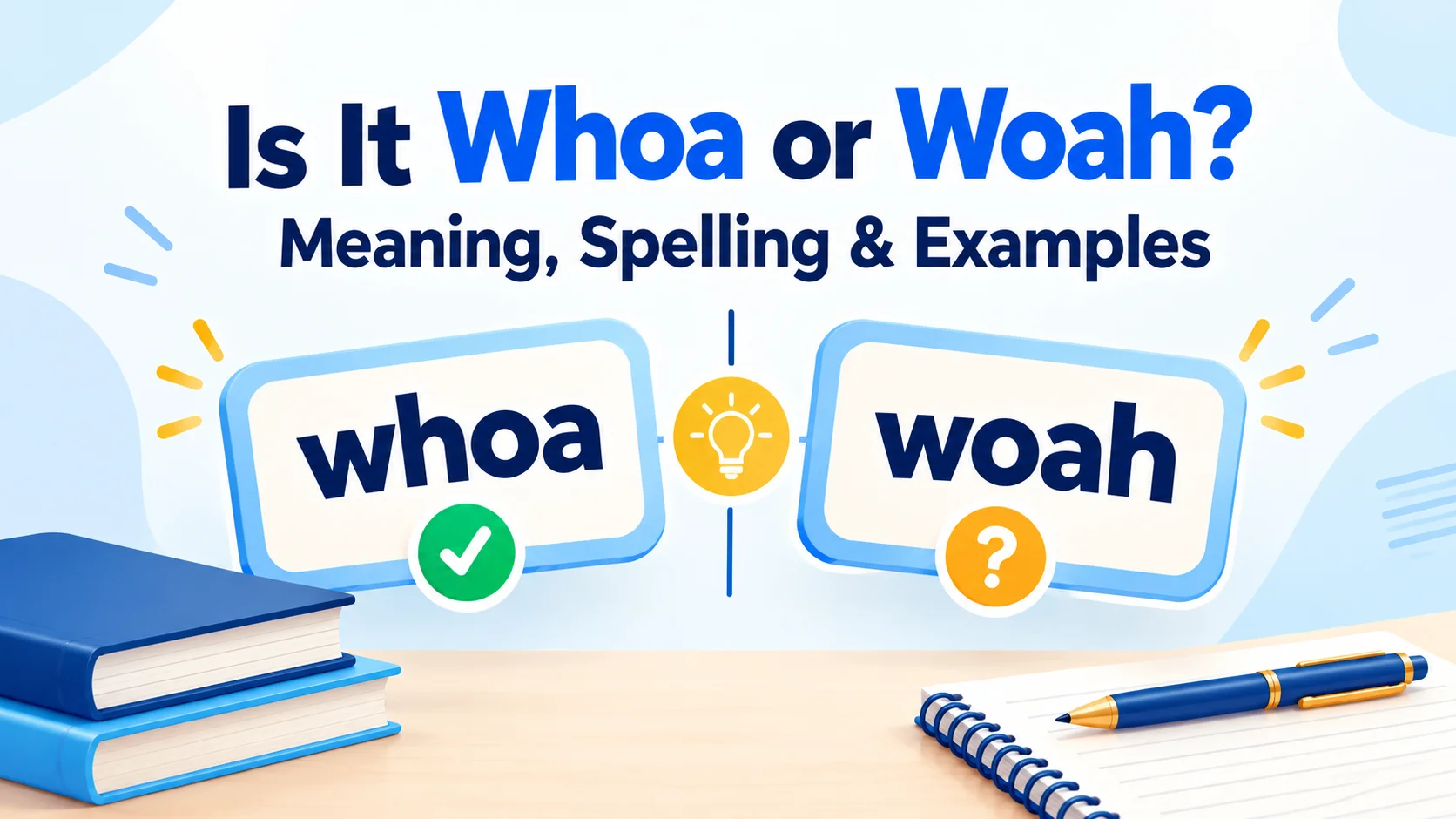
The correct spelling is usually whoa, but woah appears frequently in informal writing, text messages, and social media posts. If you have ever paused while writing a reaction such as “Whoa, that’s amazing!” and wondered which spelling to use, you are not alone. Both forms are recognizable to many English speakers, yet they do not have the same standing in standard written English. Understanding the difference helps you choose the right spelling for school assignments, professional communication, creative writing, and everyday conversations without second-guessing yourself.
The word whoa is a versatile interjection. It can express surprise, disbelief, amazement, caution, or a request to stop or slow down. Its meaning depends on the situation, punctuation, and tone. For example, “Whoa, that was unexpected!” communicates surprise, while “Whoa, slow down!” tells someone to reduce their speed. The word can also appear when a person needs a moment to process information or wants to interrupt an intense conversation. Learning these different uses is just as important as remembering the spelling, particularly if you want your writing to sound natural rather than overly formal or awkward.
This guide explains whoa vs. woah, including their meanings, common uses, example sentences, pronunciation, and differences in formal and informal writing. You will also learn why people spell the word woah, whether that variant is acceptable, and how whoa differs from words such as wow, wait, and stop. Rather than treating every informal spelling as a serious error, we will look at how context influences language choices. By the end, you will have a practical way to decide which form to use and when changing it might be unnecessary.
Quick Answer: Is It Whoa or Woah?
Whoa is the standard spelling recommended for general and formal writing. Woah is a common informal variant that readers may recognize, especially in online conversations, but it is not the preferred spelling in edited English.
| Spelling | Status | Best use | Example |
| Whoa | Standard spelling | Schoolwork, professional writing, general use | “Whoa, that was unexpected!” |
| Woah | Informal variant | Casual messages, social media, stylistic dialogue | “Woah, that looks incredible!” |
If you are unsure which version to choose, use whoa. It is the safer option in almost every context and is the spelling you are most likely to find in established dictionaries.
Easy rule to remember: Write whoa by default. Use woah only when you have a particular informal or stylistic reason to preserve that spelling.
What Does Whoa Mean?
Whoa is an interjection: a word or short expression used to communicate a reaction, feeling, or immediate response. It often stands alone or appears at the beginning of a sentence.
The word has two broad functions:
- Expressing a reaction: It communicates surprise, amazement, disbelief, or concern.
- Giving a command: It tells someone or something to stop, pause, or slow down.
These meanings overlap in everyday conversation. Someone might say “Whoa!” after seeing a surprising event, while another person might say “Whoa, easy there!” to calm a situation.
1. Whoa as an Expression of Surprise
One of the most common uses of whoa is to react to something unexpected or impressive.
Examples:
- “Whoa, I didn’t know you could play the piano!”
- “Whoa! That was a much bigger wave than I expected.”
- “Whoa, the final result looks completely different.”
- “Whoa, you finished the entire project already?”
In each example, whoa signals a reaction before the speaker explains what caught their attention.
Practical tip: Use whoa when you want to convey a stronger or more startled reaction than a neutral acknowledgment. In a formal report, however, describing the surprising result directly may be more appropriate than adding an interjection.
2. Whoa as a Sign of Disbelief
Whoa can also communicate that something is difficult to believe or that the speaker needs a moment to process it.
For example:
- “Whoa, you met the author in person?”
- “Whoa, I didn’t expect the announcement to come today.”
- “Whoa, are you saying the entire schedule has changed?”
- “Whoa, that’s a lot of information to take in.”
This use is particularly common in spoken English and informal dialogue. It can signal genuine disbelief without necessarily suggesting that the speaker is upset.
Tone matters. A cheerful “Whoa!” might communicate amazement, while a slower, more serious “Whoa, hold on” can indicate concern or skepticism.
3. Whoa as a Command to Stop or Slow Down
Historically, whoa has been used as a command to stop or slow down, particularly when addressing a horse. That meaning remains relevant today, although the word is also used figuratively.
Examples:
- “Whoa! Stop the horse before it reaches the road.”
- “Whoa, slow down. I can’t follow what you’re saying.”
- “Whoa, let’s take a step back and reconsider.”
- “Whoa there! We haven’t agreed to anything yet.”
In modern conversation, the command does not always mean a complete stop. It may simply ask someone to pause, reduce their pace, or reconsider what they are doing.
For instance, “Whoa, let’s not jump to conclusions” is a way of asking people to slow their reasoning rather than their physical movement.
What Does Woah Mean?
Woah is generally used with the same intended meanings as whoa. Writers use it to express surprise, disbelief, amazement, or a request to slow down.
Examples:
- “Woah, that was an incredible performance!”
- “Woah, I wasn’t expecting that.”
- “Woah, let’s slow down for a second.”
The main difference is not the intended meaning. It is the spelling’s status in standard English.
Why Do People Spell It Woah?
There is no single explanation for every person’s choice, but several factors help explain why woah remains common.
1. Pronunciation can influence spelling. People sometimes choose letters based on how a word sounds to them. Since whoa is pronounced with a long “o” sound, some writers may find woah more intuitive.
2. Informal writing encourages variation. Text messages, comments, and social media posts often prioritize speed and personal style over conventional spelling.
3. Familiarity reinforces the variant. When people repeatedly encounter woah online, it can begin to look correct to them, even if whoa remains the standard spelling.
4. Writers may use it deliberately. A character’s dialogue or a casual online voice may include woah because the writer prefers its appearance or wants to preserve a particular style.
None of these factors makes woah the better default for formal writing. They simply explain why the variant persists.
Is Woah a Real Word?
Woah is widely recognizable as a spelling variant, but it is not the preferred standard form in conventional edited English. For everyday writing, dictionaries and editorial conventions generally favor whoa.
It is useful to distinguish between a spelling being recognizable and a spelling being recommended. Many readers will understand woah immediately, but that does not mean a teacher, editor, or professional publication will accept it as the standard form.
If you are writing a school essay, business email, article, or formal document, choose whoa if the interjection is appropriate at all.
Whoa vs. Woah: Key Differences
The distinction becomes clearer when you separate meaning, spelling, and context.
| Feature | Whoa | Woah |
| Standard spelling | Yes | No; informal variant |
| Usual meaning | Surprise, disbelief, stop, or slow down | Usually the same intended meanings |
| Formal writing | Preferred spelling | Generally avoid |
| Text messages | Natural and appropriate | Common, but nonstandard |
| Social media | Appropriate | Often encountered |
| Creative dialogue | Suitable | Possible when intentionally preserving a character’s style |
| Safest editorial choice | Yes | Only when there is a specific reason to retain it |
The important point is that whoa and woah are not normally two words with different meanings. The difference is chiefly conventional spelling and register, not a difference in definition.
Which Spelling Is Correct?
Use whoa when you want standard spelling.
For example:
- Standard: “Whoa, I didn’t see that coming.”
- Informal variant: “Woah, I didn’t see that coming.”
Both sentences are understandable. The first is the recommended version for edited writing.
Is Woah Always Wrong?
Calling woah universally wrong can overlook the realities of informal language and creative expression. Readers commonly recognize it, and a writer may intentionally use it in dialogue or a social media post.
Nevertheless, recognition does not make it the preferred standard spelling. If your goal is conventional correctness, consistency, and acceptance across audiences, use whoa.
A useful editorial distinction is this:
- Correcting an accidental spelling choice: Change woah to whoa.
- Preserving an intentional voice: Consider leaving woah in informal dialogue if it genuinely serves the character or style.
- Writing for a formal audience: Prefer whoa, or replace the interjection with a more precise description if the tone is too casual.
Examples of Whoa and Woah in Sentences
Examples are especially helpful because whoa can express different reactions depending on context. The following sentences show how the standard spelling works in everyday English.
Examples of Whoa Expressing Surprise
- “Whoa, that is the tallest building I’ve ever seen.”
- “Whoa! I didn’t realize the concert started so early.”
- “Whoa, your science project turned out beautifully.”
- “Whoa, the weather changed quickly.”
- “Whoa, I wasn’t expecting such a detailed answer.”
These examples work well in casual conversation, dialogue, and personal messages. In a formal article, a sentence such as “The building is exceptionally tall” may communicate the information more directly.
Examples of Whoa Expressing Disbelief
- “Whoa, did the meeting really last four hours?”
- “Whoa, I can’t believe the team finished ahead of schedule.”
- “Whoa, you’re telling me we have to start again?”
- “Whoa, that is a surprising change of plans.”
- “Whoa, I need a minute to understand all of this.”
Here, the interjection conveys the speaker’s immediate reaction. It can make dialogue sound spontaneous, although frequent use may become distracting.
Examples of Whoa as a Command
- “Whoa, slow down before you reach the corner.”
- “Whoa there, let’s hear everyone’s opinion first.”
- “Whoa! The horse is moving too quickly.”
- “Whoa, give me a moment to finish my sentence.”
- “Whoa, let’s not make a decision just yet.”
Notice that some examples involve physical movement, while others ask for a pause in conversation or decision-making.
Examples of Woah in Informal Writing
These examples illustrate how people may use the nonstandard variant:
- “Woah, that sunset is beautiful.”
- “Woah, I totally missed that detail.”
- “Woah! That was an unexpected ending.”
- “Woah, we need to talk about what just happened.”
The meaning remains clear, but an editor would generally change woah to whoa unless the original spelling was intentionally retained.
When Should You Use Whoa or Woah?
The best choice depends on your audience, purpose, and the conventions of the text you are writing. You do not need to eliminate every casual expression from your writing; you simply need to recognize when an informal choice suits the situation.
| Writing situation | Recommended choice | Reason |
| School assignment | Whoa, if needed | Standard spelling is the safer choice |
| Professional email | Usually avoid the interjection; otherwise use whoa | A direct, neutral expression often sounds more professional |
| Blog article | Whoa in conversational passages | Keeps informal language conventionally spelled |
| Text message | Whoa or a deliberately informal woah | The tone is usually relaxed |
| Social media caption | Either may appear; whoa is the standard choice | Informal settings allow more variation |
| Novel or screenplay dialogue | Usually whoa | Use woah only if it serves a deliberate stylistic purpose |
| Edited educational content | Whoa | Consistency and standard usage matter |
In Academic and Professional Writing
In most academic and professional documents, the question is not just which spelling is correct. It is also whether an interjection belongs in the sentence.
Compare these versions:
- Conversational: “Whoa, the survey results changed significantly.”
- More formal: “The survey results changed significantly.”
- More analytical: “The survey results showed a substantial change from the previous measurement.”
The third version is more informative because it directs attention to the result rather than the writer’s reaction.
Expert recommendation: When editing formal prose, assess both the spelling and the tone. Correcting woah to whoa fixes the spelling, but removing the interjection may improve the sentence even more.
In Text Messages and Social Media
Informal communication gives writers more freedom to express personality. You might encounter woah in a comment, group chat, caption, or meme.
For example:
“Whoa, I did not expect that ending!”
This is conventional and casual. The variant woah would usually communicate the same thing, but you do not need to use it to sound relaxed or friendly.
If you are writing for a brand, educational page, or public account, whoa offers a simple way to keep the tone conversational without introducing a nonstandard spelling.
In Fiction and Dialogue
Writers sometimes bend conventional spelling to represent voice, rhythm, or character. However, unusual spelling should serve a purpose rather than appear randomly.
Imagine a novel in which a character repeatedly uses informal internet language. The writer might choose woah to reflect that character’s written voice. In most ordinary dialogue, however, whoa works perfectly well.
A useful test is to ask: Would changing the spelling weaken the characterization or meaning? If the answer is no, standardize it. If the spelling is intentional and consistent, preserving it may be reasonable.
Whoa vs. Wow: What’s the Difference?
Although whoa and wow can both express surprise, they are not interchangeable in every sentence.
- Whoa often conveys surprise, disbelief, caution, or a request to slow down.
- Wow primarily expresses amazement, admiration, or strong surprise.
Compare the following examples:
| Sentence | Meaning |
| “Whoa, slow down!” | A request to reduce speed |
| “Wow, that painting is beautiful!” | Admiration |
| “Whoa, I need a moment to process that.” | Surprise or disbelief |
| “Wow, you did an excellent job.” | Praise or admiration |
| “Whoa, let’s reconsider this decision.” | Caution or a request to pause |
| “Wow, what an incredible achievement!” | Amazement |
You can sometimes use either word in reaction to the same event, but the emphasis changes. “Wow, that’s expensive” expresses surprise at the price. “Whoa, that’s expensive” may sound more startled or concerned.
Remember: Wow is mainly a reaction; whoa can be a reaction or a command.
Whoa vs. Wait vs. Stop
These three words may appear in similar situations, but they communicate different levels of directness.
| Word | Main function | Example |
| Whoa | Expresses surprise or asks someone to slow down or pause | “Whoa, let’s think about this.” |
| Wait | Asks someone to delay an action or give you time | “Wait, I have another question.” |
| Stop | Directly tells someone to cease an action | “Stop the machine.” |
When to Use Each Word
Use whoa when you want a reaction or a less direct request to pause. It can sound spontaneous and conversational.
Use wait when you need time, want to interrupt, or have noticed something that needs attention.
Use stop when you need a clear instruction to end an action. Depending on the situation, it can sound more forceful than whoa or wait.
For example:
- “Whoa, that conversation is moving too quickly.” — A reaction and request to slow down.
- “Wait, I haven’t finished explaining.” — A request for time.
- “Stop talking for a moment so we can hear the announcement.” — A direct instruction.
Choosing the right word helps you communicate the intended tone instead of relying on spelling alone.
How Do You Pronounce Whoa?
Whoa is generally pronounced /woʊ/, with the same vowel sound heard in go, show, and snow. It is usually a single syllable.
The spelling can confuse learners because the letters do not correspond to the sound in an immediately obvious way. The initial wh is not pronounced as two separate sounds in the usual modern pronunciation, and the final a does not create an extra syllable.
Woah is generally intended to represent the same pronunciation. The spelling difference does not ordinarily indicate a different spoken word.
Try saying these words aloud:
- Go
- Show
- Snow
- Whoa
The vowel sound in whoa is similar to the vowel sound in the other examples.
Does the Pronunciation Change Between Whoa and Woah?
In ordinary usage, no meaningful pronunciation distinction is intended. Most writers who use woah mean the same interjection and pronounce it like whoa.
If someone asks you to say the word aloud, the standard spelling is still whoa. Learning the conventional written form is more useful than trying to assign separate pronunciations to the two spellings.
Common Mistakes When Using Whoa
Even though whoa is a short word, writers can make several mistakes when using it.
Mistake 1: Assuming Woah Is the Preferred Spelling
Because woah appears frequently online, it may look equally standard. However, conventional edited English favors whoa.
Better approach: Use whoa in general writing unless you have a clear reason to preserve the alternative spelling.
Mistake 2: Confusing Whoa With Wow
Both words can express surprise, but whoa can also ask someone to stop or slow down.
Incorrect for the intended command:
– “Wow, slow down!” — This may sound like an expression of surprise rather than a clear command.
More direct:
- “Whoa, slow down!”
- “Stop and slow down.”
Wow is not inherently incorrect in the first sentence; it simply does not communicate the command as clearly.
Mistake 3: Using Whoa in Every Formal Sentence
A sentence may be correctly spelled yet still sound too conversational for its purpose.
Instead of:
“Whoa, the figures increased by 18 percent.”
Consider:
“The figures increased by 18 percent.”
Or, when interpretation matters:
“The figures increased by 18 percent, a larger change than the previous report recorded.”
The revised sentence provides information without depending on an emotional reaction.
Mistake 4: Overusing Exclamation Marks
Whoa! can communicate a strong reaction on its own. Adding several exclamation marks may make ordinary writing look exaggerated.
Compare:
- “Whoa!!! That is unbelievable!!!”
- “Whoa! That is unbelievable.”
The second version is easier to read and usually more effective. Use punctuation to support the tone, not to compensate for unclear wording.
Mistake 5: Correcting Intentional Dialogue Without Considering Context
An editor may automatically change every woah to whoa. That is a reasonable default for standardization, but fiction and quoted material require judgment.
Before editing, determine whether the spelling is accidental or intentional. A consistent house style may require whoa throughout, while a carefully designed character voice may justify an exception.
A Simple Trick to Remember Whoa vs. Woah
If you often forget which spelling to use, keep the rule short: Whoa is the standard form.
You do not need a complicated mnemonic. Connect whoa with the conventional spelling you will use in schoolwork, articles, emails, and most other writing.
Here is a quick proofreading checklist:
- Am I using the word to express surprise, disbelief, or a request to pause?
- Have I spelled it whoa?
- If I wrote woah, is that choice intentional?
- Does the interjection fit the tone of my sentence?
- Would a more direct phrase communicate the idea better?
For example, if you write “Woah, I can’t believe we won,” a quick review can produce “Whoa, I can’t believe we won.” If the sentence belongs in a formal report, you might instead write, “The result was unexpected.”
The goal is not to make every sentence formal. It is to choose language deliberately.
Conclusion
When deciding between whoa or woah, the simplest and most reliable choice is whoa. It is the standard spelling, works in everyday conversation, and is appropriate whenever conventional written English is expected. Although woah is recognizable in informal settings, it usually serves no practical purpose that whoa cannot fulfill. Remember, too, that the word can express surprise, disbelief, caution, or a request to slow down, depending on context. One final actionable tip: add whoa to your personal proofreading checklist if you often hesitate over the spelling. A common mistake to avoid is treating online familiarity as proof that a spelling is standard. Good writing is not about eliminating personality; it is about making deliberate choices. When in doubt, choose whoa and keep moving.
FAQs
Q1. Is Whoa or Woah Correct in American English?
Whoa is the standard spelling in American English and the recommended choice for general writing. Woah is a recognizable informal variant, but it is not the preferred form in edited prose. When writing for an American school, workplace, or publication, choose whoa.
Q2. Is Woah Acceptable in Text Messages?
Yes, people commonly use woah in casual messages, and readers will usually understand it. However, whoa is also perfectly natural in texting. You do not need the nonstandard spelling to sound relaxed, expressive, or conversational.
Q3. Does Whoa Mean the Same Thing as Wow?
Not exactly. Both words can express surprise, but wow usually emphasizes amazement or admiration, whereas whoa can also signal disbelief, caution, or a request to slow down. The best choice depends on what you want the reader or listener to understand.
Q4. Is Whoa Considered Slang?
Whoa is an established English interjection, not merely a temporary internet slang expression. It appears in everyday conversation and can communicate surprise, disbelief, or a command to pause. Its informality may make it unsuitable for some formal sentences, but the word itself is widely established.
Q5. Should an Editor Change Woah to Whoa in a Quote?
An editor should generally preserve the wording and spelling of a direct quotation unless there is a clear editorial policy or a correction is explicitly indicated. In ordinary prose, standardize woah to whoa. In quotations or character dialogue, consider fidelity, context, and consistency before making changes.