

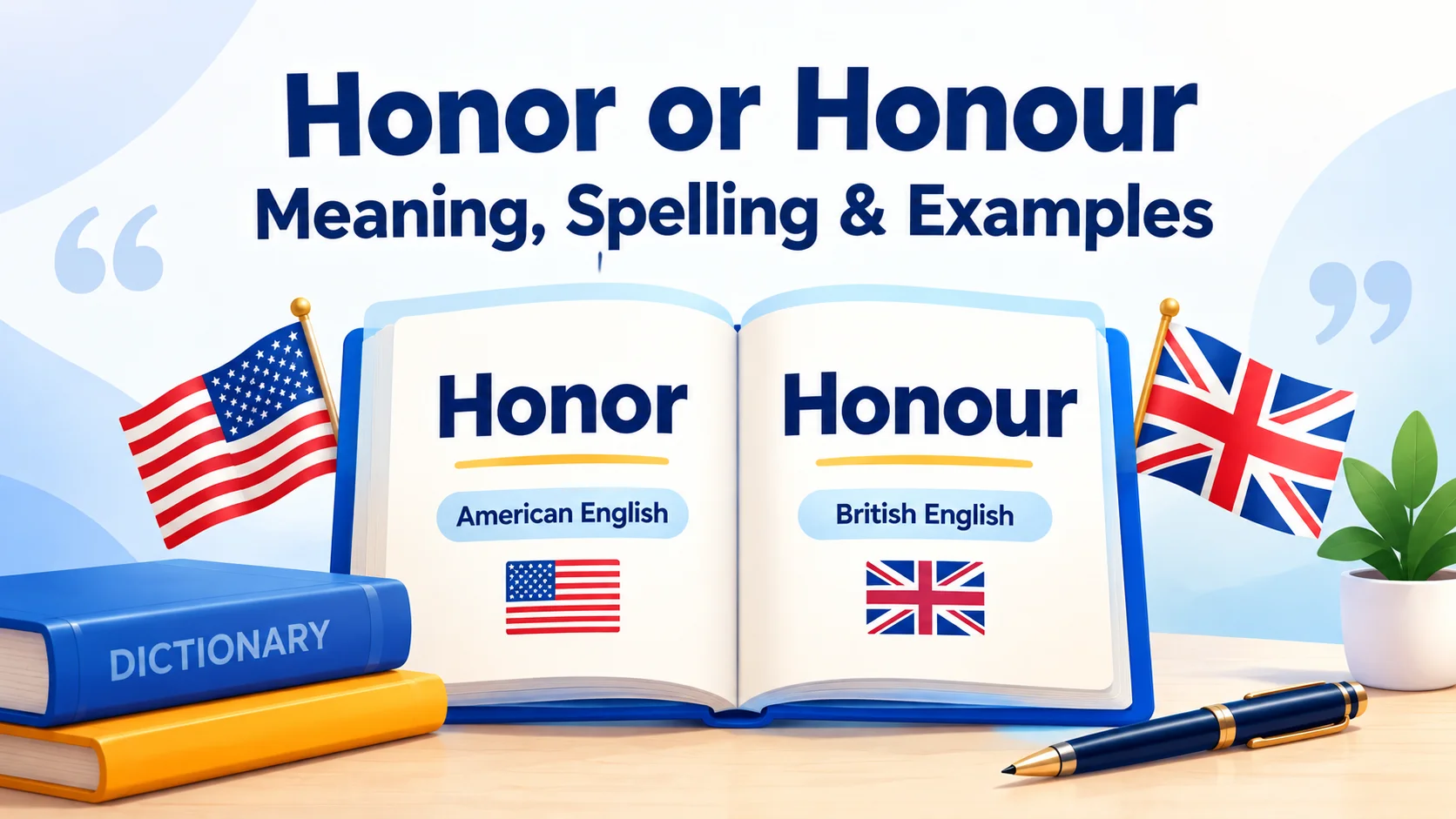
The choice between honor or honour depends on which variety of English you are using. Both spellings are correct, but honor is standard in American English, while honour is generally preferred in British English and several other varieties, including Australian English. The difference is easy to miss because the words mean exactly the same thing. Whether you are writing a school essay, preparing a business document, or publishing an article for an international audience, choosing the appropriate spelling helps your writing feel consistent and professional. The key is understanding your audience rather than treating one form as universally correct.
The distinction also extends beyond the two main spellings. American writers generally use honored, honoring, and honorable, whereas British writers typically prefer honoured, honouring, and honourable. However, some related words, including honorary, retain the same spelling in both varieties. Learning these patterns together is more useful than memorizing each word separately. It also helps explain why a spellchecker might flag a perfectly acceptable word simply because its language settings follow a different regional convention.
Beyond spelling, honor and honour have several meanings. The word can describe respect, personal integrity, public recognition, or the act of fulfilling a promise or obligation. You might receive an honor, act honorably, honor a commitment, or speak of a matter of honour. These uses share a common spelling pattern, but the precise meaning depends on context. This guide covers the definitions, regional differences, related word forms, and everyday expressions you need to use the word accurately and confidently.
Honor or Honour: Which Spelling Is Correct?
Both spellings are correct. The difference is regional rather than grammatical or semantic.
- Honor: Standard American English.
- Honour: Standard British English and generally preferred in Australian English, Canadian English, and several other varieties.
For example:
- American English: It was an honor to receive the award.
- British English: It was an honour to receive the award.
Both sentences are correct and express the same idea.
The important consideration is consistency. If you are writing an article in American English, use honor and its corresponding American forms. If you are writing for a British audience, use honour and the related British forms.
Honor vs. Honour at a Glance
| Feature | Honor | Honour |
| Main regional preference | American English | British English and many Commonwealth varieties |
| Basic meaning | Respect, integrity, recognition, or fulfilling an obligation | The same meanings |
| Past tense | Honored | Honoured |
| Present participle | Honoring | Honouring |
| Adjective | Honorable | Honourable |
| Example | She was honored for her service. | She was honoured for her service. |
Quick rule: Choose the spelling that matches your intended audience or publication’s style guide.
Should You Write Honor or Honour in Your Country?
Regional spelling conventions offer a useful starting point, although local preferences and institutional rules can vary.
| Region | Common preference | Example |
| United States | Honor | It is an honor to participate. |
| United Kingdom | Honour | It is an honour to participate. |
| Canada | Generally honour | It was an honour to attend. |
| Australia | Honour | She received an honour. |
| New Zealand | Generally honour | He considered it an honour. |
Canadian English, in particular, combines spelling conventions from different traditions. For that reason, a Canadian publication’s own style guide is more reliable than assuming every word follows one simple rule.
If your audience is international, there is no need to combine both forms. Select a recognized variety of English and apply it consistently throughout the document.
What Does Honor or Honour Mean?
Honor or honour is both a noun and a verb. Its meaning depends on how it is used.
As a noun, it can refer to respect, good character, recognition, or a distinction awarded to someone. As a verb, it can mean to show respect, recognize an achievement, or fulfill a promise or obligation.
The central idea is that something or someone is treated as worthy of respect or is recognized in a meaningful way.
Honor or Honour as a Noun
The noun has several common uses.
1. Respect and integrity
Honor can refer to the principles that guide a person’s conduct, including honesty, fairness, and keeping promises.
- She acted with honor even when nobody was watching.
- He believed that keeping his word was a matter of honour.
2. Recognition or distinction
The word can describe a special recognition received for achievement or service.
- Receiving the scholarship was a great honor.
- The award was an honour for the entire research team.
3. A privilege
People also use the word to describe an opportunity they consider particularly meaningful.
- It was an honor to meet the author.
- Serving the community was a privilege and an honour.
In these examples, the spelling changes according to regional convention, but the meaning does not.
Honor or Honour as a Verb
As a verb, honor or honour means to show respect, recognize someone, or fulfill an obligation.
- The university will honor the professor’s achievements.
- The community honoured its volunteers at a ceremony.
- The company agreed to honor the terms of the contract.
- She honoured her promise to return the borrowed book.
Notice that honoring a person and honoring an agreement are related but distinct uses. In the first, the verb means recognizing someone’s value or contribution. Secondly, it means fulfilling a commitment.
Honor as a Title or Formal Expression
The word also appears in formal titles, particularly in legal and ceremonial settings.
In many American courts, judges are addressed as Your Honor. In some British-derived legal systems, forms such as His Honour or Her Honour are used according to the relevant jurisdiction and the official’s position.
Capitalization depends on the title and context. When referring to a person by a formal title, follow the conventions of the institution or jurisdiction concerned. In ordinary sentences, the noun generally remains lowercase.
For example:
- The judge entered the courtroom.
- The lawyer addressed the judge as Your Honor.
These are different grammatical uses, so capitalization should reflect the specific context rather than the spelling preference alone.
Why Does American English Use “Honor” While British English Uses “Honour”?
The difference is part of a wider pattern in English spelling. American English often omits the u found in certain British spellings, as seen in pairs such as color/colour, favor/favour, and labor/labour.
American spelling reform helped establish some of these conventions. Noah Webster, the American lexicographer and spelling reformer, promoted simplified forms in his dictionaries and educational writings. However, the difference between American and British spelling developed over time and cannot be attributed to a single person or event.
Both honor and honour have established histories. Neither spelling is a mistake when used according to the appropriate regional convention.
Honor in American English
American English generally uses the shorter forms:
- Honor
- Honored
- Honoring
- Honorable
- Honorably
Examples:
- The school honored the graduating class.
- The city is honoring the firefighters for their service.
- She received an honorable mention in the competition.
These forms are appropriate for US-focused academic writing, business communication, journalism, and general publishing.
Honour in British English
British English generally retains the u:
- Honour
- Honoured
- Honouring
- Honourable
- Honourably
Examples:
- The school honoured the graduating class.
- The city is honouring the firefighters for their service.
- She received an honourable mention in the competition.
These forms are generally appropriate for UK-focused writing.
The distinction extends across the word family, so changing only the main noun may leave a document inconsistent.
What About Canadian, Australian, and Other English Varieties?
Many Commonwealth varieties generally favor honour, but their spelling conventions are not identical in every respect.
Canadian English, for example, often uses British-style spellings such as honour while using American-style forms for some other words. Australian and New Zealand English generally retain the u in honour and related forms.
For international publications, the safest approach is to consult a reputable regional dictionary or the publication’s editorial guidelines. A local style guide is especially useful when writing for a school, government body, or professional organization.
Honored or Honoured, Honoring or Honouring?
The regional spelling pattern carries over into the word’s common grammatical forms. Once you know which variety you are using, the related forms are straightforward.
Honored vs. Honoured
Both words are past-tense and past-participle forms of the verb.
- American: The committee honored the volunteers.
- British: The committee honoured the volunteers.
The choice does not change the tense or meaning. It simply follows the spelling convention of the selected variety.
Honoring vs. Honouring
These forms are used for ongoing actions and as gerunds.
- American: The organization is honoring its founders.
- British: The organization is honouring its founders.
The same pattern appears in other -our words, such as colouring and favouring, although the exact spelling rules differ across word families.
Honor’s vs. Honour’s and Honors vs. Honours
These forms can be confusing because apostrophes and endings serve different grammatical purposes.
| Form | Function | Example |
| Honor’s | Singular possessive or contraction in a suitable context | The student’s honor’s meaning depends on the sentence. |
| Honour’s | British spelling of the corresponding possessive form | The medal reflected the tradition of honour’s public recognition. |
| Honors | American plural noun or third-person singular verb | She received academic honors. |
| Honours | British plural noun or third-person singular verb | He graduated with honours. |
The possessive examples above are grammatically possible but can sound unnatural without a clear context. More natural possessive constructions often specify what belongs to whom:
- The student’s sense of honor was widely respected.
- The tradition of honour was central to the ceremony.
Do not add an apostrophe merely because a word ends in s. Use it when the sentence genuinely requires possession or a contraction.
Honorable or Honourable? Other Related Words
Several words follow the same regional pattern, while others keep a single conventional spelling. Knowing which category a word belongs to prevents overgeneralization.
| American English | British English | Meaning |
| Honor | Honour | Respect, integrity, or recognition |
| Honored | Honoured | Recognized or treated with respect |
| Honoring | Honouring | Showing respect or fulfilling an obligation |
| Honorable | Honourable | Deserving respect |
| Honorably | Honourably | In an honorable manner |
| Honorary | Honorary | Conferred as an honor, usually without the usual duties or payment |
| Honorific | Honorific | A title or expression of respect |
| Honorarium | Honorarium | A payment for a service, often when no standard fee is expected |
Honorable vs. Honourable
Honorable and honourable are adjectives meaning deserving of respect or characterized by integrity.
Examples:
- American: She made an honorable decision.
- British: She made an honourable decision.
The words may describe a person’s conduct, a decision, a profession, or an action. The spelling follows the regional convention.
The adjective also appears in expressions such as honorable mention, used when someone receives recognition but does not win the main award. In British writing, the usual form is honourable mention.
Honorary: Why Is It Spelled This Way?
Honorary is the conventional spelling in both American and British English. British writers do not normally change it to honorary.
An honorary title or award recognizes someone’s contribution or status without necessarily carrying the ordinary responsibilities associated with the position.
Examples include:
- She received an honorary degree from the university.
- He became an honorary member of the association.
- The organization appointed her an honorary adviser.
This is a useful exception to remember. Although honourable retains the u in British English, honorary does not.
Honorific and Honorarium
An honorific is a title or form of address that expresses respect. Examples include Dr., Professor, and certain formal titles used in particular cultures or institutions.
An honorarium is a payment made for a service, often when a conventional fee is not expected or has not been established.
Examples:
- The speaker was introduced with the appropriate honorific.
- The guest lecturer received an honorarium.
Both words generally retain these spellings in American and British English. They should not be changed mechanically to honourific or honourarium.
Honorably vs. Honourably
These adverbs describe an action carried out with integrity or in a manner worthy of respect.
- American: The athlete behaved honorably.
- British: The athlete behaved honourably.
Use the adverb when describing how someone acted, rather than using the adjective in its place.
- Correct: She handled the dispute honorably.
- Incorrect: She handled the dispute honourably.
The adjective describes a noun; the adverb describes the action.
How to Use Honor or Honour in a Sentence
The best way to understand the word is to see how its meaning shifts with the surrounding words.
Examples of Honor in American English
- It was an honor to represent the school at the national competition.
- The city honored the volunteers for their years of service.
- She graduated with honors in biology.
- The retailer agreed to honor the original warranty.
- He acted with honor when he admitted his mistake.
These examples demonstrate several uses: a privilege, public recognition, academic distinction, fulfillment of an obligation, and personal integrity.
Examples of Honour in British English
- It was an honour to represent the school at the national competition.
- The city honoured the volunteers for their years of service.
- She graduated with honours in biology.
- The retailer agreed to honour the original warranty.
- He acted with honour when he admitted his mistake.
The sentences have the same meanings as their American counterparts. Only the spelling changes.
Honor or Honour in Formal and Academic Writing
In formal writing, the main challenge is maintaining consistency across an entire document. An essay may contain honour in one paragraph and honored in another because the writer has copied material from different sources.
That mixture is not necessarily difficult to understand, but it can look careless in edited prose.
Use these practices:
- Choose American or British English before drafting.
- Check the related forms, not just the main word.
- Preserve spelling in direct quotations when accuracy requires it.
- Follow the required style guide for applications, academic assignments, and professional publications.
- Retain the official spelling of names, awards, and organizations.
A spellchecker can help, but only if its language setting matches the variety of English you intend to use.
Common Expressions With Honor or Honour
Some expressions appear frequently in everyday and formal English.
| Expression | Meaning | Example |
| In honor of / in honour of | As a mark of respect or recognition | The event was held in honour of the volunteers. |
| Do someone the honor / honour | Give someone the privilege of doing something | Would you do me the honor of joining us? |
| Honor one’s word / honour one’s word | Keep a promise | She honoured her word and returned the money. |
| A matter of honor / honour | Something connected with integrity or principle | For him, keeping the agreement was a matter of honour. |
| With honors / with honours | With a distinction or special academic recognition | She graduated with honours. |
The regional spelling remains consistent in these expressions. However, the precise meaning of with honors can vary between educational systems, so readers should consult the institution’s grading terminology when interpreting a particular qualification.
Common Mistakes When Using Honor or Honour
1. Mixing American and British Spellings
A common editing problem is using forms from both varieties in one piece of writing.
For example:
The organization honored its volunteers and presented each with an honourable mention.
This sentence mixes American honour with British honour. It would be more consistent to write either:
- American: The organization honored its volunteers and presented each with an honorable mention.
- British: The organization honoured its volunteers and presented each with an honourable mention.
There can be legitimate exceptions, such as official names and quotations, but the surrounding text should follow a consistent convention.
2. Changing “Honorary” to “Honourary”
The spelling honorary is a common overgeneralization. Writers see honourable and assume every related word needs a u in British English.
The standard form is honorary in both major varieties.
3. Confusing Honor With Respect, Prestige, or Recognition
These concepts overlap, but they are not identical.
- Respect is the regard someone has for another person.
- Prestige is the standing or reputation associated with someone or something.
- Recognition is acknowledgment of an achievement or contribution.
- Honor can express respect, integrity, recognition, or the fulfillment of a commitment.
For example, someone may have prestige because of their position without necessarily behaving honorably. Similarly, a person can honor a promise without receiving public recognition.
Choose the word that communicates your intended meaning most precisely.
4. Capitalizing Honor or Honour Unnecessarily
In ordinary prose, the word is usually lowercase.
- It was an honor to participate.
- The community acted with honour.
Capitalization is appropriate when required by a formal title or an institution’s naming convention, as in Your Honor in many American legal settings.
Do not capitalize the word merely because it expresses an important value.
Honor vs. Honour: A Simple Decision Guide
When you are unsure which spelling to use, begin with your audience rather than the word itself.
| Situation | Recommended approach |
| Writing for a US school or publication | Use American English: honor |
| Writing for a UK publication | Use British English: honour |
| Writing for a Canadian audience | Generally use honour; check the relevant style guide |
| Writing for an Australian audience | Generally use honour |
| Writing for an international website | Choose a consistent regional style |
| Quoting a source directly | Preserve the original spelling |
| Using an official name or award title | Follow its official spelling |
Which Spelling Should You Choose for School, Work, or Online Publishing?
✅For a school assignment, follow your teacher’s or institution’s requirements. For a business document, use the organization’s style guide. For an online article, consider the primary audience and the conventions used throughout the website.
If you are editing an existing document, do not change isolated words without checking the wider spelling pattern. Search for honor, honoured, honorable, and related forms to identify inconsistencies.
The goal is not to make every English-speaking reader use the same spelling. It is to make your writing predictable and appropriate for its intended audience.
Conclusion:
The choice between honor or honour is not a test of which spelling is universally correct; it is a matter of regional convention. American English generally uses honor, while British English and several other varieties prefer honour. The related forms usually follow the same pattern, although honorary is an important exception. When writing for school, work, or an online audience, decide which variety you are using before you begin and apply it consistently. One final actionable tip: check the noun, verb forms, adjective, and adverb together during proofreading rather than reviewing honor or honour alone. A common mistake to avoid is assuming that one spelling is wrong simply because a spellchecker configured for another region flags it. Consistent spelling makes your writing clearer, more polished, and better suited to its readers.
FAQs
Q1. Is honor or honour correct in English?
Both spellings are correct. Honor is standard in American English, while honour is generally preferred in British English and several other varieties. Neither is universally more correct; the appropriate choice depends on the audience and the spelling convention used throughout the text.
Q2. Is it honored or honoured in the UK?
Honoured is the standard British spelling. American English uses honour. The same regional distinction applies to honouring/honoring and honourable/honorable. When writing for a UK audience, use the British forms consistently unless quoting a source or reproducing an official name.
Q3. Why is honorific spelled without a “u” in British English?
Honorary is the conventional spelling in both American and British English. Related words do not always follow an entirely predictable pattern, so it is better to learn established forms individually than to add or remove letters mechanically based on one spelling rule.
Q4. Does honor mean the same thing as respect?
The meanings overlap, but they are not identical. Respect describes regard for someone or something, while honor can also refer to personal integrity, public recognition, or fulfilling a commitment. For example, you can honor an agreement by keeping your promise, not merely by showing respect.
Q5. Should I use honor or honour in an international article?
Choose one recognized variety of English based on your intended readership or publication guidelines. American spelling may suit a US-focused article, while British spelling may suit a UK or Commonwealth audience. Keep the choice consistent, and preserve original spellings in direct quotations and official names.