

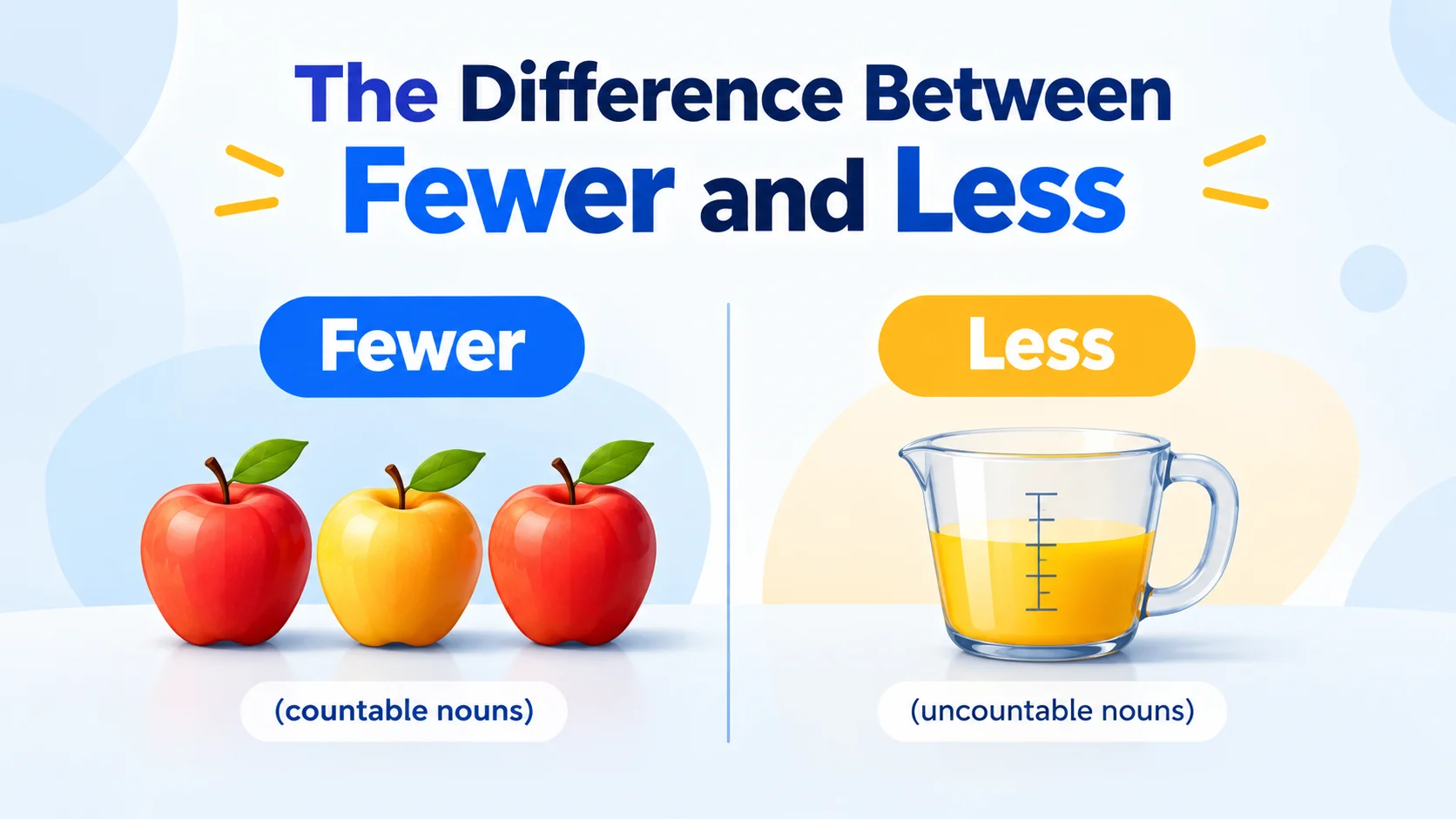
The difference between fewer and less comes down to how we describe quantities. We generally use fewer when talking about individual things we can count and less when talking about an amount, substance, or degree. That sounds straightforward until you encounter expressions such as “less than 10 items,” “fewer hours,” or “less money.” Suddenly, the simple rule seems less reliable. Understanding the distinction helps you write clearer emails, avoid common grammar mistakes, and speak more confidently. The key is to look beyond the number itself and consider what the noun represents.
In everyday English, choosing between these two words often depends on whether a noun refers to separate units or a quantity treated as a whole. You can count books, mistakes, employees, and appointments, so fewer normally fit. You measure water, patience, traffic, and information, so less is usually the natural choice. However, English also has established expressions and borderline cases that do not fit neatly into a beginner’s rule. Learning those patterns will help you understand not only what conventional grammar recommends but also why certain expressions sound natural to experienced speakers.
This guide explains when to use fewer and less, with practical examples, comparison tables, common exceptions, and a simple method for checking your own sentences. You will learn how the words work with money, time, measurements, numbers, and phrases such as fewer of and less of. We will also distinguish standard formal usage from expressions commonly heard in conversation. Rather than memorizing dozens of isolated rules, you will learn to identify the noun, understand how it is being used, and choose the word that communicates your meaning most clearly.
What Is the Difference Between Fewer and Less?
The main difference is grammatical: fewer generally describes a smaller number of countable things, while less generally describes a smaller amount or degree of something.
Compare these sentences:
- We received fewer applications this month.
- We received less mail this month.
Applications are separate items that can be counted individually. Mail, in the second sentence, is treated as a general quantity.
The same distinction applies to abstract ideas. You can have fewer problems because individual problems can be counted, but less stress because stress is usually treated as an amount.
Fewer vs. Less at a Glance
| Feature | Fewer | Less |
| Main function | Describes a smaller number | Describes a smaller amount or degree |
| Typical nouns | Plural countable nouns | Uncountable nouns |
| Common question | How many? | How much? |
| Example | Fewer customers | Less traffic |
| Abstract concepts | Fewer concerns | Less anxiety |
| Measurement | Fewer individual units | Less overall quantity or duration |
Both words are comparative forms. They indicate a smaller number or amount relative to something else, whether that comparison is stated explicitly or understood from context.
For example, “We have fewer orders today” compares today’s order count with another time or expected number. “We have less work today” compares the overall amount of work.
When to Use Fewer
Use fewer when you are talking about a smaller number of things that can be counted as separate units. These are usually plural countable nouns.
Fewer With Plural Countable Nouns
Countable nouns have singular and plural forms. You can usually place a number before them: one chair, two chairs; one question, five questions.
Examples include:
- There are fewer cars on this road today.
- I made fewer mistakes in my latest assignment.
- The shop received fewer orders than expected.
- We need fewer chairs for tomorrow’s meeting.
- She attended fewer classes this semester.
In each sentence, the noun refers to individual items or events that can be counted.
A useful editing habit is to identify the noun immediately after the quantity word. If you are referring to distinct, countable items in ordinary formal prose, fewer is generally the appropriate choice.
Fewer With People and Abstract Ideas
Countable nouns do not have to be physical objects. People, opportunities, complaints, and problems can also be counted.
For example:
- Fewer people attended the conference this year.
- The updated process produced fewer complaints.
- We have fewer opportunities to practice this skill.
- The revised instructions caused fewer problems.
- The team received fewer requests for clarification.
Although opportunities and problems are abstract concepts, each can be treated as a separate instance.
This is an important point for English learners: countability is a grammatical property, not a question of whether something is tangible.
Fewer Than: Comparing Countable Numbers
The structure fewer than is commonly used before a number when the noun refers to countable units.
Examples:
- Fewer than 15 students registered for the workshop.
- Fewer than six questions remain unanswered.
- The company hired fewer than 100 employees last year.
- Fewer than three applications met all the requirements.
The word then introduces the comparison. The number tells you the limit, while fewer signals that the comparison concerns countable units.
In careful writing, use fewer than 20 people, rather than less than 20 people, when you want to follow the traditional countable-noun rule. As discussed below, less than is also widely used in numerical expressions, so the distinction requires some context.
When to Use Less
Use less when referring to a smaller amount, quantity, or degree. It commonly appears with uncountable nouns and also modifies adjectives and adverbs.
Less With Uncountable Nouns
Uncountable nouns are generally treated as substances, concepts, or quantities rather than individual items. They usually do not take an ordinary plural form when used in their uncountable sense.
Common examples include:
- Water
- Information
- Traffic
- Money
- Furniture
- Patience
- Advice
- Equipment
Use less when describing a smaller amount of these things:
- We need less water to complete the experiment.
- The revised report contains less information about the background.
- There was less traffic on the road after midnight.
- He has less patience for unnecessary delays.
- The office needs less equipment for the smaller project.
Notice that some of these nouns describe physical substances, while others describe abstract ideas or collections. Their grammatical behavior, rather than their physical nature, determines the usual choice.
Less With Time, Work, Effort, and Information
Some of the most common uses of less involve everyday quantities that people do not normally count as separate units.
Examples:
- I need less time to complete this task now.
- The new method requires less effort.
- We have less information than we expected.
- She has less work to finish this afternoon.
- The team experienced less stress after changing the schedule.
These expressions describe overall amounts. If you change the noun to a countable unit, however, the preferred word may change.
Compare:
- Less work but fewer tasks.
- Less time but fewer hours.
- Less information but fewer facts.
The underlying subject may be similar, but the grammatical focus is different.
Less to Describe Degree or Intensity
Less is not limited to nouns. It also functions as a comparative modifier with adjectives and adverbs.
Examples:
- This explanation is less complicated than the first one.
- The second route is less expensive.
- She spoke less confidently during the interview.
- The revised process is less time-consuming.
- This option seems less practical for a small business.
In these examples, less means a lower degree of a quality or characteristic. You are not counting objects or measuring a substance.
This distinction matters because the countable-versus-uncountable rule applies most directly when fewer and less describe nouns. When comparing qualities, less is often the natural construction.
Less Than: Measurements and Amounts
Use less than when comparing a quantity, duration, measurement, or amount with a limit.
Examples:
- The journey takes less than an hour.
- The parcel weighs less than two kilograms.
- The repair cost less than expected.
- The temperature fell to less than five degrees.
- You can finish the exercise in less than 10 minutes.
Measurements often involve numbers, but the presence of a number does not automatically require fewer. The important question is whether you are counting separate objects or describing a measured quantity.
For example, less than 10 minutes describes a duration. Fewer than 10 appointments describes a number of separate appointments.
Fewer vs. Less: Common Exceptions and Borderline Cases
The basic rule is useful, but English usage also reflects convention, meaning, and context. Some expressions become clearer when you distinguish the quantity itself from the units used to describe it.
Money: Less Money but Fewer Dollars
Money is generally uncountable, while currencies and their units can be counted.
Compare:
- We spent less money this month.
- I have fewer dollars available than I did last week.
- The business earned less revenue this quarter.
- The cashier counted fewer coins than expected.
Why does the word change? In the first and third sentences, the focus is on an overall amount. In the second and fourth, the focus is on countable units.
The distinction is useful when writing about budgets, prices, and financial results. If you mean the total amount spent, less money is natural. If you mean the number of individual coins or dollar bills, fewer is appropriate.
Time: Less Time but Fewer Hours
Time can be described as a general duration or divided into countable units.
| Expression | Preferred form | Reason |
| ___ time to finish | Less | Time is treated as a general quantity |
| ___ hours available | Fewer | Hours are countable units |
| ___ than 30 minutes | Less | The duration is being measured |
| ___ appointments this week | Fewer | Appointments are countable events |
| ___ work to complete | Less | Work is treated as an overall amount |
| ___ tasks to complete | Fewer | Tasks can be counted individually |
Examples:
- We have less time to prepare for the presentation.
- We have fewer hours available this week.
- The revised schedule requires less time overall.
- I have fewer meetings on Friday.
Do not choose fewer simply because time can be divided into minutes or seconds. Use the form that matches the noun actually present in your sentence.
Distance, Weight, and Other Measurements
Measurements usually describe an amount or extent, so less is common when the measurement itself is being compared.
Examples:
- The bag weighs less than five kilograms.
- The trip took less than three hours.
- The tank contains less than 20 litres of fuel.
- The road is less than two kilometres long.
However, if the units are treated as separate countable items, fewer may be appropriate:
- The route contains fewer than five checkpoints.
- We completed fewer than 10 laps.
- The package contains fewer than 20 individual components.
The key is to distinguish a measurement from a count of units or events.
Is It Less Than 10 Items or Fewer Than 10 Items?
Both expressions appear in real English, but they are not equally preferred in every context.
Under the traditional rule, fewer than 10 items is the clearer choice because items refers to countable objects. This is the form to favor in careful writing when you are explicitly counting individual things.
However, less than is widely used in numerical expressions, signs, advertisements, and everyday speech. A phrase such as “less than 10 items” may therefore be familiar to readers even though it does not follow the strictest version of the traditional rule.
Consider your purpose:
- Formal or carefully edited prose: Fewer than 10 items.
- A measured quantity or duration: Less than 10 minutes.
- A commercial sign or familiar expression: Check the relevant house style and context.
The best advice is not to assume that every appearance of less than before a number is wrong. Look at what the number represents and how precise the writing needs to be.
Why Do People Say “One Less Thing”?
Expressions such as one less thing to worry about are well established in English. They may seem inconsistent with the rule about plural countable nouns, but the construction has a natural meaning: one item has been removed from a set of concerns or obligations.
For example:
- Finishing the report is one less thing to worry about.
- We now have one less problem to solve.
These expressions are conventional and natural. You do not need to rewrite them simply to avoid less near a countable noun.
That does not mean less can replace fewer in every plural countable-noun phrase. In standard writing, fewer mistakes, fewer people, and fewer questions remain the usual choices.
How to Use Fewer Of and Less Of Correctly
The addition depends on the structure of the phrase. It often appears when you refer to a particular group, amount, or previously identified thing.
When to Use Fewer Of
Use fewer of before a determiner or pronoun that identifies a specific set of countable items.
Examples:
- Fewer of the students submitted their assignments late.
- Fewer of these products are available now.
- Fewer of us expected the meeting to finish early.
- Fewer of the applications met the eligibility requirements.
The phrase refers to a subset of a group. Compare “fewer students attended” with “fewer of the students attended.” The first refers to students generally; the second points to a particular group already known or identified.
When to Use Less Of
Use less of when referring to a smaller amount or degree of something, often with a specific noun phrase or pronoun.
Examples:
- We need less of that material for the next batch.
- She wants less of the same routine every day.
- There is less of a difference between the two versions than I expected.
- He spends less of his income on unnecessary purchases.
The phrase less of can also appear before pronouns and names of particular quantities. Its role is not simply to mark an uncountable noun; it helps specify the portion or degree being discussed.
Can You Use Fewer and Less Without a Noun?
Yes. Both words can stand alone when the noun is already clear from context. The noun is understood rather than repeated.
Examples:
- I expected 20 visitors, but fewer arrived.
- We used to spend more, but now we spend less.
- The first group completed 12 exercises; the second completed fewer.
- I used to drink three cups of coffee a day, but now I drink less.
The choice still depends on what is implied. In the first and third examples, fewer refers to countable people or exercises. In the second and fourth, less refers to an overall amount of spending or coffee.
This is a useful way to avoid repetition. Instead of writing “The first team made fewer errors, and the second team made fewer errors,” you can write, “The first team made fewer errors, and the second made fewer.”
Common Mistakes When Using Fewer and Less
Using Less With Ordinary Plural Countable Nouns
In conventional edited English, fewer is usually preferred when a plural noun refers to separate countable items.
| Less-standard choice in formal prose | Preferred alternative |
| Less mistakes | Fewer mistakes |
| Less students | Fewer students |
| Less questions | Fewer questions |
| Less complaints | Fewer complaints |
| Less appointments | Fewer appointments |
You may hear these expressions in casual conversation, but if you are writing an essay, report, or formal email, the alternatives in the right-hand column are safer.
Using Fewer With Uncountable Nouns
The opposite mistake happens when a writer uses fewer with a noun that is normally treated as uncountable.
Examples:
- Incorrect in standard usage: “We need fewer information.”
- Better: “We need less information.”
Other examples include less water, less furniture, less advice, and less traffic. If you want to use fewer, change the noun to a countable unit where appropriate: fewer facts, fewer pieces of furniture, or fewer suggestions.
Choosing Based on the Meaning Instead of the Noun
A common source of confusion is focusing on the underlying idea rather than the grammatical form of the noun.
Compare these pairs:
- Less work / fewer tasks
- Less traffic / fewer vehicles
- Less money / fewer coins
- Less time / fewer hours
- Less information / fewer facts
Each pair describes related ideas, but the nouns frame the quantity differently. The most reliable method is to identify the actual noun in your sentence, then decide whether it is being used as countable or uncountable.
Overcorrecting Natural Expressions
Not every phrase that appears to break the basic rule needs correction. Expressions such as one less thing are well established, and numerical uses of less than are common.
Professional editing requires judgment. A useful distinction is between a conventional expression, an informal usage, and an avoidable error in formal prose. Treating these as identical leads to unnecessary corrections and can make writing sound unnatural.
Is the Difference Between Fewer and Less Different in British and American English?
The core rule is shared by British and American English: fewer generally refers to countable items, while less refers to amounts and degrees.
Both varieties use expressions such as:
- Fewer people attended.
- Less water was needed.
- Fewer hours were available.
- Less time remained.
There can be variation in informal speech, numerical expressions, and editorial preferences, but the main distinction is not a simple American-versus-British rule.
For formal writing in either variety, the practical recommendation remains the same: use fewer with ordinary plural countable nouns and less with uncountable quantities, unless a conventional expression or specific context supports another choice.
A Quick Decision Guide: Should You Use Fewer or Less?
When you hesitate, follow these three steps.
- Find the noun. Identify the thing being described, even if it is implied rather than written.
- Check how it is being used. Is it a number of separate items, or an amount, duration, or degree?
- Consider the expression as a whole. Measurements, fixed expressions, and numerical phrases may follow established patterns.
Fewer vs. Less Decision Table
| Sentence | Best choice | Explanation |
| We made ___ mistakes. | Fewer | Mistakes are countable |
| The recipe needs ___ sugar. | Less | Sugar is uncountable |
| There are ___ employees today. | Fewer | Employees can be counted |
| I have ___ patience for delays. | Less | Patience is an uncountable concept |
| We need ___ hours to finish. | Fewer | Hours are countable units |
| We need ___ time to finish. | Less | Time is treated as a quantity |
| The company spent ___ money. | Less | Money is generally uncountable |
| The box contains ___ than 20 items. | Fewer | Items are countable |
| The trip took ___ more than 30 minutes. | Less | Duration is being measured |
Quick Practice: Choose Fewer or Less
Fill in each blank before checking the answers.
- We received ___ complaints this week.
- The new printer uses ___ paper.
- I have ___ meetings on Friday.
- The trip took ___ more than two hours.
- The team needs ___ information before deciding.
Answer key
- Fewer — complaints are countable.
- Less — paper is treated as an uncountable material.
- Fewer — meetings are countable events.
- Less — the sentence measures duration.
- Less — information is generally uncountable.
If you can explain why each answer fits the noun, you understand the rule more securely than if you simply memorize the examples.
Conclusion:
The difference between fewer and less becomes easier to apply when you focus on the noun rather than the number in the sentence. Use fewer for smaller numbers of countable items and less for smaller amounts, durations, and degrees. Remember the useful contrasts: less money but fewer dollars, less time but fewer hours, and less work but fewer tasks. These examples show why context matters as much as memorization. One final actionable tip: when proofreading, underline the noun after fewer or less and ask how it is being used. A common mistake to avoid is treating the rule as absolute in every expression, especially with measurements and established phrases. Strong grammar comes from understanding the pattern and knowing when context calls for judgment.
FAQs
Q1. Is It Fewer People or Less People?
Fewer people is the standard choice in formal and carefully edited English because people can be counted individually. Less people is common in informal speech, but it is generally best to use fewer people in essays, professional writing, and other contexts where conventional grammar is expected.
Q2. Is It Less Than 10 Items or Fewer Than 10 Items?
Fewer than 10 items follows the traditional rule because items is a plural countable noun. However, less than 10 items are widely encountered in everyday and commercial contexts. For precise formal writing, fewer than 10 items is the safer choice.
Q3. Should I Say Less Money or Fewer Dollars?
Use less money when describing an overall amount and fewer dollars when counting individual dollar units. For example, “We spent less money this month” focuses on total spending, while “I have fewer dollars in cash” focuses on the number of units.
Q4. Is It Less Time or Fewer Hours?
Both can be correct because they describe different things. Less time refers to a smaller duration overall, while fewer hours refers to a smaller number of countable time units. Choose the expression that matches the noun and the meaning you intend.
Q5. Can Fewer and Less Be Used Without a Noun?
Yes. Both words can stand alone when the noun is understood from the surrounding sentence. For example, “Fewer arrived than expected” refers to countable people or items, while “We spent less this month” refers to a smaller amount of money or another understood quantity.