

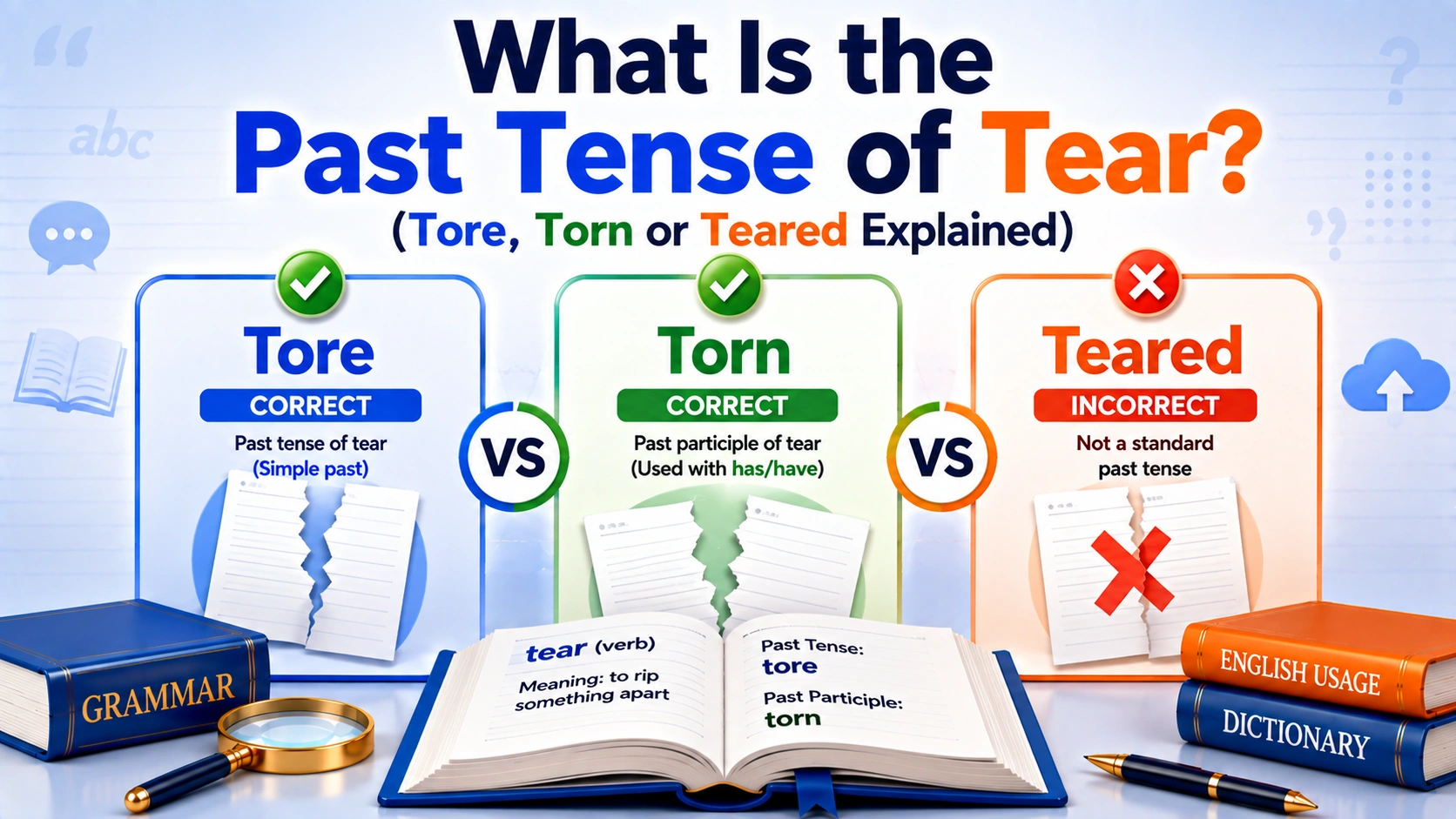
What is the past tense of tear? It’s a question that trips up many English learners because the answer depends on which meaning of “tear” you’re using. If you’re talking about ripping or splitting something, the past tense is tore, and the past participle is torn. However, if you’re referring to eyes filling with tears, you may occasionally encounter teared up, which follows a different usage pattern. Because the same spelling has two pronunciations and two meanings, it’s easy to understand why this verb creates confusion.
Many writers instinctively use teared as the past tense of tear, assuming it follows the regular verb pattern. Unfortunately, that’s one of the most common grammar mistakes in English. Since tear (to rip) is an irregular verb, it doesn’t form its past tense by simply adding -ed. Instead, it changes to tore and torn, just as wear becomes wore and worn. Knowing this difference helps you write more naturally and avoid mistakes in academic papers, professional emails, and everyday communication.
In this guide, you’ll learn the correct verb forms of tear, why the word has two entirely different meanings, when teared is actually acceptable, and how to choose the right form every time. You’ll also find comparison tables, real-world examples, pronunciation tips, memory tricks, and common grammar mistakes that even native speakers occasionally make. By the end, you’ll be able to use tore, torn, and teared confidently in the right context.
Quick Answer: Is It Tore, Torn, or Teared?
If you’re looking for the short answer, here it is:
- Tear (to rip) → Tore (simple past) → Torn (past participle)
- Teared is not the past tense of tear when you mean to rip.
- Teared can appear in the expression “teared up,” meaning someone’s eyes filled with tears because of emotion or irritation.
The Correct Verb Forms at a Glance
| Base Verb | Simple Past | Past Participle | Present Participle |
| Tear (rip) | Tore | Torn | Tearing |
Examples:
- ✅ She tore the letter into small pieces.
- ✅ The letter has been torn in half.
- ✅ He is tearing the wrapping paper carefully.
When “Teared” Is Correct—and When It Isn’t
The word teared causes confusion because it does exist, but not in the way many people think.
Correct:
- ✅ Her eyes teared up during the emotional speech.
- ✅ My eyes teared up because of the smoke.
Incorrect:
- ❌ He teared the newspaper.
- ❌ She has teared the contract.
Correct versions:
- ✅ He tore the newspaper.
- ✅ She has torn the contract.
Key Tip: If something is physically ripped, always use tore or torn. If eyes fill with tears, teared up may be appropriate.
Quick Examples You Can Copy
| Meaning | Correct Example |
| Rip paper | She tore the paper by mistake. |
| Damaged clothing | My jacket was torn on a fence. |
| Emotional reaction | He teared up while watching the movie. |
| Eye irritation | My eyes teared up because of the onions. |
| Present tense | Please don’t tear the document. |
Why “Tear” Is One of English’s Most Confusing Verbs
At first glance, tear seems like a simple everyday word. Yet it regularly appears in lists of the most confusing English verbs because it combines multiple meanings, different pronunciations, and irregular verb forms into a single spelling. Learners often assume they’re dealing with one word, when in reality they’re dealing with two distinct words that happen to share the same spelling.
Understanding why this confusion exists makes it much easier to remember the correct past tense.
One Spelling, Two Completely Different Pronunciations
Unlike most English verbs, tear changes pronunciation depending on its meaning.
| Meaning | Pronunciation | Example |
| To rip | /ter/ | Don’t tear the page. |
| Drop from the eye | /tɪər/ | A tear rolled down her face. |
This difference is important because pronunciation often signals which meaning—and therefore which grammar—you need.
For example:
- Don’t tear the envelope. (to rip)
- A tear ran down her cheek. (drop from the eye)
Although both words are spelled tear, native speakers instantly recognize them by pronunciation and context.
Two Meanings, Two Different Verb Patterns
The confusion becomes greater because the two meanings don’t behave identically.
When tear means to rip, it is an irregular verb.
| Form | Word |
| Base | Tear |
| Past | Tore |
| Past Participle | Torn |
However, when discussing eyes producing tears, English usually uses expressions like:
- teared up
- was tearing up
- had teared up
Notice that this meaning is commonly attached to the phrasal verb tear up, not simply tear.
This explains why learners sometimes incorrectly assume teared works for every meaning.
Why Even Native Speakers Get Confused
The mistake isn’t limited to English learners. Native speakers also write teared when they mean tore, especially while typing quickly.
Several factors contribute to the confusion:
- The spelling remains identical despite different meanings.
- English irregular verbs don’t always follow predictable patterns.
- Spell check won’t always flag teared because it’s a real word.
- Many people learn spoken English before studying grammar rules.
- The emotional expression teared up reinforces the mistaken belief that teared is always acceptable.
Expert Insight: Rather than memorizing isolated verb forms, connect each form to its meaning. If something is physically ripped, think tore → torn. If someone’s eyes fill with tears, think teared up. This simple association prevents the vast majority of mistakes.
Understanding the Two Meanings of “Tear”
One reason this verb causes so much confusion is that tear isn’t just one word with multiple forms—it represents two different meanings that follow different grammatical patterns. Before deciding whether to use tore, torn, or teared, you first need to identify which version of “tear” your sentence is using.
Tear (to Rip or Split Something Apart)
This is the meaning most people think of when discussing the past tense of tear. Here, tear is an irregular action verb that describes breaking, ripping, or splitting something by pulling it apart.
Examples:
- Please don’t tear the receipt.
- She accidentally tore the photograph.
- The package was torn during shipping.
- Strong winds tore the banner from the building.
- His jeans were torn after climbing the fence.
In every one of these examples:
- Base verb: tear
- Past tense: tore
- Past participle: torn
This follows the same pattern as several other common irregular verbs.
Tear (a Drop of Water From the Eye)
The second meaning refers to the liquid your eyes produce when you cry, laugh intensely, yawn, or experience irritation.
Here, tear is primarily used as a noun.
Examples:
- A single tear rolled down her cheek.
- Tears filled his eyes.
- She wiped away a tear before speaking.
When the related verb is needed, English usually uses tear up rather than simply tear.
Examples:
- She teared up during the graduation ceremony.
- His eyes teared up because of the smoke.
- I nearly teared up while reading the letter.
Notice that this emotional meaning doesn’t replace the irregular verb forms used for ripping.
How Context Changes Both Pronunciation and Grammar
The surrounding words almost always reveal which meaning is intended.
Compare these sentences:
| Sentence | Meaning | Correct Form |
| She tore the envelope open. | Rip | Irregular verb |
| The envelope was torn already. | Rip | Past participle |
| She teared up after hearing the news. | Eyes filled with tears | Phrasal verb |
| A tear rolled down her face. | Noun | Not a verb |
Once you identify the meaning, choosing the correct verb form becomes straightforward.
Quick Rule: If your sentence involves paper, fabric, clothing, books, or anything being ripped, the correct forms are tore and torn. If the sentence is about crying or watery eyes, you’ll usually encounter tear, tears, or the expression teared up.
Verb Forms of “Tear” (Meaning: To Rip)
When tear means to rip, split, or pull something apart, it follows an irregular verb pattern. Unlike regular verbs that simply add -ed to form the past tense, tear changes its spelling completely. That’s why tore and torn are correct, while teared is incorrect for this meaning.
Learning the complete verb forms makes it much easier to write accurately in school assignments, business documents, emails, and everyday conversations.
Base Form: Tear
The base form is tear. It describes the action itself without indicating time.
Examples:
- Please don’t tear the receipt.
- Try not to tear the wrapping paper.
- Be careful not to tear the fabric.
- Children sometimes tear pages accidentally.
- Don’t tear important documents.
This form is also used:
- After modal verbs (can, should, may, must)
- In infinitives (to tear)
- In simple present sentences
Examples:
- You shouldn’t tear library books.
- We need to tear the old wallpaper down.
- Can you tear this coupon out for me?
Simple Past: Tore
The simple past tense of tear is tore.
Use tore whenever the ripping happens and the action is finished.
Examples:
- She tore the letter into tiny pieces.
- I accidentally tore my passport photo.
- The storm tore several branches from the tree.
- He tore the ticket while opening the envelope.
- Someone tore the poster off the wall.
Notice that tore works without any helping verb.
Correct:
- ✅ She tore her notebook.
- ✅ The child tore the package open.
Incorrect:
- ❌ She teared her notebook.
- ❌ The child teared the package.
Past Participle: Torn
The past participle is torn.
Unlike tore, torn usually appears with helping verbs such as:
- has
- have
- had
- is
- was
- were
- be
- been
Examples:
- My jacket has been torn.
- The contract was torn into two pieces.
- The pages have been torn out.
- His shirt is badly torn.
- Several documents were torn during shipping.
Compare the difference:
- She tore the map yesterday. (simple past)
- The map has been torn. (past participle)
A quick rule:
- Tore = completed action
- Torn = completed state or action with a helping verb
Present Participle: Tearing
The -ing form is tearing.
It is used for:
- Continuous tenses
- Gerunds
- Present participles
Examples:
- She is tearing the wrapping paper carefully.
- They were tearing old magazines into strips.
- Stop tearing your homework.
- Tearing paper is surprisingly satisfying for some children.
- The machine keeps tearing the labels.
Complete Conjugation Table With Examples
| Verb Form | Word | Example |
| Base Form | tear | Please don’t tear the page. |
| Third-Person Singular | tears | He tears open every package immediately. |
| Present Participle | tearing | She is tearing the old wallpaper down. |
| Simple Past | tore | He tore the receipt accidentally. |
| Past Participle | torn | The receipt has been torn. |
Grammar Tip: If you’re unsure whether to use tore or torn, look for a helping verb. If words like has, have, had, was, were, or been appear before the verb, torn is almost always the correct choice.
Is “Teared” Ever Correct?
One of the biggest misconceptions about this verb is the belief that teared is simply another past-tense form of tear. In reality, the answer is more nuanced. Teared is a legitimate English word, but its usage is far more limited than many people realize.
Understanding when it is—and isn’t—appropriate will help you avoid one of the most common grammar mistakes involving this verb.
Why “Teared” Is Incorrect for “Rip”
When tear means to rip, split, or pull apart, teared is not the correct past tense.
This meaning follows an irregular pattern:
- Tear
- Tore
- Torn
Examples:
❌ He teared the paper.
✅ He tore the paper.
❌ Someone has teared the document.
✅ Someone has torn the document.
Because English has many irregular verbs, adding -ed doesn’t always produce the correct form.
The Rare Cases Where “Teared” Is Acceptable
The word teared is mainly found in the expression teared up.
Here it means:
- Eyes became watery.
- Someone became emotional.
- Eyes filled with tears because of irritation.
Examples:
- She teared up during the farewell speech.
- His eyes teared up because of the smoke.
- I nearly teared up while reading the final chapter.
- The touching performance left many audience members tearing up.
Notice that this usage relates to crying or watery eyes, not ripping something apart.
Why Dictionaries Still List “Teared”
Many dictionaries include teared because it appears in established expressions such as teared up. This sometimes leads writers to assume it can replace tore in every situation.
That assumption is incorrect.
Think of it this way:
| Meaning | Correct Form |
| Rip paper | Tore |
| Has ripped | Torn |
| Eyes became watery | Teared up |
Understanding the meaning first is the easiest way to choose the correct verb form. If your sentence involves physical damage, use tore or torn. If it describes an emotional or physical reaction involving the eyes, teared up is the natural expression.
Common Mistakes People Make With Tore, Torn, and Teared
Even experienced English speakers occasionally misuse the past forms of tear because the verb has two completely different meanings and follows different grammar patterns. One meaning refers to ripping or pulling something apart, while the other refers to crying. Since the pronunciations are different but the spelling is identical, it’s easy to choose the wrong verb form.
Learning the most common mistakes—and why they happen—will help you avoid them in essays, emails, business writing, exams, and everyday conversations.
Quick Tip: If tear means to rip, think tear → tore → torn. If it means to produce tears while crying, teared up is acceptable in limited contexts, but crying is usually the more natural choice.
Mistake #1: Using “Teared” Instead of “Tore” for Something That Was Ripped
This is by far the most common mistake.
Many learners assume that every regular-looking verb simply adds -ed in the past tense. However, tear (meaning to rip) is an irregular verb, so it does not become teared.
❌ Incorrect
- She teared the paper in half.
- I teared my shirt while climbing the fence.
- He accidentally teared the document.
✅ Correct
- She tore the paper in half.
- I tore my shirt while climbing the fence.
- He accidentally tore the document.
Why This Happens
English contains many regular verbs like:
- walk → walked
- clean → cleaned
- open → opened
Learners naturally expect tears to follow the same pattern. Instead, it follows an irregular pattern:
| Base Verb | Past Tense | Past Participle |
| tear | tore | torn |
Whenever the meaning is ripped apart, tore is always the correct simple past tense.
H3: Mistake #2: Using “Torn” as the Simple Past Tense
Another frequent error is using torn by itself when talking about a completed action.
Remember that torn is not the past tense. It is the past participle.
❌ Incorrect
- I torn my notebook yesterday.
- She torn the envelope open.
- Someone torn the page.
✅ Correct
- I tore my notebook yesterday.
- She tore the envelope open.
- Someone tore the page.
When Is “Torn” Correct?
Use torn with helping verbs such as:
- has
- have
- had
- was
- were
- is
- been
Examples:
- The paper was torn.
- My jacket has been torn.
- They had torn the contract before leaving.
- His jeans are torn.
A useful rule is:
- Tore = action happened
- Torn = completed state or perfect/passive construction
Mistake #3: Confusing the Two Meanings of “Tear”
One spelling represents two completely different verbs.
| Meaning | Pronunciation | Past Tense |
| To rip | /teər/ | tore |
| To cry | /tɪər/ | usually cried or teared up |
Examples:
Rip
- He tore the wrapping paper.
- The child tore the picture.
Cry
- She cried during the movie.
- His eyes teared up after hearing the news.
Because the spellings are identical, learners often mix the verb forms together.
Mistake #4: Saying “I Tore Up” When You Mean Became Emotional
English has two completely different phrasal meanings.
Tore up
Usually means ripped into pieces.
Example:
- She tore up the old photographs.
Teared up
Means eyes filled with tears.
Example:
- She teared up during the graduation ceremony.
Although both expressions exist, they describe entirely different actions.
Mistake #5: Overusing “Teared Up” Instead of “Cried”
Native speakers often prefer to cry when someone openly weeps.
Compare these:
- She cried after hearing the news. ✅
- She teared up after hearing the news. ✅
The meanings are slightly different.
Cried suggests visible crying.
Teared up suggests the eyes become watery or emotional, often without full crying.
Choosing the right expression makes your writing more precise.
Real-Life Examples of Tore, Torn, and Teared Up
Understanding grammar rules is much easier when you see them in authentic contexts. The following examples demonstrate how each form is used naturally in everyday English.
Everyday Conversations
Tore
- I accidentally tore my favorite T-shirt.
- She tore the gift wrap too quickly.
- My son tore the page from his notebook.
Torn
- My backpack is torn.
- The old map had been torn into several pieces.
- His jacket was torn after the hike.
Teared Up
- My mother teared up during the wedding speech.
- He teared up when he reunited with his childhood friend.
- I nearly teared up watching the documentary.
Academic and School Writing
- The student accidentally tore an important worksheet.
- Several pages had been torn from the textbook.
- The teacher teared up while thanking the graduating class.
Business and Professional Communication
- Someone tore the shipping label during delivery.
- The original contract had been torn before scanning.
- Several employees teared up during the retirement celebration.
Creative Writing Examples
Creative writing often benefits from using both meanings.
Example:
She tore the final letter into tiny pieces, but as the last fragment drifted to the floor, her eyes quietly teared up.
Notice how tore describes the physical action, while teared up describes the emotional reaction.
Tear in Every Verb Tense (Quick Reference)
| Tense | Form | Example |
| Base Form | tear | Please don’t tear the paper. |
| Third-Person Singular | tears | She tears open every package immediately. |
| Present Participle | tearing | They are tearing down the old building. |
| Past Tense | tore | He tore his jacket yesterday. |
| Past Participle | torn | The document has been torn. |
For the “cry” meaning:
| Expression | Example |
| tear up | I always tear up during emotional movies. |
| teared up | She teared up while thanking her family. |
| crying | He was crying throughout the ceremony. |
Expert Note: While teared appears in some dictionaries as a legitimate form for the “cry” sense (most commonly in the phrase teared up), it is not the correct past tense for tear meaning “to rip.” For physical tearing, always use tore (past tense) and torn (past participle).
Conclusion
Understanding the past tense of tear becomes much easier once you recognize that the word has two distinct meanings. When tear means to rip or pull something apart, it is an irregular verb with the forms tear → tore → torn. In contrast, when tear refers to crying, English typically uses cries, although teared up is also correct when describing eyes filling with tears rather than full-on crying. Knowing this distinction helps you write more accurately and avoid one of the most common verb mistakes in English. One final actionable tip: whenever you use tear, first ask yourself whether you’re talking about ripping or crying—the answer will immediately tell you which verb form to use. A common mistake to avoid is using teared as the past tense of tear meaning “to rip”; in standard English, the correct form is always torn.
FAQs
Q1. What is the past tense of tear?
The past tense of tear depends on its meaning. When tear means to rip or split something apart, the correct past tense is torn. If you’re referring to crying, English usually uses cries, though teared up is acceptable when describing eyes filling with tears rather than actively crying.
Q2. What is the past participle of tear?
The past participle of tear (meaning to rip) is torn. It is used with helping verbs such as has, have, had, was, and been. For example: The document has been torn and His shirt was torn during the game.
Q3. Is teared a correct English word?
Yes, but only in specific contexts. Teared is generally used in the expression teared up, meaning someone’s eyes filled with tears because of emotion. It is not the correct past tense of tear meaning to rip. For physical tearing, always use tore and torn.
Q4. Why does tear have two different pronunciations?
The spelling tear represents two different words with different meanings. When it means to rip, it is pronounced /teər/ (like air). When it refers to a drop of liquid from the eye, it is pronounced /tɪər/ (like ear). The pronunciation changes because the meanings are unrelated despite sharing the same spelling.
Q5. How can I remember the difference between tore, torn, and teared up?
A simple memory trick is to connect tore with the action, torn with the result, and teared up with emotion. Think: tear → tore → torn for ripping something, but teared up only when someone becomes emotional and their eyes fill with tears. This distinction makes choosing the correct form much easier in everyday writing.