

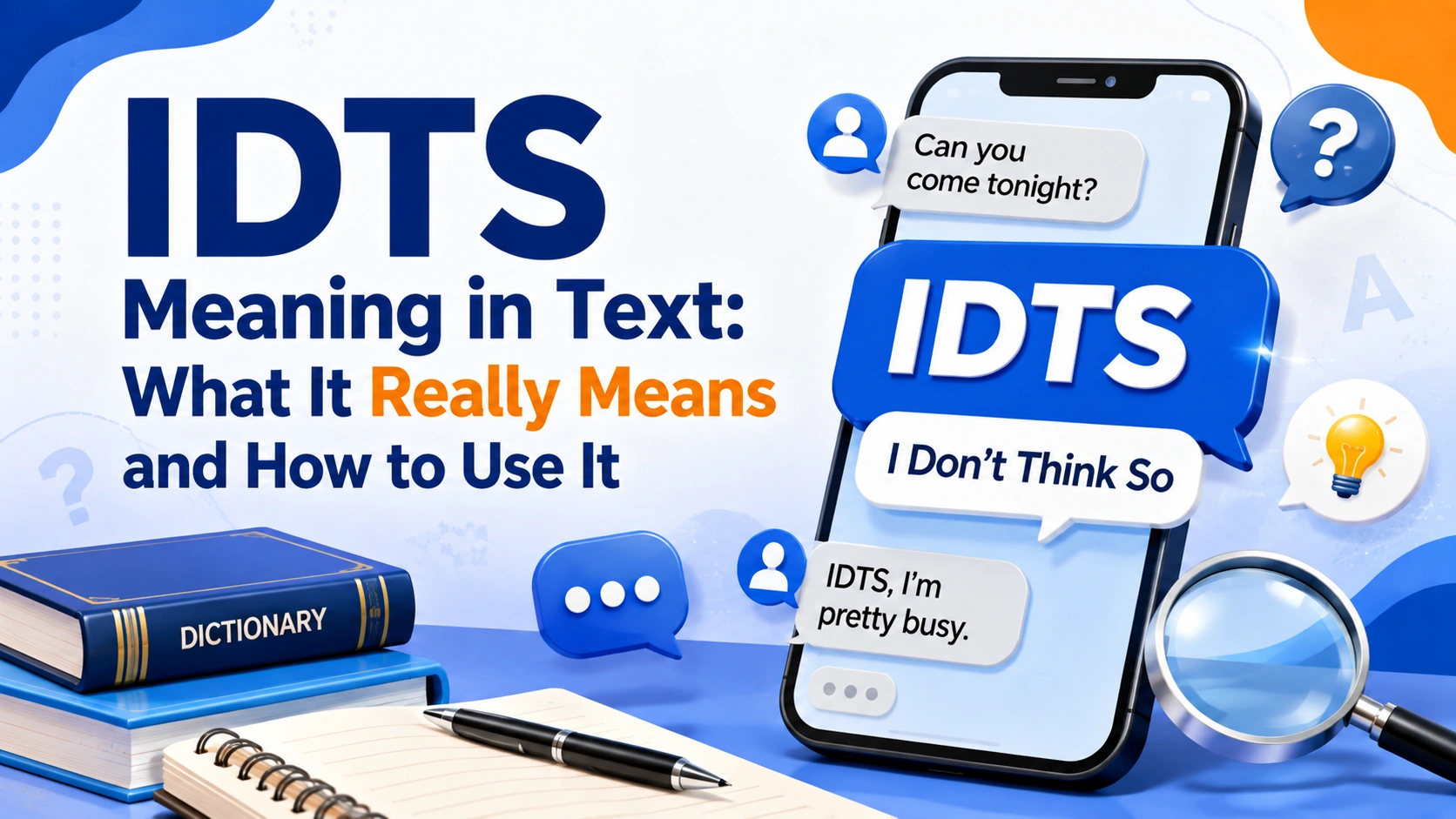
IDTS meaning in text can be confusing because the same four letters may represent different phrases depending on where they’re used and who is using them. If you’ve spotted IDTS in a text message, Snapchat conversation, TikTok comment, or online discussion, you’re probably wondering what the sender actually meant. Unlike many internet abbreviations with a single, universally accepted definition, IDTS is a context-dependent acronym. Understanding that context is far more important than memorizing one possible expansion.
Modern digital communication moves quickly, and abbreviations have become part of everyday language. From LOL and IDK to TBH, IMO, and SMH, people shorten phrases to type faster and keep conversations casual. IDTS belongs to that same family of internet slang, but it isn’t quite as standardized. Different online communities may interpret it differently, which means assuming the wrong meaning can lead to misunderstandings. Learning how to identify the intended meaning will help you communicate more confidently across messaging apps and social media platforms.
In this guide, you’ll discover the most common meaning of IDTS, explore its less common interpretations, learn how to determine the correct meaning based on context, compare it with similar texting abbreviations, and see real-world conversation examples. You’ll also learn when it’s appropriate to use IDTS, when you should avoid it, and how to respond naturally when someone sends it to you. By the end, you’ll know exactly how to interpret this acronym without second-guessing yourself.
IDTS Meaning in Text: Quick Answer
If you’re looking for the short answer, here’s what you need to know.
Quick Answer
IDTS most commonly means “I Don’t Think So.”
People use it in text messages, social media, online chats, and gaming conversations to politely or casually express disagreement, uncertainty, or doubt.
Example:
Friend: “Do you think it’ll rain today?”
You: “IDTS. The forecast looks clear.”
Although “I Don’t Think So” is by far the most common interpretation, IDTS doesn’t always carry the same meaning. Certain communities, niche forums, or specific conversations may use it differently. That’s why experienced readers look at the entire conversation instead of focusing only on the acronym itself.
Why Context Matters
Unlike abbreviations such as LOL (“Laugh Out Loud”), IDTS isn’t universally fixed.
Its meaning can change depending on:
- The conversation topic
- The relationship between the people chatting
- The platform (Snapchat, Discord, TikTok, etc.)
- The tone of the message
- The surrounding words and emojis
For example:
Example 1
“Are they reopening the store tomorrow?”
“IDTS.”
Here, it clearly means “I don’t think so.”
Example 2
“Will he accept the offer?”
“IDTS, but we’ll find out tomorrow.”
Again, the speaker is expressing uncertainty rather than certainty.
What Does IDTS Mean in Text Messages?
For most internet users, IDTS stands for “I Don’t Think So.” It’s a quick, informal way to say you don’t believe something is true, likely, or correct.
Rather than typing the entire phrase, people shorten it to save time while texting. The abbreviation also softens disagreement. Saying “IDTS” often sounds less direct than replying with a blunt “No.”
The Primary Meaning of IDTS
The primary meaning is simple:
IDTS = I Don’t Think So
People typically use it when they:
- Disagree politely
- Express doubt
- Predict something won’t happen
- Show uncertainty
- Respond casually to a question
Examples:
Friend: “Will the game be cancelled?”
Reply: “IDTS.”
Coworker: “Do you think they’ll finish the project today?”
Reply: “IDTS. There’s still a lot left.”
Sibling: “Is Dad already home?”
Reply: “IDTS.”
In every case, the writer isn’t stating a proven fact—they’re sharing an opinion or expectation.
What Tone Does IDTS Usually Convey?
One interesting aspect of IDTS is that its tone depends on context.
It can sound:
- Friendly
- Casual
- Neutral
- Doubtful
- Lighthearted
- Slightly skeptical
Unlike stronger responses such as:
- Absolutely not.
- No chance.
- Impossible.
IDTS leaves room for uncertainty.
Compare these replies:
Question: “Will our team win?”
- “No.” → Direct.
- “Definitely not.” → Strong.
- “IDTS.” → More conversational and less absolute.
That’s one reason the abbreviation has become popular in everyday messaging.
Less Common Meanings You Might Encounter
Although “I Don’t Think So” dominates online usage, you’ll occasionally see IDTS interpreted differently in niche communities or specialized conversations.
Some users have expanded it to phrases such as:
- I Don’t Think That’s…
- I Don’t Think They Should…
- I Did That Stuff (rare and highly contextual)
These interpretations are not standardized. They usually make sense only when the rest of the sentence clearly supports them.
For example:
“IDTS that’s the best solution.”
Here, the speaker has abbreviated a longer thought rather than using the standalone phrase “I don’t think so.”
Whenever you encounter an unfamiliar use, avoid guessing. Instead, read the surrounding messages carefully before deciding what the acronym means.
Expert Tip
If an acronym has multiple possible meanings, prioritize conversation context over internet acronym lists. Context almost always provides the most accurate interpretation.
How to Figure Out the Correct Meaning of IDTS
Because IDTS isn’t used as consistently as abbreviations like OMG or BTW, experienced readers rely on context rather than memorization.
Here are the four most reliable ways to identify the intended meaning.
Read the Conversation Before the Acronym
Never interpret IDTS in isolation.
Instead, ask:
- What question was asked?
- What topic are they discussing?
- Are they agreeing or disagreeing?
Example:
Person A: “Do you think she’ll come?”
Person B: “IDTS.”
The previous question makes the meaning obvious.
Consider the Platform You’re Using
Different platforms encourage different communication styles.
| Platform | Typical IDTS Usage | Formality |
| Snapchat | Casual replies | Very informal |
| TikTok | Comment reactions | Informal |
| DMs and comments | Informal | |
| Discord | Gaming discussions | Informal |
| SMS/Texting | Everyday conversation | Casual |
| Workplace chat | Rarely recommended | Semi-formal |
While the meaning usually remains the same, the frequency of use changes across platforms.
Pay Attention to the Overall Tone
Tone often reveals whether IDTS expresses:
- Doubt
- Gentle disagreement
- Skepticism
- Humor
- Sarcasm
For example:
“IDTS 😂”
The laughing emoji suggests playful disagreement.
Meanwhile:
“IDTS.”
without emojis feels more neutral or serious.
Emojis, punctuation, and capitalization all influence how readers interpret the message.
Look for Supporting Words and Emojis
The surrounding language often removes ambiguity.
Examples:
- “Honestly, IDTS.”
- “IDTS lol.”
- “IDTS but maybe.”
- “IDTS 🤔”
These extra clues help readers understand whether the writer sounds confident, uncertain, or simply joking.
Quick Comparison Table: Understanding IDTS at a Glance
| Feature | IDTS |
| Most common meaning | I Don’t Think So |
| Type | Internet slang / texting abbreviation |
| Primary purpose | Express doubt or polite disagreement |
| Formal writing | ❌ Not recommended |
| Business emails | ❌ Avoid |
| Text messages | ✅ Common |
| Social media | ✅ Very common |
| Gaming chats | ✅ Common |
| Tone | Casual, conversational, uncertain |
| Best alternative in formal writing | “I don’t believe so.” or “I don’t think that’s correct.” |
Key Takeaway
In most situations, IDTS means “I Don’t Think So.” However, don’t rely on the acronym alone. Always consider who is speaking, what they’re discussing, and where the conversation is taking place before deciding on its meaning.
What Does IDTS Mean in Text Messages?
Unlike many internet abbreviations that have one universally accepted definition, IDTS can represent different phrases depending on the conversation. That’s why context is far more important than the letters themselves. If you search for “IDTS meaning in text,” you’re probably trying to understand a message someone sent or deciding whether it’s appropriate to use the abbreviation yourself.
In most casual texting environments, IDTS most commonly stands for “I Don’t Think So.” It’s a quick, informal way to disagree, express doubt, or politely reject an idea without typing the entire sentence.
For example:
- Friend: “Do you think it’ll rain today?”
- You: “IDTS. The forecast looks clear.”
Here, IDTS simply means I don’t think so.
However, internet slang evolves quickly, and different online communities sometimes assign alternative meanings to the same abbreviation. Although those meanings are much less common, understanding them helps prevent misunderstandings.
Quick Tip: Never assume an acronym has only one meaning. Always read the surrounding conversation before interpreting it.
The Most Common Meaning of IDTS
IDTS = “I Don’t Think So”
Across text messages, WhatsApp, Messenger, Snapchat, Instagram DMs, Discord, and many online forums, I Don’t Think So is by far the most recognized meaning.
People use it when they want to:
- Politely disagree
- Express uncertainty
- Reject a suggestion
- Share an opinion without sounding overly direct
Unlike saying a firm “No,” IDTS often softens the response, making it sound more conversational.
Examples
Example 1
“Are they coming tonight?”
IDTS—they said they were busy.
Example 2
“Will the price drop tomorrow?”
IDTS, but nobody knows for sure.
Example 3
“Did he finish the project?”
IDTS. He’s still working on it.
Example 4
“Should we leave now?”
IDTS. Let’s wait another ten minutes.
Why People Prefer IDTS
People often choose abbreviations because they make digital conversations faster.
Instead of typing:
“I don’t think so.”
They simply write:
“IDTS”
The meaning stays the same while saving time.
Can IDTS Have Other Meanings?
Yes—but they’re much less common.
Like many internet acronyms, IDTS isn’t standardized, meaning some online communities create their own interpretations. These versions usually appear within niche groups, gaming communities, private chats, or industry-specific conversations rather than everyday texting.
Less Common Meanings
Depending on context, IDTS may occasionally be interpreted as:
- I Don’t See That
- I Didn’t Think So
- I Don’t Talk Seriously (rare)
- Community-specific shorthand with a unique meaning
These alternatives are uncommon and should never be assumed without context.
For example:
“IDTS that’s what happened.”
This could reasonably mean:
- I don’t think so.
- I don’t see that.
The surrounding conversation usually makes the intended meaning obvious.
How Context Changes the Meaning
One of the biggest mistakes beginners make is believing acronyms always have fixed definitions.
They don’t.
Instead, experienced readers look at three things:
The Topic
Is the conversation about an opinion?
A prediction?
A disagreement?
If so, I Don’t Think So is almost certainly the intended meaning.
The Platform
Different apps develop different slang cultures.
For example:
| Platform | Most Likely Meaning |
| SMS/Text | I Don’t Think So |
| I Don’t Think So | |
| Snapchat | I Don’t Think So |
| Instagram DM | I Don’t Think So |
| Discord | Usually I Don’t Think So, but community-specific meanings sometimes appear |
| Gaming Chat | Depends on the game’s community |
The Conversation Flow
Imagine these messages:
“Will we finish before Friday?”
“IDTS.”
Clearly, the sender is expressing doubt.
Now compare this:
“Can you actually see that?”
“IDTS.”
Here the phrase might mean I Don’t Think So, but I Don’t See That could also fit depending on earlier messages.
That’s why reading only one message in isolation often leads to incorrect interpretations.
Why IDTS Became Popular
Internet abbreviations usually become popular for the same reasons:
- Faster typing
- Mobile-friendly communication
- Casual tone
- Character limits on older social media platforms
- Shared internet culture
IDTS follows this pattern perfectly.
Instead of writing sixteen characters—
I don’t think so
—you only type four letters.
Over thousands of conversations, those small shortcuts become habits.
Another reason is tone.
Compare these replies:
No.
versus
IDTS.
The second often sounds less blunt and more conversational, which makes it popular among friends and online communities.
How IDTS Is Commonly Used in Everyday Conversations
Understanding grammar is only part of mastering internet slang. Knowing when people naturally use an abbreviation is just as important.
Here are the situations where you’ll encounter IDTS most often.
Expressing Doubt
This is the classic use.
Example
Friend:
“Will they finish today?”
Reply:
“IDTS.”
The speaker isn’t saying definitely not. They’re simply expressing uncertainty.
Politely Disagreeing
Instead of directly contradicting someone, people often soften their response.
Example:
Person A:
“I think that rumor is true.”
Person B:
“IDTS.”
Compared with simply saying “You’re wrong,” the abbreviation feels less confrontational.
Responding to Predictions
People frequently use IDTS when discussing future events.
Examples:
- “Will gas prices fall next week?”
- “IDTS.”
- “Do you think they’ll cancel the event?”
- “IDTS.”
The abbreviation signals skepticism rather than certainty.
Casual Group Chats
In fast-moving group conversations, brevity matters.
Instead of writing a full explanation, participants often reply with:
- IDTS
- IMO
- TBH
- FYI
- BRB
Because everyone in the group understands these abbreviations, communication stays quick and natural.
IDTS Meaning on Different Platforms
Although IDTS usually means “I Don’t Think So,” the way people use it can vary slightly depending on the platform. Understanding these differences helps you interpret messages more accurately and decide whether the abbreviation fits the conversation.
IDTS on Snapchat
Snapchat conversations are typically quick, casual, and centered around close friends. On this platform, IDTS almost always means “I Don’t Think So.”
People often use it to respond to:
- Questions
- Predictions
- Invitations
- Rumors
- Opinions
Examples
Friend: “Are you going to the party tonight?”
You: “IDTS. I have too much homework.”
Friend: “Do you think she’ll reply?”
You: “IDTS.”
Because Snapchat messages are informal, abbreviations like IDTS, TBH, IMO, and SMH are widely understood.
IDTS on TikTok
TikTok comments move incredibly fast, so users frequently shorten their replies.
You’ll commonly see IDTS used when reacting to:
- Viral videos
- Celebrity news
- Trending opinions
- Predictions
- Debates
Examples:
Comment:
“This trend will disappear next month.”
Reply:
“IDTS 😂”
Or:
“IDTS that’s actually what happened.”
The abbreviation often carries a light-hearted or humorous tone rather than sounding argumentative.
IDTS on Instagram
Instagram users commonly use IDTS in:
- Direct Messages
- Story replies
- Comments
- Group chats
Examples:
Friend:
“Think they’ll announce it tomorrow?”
Reply:
“IDTS.”
Or:
“IDTS that’s the original photo.”
Because Instagram conversations are conversational rather than formal, abbreviations feel natural.
IDTS in Text Messages
Traditional SMS texting remains one of the most common places to encounter IDTS.
Examples:
Parent
“Will you be home before dinner?”
Teen
“IDTS. Practice ends late.”
Friend
“Is the traffic bad?”
Reply
“IDTS.”
Here, brevity is the main reason for using the abbreviation.
IDTS on Discord and Gaming Communities
Discord communities sometimes create their own slang, so context becomes especially important.
In most servers:
IDTS = I Don’t Think So
However, some gaming groups may give the abbreviation a specialized meaning understood only by members.
For example:
Player A:
“Can we beat this boss with two healers?”
Player B:
“IDTS.”
Unless the server has established different terminology, interpreting it as “I Don’t Think So” is usually the safest choice.
When Should You Use IDTS?
Knowing the meaning isn’t enough—you also need to know when it’s appropriate.
Good Situations to Use IDTS
Use it when you’re talking with:
- Friends
- Family
- Close coworkers
- Gaming teammates
- Classmates
- Casual online communities
Examples:
- “IDTS we’ll finish today.”
- “IDTS that’s true.”
- “IDTS he’ll mind.”
These conversations naturally welcome abbreviations.
When You Should Avoid IDTS
Professional communication requires clarity.
Avoid using IDTS in:
- Job applications
- Business emails
- Academic papers
- Client communication
- Formal reports
- Legal writing
Instead, write the complete phrase.
For example:
Instead of:
IDTS this proposal is ready.
Write:
I don’t think this proposal is ready yet.
The full sentence sounds clearer, more professional, and leaves no room for misunderstanding.
Expert Tip: When writing for a broad audience, spell out “I don’t think so” instead of using IDTS. Not everyone is familiar with internet abbreviations, and clear communication should always come first.
Professional Alternatives to IDTS
Sometimes you want to express disagreement without sounding overly casual.
Here are better alternatives depending on the situation.
| Casual | More Professional |
| IDTS | I don’t think so. |
| IDTS | I don’t believe that’s correct. |
| IDTS | I’m not convinced. |
| IDTS | That seems unlikely. |
| IDTS | Based on the available information, probably not. |
| IDTS | I have some doubts about that. |
Choosing the right wording depends on your audience.
How to Respond When Someone Says “IDTS”
If someone texts IDTS, your reply should match the context of the conversation.
If They’re Expressing Doubt
Them:
“IDTS we’ll make it.”
Possible replies:
- “Why not?”
- “What makes you think that?”
- “Maybe—but let’s try anyway.”
If They’re Disagreeing
Them:
“IDTS that’s accurate.”
You could respond:
- “What do you think is correct?”
- “Can you explain your reasoning?”
- “Interesting—I saw different information.”
If They’re Unsure
Sometimes IDTS doesn’t mean “no.”
It means:
“I’m not certain.”
In that case, helpful responses include:
- “Let’s check.”
- “I’ll look it up.”
- “Maybe you’re right.”
- “We’ll find out soon.”
Understanding the speaker’s intent helps keep conversations productive instead of turning simple misunderstandings into disagreements.
IDTS vs Similar Texting Abbreviations
Many abbreviations express opinions or uncertainty, but they aren’t interchangeable.
| Abbreviation | Meaning | Primary Use |
| IDTS | I Don’t Think So | Expressing doubt or polite disagreement |
| IMO | In My Opinion | Sharing a personal viewpoint |
| IMHO | In My Humble Opinion | Offering an opinion politely |
| TBH | To Be Honest | Introducing an honest statement |
| IDC | I Don’t Care | Showing indifference |
| IDK | I Don’t Know | Expressing uncertainty |
| IKR | I Know, Right? | Agreeing enthusiastically |
| SMH | Shaking My Head | Showing disappointment or disbelief |
Understanding these differences prevents confusion and helps you choose the right abbreviation for the situation.
Conclusion
Understanding IDTS meaning in text is easier once you know that “I Don’t Think So” is its most common interpretation in modern digital communication. Whether you’re chatting on Snapchat, Instagram, WhatsApp, Discord, TikTok, or through regular text messages, the abbreviation is typically used to express doubt, polite disagreement, or uncertainty in a quick and informal way. Like many internet acronyms, however, context always matters, and reading the surrounding conversation helps you interpret the intended meaning accurately. One final actionable tip: if you’re communicating in a professional, academic, or business setting, write out “I don’t think so” instead of using IDTS to ensure clarity for every reader. A common mistake to avoid is assuming every acronym has only one meaning—always consider the platform, audience, and conversation before drawing conclusions.
FAQs
Q1. What does IDTS mean in text messages?
IDTS most commonly stands for “I Don’t Think So.” People use it to express doubt, disagreement, or uncertainty in casual conversations. It’s widely recognized in texting, social media, and messaging apps as a quicker alternative to writing the full phrase.
Q2. Is IDTS considered rude?
Not usually. IDTS is generally seen as a polite and informal way to disagree rather than a harsh rejection. However, its tone depends on the conversation and relationship between the people involved. Adding a brief explanation can make your response sound friendlier.
Q3. Can IDTS have more than one meaning?
Yes. While “I Don’t Think So” is by far the most common meaning, some online communities may use IDTS differently. Always rely on context, platform, and surrounding messages before assuming an alternative interpretation.
Q4. Should I use IDTS in professional communication?
It’s best to avoid IDTS in business emails, academic writing, client communication, or formal documents. Writing the complete phrase, “I don’t think so,” improves clarity and ensures that everyone understands your message without relying on internet slang.
Q5. What are some similar abbreviations to IDTS?
Several texting abbreviations express opinions or uncertainty, including IDK (I Don’t Know), IMO (In My Opinion), IMHO (In My Humble Opinion), TBH (To Be Honest), and IKR (I Know, Right?). Each has a different purpose, so choose the one that best matches your intended meaning.