

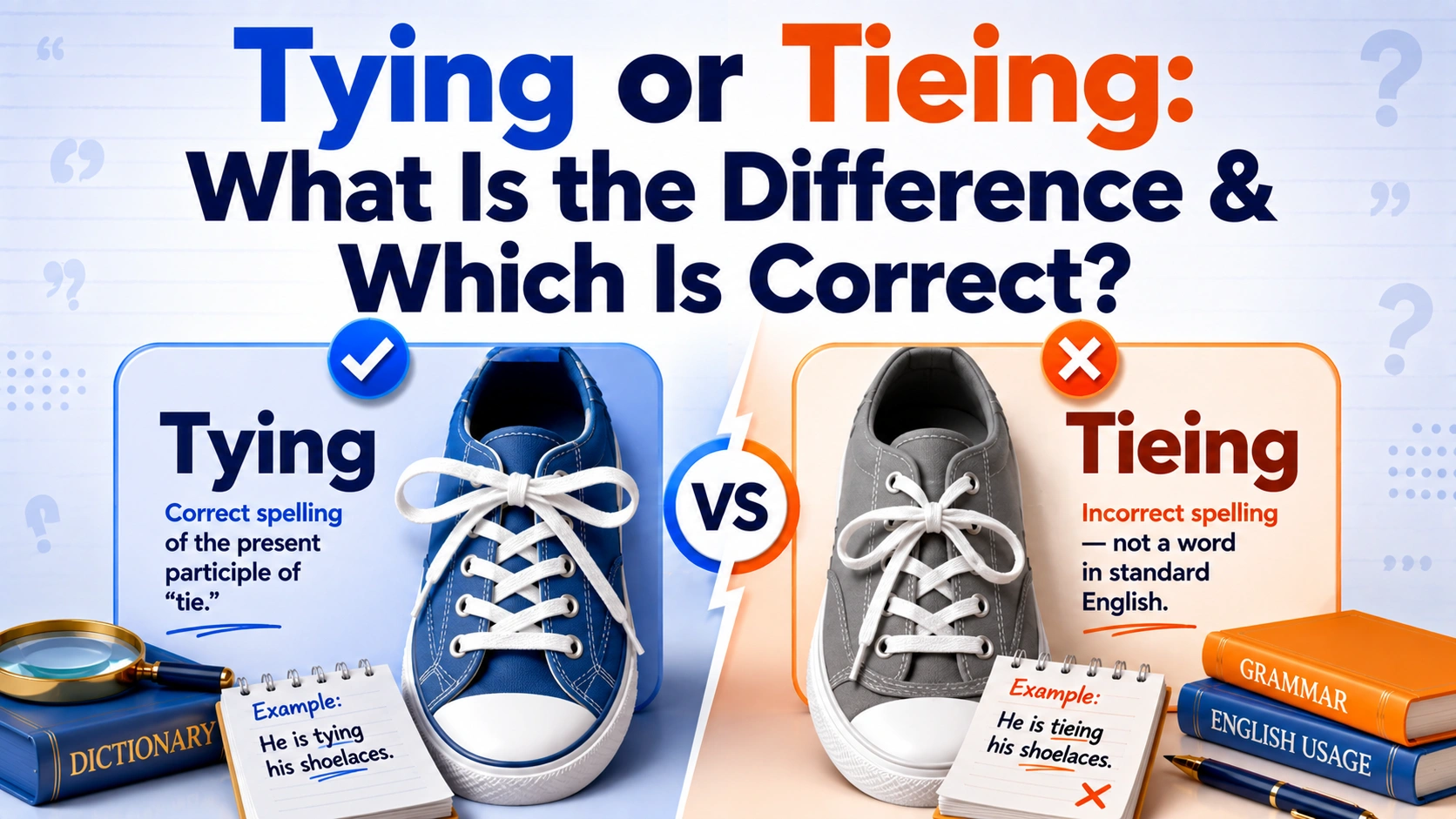
Tying or tieing is one of those spelling questions that catches even experienced English writers off guard. Because the verb tie ends with the letter e, many people naturally assume the present participle should be tieing. However, English spelling follows a different rule in this case, making tying the only standard spelling accepted in modern English. Whether you’re writing an email, school assignment, blog post, or business document, using the correct form helps your writing appear polished and professional.
The confusion exists because English contains many exceptions to its spelling rules. In some verbs, the final e remains before adding a suffix, while in others it disappears entirely. Without understanding the grammar behind these patterns, it’s easy to rely on pronunciation or guesswork. That’s why searches for tying or tieing remain common among students, professionals, ESL learners, and native speakers alike.
This comprehensive guide explains why “tying” is correct, why “tieing” is almost always incorrect, and how English spelling rules apply to verbs ending in -ie. You’ll also discover practical examples, grammar explanations, memory tricks, comparison tables, common mistakes, and expert writing tips that make this rule easy to remember and apply with confidence.
Quick Answer: Is It Tying or Tieing?
If you’re looking for the short answer, here it is:
| Word | Correct? | Meaning |
| Tying | ✅ Correct | The present participle and gerund of tie |
| Tieing | ❌ Incorrect (modern standard English) | A common misspelling of tying |
Correct examples:
- She is tying her shoelaces.
- They spent the afternoon tying fishing knots.
- He keeps tying everything with rope.
- We are tying the decorations before the party.
Incorrect examples:
- ❌ She is tieing her shoes.
- ❌ They are tieing the package.
- ❌ We finished tieing the ribbon.
Key takeaway: Whenever you need the -ing form of tie, always write tying, never tieing.
Understanding the Verb “Tie”
Before discussing the spelling change, it’s helpful to understand what the verb tie actually means and how it functions in English.
What Does “Tie” Mean?
The verb tie generally means to fasten, secure, connect, or bind something using a knot, cord, ribbon, string, or similar material. Depending on context, it can also describe creating a connection between ideas, achieving equal scores in competitions, or linking one event to another.
Common meanings include:
- Fastening objects together
- Securing clothing or accessories
- Making knots
- Connecting ideas
- Ending a competition with equal scores
Examples:
- Tie your shoes before running.
- She tied the ribbon around the gift.
- The detective tied the evidence together.
- The teams tied the match 2–2.
What Does “Tying” Mean?
Tying is the present participle and gerund form of the verb tie.
It describes:
- An action happening now
- An ongoing activity
- An activity used as a noun
Examples:
Present Continuous
- She is tying her apron.
- They are tying the boat securely.
- I’m tying these cables together.
Gerund
- Tying knots requires patience.
- Tying balloons takes time.
- Tying fishing lines is an essential outdoor skill.
In every modern dictionary and grammar guide, tying is the accepted spelling.
Why “Tieing” Looks Logical—but Isn’t Correct
Many learners wonder why tieing isn’t acceptable. After all, the base word already ends with e, so adding -ing seems like it should simply become tieing.
English, however, applies a special spelling rule to verbs ending in -ie.
Instead of keeping both letters, the -ie changes to -y before adding -ing.
That transformation produces:
- tie → tying
—not—
- tie → tieing
This spelling change keeps pronunciation smooth and avoids awkward letter combinations.
Although tieing appears logical at first glance, it doesn’t follow the established rule used in standard English.
Why Is “Tying” Spelled This Way?
The spelling of tying follows one of English grammar’s most consistent spelling conventions.
The “-ie” to “-y” Rule
When a verb ends in -ie, replace ie with y before adding -ing.
This prevents the awkward combination of three consecutive vowels and maintains the intended pronunciation.
Examples include:
| Base Verb | Correct -ing Form |
| tie | tying |
| lie | lying |
| die | dying |
Notice the consistent pattern.
Incorrect forms include:
- ❌ tieing
- ❌ lieing
- ❌ dieing
Correct forms are:
- ✅ tying
- ✅ lying
- ✅ dying
Learning these three examples together makes the rule much easier to remember.
Grammar Rule: Why English Changes “-ie” to “Y”
Unlike many verbs that simply drop a silent e before adding -ing, verbs ending in -ie follow their own spelling pattern.
Compare the two rules:
| Verb Type | Example |
| Drop silent e | make → making |
| Change ie to y | tie → tying |
Notice the difference:
- make → making
- write → writing
- drive → driving
But:
- tie → tying
- lie → lying
- die → dying
These aren’t random exceptions—they follow a recognized spelling rule taught in English grammar.
Understanding this distinction helps eliminate confusion when writing.
Tying or Tieing: Why the Confusion Happens
Many English spelling mistakes occur because pronunciation and spelling do not always follow the same pattern. At first glance, tieing appears logical. After all, if words like seeing, agreeing, and freeing keep the silent e, why shouldn’t tie become tieing?
The answer lies in a specific English spelling rule that applies to many verbs ending in -ie. Instead of simply adding -ing, the ie changes to y before the suffix is added. That’s why:
- Tie → Tying
- Die → Dying
- Lie → Lying
This spelling change prevents awkward letter combinations and makes the word easier to read. Because many learners aren’t familiar with this rule, they naturally assume tieing must be correct.
Several factors contribute to the confusion:
- People spell words according to how they sound.
- Similar verbs follow different spelling rules.
- Autocorrect doesn’t always catch every mistake.
- The incorrect form occasionally appears on websites, social media, and user-generated content.
Understanding the reason behind the spelling makes it much easier to remember the correct form.
Why Tying Is the Correct Spelling
The correct present participle of the verb tie is tying.
When verbs end in -ie, English usually changes ie to y before adding -ing. This rule avoids the unusual letter combination ieing, which is difficult to read and pronounce.
The Rule
| Base Verb | + -ing | Correct Form |
| Tie | + ing | Tying ✅ |
| Die | + ing | Dying ✅ |
| Lie | + ing | Lying ✅ |
Notice that all three verbs follow the same pattern.
Why Doesn’t English Use “Tieing”?
If English simply added -ing, the result would be tieing, which contains the awkward sequence iei.
Changing ie to y creates a cleaner, more readable spelling:
- tie + ing ❌
- ty + ing ✅
Although this rule may seem unusual at first, it has been part of standard English spelling for centuries.
Is Tieing Ever Correct?
For modern standard English, the answer is simple:
No. “Tieing” is considered a spelling error.
Major dictionaries, grammar references, educational institutions, and style guides recognize tying as the accepted spelling.
Whether you’re writing:
- school assignments,
- business emails,
- academic papers,
- books,
- blog posts,
- marketing copy,
- professional reports,
You should always write.
Occasionally, you may encounter tieing in:
- old historical documents,
- transcription errors,
- unedited internet posts,
- spelling mistakes.
These examples do not make it an accepted modern spelling.
Expert Tip: If you’re proofreading content and see tieing, it’s almost always safe to replace it with tying.
Grammar Rule Behind Tying
Understanding the grammar rule helps you avoid similar mistakes with other verbs.
Verbs Ending in -ie
When a verb ends with ie, the spelling changes before adding -ing.
Formula:
ie → y + ing
Examples
| Base Verb | Present Participle |
| Tie | Tying |
| Die | Dying |
| Lie | Lying |
This isn’t a random exception—it’s an established spelling convention designed to improve readability.
Compare with Verbs Ending in Silent -e
Not every verb ending in e behaves the same way.
| Verb | Correct -ing Form |
| Make | Making |
| Write | Writing |
| Drive | Driving |
| Hope | Hoping |
These verbs simply drop the final e.
The -ie ending is treated differently, making tying a special but consistent spelling pattern.
Common Situations Where Tying Is Used
The word tying appears in many everyday contexts, not just when fastening shoelaces.
Tying Knots
This is the most literal meaning.
Examples:
- She is tying her hiking rope carefully.
- The sailor spent years learning advanced knot tying techniques.
- He practiced tying fishing knots before the trip.
Tying Shoes
One of the first meanings children learn.
Examples:
- Emma is tying her shoes.
- Parents often teach children to tie shoelaces before school starts.
- He’s still learning proper shoe tying.
Tying Gifts
The verb often appears in holiday and celebration writing.
Examples:
- They’re tying ribbons around the presents.
- She enjoys tying decorative bows.
- Volunteers spent hours tying gift bags.
Tying Things Together
The verb can describe fastening objects together.
Examples:
- Workers were tying wooden beams together.
- Farmers were tying plants to support stakes.
- Campers were tying supplies onto backpacks.
Figurative Uses of Tying
“Tying” isn’t limited to physical objects.
It also appears in figurative expressions.
Examples:
- The evidence is tying the suspect to the crime.
- Good storytelling involves tying every chapter together.
- The conclusion does an excellent job of tying the ideas into one clear message.
- The company is tying employee bonuses to performance goals.
These figurative meanings are extremely common in journalism, business writing, education, and everyday conversation.
Tying as Different Parts of Speech
Although tying comes from the verb tie, it can function differently depending on the sentence.
As a Present Participle (Verb)
Examples:
- She is tying the rope.
- They’re tying balloons to the fence.
- We are tying everything securely.
As a Gerund (Noun)
A gerund is a verb ending in -ing that functions as a noun.
Examples:
- Tying knots requires patience.
- Tying shoelaces is an important childhood skill.
- Tying fishing flies takes years of practice.
Understanding this distinction helps improve sentence construction and grammar accuracy.
When to Use Tying
Use tying whenever you’re referring to the present participle or gerund form of the verb tie. Whether you’re talking about fastening, connecting, securing, or linking ideas together, tying is the only correct spelling in modern English.
Use Tying When You Mean “Fastening Something”
This is the most common use of the word.
Examples:
- She is tying her shoelaces before leaving.
- The sailor is tying a secure knot.
- We’re tying the boxes with strong twine.
- They spent the afternoon tying decorations around the hall.
Use Tying for Connecting or Linking Things
Sometimes tying doesn’t involve ropes or strings. It can also describe creating a connection between people, ideas, events, or systems.
Examples:
- The report is tying customer feedback to product improvements.
- Researchers are tying climate changes to ocean temperatures.
- The author does an excellent job tying every chapter together.
- The evidence is tying several suspects to the crime.
Use Tying as a Gerund
When tying acts as a noun, it still keeps the same spelling.
Examples:
- Tying knots takes patience.
- Tying balloons is part of the party preparation.
- Tying fishing flies requires precision.
- Tying ribbons neatly improves gift presentation.
When NOT to Use Tying
Although tying is the correct spelling, it shouldn’t replace every form of the verb tie.
Don’t Use It Instead of the Base Verb
Incorrect:
- I am going to tying my shoes.
Correct:
- I am going to tie my shoes.
Don’t Use It Instead of the Past Tense
Incorrect:
- Yesterday she was tying the ribbon before the ceremony ended.
Correct (if the action was completed):
- Yesterday she tied the ribbon.
Don’t Use It When Another Verb Form Is Needed
Choose the correct verb form based on the sentence.
| Meaning | Correct Form |
| Base verb | Tie |
| Present participle | Tying |
| Past tense | Tied |
| Past participle | Tied |
Using the right form improves both grammar and clarity.
When NOT to Use Tieing
This rule is much simpler.
Never Use Tieing in Standard English
The spelling tieing is considered incorrect in modern English writing.
Avoid using it in:
- Academic assignments
- Business documents
- Emails
- Job applications
- Website content
- Books
- Marketing materials
- Exams
Even if some spellcheckers fail to flag it, tying remains the accepted spelling.
Common Mistakes Learners Make
Even advanced English learners occasionally confuse tying and tieing. Understanding these mistakes helps you avoid repeating them.
Mistake #1: Spelling Based on Pronunciation
Many writers assume words should be spelled exactly as they sound.
Incorrect:
- She is tieing her shoes.
Correct:
- She is tying her shoes.
English spelling often follows historical patterns rather than pronunciation alone.
Mistake #2: Applying the Wrong “-ing” Rule
Some learners copy the pattern used with verbs like:
- agree → agreeing
- see → seeing
- free → freeing
They assume tie should behave the same way.
However, verbs ending in -ie follow a different spelling rule.
Mistake #3: Ignoring the “IE → Y” Rule
The biggest source of confusion is forgetting that ie changes to y before adding -ing.
Remember:
- die → dying
- lie → lying
- tie → tying
Learning these three words together makes the rule much easier to remember.
Mistake #4: Copying Incorrect Online Examples
Not everything published online is grammatically correct.
Blogs, forums, comments, and social media posts sometimes contain spelling mistakes that spread quickly.
Always verify uncertain spellings with trusted dictionaries or reputable grammar resources.
Easy Memory Tricks to Remember Tying
A simple memory technique can prevent this mistake permanently.
Trick 1: Think of the Word “Dying”
Most people already know that dying is correct—not dieing.
The same spelling pattern applies:
- Die → Dying
- Tie → Tying
- Lie → Lying
If you remember one, you’ll remember all three.
Trick 2: Remember the “IE Changes to Y” Rule
Whenever a verb ends in -ie, replace ie with y before adding -ing.
Visualize the rule like this:
Tie → Ty → Tying
This quick mental shortcut works every time.
Trick 3: Look for the Letter “Y”
Ask yourself:
“Does this word end with -ying?”
If the original verb ends in -ie, the answer is almost always yes.
Examples:
- tying ✅
- dying ✅
- lying ✅
This pattern is consistent and easy to recognize.
Quick Decision Guide: Tying or Tieing?
If you’re unsure which spelling to use, follow this simple guide.
| If you want to write… | Use |
| The present participle of tie | Tying ✅ |
| The gerund form of tie | Tying ✅ |
| Modern standard English | Tying ✅ |
| Formal writing | Tying ✅ |
| Exams and academic work | Tying ✅ |
| Professional communication | Tying ✅ |
| Tieing | Never use it ❌ |
Whenever you hesitate, remember this simple rule:
There is only one correct spelling in modern English: “tying.”
Real-World Examples of Tying
Seeing the word in different contexts reinforces correct usage.
Everyday Life
- She’s tying her apron before cooking.
- Dad is tying the canoe to the dock.
- I’m tying the garbage bags securely.
Education
- Students practiced tying knots during the outdoor skills lesson.
- The teacher demonstrated the correct method for tying shoelaces.
- Children improve fine motor skills by tying ribbons.
Business
- The company is tying employee rewards to measurable performance.
- Management is tying future investments to customer demand.
- Executives discussed tying bonuses to annual results.
Sports
- Athletes were tying their running shoes before the race.
- Coaches emphasized properly tying safety equipment.
- Climbers practiced tying rescue knots.
Writing and Communication
- The editor is tying together several sections of the report.
- Good conclusions succeed in tying every main idea together.
- The documentary does an excellent job tying historical events to present-day issues.
Technology
- Engineers are tying multiple systems into one platform.
- Developers are tying authentication to user accounts.
- The update focuses on tying cloud services together for a smoother experience.
Self-Assessment Quiz: Tying or Tieing?
Think you’ve mastered the difference between tying and tieing? Test your understanding with this quick quiz. Try answering each question before checking the solutions below.
Question 1
Which spelling is correct?
A. Tieing shoes
B. Tying shoes
Question 2
Fill in the blank.
She is ________ a ribbon around the gift.
A. tieing
B. tying
Question 3
Which sentence is grammatically correct?
A. They spent the afternoon tieing fishing knots.
B. They spent the afternoon tying fishing knots.
Question 4
Choose the correct sentence.
A. Good writing involves tying ideas together.
B. Good writing involves tieing ideas together.
Question 5
Which grammar rule applies to the verb tie?
A. Keep ie before adding -ing.
B. Change ie to y before adding -ing.
Quiz Answers
- B. Tying shoes ✅
- B. tying ✅
- B. They spent the afternoon tying fishing knots. ✅
- A. Good writing involves tying ideas together. ✅
- B. Change ie to y before adding -ing. ✅
If you answered all five correctly, you’ve learned one of the most commonly misunderstood English spelling rules.
Key Takeaways
Before finishing, remember these essential points:
| Question | Correct Answer |
| Which spelling is correct? | Tying ✅ |
| Is tieing a real modern English spelling? | No ❌ |
| What grammar rule applies? | Change -ie to -y before adding -ing |
| Can tying be both a verb and a gerund? | Yes |
| Should you use tying in formal writing? | Absolutely |
Quick Rule: If the verb ends in -ie, change it to -y before adding -ing. That’s why tie → tying, die → dying, and lie → lying.
Conclusion
Choosing between tying or tieing becomes simple once you understand the underlying spelling rule. In modern English, tying is the only correct spelling, while tieing is considered a misspelling. The reason is straightforward: verbs ending in -ie change those letters to -y before adding -ing. This same pattern appears in familiar words like dying and lying, making it one of the more consistent spelling rules in English grammar.Whenever you’re writing an email, assignment, article, or professional document, use tying with confidence. One final actionable tip: remember the trio tie → tying, die → dying, lie → lying whenever you’re unsure. A common mistake to avoid is spelling words based only on pronunciation rather than established grammar rules. Mastering small details like this improves both your accuracy and your credibility as a writer.
FAQs
Q1. Is tying the correct spelling?
Yes. Tying is the only accepted spelling in modern English for the present participle and gerund of the verb tie. It follows the standard -ie to -y spelling rule used in words such as dying and lying.
Q2. Is tieing ever correct?
In standard modern English, no. Tieing is regarded as a spelling mistake. While it may occasionally appear in older texts or unedited online content, reputable dictionaries and style guides recognize tying as the correct form.
Q3. Why does tie become tying instead of tieing?
English spelling rules require verbs ending in -ie to change ie to y before adding -ing. This creates a smoother and more readable spelling. The same rule explains die → dying and lie → lying.
Q4. Can tying be used as both a verb and a noun?
Yes. Tying functions as a present participle in continuous verb tenses (“She is tying the rope”) and as a gerund, where it acts as a noun (“Tying knots takes practice”). The spelling remains the same in both roles.
Q5. How can I remember the correct spelling of tying?
The easiest memory trick is to group it with dying and lying. If you remember that die becomes dying rather than dieing, you’ll naturally remember that tie becomes tying, not tieing. This simple pattern works every time.