

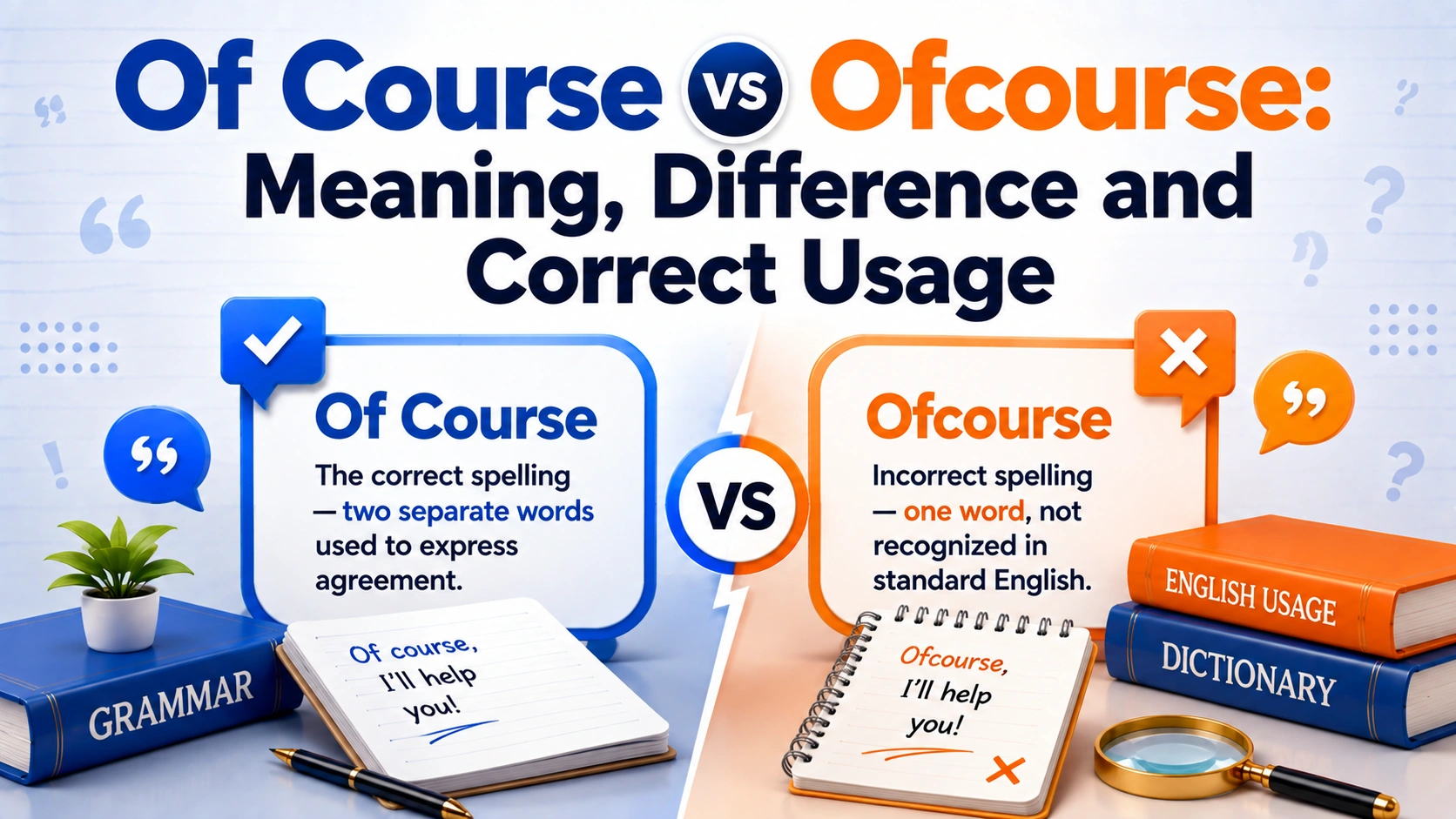
Of course vs ofcourse is one of the most common spelling questions in English because the phrase is used constantly in everyday conversation, emails, professional writing, and online communication. Since native speakers pronounce it as a single, smooth expression, many people naturally assume it should also be written as one word. That assumption is understandable—but it’s incorrect. In standard English, “of course” is always written as two separate words, while “ofcourse” is considered a misspelling by dictionaries, style guides, and grammar experts.
Small spelling mistakes often have a bigger impact than people realize. Writing ofcourse instead of of course can make an otherwise polished email, assignment, blog post, or business proposal appear less professional. This error is especially common among English learners, fast typists, and even experienced writers who rely more on pronunciation than spelling rules. Understanding why the phrase is written as two words, rather than simply memorizing it, makes the correct form much easier to remember in every situation.
This guide goes far beyond giving a simple answer. You’ll discover the grammatical reason “of course” is correct, the history behind the expression, when it can sound polite—or surprisingly rude—how to use it naturally in formal and informal writing, common mistakes to avoid, practical examples from real-life situations, expert writing tips, comparison tables, and easy memory techniques. By the end, you’ll know exactly when, where, and how to use “of course” with confidence.
Quick Answer: Is It “Of Course” or “Ofcourse”?
The answer is simple:
| Expression | Correct? | Meaning |
| Of course | ✅ Correct | A common English phrase meaning naturally, certainly, definitely, or yes. |
| Ofcourse | ❌ Incorrect | A misspelling that is not accepted in standard English. |
Correct Examples
- Of course I’ll help you with the project.
- She replied, “Of course,” without hesitation.
- Of course you can borrow my notes.
- We will of course inform you if anything changes.
- The answer is of course correct.
Incorrect Examples
- ❌ Ofcourse I’ll help you.
- ❌ She said ofcourse.
- ❌ Ofcourse you may attend the meeting.
- ❌ We are ofcourse ready.
Key Takeaway: Whenever you write this expression, always use two words: “of course.” The one-word form ofcourse is a spelling error, regardless of whether you’re writing casually or professionally.
Of Course vs Ofcourse: Comparison at a Glance
| Feature | Of Course | Ofcourse |
| Standard English | ✅ Yes | ❌ No |
| Dictionary Recognition | ✅ Yes | ❌ No |
| Professional Writing | ✅ Appropriate | ❌ Incorrect |
| Academic Writing | ✅ Correct | ❌ Incorrect |
| Business Emails | ✅ Recommended | ❌ Avoid |
| Everyday Conversation (Written) | ✅ Correct | ❌ Misspelling |
| Meaning | Certainly, naturally, definitely | None (spelling error) |
What Is the Difference Between “Of Course” and “Ofcourse”?
Although they look almost identical, there’s an important distinction.
“Of course” is a fixed English phrase made up of two separate words. It has been part of English for centuries and is widely used to express agreement, certainty, permission, expectation, or something considered obvious.
“Ofcourse,” by contrast, isn’t an alternative spelling, regional variation, or informal shortcut. It’s simply the result of merging two separate words into one. Because the phrase is spoken quickly, many writers mistakenly assume it should also be written as a single word.
The difference can be summarized in one sentence:
- Of course = correct English expression.
- Ofcourse = spelling mistake.
Unlike pairs such as email/e-mail or website/web site, where accepted spellings have changed over time, there has never been a stage in modern standard English where “ofcourse” became an accepted single word.
What Does “Of Course” Mean?
The phrase of course has several closely related meanings, and the intended meaning depends on the context rather than the spelling.
Expressing Agreement
One of its most common uses is to answer a question positively.
Examples
- “Can you help me later?”
“Of course.“ - “Will you join us for dinner?”
“Of course, I’d love to.”
Here, the phrase simply means yes or certainly.
Showing Certainty
It can also indicate that something is unquestionably true.
Examples
- Of course water freezes at low temperatures.
- She’s experienced, so of course she handled the situation well.
- Of course preparation improves your chances of success.
In these cases, the phrase emphasizes confidence rather than agreement.
Giving Permission
People often use of course to respond warmly when granting permission.
Examples
- “Of course you may use my laptop.”
- “Of course you can ask questions.”
- “Of course you’re welcome to stay.”
Compared with a simple “yes,” this wording usually sounds more encouraging and reassuring.
Confirming Expectations
Sometimes of course highlights something that seems natural or expected.
Examples
- The train was delayed, of course, because of the weather.
- She studied every day, so of course she passed.
- He apologized, of course, after realizing his mistake.
In these sentences, the phrase reinforces the idea that the outcome was predictable.
Why “Ofcourse” Is Incorrect
Many spelling mistakes occur because spoken English doesn’t always reflect written English. Ofcourse is a perfect example.
When people speak quickly, the words of and course blend together, creating the illusion of a single word. That pronunciation influences spelling, especially when typing quickly.
However, English spelling isn’t based solely on pronunciation. It also follows established conventions, and “of course” remains a two-word idiomatic expression.
Major dictionaries, educational institutions, and professional style guides all recognize only the two-word version.
That means you’ll find:
- ✅ of course
- ❌ ofcourse
Whether you’re writing:
- a university essay,
- a work email,
- a website article,
- a social media post,
- a business proposal,
The correct spelling remains exactly the same.
Why Is “Of Course” Written as Two Words?
Unlike compound words such as cannot, today, or maybe, of course hasn’t evolved into a single lexical item.
Instead, it remains what linguists call a fixed phrase—a group of separate words that functions together while retaining its original spelling.
The first word, of, is a preposition.
The second word, course, originally referred to the natural direction or progression of events. Over time, the expression of course came to mean naturally, as expected, or certainly, but its spelling never changed.
This explains why the phrase continues to appear as:
- of course
- not ofcourse
Many familiar English expressions follow the same pattern.
| Correct Phrase | Incorrect Form |
| Of course | ❌ Ofcourse |
| In fact | ❌ Infact |
| At least | ❌ Atleast |
| Each other | ❌ Eachother |
| All right* | ❌ Alright (still considered nonstandard in many formal contexts) |
Understanding this pattern makes it easier to recognize why of course should never be merged into a single word.
A Simple Rule You’ll Never Forget
Whenever you’re unsure, ask yourself this question:
Can I clearly identify the words “of” and “course” separately?
If the answer is yes—and it always is—you should write them separately.
Think of these examples:
- of interest
- of value
- of importance
- of necessity
- of course
Each expression begins with the preposition of, followed by another independent word. None become a single word in standard English.
Expert Tip: Don’t rely on pronunciation when spelling fixed English phrases. Many common expressions sound like one word in conversation but remain two separate words in writing. Remembering this principle will help you avoid not only ofcourse, but dozens of similar spelling mistakes.
Why Do People Write “Ofcourse” Instead of “Of Course”?
Considering how common the mistake is, it’s worth asking why so many people combine the two words. The answer isn’t that English is changing or that ofcourse is becoming acceptable. Instead, the error comes from the way people read, type, and pronounce the phrase.
Understanding the causes can help you avoid this mistake—and recognize similar ones in your own writing.
Fast Typing and Muscle Memory
One of the biggest reasons people write ofcourse is speed.
When typing quickly on a keyboard or smartphone, writers often merge frequently used word combinations without realizing it. Since of course it appears in emails, chats, and text messages almost every day, many people type it as a single unit.
For example:
- ❌ Ofcourse I’ll send the report today.
- ✅ Of course I’ll send the report today.
Professional editors recommend slowing down during proofreading because these small spacing mistakes are surprisingly easy to overlook.
The Phrase Sounds Like One Word
Spoken English often blends words together.
When native speakers say of course, the pause between of and course is minimal. To many learners—and even native speakers—it sounds almost identical to a single word.
Compare these pronunciations:
- Of course I’ll help.
- Of course that’s true.
Because there is little audible separation, writers sometimes assume there shouldn’t be a visual separation either.
English spelling, however, isn’t determined solely by pronunciation. Many expressions sound connected but remain separate words in writing.
Influence of Informal Digital Communication
Text messaging and social media have changed the way many people write.
People frequently ignore capitalization, punctuation, and spacing when communicating casually.
Examples include:
- gonna
- wanna
- lemme
- kinda
Although these forms appear online, they don’t become correct in formal English simply because they’re common.
The same principle applies to ofcourse. Its appearance in comments, forums, and social media posts reflects informal typing habits—not accepted grammar.
Confusion with Genuine Compound Words
English contains thousands of compound words, which makes guessing difficult.
For example:
| Two Words | One Word |
| Of course | Cannot |
| In fact | Today |
| At least | Maybe |
| Each other | Everything |
Since some expressions eventually become one word while others never do, writers sometimes assume of course belongs in the second category.
It doesn’t.
Unlike today, everywhere, or cannot, of course has consistently remained a two-word phrase in modern standard English.
Autocorrect Doesn’t Catch Every Mistake
Many people trust spellcheck more than they should.
While modern writing tools identify many grammar and spelling errors, they’re not perfect. Some mobile keyboards don’t immediately flag ofcourse, especially if they’ve learned it from repeated typing.
That’s why professional writers still proofread manually rather than relying entirely on software.
Expert Tip: Spellcheck is a helpful assistant—not a substitute for understanding grammar. Knowing the rules yourself is far more reliable than hoping technology catches every mistake.
When Should You Use “Of Course”?
Knowing the correct spelling is only part of using the phrase effectively. You should also understand when it sounds natural and what meaning it communicates in different situations.
To Express Agreement
This is perhaps the most familiar use.
Instead of replying with a plain “yes,” speakers often choose of course because it sounds warmer and more enthusiastic.
Examples
- “Can you review my presentation?”
“Of course.“ - “Would you like to join us?”
“Of course, I’d be happy to.” - “Can I borrow your charger?”
“Of course, here you go.”
To Give Permission
The phrase also reassures someone that permission is freely given.
Examples
- Of course you can leave early today.
- Of course you’re welcome to ask questions.
- Of course your family may attend the event.
Compared with a simple “yes,” this wording often feels friendlier and more supportive.
To Express Certainty
Sometimes of course emphasizes that something is unquestionably true.
Examples
- Of course regular practice improves your writing.
- Of course experience matters when making important decisions.
- If you prepare well, you’ll of course feel more confident.
In these cases, the phrase reinforces confidence rather than agreement.
To Indicate Something Is Expected
The expression can also suggest that an outcome is completely predictable.
Examples
- She studied every evening, so of course she passed the exam.
- The restaurant was popular, so of course reservations filled quickly.
- He trained for months. Of course he performed well.
Here, the phrase highlights a logical consequence.
Where Can “Of Course” Appear in a Sentence?
One reason the phrase is so versatile is that it can appear in several different positions without changing its spelling.
At the Beginning
Starting a sentence with of course immediately signals agreement or certainty.
Examples
- Of course, I’ll help with the presentation.
- Of course, everyone is invited.
- Of course, mistakes happen during learning.
This placement works well in conversation, emails, and responses.
In the Middle
When placed mid-sentence, of course often adds emphasis without interrupting the overall flow.
Examples
- The proposal will, of course, require approval.
- She is, of course, qualified for the position.
- We will, of course, notify you immediately.
In formal writing, commas are commonly used because the phrase functions as a parenthetical expression.
At the End
Ending a sentence of course usually creates a conversational tone.
Examples
- I’d be happy to help, of course.
- You can contact me anytime, of course.
- The decision is yours, of course.
This placement is especially common in spoken English and dialogue.
Can “Of Course” Sound Rude?
Surprisingly, yes.
Although the phrase is generally polite, tone and context matter far more than the words themselves.
Consider these two conversations.
Friendly Use
Customer: “Could you explain this process?”
Representative: “Of course! I’d be happy to walk you through it.”
The response sounds welcoming and helpful.
Condescending Use
Student: “Is this the correct chapter?”
Teacher: “Of course it is.”
Depending on the speaker’s tone, this reply may suggest that the question was unnecessary or obvious.
How to Avoid Sounding Dismissive
When speaking or writing professionally:
- Pair of course with additional helpful information.
- Avoid using it to imply someone should already know the answer.
- Let your tone reflect encouragement rather than impatience.
For example:
Instead of:
“Of course.”
Consider:
“Of course! I’m happy to explain further if anything is unclear.”
The second response communicates both confidence and courtesy, making it a better choice in customer service, workplace communication, and professional correspondence.
Common Mistakes People Make with “Of Course”
Although the phrase itself is simple, writers often misuse it in ways that affect clarity, professionalism, or tone. Learning these common mistakes will help you write more naturally and avoid errors that readers notice immediately.
Mistake #1: Writing “Ofcourse” as One Word
This is by far the most frequent error.
Because the phrase is pronounced quickly, many writers combine the two words without realizing they’re making a spelling mistake.
Incorrect
- ❌ Ofcourse I’ll send the documents today.
- ❌ Ofcourse you’re welcome to join us.
- ❌ She answered, “Ofcourse.”
Correct
- ✅ Of course I’ll send the documents today.
- ✅ Of course you’re welcome to join us.
- ✅ She answered, “Of course.”
Remember that of course is a fixed expression, not a compound word.
Mistake #2: Using It Too Frequently
Even though of course is grammatically correct, repeating it throughout a piece of writing can make your style sound repetitive.
Instead of writing:
Of course we’ll review the proposal. Of course we’ll discuss pricing. Of course we’ll answer your questions.
Try varying your language:
We’ll certainly review the proposal. We’ll also discuss pricing and gladly answer any questions.
Professional writers often replace repeated instances with alternatives such as:
- Certainly
- Absolutely
- Naturally
- Definitely
- Without question
- Yes
- Sure
Using variety improves readability while maintaining the same meaning.
Mistake #3: Making the Reader Feel Their Question Was Obvious
Sometimes of course unintentionally sounds dismissive.
Imagine a customer asking:
“Could you explain this policy?”
Replying with only:
“Of course.”
is usually friendly.
But replying:
“Of course it works.”
might imply the customer should already know the answer.
In customer service, education, and workplace communication, adding a little extra context creates a warmer tone.
For example:
Of course. I’d be happy to explain how it works.
This sounds far more welcoming.
Mistake #4: Using It in Formal Writing Where It Adds Nothing
Sometimes the phrase doesn’t strengthen a sentence at all.
Instead of:
The committee will of course review every application.
Simply writing:
The committee will review every application.
is often clearer and more concise.
Good editing isn’t just about choosing correct words—it’s also about removing unnecessary ones.
“Of Course” vs Similar Expressions
Although of course it is extremely versatile, it isn’t always the best choice. Several similar expressions communicate slightly different shades of meaning.
Of Course vs Certainly
Both express confidence, but certainly usually sound more formal.
| Of Course | Certainly |
| Conversational | More formal |
| Often expresses agreement | Often emphasizes certainty |
| Common in speech | Common in business writing |
Examples
- “Can you help?”
“Of course.” - “Can you assist with this request?”
“Certainly.”
Of Course vs Definitely
Definitely emphasizes certainty more strongly than agreement.
Examples
- “Will you attend?”
“Definitely.“ - “Can I borrow your notes?”
“Of course.“
Although both responses are positive, they communicate slightly different nuances.
Of Course vs Naturally
Naturally often suggests that something is expected because it follows logically.
Examples
- She trained every day, so naturally she improved.
- She trained every day, so of course she improved.
Both work, but naturally places slightly more emphasis on cause and effect.
Of Course vs Sure
Sure is shorter and more casual.
Compare:
- Of course, I’d be happy to help.
- Sure, no problem.
Both are correct, but the first sounds warmer and slightly more polished.
Real-World Examples of “Of Course”
Seeing the phrase used in realistic situations helps reinforce both its meaning and its versatility.
In Everyday Conversation
- “Of course I’ll call you when I arrive.”
- “Of course you can sit here.”
- “Of course I remember your birthday.”
- “Of course we should celebrate together.”
In Professional Emails
- Of course, I’d be happy to review the proposal before Friday.
- We will of course keep you informed throughout the project.
- Of course you may contact me if additional questions arise.
- Our team will of course provide further assistance whenever needed.
In Customer Service
- Of course—let me help you resolve that issue.
- Of course, I’ll explain each step.
- Of course, we appreciate your feedback.
- Of course, your satisfaction is important to us.
In Academic Writing
While the phrase appears less often in formal academic papers, it can still be appropriate when quoting speech or writing in a less technical style.
Example:
Students often assume the answer is of course obvious, but careful analysis reveals a more complex explanation.
In News and Journalism
Journalists occasionally use the phrase when quoting sources or writing opinion pieces.
Example:
The mayor stated, “Of course public safety remains our highest priority.”
Editing Tips: How to Spot “Ofcourse” Before Publishing
Professional editors rarely rely on spellcheck alone. Instead, they use systematic proofreading habits.
Here are a few techniques that work well.
Read Slowly
Spacing mistakes often disappear when reading quickly.
Slow, deliberate proofreading helps you notice errors such as:
- ofcourse
- atleast
- infact
- eachother
Search for Common Mistakes
Before publishing an article or sending an important email, search your document for:
- ofcourse
- atleast
- alot
- infact
Correcting these common errors instantly improves professionalism.
Read Aloud
Hearing your writing can reveal awkward wording and unnecessary repetition.
Although reading aloud won’t identify every spelling mistake, it encourages more careful editing overall.
Don’t Depend Entirely on Autocorrect
Grammar tools are valuable, but they aren’t perfect.
Professional writers treat automated suggestions as helpful guidance—not as a replacement for understanding grammar.
Editor’s Tip: Developing strong grammar knowledge saves far more time than correcting the same mistakes repeatedly.
Memory Tricks to Remember “Of Course”
Simple memory techniques make this spelling almost impossible to forget.
Trick 1: Think of Two Separate Words
Ask yourself:
Can I point to the word “of” and the word “course” separately?
Yes.
Since both are independent words, they stay separate in writing.
Trick 2: Compare It with Similar Phrases
Notice the pattern:
- of value
- of interest
- of importance
- of necessity
- of course
None become one word.
Trick 3: Expand the Phrase
Replace of course with naturally or certainly.
If those words fit, you know you’re dealing with the expression of course, written as two words.
Trick 4: Remember This Simple Sentence
Every course begins with “of,” but “of course” never becomes “ofcourse.”
A memorable sentence like this makes the rule stick much more effectively than memorizing grammar terminology.
Quick Self-Check: Of Course or Ofcourse?
Test your understanding before you finish reading. Choose the correct option for each sentence.
Question 1
Which spelling is correct?
A. Ofcourse I’ll help.
B. Of course I’ll help.
Question 2
Fill in the blank.
“________ you may use my computer.”
A. Ofcourse
B. Of course
Question 3
Which sentence follows standard English?
A. We are ofcourse ready to begin.
B. We are of course ready to begin.
Question 4
Choose the grammatically correct sentence.
A. She answered, “Of course.”
B. She answered, “Ofcourse.”
Question 5
Which statement is true?
A. Of course it is always written as two words.
B. Ofcourse is accepted in modern English.
Answers
- B ✅
- B ✅
- B ✅
- A ✅
- A ✅
If you answered all five correctly, you’ve mastered one of the most common spelling mistakes in English.
Key Takeaways
| Question | Correct Answer |
| Which spelling is correct? | Of course ✅ |
| Is ofcourse a real English word? | ❌ No |
| Should it be written as one word? | ❌ Never |
| Is of course appropriate in formal writing? | ✅ Yes |
| Can it express agreement, certainty, and permission? | ✅ Absolutely |
Quick Rule to Remember: Whenever you mean certainly, naturally, or yes, write of course as two separate words.
Conclusion
Understanding the difference between of course vs ofcourse is simpler than it first appears. Of course is the only correct spelling in modern English, while ofcourse is a common misspelling that should be avoided in every type of writing, from casual messages to academic papers and professional emails. The phrase remains two words because it is a fixed English expression, not a compound word. Once you recognize that rule, using it correctly becomes second nature.One final actionable tip: add “ofcourse” to your personal proofreading checklist alongside other common errors like alot, infact, and eachother. A common mistake to avoid is trusting pronunciation or autocorrect instead of established grammar rules. Mastering small details like this strengthens your writing, improves credibility, and helps you communicate with confidence.
FAQs
Q1. Is “of course” or “ofcourse” the correct spelling?
Of course is the correct spelling in standard English. It is always written as two separate words and is recognized by major dictionaries and style guides. Ofcourse is a spelling mistake and should be avoided in formal, academic, and professional writing.
Q2. Why do people write “ofcourse” instead of “of course”?
Many people write ofcourse because the phrase is pronounced quickly and sounds like one word in conversation. Fast typing, informal texting habits, and confusion with genuine compound words also contribute to the mistake, but these factors do not make the spelling correct.
Q3. Can “of course” be used in formal writing?
Yes. Of course it is perfectly acceptable in business emails, reports, academic writing, and professional communication. However, use it thoughtfully. In some formal contexts, words such as certainly, naturally, or indeed may provide a more precise or polished tone.
Q4. Is “ofcourse” recognized by dictionaries?
No. Reputable English dictionaries and grammar references recognize only of course as the standard spelling. If you encounter ofcourse, it is almost always an unedited typo or an informal writing mistake rather than an accepted alternative.
Q5. What’s the easiest way to remember the correct spelling?
Think of of and course as two separate words that keep their individual identities. A simple memory trick is: “Every course begins with ‘of,’ so ‘of course’ always stays two words.” Remembering similar phrases like in fact and at least can also reinforce the pattern.