

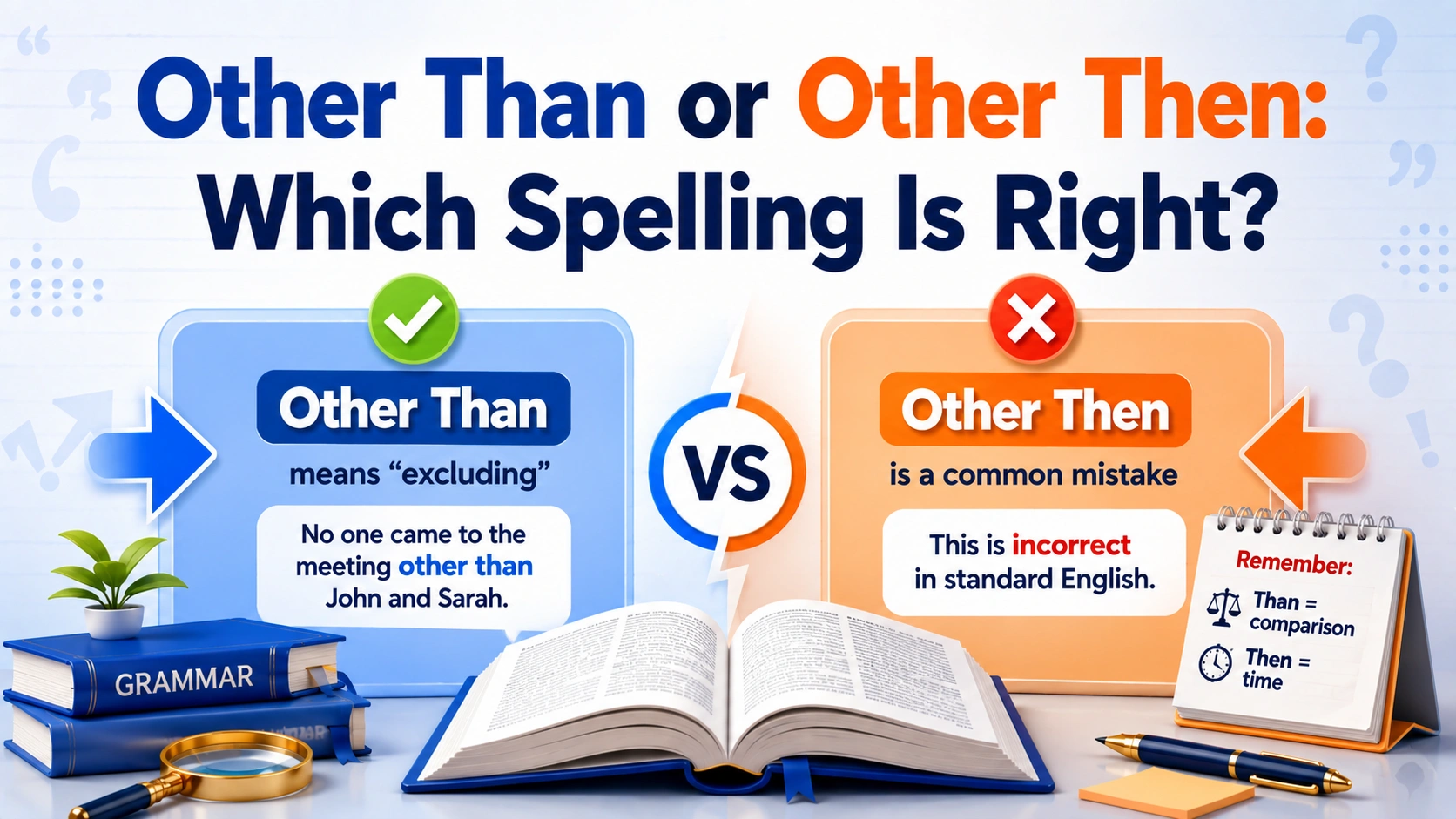
Other than or other then is one of those grammar questions that seems simple until you have to write it in an email, report, academic paper, or social media post. Because “than” and “then” sound almost identical in everyday speech, they’re among the most commonly confused words in English. Yet choosing the wrong one can instantly distract readers and make even well-written content appear less polished. The good news is that once you understand the difference between these two words, the correct phrase becomes easy to recognize every time.
Whether you’re a student completing an assignment, a professional preparing business documents, or an English learner trying to improve your writing, knowing when to use other than instead of other then is an essential grammar skill. The confusion doesn’t happen because the words share the same meaning—they don’t. Instead, it happens because they are homophones, words with similar pronunciation but different spellings and functions. Understanding the role each word plays in a sentence removes the guesswork completely.
In this guide, you’ll learn which phrase is grammatically correct, why people often make this mistake, how than and then differ, practical memory tricks, real-world examples, common writing errors, and expert proofreading tips. By the end, you’ll be able to spot the correct phrase instantly and use it confidently in both formal and everyday English.
Quick Answer: Is It “Other Than” or “Other Then”?
The correct phrase is other than.
✅ Other than is the standard English expression used to mean:
- Except
- Besides
- Apart from
- Different from
Examples:
- Everyone attended the meeting other than James.
- I don’t need anything other than a notebook.
- She speaks no language other than English.
- There was little choice other than waiting.
The phrase other then is almost always incorrect because then refers to time, sequence, or what happens next, not comparison or exclusion.
Incorrect:
- ❌ Other then my brother, nobody came.
- ❌ I don’t eat anything other then vegetables.
Correct:
- ✅ Other than my brother, nobody came.
- ✅ I don’t eat anything other than vegetables.
Key Takeaway: If you mean except, besides, or apart from, always write other than.
Why This Mistake Happens So Often
Many writers—even native English speakers—accidentally type other then because than and then sound very similar in rapid speech. Spell checkers may not always catch the error since then is a correctly spelled English word.
Other reasons include:
- Pronunciation differences across regional accents.
- Typing too quickly without proofreading.
- Confusing commonly mixed-up word pairs.
- Learning English primarily through conversation instead of writing.
Understanding the separate meanings of than and then is the simplest way to avoid repeating the mistake.
Understanding the Difference Between “Than” and “Then”
Although these words differ by only one letter, they serve completely different grammatical purposes.
| Word | Primary Function | Used For | Example |
| Than | Conjunction or preposition | Comparisons, exceptions, contrasts | Other than coffee, I drink tea. |
| Then | Adverb, adjective, noun | Time, sequence, next events | Finish your homework, then watch TV. |
A useful rule is:
- Than = Comparison or exclusion
- Then = Time or sequence
Once you remember that distinction, the phrase other than becomes the obvious choice.
What Does “Than” Mean?
Than is a grammatical word used whenever you’re making a comparison, expressing an exception, or showing a difference.
You’ll often see it after words such as:
- More
- Less
- Better
- Worse
- Rather
- Other
Examples:
- This laptop is faster than the old one.
- She knows more than I expected.
- We had no choice other than leaving early.
- Nothing matters other than honesty.
Notice that than connects two ideas by comparing or distinguishing them.
Common Expressions with “Than”
- More than
- Less than
- Rather than
- Better than
- Other than
- No sooner than
- Different than (common in American English, though different from is generally preferred in formal writing)
What Does “Then” Mean?
Unlike then, it relates to time, order, or what happens next.
It answers questions such as:
- When?
- What happened afterward?
- What comes next?
Examples:
- We ate dinner, then watched a movie.
- Finish this chapter, then begin the next one.
- Back then, computers were much slower.
- If you’re ready, then let’s start.
In every example, it indicates sequence, timing, or consequence—never comparison.
Why “Other Then” Is Usually Incorrect
The phrase other then doesn’t fit standard English grammar because then cannot express exception or exclusion.
Consider these examples:
❌ Everyone other then Sarah arrived early.
The sentence attempts to mean except Sarah, but then has no grammatical role that conveys that meaning.
Correct version:
✅ Everyone other than Sarah arrived early.
Similarly:
❌ I don’t read books other then history.
Correct:
✅ I don’t read books other than history.
Because other than is an established English expression, replacing than with then changes the grammar and creates an error.
Grammar Tip: If you can replace the phrase with except, apart from, or besides, you almost certainly need other than.
What Does “Other Than” Actually Mean?
The phrase other than has several closely related meanings, all centered on the idea of excluding, adding an exception, or showing difference.
Meaning 1: “Except”
Examples:
- Everyone came other than David.
- I don’t eat meat other than chicken.
- Nothing changed other than the schedule.
Meaning 2: “Besides”
Examples:
- Do you have any hobbies other than reading?
- Is there anyone other than your manager who can approve this?
Meaning 3: “Apart From”
Examples:
- Other than the weather, the trip was wonderful.
- Other than one typo, the report was perfect.
Meaning 4: “Different From”
Sometimes the phrase emphasizes distinction.
Examples:
- Their priorities are other than ours.
- The final proposal was other than what we expected.
Is “Other Then” Ever Correct?
This is one of the most common questions people ask.
In standard English, other then is not the correct expression when you mean except, besides, or apart from.
However, the words other and then can occasionally appear next to each other by coincidence in a sentence where then genuinely refers to time.
For example:
- We discussed several topics. Other, then we moved on to the budget.
Or:
- Finish the first task. Other responsibilities can wait until then.
Here, other and then are not forming the phrase other then. They simply happen to appear near each other while serving different grammatical functions.
Therefore, if you’re writing the fixed expression meaning except, the only correct choice is other than.
Other Than Meaning and Usage Explained
Understanding how “other than” functions in real English is the key to avoiding one of the most common grammar mistakes. Although it looks like a simple two-word phrase, it can express exceptions, additions, comparisons, exclusions, and alternatives depending on the context.
Unlike other then, which is almost always a spelling mistake, other than is a standard English expression used in everyday conversation, academic writing, journalism, business communication, and legal documents.
Let’s explore its most common uses.
As a Way to Mean “Except”
The most frequent use of other than is to indicate an exception. It tells readers or listeners that one person, thing, or situation is excluded from a group.
Think of it as meaning:
- Except
- Aside from
- With the exception of
These expressions are often interchangeable.
Examples:
- I don’t eat any fruit other than apples.
- Everyone attended the meeting other than Mark.
- The store is open every day other than Sunday.
- She rarely watches television other than documentaries.
- Nothing changed other than the meeting time.
Notice how replacing other than with other then immediately makes each sentence grammatically incorrect.
Tip: If except fits naturally, other than is almost certainly the correct phrase.
Using “Other Than” to Mean “Besides”
Sometimes other than doesn’t simply exclude something—it introduces additional possibilities or asks whether anything else exists.
In these situations, it often means:
- Besides
- Apart from
- In addition to
Examples:
- Do you have any hobbies other than photography?
- Is there anything other than pizza for dinner?
- We discussed several solutions other than hiring more staff.
- She speaks three languages other than English.
- They considered options other than moving abroad.
Here, the phrase encourages readers to think beyond one specific item.
Showing Difference or Distinction
Another common use is to distinguish one thing from another.
Instead of indicating an exception, other than highlighting that something is different or not the same.
Examples:
- The new version looks little other than the original.
- His writing style is unlike anyone other than his mentor.
- We expected something other than another delay.
- She wanted a career other than teaching.
- The results were completely other than what experts predicted.
This usage often appears in analytical writing, reviews, and discussions comparing alternatives.
Why “Other Then” Is Usually Incorrect
One reason this mistake appears so frequently is that than and then sound almost identical in many accents.
However, they perform completely different grammatical jobs.
When someone writes:
❌ Other then
they accidentally replace a comparison word with a time word.
Since other than is a fixed grammatical phrase, changing one word breaks the expression.
Incorrect Examples
Here are sentences people commonly write by mistake.
- I don’t drink anything other then water.
- Is there any solution other then waiting?
- Everyone other then Emma finished early.
- We discussed everything other then the budget.
- She enjoys every sport other then football.
Each sentence contains the same spelling mistake.
Correct Versions
Now compare them with the correct form.
- I don’t drink anything other than water.
- Is there any solution other than waiting?
- Everyone other than Emma finished early.
- We discussed everything other than the budget.
- She enjoys every sport other than football.
Notice that every corrected sentence expresses an exception rather than a sequence in time.
Can “Other Then” Ever Be Correct?
This is one of the most common questions people ask.
The short answer is:
Almost never.
The phrase other then is not accepted as a standard English expression.
However, there are extremely rare situations where other and then happen to appear next to each other without forming the phrase “other than.”
For example:
- Choose one option, and another, then continue with the instructions.
Here, other functions independently, while then starts a completely separate instruction.
Another example:
- Finish each other, then return tomorrow.
Even these constructions sound awkward and would usually be rewritten for clarity.
For practical writing purposes:
If you intend to write the phrase “other than,” never replace “than” with “then.”
Understanding Why This Mistake Happens
The confusion doesn’t come from difficult grammar—it comes from similar pronunciation.
Several factors contribute:
- Than and then differ by only one letter.
- Many English accents pronounce them similarly.
- Fast typing encourages spelling based on sound.
- Spell check may overlook the mistake because then is also a valid English word.
- Writers sometimes focus on pronunciation instead of grammatical function.
Professional editors specifically watch for this error because automated tools don’t always catch it in context.
Comparison Table: Other Than vs Other Then
| Feature | Other Than | Other Then |
| Correct English | ✅ Yes | ❌ No (in almost every case) |
| Meaning | Except, besides, apart from | No accepted meaning as a phrase |
| Grammar | Standard expression | Spelling mistake |
| Professional writing | Recommended | Should be avoided |
| Academic writing | Correct | Incorrect |
| Business communication | Correct | Incorrect |
| Dictionaries | Recognized | Not listed as a phrase |
| Example | Other than Friday | Other then Friday ❌ |
Quick Decision Guide
Ask yourself these questions before choosing the word.
| If your sentence means… | Use |
| Except | Other than |
| Besides | Other than |
| Apart from | Other than |
| In addition to | Other than |
| Time sequence | Use then, but not after other |
A simple substitution test also works:
If you can replace the phrase with except, other than is almost certainly correct.
Expert Tip: Whenever you proofread, pay special attention to than/then pairs. Because both are correctly spelled words, spellcheck may not flag the mistake. Reading the sentence aloud while asking whether it expresses comparison or time is one of the fastest ways to catch the error before publishing.
Other Than Meaning and Usage Explained
The phrase other than is a standard English expression that means except, apart from, besides, or different from, depending on the context. It appears in everyday conversations, academic writing, legal documents, journalism, and professional communication because it expresses exclusion, comparison, or alternatives clearly.
Many writers accidentally replace than with then, creating the incorrect phrase other then. While the mistake may seem minor, it immediately stands out to readers because it changes the grammar of the sentence.
The easiest way to remember it is this:
If you mean “except,” “besides,” or “apart from,” always write other than.
Let’s look at the three most common ways the phrase is used.
To Mean “Except”
This is the most common meaning of other than. It excludes one or more people, things, or situations from a group.
Think of it as another way of saying:
- Except
- Aside from
- Excluding
Examples
- Other than Sarah, everyone attended the meeting.
- I don’t eat meat other than fish.
- There was nothing in the report other than factual information.
- Other than a few spelling mistakes, your essay is excellent.
- No one other than the manager can approve this request.
Notice how replacing other than with except still produces a natural sentence.
Except Sarah, everyone attended the meeting.
The meaning stays the same.
Writing Tip: If except fits naturally, other than is almost certainly the correct choice.
To Mean “Besides” or “In Addition To”
Sometimes other than introduces an additional possibility or asks whether something else exists.
In these situations, it has a meaning similar to:
- Besides
- Apart from
- In addition to
Examples
- Do you have any hobbies other than reading?
- Is there anything other than coffee available?
- Other than English, she speaks Spanish and French.
- We discussed several topics other than the budget.
- He enjoys many sports other than football.
This usage helps broaden the discussion by introducing alternatives.
To Show Difference or Comparison
Another common use is to distinguish one thing from another.
Here, other than means:
- Different from
- Not the same as
- Separate from
Examples
- The situation was other than what we expected.
- Her explanation was other than convincing.
- His priorities are other than mine.
- This proposal is different than the original version.
- Their approach is completely other than ours.
Although this structure is slightly more formal, it frequently appears in professional and academic writing.
Common Grammar Mistakes With Other Than
Although other than is straightforward once you understand it, many learners continue making the same grammar mistakes because than and then sound similar in fast speech.
Understanding these errors makes them much easier to avoid.
Mistake #1: Using “Then” Instead of “Than”
This is by far the most frequent mistake.
❌ Incorrect
- Other than Monday
- Anyone other then you
- Nothing other than excuses
✅ Correct
- Other than Monday
- Anyone other than you
- Nothing other than excuses
Remember:
- Then compare or exclude.
- Then relates to time or sequence.
Whenever you write to others, ask yourself whether you’re talking about time. If not, you almost certainly need them.
Mistake #2: Mixing Up Comparison and Time Words
Many people know both words but confuse their functions while writing quickly.
Compare these sentences:
| Incorrect | Correct |
| I’d rather stay home than travel. | I’d rather stay home than travel. |
| Other than Friday, I’m free. | Other than Friday, I’m free. |
| Better than expected. | Better than expected. |
| Finish your work, then relax. | ✔ Correct |
Notice that then belongs with events happening one after another.
Then belongs with comparisons and exclusions.
Mistake #3: Relying Only on Spellcheck
One reason this mistake survives proofreading is that it is a perfectly valid English word.
Spellcheck usually asks:
“Is this a real word?”
It rarely asks:
“Is this the correct word for this sentence?”
For example:
Other than my brother, nobody came.
Every word is spelled correctly, yet the sentence is grammatically wrong.
That’s why careful proofreading matters, especially in:
- Academic essays
- Business emails
- Job applications
- Blog posts
- Marketing copy
- Professional reports
Grammar-checking tools often catch this error, but developing the habit of checking than versus then yourself is even more reliable.
Comparison Table: Other Than vs Other Then
| Feature | Other Than | Other Then |
| Standard English | ✅ Yes | ❌ No (in almost every context) |
| Dictionary recognized as a phrase | ✅ Yes | ❌ No |
| Used in formal writing | ✅ Yes | ❌ Never recommended |
| Means “except” | ✅ Yes | ❌ No |
| Means “besides” | ✅ Yes | ❌ No |
| Means “apart from” | ✅ Yes | ❌ No |
| Common learner mistake | No | Yes |
| Suitable for business writing | ✅ Yes | ❌ No |
| Suitable for academic writing | ✅ Yes | ❌ No |
| Should you use it? | Always when appropriate | Avoid |
Conclusion
Choosing between other than and other then is much simpler once you understand the roles of than and then in English grammar. Other than is the correct phrase whenever you mean except, apart from, besides, or when making a comparison. In contrast, other then is almost always a spelling or grammar mistake because it refers to time, sequence, or what happens next, not comparison or exclusion.The easiest way to avoid this common error is to pause before writing and ask yourself whether you’re talking about time or comparison/exceptions. If you’re excluding something or comparing ideas, then that is the word you need. One final actionable tip: whenever you type other than, mentally replace it with except. If the sentence still makes sense, you’ve chosen the correct phrase. A common mistake to avoid is relying solely on pronunciation or autocorrect, since both words sound similar but serve completely different grammatical purposes. Mastering this distinction will make your writing more accurate, professional, and confident.
FAQs
Q1. Is it grammatically correct?
In almost every situation, other then is incorrect. The standard English expression is other than because than introduces comparisons or exceptions. While other and then might appear together in rare sentence structures, they do not form the fixed phrase other then.
Q2. What does it mean?
Other than means except for, apart from, besides, or different from, depending on the sentence. It helps exclude one item from a group or compare one thing with another. Understanding the context makes choosing the correct meaning straightforward.
Q3. Why do people confuse then and then?
The confusion happens because then and then are commonly confused homophones. They sound similar in many accents but have different grammatical functions. Than is used for comparisons, while then refers to time, order, or the next step in a sequence.
Q4. Is it acceptable in formal and academic writing?
Yes. Other than is perfectly acceptable in formal, academic, legal, and business writing. It appears frequently in contracts, research papers, workplace documents, and professional communication because it clearly expresses exceptions or limitations.
Q5. What’s the easiest way to remember other than?
A simple memory trick is to associate them with comparison because both words contain the letter A. If you can replace other than with except, you’ve almost certainly chosen the correct phrase. This quick check helps eliminate one of the most common grammar mistakes in everyday writing.