

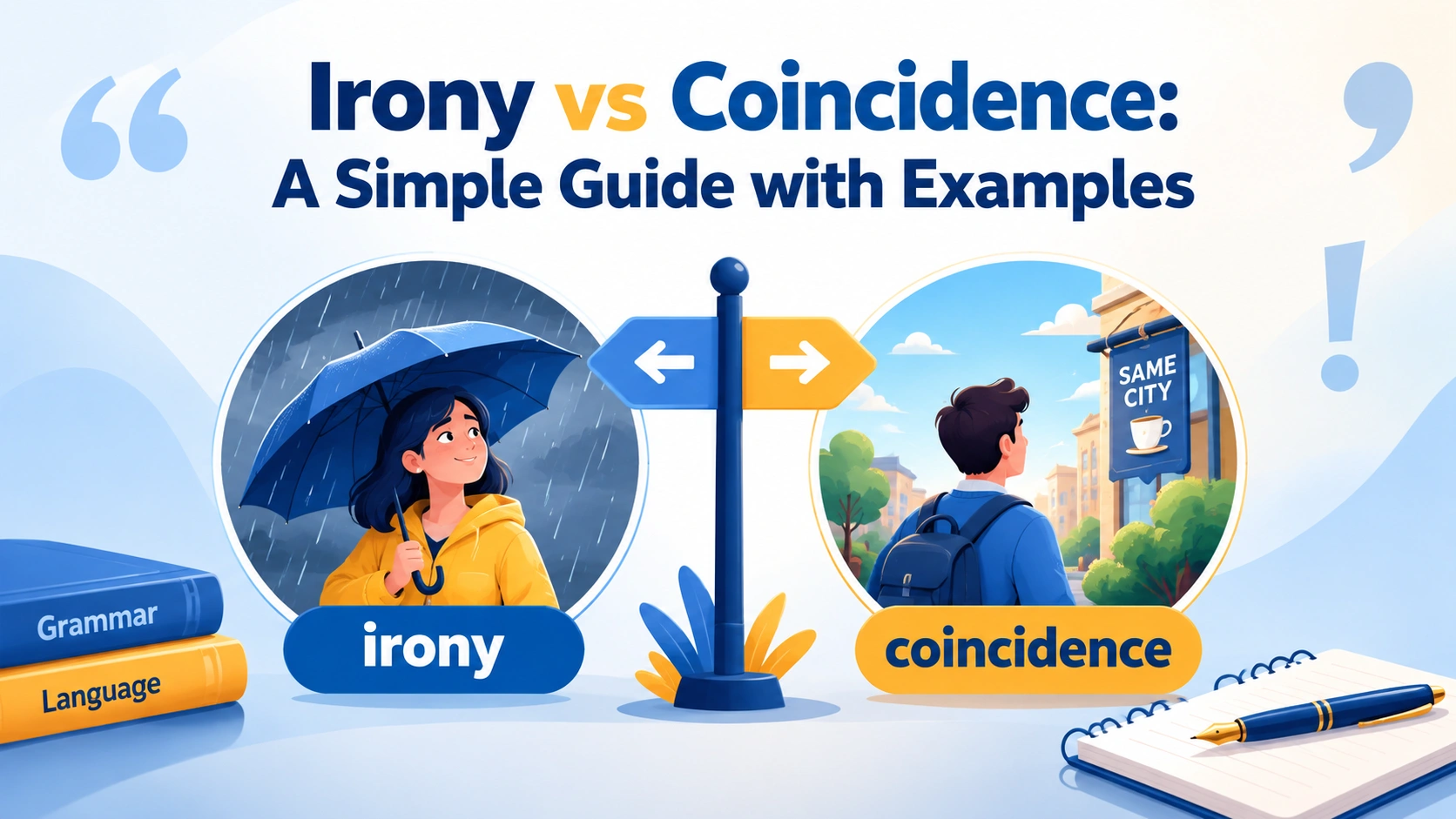
Irony vs coincidence can be confusing because both concepts involve events that surprise us. If two people discover they were born on the same day, that is probably a coincidence. If someone who campaigns against dishonesty is caught lying, the situation may be ironic. The difference is subtle but important: coincidence is primarily about an unexpected connection, while irony involves a meaningful contrast between what is expected, intended, said, or understood and what actually happens. Once you know what to look for, the distinction becomes much easier.
The confusion usually comes from the everyday use of irony. People often use it to mean strange, unexpected, unfortunate, or amusing, even when a situation is simply unusual. In more precise usage, however, irony has a particular relationship with expectation, meaning, or outcome. Cambridge, for example, defines irony partly in terms of an intended result producing an opposite or substantially different result, while ironic can also describe language that suggests the opposite of what the speaker intends.
Coincidence has a different center of gravity. It describes events or similarities that occur by chance, often at the same time or in an unexpectedly similar way. Meeting an old friend in a city neither of you expected to visit can be a coincidence without being ironic. A single situation can sometimes be both ironic and coincidental, which is where the distinction becomes especially interesting. This guide explains the difference, examines borderline cases, compares irony with sarcasm and paradox, and gives you a practical test for choosing the right word.
Quick Answer: Irony vs Coincidence
The easiest way to separate the two is this:
Coincidence is about an unexpected connection. Irony is about an unexpected contrast.
A coincidence occurs when two or more events, facts, or circumstances line up in an unusual way, generally without an obvious planned connection. Cambridge gives examples such as meeting someone unexpectedly or discovering that two people have married people with the same name on the same day.
Irony involves a different relationship. Something becomes ironic when there is a notable contrast between what people expect and what happens, between what someone says and means, or, in dramatic irony, between what the audience knows and what a character knows.
| Situation | Best description | Why? |
| Two strangers have the same birthday | Coincidence | Their circumstances unexpectedly match |
| You meet your former teacher on vacation | Coincidence | The encounter is unexpected and unplanned |
| A fitness instructor publicly admits never exercising | Potentially ironic | The person’s role contrasts with the reality |
| Someone says “Great job” after an obvious mistake, clearly meaning the opposite | Verbal irony | The words contrast with the intended meaning |
| The audience knows a character is walking into danger, but the character does not | Dramatic irony | The audience and character have different knowledge |
The key is not simply “Was this surprising?” Ask instead: “What kind of surprise is this?”
What Is Irony?
Irony is a form of contrast. The precise form varies, but something about the situation or language conflicts with what would normally be expected or understood.
In situational irony, an intended or expected result differs significantly from the actual result. In verbal irony, the speaker’s words suggest one meaning while the intended meaning points in the opposite direction.
That makes irony more than simple bad luck or surprise.
The Core Idea Behind Irony
Think of irony as a gap:
Expectation → Reality
When the gap is meaningful, striking, or deliberately constructed, irony may be present.
For example, imagine a company whose entire public reputation is built around protecting customer data. If the company accidentally exposes its own customer database, the result can be described as ironic because the outcome sharply conflicts with the organization’s purpose and expectations.
The important feature is not merely that something went wrong. The nature of what went wrong creates the contrast.
Why Context Matters
An ironic situation often requires you to know something about the people, circumstances, or expectations involved.
Suppose a teacher makes a spelling mistake on a classroom poster. That might be ironic if the teacher has been emphasizing flawless spelling all week. Without that context, it may simply be a mistake.
This is why calling something “ironic” often requires more explanation than calling something “unexpected.”
The Three Main Types of Irony
Irony is not one single mechanism. In language and literature, several forms are commonly discussed.
Verbal Irony
Verbal irony occurs when a person’s words communicate, suggest, or deliberately evoke a meaning different from the literal surface meaning.
For example, someone walks into a room filled with overturned furniture and says:
“Everything looks wonderfully organized.”
If the speaker clearly intends the opposite, the statement is ironic.
Verbal irony can be humorous, critical, playful, or subtle. It also overlaps with sarcasm, but the two terms are not interchangeable.
Situational Irony
Situational irony occurs when an outcome contrasts strongly with what would normally be expected from the circumstances.
Consider a fictional example:
A company spends years advertising itself as the world’s most secure storage service. One day, its own internal records are accidentally deleted.
The irony comes from the contrast between what the company represents and what happens to the company itself.
Situational irony does not necessarily require anyone to intentionally create the outcome.
Dramatic Irony
Dramatic irony occurs when the audience or reader knows something that a character does not.
For example, a movie shows the audience that a valuable object has been hidden inside a particular box. The character later searches the room for it and walks directly past that box.
The audience understands the situation differently from the character. That difference in knowledge creates the irony.
Dramatic irony is especially useful in fiction because it can create suspense, humor, tension, or tragedy.
Less Common Forms of Irony
Literary and rhetorical discussions can identify additional forms, including Socratic irony, in which someone presents themselves as less knowledgeable than they actually are.
You do not need to memorize every classification to use irony correctly in ordinary English. For most everyday situations, the distinction between verbal, situational, and dramatic irony is sufficient.
What Is a Coincidence?
A coincidence is an unexpected occurrence or similarity, often involving two or more events that happen at the same time or in a similar way by chance. Cambridge also defines coincidence in terms of chance or luck.
Imagine visiting a bookstore in another city and unexpectedly seeing your former classmate there. Neither of you knew the other would be there.
That is a coincidence.
There does not need to be a deeper message. There does not need to be a reversal of expectations. The remarkable part is simply that two independent paths happened to intersect.
What Makes a Coincidence Feel Remarkable?
Coincidences often attract attention because they are unlikely or surprising.
Examples include:
- Two unrelated people discovering they share the same unusual birthday.
- Meeting an old friend in a place neither person normally visits.
- Two friends independently bought the same unusual book.
- Thinking about someone shortly before receiving a message from them.
- Discovering that two families have surprisingly similar stories.
A coincidence can feel meaningful without necessarily having a meaningful cause.
Coincidence Does Not Mean Causation
This is an important distinction beyond everyday vocabulary.
If two events happen together, that does not automatically mean one caused the other.
For example, suppose you decide to wear a particular color and later discover that your friend independently chose the same color. The matching choices are coincidental. Nothing about the situation establishes that one choice caused the other.
Unexpected connection is not proof of cause.
Irony vs Coincidence: The Key Differences
The fastest way to understand the distinction is to separate connection from contrast.
| Feature | Irony | Coincidence |
| Central idea | Contrast | Unexpected connection |
| Main question | “How does reality differ from expectation or meaning?” | “How did these events unexpectedly line up?” |
| Requires surprise? | Often | Usually |
| Requires chance? | No | Often |
| Requires intention? | Sometimes, depending on the type | No |
| Can involve language? | Yes | Usually not |
| Can it involve storytelling? | Yes | Yes |
| Can it be both? | Yes | Yes |
The Most Important Difference: Contrast vs Connection
Consider two examples.
Example 1:
You visit a restaurant and unexpectedly see your neighbor there.
That’s a coincidence. Your two visits happened to overlap.
Example 2:
A restaurant that advertises itself as the city’s most punctual business repeatedly opens late.
That can be ironic because the reality conflicts with the business’s stated identity or expected behavior.
The first example is about two paths crossing.
The second is about a meaningful mismatch.
Can Something Be Both Ironic and Coincidental?
Yes.
This is one of the most useful points to understand because irony and coincidence are not mutually exclusive categories.
Imagine that a novelist writes a story about a fictional character who unexpectedly meets an old school friend in an airport. Years later, the novelist happens to experience almost the same event in real life.
The real-life event could be a coincidence because the circumstances unexpectedly resemble the fictional scenario. It could also be described as ironic if the situation creates a meaningful contrast between the author’s fiction and reality.
The two concepts answer different questions:
- Coincidence: How did these circumstances happen to line up?
- Irony: What contrast or reversal makes the situation notable?
That is why a situation can legitimately contain both.
Irony vs Coincidence Examples
The best way to master the distinction is to examine situations that look similar at first.
Examples That Are Clearly Coincidences
1. Two people have the same unusual birthday.
Neither person caused the other’s birthday. The similarity is unexpected.
2. You travel abroad and randomly meet someone from your hometown.
The two people independently ended up in the same place.
3. You buy a book and later discover that your friend bought the exact same edition that morning.
The matching decision is surprising, but there is no necessary contrast between expectation and reality.
4. You think about an old friend and receive a message from them shortly afterward.
That timing may feel uncanny, but it is still a coincidence unless there is additional context.
Examples That Are Clearly Ironic
1. A professional grammar teacher makes a public grammar mistake while criticizing someone else’s grammar.
The irony comes from the contrast between the teacher’s role and the mistake.
2. Someone says “I never lose anything” immediately after realizing they have misplaced their keys.
If the statement is intended to contrast humorously with the reality, it can be verbal or situationally ironic.
3. A company whose brand emphasizes reliability experiences a highly public failure of its own service.
The contrast between the promise and outcome is the important feature.
4. A character spends an entire story trying to avoid a particular outcome, only to cause it through their own decisions.
The outcome reverses the character’s expectations and efforts.
Examples That Are Neither Automatically Ironic Nor Coincidental
Some situations are simply unexpected, unfortunate, funny, or strange.
For example:
- You forget your umbrella and it rains.
- You miss a bus by thirty seconds.
- Your phone battery dies before an important call.
- You spill coffee on your shirt before leaving for work.
These events may be frustrating or amusing, but calling them ironic requires an additional contrast.
Surprising does not equal ironic.
That single principle prevents a large number of mistakes.
Borderline Cases: Is It Ironic, Coincidental, or Both?
Real-life examples are rarely as neat as dictionary definitions.
Consider a dentist who develops a cavity. Some people will immediately call that ironic. Others may argue that it is simply an unfortunate event unless the circumstances create a stronger contrast.
The same applies to a firefighter whose home catches fire, a driving instructor who receives a speeding ticket, or a professional chef who burns dinner.
The best analysis asks why the situation feels notable.
| Scenario | Most likely description | Reason |
| Dentist gets a cavity | Potentially ironic | Professional role creates a strong expectation |
| Dentist meets another dentist unexpectedly | Coincidence | Unexpected connection, no necessary contrast |
| Firefighter’s home catches fire | Potentially ironic | Role and outcome sharply contrast |
| Firefighter meets an old colleague while traveling | Coincidence | Unexpected meeting |
| Teacher makes a spelling mistake | Context-dependent | Irony depends on surrounding expectations |
| Two teachers independently make the same mistake | Coincidence | Matching independent events |
| A comedian accidentally predicts a real event | Could be coincidence or irony | Depends on the nature of the prediction and context |
The phrase “potentially ironic” is useful because irony is often contextual rather than mechanically determined.
How to Tell If Something Is Ironic or Coincidental
When you’re unsure, use this five-step test.
1. What Was Expected?
Identify the baseline.
What would a reasonable person expect from this situation?
Without an expectation, there may be no meaningful ironic contrast.
2. What Actually Happened?
State the outcome without interpretation.
Keeping this factual prevents you from labeling an event too quickly.
3. Is There a Meaningful Contrast?
Ask whether the outcome conflicts with the expectation, purpose, identity, statement, or intended result.
If yes, irony becomes a strong possibility.
4. Are Two Unrelated Events Simply Lining Up?
If the interesting feature is that two people, places, dates, or events unexpectedly match, coincidence may be the better word.
5. Is Chance and Contrast Present?
If both are present, the situation may reasonably be described as both coincidental and ironic.
The Five-Second Rule
Use this shortcut:
Connection by chance? Think coincidence. Contrast with expectation? Think irony.
It will not resolve every philosophical or literary debate, but it works extremely well for ordinary English.
Why People Confuse Irony With Coincidence
“Unexpected” Is Too Broad
Both words can describe something surprising, which creates the overlap.
A coincidence can be unexpected because two unlikely events happen together. Irony can be unexpected because reality turns out differently from what someone anticipated.
But the source of the surprise is different.
Everyday English Uses “Ironic” Broadly
In casual conversation, ironic is often used for situations that are merely strange, unfortunate, or unexpectedly funny. Modern dictionary usage reflects this broader sense; Cambridge includes meanings involving something being interesting, strange, or funny because it differs from what is normally expected.
That broader everyday use explains why arguments about whether something is “really ironic” can become surprisingly complicated.
Bad Luck Is Not Automatically Irony
Suppose you spend ten minutes looking for your keys and discover them in your pocket.
That’s frustrating and perhaps funny.
It is not automatically ironic.
If, however, you have just spent an hour lecturing everyone about how carefully you always keep track of your belongings, the situation gains a stronger ironic contrast.
Context can change the classification.
Irony vs Sarcasm: Why They Are Not the Same
Irony and sarcasm overlap, especially when people use words to communicate something different from their literal meaning.
But they are not synonyms.
Irony is the broader concept. It can involve outcomes, expectations, knowledge, or language.
Sarcasm is typically a sharper form of expression used to mock, criticize, ridicule, or convey contempt, often through ironic wording.
For example:
Someone makes an obvious mistake and another person says, “Brilliant work.”
The statement may be verbal irony. Whether it is also sarcasm depends on the speaker’s tone and purpose.
That distinction matters because a playful ironic comment does not necessarily attack anyone.
Irony vs Paradox: Another Common Confusion
A paradox involves an apparent contradiction or an idea that seems self-conflicting.
Irony and paradox can overlap, but they describe different relationships.
Consider:
- Irony: A company that promises flawless service repeatedly experiences service failures.
- Paradox: A statement appears contradictory even though it may contain a deeper truth.
The simplest distinction is:
Irony creates a contrast; paradox creates an apparent contradiction.
This is particularly useful when discussing literature, philosophy, or rhetorical writing, where the terms can appear close together.
How to Use “Ironic” Correctly
Use “Ironic” When There Is a Clear Contrast
Natural examples include:
- “It’s ironic that the person who always warns us about lateness arrived last.”
- “The ending is deliberately ironic.”
- “The situation was deeply ironic.”
- “The character’s confidence makes the outcome even more ironic.”
Use “Coincidence” When Chance Is the Main Point
Natural examples include:
- “What a coincidence—we booked the same hotel.”
- “It was just a coincidence that we arrived together.”
- “Meeting her there was a remarkable coincidence.”
- “Their similar stories may be a coincidence.”
Cambridge’s examples similarly use coincidence for unexpected meetings and similarities occurring by chance.
Use “Unexpected” When Neither Term Fits
Sometimes the most accurate word is simply unexpected.
That’s not a weaker choice. It is often more precise.
If an event surprises you but contains no meaningful contrast and no notable chance connection, calling it “ironic” or “coincidental” may add a meaning that the situation does not actually support.
Is “Ironical” Correct?
Yes. Ironical is an established word, and dictionaries recognize it as an alternative to ironic. Cambridge lists both forms.
However, ironic is generally the more familiar choice in contemporary everyday English. Unless you have a particular stylistic reason to use ironical, ironic is usually the natural option.
Irony and Coincidence in Literature and Film
Writers use both concepts, but they serve different storytelling purposes.
What Irony Does in a Story
Irony can:
- Create suspense
- Reveal character flaws
- Build humor
- Highlight contradictions
- Create emotional tension
- Make an ending more powerful
- Let readers recognize a truth before characters do
Dramatic irony is particularly effective because readers can understand a situation differently from the characters.
What Coincidence Does in a Story
Coincidence can:
- Bring characters together
- Trigger a plot event
- Reveal an unexpected connection
- Create mystery
- Make a story feel surprising
But excessive coincidence can make a plot feel artificially constructed. A single unexpected meeting can feel natural; a chain of highly convenient coincidences may make readers question the story’s credibility.
Why the Distinction Matters for Writers
If you are writing fiction, don’t use irony merely because a plot event is surprising.
Ask what the event means.
If a character’s actions produce the exact result they were trying to avoid, irony may be doing important thematic work.
If two unrelated characters happen to meet because they both choose the same café, that is primarily coincidence.
Famous “Ironic” Examples and Why They Are Debated
One of the most familiar modern discussions of irony concerns Alanis Morissette’s song “Ironic.” The examples in the song have generated years of debate because several situations are more naturally described as bad luck, misfortune, or coincidence than as strict examples of irony.
The debate is useful because it exposes a real language issue: people do not always use “ironic” in its narrowest literary sense.
Modern dictionary definitions can accommodate some broader everyday uses of ironic, particularly situations that are strange or funny because they differ from what would normally be expected.
So the better lesson is not simply “the song is wrong.”
The more useful lesson is:
Irony has both technical and everyday uses, and context affects how people interpret the word.
Common Mistakes With Irony and Coincidence
Mistake 1: Calling Every Surprise Ironic
A surprise is not enough.
Ask what expectation has been overturned.
Mistake 2: Calling Every Strange Connection Ironic
If the central feature is two unrelated events happening to line up, coincidence is usually more precise.
Mistake 3: Treating Irony and Sarcasm as Synonyms
Sarcasm can use verbal irony, but irony is much broader.
Mistake 4: Confusing Bad Luck With Irony
An unfortunate result becomes more clearly ironic when there is a meaningful contrast behind it.
Mistake 5: Assuming Irony Must Be Funny
Irony can be humorous, but it can also be serious, subtle, bitter, or tragic. Cambridge’s definition of tragic irony, for instance, covers situations in which audiences understand an impending bad outcome that characters do not.
Mistake 6: Assuming Coincidence Means Something Has No Explanation
Calling something a coincidence describes the relationship as observed; it does not prove that there is absolutely no underlying cause.
Mistake 7: Using “Irony” When “Paradox” Is More Accurate
If the key feature is an apparent contradiction rather than an expectation-versus-outcome contrast, paradox may be the better term.
A Practical Guide to Choosing the Right Word
| If the situation mainly involves… | Prefer… | Example |
| Two unlikely events lining up | Coincidence | “We both happened to book the same flight.” |
| An outcome opposing expectations | Irony | “The expert’s advice produced the opposite result.” |
| Words meaning something different from their literal surface | Verbal irony | “Wonderful timing,” said after a major delay |
| Audience knowing more than a character | Dramatic irony | Viewers know the secret; the character does not |
| Mocking or cutting ironic language | Sarcasm | A deliberately sharp “Excellent work” after a blunder |
| An apparent contradiction | Paradox | A statement that seems self-conflicting |
| Something simply surprising | Unexpected | “It was unexpected that she arrived early.” |
Use “Coincidence” When…
Choose coincidence when:
- Chance is central to the situation.
- Two or more independent events unexpectedly align.
- The unusual feature is the connection itself.
- There is no important reversal of expectation.
Use “Irony” When…
Choose irony when:
- An outcome sharply contrasts with expectations.
- A person’s role conflicts with what happens to them.
- Someone’s words intentionally suggest the opposite of their meaning.
- The audience knows something a character does not.
- The contrast carries significance beyond simple surprise.
Use “Unexpected” When…
Choose the unexpected when you do not need to claim anything more specific.
This is one of the most useful habits in precise writing: do not choose a more specialized word merely because it sounds more interesting.
Irony vs Coincidence: 12 Examples at a Glance
| # | Situation | Classification | Why |
| 1 | Two strangers share the same birthday | Coincidence | An unusual similarity occurs by chance |
| 2 | You unexpectedly meet an old friend abroad | Coincidence | Two independent plans happen to overlap |
| 3 | A punctuality expert arrives extremely late | Ironic | The outcome conflicts with the person’s expected identity |
| 4 | Someone says “Perfect timing” after a huge delay | Verbal irony | The words contrast with the intended meaning |
| 5 | A film audience sees danger that the character cannot see | Dramatic irony | The audience has information the character lacks |
| 6 | Two friends buy the same unusual gift independently | Coincidence | Their choices unexpectedly match |
| 7 | A company famous for reliability suffers a major reliability failure | Situational irony | The outcome contrasts with the company’s central promise |
| 8 | You forget your umbrella and it rains | Not necessarily ironic | It is unfortunate, but the contrast may be weak |
| 9 | A teacher who has just criticized careless spelling makes a spelling error | Potentially ironic | Context creates a stronger expectation |
| 10 | A chef accidentally burns dinner | Potentially ironic | The professional role creates an expectation of competence |
| 11 | A character causes the outcome they spent the story avoiding | Irony | Their actions produce the opposite of their intention |
| 12 | A strange event surprises you without any clear connection or contrast | Unexpected | Neither specialized term is necessary |
A Simple Memory Trick for Irony vs Coincidence
Use this phrase:
Coincidence connects. Irony contrasts.
If two things unexpectedly connect, think coincidence.
If reality contrasts with what someone expected, intended, said, or knew, think irony.
For example:
- Same birthday → coincidence
- Unexpected meeting → coincidence
- Opposite result → irony
- Opposite meaning → verbal irony
- Audience knows more → dramatic irony
And if both chance and contrast are present, don’t force yourself to choose only one. A situation can be coincidental and ironic at the same time.
Conclusion:
The clearest way to remember irony vs coincidence is simple: coincidence connects, while irony contrasts. A coincidence explains why two unexpected events or similarities happen to line up; irony draws attention to a meaningful gap between expectation and reality, words and meaning, or knowledge and events. The distinction becomes especially useful when you are describing real-life situations, writing precisely, or analyzing stories. One final actionable tip: before calling something ironic, identify the expectation first and then explain how reality differs from it. If there is no meaningful contrast, coincidental, unexpected, or unfortunate may be more accurate. A common mistake to avoid is treating every surprising event as irony. Precise word choice often comes down to asking one question: is the interesting feature the chance connection or the unexpected contrast?
FAQs
Q1. Is coincidence the same as irony?
No. A coincidence involves an unexpected connection or similarity, often occurring by chance. Irony involves a meaningful contrast involving expectation, meaning, outcome, or knowledge. Some situations can be both, but the concepts describe different features of the same event.
Q2. Can something be ironic and a coincidence at the same time?
Yes. A situation can involve chance and contrast simultaneously. For example, two unusually connected events may occur accidentally while also producing an outcome that sharply contradicts expectations. Calling something both is reasonable when each description explains a different part of what makes the situation notable.
Q3. Is bad luck always ironic?
No. Bad luck is not automatically ironic. If you forget an umbrella and it rains, the event is unfortunate but not necessarily ironic. It becomes more clearly ironic when the outcome creates a meaningful contrast, such as contradicting a person’s role, expectations, intentions, or previous claims.
Q4. What is the easiest way to tell irony from coincidence?
Ask whether you are noticing a connection or a contrast. If two independent events unexpectedly line up, think coincidence. If reality differs sharply from what someone expected, intended, said, or understood, think irony. This quick test works for most everyday examples.
Q5. Is “ironic” the same as “sarcastic”?
No. Sarcasm and irony overlap, but they are not identical. Sarcasm often uses verbal irony to mock, criticize, or tease someone. Irony is broader and can describe situations, outcomes, or differences in knowledge without involving any mocking intention.