

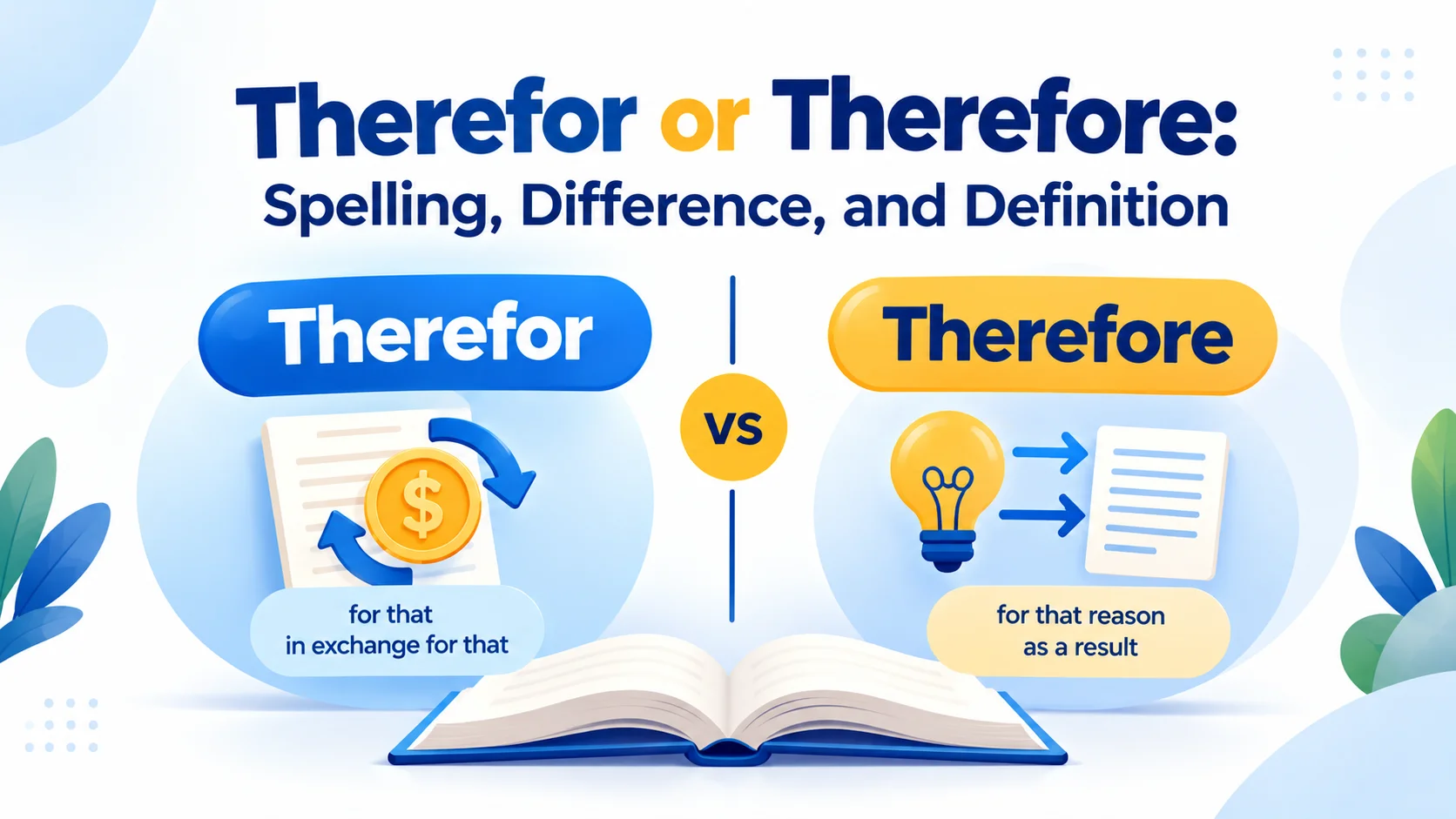
Therefor or therefore is a common spelling dilemma because the two words look almost identical but have different meanings. Although both are valid English words, they cannot be used interchangeably. Therefore means for that reason or as a result and introduces a conclusion or consequence. Therefor means for that or in exchange for that and usually refers to something mentioned earlier, such as an item, service, or obligation.
The confusion is understandable: therefore is familiar in everyday writing, while therefor is uncommon and appears mainly in specialized contexts. For example, you might write, “The roads were flooded; therefore, the event was postponed.” In a contract, however, you might encounter “the payment therefor,” meaning the payment for something already identified. Choosing the wrong spelling can change the meaning of a sentence, even though a spell-checker may accept both words.
This guide explains the difference between therefor and therefore, including their definitions, grammatical roles, sentence patterns, and punctuation. You will learn when each word is appropriate, why therefor appears in legal and financial documents, and how to distinguish these terms from related expressions such as thereby and thus. Practical examples and simple substitution tests will help you identify the correct word when proofreading essays, reports, emails, contracts, and other written documents.
Quick Answer: Therefor vs. Therefore
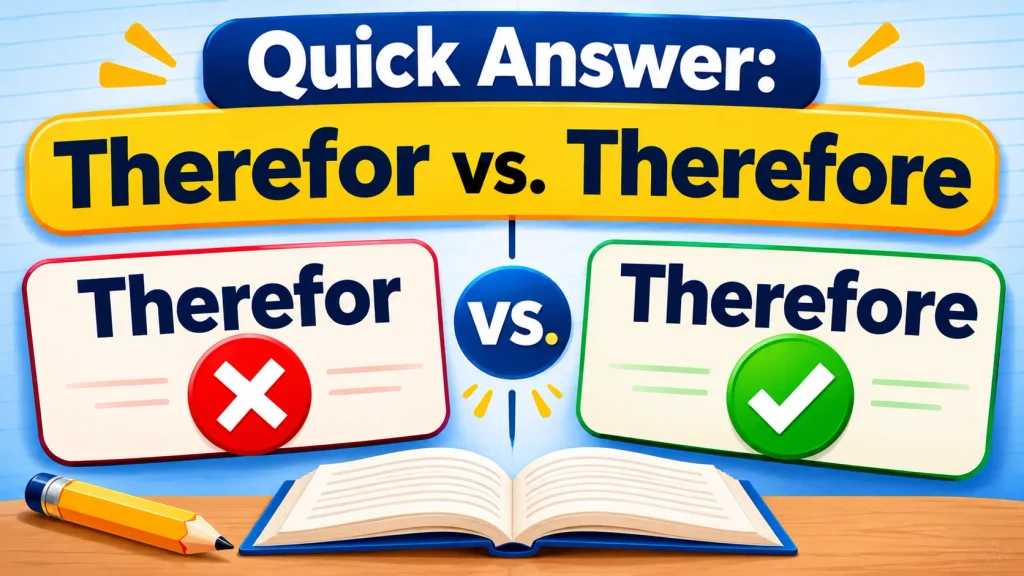
- Therefore means for that reason, consequently, or as a result. Use it to introduce a conclusion or explain an outcome.
- Therefor means for that or in exchange for that. Use it when referring to something previously mentioned, particularly in formal or specialized writing.
| Word | Meaning | Main use | Example |
| Therefore | For that reason; as a result | Introducing a conclusion or consequence | The evidence was incomplete; therefore, the review continued. |
| Therefor | For that; in exchange for that | Referring to something provided or paid for | The agreement specifies the compensation therefor. |
Easy rule: If you mean as a result, write therefore. If you mean for that item, service, or obligation, write therefor.
What Does Therefore Mean?
Therefore is an adverb meaning for that reason, consequently, or as a result. It connects an earlier fact, explanation, or observation with a conclusion or consequence.
Writers use it to make the relationship between two ideas clear. It tells readers that the statement following it logically follows from the information already presented.
Consider these examples:
- The application was incomplete; therefore, it could not be processed.
- The forecast predicted heavy rain. Therefore, the organizers moved the event indoors.
- The researchers found inconsistent results and therefore recommended further testing.
- The deadline had passed; the offer was therefore no longer available.
In each sentence, therefore introduces or emphasizes a conclusion based on the preceding information.
How to Use Therefore in a Sentence
There are several common situations in which therefore is useful.
1. To Introduce a Logical Conclusion
Use therefore when you want to show that a conclusion follows from facts, evidence, or reasoning.
Examples:
- All applicants must provide proof of identity. Therefore, incomplete applications cannot be approved.
- The measurements were consistent across the trials; therefore, the team considered the results reliable.
- The proposal meets the stated requirements. It is therefore eligible for consideration.
In academic writing, therefore can help readers follow an argument from evidence to conclusion. However, using the word does not automatically make the reasoning valid. The conclusion must still be supported by the evidence.
2. To Explain a Consequence
Therefore can also connect a situation with an action, decision, or outcome.
Examples:
- The main entrance was closed; therefore, visitors used the side entrance.
- The supplier delivered the materials late. Therefore, construction started behind schedule.
- The device exceeded its recommended operating temperature; the technician therefore switched it off.
The connection between the two ideas should be logical. If the second statement does not follow from the first, therefore may suggest a cause-and-effect relationship that the information does not support.
3. In Academic and Professional Writing
Therefore is common in essays, research papers, reports, proposals, and professional communication. It helps make conclusions and recommendations explicit.
Examples:
- The survey included a limited number of participants; therefore, its findings should not be generalized to the entire population.
- The current process produces inconsistent results. Therefore, we recommend introducing a standardized review procedure.
- The revised figures differ significantly from the original estimates and are therefore subject to further examination.
Use therefore when the relationship between ideas needs to be clear. If the connection is obvious, a simpler construction may sound more natural.
Common Expressions With Therefore
| Expression | Meaning | Example |
| Therefore, … | For that reason | Therefore, we need another approach. |
| And therefore | And as a consequence | The information was incomplete and therefore unsuitable for comparison. |
| Is therefore | Is consequently | The request is therefore subject to approval. |
| Therefore, it follows that … | The conclusion is that … | Therefore, it follows that the second estimate is more reliable. |
These expressions are useful, but repeating therefore too often can make writing sound mechanical. Depending on the sentence, so, because of this, or a direct statement may communicate the same relationship more naturally.
Synonyms for Therefore
Several expressions can replace therefore, but they do not always have precisely the same emphasis.
| Alternative | Typical use | Example |
| Consequently | A formal consequence | The shipment was delayed; consequently, the launch was postponed. |
| As a result | A clear explanation of an outcome | The system failed. As a result, the records became unavailable. |
| Thus | A concise conclusion or result | The requirements were met; thus, the application proceeded. |
| Hence | A formal or academic conclusion | The variables differed; hence, the results require careful interpretation. |
| So | Everyday conversation and general writing | The shop was closed, so we returned later. |
Choose an alternative based on the relationship you want to express. Do not replace therefore with a synonym simply to avoid repeating it if the new word changes the meaning or tone.
What Does Therefor Mean?
Therefor is an adverb meaning for that, for it, or in exchange for that. It refers to an item, service, right, or obligation already mentioned or understood from the surrounding context.
Unlike therefore, which introduces a conclusion, therefor points back to something. It is uncommon in everyday English but still appears in certain formal and specialized contexts, particularly legal documents, contracts, and financial writing.
Examples:
- The agreement specifies the amount payable therefor.
- The buyer accepted the equipment and paid therefor as agreed.
- The document describes the services provided and the compensation therefor.
- The license includes an annual fee, and the payment therefor is due in January.
In these examples, therefor means for the equipment, for the services, or for the license. It does not mean as a result.
How Therefor Works in a Sentence
The easiest way to understand therefor is to identify what the word refers to.
Consider this example:
The supplier shall deliver the equipment and receive the agreed payment therefor.
In plain English, the sentence means:
The supplier shall deliver the equipment and receive the agreed payment for it.
The word therefor refers back to the equipment. It avoids repeating the full description, although the shorter wording may be less familiar to general readers.
The reference must be clear from the surrounding text. If readers cannot identify what therefor refers to, the sentence may become confusing.
Why Therefor Appears in Legal and Financial Writing
Specialized documents sometimes use therefor as a concise way to refer to something already described.
For example:
The licensee shall pay the annual fee therefor.
A clearer version for a general audience might be:
The licensee shall pay the annual fee for the license.
The shorter form can be convenient when the referenced item or obligation has already been clearly established. However, specialized language is not automatically more precise or effective. If therefor makes a sentence difficult to understand, a plain-English alternative may be preferable.
When editing a contract or other legal document, be careful about replacing established wording. A seemingly simple change can affect how an obligation or payment is understood. Where legal consequences are involved, have the wording reviewed by a qualified professional rather than assuming two expressions are legally equivalent.
Is Therefor Correct in Everyday English?
Yes. Therefor is a correct English word, but it is uncommon in ordinary conversation and general-purpose writing.
For example:
- Specialized wording: The buyer paid therefor.
- Everyday wording: The buyer paid for it.
Both can communicate the intended meaning, but the second is more familiar to most readers.
Use therefor when its specific meaning fits the context, particularly when reading or preserving established wording in a specialized document. In ordinary writing, for it, for that, or another direct expression will usually be clearer.
Therefor or Therefore: Which One Should You Use?
The best way to choose between these words is to focus on the meaning of the sentence rather than how the words look.
Ask yourself: Am I explaining a result, or referring to something provided or paid for?
Use Therefore for Reasons and Conclusions
Choose therefore when you mean for that reason, consequently, or as a result.
Examples:
- The road was blocked; therefore, we took another route.
- The figures did not match; therefore, the accountant reviewed the records.
- The requirements were not met. The application was therefore rejected.
- The original estimate was inaccurate; therefore, the team prepared a new one.
The substitution test: Replace therefore with as a result. If the sentence still makes sense, therefore is probably the correct choice.
For example:
The road was blocked; as a result, we took another route.
The meaning remains clear, so therefore is appropriate in the original sentence.
Use Therefor for Something Given or Paid in Exchange
Choose therefor when you mean for that or in exchange for that.
Examples:
- The contract sets out the fee payable therefor.
- The parties agreed on the services and the compensation therefor.
- The document identifies the goods and the amount paid therefor.
- The license specifies the annual charge and the payment therefor.
The substitution test: Replace therefor with for it, for that, or in exchange for that. If the replacement preserves the intended meaning, therefor may be appropriate.
For example:
The contract specifies the fee for the service.
This meaning is different from saying that the contract specifies the fee as a result.
A Practical Decision Table
| Intended meaning | Correct word | Example |
| For that reason | Therefore | The deadline passed; therefore, the offer expired. |
| As a consequence | Therefore | Demand fell; therefore, production was reduced. |
| To introduce a conclusion | Therefore | Therefore, the second option is more suitable. |
| For that item | Therefor | The fee therefor is listed in the agreement. |
| In exchange for something | Therefor | The payment therefor was agreed upon by both parties. |
| Compensation for a service | Therefor | The compensation therefor is specified in the contract. |
Editing tip: If neither as a result nor for it fits naturally, reconsider the sentence. You may need a different word or a clearer construction.
Why Do People Confuse Therefor and Therefore?
Several features make these words easy to mix up.
1. They look almost identical. Both contain the sequence therefor, with therefore having an additional final e. When typing quickly, it is easy to leave out or add that letter.
2. Their meanings are not obvious from their appearance. The extra letter does not give readers a reliable clue about the difference. You need to understand the meaning of the complete word.
3. Both are grammatically valid. A spelling checker may accept either word because neither is misspelled on its own. It may not recognize that the selected word is unsuitable for the sentence.
4. Therefor is unfamiliar to many readers. Because it rarely appears in everyday writing, some people assume it is simply a typing error for therefore. That assumption can lead to incorrect edits in specialized documents.
The most reliable solution is to check the intended meaning and the word’s role in the sentence.
Therefore Punctuation: Commas, Semicolons, and Sentence Placement
Using therefore correctly also requires appropriate punctuation. Although it connects ideas in meaning, therefore is an adverb, not a coordinating conjunction like and, but, or so. It cannot automatically join two independent clauses with a comma.
Should You Put a Comma After Therefore?
A comma commonly follows therefore when it begins a sentence or an introductory clause.
Examples:
- The original plan was too expensive. Therefore, we selected a simpler option.
- Therefore, the committee recommends postponing the decision.
- The evidence was incomplete. Therefore, further investigation is necessary.
The comma separates the introductory adverb from the rest of the sentence and makes the structure easier to read.
However, a comma is not required after every occurrence of therefore. Its placement depends on the word’s position and the structure of the sentence.
For example:
- The results are therefore subject to further review.
- The revised procedure is therefore recommended.
Neither sentence requires commas around therefore.
Should You Use a Comma Before Therefore?
When therefore connects two independent clauses, a comma alone is generally not enough in standard formal writing.
An independent clause is a group of words that can stand on its own as a complete sentence.
Consider this incorrect example:
❌ Incorrect: The figures were inconsistent, therefore, we repeated the calculation.
Both parts are complete sentences:
- The figures were inconsistent.
- We repeated the calculation.
Joining them with only a comma creates a comma splice.
Here are three correct alternatives:
Option 1: Use a semicolon.
✅ The figures were inconsistent; therefore, we repeated the calculation.
Option 2: Use a period.
✅ The figures were inconsistent. Therefore, we repeated the calculation.
Option 3: Use a coordinating conjunction.
✅ The figures were inconsistent, so we repeated the calculation.
Each version is grammatically sound. A semicolon connects closely related statements, a period gives the conclusion greater independence, and so creates a more conversational connection.
Can Therefore Appear in the Middle of a Sentence?
Yes. Therefore can appear after the subject or later in a clause, depending on the sentence’s structure.
Examples:
- The revised procedure is therefore recommended.
- The results therefore require additional interpretation.
- The request was therefore referred to the review panel.
You can also place commas around therefore when you want to set it off as an interrupting or parenthetical adverb.
For example:
The proposal is, therefore, subject to further review.
This version gives therefore a little more emphasis. The following version is also correct:
The proposal is therefore subject to further review.
Choose the punctuation that best suits the sentence’s rhythm and the style of your document.
Does Therefor Need Special Punctuation?
No. Therefor follows ordinary punctuation rules. Its meaning does not create a special comma or semicolon requirement.
For example:
The agreement identifies the equipment, and the payment therefor is recorded separately.
The comma separates two independent clauses joined by the coordinating conjunction and. Therefor does not determine the punctuation.
For a general audience, you could write:
The agreement identifies the equipment, and the payment for it is recorded separately.
The second version may be easier to understand, provided it preserves the intended meaning.
Common Mistakes With Therefor and Therefore
Because both words are valid, a spelling checker may not flag an incorrect choice. Look out for these common errors when proofreading.
| Common mistake | Correct usage | Reason |
| Using therefor to introduce a result | The roads were flooded; therefore, the match was canceled. | The sentence expresses a consequence. |
| Using therefore to refer to payment for something | The contract specifies the fee therefor. | The word means the fee for that item or service. |
| Assuming therefor is always a typo | Retain therefor when its specific meaning is intended. | It is a valid, though uncommon, word. |
| Joining independent clauses with a comma before therefore | The report was incomplete; therefore, we requested a revision. | A comma alone creates a comma splice. |
| Using unnecessarily formal wording | The parties will receive payment for the services. | Plain English may be clearer for general readers. |
Mistake 1: Using Therefor to Introduce a Result
❌ Incorrect: The roads were flooded; therefor, the match was canceled.
✅ Correct: The roads were flooded; therefore, the match was canceled.
Why: The sentence explains what happened as a consequence of the flooding. Therefore is the appropriate word.
Mistake 2: Using Therefore to Refer to Payment
❌ Incorrect for the intended meaning: The contract specifies the fee therefore.
✅ Correct: The contract specifies the fee therefor.
Why: The intended meaning is the fee for that item or service. In everyday English, you could make the sentence clearer by writing, “The contract specifies the fee for the service.”
Mistake 3: Assuming Therefor Is Always a Typographical Error
Therefor is uncommon, but it is not inherently incorrect. Automatically replacing it with therefore may change the meaning of a legal or financial sentence.
Before editing it, identify what the word refers to. If it means for that or in exchange for that, therefor may be the correct choice.
Mistake 4: Using a Comma to Join Complete Sentences
❌ Incorrect: The report was incomplete, therefore, we requested a revision.
✅ Correct: The report was incomplete; therefore, we requested a revision.
Why: The two parts are independent clauses. Use a semicolon or a period before therefore rather than joining them with a comma alone.
Mistake 5: Choosing Formal Language When Plain English Is Clearer
A sentence can be grammatically correct but unnecessarily difficult to understand.
For example:
Formal: The parties shall receive the payment therefor.
Clearer alternative: The parties shall receive payment for those services.
The best choice depends on the intended meaning and audience. Specialized wording may be appropriate in a particular document, but clarity should remain the priority.
Related Words: Therefore, Therefor, Thereby, and Thus
Therefore and therefor are not the only words that can cause confusion in formal writing. Thereby and thus are also used to connect ideas, but their functions differ.
| Word | Meaning | Example |
| Therefore | For that reason; consequently | The evidence was incomplete; therefore, the review continued. |
| Therefor | For that; in exchange for that | The agreement specifies the compensation therefor. |
| Thereby | By that means; through that action | She revised the document, thereby correcting the error. |
| Thus | In this way; consequently | The requirements were satisfied; thus, the process could continue. |
Therefore vs. Thereby
Therefore emphasizes a conclusion or consequence. Thereby explains the means through which something happens or the result produced by a particular action.
Compare these examples:
- The document was inaccurate; therefore, we revised it.
- We revised the document, thereby correcting the errors.
The first sentence explains why the revision was necessary. The second explains what the revision accomplished.
Therefore vs. Thus
Therefore and thus can both introduce a conclusion or result. However, thus can also mean in this way or by this method, depending on the context.
Examples:
- The sample was too small; therefore, the findings were limited.
- The sample was too small; thus, the findings were limited.
- The team followed the instructions and thus completed the task correctly.
The first two examples express similar conclusions. In the third, thus describes how the task was completed.
Choose the word that communicates the intended relationship most clearly rather than treating these terms as interchangeable formal alternatives.
Conclusion:
The difference between therefor or therefore becomes straightforward when you focus on meaning rather than spelling. Use therefore when introducing a conclusion, reason, or consequence. Choose therefor when you mean for that or in exchange for that, usually in a specialized context where the referenced item or service is already clear. One final actionable tip: replace the word mentally with either as a result or for it. The phrase that preserves your intended meaning will usually reveal the correct spelling. A common mistake to avoid is assuming that an unfamiliar word must be wrong or relying entirely on spell-check. Both forms are legitimate, but clear writing depends on choosing the one that expresses your meaning accurately.
FAQs
Q1. Is therefor a correct English word?
Yes. Therefor is a valid English adverb meaning for that, for it, or in exchange for that. Although uncommon in everyday conversation, it appears in some legal, contractual, and financial writing. Its rarity does not make it a misspelling or an incorrect form.
Q2. What is the main difference between therefor and therefore?
Therefore means for that reason or as a result and introduces a conclusion or consequence. Therefor means for that or in exchange for that, often referring to payment or compensation for something previously mentioned. The two words are not interchangeable.
Q3. Can I start a sentence with therefore?
Yes. You can begin a sentence with therefore when it introduces a conclusion based on earlier information. For example: “The original estimate was inaccurate. Therefore, the team prepared a new one.” A comma commonly follows therefore when it begins a sentence.
Q4. Why does my spell-checker accept both therefor and therefore?
Spell-checkers recognize both therefor and therefore as correctly spelled words. They may not detect an error involving meaning because the problem is not necessarily the spelling itself. Always check whether your sentence expresses a conclusion or refers to something provided or paid for.
Q5. Is therefor interchangeable with thereby?
No. Therefor means for that or in exchange for that, while thereby means by that means or through that action. For example, “the fee therefor” refers to a fee for something, whereas “thereby reducing costs” explains how an action reduces costs.