

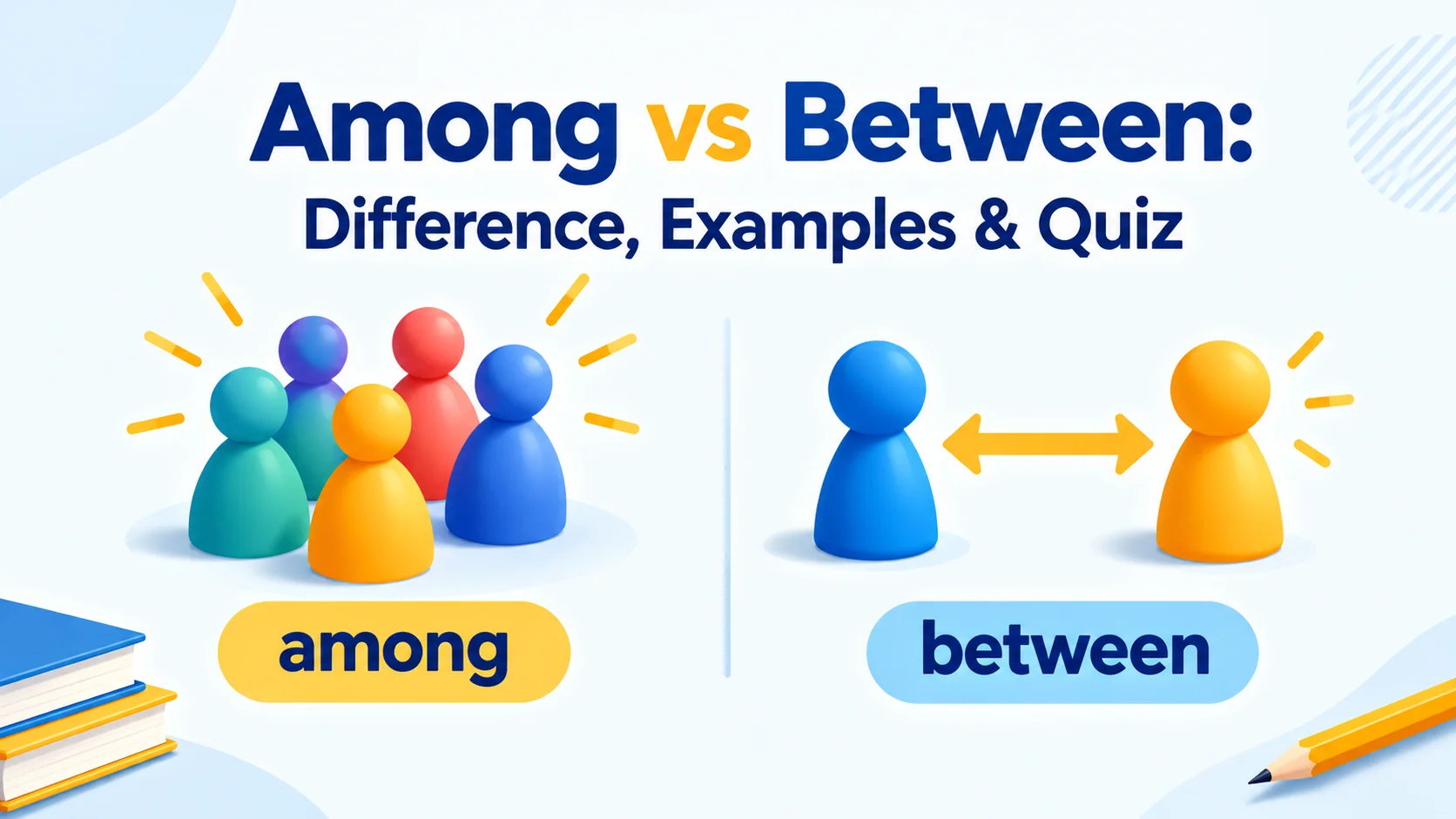
Among vs. between is a common source of confusion in English because both words describe relationships involving people, objects, places, or ideas. The traditional rule says to use between for two things and among for three or more, but that shortcut can lead to mistakes. The real distinction depends on how the people or things relate to one another. Understanding that difference helps you choose the right preposition in everyday conversations, school assignments, business writing, and formal documents without second-guessing every sentence.
Although the two words sometimes overlap, they emphasize different aspects of a situation. Among generally places someone or something within a group, collection, or shared environment. Between, on the other hand, often highlights a connection, distinction, boundary, or choice involving identifiable entities. For example, you might sit among your classmates but sit between two particular classmates. You can also discuss an agreement between three companies or choose between several job offers. These examples show why meaning matters more than the number of items when deciding which word to use.
In this guide, you will learn the definitions of among and between, discover when each preposition is appropriate, and explore examples that make their differences easier to recognize. You will also learn how to avoid common grammatical mistakes, understand expressions such as among other things and between you and me, and distinguish situations where both words may be possible. Finally, a practical among vs. between quiz will help you apply the rules to realistic sentences. By the end, you will have a reliable method for making the right choice in your own writing.
Among vs. Between: The Quick Answer
The simplest way to distinguish these words is to consider the relationship you want to describe.
- Among usually means within, surrounded by, or included in a group.
- Between usually describes a position, connection, distinction, or choice involving identifiable people or things.
Consider these examples:
- Maya walked among the visitors. She was within a group of people.
- Maya walked between the two visitors. Her position was relative to two specific people.
- The agreement between the four organizations was finalized. The organizations are treated as distinct parties.
- The prize was divided among the four winners. The emphasis is on distributing something across a group.
Both words are correct in their respective sentences. The difference comes from the intended meaning, not simply the number of people involved.
Among vs. Between at a Glance
| Feature | Among | Between |
| Main idea | Inclusion within a group or collection | A relationship, position, distinction, or choice |
| Typical focus | The group as a whole | Separate, identifiable entities |
| Physical location | Within or surrounded by a group | In a position separating or relating to specified points |
| Distribution | Shared or allocated across a group | Divided or negotiated with distinct parties in view |
| Example | She felt comfortable among her colleagues. | Trust between the colleagues grew. |
| Number of entities | Often used with groups of three or more | Can refer to two or more entities |
Remember: This table describes common patterns, not inflexible rules. The surrounding sentence determines which preposition communicates your meaning most clearly.
What Does “Among” Mean?
Among is a preposition that describes someone or something as being within a group, collection, or shared environment. It often directs attention toward the group rather than toward separate relationships between individual members.
For example:
The lost notebook was found among the library books.
The notebook was part of a larger collection of books, or at least located within that collection. The sentence does not identify a specific pair of books or a particular boundary.
Among is particularly useful when the individual members of a group are less important than the fact that someone or something belongs to, exists within, or is surrounded by that group.
1. Using Among to Describe Someone Within a Group
Use among when describing a person or object located within a crowd, collection, or gathering.
Examples:
- The speaker moved among the audience after the presentation.
- A small blue flower grew among the wild plants.
- He searched among the boxes for his passport.
- The young athlete felt confident among experienced players.
- Several familiar faces appeared among the guests.
In each example, the group provides the setting. The sentence does not primarily describe a position between particular individuals.
Writing tip: If your main idea is that someone or something is surrounded by, included in, or situated within a group, among is often the natural choice.
2. Using Among for Distribution and Sharing
Among can also describe the distribution of money, responsibilities, resources, or other things across members of a group.
Examples:
- The charity distributed food among the affected families.
- The manager divided the responsibilities among six employees.
- The remaining expenses were shared among the roommates.
- The scholarship funds were allocated among the selected students.
- The researchers divided the samples among several laboratories.
The emphasis is on the group receiving or sharing something. In some sentences, between could also be grammatical if the writer wants to emphasize separate allocations or relationships among identifiable recipients.
For instance:
- The prize money was divided among the finalists. This presents the finalists as a group receiving shares.
- The prize money was divided between the three finalists. This can also be correct, particularly when the three recipients are treated as distinct parties in the division.
The second sentence demonstrates an important point: distribution involving more than two recipients does not automatically require among.
3. Using Among for Group Membership or Ranking
Among can identify someone or something as a member of a larger category.
Examples:
- She is among the most respected editors in the industry.
- This novel ranks among the author’s finest works.
- He was among the first students to submit the assignment.
- The organization is among the country’s largest employers.
- The new proposal is among several options under consideration.
Here, among means that the person or thing belongs to a larger set. It does not necessarily describe a physical location.
4. What Does “Among Other Things” Mean?
The expression among other things means that the items mentioned are only some of the matters, activities, or subjects being discussed.
Examples:
- The role involves editing, research, and, among other things, content planning.
- The report discusses employee training and, among other things, workplace safety.
- She enjoys painting, hiking, and among other things, gardening.
The phrase is useful when a list is not exhaustive. However, it can become vague if the reader needs to know exactly what else is included. In formal writing, name the additional items whenever they are important to the reader.
5. Common Expressions With Among
| Expression | Meaning | Example |
| Among friends | Within a circle of friends | The story remained among friends. |
| Among themselves | Within the group, often without outsiders participating | The team members discussed the issue among themselves. |
| Among the best | Included in a highly regarded group | This is among the best examples in the collection. |
| Among other things | In addition to other matters | The course covers grammar and, among other things, academic writing. |
| Among the first | Included in an early group | She was among the first to arrive. |
These expressions are useful in both conversation and formal writing. Pay attention to the meaning of the complete phrase rather than trying to translate it word for word.
What Does “Between” Mean?
Between is a preposition that commonly describes the position, connection, distinction, or relationship of one thing to two or more identifiable entities. Those entities may be people, objects, places, alternatives, or abstract concepts.
For example:
The small café stands between the bookstore and the post office.
The sentence identifies two particular landmarks that help locate the café. The emphasis is on its position relative to those landmarks.
However, between is not limited to two entities. It can also describe relationships among several distinct parties, comparisons between multiple alternatives, or a location defined by several points.
1. Using Between to Describe Position or Location
Use between when something is positioned in the space separating identifiable objects or places.
Examples:
- The pharmacy is between the bank and the supermarket.
- The cat squeezed between two boxes.
- A narrow path runs between three cottages.
- The school is located between the river, the highway, and the railway line.
- She placed the photograph between two pages of her notebook.
Notice that the third and fourth examples involve more than two entities. Between works because the locations are treated as distinct reference points.
2. Using Between for Relationships and Agreements
Between often describes connections involving identifiable individuals, organizations, or groups.
Examples:
- The friendship between the two neighbors lasted for decades.
- Negotiations between the three companies continued throughout the week.
- The agreement between the union, the management team, and the employees was approved.
- Communication between the departments needs improvement.
- The dispute between the neighboring countries remains unresolved.
In professional and academic writing, between is particularly useful when the relationships or responsibilities of distinct parties matter.
For example, a contract might describe the obligations between three companies because each party has identifiable rights and responsibilities. The writer is not simply describing the companies as a group; the writer is emphasizing their legal or contractual relationships.
3. Using Between to Compare Choices and Alternatives
Use between when comparing or selecting identifiable alternatives.
Examples:
- I cannot decide between the blue jacket and the black coat.
- The committee must choose between three proposed budgets.
- The difference between these four designs is subtle.
- She had to decide between studying abroad, starting a business, and accepting a local job.
- We compared the performance differences between the five devices.
The alternatives do not need to number exactly two. What matters is that they are distinguishable options.
This use is especially common in decision-making, academic analysis, product comparisons, and business reports.
4. Using Between to Describe Time, Boundaries, and Limits
Between can identify a period or range separating two points in time, or boundaries separating locations and states.
Examples:
- The office is open between 9 a.m. and 5 p.m.
- Please submit the form between Monday and Wednesday.
- The temperature stayed between 18 and 22 degrees Celsius.
- The road forms a boundary between the two districts.
- The company must balance the competing demands between cost and quality.
The final example is understandable, although writers may prefer the competing demands of cost and quality or the balance between cost and quality, depending on the intended meaning.
5. Common Expressions With Between
| Expression | Meaning | Example |
| Between you and me | In confidence | Between you and me, the proposal needs revision. |
| Between jobs | Temporarily unemployed while seeking another job | He is between jobs at the moment. |
| Between now and Friday | During the period leading up to Friday | We need to finish the report between now and Friday. |
| Between a rock and a hard place | Facing two difficult alternatives | She felt caught between a rock and a hard place. |
| Read between the lines | Understand an implied meaning | You can read between the lines to see what the email suggests. |
One expression deserves particular attention: “between you and me” is the standard form, not “between you and I.” The reason is grammatical: between is a preposition, so it takes object pronouns such as me, him, her, and us.
Is Between for Two Things and Among for Three or More?
No. The familiar rule is a useful starting point for beginners, but it is not an accurate rule for every situation.
Both prepositions can refer to more than two people or things. Their difference usually depends on how the writer presents those entities.
- Use between when the sentence emphasizes distinct participants, identifiable alternatives, boundaries, or relationships.
- Use among when the sentence emphasizes being within a group, inclusion, or distribution across a collection.
When Between Is Correct for Three or More Things
Consider these sentences:
- The negotiations between the five countries lasted for months.
- She had to choose between three university offers.
- The road runs between the three villages.
- The differences between the four proposals were substantial.
- The responsibilities between the department heads were clearly defined.
Each sentence presents the entities as distinguishable participants, locations, or alternatives. The number of entities does not make between incorrect.
In the last sentence, the wording may be improved depending on the intended meaning. If the writer means that the responsibilities were shared across a group, the responsibilities among the department heads were clearly defined and may be more natural. If the writer means that specific responsibilities were allocated in relation to individual department heads, between can be appropriate.
This is why a good editor considers the relationship, not just the word count.
When Among Is More Natural for a Group
Now consider these examples:
- The teacher walked among the students.
- A rumor spread among the employees.
- He felt at ease among experienced writers.
- The food was distributed among the volunteers.
- Wildflowers grew among the rocks.
These sentences focus on a group or collection as a whole. They do not primarily describe a connection or boundary involving separately identified entities.
Can Both Words Be Correct in the Same Situation?
Yes. Sometimes both prepositions are grammatically possible, but they direct attention toward different aspects of the situation.
| Sentence | Main emphasis |
| The teacher moved among the students. | The teacher’s movement within the group |
| The teacher moved between the students. | Movement through spaces separating individual students |
| The funds were divided among the three charities. | Distribution across a group of recipients |
| The funds were divided between the three charities. | Division involving three distinct recipients, with each treated as a separate party |
| Trust developed among the team members. | Trust within the team as a group |
| Trust developed between the team members. | Connections between individual members |
These distinctions are tendencies, not rigid formulas. In some contexts, the two sentences may describe almost the same event. In others, the choice changes the reader’s understanding of the relationships involved.
Practical rule: Do not count the nouns first. Ask what the sentence is trying to communicate.
Among vs. Between: Examples in Everyday Sentences
The best way to master the distinction is to see how each word behaves in realistic contexts.
Examples Using Among
- The child disappeared among the shoppers.
The child became difficult to distinguish within the crowd. - The teacher distributed the worksheets among the students.
The worksheets were shared across the group. - She is among the most experienced members of the team.
She belongs to a particular category of experienced members. - The cottage was hidden among tall trees.
The cottage was surrounded by a collection of trees. - The friends kept the news among themselves.
The information remained within the group. - Several errors appeared among the submitted reports.
The errors were found within a collection of reports. - He felt relaxed among people who shared his interests.
The group provided the social setting. - The charity divided the supplies among the local shelters.
The supplies were allocated across the shelters.
Examples Using Between
- The restaurant is between the hotel and the museum.
Two identifiable landmarks define its location. - The agreement between the three partners was signed yesterday.
The partners are treated as distinct parties. - She compared the differences between the five proposals.
The proposals are separate options being evaluated. - A narrow passage runs between the buildings.
The passage occupies the space separating the buildings. - The decision between the available candidates was difficult.
The candidates are identifiable alternatives. - The temperature remained between 20 and 25 degrees.
Two numerical limits define a range. - Communication between the departments improved.
The sentence emphasizes a connection between identifiable departments. - The secret stayed between the two friends.
The information was kept confidential within a specific relationship.
Paired Examples: How One Preposition Changes the Meaning
| With among | With between | What changes? |
| She sat among the children. | She sat between the two children. | General group setting vs. specific position |
| The bird flew among the trees. | The bird flew between the trees. | Movement within a wooded area vs. movement through spaces separating trees |
| The students shared ideas among themselves. | The discussion between the students continued. | Exchange within the group vs. a relationship or discussion involving distinct participants |
| The flowers grew among the rocks. | The path ran between the rocks. | Inclusion within a collection vs. a route through separating spaces |
| The prize was distributed among the finalists. | The agreement between the finalists was finalized. | Distribution across recipients vs. a relationship among identifiable parties |
When editing, read the entire sentence rather than replacing one word mechanically. A preposition can change the image or relationship a reader forms in their mind.
Common Mistakes With Among and Between
Mistake 1: Assuming Between Can Only Refer to Two Entities
Incorrect rule: “There are three companies, so I must use them.”
Better: The agreement between the three companies was signed.
The companies are identifiable parties in an agreement. The preposition is correct even though there are more than two.
Mistake 2: Using Among for a Specific Position
Consider:
- She stood among the two guards.
- She stood between the two guards.
The second sentence is usually clearer if the intended meaning is that one guard stood on each side of her. Among generally suggests that she is within a group or collection rather than occupying a specifically defined position.
Mistake 3: Treating Among and Between as Always Interchangeable
The words overlap, but they do not always communicate the same thing.
- The child wandering among the tables describes movement within the collection of tables.
- The child wandering between the tables suggests movement through spaces separating individual tables.
Choose the word that best represents the scene.
Mistake 4: Writing “Between You and I”
The standard expression is “between you and me.”
Why? The preposition between requires an object pronoun. In this sentence, me is the object form of I.
- Correct: Between you and me, the plan needs work.
- Incorrect in standard English: Between you and I, the plan needs work.
This error often occurs because speakers associate you and I with formal expressions such as “you and I are going.” The grammatical roles are different.
A Quick Editing Checklist
Before finalizing a sentence, ask yourself:
- Am I describing inclusion within a group?
- Am I emphasizing distinct relationships, options, boundaries, or positions?
- Are the people or objects individually identifiable?
- Would changing the preposition change the picture or relationship the reader understands?
- Am I following the sentence’s meaning rather than a simplistic numerical rule?
If you can answer these questions, you can usually choose the more natural preposition.
How to Remember the Difference Between Among and Between
A memory trick can help, provided you do not treat it as an absolute rule.
- Among = within a group.
- Between = connecting, separating, or distinguishing identifiable entities.
Picture a person standing in a crowd. The person is among the crowd. Now picture someone standing between two friends. The person’s position is defined by the two friends.
For a more advanced example, imagine a committee considering three proposals. It may choose between the three proposals because each proposal is a separate alternative. If the committee’s decision is discussed as one matter among many issues, among may be appropriate in that broader context.
A Practical Method for Choosing the Right Word
Follow these steps when you are unsure:
- Identify the relationship. Is the sentence about group membership, physical location, distribution, or comparison?
- Identify the focus. Does the sentence emphasize the group as a whole or separate entities?
- Test the meaning. Replace the preposition mentally and ask whether the image or relationship changes.
- Read the full sentence. A word that sounds right in isolation may not fit the complete context.
- Revise for clarity. If neither option communicates the intended meaning cleanly, rewrite the sentence.
For example, instead of writing The tasks were divided between the team, write The tasks were divided among the team members if you mean that the members received different tasks. If you mean that particular responsibilities were assigned to named people, between may be suitable when the sentence clearly identifies those people and their respective roles.
Among vs. Between Quiz: Test Your Understanding
Choose among or between for each sentence. A few questions are designed to test whether you understand why between can refer to more than two entities.
Questions
- The lost child was found by ___ the shoppers at the market.
- I could not decide ___ the three universities that had accepted me.
- The manager divided the responsibilities ___ the six employees.
- The road runs ___ three neighboring villages.
- The teacher walked ___ the students while they worked.
- The differences ___ the four designs were difficult to spot.
- The secret remained ___ the two friends.
- Wildflowers grew ___ the rocks along the trail.
- Negotiations ___ the five organizations continued into the evening.
- The prize money was distributed ___ the finalists.
Answers and Explanations
- Among — The child was located within a crowd of shoppers.
- Between — The three universities are separate, identifiable alternatives.
- Among — The responsibilities are being distributed across a group of employees.
- Between — The villages are distinct locations that define the road’s position.
- Among — The teacher moved within the group of students.
- Between — The designs are separate options being compared.
- Between — The expression identifies a confidential relationship between two people.
- Among — The flowers grew within a collection of rocks.
- Between — The organizations are distinct negotiating parties, even though there are five.
- Among is a natural choice when emphasizing distribution across the group. Between can also be grammatical if the finalists are treated as distinct recipients in the division.
Quiz takeaway: If you missed questions 2, 4, 6, or 9 because you thought between could only refer to two things, revisit the section on the traditional rule. The number of entities is not the deciding factor.
Conclusion:
The difference between among vs. between becomes much easier to understand when you focus on relationships rather than counting people or objects. Among usually emphasizes inclusion within a group, while between often highlights connections, boundaries, positions, or comparisons involving identifiable entities. That is why “among the crowd” and “between the three companies” can both be correct. One final actionable tip: When editing a sentence, identify the relationship you want readers to picture before selecting the preposition. A common mistake to avoid is relying on the old two-versus-three rule without considering context. If you can explain why a word fits the meaning, you are more likely to use it confidently in academic, professional, and everyday writing.
FAQs
Q1. Is “Among the Two” Ever Correct?
Yes, although between the two is generally more natural when referring to two identifiable people or objects. Among the two may occur when the writer treats them as a group or pair in a broader context, but it can sound awkward if the intended meaning is simply a position separating them.
Q2. Should I Use Among or Between for Three Choices?
Use between when the three choices are identifiable alternatives being compared or considered individually. For example, “She had to choose between three courses” is correct. Use among when you mean that something belongs within a larger group, rather than emphasizing a decision among separate options.
Q3. Is “Between You and Me” Grammatically Correct?
Yes. Between you and me is the standard expression because between is a preposition and requires object pronouns. Me is the object form of I. Although “you and I” is correct in a subject position, it is not standard in this prepositional expression.
Q4. What Is the Difference Between “Among” and “Amongst”?
Amongst is a variant of among with essentially the same meaning. It is more common in British English and may sound slightly more formal or literary in some contexts. In most everyday and professional writing, either is acceptable, but consistency with the publication’s style is useful.
Q5. Can Between and Among Be Used in the Same Sentence?
Yes, when each word describes a different relationship. For example, “The teacher stood between two desks among the students” describes a position relative to the desks and a location within the student group. Use each preposition according to the relationship it expresses, not merely to avoid repetition.