

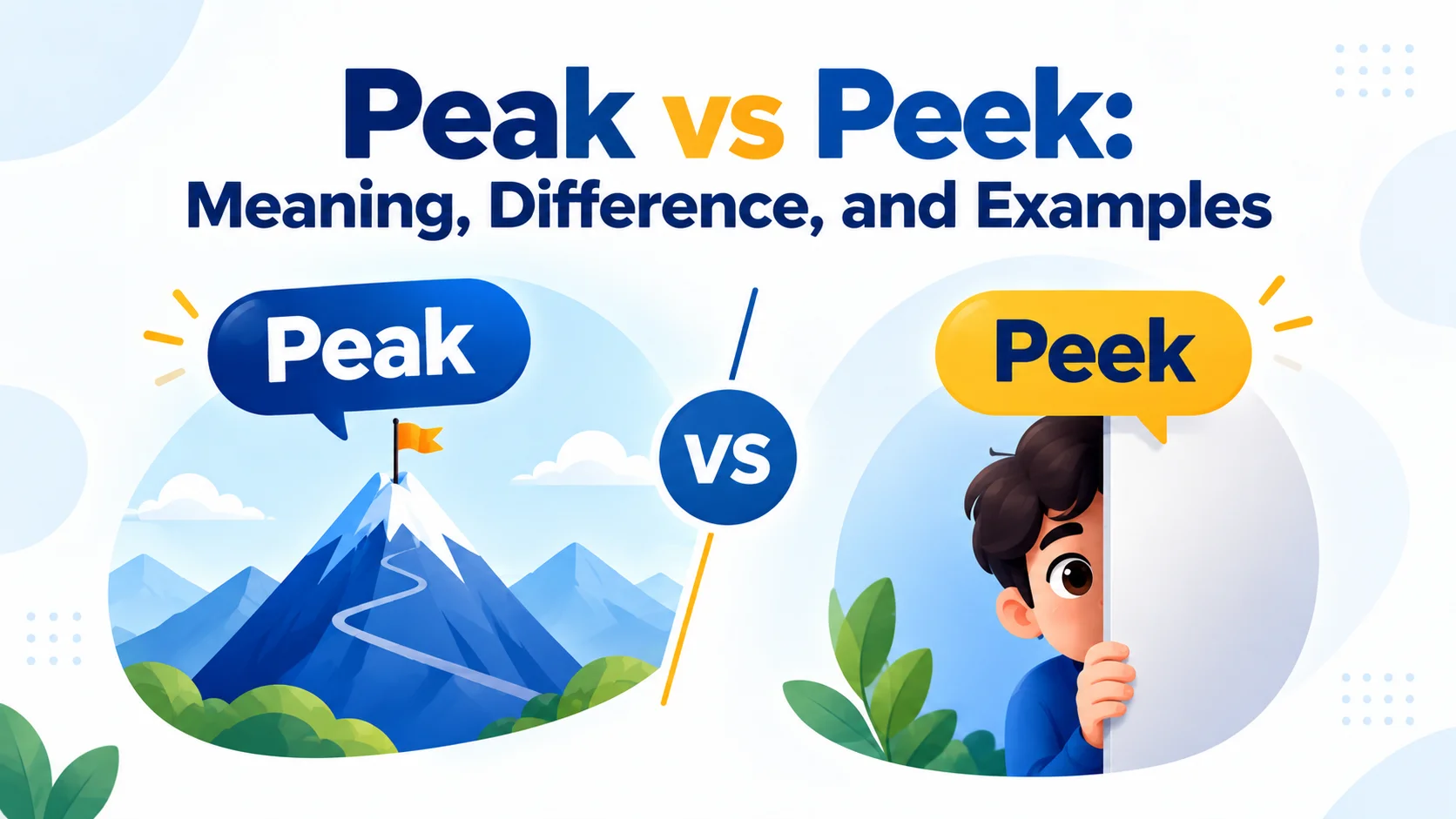
Peak vs. peek is a common English word comparison because both words sound exactly alike but have completely different meanings. Peak refers to the highest point, greatest level, or maximum of something, while peek means to take a quick or cautious look. Confusing them can lead to mistakes in everyday messages, professional documents, and online writing. For example, a mountain has a peak, but you might peek through a doorway to see what is happening inside. Recognizing this distinction makes it easier to choose the right spelling without second-guessing yourself.
Although these words share the same pronunciation, they belong to different semantic categories and appear in different expressions. You might describe a business as operating at its peak performance, explain that a tourist reached a mountain’s peak, or tell a friend to take a peek at a photograph. The challenge becomes more noticeable in phrases such as sneak peek, which is sometimes mistakenly written as sneak peak. Understanding the meaning behind each word is more reliable than memorizing isolated spelling rules, particularly when you encounter unfamiliar sentences.
This guide explains the difference between peak and peek, including their definitions, grammatical roles, common expressions, and practical examples. You will also learn how to distinguish peak from the related word pique, why sneak peek is the correct expression, and how to avoid frequent spelling errors. A comparison table, contextual examples, and a short practice quiz will help you apply the distinction confidently. Whether you are writing an email, preparing an assignment, editing website content, or improving your everyday English, you will have a straightforward method for choosing the correct word.
Peak vs. Peek: What’s the Difference?
The main difference is meaning:
- Peak means the highest point, maximum level, or greatest degree of something.
- Peek means to look quickly, briefly, or secretly at something.
Both words are pronounced /piːk/, so you cannot distinguish them by sound alone. You must consider what the sentence means.
Compare these examples:
- The climbers finally reached the mountain’s peak.
- I took a peek inside the gift bag.
In the first sentence, peak identifies the mountain’s highest point. In the second, peek describes the action of looking inside something.
Peak vs. Peek at a Glance
| Feature | Peak | Peek |
| Core meaning | Highest point or maximum level | A quick or cautious look |
| Part of speech | Noun, verb, adjective | Noun, verb |
| Typical contexts | Mountains, performance, demand, popularity | Looking inside, viewing something briefly, checking something secretly |
| Example as a noun | The climbers reached the peak. | She took a peek at the letter. |
| Example as a verb | Sales peak in December. | He peeked through the window. |
| Common expression | Peak season | Sneak peek |
| Memory clue | A peak is a high point. | A peek is a quick look. |
Quick rule: If you mean the highest point or greatest level, use peak. If you mean a brief look, use peek.
What Does Peak Mean?
Peak refers to the highest point, greatest degree, or maximum level of something. It can describe a physical location, a period of strong performance, a high level of activity, or the point at which something reaches its greatest intensity.
For example:
- The hikers stopped to photograph the mountain peak.
- The restaurant experiences peak demand during the holidays.
- Her confidence reached its peak after months of practice.
- Traffic is heaviest during peak hours.
The underlying idea is height, maximum intensity, or the greatest level. The word does not always describe something physically elevated. It can also refer to an abstract measurement, such as productivity, popularity, or demand.
1. Peak as a Noun
As a noun, peak names the highest point or maximum stage of something.
Examples:
- The climbers reached the peak just before noon.
- The singer’s popularity reached its peak last summer.
- Electricity consumption reaches its peak on particularly hot afternoons.
- The company recorded its highest sales at the peak of the holiday season.
- We arrived during the peak of the tourist season.
A peak can be a specific point or a period surrounding the highest level, depending on the context.
For instance, the peak of the mountain identifies a physical summit. Meanwhile, at the peak of her career refers to the period when someone was most successful.
2. Peak as a Verb
As a verb, peak means to reach the highest level, greatest intensity, or maximum point.
Examples:
- Online orders typically peak before major holidays.
- The athlete’s performance peaked during the final round.
- Demand for heating peaks in the coldest months.
- The project’s popularity peaked shortly after its launch.
- Researchers expect activity to peak later this year.
The verb is especially useful when describing trends, statistics, performance, and changing conditions.
Notice the grammatical forms:
| Verb form | Example |
| Base form: peak | Sales may peak next month. |
| Present tense: peaks | Demand peaks during summer. |
| Past tense: peaked | Interest peaked last year. |
| Present participle: peaking | Temperatures are peaking this afternoon. |
A useful distinction is that peak describes reaching a maximum, not necessarily remaining there. After something peaks, its level may decline, stabilize, or fluctuate.
3. Peak as an Adjective
Peak can also function as an adjective, particularly in expressions describing maximum activity, demand, or operating conditions.
Common examples include:
- Peak hours: The busiest hours of the day.
- Peak season: The period when demand or activity is greatest.
- Peak performance: The highest or most effective level of performance.
- Peak demand: The greatest level of demand during a particular period.
- Peak traffic: The heaviest traffic conditions.
Consider this sentence:
We avoid traveling during peak hours because the roads are crowded.
Here, peak describes the hours when traffic is at its busiest.
This use appears frequently in business reports, travel information, energy management, sports analysis, and everyday discussions of schedules.
4. Common Expressions With Peak
Understanding familiar phrases makes it easier to recognize when a ‘peak’ is correct.
| Expression | Meaning | Example |
| At its peak | At its highest level | The business was at its peak in 2024. |
| Peak season | The busiest or most active period | Hotel prices rise during peak season. |
| Peak performance | The highest or most effective performance | Regular practice helped the team achieve peak performance. |
| Peak hours | The busiest hours | The train is crowded during peak hours. |
| Peak demand | The greatest level of demand | The system must handle peak demand. |
| Reach a peak | Arrive at the highest point or level | Temperatures reached a peak in the afternoon. |
Does Peak Always Mean Something Positive?
No. Although peak can describe achievement or success, it is a neutral word. It simply identifies a maximum or highest point.
For example:
- The athlete reached peak performance. This is positive.
- The region experienced peak pollution levels. This is negative.
- The hospital faced peak demand during the emergency. This describes a challenging situation.
The context determines whether the peak is desirable.
What Does Peek Mean?
Peek means to take a quick, brief, or sometimes secretive look at something. It often suggests that the person is looking for a moment, looking cautiously, or trying to see something without attracting attention.
For example:
- She took a peek inside the box.
- He peeked around the corner before entering.
- Can I have a peek at your new design?
- The child peeked through the curtains.
Unlike peak, which concerns a maximum or highest point, peak concerns the act of looking.
1. Peek as a Verb
As a verb, peek describes the action of looking briefly or cautiously.
Examples:
- I peeked inside the envelope.
- She peeked through the doorway.
- The puppy peeked out from beneath the sofa.
- He peeked at the answers before submitting his work.
- Please do not peek at the surprise before the party.
The verb often appears with words such as inside, through, around, out, and at. These words clarify where someone looks or what they look at.
For instance:
- Peek inside: Look briefly into something.
- Peek through: Look through an opening or barrier.
- Peek around: Look around an edge or corner.
- Peek out: Appear or look from a partially hidden position.
- Peek at: Take a brief look at something.
These combinations are common in conversational English, but they also appear naturally in narrative writing and instructions.
2. Peek as a Noun
As a noun, peek refers to a brief look.
Examples:
- Take a peek at this photograph.
- She had a quick peek inside the room.
- The company offered customers a peek at its upcoming collection.
- I caught a peek of the new building through the trees.
- He wanted a peek at the schedule before making a decision.
The noun often appears after expressions such as take a peek, have a peek, or get a peek.
Compare these constructions:
- Verb: I peeked through the window.
- Noun: I took a peek through the window.
Both describe a brief look, but the grammatical structure changes.
3. Common Expressions With Peek
| Expression | Meaning | Example |
| Take a peek | Look briefly | Take a peek at the menu. |
| Have a peek | Have a quick look | Can I have a peek at your notes? |
| Sneak peek | A preview of something not yet fully available | The publisher released a sneak peek of the book. |
| Peek inside | Look briefly into something | She peeked inside the package. |
| Peek through | Look through an opening | He peeked through the fence. |
| Peek at | Look briefly at something | I peeked at the clock. |
These expressions are useful in casual conversation, marketing copy, entertainment announcements, and informal professional communication.
For example, a business might offer a sneak peek of an upcoming product to build interest before its official release.
4. Is Peek Always Secretive?
No. A peek can be secretive, but it does not have to be.
Compare:
- The child peeked at the presents before the celebration. This may suggest curiosity or secrecy.
- Would you like to take a peek at my presentation? This is a friendly invitation.
- The website offers a peek inside the design process. This is a figurative description of a preview.
The central idea is a brief look. Secrecy, curiosity, and caution depend on the situation rather than being essential parts of the definition.
Peak vs. Peek in Real-Life Sentences
The easiest way to distinguish these words is to examine the meaning of each sentence. The following examples show how the correct spelling changes according to context.
Everyday Conversation
- Peak: We reached the peak of the trail before sunset.
- Peek: Can I take a peek at your new phone?
The first sentence identifies a location. The second describes a quick look.
Work and Business
- Peak: Customer inquiries usually peak after a new product launch.
- Peek: The design team gave us a peek at the upcoming campaign.
The first describes the maximum level of inquiries. The second describes a preview.
Education and Writing
- Peak: The student’s performance peaked near the end of the semester.
- Peek: I took a peek at the assignment instructions before class.
In the first sentence, peaked describes a change in performance. In the second, peek describes an action.
Technology and Entertainment
- Peak: The game’s popularity peaked shortly after its release.
- Peek: The studio shared a sneak peek of the next episode.
One word describes the highest level of popularity; the other describes a preview.
Travel and Scheduling
- Peak: Flights are often more expensive during peak travel periods.
- Peek: We peeked through the observation window.
The adjective peak describes a busy travel period. The verb peeked describes looking through an opening.
A Simple Decision Table
| If your sentence refers to… | Choose | Example |
| The top of a mountain | Peak | They climbed to the peak. |
| The highest sales level | Peak | Sales peaked in July. |
| The busiest travel period | Peak | We traveled outside peak season. |
| A brief look at a document | Peek | I took a peek at the report. |
| Looking around a corner | Peek | She peeked around the corner. |
| A preview of a new product | Peek | The company shared a sneak peek. |
Practical tip: Replace the word mentally with its meaning. If the highest point or maximum level makes sense, choose the peak. If a quick look makes sense, choose peek.
Sneak Peek vs. Sneak Peak: Which Is Correct?
The correct expression is sneak peek, not sneak peak.
A sneak peek is a brief preview of something that has not been fully released, revealed, or made available. It can refer to a film trailer, a product announcement, a book excerpt, a new website design, or an upcoming event.
Examples:
- The publisher shared a sneak peek of the next chapter.
- Customers received a sneak peek at the new collection.
- The streaming service released a sneak peek of its upcoming series.
- We got a sneak peek at the redesigned website.
Why Is Sneak Peek Correct?
The phrase combines sneak, which suggests doing something quietly or without drawing attention, with peek, meaning a quick look.
Together, the words describe getting a brief preview, sometimes before the general public sees it.
The word peak does not fit this meaning. A sneak peak would incorrectly use a word associated with the highest point or level.
| Incorrect | Correct | Explanation |
| We watched a sneak peak of the film. | We watched a sneak peek of the film. | The film was briefly previewed. |
| Here’s a sneak peak of our new website. | Here’s a sneak peek of our new website. | The website is being previewed. |
| The company offered a sneak peak of its product. | The company offered a sneak peek of its product. | Customers received an early look. |
Is Sneak Peek Formal or Informal?
Sneak peek is widely understood and acceptable in everyday and professional communication, especially in marketing, media, publishing, and entertainment.
However, the best choice depends on the document’s purpose. In a formal research paper, preview, advance excerpt, or preliminary overview may be more precise. In a promotional email, a phrase such as Get a sneak peek at our new collection sounds natural and inviting.
The important point is not to avoid sneak peek in professional writing. It is to choose wording that matches your audience and purpose.
Peak vs. Peek vs. Pique
A third word, pique, is often confused with peak and peek because all three sound alike in many varieties of English.
However, pique has a different meaning. As a verb, it commonly means to stimulate interest, curiosity, or attention. It can also mean to irritate or offend someone’s pride, depending on the expression.
Examples:
- The documentary piqued my curiosity.
- The unusual headline piqued her interest.
- His comments piqued her pride.
The most common source of confusion is the expression pique someone’s interest. The correct spelling is pique, not peak or peek.
Comparison of Peak, Peek, and Pique
| Word | Main meaning | Example |
| Peak | Highest point or maximum level | The team’s performance reached its peak. |
| Peek | A quick look | She took a peek inside the room. |
| Pique | To stimulate interest or provoke a reaction | The mystery piqued his curiosity. |
How to Choose the Correct Word
Ask yourself what the sentence describes:
- A maximum or highest point? Use peak.
- A brief look? Use peek.
- Interest, curiosity, or offended pride? Consider pique.
For example:
The unusual photograph piqued my interest, so I took a peek at the photographer’s website.
Both words appear correctly in the same sentence. Piqued explains what stimulated the interest, while peek describes the subsequent action.
This distinction is particularly helpful in professional writing because pique interest and take a peek are both established expressions, but they cannot be used interchangeably.
Are Peak and Peek Pronounced the Same Way?
Yes. Peak and peek are homophones: words that share the same pronunciation but have different meanings and spellings.
Both are pronounced /piːk/, with a long ee sound, as in see and week.
| Word | Pronunciation | Meaning |
| Peak | /piːk/ | Highest point or maximum |
| Peek | /piːk/ | Brief look |
| Pique | /piːk/ | Stimulate interest or provoke a reaction |
Because their pronunciation is identical, listening carefully will not usually help you choose the correct spelling. Instead, pay attention to the sentence’s meaning and grammatical structure.
For example, if you hear someone say, “Sales will peak next month,” the context indicates that sales will reach their highest level. If someone says, “Take a peek at this,” they are asking you to look briefly.
Why Homophones Cause Writing Errors
Homophones are particularly easy to confuse when writing quickly, taking notes, or relying on speech-to-text software. A spell-checker may also fail to catch the mistake because peak and peek are both correctly spelled words.
For instance, a sentence such as Take a peek at the report may pass a basic spelling check even though the intended meaning requires peek.
To prevent this problem, proofread for meaning, not just spelling. Ask whether each word expresses the idea you intended.
Easy Ways to Remember Peak vs. Peek
If you regularly mix up these words, use a memory technique that connects the spelling with the meaning.
1. Peak Has an A Like Apex
The word peak contains the letter a, just like apex, which means the highest point of something.
Think of a mountain rising to its peak or a graph climbing to its maximum value.
Examples:
- The climbers reached the peak.
- Demand reached its peak.
- The athlete performed at her peak.
This association works particularly well for physical height and abstract maximums.
2. Peek Has Two Es for Eyes
The double e in peek can remind you of eyes looking at something.
When you peek at a box, document, or room, you briefly look at it.
Examples:
- Take a peek inside.
- He peeked around the corner.
- She wanted a peek at the photographs.
The connection is simple: eyes help you look, and peek means to look briefly.
3. Substitute a Synonym
When you are uncertain, replace the word with a simpler expression.
- If the highest point works, use peak.
- If a quick look works, use peek.
- If stimulated interest works, use piqued.
For example:
The announcement piqued my interest.
Replace peaked and reached its highest point. The sentence no longer expresses the intended meaning. Try stimulating my interest instead, and you will see that piqued my interest is correct.
4. Learn Complete Phrases
Memorizing common expressions is often more effective than remembering isolated definitions.
Learn these combinations as complete units:
- Reach a peak
- Peak performance
- Peak season
- Take a peek
- Sneak peek
- Peek inside
- Pique someone’s interest
When you recognize the entire phrase, the correct spelling becomes easier to recall.
Common Peak and Peek Mistakes to Avoid
Even when you know the definitions, several writing habits can lead to errors. Recognizing them makes proofreading more effective.
Mistake 1: Writing Sneak Peak Instead of Sneak Peek
Incorrect: The company released a sneak peak of its new product.
Correct: The company released a sneak peek of its new product.
A preview is a quick look, so peek is the appropriate word.
Mistake 2: Using Peak When You Mean a Quick Look
Incorrect: Can I take a peak at your notes?
Correct: Can I take a peek at your notes?
The sentence asks for permission to look briefly, not to reach a maximum level.
Mistake 3: Using Peek to Describe the Highest Level
Incorrect: The team’s performance reached its peek.
Correct: The team’s performance reached its peak.
The intended meaning is the highest level of performance.
Mistake 4: Confusing Peak With Pique
Incorrect: The story piqued my interest is sometimes mistakenly written as The story peaked my interest.
Correct: The story piqued my interest.
Use pique when something stimulates curiosity or interest. Use peak when something reaches a maximum.
Mistake 5: Trusting Spell-Check Alone
A spell-checker may accept the wrong word because both peak and peek are valid English spellings.
Instead of checking whether the word exists, check whether it fits the sentence.
Editing checklist:
- Does the sentence describe a highest point or maximum level?
- Does it describe someone looking briefly?
- Is the phrase sneak peek spelled correctly?
- Does the sentence use pique when referring to stimulated interest?
- Does the chosen word fit the sentence’s intended meaning?
Peak vs. Peek: Practice Quiz
Test your understanding by choosing the correct word for each sentence. Try completing all five before checking the answers.
- The store experiences its busiest period during ______ season.
- She took a quick ______ at the invitation.
- The athlete’s performance ______ during the championship.
- The filmmaker released a sneak ______ of the upcoming movie.
- The unusual discovery ______ the scientist’s curiosity.
Answers and Explanations
- Peak — Peak season describes the busiest or most active period.
- Peek — A quick look at an invitation is a peek.
- Peaked — The verb means the athlete’s performance reached its highest level.
- Peek — The correct expression is sneak peek, meaning a preview.
- Piqued — The discovery stimulated the scientist’s curiosity.
If you missed an answer, identify the intended meaning before reviewing the spelling. This method helps you apply the distinction to new sentences rather than simply memorizing the quiz.
Conclusion:
Understanding peak vs. peek comes down to recognizing what you want to express. Peak refers to a highest point, maximum level, or greatest degree, while peek means taking a brief look. Remember that a mountain has a peak, but you take a peek inside a room. The distinction also explains why sneak peek is correct and why pique my interest requires a third spelling. One final actionable tip: when proofreading, replace the word with highest point, quick look, or stimulated interest to check whether its meaning fits. A common mistake to avoid is relying on pronunciation or spell-check alone, since these words sound alike and are all valid spellings. Choose words by meaning, and your writing will become clearer and more precise.
FAQs
Q1. Is it peak or peek my interest?
The correct expression is pique my interest, not peak my interest or peek my interest. The verb pique means to stimulate curiosity or attention. For example, “The unusual title piqued my interest, so I read the article.” Use peek when referring to a brief look.
Q2. Can peak and peek be used as verbs?
Yes. Peak as a verb means to reach a maximum, as in “Demand peaked in July.” Peek means to look briefly, as in “She peeked through the doorway.” Although both verbs can describe actions or changes, their meanings are entirely different.
Q3. Is a sneak peek the same as a preview?
A sneak peek is a type of preview, often presented informally or before a full release. A preview can also refer to a formal advance showing, sample, or overview. For example, a publisher might offer a sneak peek of a chapter before publishing the complete book.
Q4. What is the plural of peak and peek?
The usual plurals are peaks and peeks. Peaks refers to multiple summits or maximum points, as in “The mountain range has several peaks.” Peeks refers to multiple brief looks, as in “She took several peeks at the gift.” The plural depends on the intended meaning.
Q5. Are peak and peek interchangeable in informal writing?
No. Even in casual messages, peak and peek express different meanings. Using one instead of the other can change or confuse the message. Because both are legitimate spellings, automatic correction may not catch the error. Check the meaning of the sentence before sending or publishing it.