

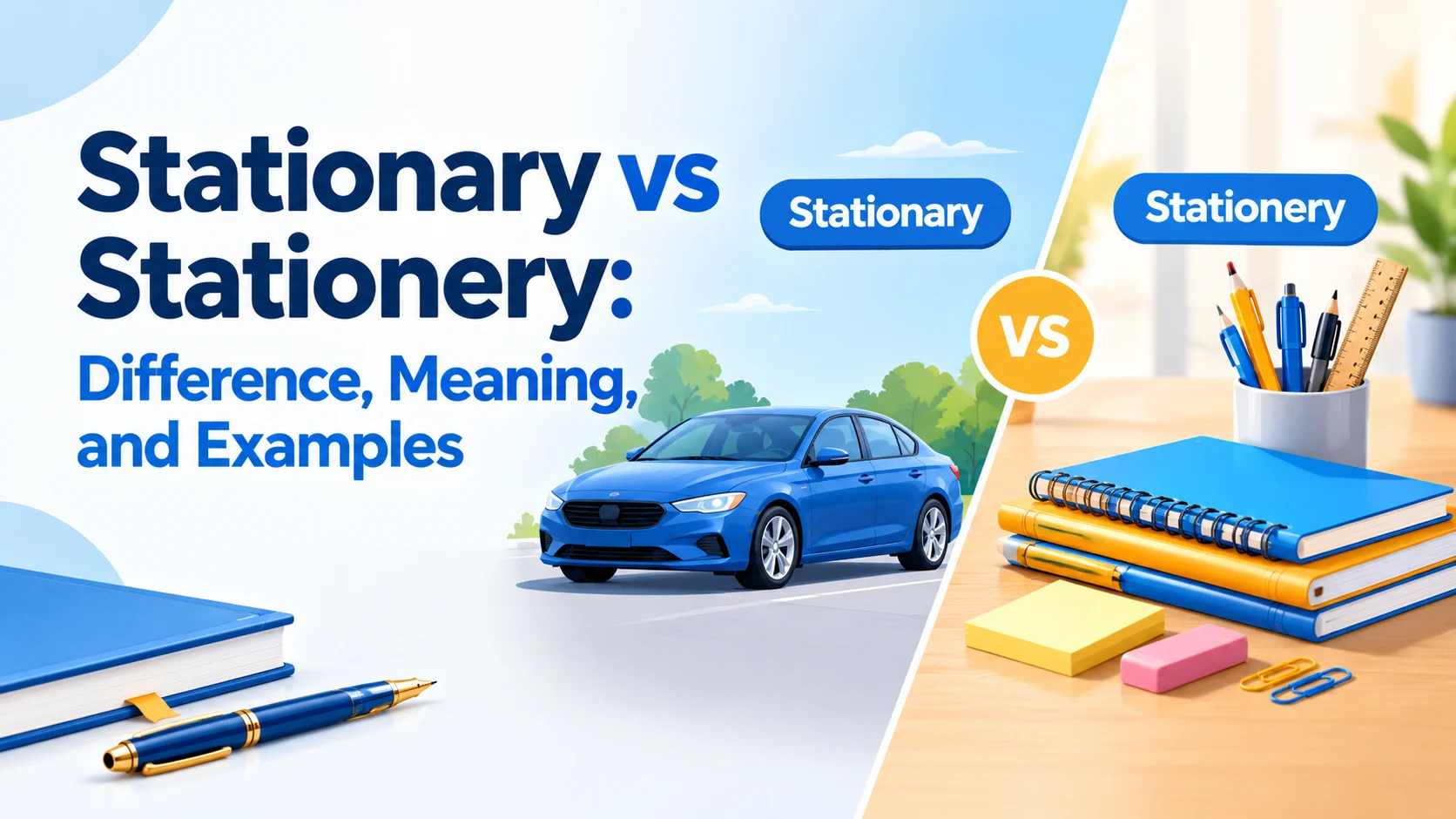
The difference between stationary vs stationery comes down to one letter—and a completely different meaning. Stationary describes something that is not moving, while stationery refers to writing materials such as paper, envelopes, and notepads. Because the two words sound alike in many English accents, even confident writers sometimes mix them up in emails, school assignments, and business documents. The good news is that you do not need to memorize complicated grammar rules to get them right. A simple spelling trick, a clear understanding of their meanings, and a few practical examples can make the distinction easy to remember.
The confusion becomes more noticeable when these words appear in familiar expressions. You might write about a stationary bike, order office stationery, or describe a vehicle that remained stationary at a traffic light. Each phrase is correct for a different reason, and substituting one word for the other can make a sentence confusing or unintentionally incorrect. Understanding how the words function in context is more reliable than depending on pronunciation alone. Once you recognize whether a sentence describes movement and position or writing supplies, choosing the right spelling becomes much more straightforward.
This guide explains the meaning of stationary and stationery, their parts of speech, common expressions, and the mistakes that cause confusion. You will also find a comparison table, examples from everyday and professional writing, a quick memory technique, and a short practice exercise with answers. Whether you are checking an important email, preparing an assignment, or writing product descriptions for an office-supply business, the aim is practical: help you choose the correct word confidently. By the end, you should be able to recognize the difference at a glance—and explain it clearly to someone else.
Stationary vs Stationery: The Quick Difference
The simplest way to distinguish the words is to ask what the sentence is describing. If it describes something not moving or not changing, use stationary. If it refers to writing materials or office supplies, use stationery. Oxford Learner’s Dictionaries identifies stationary as an adjective and stationery as an uncountable noun.
| Feature | Stationary | Stationery |
| Meaning | Not moving or remaining in one position | Materials used for writing and office tasks |
| Part of speech | Adjective | Noun |
| Common examples | Stationary vehicle, stationary bike, stationary object | Office stationery, wedding stationery, stationery set |
| Typical question it answers | What is not moving? | What supplies are being used or purchased? |
| Memory clue | A for at rest | E for envelope |
| Example sentence | The bus remained stationary. | I bought new stationery. |
Quick test: “The stationery was stationary on the desk” is grammatically possible. The stationery is the writing material; stationary describes its position. The words are different even when they appear in the same sentence.
What Does Stationary Mean?
Stationary is an adjective meaning not moving, not intended to move, or staying in one position. It can describe a vehicle waiting at a traffic light, a camera that must remain still, or a piece of exercise equipment that stays in one place. The word can also describe something that is not changing in condition or quantity, such as a stationary population.
The key is that stationary describes a condition or characteristic. It does not name an object or a supply. You can have a stationary car, a stationary machine, or a stationary person, but you would not use stationary as the name for paper or envelopes.
Common Uses of Stationary
1. Vehicles and transport
Use stationary when a vehicle is temporarily or consistently not moving.
- The taxi remained stationary while the driver checked the address.
- A stationary vehicle blocked the entrance to the parking area.
- The train was stationary for several minutes before leaving the platform.
2. Objects and equipment
The word also describes objects or machines that stay in one position.
- Keep the camera stationary while taking the photograph.
- The workshop uses stationary equipment that is not moved between jobs.
- A stationary bike allows someone to cycle indoors without travelling along a road.
3. People and movement
Stationary can describe a person who is not moving, although still may sound more natural in casual conversation.
- The players remained stationary until the referee gave the signal.
- Please stand stationary for a moment while I adjust the tripod.
4. Conditions that are not changing
Stationary can also mean that a situation or quantity is staying at roughly the same level.
- The population remained stationary over the period studied.
- The price stayed stationary for several weeks.
In these examples, the word is not about a physical object standing still. It describes a lack of change. This usage is more common in formal, technical, or analytical contexts.
Stationary vs Still, Fixed, and Immobile
These words overlap, but they are not always interchangeable.
| Word | Main meaning | Example |
| Stationary | Not moving or not changing | The vehicle remained stationary. |
| Still | Not moving; often conversational | Please keep still for the photo. |
| Fixed | Set, attached, or established in a position | The shelf is fixed to the wall. |
| Immobile | Unable to move or not moving | The injured bird remained immobile. |
| Static | Not changing or not involving movement | The display contains a static image. |
Choose the word that matches the intended meaning. A camera can remain stationary during recording, a person can keep still for a photograph, and a wall-mounted shelf can be fixed in place. Calling the shelf stationary is possible in some contexts, but fixed more clearly communicates that it is attached.
What Does Stationery Mean?
Stationery is a noun referring to materials used for writing, correspondence, and many office tasks. Typical examples include paper, pens, pencils, envelopes, notepads, and letter-writing materials. In a more specific sense, the word can refer to special paper and matching envelopes used for letters, invitations, or formal correspondence.
You will often encounter stationery in school supply lists, office purchasing, printing businesses, and invitations. For example, a company might order branded stationery featuring its logo, while someone planning an event might choose wedding stationery that matches the occasion.
Unlike stationary, which describes something, stationery names a category of things.
What Items Count as Stationery?
The exact range depends on the context. A school may use stationery broadly for everyday writing supplies, while a design studio may use it to describe printed paper products.
Common examples include:
- Paper products: Writing paper, notepads, notebooks, and letterheads
- Correspondence materials: Envelopes, greeting cards, thank-you cards, and invitations
- Writing tools: Pens, pencils, markers, and related items
- Business materials: Branded letterheads, printed envelopes, and business correspondence supplies
Some retailers classify rulers, folders, and other desk items as stationery too. In general, the term is most closely associated with writing materials and related paper products, rather than every object found in an office.
Stationery in Sentences
Here are examples showing how the word works in everyday writing:
- I bought new stationery before the school term began.
- The business ordered branded stationery for its new office.
- She chose floral stationery for her thank-you notes.
- The hotel provided guests with paper and stationery for writing letters.
- Please store the unused stationery in the top drawer.
Notice that stationery often appears as an uncountable noun. You would normally write “some stationery” or “a set of stationery,” rather than “a stationery” when referring generally to writing supplies.
If you need to count individual items, name them directly: three notebooks, five envelopes, or two packs of writing paper.
What Is the Difference Between Stationery and Office Supplies?
The terms overlap, but office supplies is generally the broader category. Stationery usually focuses on writing materials and related paper products. Office supplies can also include items such as staplers, storage products, and other everyday workplace necessities.
For example, a purchasing list might include stationery such as envelopes and notepads alongside non-stationery supplies such as a stapler. Businesses and retailers may categorize products differently, so the distinction is useful rather than absolute.
The Easiest Way to Remember Stationary vs Stationery
The most reliable memory trick connects each spelling to a familiar word.
Remember Stationary With A: “At Rest”
The A in stationary can remind you of at rest. If something is stationary, it is not moving or is staying in one position.
- The car remained stationary at the crossing.
- The camera must stay stationary during the shot.
Think of a parked car whenever you need to recall this spelling.
Remember Stationery With E: “Envelope”
The E in stationery can remind you of an envelope. Envelopes are common stationery items, along with paper and writing materials.
- She bought matching stationery and envelopes.
- The office needs more stationery for letters and notes.
Picture a stack of envelopes on a desk. That image links the e spelling to writing supplies.
A Second Clue: Check the Grammar
The part of speech can also help you decide:
- If the word describes a noun, such as bike, vehicle, or camera, you probably need the adjective stationary.
- If the word names supplies that someone buys, stores, or uses, you need the noun stationery.
Compare:
- We purchased stationery for the office.
- The exercise bike is stationary.
The first sentence names something purchased; the second describes the bike.
Common Mistakes With Stationary and Stationery
Because the words sound alike, a spellchecker may not catch the error. Both spellings are valid English words, so software may accept the wrong one if it fits the sentence grammatically. The best safeguard is to check the meaning, not just the spelling.
Mistake 1: Writing “Office Stationary”
Incorrect: We need to order more office stationary.
Correct: We need to order more office stationery.
The sentence is about supplies that employees use, so the noun stationery is required. A stationary office would mean something different: an office that does not move, which is rarely the intended message.
Mistake 2: Writing “The Car Was Stationery”
Incorrect: The car was stationery at the traffic light.
Correct: The car was stationary at the traffic light.
Here, the sentence describes the car’s movement. Because stationary is an adjective, it describes the car’s condition.
Mistake 3: Using “Stationeries” for Multiple Supplies
In ordinary use, stationery is usually uncountable. Instead of writing “I bought three stationeries,” say:
- I bought three notebooks.
- I ordered two packs of writing paper.
- I purchased several stationery items.
The word stationeries does appear in some specialized or less common uses, but it is not the natural choice for counting everyday writing supplies. Naming the individual products makes the sentence clearer.
Mistake 4: Assuming the Spelling Can Be Heard
In many English accents, stationary and stationery are pronounced alike. That means a listener may understand the intended meaning from context, but pronunciation alone will not reveal the spelling.
If you are writing from dictation or using speech-to-text software, review the sentence before sending it. “Please order stationery” and “please remain stationary” sound similar but communicate very different instructions.
Stationary vs Stationery in Real-Life Situations
The easiest way to apply the distinction is to connect it to the task you are doing.
In Emails and Workplace Writing
Use stationery when requesting writing materials or printed business supplies:
Could you order more stationery with the updated company logo?
Use stationary when describing an object that needs to stay in place:
Please keep the scanner stationary while the document is being processed.
In workplace communication, these mistakes can be more than spelling errors. A wrong word can make an instruction look careless or briefly confuse the reader.
In School Assignments and Exams
- “Please bring your own stationery to the examination.”
- “The bus remained stationary while the passengers boarded.”
For school supply lists, stationery is the appropriate term. For a science report describing motion, stationary may be the correct adjective.
In Invitations and Personal Correspondence
Stationery is especially common when discussing designed or personalized paper products.
- They selected elegant wedding stationery.
- The invitation was printed on matching stationery.
- She ordered personalized stationery for handwritten notes.
In this context, stationary would not make sense because the sentence is about paper products, not movement.
In Science, Engineering, and Technical Writing
In technical writing, it is worth being precise about what “not moving” means. An object may be stationary relative to one reference point but moving relative to another.
For example, a passenger sitting still inside a moving bus is stationary relative to the seat, but the passenger is moving relative to the road. When describing motion scientifically, state the relevant reference frame whenever it affects the meaning.
Common Expressions With Stationary and Stationery
Knowing familiar word combinations makes it easier to spot the correct spelling quickly.
| Expression | Correct meaning and use |
| Stationary bike | Exercise equipment that stays in place while the user pedals |
| Stationary vehicle | A vehicle that is not moving |
| Stationary object | An object described as remaining in one position |
| Stationary population | A population that is not changing in size over the period being discussed |
| Office stationery | Writing materials and related paper products used at work |
| Wedding stationery | Printed paper items for a wedding, such as invitations and matching cards |
| Personal stationery | Writing paper or correspondence materials selected for individual use |
| Stationery shop | A shop that sells writing materials and related supplies |
One related word is stationer, which traditionally refers to a person who sells stationery. The Oxford Learner’s Dictionary also records stationer’s as a term for a shop selling these products.
A practical editing habit is to learn these expressions as complete phrases. If you regularly write stationery orders, stationery cupboards, or stationary bikes, remembering the whole phrase can be faster than applying the spelling rule from scratch each time.
Test Yourself: Stationary or Stationery?
Choose the correct word for each sentence before checking the answers.
- The train remained ______ until the signal changed.
- I need to buy more ______ for the new school term.
- Keep the camera ______ while recording.
- The company ordered branded ______ for its clients.
- The cyclist stayed ______ at the crossing.
- She selected matching ______ for the invitations.
- The machine is ______, so the material moves through it.
- Please put the envelopes with the rest of the ______.
Answers and Explanations
- Stationary — the train is not moving.
- Stationery — the sentence refers to writing and school supplies.
- Stationary — the camera must remain in one position.
- Stationery — the company has ordered writing or printed paper materials.
- Stationary — the cyclist is temporarily not moving.
- Stationery — invitations and matching paper products belong to this category.
- Stationary — the machine stays in place while the material moves through it.
- Stationery — the envelopes are being stored with other writing supplies.
If you missed an answer, identify what the sentence is about before trying again. Movement or lack of change points to stationary; writing materials point to stationery. That meaning-based check is more useful than memorizing individual sentences.
Conclusion:
The difference between stationary vs stationery is simple once you connect each spelling with its meaning. Stationary describes something that is not moving or changing, while stationery refers to writing materials and related paper products. The distinction matters in everything from school assignments and everyday messages to business emails and formal invitations. One final actionable tip: when you are unsure, pause and ask whether the sentence describes a position or names a set of supplies. That quick check will resolve most cases. A common mistake to avoid is trusting spellcheck without reviewing the meaning, since both words are spelled correctly on their own. Learn the envelope clue for stationery and the at-rest clue for stationary, and you will have a practical way to remember the difference whenever you write.
FAQs
Q1. Is stationary or stationery correct when referring to office supplies?
Stationery is correct when referring to office supplies such as paper, envelopes, pens, and notepads. For example, “The manager ordered office stationery for the new employees.” Use stationary only when describing something that is not moving or changing position.
Q2. Is stationery countable or uncountable?
Stationery is generally an uncountable noun when it refers to writing materials collectively. You would usually say “some stationery” or “a lot of stationery.” To count individual products, specify the items: three notebooks, six envelopes, or two stationery sets.
Q3. What is the difference between a stationer and stationery?
A stationer is a person or business that sells stationery, while stationery refers to the writing materials themselves. For example, you might visit a stationer to purchase envelopes and notebooks. The similar spellings are related historically, but the words have different grammatical roles.
Q4. Can stationary mean something other than physically standing still?
Yes. Stationary can also describe something that remains unchanged in condition or quantity. For instance, a population or price may remain stationary over a particular period. In these contexts, the word describes a lack of change rather than an object’s physical position.
Q5. Why does spellcheck sometimes miss stationary and stationery mistakes?
Spellcheck tools may accept both words because stationary and stationery are correctly spelled English words. A tool may not recognize that you intended the other meaning. For important writing, check the sentence’s meaning and grammar instead of relying on automated spelling suggestions alone.