

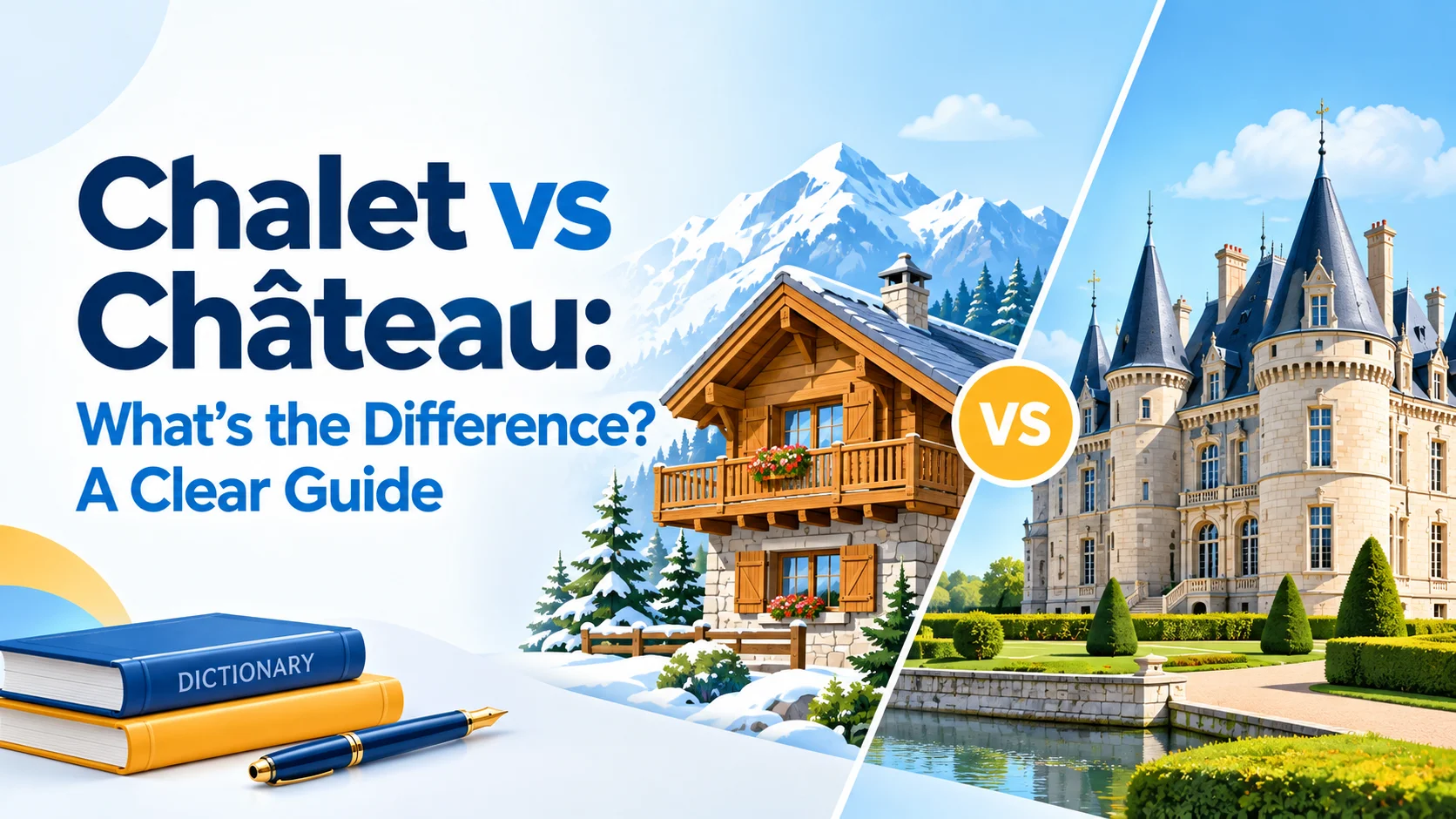
Chalet vs château is a comparison that can confuse travelers, architecture enthusiasts, and anyone browsing European property listings. Both words describe buildings, but they come from different architectural traditions and carry distinct historical associations. A chalet is traditionally an Alpine dwelling associated with mountain life, while a château is a French term for a castle or a grand country residence. The difference is more than appearance: each word reflects a different relationship between a building, its surroundings, and the people who originally used it. Understanding these distinctions makes it easier to recognize both types of property.
Imagine booking a winter holiday in the Swiss Alps and later visiting a historic estate in the French countryside. Your mountain accommodation might be advertised as a chalet, with timber details, a sloping roof, and balconies overlooking the landscape. The French estate might be called a château, with substantial masonry, formal rooms, and landscaped grounds. These images illustrate common associations, but they are not strict rules. Modern chalets can be luxurious, and not every château resembles a medieval fortress. Context, architectural character, and historical purpose all matter.
This guide explains what a chalet and a château mean, how their architecture differs, where the traditions originated, and how both building types are used today. You will also learn how to distinguish a château from a castle or manor house, recognize misleading real-estate descriptions, and use the words correctly in everyday English. Whether you are planning a trip, studying architecture, writing a property description, or simply curious about the terminology, the goal is to give you a practical understanding that goes beyond the familiar contrast between a mountain lodge and a grand French residence.
Chalet vs Château: The Difference at a Glance
The quickest way to distinguish the two is to look at their architectural tradition and historical role, rather than their price or size.
| Feature | Chalet | Château |
| Basic meaning | Alpine-style house or traditional mountain dwelling | French castle or grand country residence |
| Cultural association | Alpine regions of Europe | France and French architectural history |
| Traditional setting | Mountain villages, slopes, and pastures | Estates, countryside, and historic settlements |
| Common materials | Timber, stone, and other locally available materials | Often stone or masonry, with construction varying by period |
| Recognizable features | Sloping roof, projecting eaves, and wooden details | May feature towers, courtyards, formal façades, or elaborate rooms |
| Historical purpose | Shelter, farming, and mountain living | Defense, residence, administration, or displaying social status |
| Modern use | Holiday home, ski lodge, private residence | Private home, heritage attraction, hotel, or event venue |
| Defining clue | Alpine building tradition | French historical or residential tradition |
These are typical characteristics, not a checklist every building must satisfy. Oxford Learner’s Dictionaries describes a chalet as a wooden house associated with mountain regions, while its entry for château identifies a castle or large country house in France.
What Is a Chalet?
A chalet is traditionally a dwelling associated with the European Alps, particularly Switzerland and neighboring mountain regions. Older examples were connected with herding, farming, and seasonal mountain life. Their construction reflected the demands of the local climate and the materials available.
Today, the word is also widely used for mountain holiday homes and ski accommodation. A modern chalet might have contemporary glazing, central heating, and spacious living areas while retaining traditional features such as timber cladding and a sloping roof.
What Is a Château?
A château is a French term for a castle or a substantial country residence. Historically, some châteaux served defensive purposes, while others developed into comfortable residences for royalty, nobles, or wealthy landowners.
The word does not automatically mean medieval fortress. A château may have towers and fortified walls, or it may resemble an elegant country house with formal gardens and large reception rooms.
The Main Difference in One Sentence
A chalet is associated with Alpine mountain architecture, whereas a château belongs to the French tradition of castles and grand residences.
That distinction remains useful even when a modern chalet is luxurious or a historic château has been converted into a hotel.
What Does Chalet Mean?
The word chalet originally referred to a type of mountain shelter or dwelling. Its meaning developed alongside the traditional building practices of Alpine communities, where houses and agricultural structures had to serve practical purposes in a demanding environment.
The term now has a broader meaning in English. A building does not have to be an old farmhouse in Switzerland to be called a chalet; it may be a newer home built in a similar architectural style.
Traditional Meaning of a Chalet
Historically, chalets were connected with rural and pastoral life in the Alps. Some served as shelters for herders, while others formed part of seasonal farming operations.
In Alpine farming, families could move livestock to higher pastures during warmer months. Buildings in these areas supported activities such as sheltering people and animals or processing dairy products. The exact use varied according to local farming practices and the type of structure.
This background explains why the traditional chalet was not originally defined by luxury. Its first association was practical mountain living, not an expensive ski holiday.
Common Architectural Features of a Chalet
Traditional and chalet-inspired buildings may share several visual characteristics:
- Sloping roofs: These suit mountainous environments and can help manage snow and rain, depending on the roof’s design.
- Projecting eaves: Broad roof overhangs can help protect exterior walls from weather.
- Timber construction: Wood may form the main structure or appear prominently in the exterior.
- Stone elements: Stone foundations, lower floors, or walls are found in some regional designs.
- Balconies and galleries: These provide outdoor space and are common in many modern interpretations.
- Practical interiors: Traditional layouts reflect everyday domestic or agricultural needs, while modern versions may prioritize holiday comfort.
Not every chalet includes every feature. Building traditions differ across the Alps, and contemporary architects frequently combine traditional details with modern materials.
Where Are Chalets Traditionally Found?
Chalets are closely associated with the Alpine regions of Switzerland, France, Austria, and nearby parts of Europe. Their traditional forms vary from one region to another.
A Swiss chalet, for example, may have a prominent timber exterior and broad eaves. A building in another Alpine region might use more stone or follow a different local layout.
The word is no longer limited to these locations. A holiday property in Canada or another mountainous destination might be marketed as a chalet because it follows a similar style or serves a similar purpose.
The useful distinction is between a chalet’s architectural inspiration and its actual geographical location.
How the Meaning of Chalet Has Changed
Tourism helped broaden the word’s associations. As mountain destinations became popular for skiing and other holidays, chalets became familiar as places to stay rather than simply buildings connected with rural work.
Today, the term can describe:
- A traditional Alpine dwelling.
- A ski lodge or holiday rental.
- A private mountain retreat.
- A modern house inspired by Alpine architecture.
- In some varieties of English, a small holiday house in a non-mountain setting.
This broader usage is legitimate, but context matters. Calling a modern timber house a chalet describes its style or use; it does not establish that the building is historically traditional.
What Does Château Mean?
Château is a French word whose meaning ranges from a castle or fortified residence to a grand country house. Its precise sense depends on the building’s history, setting, and use.
The French word has a wider historical range than the English stereotype of a palace-like mansion. The French Academy’s dictionary includes both fortified feudal residences and substantial country houses among its definitions.
The Meaning of Château in French Architecture
In medieval France, a château could serve as a center of defense, authority, and residence. Its location and construction might help control a territory or protect its inhabitants.
Over time, the term also became associated with residences designed more for comfort, prestige, and social life than for military defense. Some retained towers and other medieval features, while others adopted architectural styles associated with the Renaissance and later periods.
This is why a château is not necessarily a castle built for warfare. The term encompasses different forms of French residence, including buildings that were never primarily defensive.
Architectural Features of a Château
Depending on its period and function, a château may include:
- Stone or masonry walls: Common in many historic examples, though construction materials vary.
- Towers and turrets: Found in some fortified or castle-inspired buildings, but not required.
- Formal façades: Later residences may feature balanced windows and carefully planned entrances.
- Courtyards: Some estates are organized around open central spaces.
- Grand reception rooms: Larger residences may include halls, salons, or ceremonial spaces.
- Gardens and grounds: Formal landscaping often accompanies prestigious country residences.
A château does not need all these features to qualify as one. An early fortified building and a later country residence can both be described by the term despite looking very different.
Where Are Châteaux Traditionally Found?
Châteaux are strongly associated with France, particularly its historic rural estates and regions with prominent collections of castles and country residences.
The Loire Valley is especially well known for its châteaux. Buildings in this region illustrate how French residences changed over time, including the shift toward Renaissance design and more comfortable domestic spaces.
A château can also be found outside France. In English, the word may describe a residence built in a French-inspired style or a property whose established name uses the term. Such usage does not mean that every château outside France has the same historical status as a French château.
Château, Castle, and Manor House: Are They the Same?
These terms overlap, but they are not exact synonyms.
- A castle is commonly associated with fortification and defense, although castles also served as residences and administrative centers.
- A château may be a fortified castle or a grand French country residence.
- A manor house is historically associated with a landed estate and the residence of its owner; it is not necessarily fortified.
Consider a historic French estate with elegant rooms and landscaped grounds but no substantial defensive features. Château may be a more natural description than fortress. If the building has a significant defensive history, castle may also be appropriate in English.
Expert tip: When writing about a specific historic building, use its established name and documented history rather than choosing a label based only on its appearance.
Chalet vs Château Architecture: How to Recognize Each Building
When looking at photographs, the roofline and overall layout can offer useful clues. However, no single architectural feature proves that a building is a chalet or a château. The strongest identification comes from combining its design, regional context, and known history.
Roof Design and Exterior Shape
A chalet often has a roof that slopes down toward the sides, sometimes with wide overhangs. The roof and exterior are frequently prominent elements of its appearance.
A château can have a much more varied silhouette. Depending on its age and style, it may feature steep roof sections, towers, dormer windows, or a comparatively symmetrical façade.
What to look for: A combination of timber detailing, broad eaves, and an Alpine setting suggests a chalet. A historic French residence with a formal façade, estate grounds, and period architectural features may be a château.
Neither clue is conclusive on its own.
Wood, Stone, and Exterior Finishes
Traditional chalet architecture often makes visible use of wood, sometimes combined with stone. The materials reflect local building traditions and practical needs.
Many historic châteaux use stone or other masonry, particularly those designed to last for generations or built with defensive and prestigious functions in mind. Later renovations may introduce different materials.
Modern construction complicates the comparison. A luxury chalet can have extensive stonework, while a château-inspired house can use contemporary materials. Material alone is not a reliable classification test.
Balconies, Towers, Courtyards, and Gardens
These features can help you understand a building’s design:
- Balconies and galleries: Common in chalet-style homes, where outdoor views and access matter.
- Towers and turrets: Present in some châteaux, especially those retaining castle-like features.
- Courtyards: Found in some large residences and historic estates.
- Formal gardens: Often associated with prestigious châteaux, although garden styles vary by period.
- Decorative timberwork: Frequently used in traditional or chalet-inspired Alpine architecture.
A building may have several of these features at once. What matters is how they fit together and what the building was designed to do.
Can a Chalet Look Luxurious? Can a Château Be Simple?
Absolutely. A chalet can be an expansive, high-end residence with modern amenities, while a château can be comparatively restrained in its decoration.
The misconception comes from confusing architectural identity with wealth. The traditional chalet is associated with mountain living, not necessarily of modest cost. The château is associated with French castles and grand residences, but its history and design can be more varied than the image of an extravagant palace suggests.
The History Behind Chalets and Châteaux
Their historical backgrounds explain why these words evoke different settings even when modern buildings blur the visual distinction.
How Alpine Chalets Developed
Traditional chalets emerged from the practical needs of Alpine communities. Mountain farming, seasonal movement of livestock, local timber, and changing weather all influenced building practices.
The chalet later became a recognizable symbol of Switzerland and Alpine life. The Swiss National Museum explains how tourism during the 19th century helped turn the chalet into an internationally recognizable image of Switzerland. Wealthy visitors and property owners even commissioned chalet-inspired buildings outside the Alps.
That development matters because a building can look like a traditional chalet without having originated as one. The style traveled beyond its original region and acquired new meanings.
How French Châteaux Evolved
The history of the châteaux includes both fortified residences and buildings designed increasingly for comfort and display.
During the late medieval period and the Renaissance, some French residences developed from defensive structures into more elaborate homes. Their architecture reflected changing ideas about status, domestic comfort, art, and social life.
The Loire Valley offers useful examples. Regional tourism sources describe estates that developed from defensive fortresses into elegant Renaissance and classical residences.
This explains why two châteaux can look strikingly different: they may belong to different architectural periods or have served different purposes.
Why Both Building Types Became Symbols of Luxury
Tourism and popular culture helped shape modern associations.
- The chalet became linked with winter holidays, skiing, mountain views, and cozy retreats.
- The château became linked with French history, grand estates, formal gardens, and prestigious accommodation.
Neither association tells the complete story. Traditional chalets had practical rural functions, and châteaux could serve political, defensive, and domestic purposes. Modern luxury is only one chapter in the history of each term.
Chalet vs Château in Modern Life
Today, the words describe not only historic architecture but also how properties are marketed and used.
Chalets as Ski Lodges and Holiday Homes
A modern chalet may be a privately owned mountain house, a holiday rental, or accommodation within a ski resort. Some preserve traditional exterior features, while others reinterpret the style with large windows, open-plan rooms, and modern heating systems.
For travelers, the word often signals a mountain-oriented stay rather than a specific age or construction method.
For example:
We rented a modern chalet overlooking the valley for our winter holiday.
The sentence communicates the property’s style and setting without claiming that it is a historic Alpine farmhouse.
Châteaux as Historic Homes, Hotels, and Event Venues
Châteaux may remain private residences or be adapted for tourism and hospitality. Some welcome visitors to their historic rooms and gardens; others offer accommodation or host events.
The Loire Valley’s official tourism resources, for example, list châteaux and historic residences available for overnight stays.
A château’s present-day use does not erase its architectural history. A building can function as a hotel while still being a château because of its established identity and character.
Why Real-Estate Listings Sometimes Use These Terms Loosely
Property marketing often emphasizes atmosphere. A listing might call a house a chalet because of its timber façade or call it a château because it is large and French-inspired.
That wording can be understandable, but it is not always a precise historical description.
When evaluating a property, check:
- Its location and architectural style.
- Its documented age and history, if relevant.
- Whether the term appears in the property’s established name.
- Whether the description refers to traditional architecture or a modern interpretation.
This approach is particularly useful when a listing uses grand terminology without explaining the building itself.
Can a Building Be Both a Chalet and a Château?
Usually, the terms describe different traditions, but a modern building can combine design influences.
For instance, an architect might create a large Alpine residence with a formal entrance and elaborate interiors inspired by French country houses. It could reasonably be described as a chalet-inspired residence with château-like features.
That does not automatically make it a historic château. The most accurate description identifies the style being borrowed rather than suggesting a historical identity the building does not possess.
Chalet vs Château in Everyday English
In ordinary writing, choose the word that best matches the building and the context. You rarely need to describe every architectural detail, but the term should not mislead the reader.
When to Use Chalet
Use chalet when referring to a traditional Alpine dwelling, a building in chalet style, or accommodation commonly known as a chalet.
Examples:
- “We booked a chalet near the ski slopes.”
- “The wooden chalet has a balcony overlooking the mountains.”
- “The architect designed a modern chalet inspired by Swiss buildings.”
When to Use Château
Use château when describing a French castle or grand country residence, or when referring to a building established under that name.
Examples:
- “The family visited a Renaissance château in the Loire Valley.”
- “The historic château overlooks the surrounding vineyards.”
- “The château now operates as a small heritage hotel.”
Commonly Confused Expressions
| Expression | Typical meaning |
| Alpine chalet | A dwelling associated with Alpine architecture |
| Ski chalet | A chalet or chalet-style property used for ski holidays |
| French château | A French castle or grand country residence |
| Château hotel | A château used for accommodation |
| Château-style house | A house inspired by château architecture, not necessarily a historic château |
| Chalet-style home | A house that adopts chalet design features |
These expressions show how a building’s style, location, and current use can influence its description without making all the terms interchangeable.
Real-Life Examples
Travel writing: “The chalet offered a convenient base for exploring the mountain trails.” The term fits a mountain-oriented accommodation setting.
Architectural writing: “The château combines Renaissance design with features retained from an earlier fortified residence.” This describes a building with a documented architectural evolution.
Property marketing: “The house has a chalet-inspired exterior and a contemporary interior.” This is more precise than claiming the building is a traditional chalet if it was built recently.
Historical writing: “The château served as a residence rather than primarily as a fortress.” This explains function instead of relying on appearance alone.
Chalet vs Château: Pronunciation, Spelling, and Word Origins
Both words entered English from French, so their spelling and pronunciation may be unfamiliar to some readers.
How to Pronounce Chalet
The usual English pronunciation is approximately sha-LAY, with the stress on the second syllable. Pronunciation varies somewhat between accents. Oxford Learner’s Dictionaries provides a pronunciation entry for the word.
How to Pronounce Château
In English, château is commonly pronounced approximately sha-TOH, with stress on the second syllable. The final letters do not form an additional pronounced syllable.
Why Does Château Have an Accent Mark?
The standard French spelling is château, with a circumflex over the a. English also commonly uses chateau without the accent, especially where a publication or technical system avoids diacritical marks.
When writing in French or reproducing an official name, preserve the accent where appropriate. In general English prose, either form may be acceptable depending on the chosen editorial style.
Where Do the Words Come From?
Chalet entered English from Swiss French and is associated historically with mountain shelters and dwellings. Château comes from French and ultimately traces to Latin castellum, meaning a fortress.
Their origins help explain the contrast: one is rooted in Alpine domestic and agricultural life, while the other is connected with the history of castles and substantial residences.
Common Misconceptions About Chalets and Châteaux
Several assumptions make these words harder to distinguish than they need to be.
A Chalet Is Not Always a Small Building
Traditional chalets may be modest, but modern chalet-style homes can be spacious, multi-storey properties with extensive living areas. Size does not determine whether the term is appropriate.
A Château Is Not Always a Medieval Fortress
Some châteaux began as fortified residences, while others are better understood as grand country houses. Towers and defensive walls are not essential features of every château.
Not Every Mountain House Is a Chalet
A house in the mountains may follow a completely different architectural tradition. The term chalet is most appropriate when the building’s design, established use, or recognized identity supports the description.
Not Every Grand French House Is a Château
A large house in France is not automatically a château. Its established name, history, architectural character, and local usage help determine the appropriate term.
How to Choose the Right Word in Writing
The best choice depends on what you are describing and how precise the context needs to be.
For Travel Guides and Tourism Websites
Describe the property accurately and explain what visitors can expect. If a holiday rental is a modern building inspired by Alpine architecture, chalet-style accommodation may be more informative than implying that it is a traditional historic dwelling.
For Architecture and History Articles
Use the building’s historical identity and documented function. Distinguish between a fortified castle, a grand residence, and a modern building that borrows elements from either tradition.
For Real-Estate Listings and Marketing Copy
Avoid using château merely as a synonym for an expensive house or chalet for any property with a mountain view. Descriptive accuracy helps readers understand what is being offered and builds trust.
A Simple Decision Checklist
Before choosing a term, ask:
- Does the building follow an Alpine chalet tradition or style?
- Is it a French castle, grand residence, or established château?
- Does its documented history support the description?
- Is the word being used architecturally, historically, or as a marketing label?
- Would a more specific description help the reader understand the property?
If the building is modern or combines styles, say so. Accurate description is more useful than forcing a property into a category that does not quite fit.
Conclusion:
Understanding chalet vs château means looking beyond the familiar images of a cozy mountain lodge and an elegant French estate. A chalet belongs to an Alpine building tradition shaped by mountain life, local materials, and practical needs. A château belongs to a French architectural history that includes both fortified residences and grand country houses. Modern buildings may borrow from either style, so appearance alone is not always enough to establish their identity.When describing a property, consider its architectural features, historical background, and actual use. These details help you choose a term that informs rather than exaggerates. One final actionable tip: check the property’s documented history before describing it as historic. A common mistake to avoid is assuming that every chalet must be small or every château must be a fortress. The most accurate description is the one that explains what the building really is.
FAQs
Q1. What Is the Main Difference Between a Chalet and a Château?
A chalet is traditionally an Alpine dwelling or a house built in that style. A château is a French castle or grand country residence. Their historical backgrounds and architectural traditions differ, although modern properties can borrow features from either style.
Q2. Is a Château the Same as a Castle?
Not always. A château can be a castle, particularly when it has a defensive history, but the word also describes grand French country residences. Some châteaux were designed primarily for comfortable living and prestige rather than military defense.
Q3. Is a Chalet Always Located in the Mountains?
No. Traditional chalets are associated with Alpine regions, but the term is also used for holiday homes and buildings inspired by Alpine architecture elsewhere. A modern chalet-style house can exist far from the mountains without being a traditional Alpine dwelling.
Q4. Which Is Bigger: a Chalet or a Château?
A château is often larger and more formal than a traditional chalet, but size is not a defining rule. Large chalets exist, and some châteaux are comparatively modest. Architectural tradition, historical identity, and context provide better clues than floor area alone.
Q5. What Is the Correct Plural of Château?
Both châteaux and châteaus are accepted English plurals. Châteaux retains the French spelling and is common in writing about French architecture; chateaus is an established English alternative. The plural of chalet is simpler: chalets.