

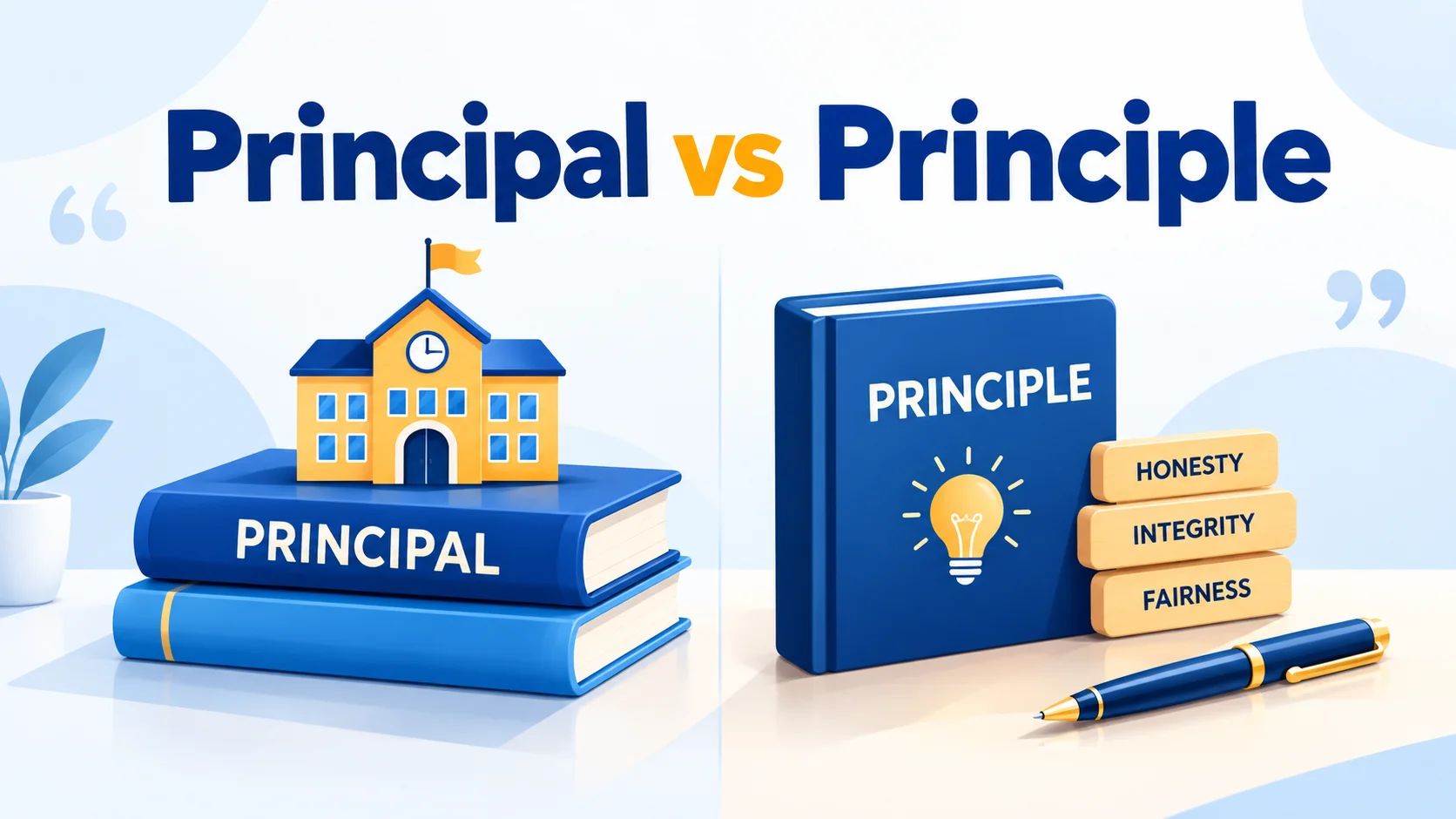
Principal vs. principle is a common source of confusion in English because the two words sound alike but have different meanings and grammatical uses. One can refer to a school leader, the main reason for something, or the original amount of a loan. The other describes a fundamental rule, belief, or truth. Choosing the wrong spelling can make an otherwise clear sentence look careless, especially in academic assignments, professional emails, and business documents. Fortunately, once you understand what each word means and how it functions in a sentence, distinguishing between principal and principle becomes much easier.
The most reliable way to choose the correct word is to consider the meaning you want to communicate. Are you describing something that is main or most important, referring to a person in charge, or discussing the original amount of money borrowed? In these situations, principal is usually the appropriate choice. If you mean a moral belief, a scientific rule, or a standard that guides behavior, you need principle. These distinctions become clearer when you examine the words in context rather than relying on spelling alone.
This guide explains the definitions, parts of speech, practical differences, and common expressions associated with both words. You will learn how to use them in school, finance, business, science, and everyday communication. We will also examine the frequently confused phrase in principle, explore examples that reveal how meaning changes with word choice, and identify mistakes worth avoiding. By the end, you will have a straightforward method for deciding between the two spellings, along with memory techniques and a short practice exercise to test your understanding.
Principal vs. Principle: The Quick Answer
The essential difference is that principal means main, chief, or most important, and it can also refer to a school leader or the original amount of a loan. Principle means a fundamental rule, belief, standard, or truth.
Consider these sentences:
- The principal announced a new school policy.
- Honesty is an important principle in journalism.
- The principal reason for the delay was heavy traffic.
- The engineer explained the principle behind the machine.
Notice how the words perform different jobs.✅ In the first sentence, the principal identifies a person. In the third, it describes the main reason. In the second and fourth, principle refers to a guiding value or an underlying rule.
A useful memory aid is to associate principal with a school principal and principle with a rule you believe in. This is not a substitute for understanding the definitions, but it provides a quick way to recall the distinction when writing.
What Does Principal Mean?
Principal has several related meanings, but they share an underlying idea: something or someone that is primary, leading, or especially important.
The word can function as both a noun and an adjective. Its precise meaning depends on the context, so it is worth learning its common uses individually.
Principal as a Noun
A noun names a person, place, thing, or idea. When used as a noun, principal commonly refers to a school leader, a main party involved in a transaction, or the original amount of money borrowed or invested.
1. Principal Meaning a School Leader
In many English-speaking countries, a principal is the person responsible for leading a school. The role may include supervising teachers, managing school operations, communicating with parents, supporting students, and implementing educational policies.
Examples:
- The principal addressed the students during assembly.
- Our school principal introduced a new attendance policy.
- The parents requested a meeting with the principal.
In American English, principal is the usual term for this school leadership role. Other varieties of English may use headteacher, headmaster, or headmistress, depending on the country and institution.
Writing tip: Use principal when referring to the person in charge of a school. Writing principle in this context is a spelling error because a guiding rule cannot perform the role of a school leader.
2. Principal Meaning the Main Person or Party
In business, legal, and professional contexts, a principal can be the main person or entity involved in an arrangement. In an agency relationship, the principal is the person or organization that authorizes an agent to act on its behalf.
Examples:
- The agent obtained approval from the principal before signing the agreement.
- The principal authorized the representative to negotiate the contract.
- The parties clarified their responsibilities before completing the transaction.
The exact legal meaning depends on the arrangement and applicable law. The important distinction for everyday writing is that principal identifies a person or party, not a general belief or rule.
3. Principal Meaning the Original Amount of a Loan or Investment
In finance, principal refers to the amount of money originally borrowed or invested, excluding interest. The term is particularly common in mortgages, personal loans, business financing, and investment discussions.
For example, imagine that someone borrows $10,000. The $10,000 is the original loan principal. If the borrower must also pay interest, that interest is a separate cost of borrowing.
Examples:
- She made an extra payment toward her loan principal.
- Interest is calculated using the outstanding principal according to the loan’s terms.
- The investment generated income while preserving the principal.
The distinction matters because a payment may be allocated between principal and interest. Paying down the principal generally reduces the amount still owed, which can affect future interest calculations depending on the loan terms.
A related expression is principal balance, meaning the amount of principal that remains outstanding at a particular time.
Principal as an Adjective
An adjective describes or gives information about a noun. When principal is an adjective, it means main, chief, primary, or most important.
This use extends well beyond schools and financial matters.
Examples:
- Cost was the principal reason for changing suppliers.
- The principal objective of the project is to improve safety.
- She played the principal role in the production.
- The principal investigator presented the research findings.
- Customer satisfaction remains our principal concern.
In each example, the principal identifies the leading reason, objective, role, researcher, or concern.
One helpful test is to replace the word with main. If the sentence retains its intended meaning, the principal is probably correct.
For example:
- The principal concern is safety.
- The main concern is safety.
Both sentences communicate the same idea.
However, this test is not universal. You cannot replace principal with main in the principal called a meeting without changing the sentence’s meaning. In that example, principal is a noun referring to a person.
Common Expressions Using Principal
The following expressions appear frequently in everyday, academic, and professional English.
| Expression | Meaning | Example |
| School principal | The person who leads a school | The school principal met with parents. |
| Principal reason | The main reason | Cost was the principal reason for the change. |
| Principal amount | The original amount borrowed or invested | The principal amount was $5,000. |
| Principal role | The leading role | She played the principal role in the performance. |
| Principal investigator | The person primarily responsible for a research project | The principal investigator presented the results. |
| Principal balance | The outstanding amount of loan principal | The principal balance decreased after the payment. |
Remember that principal does not always describe a person. Its meaning changes with the noun it modifies or the context in which it appears.
What Does Principle Mean?
Principle is a noun that refers to a fundamental rule, belief, standard, or truth. Principles can guide personal decisions, shape professional conduct, explain how systems work, or support legal and scientific reasoning.
Unlike principal, principle is ordinarily used as a noun in standard contemporary English.
Principle as a Moral Belief or Personal Value
A moral principle is a standard that influences how someone decides what is right, fair, or acceptable. People may develop principles through personal experience, education, cultural traditions, professional responsibilities, or philosophical reflection.
Examples:
- Honesty is one of her strongest principles.
- He refused to compromise his principles for personal gain.
- The journalist followed the principle of accuracy when reporting the story.
- They acted on principle rather than choosing the easiest option.
A principle differs from a temporary preference. Someone may prefer working alone, for example, without treating that preference as a fundamental rule. By contrast, a person who consistently values honesty may regard it as a principle that guides difficult decisions.
Principles can also conflict. Someone might value both loyalty and honesty, for instance, and need to consider how to respect both when a difficult situation arises.
Principle as a Fundamental Rule or General Truth
The word also describes an underlying rule or idea that helps explain how something works or how a system should operate.
Examples:
- The design follows the principles of effective communication.
- The organization operates according to the principle of equal treatment.
- The teacher explained the basic principles of good writing.
- The proposal was built on the principle that decisions should be transparent.
In these examples, principle does not necessarily refer to personal morality. It identifies a foundational idea that shapes a process, decision, or system.
This distinction is useful in academic writing. A writer might describe a research method as being based on a particular principle, then explain how that principle supports the method’s design.
Principle in Science, Mathematics, and Technology
Scientific and technical writing frequently uses principle to describe an established concept, general rule, or foundational explanation.
Examples include:
- The machine operates on the principle of leverage.
- Students studied the principles of probability.
- The experiment illustrates a basic scientific principle.
- The engineer explained the principle behind the sensor.
A scientific principle is not simply a personal opinion. It is a foundational concept supported by the relevant body of knowledge. The strength and scope of the evidence depend on the particular principle being discussed.
For students, understanding this usage helps distinguish a principle, which provides a general explanatory foundation, from a specific procedure, measurement, or observation.
Principle in Law, Politics, and Professional Ethics
In legal, political, and professional contexts, a principle may establish a standard for making decisions or evaluating conduct.
Examples:
- The committee defended the principle of transparency.
- The policy was evaluated against the principle of equal treatment.
- The organization adopted guiding principles for responsible decision-making.
- The professional code emphasizes the principle of confidentiality.
The word often appears in formal expressions such as fundamental principle, guiding principle, ethical principle, and legal principle.
Keep in mind that describing something as a principle does not automatically make it a legally binding rule. The legal effect of a principle depends on the relevant law, policy, contract, or professional framework.
Common Expressions Using Principle
| Expression | Meaning | Example |
| Moral principle | A belief about right and wrong | Fairness is a moral principle she values. |
| Guiding principle | An idea that directs decisions | Transparency is our guiding principle. |
| Scientific principle | A foundational scientific concept | The lesson introduced a scientific principle. |
| Fundamental principle | A basic rule or truth | Equality is a fundamental principle of the policy. |
| In principle | In theory or as a general idea | In principle, we support the proposal. |
| On principle | Because of a strongly held belief | He declined on principle. |
| Principles of design | Basic ideas that guide design decisions | The course covers the principles of design. |
These expressions illustrate why principle appears across so many subjects. Its central meaning remains consistent: an underlying rule, belief, or idea.
Principal vs. Principle: Key Differences
Although the two words sound alike, they differ in meaning, grammatical function, and typical context.
| Feature | Principal | Principle |
| Part of speech | Noun or adjective | Noun |
| Main meaning | Main, chief, leading; a school leader or original financial amount | A fundamental rule, belief, standard, or truth |
| Education | A school leader | A rule or value followed by a school |
| Finance | Original loan or investment amount | A general rule or concept |
| Professional writing | Principal concern, principal investigator | Ethical principle, guiding principle |
| Example | The principal reason was expense. | Fairness is an important principle. |
| Substitution clue | Often replaceable with main when used as an adjective | Often replaceable with rule, belief, or fundamental truth |
Why Are Principal and Principle So Often Confused?
The words are homophones in many varieties of English. Homophones share a pronunciation but have different spellings and meanings. Because principal and principle sound alike, listeners cannot always determine which spelling a speaker intends without context.
This becomes a practical problem when writing quickly. Someone might correctly understand a sentence while speaking but choose the wrong word when typing it.
Spell-checking software may not catch the error because both spellings are legitimate English words. A grammar tool might identify some mistakes, but it cannot always determine the intended meaning.
The most reliable solution is to check the meaning of the sentence rather than relying exclusively on automated correction.
Principal vs. Principle Examples in Real Sentences
Seeing the words in realistic situations makes their distinction easier to apply.
Examples of Principal in Sentences
- The principal welcomed the students at the beginning of the academic year.
- Our principal objective is to make the service more accessible.
- The borrower paid an additional amount toward the loan principal.
- The principal investigator explained the research methodology.
- Her principal concern was whether the building met safety requirements.
- The business appointed a new principal to oversee the transaction.
The first and sixth examples use principal as a noun referring to a person or party. The remaining examples show the word describing a main objective, a financial amount, or a leading researcher or concern.
Examples of Principle in Sentences
- Honesty is a principle that guides her professional decisions.
- The engineer explained the principle behind the device.
- The organization follows the principle of equal treatment.
- He stood by his principles even when the decision was unpopular.
- The experiment demonstrated a fundamental scientific principle.
- The proposal was evaluated according to the principle of transparency.
These sentences use principle to refer to rules, beliefs, or underlying concepts. Notice that the plural form is principles, as in ethical principles or principles of design.
Principal vs. Principle in Similar Sentences
The following comparisons show how context determines the correct spelling.
Example 1: School leadership and school values
- The principal introduced the new school policy.
- The policy was based on the principle of fairness.
The first sentence identifies a person. The second identifies a rule guiding the policy.
Example 2: A main reason and a moral belief
- The principal reason for the delay was a lack of funding.
- She refused to mislead the public because it violated her principles.
In the first sentence, principal means main. In the second, principles refer to beliefs about appropriate conduct.
Example 3: Finance and general rules
- The bank calculated interest using the outstanding loan principal.
- The company followed the principle of transparency when explaining its fees.
The first sentence concerns money. The second concerns a standard of conduct.
The key lesson is that these words are not interchangeable, even when they appear in similar professional or academic contexts.
When to Use Principal vs. Principle
If you are unsure which word belongs in a sentence, use this three-step decision process.
Step 1: Determine What You Mean
Ask yourself what the word is supposed to describe.
- A school leader or main party? Use principal.
- The main reason, objective, or concern? Use principal.
- The original amount of a loan or investment? Use principal.
- A moral belief, scientific rule, or fundamental standard? Use principle.
This first step resolves most ordinary spelling questions.
Step 2: Try a Replacement Word
Replace the word with a simpler term that expresses your intended meaning.
| Your intended meaning | Try replacing it with | Correct word |
| Main reason | Main | Principal |
| School leader | School leader | Principal |
| Original loan amount | Amount borrowed | Principal |
| Moral standard | Belief or rule | Principle |
| Scientific foundation | Fundamental concept | Principle |
| General theoretical agreement | In theory | In principle |
For example, consider the sentence, “The principal concern is safety.”
Replacing principal with main produces “The main concern is safety.” The meaning remains intact, confirming the adjective’s use.
Now consider, “Safety is an important principle.” Replacing principle with rule produces “Safety is an important rule.” Although the wording is not always identical in nuance, it preserves the intended general idea.
Step 3: Check the Whole Sentence
Replacement tests are helpful, but context remains essential. A word can have a specialized meaning that a simple substitute does not capture.
For example, principal in a financial document may refer specifically to the outstanding amount owed, not merely something that is important. Similarly, a principle in scientific writing may have a technical meaning that is more precise than the everyday word rule.
Expert tip: When editing an important document, read the full sentence and the sentence before it. Context often reveals whether you are discussing a leading person or thing, a sum of money, or an underlying rule.
In Principle vs. In Principal: Which Is Correct?
The standard expression is in principle, not in principle, when you mean that something is acceptable in theory or consistent with a general idea.
What Does In Principle Mean?
In principle means theoretically, generally, or at the level of basic agreement. It can indicate support for an idea even when practical details remain unresolved.
Examples:
- In principle, I agree with your proposal.
- The committee approved the plan in principle.
- The system works in principle, but it needs more testing.
- We support the idea in principle, provided the costs are manageable.
The phrase is especially useful when someone agrees with the central idea but has not committed to every detail.
For example, a manager might approve a proposed schedule in principle while asking the team to revise its budget and implementation plan. The general idea is acceptable, but the practical arrangements still need work.
Why Is the Principal Usually Incorrect?
The error occurs when writers confuse the noun principle, meaning a rule or underlying idea, with principal, meaning main, leading, or a person or amount.
Consider these examples:
- Incorrect: In principle, we support the proposal.
- Correct: In principle, we support the proposal.
The intended meaning is theoretical agreement, so principle is the appropriate spelling.
This does not mean that principal is never used near the word in. It can appear in entirely different constructions, such as a sentence describing a principal involved in a transaction. The specific expression in principle, however, is not the standard alternative to in principle.
In Principle vs. In Practice
These expressions are often used together to contrast an idea with its real-world implementation.
- In principle: The policy appears reasonable as a general idea.
- In practice: The policy may be difficult to implement because of real-world conditions.
For example:
“In principle, the new process should save time. In practice, employees may need additional training before it becomes efficient.”
This contrast is useful in reports, academic essays, business discussions, and policy analysis.
Common Principal vs. Principle Mistakes to Avoid
A few recurring errors account for much of the confusion between these words.
Mistake 1: Writing Principle When You Mean Main
Incorrect: The principle reason for the change was cost.
Correct: The principal reason for the change was cost.
Here, the word means main or most important, so the adjective principal is required.
Mistake 2: Writing Principal When You Mean a Guiding Rule
Incorrect: Honesty is an important principal in journalism.
Correct: Honesty is an important principle in journalism.
The sentence refers to a standard of conduct, not a person or something described as the main item.
Mistake 3: Confusing School Principal With a General Principle
Incorrect: The school principle spoke to the students.
Correct: The school principal spoke to the students.
A school leader is a principal. A school may also have principles, such as fairness or respect, but those principles are beliefs or standards rather than people.
Mistake 4: Using In Principal Instead of In Principle
Incorrect: In principal, the proposal is acceptable.
Correct: In principle, the proposal is acceptable.
Use in principle when expressing general agreement or theoretical acceptance.
Mistake 5: Assuming Principal Is Always a Noun
Incorrect reasoning: Principal refers only to a school leader.
Correct understanding: Principal can also be an adjective meaning main or most important, as in principal objective and principal concern.
Recognizing both grammatical roles prevents errors in more formal writing.
Easy Ways to Remember Principal vs. Principle
Memory tricks are useful when they help you recall meaning quickly. The following methods work best when combined with the definitions and sentence context.
Remember the School Principal
Think of a school principal as the person who leads a school. The same spelling appears in expressions such as principal investigator and principal reason.
For adjective uses, connect principal with primary or main. For financial uses, remember the specific expression loan principal.
Remember Principle as a Rule You Believe In
Associate principle with a belief, standard, or fundamental rule. It can be a personal moral principle, a scientific principle, or a principle of design.
For example:
- A principal leads the school.
- A principle guides a decision.
This distinction is short enough to recall while writing an email or completing an exam.
Use the Main-or-Rule Test
When you encounter either word, ask:
- Does the sentence refer to a main person, leading role, important reason, or original loan amount? Consider principal.
- Does it refer to a rule, belief, ethical standard, or underlying truth? Consider principle.
- Does the phrase mean theoretical agreement? Write in principle.
The test is especially useful for proofreading because it checks meaning rather than just spelling.
Principal vs. Principle Practice Worksheet
Choose the correct word for each blank. Try answering all eight items before checking the explanations.
- The school ______ welcomed the new students.
- Honesty is an important ______ in professional life.
- The ______ reason for the cancellation was bad weather.
- The machine operates according to a scientific ______.
- The borrower paid down the loan ______.
- ______, the two teams agree on the proposed changes.
- The ______ investigator presented the research findings.
- The organization follows the ______ of equal treatment.
Answers and Explanations
| No. | Correct answer | Explanation |
| 1 | Principal | Refers to the person leading the school. |
| 2 | Principle | Refers to a moral or professional standard. |
| 3 | Principal | Means the main reason. |
| 4 | Principle | Refers to an underlying scientific concept. |
| 5 | Principal | Refers to the original loan amount. |
| 6 | In principle | Means in theory or as a general idea. |
| 7 | Principal | Identifies the person primarily responsible for the research. |
| 8 | Principle | Refers to a standard guiding organizational conduct. |
If you missed an item, focus on the intended meaning rather than memorizing the sentence. Once you identify whether the context concerns importance, a person, money, or a guiding rule, the spelling becomes much easier to determine.
Conclusion:
Understanding principal vs. principle comes down to identifying what a sentence means. Principal refers to a leading person or party, the main or most important thing, or the original amount of a loan. Principle refers to a fundamental rule, belief, standard, or truth. These distinctions apply across schoolwork, finance, professional communication, science, and everyday writing. One final actionable tip: before choosing a spelling, replace the word mentally with main, school leader, loan amount, rule, or belief and see which meaning fits. A common mistake to avoid is assuming that spell-checking will catch every error; both words are correctly spelled, so the wrong choice may go unnoticed. Learn the meanings, pay attention to context, and remember that in principle is the standard expression for theoretical agreement. With that habit, you can choose the right word confidently and write more precisely.
FAQs
Q1. Is Principal a Noun or an Adjective?
Principal can be both a noun and an adjective. As a noun, it may refer to a school leader or the original amount of a loan. As an adjective, it means main or most important, as in principal objective or principal concern. The sentence determines its grammatical role.
Q2. Is Principle Ever an Adjective?
In standard contemporary English, principle is ordinarily a noun, not an adjective. It refers to a rule, belief, or fundamental truth. When describing something based on principles, writers generally use principled, as in “She made a principled decision,” or a phrase such as “a principle-based approach.”
Q3. Is It School Principal or School Principle?
The correct expression is school principal because the principal identifies the person who leads the school. A school can also have principles, such as fairness, respect, and honesty, but those are standards that guide behavior. The two words sound alike but serve different purposes.
Q4. What Is the Difference Between Principal and Principle in Finance?
In finance, principal refers to the original amount borrowed or invested, while principle refers to a rule or underlying concept. For example, a borrower repays loan principal, whereas a lender may follow the principle of transparent communication when explaining interest and fees.
Q5. Why Do Principal and Principle Sound the Same?
Principal and principle are homophones in many varieties of English, meaning they share a pronunciation but differ in spelling and meaning. Their similar sounds explain why spelling mistakes occur even among fluent writers. Checking the intended meaning is more reliable than relying on pronunciation or spell-checking alone.