
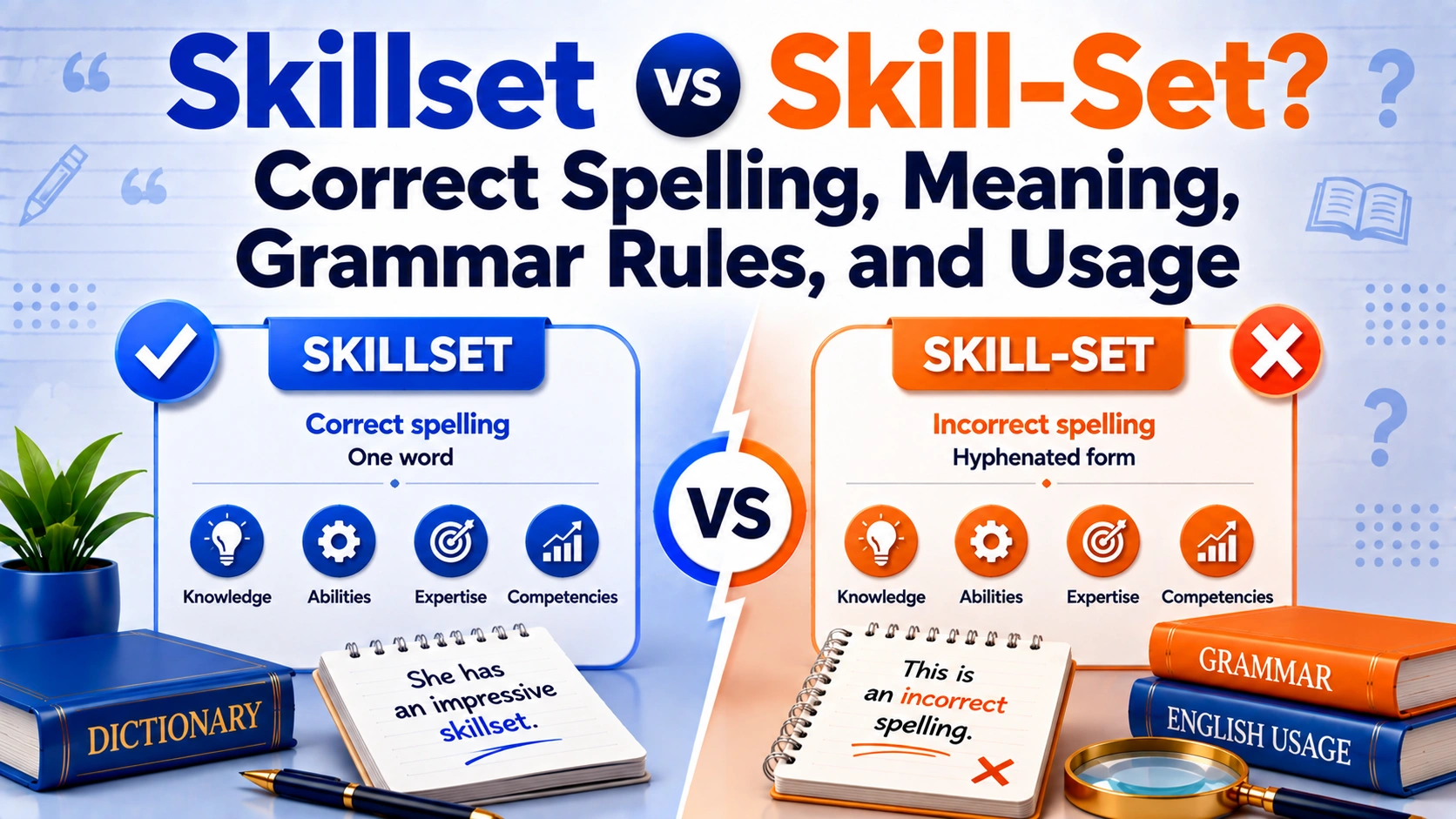
Skillset vs skill-set is a surprisingly common grammar and spelling question, especially in today’s workplace where resumes, LinkedIn profiles, job descriptions, and professional development discussions frequently refer to a person’s abilities. At first glance, both forms appear reasonable because English contains many compound words that have existed as two words, hyphenated words, and single words at different stages of their evolution. That similarity leads many writers to wonder whether skillset, skill-set, or even skill set is the most accurate choice. Understanding the difference helps you write with greater precision and professionalism.
The confusion becomes even more understandable when you consider how compound words develop over time. English is full of examples that gradually changed from two separate words into hyphenated forms before eventually becoming single words. However, not every compound follows exactly the same path, and dictionaries, publishers, and organizations don’t always adopt new spellings at the same pace. As a result, you may encounter skillset, skill-set, and skill set in different publications, leaving even experienced writers unsure which version belongs in modern English.
This guide explains the complete story behind skillset vs skill-set, including which spelling is preferred today, when skill set is still appropriate, how major dictionaries and style guides treat the word, and what recruiters, editors, and business professionals typically expect. You’ll also learn the grammar behind compound nouns, practical usage examples, common writing mistakes, helpful memory tricks, comparison tables, and expert recommendations so you can choose the right form confidently in every situation.
Quick Answer: Should You Write Skillset or Skill-Set?
If you simply want the correct modern usage, here’s the short answer.
| Form | Modern Standard Usage | Recommendation |
| Skillset | ✅ Widely accepted | Best choice in most modern business and professional writing |
| Skill set | ✅ Correct | Also acceptable, especially in formal or dictionary-style writing |
| Skill-set | ⚠️ Less common | Generally considered dated or unnecessary in modern English |
Is Skillset Correct?
Yes. Skillset is widely accepted in modern English and has become the preferred spelling in many business, HR, recruitment, technology, and professional development contexts. It refers to the complete collection of skills, abilities, and competencies a person possesses.
Examples:
- She has an impressive skillset for project management.
- Employers increasingly value adaptable skillsets.
- His technical skillset includes cloud computing and cybersecurity.
Is Skill Set Also Correct?
Yes. The skill set remains grammatically correct and is still listed by several dictionaries. Many editors, academic publishers, and organizations continue to use the two-word version, particularly in more traditional or formal writing.
Examples:
- The role requires a broad skill set.
- Your skill set should match the position’s requirements.
- This training expands your professional skill set.
Is Skill-Set Correct?
While you’ll occasionally find skill-set in older books, archived articles, or publications that follow older editorial conventions, the hyphenated form is far less common today. Modern style generally favors either skillset or skill set instead.
A Simple Rule You Can Remember
If you’re writing for today’s workplace, “skillset” is usually the safest modern choice. If your organization or style guide prefers “skill set,” use it consistently. Avoid “skill-set” unless you’re following a specific editorial style or quoting older material.
What Does Skillset Mean?
Regardless of whether it’s written as skillset or skill set, the meaning remains the same.
A skillset is the combined collection of knowledge, practical abilities, technical expertise, interpersonal strengths, and learned competencies that enable someone to perform particular tasks effectively.
Unlike an individual skill, which refers to one specific ability, a skillset describes the overall combination of capabilities someone brings to a role, profession, or project.
For example:
- Public speaking is a skill.
- Data analysis is another skill.
- Communication, leadership, research, and data analysis together form a professional skillset.
This distinction matters because employers rarely hire based on one isolated ability. Instead, they evaluate whether a candidate’s entire skillset matches the responsibilities of the role.
Skillset vs Individual Skills
Consider these examples:
| Individual Skill | Broader Skillset |
| Excel proficiency | Financial analysis skillset |
| Coding in Python | Software development skillset |
| Public speaking | Communication skillset |
| Negotiation | Sales skillset |
| Graphic design | Creative design skillset |
Thinking in terms of a complete skillset helps explain why employers often describe candidates as “well-rounded” rather than simply “skilled.”
Skillset vs Skill-Set vs Skill Set: Understanding the Difference
Although all three versions refer to the same underlying idea, their spelling reflects different stages in the evolution of English compound words.
| Form | Status Today | Where You May See It |
| Skillset | Modern and increasingly preferred | Business writing, HR, resumes, LinkedIn, technology |
| Skill set | Still correct and widely accepted | Dictionaries, formal documents, academic writing |
| Skill-set | Older or less common | Historical publications, legacy style guides |
The important point is that the meaning doesn’t change. Only the preferred spelling differs depending on publication style and editorial preference.
Most readers won’t question either skillset or skill set, but many professional editors now consider the hyphen unnecessary.
Why Has the Spelling Changed Over Time?
One reason writers become confused is that English compound words rarely remain fixed forever.
Many begin life as two separate words before gradually becoming hyphenated. Eventually, once readers become familiar with the expression, the hyphen often disappears entirely.
For example:
| Early Form | Transitional Form | Modern Form |
| Web site | Web-site | Website |
| On line | On-line | Online |
| Database | Data-base | Database |
The evolution of skillset follows a similar pattern.
Initially, writers used a skill set because the phrase was relatively new. As usage increased, some editors adopted a skill-set to emphasize that the two words functioned as one concept. Over time, modern publications increasingly dropped the hyphen, resulting in the single-word form skillset.
This gradual evolution is normal in English and reflects changing usage rather than changing meaning.
The Grammar Rule Behind Skillset
Understanding compound nouns makes the spelling much easier to remember.
A compound noun combines two or more words to express one complete idea.
Some compounds always remain separate:
- high school
- post office
- real estate
Others become permanently joined:
- notebook
- keyboard
- smartphone
Still others exist in multiple accepted forms while the language continues evolving.
Skillset belongs to this third category.
The spelling isn’t determined by a strict grammar law. Instead, it’s largely shaped by modern usage, editorial preference, and language evolution.
That’s why both skillset and skill set remain acceptable today, while skill-set continues to decline in popularity.
Professional editors generally recommend following one important principle:
Choose one spelling and use it consistently throughout your document.
Mixing skillset, skill set, and skill-set in the same article creates unnecessary inconsistency and weakens the professionalism of your writing.
Dictionary Usage and Modern Style Guide Preferences
One reason the debate over skillset vs skill-set continues is that different dictionaries, publishers, and organizations adopted the word at different times. Unlike many grammar questions that have one universally accepted answer, compound words often evolve gradually. As a result, you’ll still find more than one spelling in reputable sources.
The encouraging news is that modern usage has become much more consistent. Business publications, recruitment websites, corporate blogs, and technology companies increasingly favor skillset or skill set, while the hyphenated skill-set appears far less frequently than it once did.
What Major Dictionaries Show
Although dictionary entries may differ slightly in presentation, they generally recognize the concept without treating skill-set as the preferred modern spelling.
Here’s a practical summary:
| Source Type | Most Common Preference |
| Modern business writing | Skillset |
| Traditional dictionaries | Skill set |
| Academic publications | Usually skill set |
| HR and recruitment content | Frequently skillset |
| Corporate websites | Mostly skillset |
| Older publications | Sometimes skill-set |
Rather than viewing one form as “right” and the other as “wrong,” think of skillset and skill set as two accepted spellings serving different editorial preferences.
What Professional Editors Recommend
Editors generally focus on consistency rather than insisting on one universal spelling.
For example:
- If your company’s style guide uses skillset, use that form throughout the document.
- If your university requires a skill set, remain consistent from beginning to end.
- Avoid switching between spellings within the same article, report, or resume.
Consistency is one of the easiest ways to make your writing appear polished and intentional.
Skillset vs Skill Set in Professional Writing
Different types of writing often favor slightly different conventions. Knowing what readers expect helps you make better stylistic choices.
On Resumes and CVs
Modern resumes increasingly use skillset because it looks concise and contemporary.
Examples:
- Strong leadership skillset
- Technical skillset in cloud computing
- Diverse project management skillset
Many recruiters scan resumes quickly, and the single-word version has become familiar in recruitment software and applicant tracking systems.
In Job Descriptions
Employers frequently describe the qualities they’re seeking by referring to a candidate’s skillset.
Examples:
- We’re looking for someone with a strong analytical skillset.
- The ideal applicant possesses a customer-focused skillset.
- This position requires both technical and communication skillsets.
Because HR departments often publish hundreds of job postings, modern terminology tends to become standardized quickly.
In Academic Writing
Academic writing generally prefers more traditional wording.
Many universities, journals, and textbooks continue using the skill set, particularly in formal research.
Example:
Students develop a broad skill set through interdisciplinary coursework.
Neither spelling is grammatically incorrect, but academic editors sometimes favor the two-word form because it aligns with long-established editorial conventions.
In Business Reports
Business reports increasingly lean toward skillset, especially when discussing workforce development, leadership, organizational capabilities, and employee training.
Example:
Expanding the team’s digital skillset will improve long-term competitiveness.
The single-word version feels natural in modern corporate communication because it treats the concept as one integrated capability rather than two separate words.
Why Writers Still Get Confused
If both skillset and skill set are acceptable, why does confusion persist?
Several factors contribute.
Compound Words Don’t Always Follow One Pattern
English contains thousands of compound words, but they don’t evolve uniformly.
Compare these examples:
| Two Words | Hyphenated | One Word |
| High school | Decision-making | Notebook |
| Real estate | Long-term | Smartphone |
| Skill set | Skill-set (older) | Skillset |
Because there isn’t one universal rule, writers often rely on instinct instead of established usage.
Older Resources Still Use Hyphens
Books, archived websites, and older training materials sometimes contain skill-set because that spelling reflected editorial preferences at the time of publication.
When readers encounter those older sources, they naturally assume the hyphen is still required.
Language, however, evolves continuously.
Different Organizations Follow Different Style Guides
A company may publish a skillset in its HR handbook while a university recommends a skill set in academic papers.
Neither organization is necessarily wrong—they’re simply following different editorial standards.
This is why understanding your audience matters just as much as understanding grammar.
Is Skill-Set Ever Appropriate?
Although skill-set has largely fallen out of favor, there are still situations where you might encounter it.
Examples include:
- Older business books
- Archived magazine articles
- Historical corporate documents
- Publications following legacy house styles
- Direct quotations from earlier sources
If you’re quoting material exactly as originally published, preserving the hyphen is appropriate.
For new writing, however, most editors recommend choosing either:
- skillset (modern preference), or
- skill set (traditional preference).
Using skill-set in newly written content may make your writing appear slightly dated, even though many readers will still understand it perfectly.
Common Mistakes Writers Make
Understanding the most frequent errors makes it easier to avoid them.
Mistake #1: Mixing Multiple Spellings
Incorrect:
Her skillset is impressive. This skill set includes leadership. That skill-set continues growing.
Correct:
Her skillset is impressive. This skillset includes leadership. That skillset continues growing.
Or consistently use a skill set throughout.
Mistake #2: Assuming the Hyphen Makes Writing More Formal
Some writers believe adding a hyphen automatically sounds more professional.
It doesn’t.
Modern English generally removes unnecessary hyphens as compound words become familiar.
Just as email replaced e-mail in many publications, skillset has increasingly replaced skill-set.
Mistake #3: Confusing a Skill with a Skillset
A single ability isn’t automatically a skillset.
Incorrect:
Microsoft Excel is a skillset.
Better:
Microsoft Excel is a skill.
Correct:
Financial analysis requires a broad skillset, including Excel, budgeting, forecasting, and reporting.
Remember:
- One ability = skill
- Collection of abilities = skillset
Mistake #4: Overusing the Word
Because skillset is popular in business writing, some writers repeat it excessively.
Instead of writing:
This skillset helps improve your skillset while expanding your professional skillset.
Use greater variety:
- expertise
- capabilities
- competencies
- strengths
- qualifications
- professional abilities
Good writing balances precision with variety.
Easy Memory Trick
Here’s a simple way to remember modern usage.
If you’re describing someone’s complete collection of abilities in today’s workplace, think of it as one integrated concept—one skillset.
Another helpful reminder:
- One skill → one ability
- One skillset → one complete group of abilities
This mental association makes the single-word spelling feel natural and easy to remember.
Quick Decision Guide
| If you’re writing… | Best Choice |
| Modern resume | Skillset |
| LinkedIn profile | Skillset |
| Corporate website | Skillset |
| Business report | Skillset |
| Academic paper | Skill set (if required by style guide) |
| Older quoted material | Preserve original spelling |
| Modern blog article | Skillset |
Real-World Examples of Skillset in Different Contexts
Understanding grammar is important, but seeing a word used naturally is what helps it become part of your own writing. Below are realistic examples from professional and everyday situations where skillset fits naturally.
Business and Corporate Communication
Businesses frequently refer to an employee’s overall capabilities rather than individual skills.
Examples:
- The company is looking for candidates with a strong leadership skillset.
- Her management skillset helped the organization complete the project ahead of schedule.
- Building a diverse skillset prepares employees for future leadership roles.
- Our team’s technical skillset continues to expand through ongoing training.
Resume and Job Applications
Recruiters often evaluate applicants based on the combination of skills they bring to a role.
Examples:
- My skillset includes project management, budgeting, and stakeholder communication.
- This certification strengthened my cybersecurity skillset.
- Employers value candidates with both technical and interpersonal skillsets.
- A balanced skillset often distinguishes top applicants from equally qualified candidates.
Education and Learning
Teachers and educational institutions commonly discuss developing broader competencies rather than isolated abilities.
Examples:
- The course helps students build a practical digital skillset.
- University internships strengthen graduates’ professional skillsets.
- A well-rounded skillset prepares students for changing careers.
- The program develops analytical and communication skillsets simultaneously.
Technology and IT
Technology evolves quickly, making continuous skill development essential.
Examples:
- Modern developers need a broad programming skillset.
- Cloud computing has become an essential part of today’s IT skillset.
- Artificial intelligence is expanding the required skillset for software engineers.
- Employers increasingly seek professionals with hybrid technical skillsets.
Personal Development
The word also appears frequently outside the workplace.
Examples:
- Volunteering expanded her leadership skillset.
- Traveling improved his communication skillset.
- Reading widely strengthens your critical thinking skillset.
- Every new experience contributes to your overall skillset.
Skillset vs Similar Terms
Although skillset is widely used, it isn’t always the most precise word. Depending on your context, another term may communicate your meaning more effectively.
| Term | Meaning | Best Used When |
| Skillset | Collection of practical abilities | General professional writing |
| Skills | Individual abilities | Listing specific competencies |
| Competencies | Skills combined with knowledge and behavior | HR and organizational development |
| Expertise | Deep knowledge in a subject | Highlighting specialization |
| Qualifications | Education, certifications, and experience | Hiring and recruitment |
| Capabilities | Overall ability to perform tasks | Business strategy and management |
For example:
- A resume may list individual skills.
- An employer may evaluate your overall skillset.
- A performance review may assess your professional competencies.
Choosing the right word makes your writing more precise.
Should You Use “Skillset” in Formal Writing?
Yes—but consider your audience.
Use Skillset When:
- Writing resumes
- Creating LinkedIn profiles
- Preparing business reports
- Writing HR documents
- Publishing marketing content
- Creating training materials
- Writing corporate blogs
Consider Skill Set When:
- Following an academic style guide
- Writing research papers
- Working with publishers that prefer traditional compounds
- Following an organization’s editorial manual
The important point isn’t choosing one universally “correct” version—it’s matching the expectations of your readers.
Best Practices for Using Skillset
Professional writers don’t simply choose the correct spelling—they use the word effectively.
Be Specific
Instead of writing:
She has a great skillset.
Write:
She has a strong skillset in financial forecasting, team leadership, and strategic planning.
Specific examples provide much greater value.
Support Claims with Evidence
Rather than simply stating someone possesses an impressive skillset, explain how those abilities produced measurable results.
For example:
His problem-solving skillset reduced production delays by 20%.
Concrete outcomes make writing more persuasive.
Avoid Buzzword Overload
Business writing sometimes overuses words like:
- skillset
- synergy
- innovation
- excellence
- solutions
Using skillset naturally is far more effective than repeating it throughout every paragraph.
Mini Editing Checklist
Before publishing your document, ask yourself:
- ✅ Did I use one spelling consistently?
- ✅ Does the word refer to multiple skills rather than one?
- ✅ Would another word (skills, expertise, competencies) communicate my meaning better?
- ✅ Does the sentence sound natural?
- ✅ Am I following my organization’s preferred style?
A quick review like this prevents small inconsistencies from distracting readers.
Practice Quiz: Skillset, Skill Set, or Skill-Set?
Test your understanding before moving on.
Question 1
Which spelling is generally preferred in modern business writing?
A. Skill-set
B. Skill set
C. Skillset
Question 2
Which sentence sounds most natural?
A. She has an excellent skillset in digital marketing.
B. She has an excellent skill-set in digital marketing.
C. She has an excellent skill set in digital marketing.
Question 3
True or False?
Skill-set is the preferred spelling in most modern corporate publications.
Question 4
Which word describes a collection of related abilities?
A. Skill
B. Skillset
C. Qualification
Question 5
What is the best writing practice?
A. Switch between spellings throughout the article.
B. Use whichever spelling your style guide or audience expects—and stay consistent.
C. Always use the hyphenated version.
Answers
- C. Skillset ✅
- A (Modern business writing) and C (Traditional formal style) are both acceptable, depending on your style guide. ✅
- False ✅
- B. Skillset ✅
- B. Stay consistent. ✅
If you answered all five correctly, you now understand not only the preferred modern spelling but also when different versions may still appear and why consistency matters more than memorizing one rigid rule.
Key Takeaways
Before you finish, remember these essential points about skillset vs skill-set.
| Question | Answer |
| Which spelling is most common today? | Skillset ✅ |
| Is the skill-set still seen? | Yes, but it’s much less common. |
| Which form do most businesses and recruiters prefer? | Skillset ✅ |
| Which spelling may appear in older publications? | Skill-set |
| Is skill set (two words) also acceptable? | Yes, especially in traditional dictionaries and some style guides. |
| Should you stay consistent within one document? | Absolutely. |
Quick Rule to Remember: In modern business, recruitment, and professional writing, skillset is generally the preferred spelling. If you’re following a specific academic, editorial, or organizational style guide, check its recommendation and use that form consistently.
Conclusion
Choosing between skillset, skill set, and skill-set isn’t simply a matter of preference—it’s about understanding current usage, audience expectations, and editorial consistency. While all three forms have appeared throughout the history of English, skillset has emerged as the preferred spelling in modern business, recruitment, and professional writing. Skill set remains acceptable in many dictionaries and style guides, whereas skill-set is now largely an older, less common variant. Knowing these distinctions helps you write with greater confidence and professionalism, whether you’re creating a resume, drafting a report, or publishing online content.One final actionable tip: before submitting an important document, check the style guide or publication standards you’re writing for and stick to one spelling throughout the entire piece. A common mistake to avoid is mixing skillset, skill set, and skill-set within the same document. Maintaining consistent terminology not only improves readability but also demonstrates attention to detail—an important quality in both professional communication and polished writing.
FAQs
Q1. Which is correct: skillset, skill set, or skill-set?
All three forms have appeared in English, but skillset is the most common choice in modern business, recruitment, and online writing. Skill set is still accepted by many dictionaries and style guides, while skill-set is now relatively uncommon and is generally considered an older variant. Choose the form your style guide recommends and use it consistently.
Q2. Should I write a skillset on my resume or LinkedIn profile?
Yes. In most cases, skillset is the best choice for resumes, LinkedIn profiles, cover letters, and professional portfolios because it reflects current business usage. However, if you’re applying to an organization that follows a specific editorial style, match its preferred spelling for consistency.
Q3. Is the skill-set considered wrong?
Not necessarily. Skill-set isn’t grammatically incorrect, but it has become much less common in modern English. Most contemporary employers, recruiters, and business publications favor skillset, making it the more natural choice for current professional communication.
Q4. Does British English use skill set while American English uses skillset?
There isn’t a strict British-versus-American distinction. Both varieties of English use skillset increasingly often, although skill set still appears in some dictionaries, academic publications, and editorial style guides. The difference usually depends more on publication style than regional spelling conventions.
Q5. Why has skillset become more popular over time?
English frequently turns commonly used word combinations into closed compound words. As the term became widespread in recruitment, education, and workplace communication, writers gradually shifted from skill set and skill-set to the simpler skillset. This natural language evolution explains why skillset is now the preferred spelling in many modern contexts.