

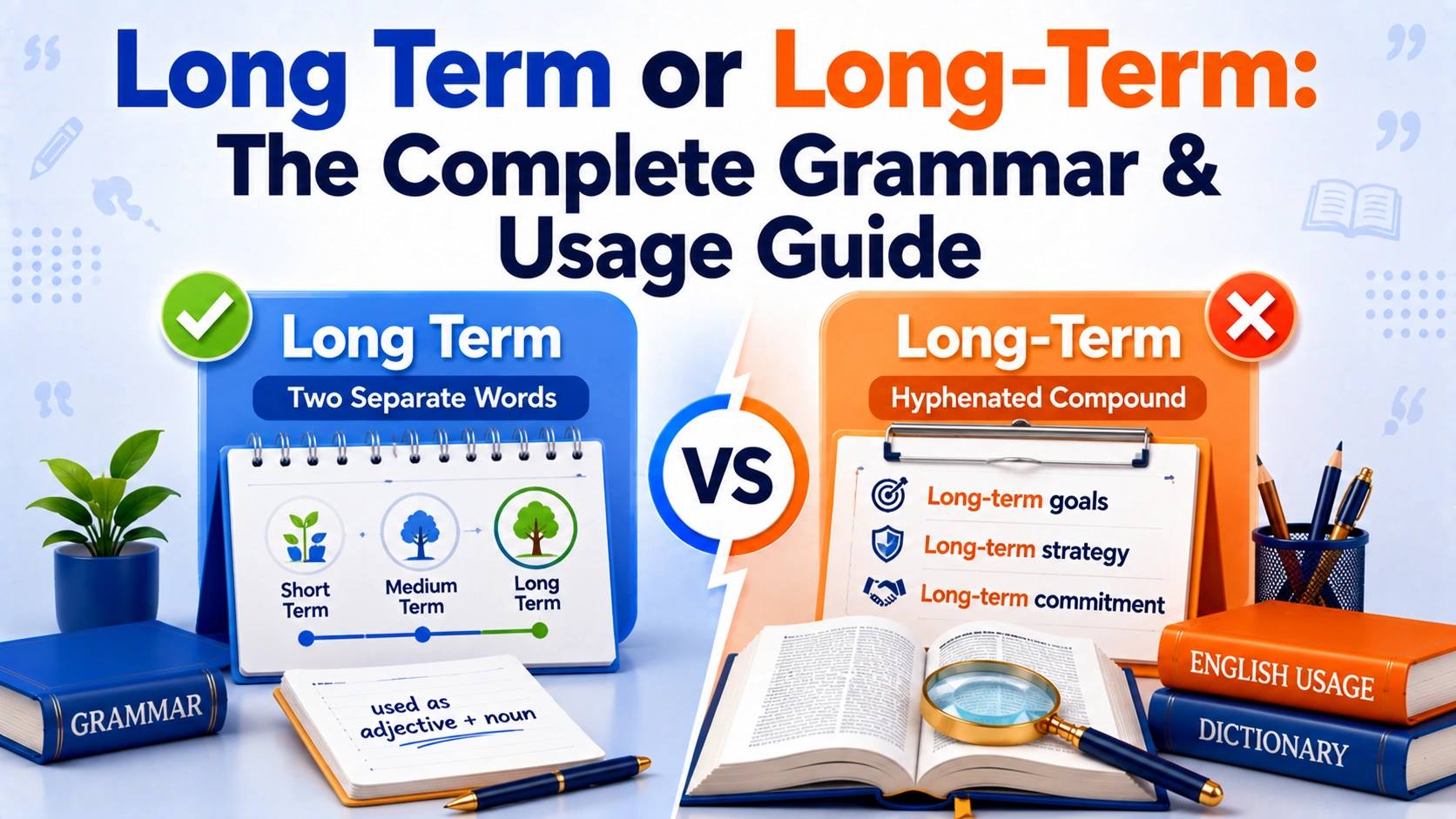
Long term or long-term is one of the most frequently searched grammar questions because both forms are correct—but not in the same situations. A single hyphen determines whether the phrase functions as a compound adjective or a noun phrase, making it an important distinction in professional writing, academic papers, business communication, and everyday English. While the difference may seem minor, using the wrong form can make polished writing look less accurate and leave readers questioning your attention to detail.
English hyphenation rules often confuse writers because they depend more on grammar and sentence structure than meaning. You may have seen long-term investment, long-term goals, and long term success in different places and wondered why the punctuation changes. The answer isn’t random or based on personal preference. Instead, it follows a well-established grammatical rule used throughout English to improve clarity and readability.
This guide explains exactly when to use long term, when to use long-term, and why longterm isn’t considered standard English. You’ll learn the grammar rule behind the hyphen, discover practical examples from real-world writing, avoid common mistakes, and gain simple memory tricks that professional editors use. By the end, you’ll know how to choose the correct form confidently in every sentence.
Long Term or Long-Term: The Quick Answer
Which Form Is Correct?
The answer depends on how the phrase functions in your sentence.
- Long-term is correct when it comes before a noun and acts as a compound adjective.
- Long term is correct when it functions as a noun phrase or appears after a verb.
- Longterm (written as one word) is not accepted in standard English.
| Form | Correct? | Grammar Role | Example |
| Long-term | ✅ Yes | Compound adjective | We need a long-term strategy. |
| Long term | ✅ Yes | Noun phrase / adverbial phrase | This investment will pay off in the long term. |
| Longterm | ❌ No | Not standard English | ❌ We need a longterm solution. |
Quick Examples
Correct
- We adopted a long-term business strategy.
- She has long-term career goals.
- The company is thinking long term.
- This decision will benefit everyone in the long term.
- Doctors continue studying the long-term effects of the treatment.
Incorrect
- ❌ We adopted a long term strategy.
- ❌ The report discusses longterm planning.
- ❌ They announced a longterm investment.
Quick Rule: If the phrase describes a noun, add the hyphen. If it stands alone or follows the verb, leave the hyphen out.
Understanding the Difference Between “Long Term” and “Long-Term”
Although both expressions refer to something lasting over an extended period, they serve different grammatical purposes. Understanding those roles is the easiest way to eliminate uncertainty whenever you write.
What Does “Long-Term” Mean?
Long-term is a compound adjective that describes a noun. It tells readers that something is designed to last for a considerable period or produce results over time.
You’ll commonly find it before nouns such as:
- strategy
- investment
- relationship
- project
- commitment
- objective
- plan
- care
- effect
- solution
Examples:
- The company adopted a long-term growth strategy.
- They signed a long-term contract.
- Scientists continue researching the long-term effects of air pollution.
- Building long-term customer relationships requires consistency.
In each sentence, the hyphen joins long and term into a single descriptive unit modifying the noun.
What Does “Long Term” Mean?
Long term functions as a noun phrase or appears within an adverbial expression. Instead of describing a noun directly, it refers to an extended period of time or the broader future.
Common expressions include:
- in the long term
- over the long term
- think long term
- focus on the long term
- benefit in the long term
Examples:
- This investment should perform well in the long term.
- Successful leaders usually think long term.
- The project may cost more today but save money over the long term.
- Consumers often overlook benefits that appear only in the long term.
Notice that long term isn’t directly modifying a noun, so no hyphen is necessary.
Why the Meaning Doesn’t Change—but the Grammar Does
One of the biggest reasons writers become confused is that both forms share the same basic meaning. Whether you write long-term investment or benefits in the long term, you’re still referring to an extended period.
The difference lies entirely in sentence structure.
Compare these examples:
- We created a long-term marketing plan.
- Our marketing plan will succeed in the long term.
Both discuss future success, but only the first uses the phrase to describe a noun. That’s why it requires a hyphen.
Is One Form More Formal Than the Other?
No. Both are accepted in formal English.
You’ll find them in:
- business reports
- academic journals
- government publications
- newspapers
- legal documents
- books
- corporate communications
Professional writers don’t choose between the two based on formality. They choose based on grammar.
The Grammar Rule Explained
English uses hyphens to connect words that work together as a single adjective before a noun. This rule applies to hundreds of common expressions, not just long-term.
Use Long-Term Before a Noun
Whenever long and term jointly describe a noun, they become a compound modifier and should be hyphenated.
Examples:
- a long-term investment
- a long-term objective
- a long-term partnership
- a long-term solution
- a long-term policy
- a long-term commitment
The hyphen signals that both words belong together and should be read as one descriptive phrase.
Without the hyphen, readers may briefly misunderstand how the sentence is structured, especially in more complex writing.
Use Long Term After a Verb or as a Noun Phrase
When the expression refers to the future generally rather than describing a noun, the hyphen disappears.
Examples:
- We must think long term.
- This policy will benefit the organization in the long term.
- Investors should focus on the long term, not daily market fluctuations.
- The decision may seem expensive now but worthwhile over the long term.
Here, long term acts as the object of a preposition or part of an adverbial phrase rather than an adjective.
Why English Uses Hyphens Here
Hyphens improve clarity by preventing readers from misinterpreting groups of words.
Compare:
- long-term planning
- long term planning
The first immediately tells readers that long-term modifies planning. The second may cause a brief pause because the relationship between the words isn’t as clear.
This is why professional editors, publishers, and most major style guides recommend hyphenating compound modifiers before nouns.
When to Use Long-Term
Knowing the grammar rule is one thing; applying it naturally while writing is another. The easiest way to remember the correct form is to look at the word immediately after the phrase. If long-term directly describes a noun, it needs a hyphen because the two words work together as a single adjective.
Think of long-term as one descriptive unit. The hyphen signals that long and term belong together before the noun.
Use Long-Term Before a Noun
Whenever the phrase answers the question “What kind of?”, use the hyphen.
Examples:
- We need a long-term strategy for business growth.
- She made a long-term investment in renewable energy.
- The company announced a long-term partnership with a local supplier.
- Doctors continue studying the long-term effects of the medication.
- The government introduced a long-term housing policy.
In each sentence, long-term modifies the noun that follows.
Common Nouns That Usually Follow “Long-Term”
Although long-term can describe many nouns, certain combinations appear frequently in professional and everyday English.
Business
- long-term strategy
- long-term growth
- long-term investment
- long-term objective
- long-term planning
- long-term profitability
Healthcare
- long-term care
- long-term treatment
- long-term recovery
- long-term health
- long-term effects
Education
- long-term learning
- long-term goals
- long-term academic planning
Relationships
- long-term relationship
- long-term commitment
- long-term friendship
Science
- long-term climate patterns
- long-term environmental impact
- long-term research
Because these combinations appear regularly in published writing, they’re worth becoming familiar with.
Why the Hyphen Matters
Without the hyphen, readers may briefly misunderstand how the sentence is organized.
Compare:
✅ The company adopted a long-term plan.
❌ The company adopted a long term plan.
Although many readers will still understand the second sentence, the first follows standard English punctuation and is considered more polished by editors and publishers.
When to Use Long Term
Not every sentence requires the hyphen. When the phrase refers to an extended period itself instead of describing a noun, long term remains two separate words.
Most often, you’ll find it:
- after a verb
- after a preposition
- functioning as a noun phrase
Use “Long Term” in Prepositional Phrases
Examples:
- The decision will benefit us in the long term.
- Investors should focus on the long term.
- The policy proved successful over the long term.
- The project generated value for the long term.
Notice that long term isn’t modifying a noun directly.
Use “Long Term” After Certain Verbs
Many writers forget that compound adjectives usually lose their hyphen once they move away from the noun.
Examples:
- Good leaders think long term.
- Successful investors plan long term.
- Businesses should focus long term rather than chasing quick profits.
- Families often save for the long term.
Again, the phrase isn’t functioning as an adjective.
A Simple Test You Can Use
Whenever you’re unsure, ask yourself one question:
Is the phrase describing the noun immediately after it?
If the answer is yes, use long-term.
If the answer is no, write long term.
Examples:
Describing a noun
- long-term solution ✅
- long-term investment ✅
- long-term agreement ✅
Not describing a noun
- in the long term ✅
- think long term ✅
- over the long term ✅
This single test works in nearly every situation.
Long Term vs Long-Term: Side-by-Side Comparison
| Feature | Long-Term | Long Term |
| Hyphenated | ✅ Yes | ❌ No |
| Part of speech | Compound adjective | Noun phrase / adverbial phrase |
| Comes before a noun | ✅ Yes | ❌ No |
| Appears after verbs | Rarely | ✅ Yes |
| Used after prepositions | Rarely | ✅ Yes |
| Formal writing | ✅ Yes | ✅ Yes |
| Meaning | Describes something lasting a long time | Refers to an extended period of time |
Why Do So Many Writers Get Confused?
The confusion isn’t caused by pronunciation because both forms sound identical. Instead, it’s caused by the way English handles compound modifiers.
Several factors contribute to the mistake.
1. Both Forms Mean Almost the Same Thing
Whether you write:
- long-term planning
- in the long term
you’re still talking about the future.
Since the meaning hardly changes, writers often assume the punctuation doesn’t matter.
2. Hyphen Rules Depend on Grammar, Not Meaning
English hyphenation isn’t based on definitions.
Instead, it’s determined by sentence structure.
That’s why:
- high-quality product
- well-known author
- full-time employee
- long-term investment
all require hyphens before nouns.
Move them elsewhere, and the hyphen often disappears.
Examples:
- The author is well known.
- She works full time.
- The benefits appear in the long term.
3. Spellcheck Doesn’t Always Help
Many grammar checkers focus on spelling rather than punctuation.
Since both long and term are correctly spelled words, some tools won’t warn you if the hyphen is missing.
That’s why professional proofreading still matters.
4. Different Style Guides Create Uncertainty
Major style guides—including AP Style, Chicago, and many publisher house styles—generally agree on hyphenating compound adjectives before nouns.
However, they sometimes vary in edge cases, making writers believe the rule itself changes.
In reality, the core principle remains remarkably consistent.
Is “Longterm” Ever Correct?
One mistake deserves separate attention because it appears surprisingly often in online writing.
The single-word form longterm is not considered standard English.
Avoid Writing “Longterm”
Incorrect:
- ❌ longterm strategy
- ❌ longterm investment
- ❌ longterm relationship
Correct:
- ✅ long-term strategy
- ✅ long-term investment
- ✅ long-term relationship
Similarly,
Incorrect:
- ❌ in the longterm
Correct:
- ✅ in the long term
Neither major dictionaries nor respected style guides recognize longterm as the standard spelling.
Common Mistakes Writers Make
Even experienced writers occasionally misuse this expression. Fortunately, the errors follow predictable patterns.
Mistake #1: Forgetting the Hyphen Before a Noun
Incorrect:
- We developed a long term strategy.
Correct:
- We developed a long-term strategy.
Mistake #2: Keeping the Hyphen When It Isn’t Needed
Incorrect:
- This decision will help us in the long-term.
Correct:
- This decision will help us in the long term.
Mistake #3: Writing It as One Word
Incorrect:
- Our company focuses on longterm growth.
Correct:
- Our company focuses on long-term growth.
Mistake #4: Being Inconsistent
Some writers switch between forms within the same article.
Example:
- long-term planning ✅
- long term planning ❌
Consistency strengthens readability and demonstrates careful editing.
Editor’s Tip: The Five-Second Hyphen Test
Professional editors rarely memorize long lists of hyphenated expressions. Instead, they ask a simple question before making a correction:
Does this phrase directly describe the noun that follows?
If yes, add the hyphen.
If not, leave it out.
Using this quick test consistently will help you avoid not only mistakes with long term and long-term, but also similar expressions such as:
- high-quality
- well-known
- full-time
- part-time
- short-term
- low-cost
- decision-making
Once you recognize the underlying pattern, these hyphenation decisions become almost automatic.
Real-World Examples of Long Term and Long-Term
Understanding the rule is easier when you see it used naturally. Below are examples from situations you’ll encounter in everyday communication, professional writing, education, healthcare, finance, and technology.
Business and Finance
Business writing frequently uses both forms because companies discuss future planning and long-range objectives.
Long-Term (Before a Noun)
- The company introduced a long-term growth strategy.
- Investors prefer long-term investments over speculative trades.
- Management announced a long-term expansion plan.
- Building long-term customer loyalty requires excellent service.
- The board approved a long-term financial commitment.
Long Term (Noun Phrase)
- Smart investors focus on the long term.
- The decision should benefit shareholders in the long term.
- Economic stability matters more over the long term than short-term gains.
- Businesses that think long term often outperform competitors.
Healthcare
Medical professionals regularly distinguish between immediate and future outcomes.
Examples:
- Doctors continue monitoring the long-term effects of the treatment.
- Researchers studied long-term patient outcomes.
- Physical therapy supports long-term recovery.
- The medication appears safe in the long term.
- Patients should consider lifestyle changes for the long term.
Education
Teachers and educators often discuss sustained learning rather than quick results.
Examples:
- Reading daily produces long-term academic benefits.
- Schools encourage long-term learning habits.
- Success depends on the long term, not a single exam.
- Effective teachers help students think long term about their education.
Personal Life
The phrase appears naturally in conversations about relationships, health, and personal development.
Examples:
- They are building a long-term relationship.
- She created a long-term savings plan.
- Exercise improves health in the long term.
- Good habits produce better results over the long term.
- Parents often make sacrifices for the long term.
Technology
Technology companies frequently describe future planning and ongoing development.
Examples:
- Engineers developed a long-term security solution.
- The company announced a long-term software roadmap.
- Cloud computing offers advantages in the long term.
- Developers are planning long term instead of releasing temporary fixes.
Long Term vs Long-Term: Common Grammar Mistakes
Although the rule itself is straightforward, several mistakes appear repeatedly in blogs, business reports, emails, and even published content.
Mistake #1: Omitting the Hyphen Before a Noun
Incorrect:
❌ We need a long term solution.
Correct:
✅ We need a long-term solution.
Because the phrase describes a solution, it functions as one adjective.
Mistake #2: Adding an Unnecessary Hyphen
Incorrect:
❌ This policy will help us in the long-term.
Correct:
✅ This policy will help us in the long term.
Here, the phrase functions as a noun phrase rather than an adjective.
Mistake #3: Writing “Longterm”
Incorrect:
❌ longterm investment
❌ longterm planning
Correct:
✅ long-term investment
✅ long-term planning
Modern dictionaries and style guides do not recognize longterm as standard English.
Mistake #4: Switching Styles Within One Document
Sometimes writers alternate between forms without noticing.
Example:
- long-term planning ✅
- long term planning ❌
- long-term objectives ✅
Professional writing should remain consistent.
Easy Memory Tricks
Many editors use quick mental shortcuts instead of memorizing grammar terminology.
Trick #1: Look at the Next Word
Ask yourself:
Does another noun immediately follow?
If yes:
Use long-term
Examples:
- long-term project
- long-term solution
- long-term contract
If no:
Use long term
Examples:
- in the long term
- think long term
- over the long term
Trick #2: Replace It with “Short-Term”
Most people naturally write:
- short-term loan
- short-term memory
The exact same grammar applies:
- long-term loan
- long-term memory
Trick #3: Think “Before vs After”
Before a noun
➡ Hyphen
After a verb
➡ No hyphen
Examples:
She developed a long-term plan.
She plans for the long term.
Quick Decision Guide
Whenever you’re unsure, use this table.
| If you’re writing… | Correct Form |
| A compound adjective before a noun | Long-term ✅ |
| A noun phrase after a verb | Long term ✅ |
| After “in the” | Long term ✅ |
| After “over the” | Long term ✅ |
| Before words like strategy, investment, plan, effects | Long-term ✅ |
| One word (“longterm”) | ❌ Never |
Mini Grammar Quiz
Test yourself before moving on.
Question 1
Which sentence is correct?
A. We adopted a long term strategy.
B. We adopted a long-term strategy.
Question 2
Choose the correct sentence.
A. This decision will help us in the long-term.
B. This decision will help us in the long term.
Question 3
Which spelling is correct?
A. longterm planning
B. long-term planning
Question 4
Fill in the blank.
Successful investors think ________.
A. long-term
B. long term
Question 5
Choose the correct sentence.
A. Scientists continue studying the long-term effects.
B. Scientists continue studying the long term effects.
Quiz Answers
- B ✅
- B ✅
- B ✅
- B ✅
- A ✅
If you answered all five correctly, you’ve mastered one of the most common hyphenation rules in English.
Key Takeaways
| Question | Correct Answer |
| Which form comes before a noun? | Long-term ✅ |
| Which form follows “in the”? | Long term ✅ |
| Is “longterm” correct? | ❌ No |
| Does the meaning change? | No—the grammar changes |
| Is the rule accepted in formal English? | Yes |
Remember: Use long-term when the phrase modifies a noun, and long term when it functions as a noun phrase or follows a verb. Once you recognize that distinction, choosing the correct form becomes automatic.
Conclusion
Understanding the difference between long term and long-term is less about memorizing two spellings and more about recognizing how each functions in a sentence. Long-term is the correct choice when it acts as a compound adjective before a noun, while long term is used as a noun phrase or adverbial expression, typically after a verb or preposition. Mastering this simple distinction makes your writing clearer, more professional, and grammatically accurate. One final actionable tip: whenever you’re unsure, look at the word immediately after the phrase—if it’s describing a noun, add the hyphen. A common mistake to avoid is writing longterm as one word or forgetting the hyphen before nouns. Small grammar improvements like this can significantly strengthen your credibility as a writer.
FAQs
Q1. Is long-term always hyphenated?
No. Long-term is hyphenated only when it functions as a compound adjective before a noun, such as long-term investment, long-term plan, or long-term success. When the phrase follows a verb or stands alone as a noun phrase—such as in the long term—the hyphen should be omitted.
Q2. Is it long term or long-term?
Both are correct, but they are used differently. Use long-term before a noun because it acts as a single descriptive adjective (for example, long-term strategy). Use long term when referring to an extended period of time, such as thinking long term or benefiting in the long term.
Q3. Can I write longterm as one word?
No. Longterm is not the standard spelling in modern English. Major dictionaries and style guides recognize only long-term (hyphenated) and long term (two separate words). Writing it as one word is generally considered a spelling error in formal and professional writing.
Q4. Do British English and American English use different rules?
Not really. Both British English and American English follow the same basic grammar rule: use long-term before a noun and long term elsewhere. While publishers may have different editorial preferences, the hyphenation rule itself remains consistent across both varieties of English.
Q5. What’s the easiest way to remember the difference?
A simple trick is to check whether the phrase comes before a noun. If it does, use long-term with a hyphen because it acts as one adjective. If it appears after a verb or in expressions like over the long term or in the long term, write long term without a hyphen. This quick check works in almost every situation.