

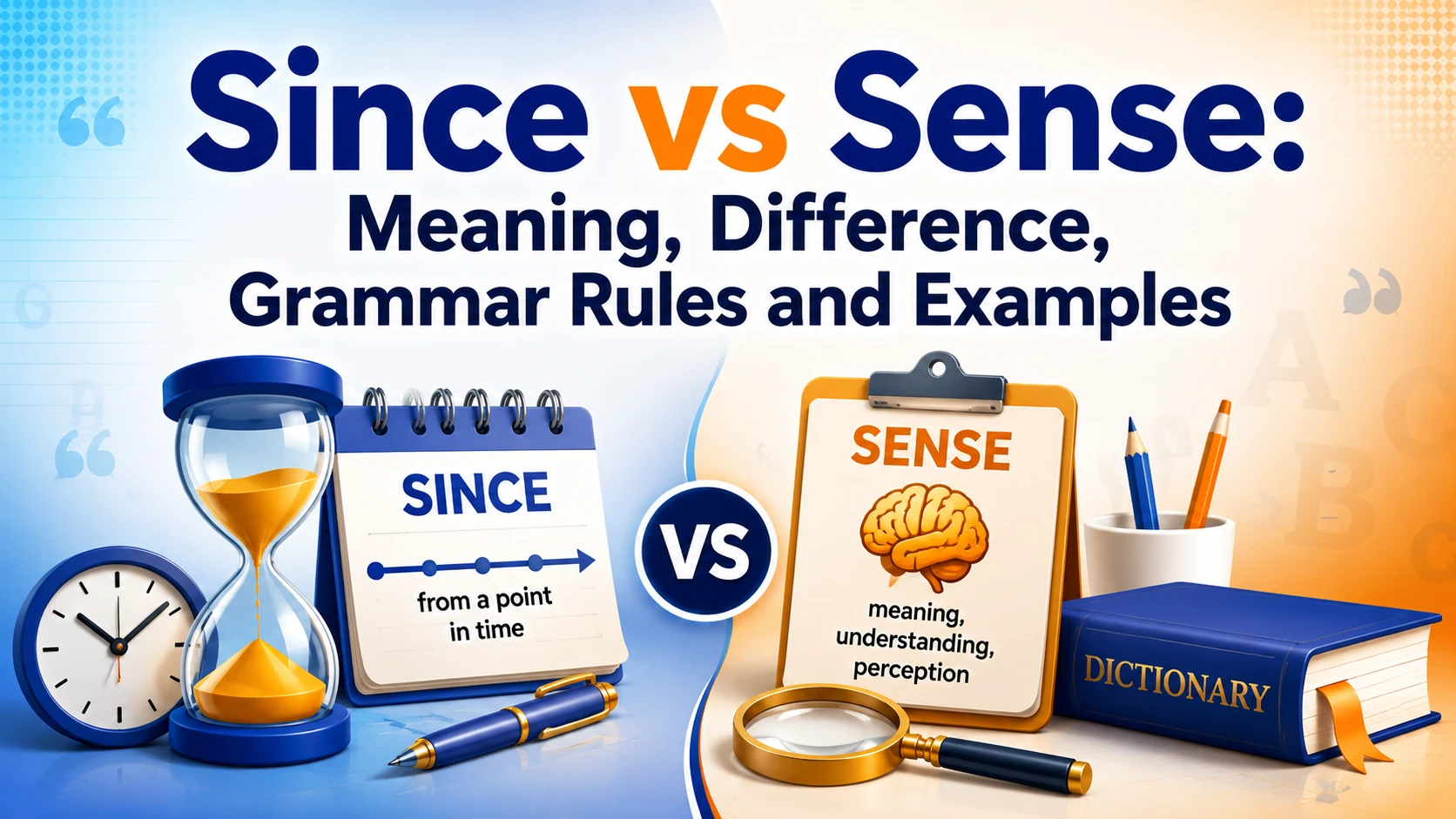
Since vs sense is a common source of confusion for English learners and even native speakers because the two words sound almost identical but serve entirely different purposes. Since relates to time or reason, while sense refers to perception, understanding, judgment, or meaning. Choosing the wrong word can make a sentence grammatically incorrect or completely change what you’re trying to say. Whether you’re writing an email, completing an assignment, or improving your grammar, knowing the distinction helps you communicate with greater accuracy and confidence.
English contains many homophones and near-homophones—words that sound alike but differ in spelling and meaning—and since and sense are among the most frequently confused. Their similar pronunciation often causes spelling mistakes, especially in informal writing, while their different grammatical roles create additional challenges. Understanding how each word functions in a sentence is more valuable than simply memorizing definitions because it enables you to recognize the correct choice in unfamiliar contexts.
This guide explains the meaning, grammar, pronunciation, usage rules, and real-world applications of since and sense in clear, practical language. You’ll learn when since express time or reason, how sense functions as both a noun and a verb, the mistakes writers make most often, and simple techniques that make choosing the correct word effortless. By the end, you’ll be able to use both words naturally in everyday conversation and formal writing.
Since vs Sense at a Glance
If you only need a quick answer, remember this:
- Since relates to time or reason.
- Sense relates to understanding, perception, awareness, or judgment.
Although they sound similar in many accents, they cannot replace each other because they belong to different parts of speech and carry different meanings.
The Quick Answer
Think of the words this way:
- Since = Time or Because
- Sense = Feeling, Meaning, or Understanding
Examples:
- I’ve lived here since 2020.
- Since it was raining, we stayed indoors.
- That explanation doesn’t make sense.
- Dogs have a strong sense of smell.
One word answers “when?” or “why?”, while the other answers “what do you understand or perceive?”
Side-by-Side Comparison Table
| Feature | Since | Sense |
| Main Meaning | From a point in time; because | Perception, understanding, judgment |
| Part of Speech | Preposition, conjunction, adverb | Noun, verb |
| Refers To | Time or reason | Awareness, meaning, feeling |
| Example | Since Monday | Common sense |
| Can Replace “Because”? | Yes (in many contexts) | No |
The Easiest Way to Remember the Difference
A simple memory trick is:
- Since starts with S + Time Start—it often marks when something began or explains why something happened.
- Sense contains the word “sens”, which appears in words related to sensation, sensitive, and sensory.
Quick Tip: If your sentence discusses time or cause, choose since. If it discusses understanding, perception, or the five senses, choose sense.
What Do “Since” and “Sense” Mean?
Before comparing the two words directly, it’s helpful to understand each one individually. Although their pronunciation is similar, their meanings developed independently and they perform different grammatical functions.
The Meaning of “Since”
The word since is primarily used to indicate:
- A starting point in time
- A reason or cause
- Continuation from a past event until now
Examples:
- We’ve been friends since childhood.
- She’s worked here since June.
- Since everyone agreed, the meeting ended early.
In each example, since connects events through time or cause rather than describing a physical or mental ability.
The Meaning of “Sense”
The word sense refers to:
- One of the body’s abilities to perceive the world
- Understanding or meaning
- Sound judgment
- Awareness or intuition
Examples:
- Humans have five traditional senses.
- That decision makes perfect sense.
- I sense something is wrong.
Unlike since, sense often relates to how we perceive, interpret, or understand information.
Why These Words Are Commonly Confused
The confusion usually comes from three factors:
- Their pronunciation is nearly identical in many English accents.
- They differ by only one letter.
- Spell-check tools may not catch the mistake because both are correctly spelled words.
For example:
❌ I have lived here sense 2021.
✅ I have lived here since 2021.
Or:
❌ That explanation doesn’t make since.
✅ That explanation doesn’t make sense.
Because both words are legitimate English words, proofreading for context—not just spelling—is essential.
Since vs Sense: What’s the Real Difference?
At first glance, these words seem closely related because they sound alike. In reality, they belong to different grammatical categories and answer different questions within a sentence.
Difference in Meaning
The biggest distinction is their meaning.
Since expresses:
- Time
- Duration
- Cause or reason
Sense expresses:
- Understanding
- Perception
- Awareness
- Judgment
- Meaning
For example:
- I’ve known her since college.
- His explanation made complete sense.
The first sentence establishes a timeline. The second evaluates understanding.
Difference in Grammar
These words also perform different grammatical roles.
Since can function as:
- A preposition
- A conjunction
- An adverb
Sense can function as:
- A noun
- A verb
Understanding these roles helps prevent grammatical mistakes, especially in formal writing.
Difference in Pronunciation and Spelling
In many accents, both words are pronounced almost the same.
However:
- Since ends with -ce.
- Sense ends with -se.
The spelling difference reflects their separate origins rather than a pronunciation change.
Comparison Table with Everyday Examples
| Situation | Correct Word | Example |
| Talking about time | Since | I’ve worked here since 2022. |
| Giving a reason | Since | Since you’re here, let’s begin. |
| Talking about understanding | Sense | That idea makes sense. |
| Referring to perception | Sense | Her sense of hearing is excellent. |
| Expressing intuition | Sense | I sensed a change in his attitude. |
Expert Insight: Instead of focusing on spelling alone, identify the role the word plays in the sentence. This approach dramatically reduces confusion.
How to Use “Since” Correctly
The word since is one of the most versatile words in English because it can function as a preposition, conjunction, or adverb. Despite these different roles, its meaning almost always revolves around time or reason.
Since as a Time Expression
The most common use of since identifies the point at which something began and continues until the present or another reference point.
Examples:
- I’ve lived in this city since 2018.
- She has studied French since high school.
- They’ve owned the business since last summer.
Notice that it introduces a specific starting point, not a duration.
Compare:
- Correct: I’ve worked here since January.
- Correct: I’ve worked here for three years.
The first identifies when the action began. The second tells how long it has lasted.
Since as a Conjunction Meaning “Because”
Since can also explain why something happens, acting as an alternative to because in many situations.
Examples:
- Since everyone was ready, we started early.
- Since the roads were closed, we canceled the trip.
- Since you already know the basics, we’ll move to the next lesson.
In formal writing, since often creates a smoother connection between ideas when the reason is already obvious to the reader.
Since with Present Perfect Tense
One of the most important grammar rules involves pairing since with the present perfect tense when describing actions that started in the past and continue to the present.
Examples:
- I have worked here since 2021.
- She has known him since childhood.
- They have lived abroad since graduating.
This pattern is extremely common in spoken and written English, making it essential for learners to master.
Since with Specific Points in Time
A key rule to remember is that since is used with a specific point in time, not a length of time. This distinction is one of the most common grammar challenges for English learners.
Specific points in time include:
- A year
- A month
- A day
- A date
- An event
- A moment in life
Examples:
- We’ve lived here since 2019.
- She’s been busy since Monday.
- They’ve been friends since childhood.
- I’ve enjoyed photography since my first camera.
By contrast, when talking about a period of time, English uses for instead.
Compare:
| Correct Usage | Explanation |
| Since 2018 | Starting point |
| Since last week | Starting point |
| Since graduation | Starting event |
| For six years | Length of time |
| For three months | Duration |
| For a long time | Duration |
Grammar Tip: If you can answer the question “When did it start?”, since is usually the correct choice.
Common Phrases That Use “Since”
English contains many everyday expressions. Learning them as complete phrases improves both fluency and accuracy.
Some of the most common include:
- Ever since
- Since then
- Since when?
- Since birth
- Since childhood
- Since yesterday
- Long since
Ever Since
Ever since it emphasizes continuous action from a past point until now.
Examples:
- We’ve been close friends ever since college.
- She’s loved painting ever since she was a child.
Since Then
This phrase refers to everything that happened after a previously mentioned event.
Example:
- He changed careers in 2021 and has been much happier since then.
Since when?
This question expresses surprise or asks when a new situation began.
Examples:
- Since when do you enjoy spicy food?
- Since when did she start learning Italian?
Example Sentences Using “Since”
Here are several examples showing different grammatical uses:
- I’ve worked remotely since January.
- Since traffic was heavy, we left earlier than planned.
- She’s been interested in astronomy since middle school.
- We haven’t seen each other since the conference.
- He’s improved significantly since last year.
Notice that since it consistently connects the sentence to either time or reason.
How to Use “Sense” Correctly
Unlike since, the word sense focuses on perception, understanding, awareness, or judgment. It appears frequently in everyday conversation, academic writing, psychology, literature, and science. Depending on the sentence, sense can function as either a noun or a verb.
Understanding these two roles helps eliminate confusion and makes your writing more precise.
Sense as a Noun
The noun sense has several related meanings, all centered on the idea of perceiving or understanding something.
Physical Senses
One of the earliest meanings refers to the body’s ability to perceive the world.
Examples include:
- Sense of sight
- Sense of hearing
- Sense of smell
- Sense of taste
- Sense of touch
Example sentences:
- Dogs have an excellent sense of smell.
- Birds rely on their sense of direction during migration.
- Her sense of hearing remained sharp despite her age.
Although we often refer to the traditional five senses, modern science recognizes additional sensory systems such as balance and body awareness.
Good Judgment or Practical Sense
Another common meaning refers to sound decision-making.
Examples:
- She has excellent business sense.
- He showed good sense by saving money early.
- Use your common sense before making a decision.
Here, sense refers to wisdom, logic, or practical thinking rather than physical perception.
Meaning or Understanding
The noun also describes whether something is understandable.
Examples:
- That explanation makes sense.
- Your argument makes perfect sense.
- This paragraph doesn’t make much sense.
One of the most common English expressions is:
“Make sense.”
It simply means to be logical or understandable.
Sense as a Verb
Although less common than the noun, sense can also function as a verb.
When used this way, it means:
- To detect
- To become aware of
- To perceive
- To notice something through instinct or observation
Examples:
- I sense that something is wrong.
- She sensed hesitation in his voice.
- The device can sense movement automatically.
- Animals often sense danger before humans do.
Notice that the verb doesn’t always involve one of the five senses. It frequently refers to intuition or subtle awareness.
Common Expressions with “Sense”
Many everyday English expressions use sense naturally.
Some of the most common include:
- Make sense
- Common sense
- Sense of humor
- Sense of responsibility
- Sense of direction
- Sense of purpose
- Sense of achievement
- Sense of belonging
- Sense of urgency
These collocations appear frequently in conversations, books, newspapers, and professional writing.
Example sentences:
- She has a wonderful sense of humor.
- Good leaders demonstrate a strong sense of responsibility.
- Traveling alone improved his sense of independence.
- The manager created a sense of urgency before the project deadline.
Learning these phrases as complete units helps you sound more natural than memorizing the word in isolation.
Example Sentences Using “Sense”
Below are examples illustrating different meanings of sense.
Physical perception
- Sharks have an extraordinary sense of smell.
- My sense of taste returned after I recovered.
Understanding
- Your explanation finally makes sense.
- That solution doesn’t make much sense.
Judgment
- She showed remarkable common sense during the emergency.
- Investing carefully demonstrates financial sense.
Verb
- I could sense his disappointment immediately.
- Modern smartphones can sense changes in orientation.
These examples demonstrate how one word can express perception, reasoning, awareness, and intuition depending on context.
Grammar Rules You Need to Know
Understanding the grammar behind since and sense prevents mistakes that simple definitions cannot.
Rather than asking, “Which spelling looks right?” ask:
What job is this word doing in the sentence?
That question usually leads to the correct answer.
When “Since” Functions as a Preposition
As a preposition, since it introduces a starting point in time.
Structure:
Since + specific time
Examples:
- Since Monday
- Since 2015
- Since graduation
- Since breakfast
Example sentences:
- I’ve been working here since April.
- Nothing has changed since last week.
When “Since” Functions as a Conjunction
As a conjunction, since it connects two clauses.
It usually expresses either:
- Time
- Reason
Examples:
Time:
- She’s been happier since she changed jobs.
Reason:
- Since everyone agreed, we approved the proposal.
Understanding the surrounding context tells you which meaning applies.
Countable and Uncountable Uses of “Sense”
Most of the time, sense is a countable noun.
Examples:
- The five senses
- A sense of humor
- A sense of direction
However, in expressions involving understanding or awareness, it often behaves like an abstract concept.
Examples:
- It makes sense.
- That doesn’t make sense.
You rarely count these uses individually because they describe ideas rather than physical objects.
Common Sentence Patterns
Learning recurring sentence structures helps reinforce correct usage.
| Pattern | Example |
| Since + point in time | Since 2020 |
| Since + clause | Since we arrived |
| Since + reason | Since you’re here |
| Make sense | That makes sense. |
| Sense of + noun | Sense of humor |
| Sense + verb | I sensed trouble. |
Instead of memorizing isolated rules, focus on these patterns. You’ll begin recognizing them naturally while reading, listening, and writing.
Since vs Sense in Everyday English
Although since and sense have distinct meanings, both appear frequently in everyday communication. Understanding how they function in different situations helps you choose the correct word naturally rather than relying on memorization.
Conversations
In casual speech, since usually refers to time or gives a reason, while sense often relates to understanding or intuition.
Examples:
- I haven’t seen her since last Friday.
- Since you’re already here, let’s have lunch together.
- That explanation makes perfect sense.
- I sense you’re not convinced.
Because these words sound alike in many accents, spoken English rarely causes confusion. Most mistakes happen in writing.
Emails and Professional Writing
Professional communication requires precise word choice because spelling errors can affect credibility.
Correct examples:
- We’ve been working together since March.
- Since the deadline changed, we’ve updated the schedule.
- Your proposal makes excellent sense from a financial perspective.
- I sense some hesitation about the new policy.
Using the wrong word in business emails can distract readers from your message.
Academic Writing
Academic English often uses both words, but for different purposes.
Since commonly introduces:
- Historical timelines
- Research periods
- Logical reasons
Example:
- The study has expanded significantly since its initial publication.
Sense appears when discussing:
- Psychology
- Literature
- Philosophy
- Human perception
- Linguistics
Example:
- The novel creates a strong sense of isolation.
News and Journalism
Journalists frequently use since to establish timelines.
Examples:
- The company has doubled its revenue since 2022.
- Traffic has improved since the new highway opened.
Meanwhile, sense often describes public opinion or interpretation.
Examples:
- Residents expressed a growing sense of optimism.
- Officials reported a sense of urgency.
Social Media and Informal Communication
Informal writing often shortens sentences, making context even more important.
Examples:
- Haven’t laughed this much since college.
- That meme makes no sense.
- I sense drama coming.
Even in casual communication, choosing the correct spelling improves clarity.
Common Collocations and Expressions
Learning words in common combinations is one of the fastest ways to sound natural in English.
Popular Collocations with “Since”
Frequently used combinations include:
- Since yesterday
- Since birth
- Since childhood
- Since then
- Ever since
- Since last year
- Since the beginning
- Since recently
Example sentences:
- She’s loved music since childhood.
- We’ve stayed in touch ever since graduation.
- Sales have increased since the beginning of the year.
Popular Collocations with “Sense”
Some of the most common collocations are:
- Common sense
- Sense of humor
- Sense of direction
- Sense of responsibility
- Sense of purpose
- Sense of achievement
- Sense of belonging
- Sense of confidence
- Sense of security
- Sense of pride
These expressions appear across spoken English, literature, education, and business communication.
Idioms That Include “Sense”
English also contains several idioms featuring sense.
Examples include:
- Come to your senses
- Knock some sense into someone
- Talk sense
- Make sense
- See sense
Example sentences:
- He finally came to his senses and apologized.
- Please talk sense instead of guessing.
- Your explanation really makes sense now.
Understanding these idioms improves both comprehension and natural expression.
Since vs Sense in Real-Life Contexts
Looking at real situations helps reinforce when each word belongs.
Workplace Communication
Managers often write:
- We’ve used this software since 2021.
- Since productivity increased, we’re expanding the team.
Employees may also say:
- Your suggestion makes good sense.
- I sense the client has concerns.
Notice how one word establishes time or reason, while the other evaluates understanding or perception.
School and Education
Teachers regularly use since when discussing historical events or grammar.
Examples:
- Students have studied this topic since September.
- Since everyone finished early, we’ll review together.
Meanwhile, sense appears in reading comprehension and creative writing.
Examples:
- The story creates a strong sense of mystery.
- That conclusion doesn’t make sense.
Healthcare and Psychology
Medical professionals may write:
- The patient has improved since beginning treatment.
Psychologists might discuss:
- A person’s sense of identity.
- A child’s sense of safety.
- Emotional sense of belonging.
Although both words appear in healthcare, they describe entirely different concepts.
Business and Customer Service
Businesses frequently discuss:
- Sales since last quarter.
- Customer satisfaction since launching the service.
They also evaluate:
- Consumer sense of trust.
- Brand sense of identity.
Marketing often focuses on creating positive emotional associations rather than simply presenting facts.
Everyday Decision-Making
Daily conversations naturally include both words.
Examples:
- I’ve exercised regularly since January.
- That decision makes financial sense.
- Since traffic is heavy, let’s leave earlier.
- I sense we’re forgetting something.
These examples demonstrate that both words appear frequently but never replace one another.
Common Mistakes When Using Since and Sense
Even experienced writers occasionally confuse these words because spell-check software doesn’t identify correctly spelled but contextually incorrect words.
Using “Sense” Instead of “Since”
Incorrect:
❌ I’ve lived here sense 2018.
Correct:
✅ I’ve lived here since 2018.
Whenever you’re referring to a starting point in time, use since.
Misusing “Since” in Time Expressions
Some learners incorrectly combine since with durations.
Incorrect:
❌ I’ve lived here since three years.
Correct:
✅ I’ve lived here for three years.
Or:
✅ I’ve lived here since 2022.
Remember:
- Since = starting point
- For = duration
Confusing Cause with Time
Because since has two meanings, readers must interpret context carefully.
Example:
- Since you’re already here, let’s begin.
Here, since means because, not time.
Understanding the sentence’s purpose prevents misinterpretation.
Spelling Errors Caused by Similar Pronunciation
Many learners simply write whichever spelling “looks right.”
The solution isn’t memorizing spellings—it is identifying the word’s function.
Ask yourself:
- Am I talking about time?
- Am I giving a reason?
- Am I discussing understanding or perception?
The answer immediately reveals the correct spelling.
How to Choose the Right Word Every Time
Instead of relying on memory alone, use a simple decision-making process.
Ask Whether You’re Talking About Time, Reason, or Meaning
Begin by asking:
Does this sentence describe when something happened?
Choose since.
Does it explain why something happened?
Usually choose since.
Does it describe understanding, judgment, or perception?
Choose sense.
Identify the Word’s Job in the Sentence
Determine whether the word functions as:
- Preposition
- Conjunction
- Adverb
- Noun
- Verb
If it functions as a noun or verb involving awareness, it almost certainly makes sense.
A Simple Memory Trick
Think of these associations:
Since → Start
Both begin with S and relate to a starting point.
Sense → Senses
The spelling reminds you of:
- Sensory
- Sensitive
- Sensation
These words all relate to perception.
Quick Decision Table
| Ask Yourself | Correct Word |
| Am I referring to a starting point in time? | Since |
| Am I giving a reason? | Since |
| Am I talking about understanding? | Sense |
| Am I describing perception or intuition? | Sense |
| Does it mean “make logic”? | Sense |
Similar Words That Often Cause Confusion
Since vs For
- Since refers to a starting point.
- For refers to duration.
Examples:
- Since Monday
- For two weeks
Since vs Because
Both can express reasons.
However, because is usually more direct, while since often introduces information the reader already knows.
Example:
- Since it was late, we went home.
- Because it was late, we went home.
Both are correct, but the tone differs slightly.
Sense vs Feeling
Although related, these words aren’t identical.
- Sense often refers to perception or understanding.
- Feeling usually refers to emotion or physical sensation.
Sense vs Meaning
Sometimes sense means “meaning.”
Example:
- That sentence doesn’t make sense.
But meaning refers specifically to definition or interpretation, while sense often includes logic and coherence.
Since vs Ever Since
Ever since emphasizes continuity more strongly than since.
Compare:
- We’ve been neighbors since 2015.
- We’ve been neighbors ever since we moved here.
Both are correct, but the second emphasizes the continuous relationship.
Practice Exercises
Exercise 1: Choose the Correct Word
Choose since or sense.
- I’ve worked here _____ 2021.
- That explanation makes perfect _____.
- _____ everyone agreed, the meeting ended early.
- Dogs have a strong _____ of smell.
- I could _____ something unusual.
Exercise 2: Correct the Mistake
Find and correct the incorrect word.
- I’ve known her sense high school.
- That idea doesn’t make since.
- We’ve waited since three hours.
Exercise 3: Fill in the Blank
Complete each sentence.
- We’ve lived here ______ graduation.
- She has an excellent ______ of humor.
- ______ you’re ready, let’s begin.
- I can ______ that something changed.
Answer Key with Explanations
- Since
- Sense
- Since
- Sense
- Sense
Corrections:
- Since high school
- Makes sense
- For three hours
Expert Tips for Avoiding Since vs Sense Mistakes
Focus on the Sentence Function
Always identify what role the word performs instead of relying on pronunciation.
Learn Words Through Context Instead of Memorization
Reading authentic English helps you recognize natural usage patterns much faster than isolated vocabulary lists.
Read Common English Collocations
Expressions like common sense, make sense, since then, and ever since become automatic through repeated exposure.
Proofread for Homophone Errors
Spell-check won’t catch every mistake. During proofreading, pay special attention to commonly confused words like since and sense.
Conclusion
Mastering since vs sense is less about memorizing spellings and more about understanding the role each word plays in a sentence. Since connects ideas through time or reason, while sense relates to perception, understanding, intuition, or good judgment. Once you recognize this distinction, choosing the correct word becomes much easier in conversations, academic writing, business communication, and everyday English. One final actionable tip: before writing either word, pause and ask whether you’re describing when or why something happened or what is understood or perceived. A common mistake to avoid is relying on pronunciation alone—these words may sound alike, but their meanings and grammatical functions are entirely different.
FAQs
Q1. Is “since” a preposition or a conjunction?
Since it can function as both. It acts as a preposition when introducing a point in time (“since Monday”) and as a conjunction when introducing a clause that expresses time or reason (“Since you arrived, everything has changed”).
Q2. Can “since” mean “because”?
Yes. In many contexts, since functions as a synonym for because, especially when the reason is already understood or less emphatic. However, because it is often preferred when the cause needs stronger emphasis or greater clarity.
Q3. Is “sense” only related to the five senses?
No. While sense can refer to sight, hearing, smell, taste, and touch, it also describes judgment, intuition, understanding, meaning, responsibility, and awareness. Expressions like common sense and sense of purpose have nothing to do with physical perception.
Q4. Why do people confuse “since” and “sense”?
The confusion comes mainly from their similar pronunciation. Because both are correctly spelled English words, spell-checkers may not detect the error. Focusing on the word’s meaning and grammatical function is the most reliable way to choose the correct one.
Q5. How can I remember the difference between “since” and “sense”?
Think of since as referring to time or reason, and sense as relating to understanding or perception. A helpful memory trick is that sense appears in words like sensory and sensation, while since it often introduces a starting point in time.