

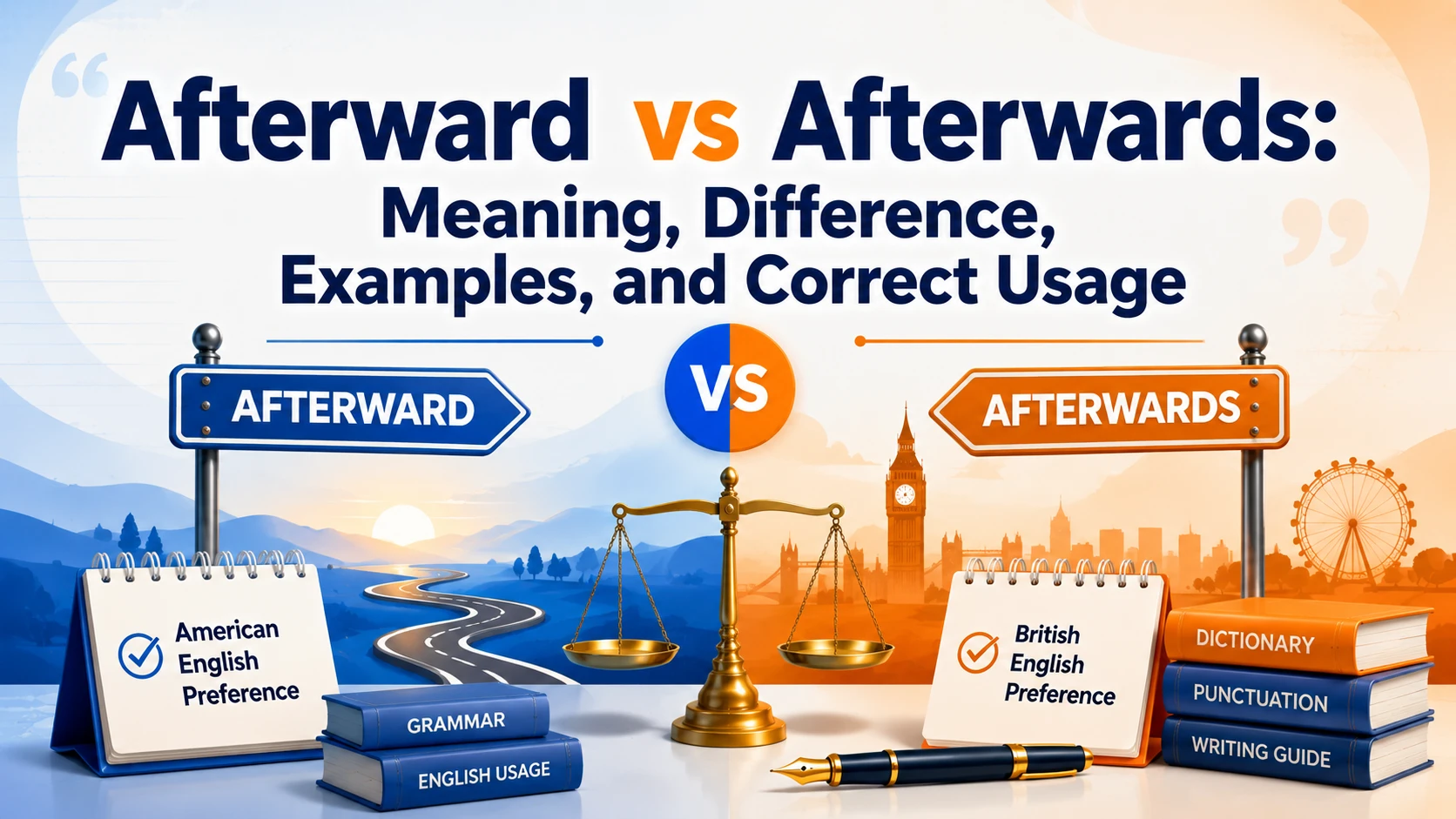
Afterward vs afterwards is a spelling variation that often leaves English learners and even experienced writers wondering which form is correct. The good news is that both words are grammatically correct and share the same meaning. The real difference lies in regional English preferences, writing style, and consistency rather than grammar. Whether you’re writing a business email, an academic paper, or casual content online, understanding when to choose afterward or afterwards helps you produce polished, natural-sounding English that matches your audience’s expectations.
Many spelling differences in English—such as color vs colour, toward vs towards, and forward vs forwards—reflect the evolution of American and British English rather than differences in meaning. Afterward and afterwards belong to the same category. Although the extra -s may seem insignificant, using the preferred form for your audience creates consistency and demonstrates attention to detail. Writers who understand these regional conventions are less likely to mix spelling styles, a mistake that editors frequently notice.
This guide explains the meaning, grammar, regional usage, sentence structure, punctuation, and practical applications of afterward and afterwards in plain English. You’ll discover whether one form is more formal than the other, how dictionaries and style guides treat each spelling, common mistakes to avoid, useful alternatives, and simple memory tricks that make choosing the right form effortless. By the end, you’ll be able to use both words confidently in academic, professional, and everyday writing.
Afterward vs Afterwards at a Glance
If you’re looking for a quick answer, here’s the essential point:
- Afterward and afterwards have the same meaning.
- Neither spelling is more grammatically correct.
- American English generally prefers “afterward.”
- British English generally prefers “afterwards.”
Your choice depends on which variety of English you’re writing in, not on grammar or meaning.
The Quick Answer
Think of it this way:
- Afterward = Preferred in American English
- Afterwards = Preferred in British English
Examples:
- We went out for dinner, and afterward we watched a movie. (American English)
- We went out for dinner, and afterwards we watched a movie. (British English)
Both sentences are equally correct. Only the regional spelling preference changes.
Side-by-Side Comparison Table
| Feature | Afterward | Afterwards |
| Meaning | Later; after that | Later; after that |
| Grammar | Adverb | Adverb |
| American English | Preferred | Less common |
| British English | Accepted but less common | Preferred |
| Formal Writing | Correct | Correct |
| Pronunciation | Same | Same |
Which One Should You Use?
The best choice depends on your audience.
| Audience | Recommended Form |
| United States | Afterward |
| Canada (most publications) | Afterward |
| United Kingdom | Afterwards |
| Australia | Afterwards (more common) |
| International audience | Either—remain consistent |
Quick Tip: The most important rule isn’t choosing one spelling over the other—it’s using the same form consistently throughout your document.
What Do “Afterward” and “Afterwards” Mean?
Before exploring regional preferences, it’s important to understand what these words actually mean.
Both afterward and afterwards are adverbs that refer to a later time or something that happens after a previously mentioned event.
They answer questions such as:
- What happened next?
- What happened later?
- What followed?
Examples:
- We finished the meeting and talked afterward.
- She called me afterwards to confirm the details.
In both sentences, the word indicates what occurred after an earlier action.
Definition of “Afterward”
Afterward means:
- At a later time
- Following an earlier event
- Subsequently
- After that
Examples:
- We visited the museum and went shopping afterward.
- He apologized afterward for his comments.
- Everyone relaxed afterward.
Notice that the word doesn’t specify how much later the event occurred. It simply indicates sequence.
Definition of “Afterwards”
The definition of afterwards is identical.
It also means:
- Later
- After that
- Subsequently
- Following an earlier event
Examples:
- We had dinner and watched a film afterwards.
- She emailed me afterwards.
- The team celebrated afterwards.
The additional -s does not change the meaning in any way.
Do They Have Different Meanings?
No.
This is one of the biggest misconceptions about these words.
Many learners assume:
- One is more formal.
- One refers to a longer period.
- One has a different grammatical function.
None of these assumptions is correct.
Both words:
- Mean exactly the same thing.
- Function as adverbs.
- Can appear in the same sentence positions.
- Express the same relationship between events.
The only practical difference is regional spelling preference.
Afterward vs Afterwards: What’s the Difference?
Since the meanings are identical, what actually distinguishes these two words?
The answer lies in spelling conventions, regional English, and editorial consistency rather than grammar.
Difference in Spelling
The only visible difference is the final letter.
- Afterward
- Afterwards
That single -s reflects a historical spelling variation that survives in modern English.
This pattern appears in several other English words:
| American English | British English |
| Toward | Towards |
| Forward | Forwards |
| Backward | Backwards |
| Upward | Upwards |
| Downward | Downwards |
These variations developed naturally as English evolved in different regions.
Difference in Meaning
There is no difference in meaning.
Whether you write:
- We’ll discuss it afterward.
or
- We’ll discuss it afterwards.
The message remains exactly the same.
Readers interpret both as:
“Later.”
Difference in Grammar
Both words function as adverbs.
They modify verbs by describing when an action occurs.
Examples:
- We talked afterward.
- We talked afterwards.
Neither word changes tense, sentence structure, or grammatical meaning.
Are They Interchangeable?
Yes—with one important condition.
They are interchangeable only if you’re consistent with your chosen variety of English.
For example:
American English:
- We met afterward.
- We left afterward.
- We celebrated afterward.
British English:
- We met afterwards.
- We left afterwards.
- We celebrated afterwards.
Avoid switching between the two spellings in the same article, report, or website unless you’re quoting material that uses a different regional style.
Quick Comparison Table
| Question | Answer |
| Same meaning? | Yes |
| Same pronunciation? | Yes |
| Same grammar? | Yes |
| American preference? | Afterward |
| British preference? | Afterwards |
| Can both appear in dictionaries? | Yes |
Expert Insight: Editors rarely object to either spelling by itself. What they do notice is inconsistency. Choosing one regional style and applying it throughout your writing creates a more professional and trustworthy impression.
Is “Afterward” or “Afterwards” More Correct?
One of the most common questions English learners ask is whether one spelling is “proper” while the other is incorrect.
The short answer is no.
Both spellings are recognized by major dictionaries and accepted in standard English.
Why Both Forms Are Grammatically Correct
English contains several pairs of words that differ only because of regional spelling traditions.
Just as:
- color / colour
- organize / organise
- toward / towards
both remain correct within their respective language varieties, afterward and afterwards follow the same principle.
The grammatical function never changes.
Both act as adverbs meaning:
- later
- after that
- subsequently
The choice depends on style rather than grammar.
Which Form Modern Dictionaries Prefer
Leading dictionaries recognize both spellings.
However, they usually indicate regional preference:
- Afterward is the primary entry in American dictionaries.
- Afterwards is more common in British dictionaries and publications.
Rather than declaring one “right,” dictionaries explain where each form is most commonly used.
Does One Sound More Formal?
Not really.
Both spellings appear in:
- Newspapers
- Academic writing
- Business communication
- Books
- Government publications
- Everyday conversation
Formality depends far more on sentence structure, vocabulary, and tone than on whether you choose afterward or afterwards.
For example:
- The committee met afterward to review the proposal.
- The committee met afterwards to review the proposal.
Both sound equally professional.
British English vs American English Usage
The primary difference between afterward and afterwards isn’t grammar or meaning—it’s regional preference. Understanding these conventions helps you write naturally for your intended audience and maintain consistency throughout your work.
Modern English has evolved into several major varieties, with American English and British English being the most influential. Over time, each developed its own spelling preferences. The -ward and -wards variation is one of the clearest examples of this evolution.
Why American English Usually Prefers “Afterward”
American English generally favors forms without the final -s in many directional or time-related adverbs.
For example:
- afterward
- toward
- forward
- backward
- upward
- downward
Examples:
- We discussed the proposal afterward.
- I’ll explain everything afterward.
- She thanked everyone afterward.
This preference became more consistent during the standardization of American spelling in the nineteenth century. Although afterwards is still understood in the United States, it appears far less often in newspapers, educational materials, and professional writing.
Why British English Commonly Uses “Afterwards”
British English traditionally prefers the -wards ending in many everyday words.
Examples include:
- afterwards
- towards
- forwards
- backwards
- upwards
- downwards
Examples:
- We went for coffee afterwards.
- They spoke privately afterwards.
- Everyone celebrated afterwards.
Readers in the United Kingdom generally expect this spelling because it aligns with other familiar British forms.
Regional Preferences Around the English-Speaking World
Other English-speaking countries often follow one of these conventions, although local publications may vary.
| Country or Region | Common Preference |
| United States | Afterward |
| Canada | Afterward (more common) |
| United Kingdom | Afterwards |
| Australia | Afterwards |
| New Zealand | Afterwards |
| Ireland | Afterwards |
International companies sometimes choose one style guide and apply it globally to maintain brand consistency.
Should You Change Your Writing for Your Audience?
Yes.
Choosing the spelling your audience expects improves readability and professionalism.
For example:
- Writing for an American university? Use afterward.
- Publishing for a British magazine? Use afterwards.
- Creating a global website? Either form is acceptable, but remain consistent throughout every page.
Expert Tip: Consistency is more important than preference. Switching between afterward and afterwards in the same document can make your writing appear unedited.
How to Use “Afterward” Correctly
Although afterward is simple to understand, many learners aren’t sure where it belongs in a sentence. As an adverb, it describes when something happens and typically refers to an event that follows another.
Afterward in Everyday Conversation
In casual speech, afterward naturally links events in chronological order.
Examples:
- We watched a movie and talked afterward.
- I’ll call you afterward.
- Let’s discuss it afterward.
These sentences sound natural because afterward eliminates the need to repeat phrases like later that day or following the meeting.
Afterward in Academic and Professional Writing
Professional writers often use afterward to improve the flow of reports, essays, and emails.
Examples:
- The participants completed a survey afterward.
- The committee met afterward to review the findings.
- Employees received feedback afterward.
Using afterward helps connect ideas smoothly without making sentences unnecessarily long.
Common Sentence Patterns
Here are several common structures you’ll encounter:
At the end of a sentence
- We celebrated afterward.
- She apologized afterward.
At the beginning of a sentence
- Afterward, everyone returned to work.
- Afterward, we reviewed the results together.
In the middle of a sentence
- We afterward realized the mistake.
Although grammatically possible, placing afterward in the middle of a sentence is much less common. Most writers prefer the beginning or end for greater clarity.
Example Sentences Using “Afterward”
- We met the clients and had lunch afterward.
- She felt much better afterward.
- The students discussed the lecture afterward.
- Everyone signed the documents afterward.
- I’ll explain the details afterward.
Notice that afterward simply indicates sequence without specifying an exact time.
How to Use “Afterwards” Correctly
The usage of afterwards is virtually identical. The only noticeable difference is that it follows British English spelling conventions.
Afterwards in Daily Communication
British speakers commonly use afterwards in both speech and writing.
Examples:
- We visited the museum and had tea afterwards.
- I’ll see you afterwards.
- They spoke privately afterwards.
These examples sound completely natural in British English.
Afterwards in British Publications
Books, newspapers, and magazines published in the UK frequently prefer afterwards.
Examples:
- The minister addressed reporters afterwards.
- The guests gathered afterwards for refreshments.
- The report was released afterwards.
Readers accustomed to British English usually expect this spelling.
Common Sentence Patterns
Like afterward, afterwards can appear in several positions.
Beginning
- Afterwards, everyone left quietly.
End
- We continued the discussion afterwards.
After a clause
- The ceremony ended, and afterwards everyone attended the reception.
Example Sentences Using “Afterwards”
- We went shopping afterwards.
- He phoned me afterwards.
- Everyone laughed afterwards.
- She explained everything afterwards.
- We celebrated the victory afterwards.
The meaning remains exactly the same regardless of placement.
Grammar Rules You Need to Know
Although choosing between afterward and afterwards is primarily a spelling decision, understanding their grammatical role helps you use them more naturally.
Parts of Speech and Sentence Function
Both words function exclusively as adverbs.
They answer questions such as:
- When?
- What happened next?
- At what later time?
Examples:
- They met afterward.
- We spoke afterwards.
Neither word functions as a noun, adjective, or verb.
Position in a Sentence
One advantage of these adverbs is their flexibility.
They commonly appear:
- At the beginning
- At the end
- Occasionally after a conjunction
Examples:
- Afterward, we reviewed the results.
- We reviewed the results afterward.
- The meeting ended, and afterward everyone left.
Sentence-final position is by far the most common in everyday writing.
Punctuation Tips
When afterward or afterwards begins a sentence, it’s usually followed by a comma.
Examples:
- Afterward, we continued the discussion.
- Afterwards, everyone returned home.
When the word appears at the end of a sentence, no comma is needed.
Example:
- Everyone returned home afterward.
Proper punctuation improves readability without changing meaning.
Can You Start a Sentence with Afterward or Afterwards?
Absolutely.
Many writers begin sentences with these adverbs to create smoother transitions between ideas.
Examples:
- Afterward, the team analyzed the results.
- Afterwards, they prepared the final report.
- Afterward, we discovered a better solution.
Starting a sentence this way helps maintain a logical flow, especially in longer pieces of writing.
Common Grammar Patterns
The following patterns occur frequently in English.
| Pattern | Example |
| Verb + afterward | We met afterward. |
| Verb + afterwards | We met afterwards. |
| Afterward + comma | Afterward, we left. |
| Afterwards + comma | Afterwards, we left. |
| Clause + afterward | The meeting ended afterward. |
| Clause + afterwards | The meeting ended afterwards. |
Rather than memorizing isolated rules, focus on these recurring patterns. With regular exposure through reading and writing, using afterward and afterwards becomes intuitive.
Afterward vs Afterwards in Real-Life Contexts
Learning grammar is useful, but knowing how these words appear in everyday communication is what builds confidence. Whether you’re writing an email, preparing a report, or posting on social media, afterward and afterwards work naturally when they match your chosen variety of English.
Workplace Emails and Business Writing
Professional writing often describes events in chronological order, making these adverbs especially useful.
American English
- We will review the proposal afterward.
- Please join us for refreshments afterward.
- The manager answered additional questions afterward.
British English
- We will review the proposal afterwards.
- Please stay afterwards for a short discussion.
- The team met afterwards to evaluate the project.
School and Academic Assignments
Students frequently describe research methods, experiments, and historical events.
Examples:
- Participants completed a questionnaire afterward.
- The results were analyzed afterwards.
- The researcher interviewed volunteers afterward.
Books, Journalism, and Publishing
Writers use these words to create smooth transitions between events.
Example:
The ceremony concluded at noon. Afterward, guests gathered for a reception.
or
The ceremony concluded at noon. Afterwards, guests gathered for a reception.
Both versions communicate exactly the same sequence.
Social Media and Everyday Conversations
These adverbs also appear in casual writing.
Examples:
- We grabbed pizza afterward.
- We talked for hours afterwards.
- Let’s meet afterward.
- I’ll text you afterwards.
Common Expressions and Natural Usage
Although afterward and afterwards are common transition words, they’re only one way to express sequence.
Frequently Used Phrases
Common combinations include:
- shortly afterward
- immediately afterward
- soon afterward
- long afterward
- shortly afterwards
- immediately afterwards
- years afterward
- months afterwards
Examples:
- She called shortly afterward.
- The announcement came immediately afterwards.
Alternatives That Mean the Same Thing
Depending on context, you may also use:
- later
- then
- subsequently
- afterward(s)
- following that
- eventually
- later on
Each carries a slightly different tone.
| Alternative | Best Used When |
| Later | Casual conversation |
| Then | Showing sequence in stories |
| Subsequently | Formal or academic writing |
| Following that | Reports and presentations |
| Eventually | Longer passage of time |
When Another Transition Word Is Better
Sometimes afterward isn’t the strongest choice.
Instead of:
Afterward, the company announced its quarterly earnings.
You might write:
Subsequently, the company announced its quarterly earnings.
The second version sounds more formal and fits business writing better.
Afterward vs Afterwards vs Later vs Then
Many English learners wonder whether these words are interchangeable. They overlap, but each has its own nuance.
| Word | Meaning | Typical Use |
| Afterward | Later, after that | American English |
| Afterwards | Later, after that | British English |
| Later | At a future time | Universal |
| Then | Next in sequence | Stories, instructions |
| Subsequently | Following an earlier event | Formal writing |
Afterward vs Later
Later can refer to any future time.
Example:
- I’ll call you later.
Afterward refers specifically to something that happens after another event.
Example:
- We finished dinner and talked afterward.
Afterwards vs Then
Then simply indicates the next step.
Example:
- Finish the report, then email it.
Afterwards often summarizes what happened after an entire event.
Example:
- The presentation ended. Afterwards, everyone networked.
Afterward vs Subsequently
Subsequently sounds considerably more formal.
Academic example:
- The samples were collected and subsequently analyzed.
Everyday English:
- The samples were collected, and afterward they were analyzed.
Both are correct, but they suit different audiences.
Common Mistakes Writers Make
Most mistakes involve style rather than grammar.
Mixing British and American Spellings
Incorrect:
- We met afterward, and afterwards we had coffee.
Choose one spelling and use it consistently.
Using Both Forms in the Same Document
Editors look for consistency.
If your document includes:
- organization
- color
- center
then afterward fits best.
If it includes:
- organisation
- colour
- centre
then afterwards is the better choice.
Confusing “Afterward” with “After”
These words aren’t interchangeable.
Correct:
- We talked afterward.
Correct:
- We talked after dinner.
Incorrect:
- We talked afterward at dinner.
Overusing Transitional Adverbs
Repeating afterward in every paragraph creates repetitive writing.
Instead, vary your transitions.
Consider alternating with:
- later
- then
- subsequently
- following that
- eventually
How to Remember the Difference
Fortunately, remembering the difference is easy.
The “-S” Memory Trick
Think:
S = Standard British spelling
- Afterwards → British English
- Afterward → American English
Although this isn’t a grammar rule, it’s a useful memory aid.
Think About Your Target Audience
Ask yourself:
- Am I writing for American readers?
- Am I writing for British readers?
The answer usually determines the correct spelling.
A Simple Decision Guide
| If you’re writing for… | Use |
| American readers | Afterward |
| British readers | Afterwards |
| International readers | Either (stay consistent) |
Quick Reference Checklist
Before publishing, ask:
- ✅ Did I choose one spelling?
- ✅ Is it consistent throughout?
- ✅ Does it match my audience?
- ✅ Does it fit my style guide?
If you answered yes to all four, you’ve made the right choice.
Expert Tip: Professional editors rarely reject either spelling. They do, however, notice inconsistent language styles within the same document.
Similar Word Pairs That Cause Confusion
Afterward and afterwards belong to a larger group of regional spelling variations.
Toward vs Towards
- Toward → American English
- Towards → British English
Forward vs Forwards
Again, both are correct, but regional preference differs.
Backward vs Backwards
The same spelling pattern appears here.
Anyway vs Anyways
Unlike afterward/afterwards, anyways is considered informal in most professional writing.
Among vs Amongst
Both are correct, although among is much more common in modern English.
Understanding these related word pairs makes regional spelling patterns easier to recognize.
Practice Exercises
Exercise 1: Choose the Correct Form
Select the preferred spelling for the audience.
- The meeting ended, and everyone left ________. (American English)
- We’ll discuss the issue ________. (British English)
- She called me shortly ________. (American English)
- The guests stayed for coffee ________. (British English)
Exercise 2: Rewrite the Sentence
Rewrite these sentences for the opposite variety of English.
- We spoke afterward.
- I’ll explain afterward.
- They celebrated afterwards.
- She arrived afterwards.
Exercise 3: Identify the Preferred Regional Usage
Choose whether the sentence is better suited for:
- American English
- British English
Example:
We talked afterwards.
Answer: British English
Answer Key with Explanations
- afterward
- afterwards
- afterward
- afterwards
The only change is the preferred regional spelling—not the meaning or grammar.
Expert Tips for Consistent and Natural Usage
Match Your Audience’s English Variety
Choose the spelling your readers expect.
Stay Consistent Throughout Your Writing
Never switch between regional spellings unless you’re quoting another source.
Read High-Quality Publications for Exposure
Reading respected newspapers, books, and academic journals helps you recognize natural usage patterns.
Proofread for Regional Consistency
Before publishing, search your document for both spellings to ensure you’ve used only one consistently.
Conclusion
Choosing between afterward and afterwards is much simpler than many writers assume. Both spellings are correct, share the same meaning, and function identically in English grammar. The only real distinction is regional preference: afterward is generally favored in American English, while afterwards is more common in British English. Once you identify your audience, the decision becomes straightforward. One final actionable tip: select one spelling before you begin writing and keep it consistent throughout your document. A common mistake to avoid is mixing American and British spellings in the same piece of writing. Consistency creates polished, professional content and helps your writing feel natural to every reader.
FAQs
Q1. Is “afterward” or “afterwards” correct?
Both are grammatically correct and have the same meaning. The difference is regional: afterward is preferred in American English, while afterwards is more common in British English. Choose the form that matches your audience and use it consistently throughout your writing.
Q2. What’s the difference between “afterward” and “afterwards”?
There is no difference in meaning, pronunciation, or grammar. The only distinction is spelling preference based on the variety of English you’re using. Both function as adverbs meaning later or after that.
Q3. Can I use both forms in the same document?
It’s best not to. Mixing afterward and afterwards can make your writing appear inconsistent. Pick one spelling based on your chosen style guide or target audience and apply it consistently from beginning to end.
Q4. Can “afterward” or “afterwards” begin a sentence?
Yes. Both words can naturally appear at the beginning of a sentence and are usually followed by a comma. This placement often creates a smooth transition between ideas in both formal and informal writing.
Q5. Are “afterward” and “afterwards” becoming outdated?
No. Both forms remain widely used in modern English. Afterward continues to dominate American publications, while afterwards remains common in British English. Neither spelling is considered old-fashioned when used appropriately.