

Pre vs. post comes down to one simple distinction: pre- means “before,” while post- means “after.” These prefixes help show when an action, event, or condition occurs in relation to another event. You will encounter them in everyday words such as preheat and postpone, as well as in specialized terms such as preoperative, postgraduate, and postproduction. Although their meanings are straightforward, choosing the right prefix requires understanding the event or point in time being discussed.
Both prefixes appear in education, healthcare, business, technology, sports, and academic writing. For example, a pretest measures knowledge before instruction, whereas a posttest evaluates learning afterward. Similarly, prenatal describes the period before birth, while postnatal refers to the period after birth. Recognizing this pattern makes unfamiliar vocabulary easier to understand and helps prevent mistakes when describing different stages of a process.
This article explains the meanings of pre- and post-, shows how to use them correctly, and explores common word pairs, spelling conventions, and practical examples. You will also learn why not every word has both forms and how to decide whether a compound should be written as one word or with a hyphen.
Quick Answer: What Is the Difference Between Pre and Post?
Pre- means before an event, action, or point in time. Post- means after it. Both are prefixes commonly used to describe the timing or sequence of something.
Think of the relationship this way:
Pre → Main Event → Post
Examples:
- Preheat: Heat something before cooking.
- Postoperative: Relating to the period after surgery.
- Preseason: The period before a sports season.
- Postseason: The period after the regular season.
- Pretest: An assessment taken before instruction.
- Posttest: An assessment taken after instruction.
The key is to identify the event being used as the reference point. Something that happens beforehand takes pre-, while something that happens afterward takes post-.
What Do Pre- and Post- Mean?
Pre- and post- are prefixes: word elements added to the beginning of another word or word base to change or clarify its meaning. In this case, they usually establish a time relationship.
Both come from Latin:
- Pre- comes from Latin prae, meaning before or in front of.
- Post- comes from Latin post, meaning after or behind.
Their meanings have remained consistent in many English words.
The Meaning of Pre-
The prefix pre- means before, earlier than, or in advance of something. It indicates that an action, condition, or stage occurs before a particular event.
For example:
- Preheat: Heat something before using it for cooking.
- Prepay: Pay before receiving a product or service.
- Preview: View something before its official release or full presentation.
- Preschool: An educational setting for children before primary school.
- Preorder: Order a product before it becomes available.
In each example, pre- establishes an earlier point in time.
It can also describe a condition that existed before another event. For instance, a preexisting condition is a condition that was already present before a specified event or point in time.
The Meaning of Post-
The prefix post- means after, following, or subsequent to something. It identifies an action, condition, or stage that occurs after a particular event.
Examples include:
- Postgraduate: Relating to study after completing an undergraduate degree.
- Postoperative: Occurring during or relating to the period after surgery.
- Posttest: An assessment given after instruction or an intervention.
- Postwar: Relating to the period following a war.
- Postproduction: The stage of film or video production that follows filming.
In these examples, post- identifies what comes later in a sequence.
Pre- vs. Post-: Side-by-Side Comparison
| Feature | Pre- | Post- |
| Basic meaning | Before | After |
| Time relationship | Earlier than an event | Later than an event |
| Common purpose | Preparation, anticipation, or an earlier condition | Follow-up, evaluation, recovery, or a later condition |
| Position in a timeline | Before the main event | After the main event |
| Example in education | Pretest | Posttest |
| Example in medicine | Preoperative | Postoperative |
| Example in sports | Preseason | Postseason |
| Example in film | Preproduction | Postproduction |
The difference is about timing, not the importance of the activity. A pre-event action is not automatically preparatory, and a post-event action is not always a result or consequence. The prefix simply tells you when something occurs.
How to Use Pre- Correctly
Use pre- when you want to describe something that happens, exists, or is arranged before a particular event.
It commonly appears in words relating to preparation, advance arrangements, early stages, and previous conditions.
1. To Describe Preparation Before an Event
Many pre- words refer to activities completed before something begins.
Examples:
- The chef will preheat the oven before baking the cake.
- The organizers arranged a pre-event meeting.
- All participants must complete a pre-registration form.
- The airline requires a preflight safety inspection.
The prefix establishes that these actions occur before the main activity.
2. To Describe Advance Payment or Arrangements
Pre- is also common in business and everyday transactions.
Examples:
- Customers can prepay for their annual subscriptions.
- We placed a preorder for the new phone.
- The company offered preapproved financing to eligible customers.
- She made a prearranged appointment with the consultant.
These terms describe something completed or arranged in advance.
3. To Describe an Existing Condition
Sometimes, pre- identifies something that was already present before a specified event.
Examples:
- The doctor reviewed the patient’s preexisting medical condition.
- The investigation uncovered prewar documents.
- The report examined the company’s prelaunch financial position.
In these cases, the prefix does not necessarily describe preparation. It establishes that something existed or occurred earlier.
Common Words Beginning with Pre-
| Word | Meaning | Example |
| Preheat | Heat before using | Preheat the oven to 180°C. |
| Preview | View in advance | We watched a preview of the film. |
| Prepay | Pay beforehand | You must prepay for the service. |
| Preorder | Order before availability | I preordered the new book. |
| Pretest | Test before instruction or an intervention | Students took a pretest. |
| Preschool | Education before primary school | Her child attends preschool. |
| Preexisting | Existing beforehand | The policy excludes certain preexisting conditions. |
| Preflight | Before a flight | The pilot completed a preflight inspection. |
| Preseason | Before the regular sports season | The team began preseason training. |
| Preproduction | Planning before production | The film entered preproduction in June. |
How to Use Post- Correctly

Use post- when describing something that happens, exists, or is carried out after a particular event.
It frequently appears in words associated with recovery, evaluation, follow-up, historical periods, and later stages of a process.
1. To Describe Activities After an Event
Post- identifies actions that take place after something has happened.
Examples:
- The hospital provided postoperative care after the procedure.
- Students completed a posttest after the course.
- The team held a post-event discussion.
- Engineers performed post-installation checks on the equipment.
These activities belong to a later stage of the process.
2. To Describe Recovery and Follow-Up
In healthcare and other professional settings, post- often describes what happens after treatment, an operation, or another significant event.
Examples:
- The patient attended a postoperative appointment.
- The doctor discussed postnatal care with the mother.
- The athlete followed a postworkout recovery routine.
- The therapist recommended post-treatment monitoring.
The prefix helps distinguish follow-up care from preparation or treatment beforehand.
3. To Describe Later Historical or Social Periods
Post- is also used to describe periods that follow major historical or social changes.
Examples:
- The country experienced economic growth during the postwar period.
- Researchers examined postcolonial literature.
- The documentary explored changes in postindustrial society.
- The article discussed post-pandemic working patterns.
These terms establish a relationship with an earlier historical event or period.
Common Words Beginning with Post-
| Word | Meaning | Example |
| Postgraduate | Relating to study after an undergraduate degree | She enrolled in a postgraduate program. |
| Postoperative | Relating to the period after surgery | Postoperative care is essential. |
| Postnatal | Relating to the period after birth | The clinic provides postnatal support. |
| Posttest | A test given after instruction or an intervention | The class completed a posttest. |
| Postwar | Relating to the period after a war | The postwar economy changed rapidly. |
| Postproduction | Work completed after filming or recording | Editing is part of postproduction. |
| Postscript | Additional text added after the main message | He added a short postscript to his letter. |
| Postmortem | An examination after death; also a review after an event | The team held a project postmortem. |
| Postdoctoral | Relating to work or research after a doctorate | She accepted a postdoctoral position. |
| Postseason | The period after a regular sports season | The club qualified for postseason play. |
Pre and Post in Different Fields
The prefixes are useful because they can describe sequences in many areas of life. Their basic meanings remain the same, but the event they refer to depends on the subject.
Education and Learning
Teachers and educational researchers use pre- and post- to describe assessments and stages of learning.
- Pretest: An assessment conducted before a lesson, course, or educational intervention.
- Posttest: An assessment conducted afterward.
- Preschool: Education provided before primary school.
- Postgraduate: Education or study pursued after an undergraduate degree.
For example, a teacher might give students a pretest before starting a science unit and a posttest after completing it. Comparing the results can help assess changes in their knowledge.
Healthcare and Medicine
Medical terminology uses both prefixes to distinguish stages of care.
| Pre- Term | Meaning | Post- Term | Meaning |
| Prenatal | Before birth | Postnatal | After birth |
| Preoperative | Before surgery | Postoperative | After surgery |
| Pre-treatment | Before treatment | Post-treatment | After treatment |
| Pre-admission | Before hospital admission | Post-discharge | After leaving the hospital |
These terms are especially useful in medical communication because the timing of an examination, treatment, or instruction can affect its meaning.
One distinction worth remembering is that prenatal and postnatal refer to periods before and after birth, while preoperative and postoperative refer to periods surrounding an operation.
Business and Marketing
Companies use pre- and post- terms to organize product launches, campaigns, and customer relationships.
Before a launch:
- Prelaunch planning
- Preorder campaigns
- Pre-release testing
- Preapproval processes
After a launch:
- Post-launch analysis
- Post-sale support
- Post-release updates
- Post-launch customer feedback
For example, a software company may conduct pre-release testing to identify problems before launching a product. After release, its team may review post-launch feedback to identify improvements.
Research and Scientific Studies
Researchers often compare conditions before and after an intervention.
Common expressions include:
- Pre-intervention measurements
- Post-intervention results
- Pretest scores
- Posttest scores
- Pre-treatment data
- Post-treatment analysis
For instance, a study may record participants’ blood pressure before a treatment and measure it again afterward. The terms identify when the measurements were taken.
However, a before-and-after comparison alone does not prove that an intervention caused a change. Other factors may also influence the results.
Technology and Software
Technology professionals use these prefixes to describe different stages of installation, development, and deployment.
Examples include:
- Preinstallation checks: Checks performed before installing software or equipment.
- Preconfigured systems: Systems configured in advance.
- Post-installation setup: Tasks completed after installation.
- Post-update testing: Testing performed after an update.
- Post-deployment monitoring: Monitoring after software or a system has been deployed.
For example, an IT team may perform predeployment testing before releasing a software update and post-deployment monitoring afterward.
Sports and Fitness
Sports terminology uses these prefixes to describe training and competition schedules.
- Preseason: The period before the regular competitive season.
- Postseason: The period after the regular season, often including playoffs.
- Preworkout: Relating to the period before exercise.
- Postworkout: Relating to the period after exercise.
For example, athletes may follow a preworkout warm-up routine before training and a postworkout recovery routine afterward.
Common Pre- and Post- Word Pairs
Some words form particularly useful pairs because they describe opposite stages of the same process. Comparing them makes the time relationship easier to recognize.
Pretest vs. Posttest
A pretest is an assessment given before instruction, training, or an intervention. A posttest is given afterward.
Example:
- The students took a pretest before the teacher introduced the new topic.
- They completed a posttest at the end of the unit.
The results can help teachers evaluate what students knew beforehand and what they demonstrated afterward.
Prenatal vs. Postnatal
These terms describe periods surrounding birth.
- Prenatal: Before birth.
- Postnatal: After birth.
Example:
- Prenatal appointments help monitor pregnancy.
- Postnatal care supports the mother and baby after delivery.
The terms are not interchangeable because they refer to different stages.
Preproduction vs. Postproduction
These terms describe two stages of film, television, and video production.
| Preproduction | Postproduction |
| Planning and preparation before filming | Work completed after filming |
| Script development | Video editing |
| Casting | Sound mixing |
| Budgeting | Visual effects |
| Scheduling | Color correction |
Production itself—the filming or recording stage—takes place between these two phases.
Preseason vs. Postseason
These terms describe different stages of a sports calendar.
| Stage | When It Happens | Main Purpose |
| Preseason | Before the regular season | Training, preparation, and practice |
| Regular season | During scheduled competition | Playing official league or tournament games |
| Postseason | After the regular season | Playoffs, championships, or other concluding competitions |
Not every sport uses the same competition format, but the time distinction remains consistent.
Preoperative vs. Postoperative
These medical terms refer to the stages surrounding surgery.
- Preoperative: Before an operation.
- Postoperative: After an operation.
For example, preoperative assessments may help evaluate a patient’s readiness for surgery, while postoperative monitoring focuses on the patient’s condition following the procedure.
Should Pre and Post Be Hyphenated?
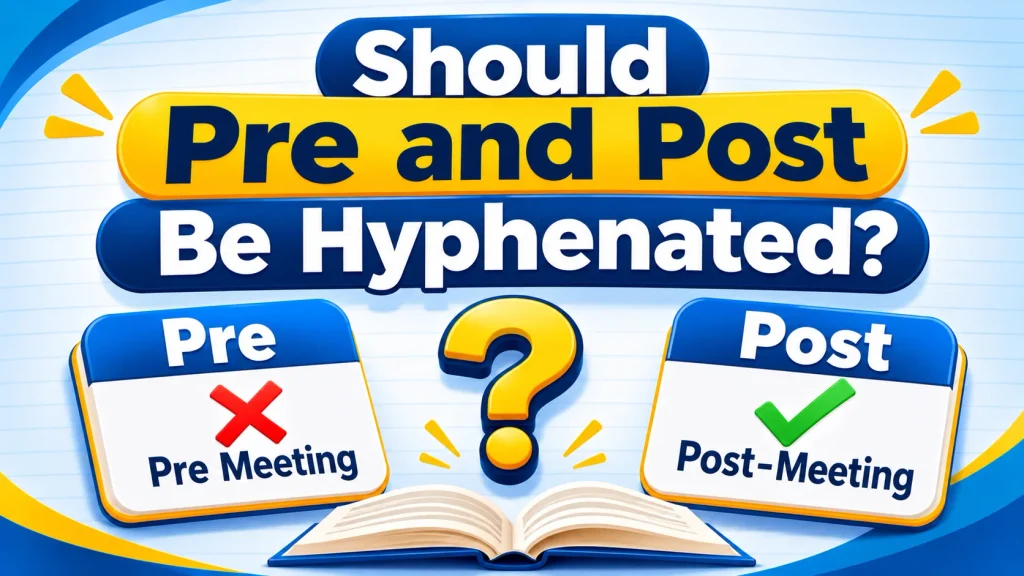
One common spelling question is whether to write pre and post with a hyphen. The answer depends on the word, its established spelling, and the style guide being followed.
In many familiar English words, the prefix is joined directly to the base without a hyphen. However, a hyphen may be useful or necessary in certain combinations, particularly when the next element is a proper noun or a date.
Words Usually Written as One Word
Many established compounds are written without a hyphen.
| Preferred Form | Less Preferred or Incorrect in Standard Usage |
| Preheat | Pre-heat |
| Preschool | Pre-school |
| Prepay | Pre-pay |
| Pretest | Pre-test |
| Preexisting | Pre-existing |
| Postgraduate | Post-graduate |
| Postwar | Post-war |
| Posttest | Post-test |
| Postscript | Post-script |
Some hyphenated alternatives may appear in particular publications or specialist contexts, but the closed forms are standard for these familiar words.
When to Use a Hyphen
A hyphen is often used when a prefix attaches to a proper noun, a capitalized expression, or a number.
Examples:
- Pre-World War II developments
- Post-2020 economic trends
- Post-COVID recovery
- Pre-Christmas sales
The hyphen separates the prefix from the following element and makes the construction easier to read.
A hyphen can also help prevent ambiguity or awkward letter combinations. For example, a writer may choose pre-employment screening to make the structure clear.
Pre- and Post- Before the Same Word
When two related terms are discussed together, the hyphen may be retained to show that the prefix is being attached to a shared base.
For example:
- The study compared pre- and post-treatment results.
- The company reviewed pre- and post-launch performance.
This construction avoids repeating the shared word while keeping the relationship clear.
Should You Write Pre or Pre-?
When discussing the prefix itself, write pre- with a hyphen to show that it is a word element attached to another base. The same applies to post-.
For example:
- The prefix pre- means before.
- The prefix post- means after.
When using a complete word, follow its established spelling: preheat, postwar, pretest, or postgraduate.
Practical rule: Check a current dictionary for established compounds and follow your publisher’s or organization’s style guide when one is required. Hyphenation is partly a spelling convention, not a change in the basic meaning of either prefix.
Common Mistakes When Using Pre and Post
Most errors involving these prefixes happen because writers lose track of the event being discussed or assume that every combination is a standard English word.
1. Choosing the Wrong Prefix
The most obvious mistake is using post- for something that happens before an event or pre- for something that happens afterward.
❌ Incorrect: The patient received postoperative instructions before the surgery.
✅ Correct: The patient received preoperative instructions before the surgery.
Why: The instructions were provided before the operation, so preoperative is the appropriate term.
2. Ignoring the Reference Event
A prefix only makes sense when you know what event it refers to.
Consider a product launch:
- A prelaunch meeting takes place before the product is released.
- A post-launch review takes place after the release.
The meeting and review may concern the same product, but they belong to different stages.
3. Adding Hyphens to Every Compound
Not every word containing these prefixes needs a hyphen.
❌ Incorrect: The students completed a post-graduate course.
✅ Correct: The students completed a postgraduate course.
Why: Postgraduate is an established closed compound in standard English.
4. Assuming Every Word Has Two Versions
English does not automatically create a standard opposite for every word.
For example:
- Preview is an established word, but postview is not a common standard counterpart.
- Postscript is established, but prescript does not normally mean a message written before the main message.
- Postmortem is widely used, while premortem has specialized uses, particularly in risk analysis and planning.
A combination may be understandable without being a commonly accepted word. Check unfamiliar forms before using them in formal writing.
5. Confusing Post- With the Word Post
The prefix post- means after, but the separate word post has several meanings.
Compare:
- Postwar: The period after a war.
- Post office: A place where mail is handled.
- Post a message: Publish or share a message online.
The meaning depends on the grammatical role and context. Do not assume that every occurrence of post is the prefix.
How to Choose Between Pre and Post
If you are unsure which prefix belongs in a word, use this simple process.
Step 1: Identify the main event.
Determine which event, activity, or point in time the word refers to.
Step 2: Establish the sequence.
Ask whether the action or condition occurs before or after that event.
Step 3: Choose the prefix.
- Use pre- for something that happens beforehand.
- Use post- for something that happens afterward.
Step 4: Check the complete word.
Make sure the combination is an established or appropriate English term. Do not assume that a logically formed word is automatically standard.
A Simple Decision Guide
| Question | Choose |
| Does it happen before surgery? | Preoperative |
| Does it happen after surgery? | Postoperative |
| Is the test taken before instruction? | Pretest |
| Is the test taken after instruction? | Posttest |
| Is the activity before the regular sports season? | Preseason |
| Is the activity after the regular season? | Postseason |
Memory trick: Think of pre as the preparation or earlier stage and post as what follows. The most reliable test, however, is always the timing of the action in relation to the main event.
Related Prefixes: Pre-, Post-, Ante-, and Peri-

Pre- and post- are not the only English prefixes that describe time or position. A few related prefixes are worth recognizing, particularly when reading academic or technical material.
| Prefix | Basic Meaning | Example | Explanation |
| Pre- | Before | Prenatal | Before birth |
| Post- | After | Postnatal | After birth |
| Ante- | Before | Antebellum | Before a war, especially the American Civil War in common historical usage |
| Peri- | Around | Perinatal | Around the time of birth |
Pre- vs. Ante-
Both pre- and ante- can express the idea of something happening before another event.
For example:
- Prewar: Relating to the period before a war.
- Antebellum: Relating to the period before a war, especially the American Civil War in United States history.
Although their meanings overlap, they are not interchangeable in every expression. Established vocabulary and context determine which term is appropriate.
Pre- vs. Peri-
These prefixes are particularly important in medical terminology.
- Pre- means before.
- Peri- means around or surrounding.
For example:
- Prenatal: Before birth.
- Perinatal: Around the time of birth.
Confusing them can change the intended time relationship, so pay attention to the prefix when interpreting medical terms.
Post- vs. After
In many sentences, post- and after communicate the same general time relationship.
Compare:
- Postoperative care is essential.
- Care after surgery is essential.
Both express the idea of care following an operation. The first uses a compact technical adjective, while the second uses a more direct phrase.
Choose the wording that suits your audience. Technical writing often uses established compounds, while everyday communication may be clearer with the word after.
Conclusion
The difference between pre vs. post is straightforward once you identify the event being discussed. Pre- means before, while post- means after. These prefixes help describe stages in education, healthcare, business, technology, sports, and everyday activities without requiring a lengthy explanation. Their meanings remain consistent, but their spelling depends on established English usage and the context in which they appear. One final actionable tip: when you encounter an unfamiliar term, identify its main event, place the action on a timeline, and then check whether the complete word is commonly accepted. A common mistake to avoid is assuming that every word beginning with one prefix automatically has an opposite form beginning with the other. Learning both the meanings and established word patterns will help you interpret unfamiliar vocabulary and use these prefixes accurately.
FAQs
Q1. Does pre always mean before?
In words formed with the prefix pre-, it generally means before, earlier than, or in advance of something. The exact reference point depends on the word and context. For example, preheat means heat beforehand, while preexisting describes something already present.
Q2. Does post always mean after?
The prefix post- generally means after or following an event. It appears in words such as postoperative, postgraduate, and postwar. However, the separate word post has other meanings, including a mail service, a position, or an online publication.
Q3. Is it pretest or pre-test?
Pretest is a standard closed form and is commonly used in modern English. However, pre-test also appears in some publications and specialized writing. If your workplace or publisher has a style guide, follow its preferred spelling for consistency.
Q4. Can every word have both pre- and post- forms?
No. Some words have established pairs, such as pretest and posttest, but others do not. English vocabulary develops through usage, not just by combining prefixes with words. Check a dictionary or reliable specialist source before using an unfamiliar combination.
Q5. Are pre- and post- formal or informal prefixes?
Both prefixes are used in formal and informal English. They appear in everyday vocabulary, professional communication, academic writing, and technical terminology. Words such as prepay and postwar are widely understood, while terms such as preoperative and postdoctoral are more specialized.