

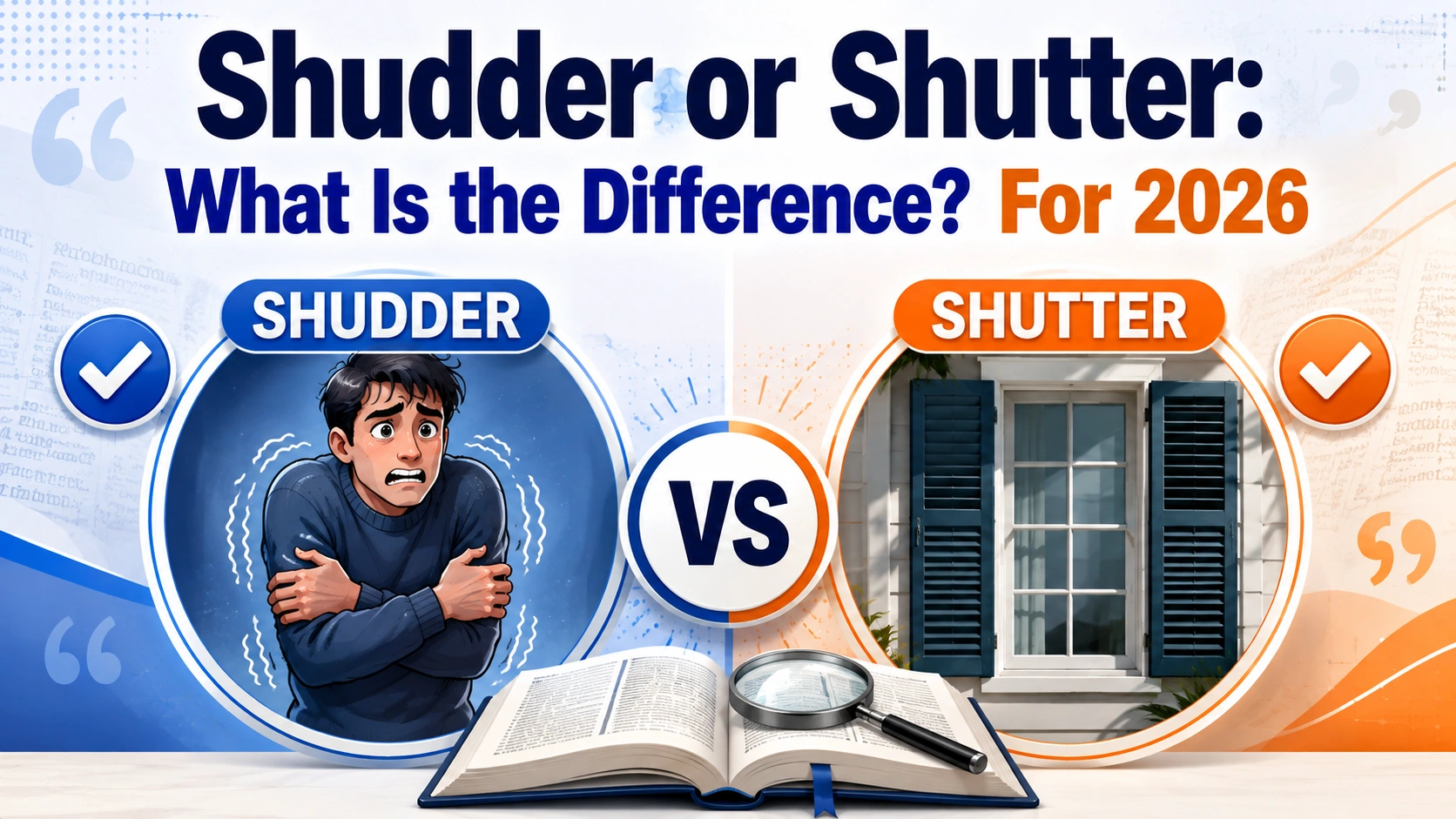
Shudder or shutter? These two words look almost identical, but they describe completely different ideas. Shudder usually means to shake suddenly because of fear, disgust, cold, anxiety, or another strong reaction, while shutter refers to something that covers or closes an opening, the mechanism in a camera, or the act of closing something down. The difference is only one letter, but using the wrong word can change the meaning of an otherwise correct sentence. This makes the pair especially confusing for English learners, writers, and anyone proofreading quickly.
The easiest distinction is shudder = shake and shutter = shut or close. If someone remembers a frightening experience and physically trembles, they shudder. If someone closes a window with a movable cover, they close the shutters. In photography, a camera has a shutter, not a “shudder.” The same word also appears in business reporting: a company may shutter a factory or store, meaning that it closes the operation.
This guide goes beyond that basic memory trick. It explains the meanings, grammar, pronunciation, common phrases, photography terminology, window-related uses, business usage, and subtle differences between shudder, shiver, and shutter. You will also see practical examples and correction exercises designed to make the distinction easier to recognize in real writing. By the end, you should be able to choose the right word from context rather than relying on spelling alone.
Shudder vs. Shutter: Quick Answer
Shudder is used when someone or something shakes suddenly or violently, especially because of an unpleasant emotion, physical sensation, or disturbing experience.
- She shuddered at the thought of what might happen.
- He shuddered with fear.
- The cold made her shudder.
- The old building shuddered during the earthquake.
Shutter is used for a window covering, a camera mechanism, or the action of closing a window, business, facility, or activity.
- They closed the wooden shutters before the storm.
- The photographer adjusted the camera shutter.
- The store was shuttered after years of declining sales.
Quick rule: Shudder shakes. Shutter shuts.
Both are legitimate English words. The problem is not choosing between a correct and incorrect spelling; it is choosing the correct word for the meaning you intend.
Shudder and Shutter at a Glance
| Feature | Shudder | Shutter |
| Core meaning | Shake suddenly | Cover, close, or control an opening |
| Common part of speech | Verb, noun | Noun, verb |
| Fear | Yes | No |
| Disgust | Yes | No |
| Cold | Can be used | No |
| Window covering | No | Yes |
| Camera | No | Yes |
| Photography | No | Yes |
| Business closure | No | Yes |
| Physical vibration | Yes | Not normally |
| Example | I shuddered at the thought. | They shuttered the store. |
The table reveals why context is more useful than spelling. Shudder is centered on movement or reaction, whereas shutter is associated with closing, covering, or a camera’s exposure mechanism.
What Does “Shudder” Mean?
Shudder is primarily a verb meaning to shake suddenly, briefly, or involuntarily. The movement is often connected with an unpleasant thought, frightening experience, disgust, or another strong reaction. Cambridge also gives a broader physical sense in which something such as a vehicle, building, or ground can shudder—that is, shake violently and quickly.
The word can therefore describe both a human reaction and a physical vibration.
Shudder as a Verb
When a person shudders, the movement is generally involuntary.
Consider:
- I shuddered when I remembered the accident.
- She shuddered at the thought of entering the abandoned house.
- He shuddered with horror.
- The child shuddered in the cold wind.
The important idea is not simply “movement.” It is usually sudden or involuntary shaking connected to a powerful sensation or event.
Shuddering From Fear
Fear is one of the most familiar contexts.
She shuddered when she heard footsteps behind her.
This does not merely say that she was afraid. It emphasizes the physical reaction produced by the fear.
Compare:
- She was frightened. → describes an emotional state.
- She shuddered. → describes a physical reaction to that state.
That distinction makes shudder useful in narrative writing because it shows a reaction rather than simply naming an emotion.
Shuddering From Disgust
Shudder is also natural when something is deeply unpleasant or revolting.
- I shudder at the thought of eating that.
- He shuddered when he remembered the smell.
- She shuddered at the unpleasant memory.
This is one reason the word is broader than tremble. The context often contains an element of emotional or sensory aversion.
Shuddering Because of Cold
Shudder can describe shaking caused by cold, although shiver is often the more straightforward everyday choice when cold is the main reason.
For example:
She shuddered as the icy wind hit her face.
That sentence is possible, but:
She shivered in the icy wind.
is often more neutral when the writer simply wants to describe cold-induced trembling. Cambridge defines shiver as shaking slightly because of cold, illness, or fear.
Shuddering From an Unpleasant Memory
A person can shudder simply by thinking about something disturbing.
- I still shudder when I remember that night.
- He shuddered at the memory of the mistake.
- She shuddered to think what could have happened.
Here, no physical danger needs to be present. The thought itself can trigger the reaction.
Shudder for Machines, Vehicles, and Structures
People are not the only things that can shudder.
English can use shudder to describe sudden, rough, or violent vibration:
- The engine shuddered as the car slowed down.
- The train shuddered to a halt.
- The ground shuddered beneath the building.
This use is particularly useful in descriptive writing. It communicates irregular, noticeable movement, rather than simply saying that something moved.
Shudder as a Noun
Shudder can also be a noun meaning a sudden shaking movement or reaction.
Examples:
- A shudder ran through her as she heard the news.
- He gave a slight shudder.
- The machine stopped with a violent shudder.
The difference is grammatical:
- Verb: She shuddered.
- Noun: She felt a shudder.
Common Noun Patterns
Several constructions occur naturally:
- a shudder
- a slight shudder
- a sudden shudder
- a violent shudder
- a shudder of fear
- a shudder of disgust
You may also encounter the figurative phrase send a shudder through someone, meaning that something causes a strong emotional reaction.
How to Use “Shudder” Correctly
“Shudder at” Something
One of the most useful patterns is:
shudder + at + noun/noun phrase
Examples:
- She shuddered at the thought.
- He shudders at the memory.
- They shuddered at the possibility of failure.
“Shudder with” an Emotion
Another common structure is:
shudder + with + emotion
Examples:
- She shuddered with fear.
- He shuddered with disgust.
- The witness shuddered with anxiety.
“Shudder to Think”
The expression shudder to think introduces an unpleasant possibility.
For example:
I shudder to think what would have happened if we had been late.
It communicates that the speaker finds the possible outcome disturbing or frightening.
“Shudder to a Halt”
When a vehicle or machine shakes as it stops, English can use:
The bus shuddered to a halt.
This is a particularly useful example because shudder here has nothing to do with fear. It describes the physical movement of the vehicle.
What Does “Shutter” Mean?
Shutter has several important meanings, but they share an underlying idea of opening, covering, or closing something.
As a noun, it commonly refers to:
- A cover for a window
- A camera mechanism
- A movable device used to control or block an opening
As a verb, it can mean:
- To close shutters over a window
- To close down a business, facility, or activity
Cambridge lists both the window and photography senses and also recognizes the verb meaning “to close down a business or activity.”
Shutter as a Window Covering
The traditional meaning of shutter is a wooden or metal covering associated with a window.
Examples:
- They closed the shutters before sunset.
- The house has blue shutters around the windows.
- The storm shutters protected the windows.
- She opened the shutters to let in more light.
A shutter is different from a curtain or blind because it is generally a solid or structured covering, often hinged or otherwise designed to close over an opening.
Types of Window Shutters
Depending on the context, you may hear:
- wooden shutters
- interior shutters
- exterior shutters
- storm shutters
- security shutters
- rolling shutters
The precise design varies, but the central idea remains the same: a shutter can cover or close an opening.
Shutter in Photography
Photography gives shutter another highly important meaning.
A camera shutter is the mechanism that controls when light reaches the film or image sensor during an exposure. Cambridge defines it as the part of a camera that opens temporarily to allow light to reach the film when a photograph is taken.
That is why photographers talk about:
- camera shutter
- shutter speed
- shutter button
- shutter release
- electronic shutter
- mechanical shutter
What Is Shutter Speed?
Shutter speed refers to how long the camera’s exposure is allowed to occur.
In simple terms:
- A fast shutter speed can help freeze rapid movement.
- A slow shutter speed allows a longer exposure and can produce motion blur.
This is one of the clearest places where the spelling matters.
Correct: shutter speed
Incorrect: shudder speed
The latter would describe something entirely different and is not the standard photography term.
Shutter vs. Aperture
These two photography terms are sometimes confused:
| Photography term | Basic function |
| Shutter | Controls when/how long light is admitted during exposure |
| Aperture | Controls the size of the lens opening |
| ISO | Refers to the camera’s sensitivity setting |
The important point for this article is simple: photography uses shutter, never shudders.
Shutter as a Verb
The verb shutter has two especially useful applications.
To Close a Window
The literal verbal meaning is to close a window by using shutters.
They shuttered the windows before the storm arrived.
Here, shuttered means that the windows were covered or closed with shutters.
To Close a Business or Facility
Modern English also commonly uses shutter figuratively for closing down a business, plant, office, facility, account, or activity.
Examples:
- The company shuttered its downtown store.
- The factory was shuttered after demand fell.
- The organization decided to shutter the program.
- Several branches were shuttered during the restructuring.
Cambridge specifically records shutter in this sense for closing down a business or activity.
“Shuttered” vs. “Closed”: Is There a Difference?
The two words can overlap, but they do not always have exactly the same tone.
Closed is the general, neutral word:
The restaurant closed last year.
Shuttered can sound more journalistic or formal:
The restaurant was shuttered after years of financial difficulties.
The second sentence places more emphasis on the act or result of shutting down an operation. It is common in news and business writing.
However, shuttered does not automatically tell you whether the closure is temporary or permanent. The surrounding context has to provide that information.
Shudder vs. Shutter: Why the Confusion Happens
The words are easy to mix up for several reasons.
They Look Almost Identical
Only one letter separates them:
shudder
shutter
That small spelling difference carries a major semantic difference.
Their Pronunciations Are Very Similar
Cambridge gives:
- shudder: /ˈʃʌd.ər/ in British English and /ˈʃʌd.ɚ/ in American English
- shutter: /ˈʃʌt.ər/ in British English and /ˈʃʌt̬.ɚ/ in American English
The key consonant difference is the middle sound:
- shudder → d
- shutter → t
Because the words are short and similar, learners may recognize the sound but still select the wrong spelling.
Both Are Real English Words
This is an important proofreading issue.
If you type shudder when you mean shutter, ordinary spell-check software may not identify the problem because shudder is correctly spelled.
Likewise, shutter is perfectly legitimate in a sentence about windows, photography, or business closures.
The problem is contextual correctness, not spelling validity.
That is why meaning-based proofreading is more reliable than depending entirely on automated spelling correction.
Shudder vs. Shutter vs. Shiver
These three words deserve comparison because learners sometimes treat them as interchangeable.
| Word | Main idea | Typical context |
| Shudder | Sudden shaking/reaction | Fear, disgust, unpleasant thoughts, violent vibration |
| Shiver | Slight trembling | Cold, fear, illness |
| Shutter | Cover, close, or camera mechanism | Windows, photography, business closure |
Shudder vs. Shiver
There is overlap. Both can describe bodily shaking.
However, shiver is strongly associated with cold and slight trembling, while shudder often conveys a more intense or unpleasant reaction. Cambridge’s definitions reflect this distinction: shudder emphasizes sudden shaking connected with an unpleasant thought or feeling, while shiver includes cold, illness, and fear.
Compare:
She shivered in the cold.
This sounds completely ordinary.
She shuddered at the thought of what was inside.
The second sentence has a stronger emotional or psychological quality.
Common Mistakes With Shudder and Shutter
Mistake 1: “I Shuttered With Fear”
❌ I shuttered when I heard the noise.
✅ I shuddered when I heard the noise.
Fear produces the shaking reaction, so shudder is appropriate.
Mistake 2: “Close the Shudders”
❌ Please close the shudders.
✅ Please close the shutters.
The window covering is a shutter.
Mistake 3: “Shudder Speed”
❌ The photographer increased the shudder speed.
✅ The photographer increased the shutter speed.
Photography uses shutter.
Mistake 4: “The Store Shuddered”
❌ The company shuddered its final branch.
✅ The company shuttered its final branch.
A company can shutter a branch, meaning close it.
Mistake 5: “The Building Shuttered During the Earthquake”
This sentence could be misunderstood.
If you mean that the building physically shook:
The building shuddered during the earthquake.
If you mean that the building was closed:
The building was shuttered after the earthquake.
The context changes the word—and the meaning.
Shudder or Shutter? Use the Meaning Test
When you hesitate between the two, do not stare at the spelling. Ask what the sentence is describing.
If the subject is shaking
Choose shudder.
- He shuddered with fear.
- The engine shuddered.
- She shuddered at the memory.
If something is being covered or closed
Choose a shutter.
- Close the shutters.
- They shuttered the windows.
- The shop was shuttered.
If the sentence involves a camera
Choose a shutter.
- Adjust the shutter speed.
- The camera shutter opened.
- She pressed the shutter release.
If a business is being closed
Choose a shutter.
- The company shuttered three locations.
A Practical Decision Table
| Ask yourself | If yes, choose |
| Is something trembling? | Shudder |
| Is the reaction caused by fear or disgust? | Shudder |
| Is an unpleasant memory causing a reaction? | Shudder |
| Is a vehicle or machine vibrating suddenly? | Shudder |
| Is it a window covering? | Shutter |
| Is it a camera mechanism? | Shutter |
| Is it related to shutter speed? | Shutter |
| Is a business being closed? | Shutter |
| Is an opening being covered or closed? | Shutter |
Real-World Examples of Shudder
Fear
She shuddered when the lights suddenly went out.
Disgust
He shuddered at the thought of touching the spoiled food.
Cold
The hikers shuddered as the temperature dropped.
Unpleasant Memory
I still shudder when I remember that embarrassing mistake.
Physical Vibration
The truck shuddered as it climbed the steep hill.
Sudden Stop
The train shuddered to a halt.
These examples demonstrate that shudder does not require horror. Its broader idea is sudden or involuntary shaking, often with an unpleasant emotional or physical cause.
Real-World Examples of Shutter
Windows
The homeowners closed the shutters before the storm.
Architecture
The old house still has its original wooden shutters.
Photography
A fast shutter speed helped capture the moving athlete.
Business
The company shuttered two stores after a difficult year.
Manufacturing
The manufacturer temporarily shuttered the plant.
Digital or Organizational Activity
The organization decided to shutter the outdated program.
These examples show why defining shutter only as a “window cover” is incomplete. Its verb meaning of closing a business or activity is an important part of contemporary usage.
American English vs. British English
There is no major British-versus-American spelling distinction between shudder and shutter. Both words are standard in both varieties.
The pronunciation can differ slightly by accent, however. Cambridge lists the British and American pronunciations separately, with the final vowel and the American pronunciation of the middle consonant showing small differences.
The practical takeaway is straightforward:
You do not need a regional spelling rule to choose between shudder and shutter. You need the correct meaning.
Easy Memory Tricks
Shudder = Shake
Connect shudder with shaking.
If a person reacts physically to fear, disgust, or an unpleasant thought, think:
Shudder → Shake
Shutter = Shut
Connect shutter with shut.
A shutter can:
- shut a window,
- control a camera opening,
- or describe shutting down a business.
So:
Shutter → Shut
Shudder shakes; shutter shuts.
This is a mnemonic, not a complete explanation of the words’ histories, but it is highly practical for everyday writing.
Mini Case Study: One Letter Changes the Meaning
Consider this sentence:
The company shuttered the building after the storm.
This means the company closed the building or operation.
Now change one letter:
The company shuddered the building after the storm.
That version does not communicate the intended business or facility closure. The reader is left wondering whether the building itself was shaking.
The lesson is important for editors: near-identical spellings can hide major semantic errors. When proofreading, ask whether the chosen word makes sense in context rather than merely checking whether it is spelled correctly.
Practice: Choose Shudder or Shutter
Fill in each blank with shudder or shutter in the appropriate form.
- She began to ______ when she remembered the frightening story.
- Please close the window ______ before the storm.
- The photographer selected a faster ______ speed.
- The company decided to ______ its smallest branch.
- The engine began to ______ as the vehicle slowed.
- He ______ at the thought of entering the abandoned building.
- The old house has wooden ______ on every window.
- The train ______ to a sudden stop.
- The factory was ______ after years of declining demand.
- She ______ with disgust when she smelled the spoiled food.
Answers
- shudder
- shutters
- shutter
- shutter
- shudder
- shuddered
- shutters
- shuddered
- shuttered
- shuddered
The easiest way to solve these is to identify the meaning first. Numbers 1, 5, 6, 8, and 10 involve shaking or reacting, so they require shudder. The others involve windows, photography, or closure, so they require shutter.
Conclusion:
The difference between shudder and shutter becomes much easier once you stop treating it as a spelling problem and start treating it as a meaning problem. Shudder describes sudden shaking or trembling, often caused by fear, disgust, an unpleasant thought, cold, or physical vibration. Shutter, on the other hand, refers to a window covering, a camera mechanism, or the act of closing a window, business, facility, or activity. Both words are correct English; only the context determines which one belongs in a sentence.One final actionable tip: when you hesitate, replace the word mentally with “shake” or “shut/close.” If “shake” fits, choose shudder. If “shut” or “close” fits, choose shutter. A common mistake to avoid is relying on spell-check alone, because both words are legitimate. Remember the simplest rule: shudder shakes; shutter shuts.
FAQs
Q1. What is the easiest way to remember shudder vs. shutter?
Think “shudder = shake” and “shutter = shut.” If someone or something is trembling, shudder is usually the word you need. If you are talking about a window covering, camera mechanism, or closing a business, use a shutter. The mnemonic works because it connects each word to its central modern use.
Q2. Can “shudder” describe something other than a person?
Yes. A vehicle, machine, building, ground, or other physical object can shudder when it shakes suddenly or violently. For example, The engine shuddered as the car stopped. The word therefore describes a physical movement, not exclusively an emotional human reaction.
Q3. Is “shutter” only related to windows?
No. Shutter has important photography and business meanings as well. A camera has a shutter that controls exposure, while a company can shutter a store, factory, or other operation. This makes the shutter considerably broader than simply “a cover on a window.”
Q4. Is “shudder” the same as “shiver”?
Not exactly. There is some overlap, especially when describing involuntary shaking. Shiver is strongly associated with cold and slight trembling, while shudder often emphasizes a sudden reaction to something unpleasant, frightening, or disturbing. The best choice depends on the specific context.
Q5. Why does spell-check sometimes fail to catch shudder/shutter mistakes?
Because both words are correctly spelled English words. A spell-checker can recognize that you typed a valid word without understanding whether it matches your intended meaning. For example, shutter is spelled correctly if I shudder at the thought, but it is the wrong word. Contextual proofreading is essential.