

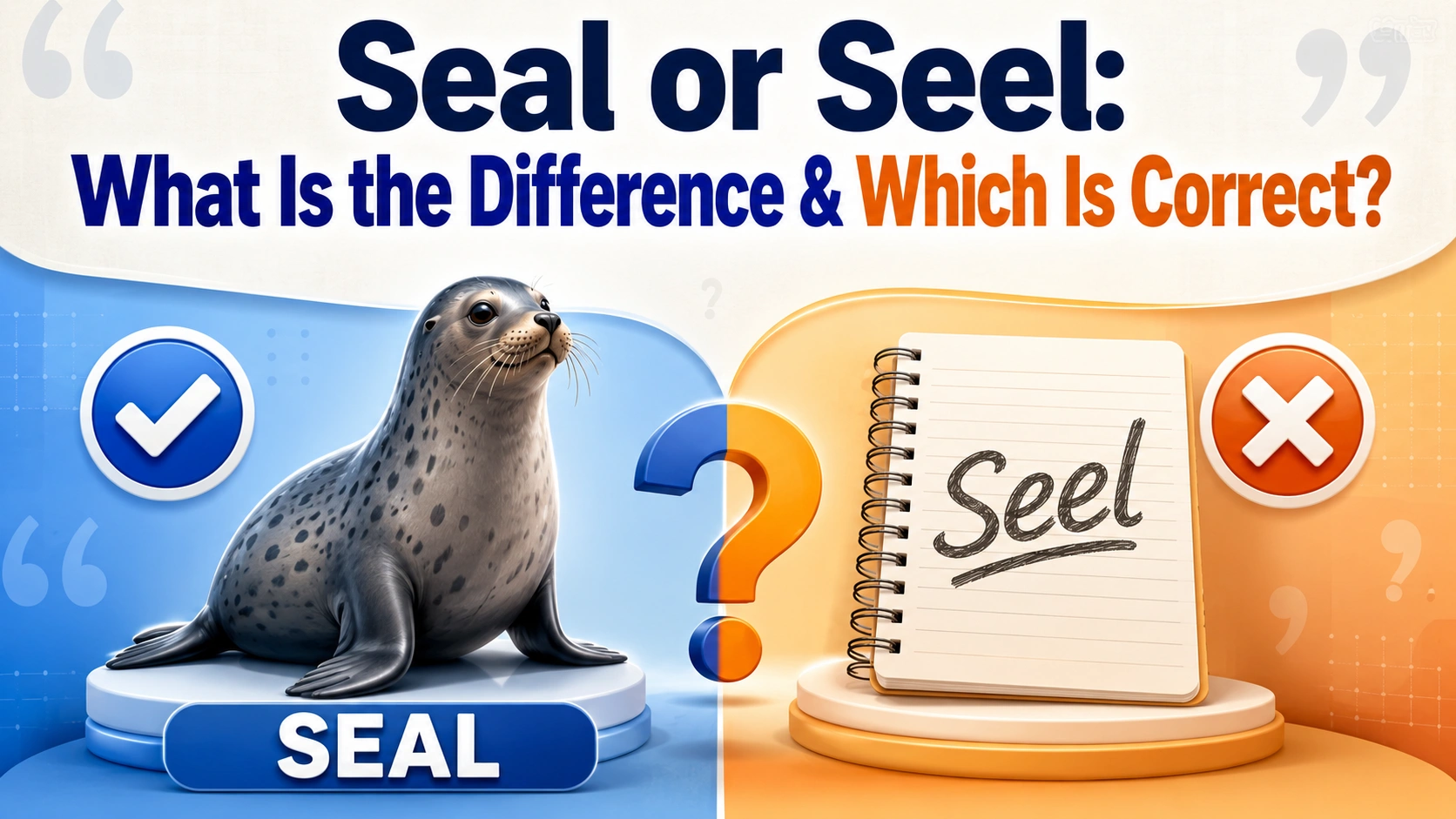
Seal or seel can be confusing because both spellings are genuine English words, yet they do not normally mean the same thing. In modern English, seal is overwhelmingly the word you want: it can mean to close something securely, make something airtight or watertight, officially authenticate something, finalize an agreement, or refer to a marine mammal. Seel, by contrast, is a rare historical verb associated chiefly with falconry and the closing of a hawk’s or falcon’s eyelids.
The important point is that seel is not simply an alternative spelling of modern seal. If you are writing an email, school assignment, report, business document, or everyday message, choosing seel when you mean seal will normally be a spelling error. However, calling seel an entirely “wrong” word would also be inaccurate. Major dictionaries still record it because it has a genuine historical use.
This guide explains seal vs. seel from both a modern and historical perspective. You will learn their meanings, pronunciation, origins, grammatical uses, common phrases, real-world examples, frequent mistakes, and the situations in which seel may legitimately appear. By the end, you will have a simple rule for choosing the right spelling without having to memorize complicated exceptions.
Seal vs. Seel at a Glance
| Feature | Seal | Seel |
| Modern everyday English | Very common | Very rare |
| Main grammatical role | Noun and verb | Mainly verb |
| Meaning “close or secure” | Yes | No |
| Meaning “official mark” | Yes | No |
| Meaning “finalize” | Yes | No |
| Meaning “marine mammal” | Yes | No |
| Historical falconry meaning | No | Yes |
| Common in school/business writing | Yes | Generally no |
| Historical/literary relevance | Yes | Yes |
| Should learners normally choose it? | Yes | Only in specialized contexts |
Quick rule: If you mean close, secure, authenticate, finalize, or the marine animal, use seal. If you encounter seel, it is most likely being used in a historical or specialized context.
What Does “Seal” Mean?
Seal is a highly versatile modern English word. It works as both a noun and a verb, and its meanings extend from physical closure to official authentication and figurative finality.
Seal as a Verb
As a verb, seal generally involves closing, securing, confirming, or making something final.
1. To close something securely
You can seal an object when you close it in a way that prevents it from opening or being accessed easily.
- Please seal the envelope before mailing it.
- She sealed the package with tape.
- Make sure the container is sealed tightly.
- The workers sealed the opening in the wall.
This meaning is especially common with envelopes, packages, containers, doors, cracks, openings, and surfaces.
2. To prevent air, water, or another substance from passing through
In technical and practical contexts, seal can mean to create a barrier against leakage or unwanted passage.
- The rubber ring seals the pipe.
- The window needs to be sealed against drafts.
- Engineers added a protective coating to seal the surface.
- The lid creates an airtight seal.
This is why terms such as weather seal, water seal, door seal, and mechanical seal are common in technical English.
3. To authenticate or formally confirm something
Historically, a seal could be an emblem or impression used to authenticate a document. The verb developed a related meaning: to formally confirm or authenticate something. Modern dictionaries continue to record this sense.
For example:
- The document was sealed with the organization’s official emblem.
- The agreement was formally sealed.
- The certificate bears the seal of the institution.
4. To finalize something
In figurative modern English, seal can mean to make a decision or outcome final.
- Her final answer sealed the deal.
- The victory sealed the team’s place in the final.
- That decision sealed his fate.
Here, nothing is literally being closed with wax or glue. The idea is metaphorical: once something is “sealed,” it is effectively settled or made final.
Seal as a Noun
The noun seal has several distinct but well-established meanings.
An official mark or emblem
A seal may be an emblem, stamp, impression, or other identifying mark used to authenticate something.
Examples include:
- an official government seal
- a university seal
- a company seal
- a legal seal
- a wax seal on a historical document
A physical closure
A seal can also be the thing that prevents a container, opening, pipe, or surface from allowing unwanted passage.
- The bottle has a broken seal.
- Check the door seal for damage.
- The container has an airtight seal.
A marine mammal
A seal is also a marine mammal. This is an entirely different sense of the same spelling.
- We saw a seal swimming near the shore.
- The zoo has several seals.
- The young seal returned to the water.
Major dictionaries distinguish this animal sense from the noun meaning an authenticating mark or closure. The animal word has a different historical origin.
What Does “Seel” Mean?
Seel is a real English word, but this is where many explanations become misleading. It should not simply be labeled “wrong.” Dictionaries record seel as a specialized and archaic verb, particularly associated with falconry.
“Seel” Is Mainly a Historical Falconry Term
Historically, to seel referred to sewing together or closing the eyelids of a hawk or falcon, a practice associated with training and handling birds of prey.
Merriam-Webster records seel as a verb meaning to close the eyes of a bird such as a hawk by drawing threads through the eyelids, while also identifying a broader archaic meaning involving closing the eyes.
Dictionary.com and Collins likewise identify the word with historical falconry and give related archaic meanings such as to close the eyes or to blind.
Why You May Encounter “Seel” in Literature
The word survived beyond technical falconry terminology and occasionally appeared in older literary writing.
That matters because modern readers may encounter seel in a historical text and assume the writer made a spelling mistake. In some cases, the opposite is true: the unusual spelling is intentional because the word itself belonged to an older vocabulary.
For modern readers, the practical lesson is simple:
A dictionary entry does not automatically mean a word is common or interchangeable with a modern-looking alternative.
Seel is legitimate historical vocabulary, but that does not make it a suitable substitute for seal.
Seal vs. Seel: The Actual Difference
The central distinction is meaning and usage, not merely spelling.
They Are Not Two Modern Spellings of the Same Word
If you write:
Please seal the envelope.
you are using ordinary modern English.
If you write:
Please seel the envelope.
you have changed the word. Seel does not mean “seal an envelope” in normal contemporary English.
Likewise:
The company sealed the agreement.
is correct.
Changing sealed to seeled would not create an alternative spelling. It would create a different word.
Meaning Difference
| Intended meaning | Correct word | Example |
| Close an envelope | seal | Seal the envelope before posting it. |
| Close a container | seal | Seal the jar tightly. |
| Prevent leakage | seal | The coating seals the crack. |
| Authenticate a document | seal | The document carries an official seal. |
| Finalize an agreement | seal | The contract sealed the arrangement. |
| Refer to a marine mammal | seal | A seal surfaced near the boat. |
| Historical falconry term | seel | The historical text uses seel in a falconry context. |
This is why the safest approach is meaning first, spelling second. Do not choose between seal and seel simply because they look similar.
Seal or Seel: Which One Is Correct?
For practically all ordinary modern writing, seal is correct.
That includes:
- school assignments
- essays
- emails
- reports
- business communication
- websites
- social media posts
- instructions
- packaging information
- technical writing
- everyday conversation
Use seel only when the context specifically calls for the historical word.
✅Use “Seal” When You Mean:
- to close something
- to secure something
- to prevent leakage
- to authenticate something
- an official emblem
- a protective closure
- to finalize an agreement
- to make an outcome final
- the marine mammal
Use “Seel” When You Are Discussing:
- historical falconry
- older English vocabulary
- historical literature
- the historical treatment of hawks or falcons
- a text in which seel is deliberately being used
A Practical Test
When you are unsure, replace the word with the meaning you intend.
If your sentence means:
“close it” → seal
“secure it” → seal
“finalize it” → seal
“officially authenticate it” → seal
“marine mammal” → seal
If the sentence concerns the historical falconry term involving a bird’s eyelids, then seel may be appropriate.
Why Do People Confuse “Seal” and “Seel”?
The confusion is understandable.
The Words Are Pronounced Similarly
Both words can be associated with a long ee sound in English, although dictionary entries show regional pronunciation differences for seel. Dictionary.com, for example, gives different pronunciation information for its British and American entries.
That means pronunciation alone is not a reliable way to decide which spelling belongs on the page.
“Seel” Looks Like a Plausible Spelling
English has many words in which the ee spelling represents a long /iː/ sound:
- see
- feel
- green
- need
A learner who hears seal may therefore reasonably wonder whether seel is possible.
The answer is that seel exists, but its existence does not make it the correct spelling for ordinary meanings of seal.
Modern “Seal” Has Many Meanings
The word can describe an animal, a physical closure, an official mark, or the act of finalizing something. That semantic range makes seal much more common than seel.
Common Mistakes With Seal and Seel
Mistake 1: Writing “Seel” for “Seal”
Incorrect in ordinary modern English:
Please seel the package.
Correct:
Please seal the package.
The intended meaning is “close securely,” so a seal is required.
Mistake 2: Assuming “Seel” Is the British Version of “Seal”
This is an important misconception.
Seel is not simply the British spelling of seal.
The ordinary modern word seal is used across major varieties of English. Seel is a separate historical word.
Mistake 3: Assuming Every Dictionary Word Is Common
A dictionary can contain words that are:
- archaic
- obsolete
- regional
- technical
- literary
- historical
Therefore, finding seel in a dictionary does not mean you can replace seal with it in everyday writing.
Mistake 4: “Correcting” a Historical Text
Suppose you are reading a historical or literary passage and encounter seel. Do not automatically change it to seal.
First determine what the author meant.
Historical vocabulary can preserve meanings that are no longer part of ordinary English.
Mistake 5: Treating the Words as Synonyms
They are not normal synonyms.
Seal can mean close or secure.
Seel has a specialized historical meaning related to closing a bird’s eyelids, with an archaic extension involving closing or blinding the eyes.
Seal in Everyday English: Examples by Context
The best way to understand seal is to see how its meaning changes with context.
Physical Closure
She sealed the envelope before putting it in the mailbox.
Here, seal means to close securely.
Packaging
Check that the safety seal is intact before opening the container.
Here, seal is a noun describing a protective closure.
Waterproofing
The workers applied a compound to seal the gap.
Here, the purpose is to prevent water or another substance from passing through.
Business
The final approval sealed the agreement.
Here, seal means to finalize or confirm.
Figurative
His performance sealed his place on the team.
This does not involve a physical seal. The meaning is metaphorical: the result became effectively certain or final.
Animal
We watched a seal swimming in the water.
Here, seal refers to the marine mammal.
Common Expressions With “Seal”
“Seal the Deal”
Seal the deal means to finalize an agreement or arrangement.
The signed contract sealed the deal.
It is common in business but can also appear in informal conversation.
“Seal of Approval”
A seal of approval means a strong or official indication that something has been approved or endorsed.
The product received the expert’s seal of approval.
“Seal Someone’s Fate”
To seal someone’s fate means to make an outcome effectively certain, often an unfavorable one.
The final mistake sealed his fate in the competition.
“Sealed Envelope”
A sealed envelope is an envelope that has been securely closed.
Place the completed form inside a sealed envelope.
“Under Seal”
In legal contexts, something may be described as being under seal, meaning it has a particular formal or restricted legal status depending on the jurisdiction and context.
This is a good example of why seal appears in professional vocabulary far beyond ordinary physical closure.
Seal vs. Close vs. Shut vs. Secure
Sometimes the real question is not seal or seel, but whether seal is the best word at all.
| Word | Main idea | Example | Typical nuance |
| close | Make something not open | Close the door. | Broad and neutral |
| shut | Bring something into a closed position | Shut the window. | Often more direct or conversational |
| seal | Close securely or prevent passage/access | Seal the container. | Emphasizes security, protection, or finality |
| secure | Make safe, stable, or firmly fixed | Secure the lid. | Focuses on safety or fastening |
Why “Seal” Is More Specific Than “Close”
You can close a bottle without necessarily creating an airtight barrier.
You seal it when the emphasis is on making the closure secure or preventing something from entering or escaping.
For example:
Close the box.
simply tells someone to put the box into a closed position.
Seal the box.
suggests that the box should be closed securely, perhaps with tape, adhesive, or another sealing method.
That distinction becomes especially useful in technical, manufacturing, packaging, and instructional writing.
Seal vs. Seel: Pronunciation
Seal is commonly pronounced /siːl/.
The historical word seel is also represented with an /iː/ pronunciation in major dictionary sources, although American and British dictionary entries can represent the word differently in pronunciation notation.
For learners, this creates an important spelling lesson:
Words that sound alike or nearly alike do not necessarily share a spelling or meaning.
This is similar to many other English word pairs in which context determines the correct written form.
If you hear someone say seal and need to write it, do not choose seel merely because the letters seem to match the sound. In ordinary modern English, seal is the spelling you should expect.
The Etymology of “Seal”
The history of seal is particularly interesting because the modern word actually brings together more than one historical source.
Merriam-Webster traces the noun seal meaning the marine animal to Middle English sele, from Old English seolh. Its other noun sense, involving an authenticating mark or device, comes through Middle English forms influenced by Anglo-French and ultimately Latin sigillum, a diminutive of signum meaning a sign or mark.
This explains something that can otherwise seem strange: the marine-animal sense and authentication/closure sense have different historical backgrounds, even though modern English spells them identically.
The verb seal developed from the latter family of meanings and is now used both literally and figuratively.
The Etymology of “Seel”
The history of seel is separate from the common modern meanings of seal.
Merriam-Webster traces seel to Middle English silen, from Anglo-French ciller, ultimately connected with Latin cilium, meaning an eyelid. Its first known use is recorded in the 15th century.
Collins gives a closely related history, tracing the word through Middle French and ultimately to Latin cilium.
So although seal and seel look almost identical and can sound similar, their histories are not simply two spelling traditions for one modern word.
Why “Seel” Became Rare
The historical word survived mainly because it was tied to a specialized practice.
Falconry developed a vocabulary of its own, much like modern professions have specialized terminology. As that particular vocabulary became less familiar to general speakers, seel stopped being an ordinary everyday word.
Modern dictionaries therefore label or describe it as archaic, obsolete, or specialized, depending on the dictionary and sense.
This is a useful general lesson in vocabulary:
A word can remain historically legitimate while becoming practically irrelevant to most modern writers.
That is exactly the situation with seel.
Is “Seel” Ever Appropriate in Modern Writing?
Yes—but the context needs to justify it.
Appropriate Contexts
You might use or discuss seel when:
- studying historical English,
- explaining falconry terminology,
- analyzing older literature,
- discussing word origins,
- reproducing historical language,
- explaining a quotation containing the word.
Inappropriate Contexts
Avoid using seel as a replacement for seal in:
- ordinary emails,
- school essays,
- business reports,
- product instructions,
- casual messages,
- modern articles,
- general professional writing.
If your intended sentence is:
Please seal the document.
There is no advantage to writing seel. It is simply the wrong word for that meaning.
A Simple Decision Guide
Use this checklist before choosing the spelling.
| Ask yourself… | If the answer is yes | Choose |
| Am I closing an envelope or package? | Secure closure | seal |
| Am I preventing air or water from passing? | Create a barrier | seal |
| Am I referring to an official emblem or stamp? | Authentication | seal |
| Am I finalizing an agreement? | Confirmation/finality | seal |
| Am I talking about marine animals? | Animal | seal |
| Am I discussing historical falconry? | Specialized historical term | seel |
| Am I analyzing an old literary passage containing “seel”? | Historical vocabulary | seel |
Memory Trick: Think “Sea” for the Animal
A useful—but purely mnemonic—way to remember the common spelling is:
seal → sea → marine animal
The same spelling also covers the everyday verb and noun meanings.
For example:
- seal the envelope
- seal the agreement
- official seal
- marine seal
Do not use this memory trick as an etymology lesson. The marine-animal word and the authentication-related word have different historical roots. It is simply a convenient way to remember the modern spelling.
Practice: Choose “Seal” or “Seel”
Fill in each blank with seal or seel.
- Please ___ the envelope before sending it.
- The company added a rubber ___ to the machine.
- The final vote ___ the agreement.
- We watched ___ swimming near the coast.
- The historical passage describes the practice of ___ a hawk’s eyelids.
- Make sure you ___ the container tightly.
- The document bears the official ___ of the institution.
- The unusual word appeared in a discussion of historical falconry.
Answers
- seal
- seal
- sealed
- seal
- seeling / seel depending on the grammatical construction
- seal
- seal
- seel
The important distinction is not simply the sentence’s spelling. Look at the underlying meaning. Modern closure, authentication, finalization, and the marine animal point to seal. Historical falconry points toward seel.
Conclusion:
When the choice is between seal or seel in ordinary modern English, the answer is straightforward: choose seal. It is the standard word for closing or securing something, creating a protective barrier, authenticating something, finalizing an arrangement, referring to an official mark, and naming the marine mammal.Seel is not simply a misspelled version of seal, either. It is a legitimate historical English verb, chiefly associated with falconry and the closing of a hawk’s or falcon’s eyelids. Major dictionaries continue to record it, but its specialized and archaic status makes it unsuitable for normal everyday writing.One final actionable tip: choose the spelling based on the meaning you intend, not merely on how the word sounds. A common mistake to avoid is assuming that because seel exists in a dictionary, it can replace seal in modern sentences. It cannot.
FAQs
Q1. Is “seel” a correct English word?
Yes. Seel is a genuine English word, but it is uncommon and largely historical or archaic. Its best-known meaning is a falconry term referring to closing the eyelids of a hawk or falcon. It should not be treated as a normal modern spelling alternative to seal.
Q2. Is “seel” the British spelling of “seal”?
No. Seel is not simply a British spelling variant of modern seal. The ordinary word seal is used in modern British and American English. Seel is a separate historical word with its own etymology and specialized meaning.
Q3. Should I use “seal” or “seel” in a school essay?
Use seal unless your essay is specifically discussing historical language, falconry, or a literary passage where seel is the intended word. For ordinary meanings such as closing, securing, authenticating, or finalizing something, seal is the appropriate modern spelling.
Q4. What is the difference between “seal” and “seel” in meaning?
Seal has many common modern meanings, including closing something securely, creating a protective barrier, authenticating a document, finalizing an outcome, and referring to a marine mammal. Seel is primarily a historical/archaic verb associated with closing a bird’s eyelids.
Q5. Why does “seel” appear in old books?
Seel belonged to older English vocabulary and was particularly associated with falconry. It was also used figuratively in historical literature. If you encounter it in an old text, its unusual spelling may be intentional rather than a typographical error. Modern readers should interpret it according to the historical context.