

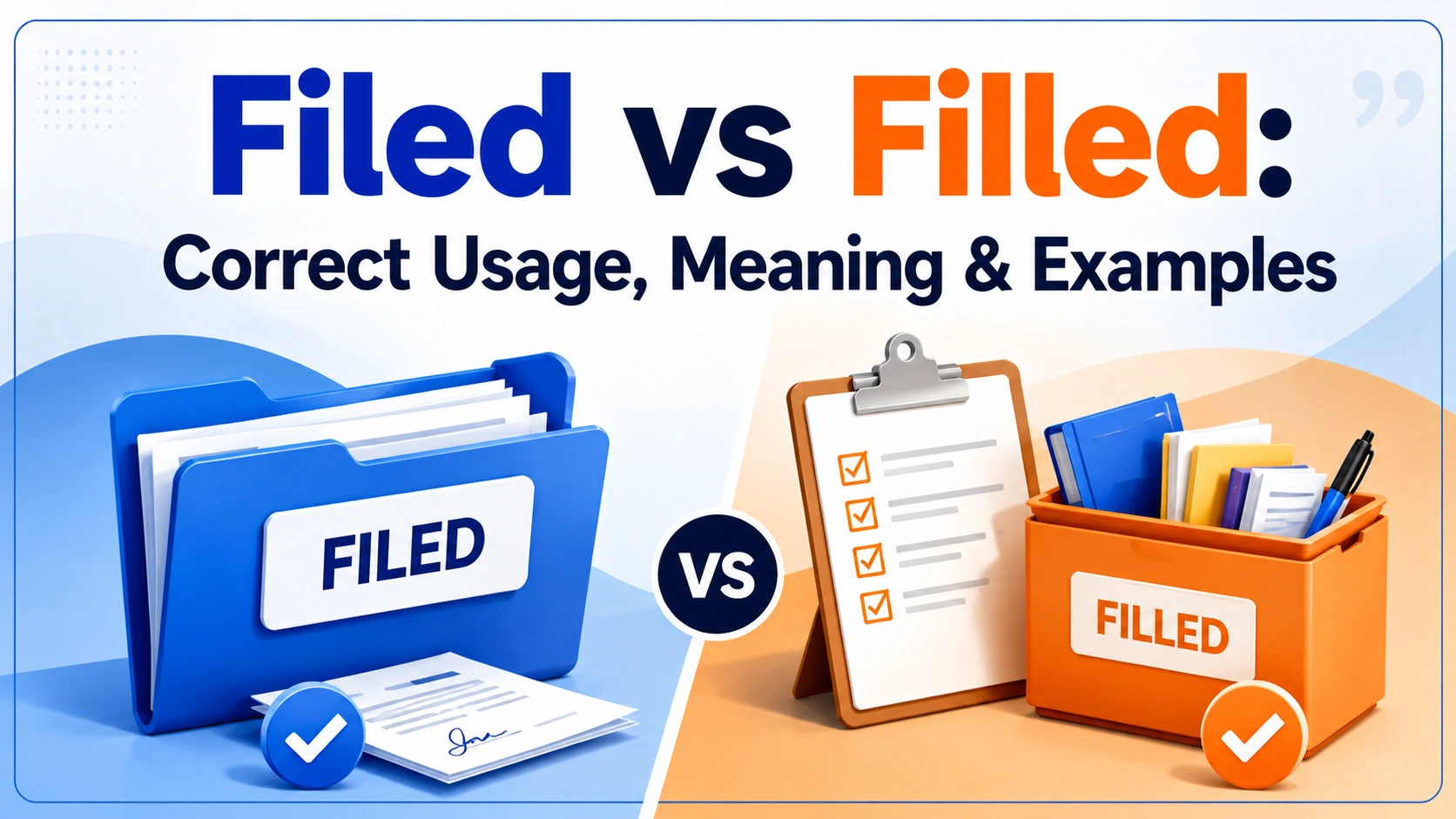
Filed and filled are easy to confuse because their spellings differ by only one letter, yet they describe very different actions. Filed comes from file, while filled comes from fill. One commonly relates to submitting, recording, or organizing documents; the other describes making something full, occupying space, or completing something.
The distinction becomes especially important in workplace, legal, academic, and everyday English. You can file a complaint, file a report, or file documents, but you fill a bottle, fill a room, and fill out a form. In some situations, both verbs can appear in the same process: you might fill out an application and then file the completed application. Understanding that difference helps prevent errors that spell-checkers often miss.
This guide explains filed vs filled from the ground up, including their meanings, grammar, pronunciation, common collocations, form-related expressions, legal and professional usage, spelling patterns, and the mistakes learners make most often. You will also see practical examples showing why a sentence needs one word rather than the other. By the end, the difference should be clear enough to recognize immediately in both writing and conversation.
Filed vs Filled: The Quick Answer
The easiest way to distinguish the two is to look at their base verbs:
| Word | Base verb | Core idea | Example |
| filed | file | Submitted, recorded, organized, or worked on with a file | She filed the report yesterday. |
| filled | fill | Made full, occupied, supplied, or completed | She filled the bottle with water. |
A useful mental shortcut is:
Filed → file → documents, records, official submissions
Filled → fill → full, space, completion
However, this is only a memory aid, not a complete definition. File also has a physical tool-related meaning, as in filed the rough edge, while fill can describe abstract things such as filled with happiness.
What Does “Filed” Mean?
Filed is the simple past and past participle of file. The verb has several related meanings, but its most important uses fall into three groups: storing information, officially submitting documents, and smoothing or shaping material with a file.
Filed means officially submitted
In legal, governmental, financial, and administrative English, filed often means that a document, application, complaint, report, or other item was formally submitted to an authority or entered into an official record.
Examples:
- The company filed its annual report.
- She filed a complaint with the department.
- The lawyer filed a motion with the court.
- They filed a claim for compensation.
- He filed his tax return before the deadline.
This is why expressions such as filed a lawsuit, filed a complaint, and filed an application are standard English. Cambridge defines this sense of file as sending a document to an official authority or officially recording something, particularly in a court.
Filed means organized or stored
File can also mean to put information or documents into an organized filing system.
Examples:
- She filed the invoices by date.
- The assistant filed the patient records.
- I filed the receipts in the correct folder.
- The old reports were filed alphabetically.
Here, filed does not necessarily mean “submitted to an authority.” It means stored or arranged systematically so the information can be retrieved later.
Filed can describe work done with a file
There is another, less paperwork-focused meaning.
A file can be a tool used to smooth, shape, or remove material from an object. Consequently, files can describe that physical action.
Examples:
- He filed the rough edge of the metal.
- The technician filed the surface smooth.
- She filed her nails carefully.
This is a useful reminder that filed does not always mean “submitted paperwork.”
Common Collocations With “Filed”
Learning common word combinations makes the distinction much easier in real writing.
| Common expression | Meaning |
| filed a complaint | Formally submitted a complaint |
| filed a lawsuit | Started a legal action by formally submitting it |
| filed a claim | Submitted a claim for consideration |
| filed an application | Officially submitted an application |
| filed a report | Submitted or officially recorded a report |
| filed a motion | Submitted a formal request in a legal proceeding |
| filed documents | Organized or submitted documents, depending on context |
| filed records | Stored records in an organized system |
| filed paperwork | Organized or formally submitted paperwork |
| filed a tax return | Submitted a tax return to the relevant authority |
These combinations are particularly useful because they show how context determines the precise meaning of filed.
What Does “Filled” Mean?
Filled is the simple past and past participle of fill. Its central meaning is to make something full or use available space. From that basic idea, English develops several physical, practical, occupational, and metaphorical uses.
Filled means made full
This is the most straightforward use.
Examples:
- She filled the glass with water.
- He filled the tank with fuel.
- They filled the box with books.
- I filled the bottle to the top.
The basic structure is often:
fill + object + with + substance
For example:
He filled the container with rice.
Cambridge gives the same basic pattern for adding something to a container or space until it becomes full.
Filled means occupied a space
Something does not have to be a container to be filled.
Examples:
- The audience filled the theater.
- Clouds filled the sky.
- Smoke filled the room.
- The streets were filled with people.
In these cases, filled means that people, objects, or something noticeable occupied a substantial amount of available space.
Filled can describe abstract experiences
English also uses filled metaphorically.
Examples:
- She was filled with gratitude.
- He was filled with excitement.
- The news filled them with hope.
- The child was filled with curiosity.
Nothing is literally being poured into a person. Instead, the emotion or quality becomes strongly present.
This pattern is particularly common with:
filled with + emotion/quality
Examples include filled with joy, filled with fear, filled with pride, and filled with uncertainty.
Filled can mean occupied by a person in a role
The verb fill can also mean to provide someone for a job, position, post, or vacancy.
Examples:
- The company filled the vacant position.
- They filled the role with an experienced manager.
- The school has filled all its teaching positions.
- The vacancy was filled within a week.
Cambridge notes a regional distinction in terminology: fill a position is particularly associated with US English, while fill a post is especially common in UK English.
Filed vs Filled: The Central Difference
The difference becomes clearer when you stop looking at spelling and focus on what the subject actually did.
| If the action involves… | Use | Example |
| Official submission | filed | She filed a complaint. |
| Legal recording | filed | The lawyer filed the motion. |
| Organizing records | filed | He filed the invoices. |
| Using a file tool | filed | She filed the rough edge. |
| Making a container full | filled | He filled the bottle. |
| Occupying a space | filled | The crowd filled the hall. |
| Completing information | filled out/in | She filled out the form. |
| Providing someone for a vacancy | filled | They filled the position. |
| Producing a strong abstract state | filled | He was filled with pride. |
The central distinction can be expressed in one sentence:
Filed is about filing; filled is about filling.
That sounds obvious, but reconnecting each past-tense form to its base verb is one of the most dependable ways to avoid the error.
Filed vs Filled When Talking About Forms
Forms create some of the most confusing examples because both words can legitimately appear in the same situation.
“Filled out a form” means completed it
When you enter information into the boxes, fields, or spaces on a form, you fill out the form in American English.
Please fill out this application before Friday.
In British English, filling in a form is especially common. Cambridge identifies fill in a form as mainly British and notes that American English usually prefers to fill out a form.
“Filed a form” means submitted or recorded it
If the completed form is formally submitted to an authority or entered into a record, filed may be appropriate.
The attorney filed the completed form with the court.
This is a completely different action from completing the fields.
Why both verbs can appear together
Consider this sequence:
- You receive an application.
- You fill out the application.
- You check the information.
- You sign it.
- You file the completed application.
So these are both correct:
- She filled out the application.
- She filed the application.
They simply describe different moments in the process.
Practical rule: If you are writing information into the blanks, think fill. If you are formally submitting or recording the document, think file.
Filed vs Filled in Legal and Professional English
Professional writing makes the distinction especially important because these verbs often occur beside similar nouns.
Filed a complaint
Correct:
The employee filed a complaint with the appropriate department.
The complaint was formally submitted.
Filled out a complaint form
Also correct:
The employee filled out the complaint form.
The employee completed the required fields.
Filed an application
Correct:
The applicant filed an application for the position.
This emphasizes formal submission.
Filled out an application
Correct:
The applicant filled out the application.
This emphasizes completing the questions and information requested.
The distinction is subtle but meaningful. In formal writing, choosing the correct verb can tell readers exactly which stage of an administrative process occurred.
Common Mistakes With Filed and Filled
Mistake 1: “Filled a lawsuit”
❌ She filled a lawsuit against the company.
✅ She filed a lawsuit against the company.
A lawsuit is formally filed, not filled.
Mistake 2: “Filed out a form”
❌ Please file out this form.
✅ Please fill out this form.
The form is being completed, so fill out is required.
Mistake 3: “Filed the bottle with water”
❌ He filed the bottle with water.
✅ He filled the bottle with water.
The bottle is being made full, so use is filled.
Mistake 4: “Filled the documents”
This may be grammatically possible in a highly unusual context, but it often fails to express what the writer actually means.
Compare:
She filed the documents.
= She organized or stored them.
She filled the folder with documents.
= She put documents into the folder until it contained them.
The difference comes from the action and sentence structure, not merely from the noun.
Mistake 5: Assuming spell-check will catch the problem
A spell-checker may accept both filed and filled because both are legitimate English words.
For example:
She filed the complaint yesterday.
There is nothing misspelled here. The problem is word choice.
That is why proofreading for meaning matters more than relying exclusively on automated spelling tools.
File, Filed, Filing: The Grammar Pattern
Because filed is a verb form, it helps to see its complete pattern.
| Verb form | Example | Function |
| file | I file the records. | Base/present form |
| files | She files the records. | Third-person singular present |
| filed | She filed the records. | Simple past |
| filed | She has filed the records. | Past participle |
| filing | She is filing the records. | Present participle/gerund |
The important point is that filed serves both as the simple past and past participle.
Examples:
Simple past:
They filed the report yesterday.
Present perfect:
They have filed the report.
Past perfect:
They had filed the report before the meeting.
The spelling remains filed in all three cases.
Fill, Filled, Filling: The Grammar Pattern
The corresponding forms of fill are:
| Verb form | Example |
| fill | I fill the bottle. |
| fills | She fills the bottle. |
| filled | She filled the bottle. |
| filled | She has filled the bottle. |
| filling | She is filling the bottle. |
Notice that the past tense and past participle are both filled.
Examples:
- He filled the tank yesterday.
- He has filled the tank already.
- He had filled the tank before the trip.
This parallel structure makes the words easy to compare:
file → filed → filed → filing
fill → filled → filled → filling
Why “Filled” Has Two Ls but “Filed” Does Not
The spelling difference comes from the different base verbs.
File ends in a silent e:
file → filed
The final e remains when -d is added.
Fill already ends in ll:
fill → filled
The doubled consonant remains, producing fill.
The difference becomes even more obvious in the present participles:
- file → filing
- fill → filling
The final e disappears before -ing in filing, while the double l remains in filling.
For learners, the safest approach is not to invent a special rule for filed and filled. Learn each form as part of its base verb.
Filed vs Filled Pronunciation
The words are also distinguished by their vowel sounds.
- filed is pronounced /faɪld/
- filled is pronounced /fɪld/
The first begins with the vowel sound found in file, five, and smile.
The second uses the shorter vowel sound found in fill, sit, and build.
A practical listening test is to say the base verbs first:
file → filed
fill → filled
If you can hear the difference between file and fill, you can usually carry that distinction into their past-tense forms.
Related Confusion: File vs Fill vs Feel
A third word sometimes enters the picture: feel.
These words have different meanings and grammatical patterns:
| Word | Basic meaning | Past tense |
| file | organize, submit, or smooth | filed |
| fill | make full or complete | filled |
| feel | experience a sensation or emotion | felt |
Examples:
- I filed the report.
- I filled the bottle.
- I felt tired.
The forms may sound somewhat similar to learners, but their meanings are completely different.
Filed vs Filled: A Practical Decision Guide
When proofreading your sentence, use this sequence.
Step 1: Identify the base verb
Ask:
Am I talking about file or fill?
If the answer is file, use filed for the simple past.
If the answer is fill, use filled.
Step 2: Identify the action
Use filed if someone:
- submitted a document;
- organized records;
- entered something into an official record;
- used a file tool to smooth material.
Use filled if someone:
- made something full;
- occupied a space;
- supplied a vacancy;
- completed a form with information;
- caused someone to experience a strong emotion.
Step 3: Check the phrase
Some expressions are so established that they provide a useful clue:
- file a lawsuit
- file a complaint
- file a claim
- fill out a form
- fill in a form
- fill a bottle
- fill a vacancy
- fill a room
Step 4: Read the sentence again
If both words appear possible, ask:
What changed because of the action?
If a document becomes officially recorded or organized, filed is probably right.
If a space became occupied or a form became complete, filled is probably right.
A Mini Case Study: One Application, Two Verbs
Imagine a student applying for a program.
First, the student receives an application form. They enter their name, contact information, qualifications, and other requested details.
The student filled out the application.
Next, the completed application is submitted through the required official process.
The office filed the application.
Neither sentence can simply replace its verb with the other.
If you write:
The student filed out the application.
you have confused the file with fill out.
If you write:
The office filled the application.
you have changed the intended meaning and made the sentence unnatural.
This is a useful example because it shows that the words are not merely spelling variants. They represent different actions in a real process.
Quick Reference: Filed or Filled?
| Sentence | Correct? | Why |
| She filed a complaint. | ✅ | A complaint is formally submitted. |
| She filed a complaint. | ❌ | Not the intended standard expression. |
| She filled out the form. | ✅ | She completed the form. |
| She filed out the form. | ❌ | Filed out is not the standard phrase. |
| He filled the bottle. | ✅ | He made the bottle full. |
| He filed the bottle. | ❌ | The verb does not fit the intended action. |
| She filed the records. | ✅ | She organized/stored them. |
| She filled the records. | ❌ | Does not express record organization. |
| The room was filled with people. | ✅ | People occupied the space. |
| The room was filed with people. | ❌ | Filed is the wrong verb. |
Practice: Choose Filed or Filled
Complete each sentence with the most appropriate form.
- The attorney ______ the motion yesterday.
- Please ______ out the registration form.
- She ______ the jar with rice.
- The assistant ______ the invoices by month.
- The theater was ______ with spectators.
- They ______ the vacant position last month.
- He ______ a formal claim with the agency.
- She ______ the application before submitting it.
- The cabinet was ______ with old records.
- The technician ______ the rough edge smooth.
Answers
- filed
- fill
- filled
- filed
- filled
- filled
- filed
- filled
- filled
- filed
The ninth example is particularly useful: filled with old records means the cabinet contained many records, whereas filed the old records would mean someone organized or stored the records.
Common Phrases Worth Remembering
With “filed”
- filed a complaint
- filed a lawsuit
- filed a claim
- filed an application
- filed a report
- filed a motion
- filed documents
- filed records
- filed paperwork
- filed a tax return
With “filled”
- filled a bottle
- filled a glass
- filled a room
- filled the space
- filled a vacancy
- filled a position
- filled a need
- filled a gap
- filled out a form
- filled in a form
- filled with joy
- filled with confidence
Memorizing these as phrases is more useful than memorizing the words in isolation because it develops a sense of natural English word combinations.
A Simple Memory Trick
Use two short associations:
Filed → File
Think file cabinet.
Documents go into a file, and formal documents can be filed.
Filled → Full
Think full.
A container can be filled, a room can be filled, and a form can be filled out.
FILED = FILE
FILLED = FULL
There is also a particularly useful sentence to memorize:
Fill out the form; file the completed form.
It captures the difference between completing information and officially submitting or recording documentation.
Final Checklist for Writers and Learners
Before choosing filed or filled, ask:
- Is the base verb file? → filed
- Is the base verb fill? → filled
- Is a document being officially submitted? → filed
- Are records being organized? → filed
- Is a physical object being smoothed with a file? → filed
- Is a container becoming full? → filled
- Is a space being occupied? → filled
- Is a position or vacancy being supplied? → filled
- Is someone completing a form? → filled out/in
- Could the sentence describe two separate stages? → You may need both words.
Conclusion:
Filed vs filled is not a matter of choosing between two spellings of the same word. They come from different verbs and describe different actions. Filed comes from file and commonly refers to organizing records, formally submitting documents, or using a file as a tool. Filled comes from fill and refers to making something full, occupying space, supplying a vacancy, completing information, or producing an emotional state.The most useful distinction appears with paperwork: you fill out or fill in a form, but you may file the completed document. One final actionable tip: when uncertain, return to the base verb and ask what action actually happened. A common mistake to avoid is trusting spell-check alone, because both filed and filled are correctly spelled words. Once you connect filled with file and filled with full, the difference becomes much easier to recognize—and much harder to forget.
FAQs
Q1. Is it “filed a complaint” or “filled a complaint”?
The correct expression is “filed a complaint” when you mean formally submitting a complaint to an organization or authority. If you are completing a document containing complaint details, you might instead say “filled out a complaint form.” The distinction depends on the action being described.
Q2. Is “filed out a form” ever correct?
In standard modern English, “filed out a form” is not the normal expression for completing paperwork. Use “filled out a form” in American English or “filled in a form” in British English. Filed may be appropriate later if the completed document is officially submitted or recorded.
Q3. Can I say “filled the application”?
It depends on the intended meaning. “Filled out the application” means completed its questions or fields. In some contexts, filled the application may be understood, but filled out/in is clearer for form completion. Filed the application instead emphasizes formal submission.
Q4. What is the difference between “filed documents” and “filled documents”?
Filed documents are documents that have been organized, stored, or officially submitted, depending on context. Filled documents is not normally used to mean completed paperwork; instead, say filled-out documents when emphasizing that information has been entered into them.
Q5. Do American and British English use filed differently?
The core meaning of filed is essentially the same in both varieties. A more noticeable regional difference involves forms: American English commonly uses “fill out a form,” while British English commonly uses “fill in a form.” The distinction between filed and filled itself remains unchanged.