

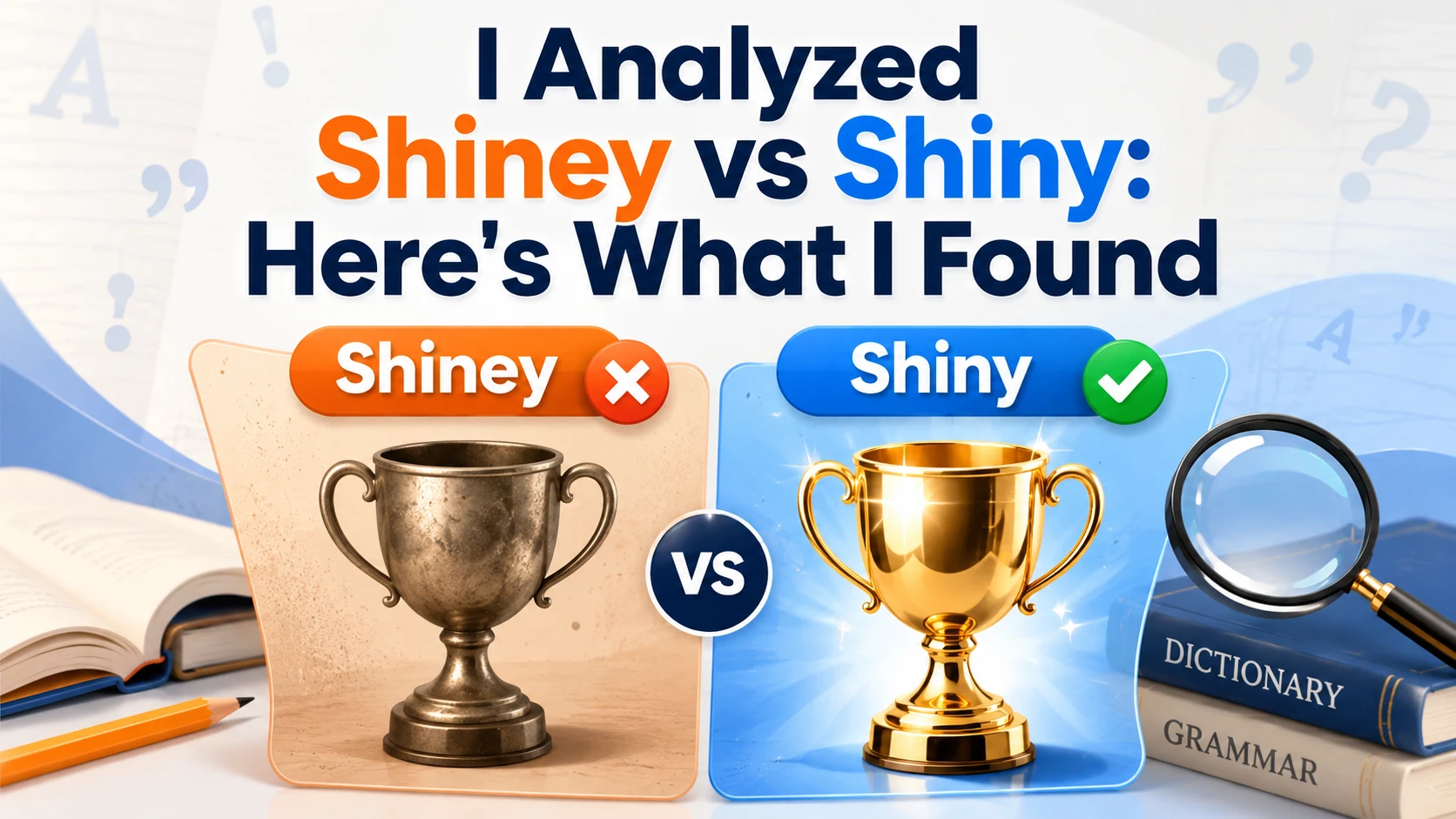
Shiney vs shiny is a surprisingly common spelling dilemma because both versions look plausible at first glance. If you’ve ever paused before writing shiny, you’re in good company. Students, English learners, content writers, and even native speakers occasionally wonder whether the adjective should include an extra “e.” The confusion is understandable: the base verb is shine, so many people naturally assume the adjective should become shiney. However, English spelling follows a different pattern here, and only one version is accepted in standard dictionaries.
Correct spelling matters more than many people realize. Whether you’re writing an academic paper, publishing a blog post, preparing a marketing copy, or simply sending an email, using the wrong spelling can weaken your credibility. Since shiny is a frequently used descriptive adjective, spelling it correctly helps your writing appear polished and professional. More importantly, understanding why it is spelled this way makes it easier to remember similar English word patterns instead of relying on memorization alone.
This guide explains the difference between shiney and shiny, why only one spelling is correct, how the adjective is formed from the verb shine, and when to use it naturally in different contexts. You’ll also discover practical examples, grammar rules, comparison tables, memory tricks, common mistakes, and proofreading tips that make the correct spelling easy to remember. By the end, you’ll know exactly why shiny is the standard spelling and how to use it confidently in everyday and professional writing.
Quick Answer: Is It “Shiney” or “Shiny”?
The answer is straightforward:
- ✅ Shiny is the correct spelling.
- ❌ Shiney is a misspelling and is not recognized in standard English dictionaries.
- ✅ Shiny is the adjective formed from the verb shine, meaning bright, glossy, reflective, or giving off light.
Key Takeaway: Whenever you describe something that reflects light, looks polished, or has a glossy appearance, always write shiny, never shiney.
Shiny vs. Shiney at a Glance
| Feature | Shiny | Shiney |
| Correct English spelling | ✅ Yes | ❌ No |
| Found in major dictionaries | ✅ Yes | ❌ No |
| Standard adjective from shine | ✅ Yes | ❌ No |
| Appropriate in academic writing | ✅ Yes | ❌ Never |
| Appropriate in business writing | ✅ Yes | ❌ Never |
| Used by native speakers | ✅ Always | ❌ Considered an error |
Examples
Correct
- The polished table looked shiny.
- She wore a shiny silver dress.
- The new car still looks shiny.
Incorrect
- The polished table looked shiney.
- He bought a shiney watch.
- Her shoes were shiney after cleaning.
Expert Tip: If your spell checker suggests shiny, accept the correction. There is no standard situation where shiney is preferred.
What Does “Shiny” Mean?
Shiny is an adjective that describes something bright, glossy, reflective, polished, or capable of reflecting light. It can describe both physical appearance and, in some contexts, figurative qualities such as attractiveness or newness.
Unlike the verb shine, which describes the action of giving off or reflecting light, shiny describes the appearance of a person, object, or surface.
Common Meanings of “Shiny”
Depending on the context, shiny may mean:
- Reflecting light clearly
- Smooth and polished
- Bright or gleaming
- New-looking or well-maintained
- Metallic or glossy in appearance
Although the exact shade of meaning changes slightly, the central idea remains the same: something that catches the eye because it reflects light or has a polished finish.
How “Shiny” Is Formed from “Shine”
One of the biggest reasons people write shiney is that they start with the verb shine and assume they simply add -y.
English doesn’t work that way.
Instead, when many verbs ending in a silent -e become adjectives ending in -y, the final e is dropped.
The pattern looks like this:
| Base Word | Adjective |
| Shine | Shiny |
| Ice | Icy |
| Spice | Spicy |
| Noise | Noisy |
| Stone | Stony |
Notice the pattern:
shine → shiny
Not:
❌ shine → shiney
This spelling rule is one of the easiest ways to remember the correct form.
Why “Shiney” Is Incorrect
Many spelling mistakes happen because English pronunciation doesn’t always match spelling. Shiney looks logical because the base word contains an e, but English spelling conventions remove it before adding -y.
Major dictionaries recognize only:
- shiny
They do not recognize:
- shiney
You’ll often find shiney online, but almost all examples come from:
- typing errors
- learner mistakes
- social media posts
- informal comments
- unedited websites
Popularity doesn’t make a spelling correct.
Where You’ll Commonly See “Shiny”
Because shiny is a versatile adjective, it appears across many kinds of writing.
Everyday Conversation
People frequently use shiny when describing objects that look new or polished.
Examples:
- Your shoes look shiny today.
- That’s a shiny new bicycle.
- I bought a shiny phone case.
Product Descriptions
Retailers often use shiny to describe appearance.
Examples:
- A shiny stainless-steel refrigerator
- Shiny black leather boots
- Shiny gold jewelry
Creative Writing
Authors use shiny to create vivid descriptions.
Examples:
- The dragon guarded a pile of shiny coins.
- Moonlight reflected off the shiny lake.
- She admired the shiny marble floor.
Marketing and Advertising
Businesses often emphasize attractive finishes.
Examples:
- A shiny finish enhances the premium appearance.
- Keep your car looking shiny year-round.
- Restore shiny surfaces with our polish.
When Should You Use “Shiny”?
Use shiny whenever you describe something that appears:
- polished
- glossy
- reflective
- bright
- smooth
- freshly cleaned
- metallic
- visually attractive because it reflects light
Examples:
- The apples looked shiny after being washed.
- His hair appeared shiny in the sunlight.
- The trophy remained shiny for years.
- She bought a shiny silver necklace.
The adjective works equally well in both formal and informal writing.
Can “Shiny” Be Used Figuratively?
Yes.
Although shiny usually refers to physical appearance, writers also use it figuratively.
Examples:
- a shiny new idea
- a shiny career opportunity
- a shiny marketing campaign
Here, shiny suggests something new, appealing, exciting, or attractive, rather than literally reflective.
This figurative meaning appears frequently in journalism, advertising, and business writing.
Why “Shiney” Is Incorrect
Many people assume shiney is a valid alternative spelling because it looks like it naturally comes from the verb shine. After all, if the base word ends with -e, wouldn’t adding -y simply produce shiney? It seems logical, but that’s not how standard English forms this adjective. According to modern English spelling conventions, the silent e is dropped before adding -y, resulting in shiny.
Another reason this mistake is so common is that both spellings appear online. Search engines, forums, social media posts, and user-generated content often contain spelling errors that spread through repetition. Seeing shiney frequently doesn’t make it correct. Dictionaries, grammar references, publishers, and professional editors consistently recognize shiny as the only standard spelling.
The Spelling Rule Behind “Shiny”
The adjective shiny follows a common English spelling rule:
When a word ends with a silent “e” and the suffix “-y” is added, the final “e” is usually dropped.
Examples include:
| Base Word | Correct Adjective |
| Shine | Shiny |
| Ice | Icy |
| Smoke | Smoky |
| Slime | Slimy |
| Stone | Stony |
Notice the pattern:
- shine → shiny ✅
- shine → shiney ❌
The same spelling rule applies to many other English words, making shiny consistent with standard grammar.
Grammar Tip: Whenever you add -y to many words ending in a silent e, the e is removed first.
Is “Shiney” Ever a Correct Word?
The simple answer is no.
Major English dictionaries, style manuals, and educational references recognize only shiny. The spelling shiney is considered a spelling mistake rather than an accepted variant.
You should avoid shiney in:
- Academic essays
- Business emails
- Blog posts
- Website content
- Product descriptions
- Job applications
- Marketing materials
- Social media captions (if you want polished writing)
Although readers may understand what you mean, using shiney can reduce your credibility because it signals poor proofreading or unfamiliarity with standard spelling.
Shiny vs. Shiney: Side-by-Side Comparison
| Feature | Shiny | Shiney |
| Correct spelling | ✅ Yes | ❌ No |
| Found in dictionaries | ✅ Yes | ❌ No |
| Standard English adjective | ✅ Yes | ❌ No |
| Appropriate for formal writing | ✅ Always | ❌ Never |
| Appropriate for school assignments | ✅ Yes | ❌ No |
| Accepted by editors | ✅ Yes | ❌ No |
| Recommended for learners | ✅ Always | ❌ Avoid |
Meaning
Only shiny has an accepted meaning in English.
It describes something that is:
- Reflective
- Glossy
- Bright
- Polished
- Smooth
- Gleaming
Because shiney isn’t a standard word, it has no independent dictionary definition.
Grammar
Shiny functions only as an adjective.
Examples:
- The mirror looks shiny.
- She bought shiny black shoes.
- The polished floor remained shiny all day.
By contrast, shiney has no grammatical role in standard English.
Pronunciation
One reason people misspell the word is pronunciation.
Both spellings would typically be pronounced the same way:
SHY-nee (/ˈʃaɪni/)
Since the silent e isn’t heard, some writers mistakenly include it in the spelling.
English spelling, however, often differs from pronunciation, so it’s important to rely on spelling rules rather than sound alone.
Why People Misspell “Shiny” as “Shiney”
Misspellings usually happen for predictable reasons, and shiney is no exception. Understanding these causes makes the correct spelling easier to remember.
Confusion with the Base Word “Shine”
The biggest source of confusion is the verb shine.
Many learners assume:
- shine → shiney ❌
Instead, English drops the silent e before adding -y:
- shine → shiny ✅
Keeping this spelling pattern in mind helps prevent similar mistakes with other words.
Spelling Based on Pronunciation
English isn’t always phonetic.
Because shiny is pronounced almost exactly as shiney would be, writers sometimes spell the word according to how it sounds instead of following the correct spelling rule.
This is especially common among:
- English learners
- Young students
- Fast typists
- Writers who rely on speech instead of reading
Influence of Similar Words
Some adjectives keep the final e, while others don’t.
This inconsistency causes confusion because English contains many irregular spelling patterns.
The safest approach is to remember shiny as a complete word rather than trying to build it from pronunciation.
Typing and Proofreading Errors
Fast typing can also lead to shiney, especially since many spell-check tools don’t always flag uncommon mistakes immediately in informal writing environments.
Before publishing any document, quickly scan for frequently confused words like:
- shiny
- definitely
- separate
- beginning
- occurred
A brief proofreading pass can eliminate many small spelling mistakes before readers notice them.
How to Use “Shiny” Correctly in Sentences
Knowing that shiny is the correct spelling is only part of the story. To write naturally and confidently, it’s equally important to understand where the adjective belongs in a sentence, what kinds of nouns it commonly describes, and which words it frequently appears with.
Describing Physical Objects
The most common use of shiny is to describe objects with smooth, polished, or reflective surfaces.
Examples:
- The shiny black car attracted everyone’s attention.
- She polished her shiny leather shoes.
- A shiny gold coin lay on the table.
- The child picked up a shiny pebble from the beach.
- We bought a shiny stainless-steel refrigerator.
In these examples, shiny tells readers how the object looks rather than what it does.
Describing Appearance
Sometimes shiny refers to someone’s appearance, especially hair, clothing, or accessories.
Examples:
- Her hair looked shiny after using the conditioner.
- He wore a shiny silk tie to the wedding.
- The dancer’s costume was bright and shiny.
- The model wore shiny silver boots.
- The fabric had a smooth, shiny texture.
In beauty and fashion writing, shiny usually carries a positive meaning because it suggests cleanliness, health, or luxury.
Describing Surfaces and Finishes
Many products are described according to their finish.
Examples:
- The floor became shiny after polishing.
- This paint creates a shiny finish.
- The table has a shiny protective coating.
- The ceramic tiles remain shiny for years.
- The furniture regained its shiny appearance after waxing.
These examples frequently appear in home improvement, interior design, and product descriptions.
Common Sentence Patterns with “Shiny”
Learning sentence patterns helps you use adjectives naturally instead of translating directly from another language.
Adjective + Noun
This is by far the most common structure.
Examples:
- a shiny watch
- shiny shoes
- a shiny surface
- shiny metal
- a shiny new bicycle
Linking Verb + Shiny
The adjective often follows linking verbs such as is, looks, became, seems, and remains.
Examples:
- The mirror is shiny.
- The floor looks shiny.
- Her hair became shiny after treatment.
- The car remained shiny despite the rain.
- These tiles seem shiny under bright lights.
Adverb + Shiny
Adverbs can modify the adjective for greater precision.
Examples:
- extremely shiny
- unusually shiny
- perfectly shiny
- remarkably shiny
- surprisingly shiny
Example sentences:
- The polished marble looked remarkably shiny.
- The trophy remained perfectly shiny after cleaning.
Real-World Examples of “Shiny”
Seeing the word in authentic situations makes it easier to remember.
Everyday Conversations
People often use shiny to describe attractive or clean objects.
Examples:
- Your new phone looks shiny.
- These shoes are still shiny.
- Why is this table so shiny?
- That necklace is really shiny.
- Everything looked shiny after the rain.
School and Academic Writing
Students may use shiny when describing observations.
Examples:
- The mineral had a shiny surface.
- The scientist observed several shiny crystals.
- The polished rock appeared shiny under the microscope.
- Some insects have shiny wings.
Product Descriptions
Retailers frequently use shiny to highlight appearance.
Examples:
- Features a shiny chrome finish.
- Made with shiny stainless steel.
- Elegant shiny black design.
- Durable shiny protective coating.
Creative Writing
Writers often use shiny to create vivid imagery.
Examples:
- Moonlight reflected from the shiny lake.
- The knight’s shiny armor gleamed in the sun.
- She admired the shiny ornaments hanging from the tree.
- A shiny star appeared above the mountains.
Common Expressions That Use “Shiny”
Native speakers often remember complete expressions rather than isolated words.
Shiny New
Used for something recently purchased or newly made.
Examples:
- He bought a shiny new laptop.
- They moved into a shiny new office.
- She proudly showed everyone her shiny new bicycle.
Bright and Shiny
Often emphasizes cleanliness or attractiveness.
Examples:
- Everything looked bright and shiny.
- The kitchen was clean, bright, and shiny.
- The freshly polished floor became bright and shiny.
Shiny Object
Frequently used literally and figuratively.
Literal examples:
- Birds often collect shiny objects.
- The child picked up every shiny object he found.
Figurative example:
- Don’t get distracted by every shiny object in business.
In business and productivity, the phrase “shiny object syndrome” describes constantly chasing new ideas instead of focusing on long-term goals.
Common Mistakes to Avoid
Understanding the most frequent errors helps you avoid them in your own writing.
Writing “Shiney” Instead of “Shiny”
This is the most common mistake.
Incorrect
- The car looks shiney.
- She bought shiney shoes.
Correct
- The car looks shiny.
- She bought shiny shoes.
Confusing “Shiny” with “Shining”
Although related, these words are not interchangeable.
Shiny describes appearance.
Shining describes an action.
Examples:
- The shiny floor reflected the lights.
- The sun was shining brightly.
Overusing “Shiny”
Sometimes a more specific adjective fits better.
Instead of repeating shiny, consider words such as:
- glossy
- polished
- reflective
- gleaming
- lustrous
- sparkling
Choosing the most precise adjective improves both clarity and style.
Quick Reminder: If you’re describing something that looks polished or reflects light, the correct spelling is always shiny. Remember the spelling pattern: shine → shiny, not shiney.
Conclusion
Understanding the difference between shiney and shiny is easier once you know the spelling rule behind the word. Shiny is the only accepted spelling in standard English and is used to describe something that reflects light, looks polished, appears bright, or has a smooth, glossy surface. By contrast, shiney is simply a common misspelling that occasionally appears in informal writing, online comments, or typing errors, but it is not recognized by major English dictionaries. Whether you’re writing an email, school assignment, blog post, product description, or creative story, choosing shiny helps your writing remain accurate, professional, and credible.One final actionable tip: whenever you’re unsure, think of the base verb shine. When it becomes an adjective, the silent e is dropped before adding -y, giving you shiny, not shiney. A common mistake to avoid is spelling the word based on pronunciation instead of following the standard spelling pattern.
FAQs
Q1. Is shiney a real English word?
No. Shiney is not recognized as a standard English word by major dictionaries. It is considered a spelling mistake. The correct adjective is shiny, which describes something bright, glossy, polished, or reflective. In both formal and informal writing, you should always use shiny.
Q2. Why do people spell shiny as shiney?
The mistake usually happens because writers keep the silent e from the base verb shine before adding -y. However, English spelling rules require dropping the final e, producing shiny. Fast typing and unfamiliarity with the rule also contribute to this common error.
Q3. Is shiny an adjective or a noun?
Shiny is an adjective. It describes the appearance or condition of a person, object, or surface that reflects light or looks polished. It is not used as a noun or verb. For example: The shiny new car attracted everyone’s attention.
Q4. Can I use shiny in formal and professional writing?
Yes. Shiny is perfectly acceptable in academic papers, business communication, product descriptions, technical documentation, and creative writing whenever you’re describing something with a glossy, reflective, or polished appearance. It is the only correct spelling for professional use.
Q5. What’s the easiest way to remember the correct spelling of shiny?
A simple memory trick is to remember “drop the E before adding Y.” Start with the base word shine, remove the final e, and then add -y to form shiny. Thinking of the rule shine → shiny makes the correct spelling much easier to recall every time.