
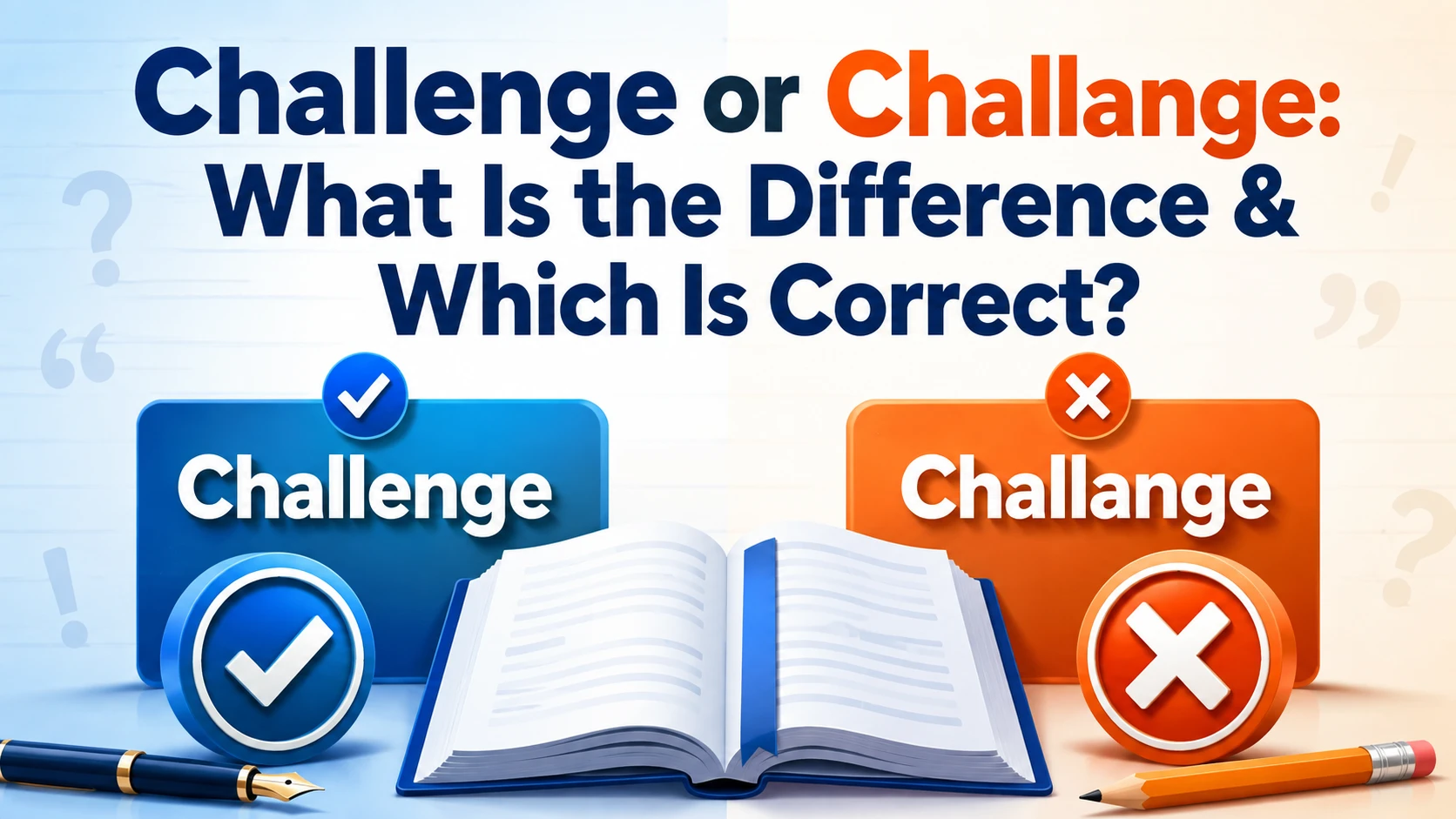
Challenge or challange is a spelling pair that frequently confuses English learners, students, job seekers, and even fluent writers because the two words differ by only a single letter. At first glance, challange may seem like a reasonable alternative spelling, especially since English contains many words with irregular patterns. However, appearances can be misleading. While challenge is a standard English word recognized by every major dictionary, challange is simply a misspelling. Using the incorrect version can weaken your writing, reduce credibility, and create an unprofessional impression in academic papers, emails, résumés, or business documents.
The confusion usually stems from pronunciation. In everyday speech, the ending of a challenge isn’t always pronounced clearly enough for writers to distinguish between -enge and -ange. As a result, many people rely on how the word sounds rather than how it is actually spelled. Typing quickly, limited exposure to written English, and autocorrect limitations also contribute to the popularity of the mistake. Since challenge is used across education, business, sports, technology, psychology, and everyday conversation, learning its correct spelling is essential for anyone who wants to write polished and accurate English.
This guide explains the difference between challenge and challange, why only one spelling is correct, and how the word functions as both a noun and a verb. You’ll also discover grammar rules, practical sentence patterns, comparison tables, common learner mistakes, memory tricks, real-world examples, and proofreading tips that make the correct spelling easy to remember. By the end, you’ll know exactly when to use challenge, why challange should always be avoided, and how to use the word confidently in both formal and everyday communication.
Quick Answer: Is It “Challenge” or “Challange”?
The answer is straightforward:
- ✅ Challenge is the correct spelling.
- ❌ Challange is a spelling mistake and is not recognized in standard English.
- ✅ Challenge can be used as both a noun and a verb.
Whenever you’re referring to a difficult task, competition, problem, invitation to compete, or the act of questioning or testing something, the correct word is challenge.
Key Takeaway: If you’re writing in English, always use challenges. The spelling challange should never appear in formal, academic, professional, or everyday writing.
Challenge vs. Challange: Side-by-Side Comparison
| Feature | Challenge | Challange |
| Correct English spelling | ✅ Yes | ❌ No |
| Found in dictionaries | ✅ Yes | ❌ No |
| Used in formal writing | ✅ Yes | ❌ Never |
| Used in academic writing | ✅ Yes | ❌ Never |
| Functions as a noun | ✅ Yes | ❌ No |
| Functions as a verb | ✅ Yes | ❌ No |
| Accepted in exams and professional documents | ✅ Yes | ❌ No |
Correct Usage Examples
✅ Challenge
- She accepted the challenge without hesitation.
- Learning a new language can be a rewarding challenge.
- The lawyer challenged the evidence presented in court.
- Our team faced several challenges during the project.
❌ Incorrect Usage
- She accepted the challange.
- Learning English is a challange.
- The company must challange the decision.
What Does “Challenge” Mean?
Challenge is a versatile English word that can function as both a noun and a verb. Although its exact meaning changes slightly depending on context, it always relates to difficulty, testing, questioning, competition, or demanding effort.
Because of its flexibility, challenge appears in virtually every type of writing—from casual conversations and classroom assignments to legal documents, business reports, and motivational speeches.
Challenge as a Noun
As a noun, challenge refers to something that requires skill, effort, determination, or problem-solving. It may also describe a formal invitation to compete or a situation that tests someone’s abilities.
Examples:
- Starting a new business is a significant challenge.
- Climate change remains a global challenge.
- Completing the marathon was his biggest challenge.
- Every challenge offers an opportunity to grow.
In these examples, challenge represents an obstacle or demanding situation rather than an action.
Challenge as a Verb
As a verb, challenge means to question, dispute, test, confront, or invite someone to compete.
Examples:
- The journalist challenged the politician’s statement.
- Students should challenge ideas respectfully.
- She challenged her friend to a chess match.
- Scientists continue to challenge outdated theories.
Here, challenge describes an action taken against an idea, person, assumption, or competitor.
Common Meanings Across Different Contexts
The meaning of challenge shifts slightly depending on where it is used, but the central idea remains the same: something that tests ability, effort, or judgment.
Everyday Conversations
People commonly use challenges when discussing personal goals, daily struggles, or difficult situations.
Examples:
- Finding enough time is my biggest challenge.
- Cooking for twenty people was quite a challenge.
- Parenting comes with many challenges.
- Learning to drive can be challenging.
Education
Teachers and students frequently use the word when discussing learning, assignments, and intellectual growth.
Examples:
- The final exam was a real challenge.
- The teacher challenged students to think critically.
- Solving complex equations can be challenging.
- Group projects often present communication challenges.
Business and Workplace
In professional settings, challenge often refers to obstacles, strategic decisions, or performance expectations.
Examples:
- Hiring skilled employees remains a challenge.
- The manager challenged the team to improve sales.
- Economic uncertainty created several business challenges.
- Effective leadership requires overcoming challenges.
Sports and Competition
Athletes regularly encounter challenges as both a noun and a verb.
Examples:
- Winning the championship was their greatest challenge.
- The coach challenged players to improve their fitness.
- Every tournament presents a new challenge.
- She accepted the challenge with confidence.
Personal Growth and Self-Improvement
Motivational writing frequently uses challenges to describe experiences that encourage learning and resilience.
Examples:
- Challenge yourself to learn something new each month.
- Personal growth begins when you embrace challenges.
- Facing challenges builds confidence and experience.
- Every setback can become a valuable challenge.
Technology and Gaming
Modern technology also uses challenges in several specialized ways.
Examples:
- The software security challenge was quickly resolved.
- Players completed every daily challenge.
- Artificial intelligence presents both opportunities and challenges.
- The coding challenge tested participants’ programming skills.
Legal and Formal Contexts
In legal writing, challenge often means to question the validity or legality of a decision, law, or evidence.
Examples:
- The attorney challenged the witness’s testimony.
- Several organizations challenged the new regulation.
- The court considered whether the decision could be challenged.
- Citizens have the right to challenge unlawful actions.
Legal usage emphasizes questioning or disputing rather than difficulty.
Is “Challange” Ever a Correct Word?
Many English learners wonder whether challange might be an accepted alternative spelling or a regional variation. Fortunately, the answer is clear.
Why “Challange” Is Considered a Misspelling
Challange is not a recognized English word. It doesn’t appear as a correct entry in major dictionaries because it violates the standard spelling of challenge.
The error usually happens because writers replace the correct ending -enge with -ange, even though English spelling rules do not support this change.
Whether you’re writing:
- essays
- business emails
- reports
- blog posts
- social media captions
- résumés
- professional documents
…the correct spelling is always challenging.
Why Spell Check Doesn’t Always Catch It
Although many writing tools identify challange as incorrect, not every application catches spelling mistakes immediately.
This happens because:
- some editors have limited dictionaries
- autocorrect may be disabled
- browsers don’t always check text fields
- fast typing leads to overlooked errors
Proofreading remains the most reliable way to catch spelling mistakes before publishing or submitting your work.
Can “Challange” Ever Be Correct in Any English Variety?
No.
Neither American English, British English, Canadian English, Australian English, nor any other standard variety of English accepts challange as the correct spelling.
Unlike words such as color/colour or organize/organise, there is no regional spelling variation for challenge.
Expert Tip: If you ever hesitate, remember that every major English dictionary, style guide, and educational institution recognizes only challenges. The spelling challange is always an error.
Definition of Challenge
Challenge is the correct spelling in modern English. It functions as both a noun and a verb, making it one of the most versatile words in the language. Whether you’re talking about a difficult situation, questioning an idea, inviting someone to compete, or encouraging personal growth, challenge is the word you should use.
Unlike challange, which is simply a spelling mistake, challenge appears in dictionaries, academic writing, business communication, legal documents, journalism, and everyday conversations.
At its core, challenge refers to something that tests ability, effort, skill, or determination. The exact meaning depends on the context, but the central idea remains the same: facing or presenting something that requires effort or response.
Key Point: If you’re writing in English, challenge is always the correct spelling. Challange should never replace it.
Common Meanings of “Challenge”
Because challenge is used in many different situations, it carries several closely related meanings.
A Difficult Task or Problem
The most common meaning refers to a situation that requires effort, patience, or skill to overcome.
Examples:
- Learning a new language is a challenge.
- Starting a business presents many challenges.
- Time management can be a challenge for students.
In this sense, a challenge is not necessarily negative. It often represents an opportunity to learn, improve, or achieve something meaningful.
An Invitation to Compete
Challenges can also describe inviting someone to prove their ability through competition.
Examples:
- She challenged her friend to a chess match.
- The champion accepted the challenge.
- Several teams challenged for the title.
Sports, games, and competitions frequently use this meaning.
Questioning Something
Another common meaning involves disputing, questioning, or objecting to an idea, statement, decision, or authority.
Examples:
- The lawyer challenged the evidence.
- Scientists challenged the previous theory.
- Citizens challenged the new policy in court.
Here, challenge means to argue against or test the validity of something.
Testing Someone’s Ability
Sometimes challenge means to push someone beyond their comfort zone so they can develop new skills.
Examples:
- The teacher challenged students to think critically.
- This project will challenge your creativity.
- Good leaders challenge their teams to improve.
Rather than creating problems, this meaning focuses on growth and improvement.
Is “Challenge” a Noun or a Verb?
One reason challenge appears so often is that it functions naturally as both.
| Part of Speech | Meaning | Example |
| Noun | A difficult task, obstacle, or competition | Solving the puzzle was a challenge. |
| Verb | To question, compete against, or test someone | She challenged the final decision. |
Understanding this dual role helps you use the word correctly in different sentence structures.
Common Contexts Where “Challenge” Is Used
Because of its broad meaning, challenge appears across almost every field of communication.
Business and the Workplace
Professionals use challenges to discuss obstacles, goals, leadership, and problem-solving.
Examples:
- Every growing company faces financial challenges.
- Managers challenge employees to improve performance.
- Customer retention remains our biggest challenge.
- The startup successfully overcame early challenges.
In business writing, challenge often appears alongside words such as strategy, innovation, productivity, leadership, risk, and growth.
Education
Teachers and students frequently use challenges to describe learning experiences and academic development.
Examples:
- Mathematics can be challenging for beginners.
- The assignment challenged students to think independently.
- Every research project brings new challenges.
- Debate competitions challenge critical thinking skills.
Educational contexts often emphasize challenge as something positive because it promotes learning.
Sports and Fitness
Competitive environments regularly use challenges to describe contests and physical tests.
Examples:
- The athlete welcomed the challenge.
- The team challenged the defending champions.
- Completing a marathon is a huge challenge.
- Every tournament presents new challenges.
Here, challenge usually combines determination, competition, and improvement.
Technology
Technology professionals often discuss technical challenges that require innovative solutions.
Examples:
- Cybersecurity remains a major challenge.
- Engineers solved several technical challenges.
- Software developers face coding challenges every day.
- Artificial intelligence introduces new ethical challenges.
In technical writing, challenge often refers to complex problems requiring creative thinking.
Healthcare
Medical professionals also use challenges in various contexts.
Examples:
- Managing chronic pain is a significant challenge.
- Doctors face new healthcare challenges each year.
- Mental health presents unique treatment challenges.
- Hospitals continue addressing staffing challenges.
The word typically describes obstacles that require expertise and long-term solutions.
Personal Growth
Many motivational and self-development discussions use challenge in a positive sense.
Examples:
- Every challenge teaches an important lesson.
- Personal growth begins when you embrace challenges.
- Facing new challenges builds confidence.
- Difficult experiences often become valuable opportunities.
In this context, challenge emphasizes resilience rather than difficulty alone.
Common Collocations with “Challenge”
Native speakers naturally pair challenges with certain words. Learning these collocations makes your English sound more fluent.
Some of the most common combinations include:
- face a challenge
- overcome a challenge
- accept a challenge
- meet a challenge
- present a challenge
- embrace a challenge
- challenge yourself
- challenge an idea
- challenge a decision
- challenge authority
- challenge assumptions
- issue a challenge
- rise to the challenge
- major challenge
- significant challenge
Using these natural combinations improves both writing and speaking.
Definition of Challange
Unlike challenge, challange is not a standard English word. It does not appear in major dictionaries as an accepted spelling and should not be used in formal, academic, professional, or everyday writing.
In nearly every situation, challange is simply a misspelling of challenge.
People often type it accidentally because English spelling patterns can be confusing. The pronunciation of “challenge” does not clearly indicate that the middle vowel should be “e” rather than “a,” making this one of the more common spelling errors among learners and native speakers alike.
For example:
❌ The project was a difficult challange.
✅ The project was a difficult challenge.
Why Does “Challange” Look Correct?
Several factors make this spelling mistake surprisingly common.
English Spelling Isn’t Always Phonetic
English words are often pronounced differently from how they’re spelled.
When people hear the word challenge, they may incorrectly assume the middle vowel is “a”, producing challange instead.
Similar-Looking Words
English contains many words ending in -ange, such as:
- change
- strange
- exchange
- rearrange
Because these endings are familiar, writers sometimes unconsciously replace -enge with -ange.
Fast Typing
Many spelling mistakes occur simply because fingers move faster than the brain.
Since challange differs by only one letter, it’s an easy typo to make, especially when typing quickly.
Spell Check Isn’t Foolproof
Modern grammar tools catch most spelling mistakes, but they don’t always prevent every error.
If proofreading is rushed or autocorrect is disabled, challange can easily remain unnoticed until someone else reads the document.
Why “Challenge” Uses -enge, Not -ange
The spelling comes from the word’s historical development through Old French and Middle English.
Although English spelling has evolved over centuries, the accepted modern form remains a challenge.
This means:
- challenge ✅ Correct
- challange ❌ Incorrect
There are no regional English dialects where challange is considered the standard spelling.
Whether you’re writing American English, British English, Canadian English, or Australian English, challenge is always correct.
Expert Tip: If you’re unsure, remember that challenge ends the same way as knowledge ends with an “e” sound before the final letters—not with the “ange” pattern found in change. This simple mental association helps many writers avoid the mistake.
When to Use Challenge in Different Contexts
Understanding the meaning of challenge is only part of using it correctly. You also need to know when it fits naturally in different types of writing and speech. Because the word functions as both a noun and a verb, its usage varies slightly depending on the situation.
Below are the most common contexts where challenge is the appropriate choice.
Academic Writing
In schools, colleges, and research papers, challenge often describes difficult subjects, research problems, opposing viewpoints, or intellectual tasks.
Examples:
- Climate change presents significant environmental challenges.
- The study challenges previous assumptions about consumer behavior.
- Students were challenged to defend their arguments with evidence.
- Learning advanced mathematics can be challenging at first.
Academic writing frequently pairs challenges with words like research, hypothesis, theory, methodology, critical thinking, and analysis.
Business and Professional Communication
Businesses use challenges to discuss obstacles, goals, risks, leadership, and strategic planning.
Examples:
- One of our biggest challenges is customer retention.
- The company challenged its competitors with innovative products.
- Economic uncertainty created several financial challenges.
- Managers should challenge employees to develop new skills.
In professional settings, challenge often carries a positive meaning because it encourages growth and innovation rather than simply describing problems.
Everyday Conversations
In casual speech, challenge refers to anything that requires extra effort.
Examples:
- Cooking this recipe was a real challenge.
- Finding parking downtown is always a challenge.
- Raising young children can be challenging.
- That puzzle was more challenging than I expected.
This is the meaning most English learners encounter first.
Sports and Competition
Competitive activities regularly use challenges for contests, opponents, and tests of skill.
Examples:
- The boxer challenged the defending champion.
- Every match brings new challenges.
- She accepted the fitness challenge.
- Our team loves a difficult challenge.
Sports commentators also use expressions like challenge for the title, challenge the record, and rise to the challenge.
Legal and Government Contexts
Legal English often uses challenge to mean questioning or disputing a law, decision, election, or ruling.
Examples:
- The company challenged the court’s decision.
- Several organizations challenged the new regulations.
- The lawyer challenged the witness’s testimony.
- Citizens have the right to challenge unlawful actions.
Here, challenge means to formally dispute something.
Technology and Engineering
Technology professionals frequently discuss technical challenges during product development.
Examples:
- Developers solved several security challenges.
- Artificial intelligence creates new ethical challenges.
- Engineers challenged the existing design to improve efficiency.
- Software compatibility remains a common challenge.
In technical writing, challenge usually refers to complex problems requiring practical solutions.
When You Should Never Use “Challange”
One of the simplest grammar rules to remember is this:
There is virtually no situation where “challange” is correct.
Whether you’re writing:
- Emails
- Essays
- Business reports
- Social media posts
- Books
- Articles
- Resumes
- Research papers
…the correct spelling is always challenging.
Incorrect examples:
- This project was a major challange.
- She enjoys every challange.
- We must challange the decision.
Correct versions:
- This project was a major challenge.
- She enjoys every challenge.
- We must challenge the decision.
Quick Decision Guide: Challenge or Challange?
If you’re unsure while writing, use this simple checklist.
| If you mean… | Correct Word |
| A difficult task | Challenge ✅ |
| To question a decision | Challenge ✅ |
| To compete against someone | Challenge ✅ |
| To test someone’s abilities | Challenge ✅ |
| A spelling ending in “-ange” | Never use challange ❌ |
Simple Rule: If you’re talking about difficulty, competition, questioning, or growth, the answer is always challenge.
Common Mistakes Writers Make
Even experienced writers occasionally misspell challenges. Fortunately, the errors are easy to avoid once you recognize the patterns.
Mistake 1: Replacing -enge with -ange
This is by far the most common mistake.
❌ challange
✅ challenge
The pronunciation makes the spelling easy to confuse, but standard English always uses -enge.
Mistake 2: Depending Only on Pronunciation
English spelling doesn’t always match pronunciation.
Many people spell words exactly as they sound, which leads to errors like:
- challange
- knowlege
- privilage
Instead, learn the accepted spelling rather than relying on sound alone.
Mistake 3: Forgetting Spell Check Isn’t Perfect
While most writing software flags challange, proofreading is still essential.
Good writers always perform one final review before publishing important documents.
Mistake 4: Mixing Noun and Verb Usage
Some learners understand the spelling but misuse the grammar.
Correct:
- The interview was a challenge. (noun)
- The interview challenged me. (verb)
Incorrect:
- The interview was challenging me. (when referring to the event itself rather than the action)
Understanding whether you need a noun, verb, or adjective (challenging) improves sentence accuracy.
Easy Memory Tricks
Small memory devices can prevent this spelling mistake permanently.
Remember “Challenge Ends Like Knowledge”
Both words contain “e” before the final letters.
- knowledge
- challenge
This pattern helps many learners remember the correct spelling.
Think of the Adjective
The adjective is challenging.
Since it begins with challenge, the base word must also be challenge.
- challenge
- challenging
- challenger
Notice that none of these use challange.
Read More English
Frequent reading naturally reinforces correct spelling.
The more books, newspapers, articles, and professional documents you read, the easier it becomes to recognize incorrect spellings instantly.
Expert Tip: Don’t memorize challange as an alternative spelling—it isn’t one. Train your eyes to recognize challenge as the only standard form.
Conclusion
Although challenge and challange differ by just one letter, only challenge is recognized as the correct spelling in modern English. Whether you’re describing a difficult task, questioning a decision, inviting someone to compete, or encouraging personal growth, challenge is the word you should use. Challange is simply a common spelling error and should be avoided in academic writing, business communication, professional documents, and everyday conversations. Remember that accurate spelling not only improves readability but also strengthens your credibility as a writer. One final actionable tip: if you’re ever unsure, think of related words like challenging, challenger, or challenged—they all begin with challenge, reinforcing the correct spelling. A common mistake to avoid is assuming that challange is an acceptable regional or alternative spelling. It isn’t. Mastering this simple distinction will help you write with greater confidence, professionalism, and precision.
FAQs
Q1. Which spelling is correct: challenge or challange?
Challenge is the only correct spelling in standard English. It appears in all major dictionaries and is accepted in American, British, Canadian, and Australian English. Challange is a misspelling and should not be used in formal or informal writing.
Q2. Why do people commonly misspell challenge as challange?
The mistake usually happens because English spelling isn’t always phonetic. Many writers assume the word ends in -ange, influenced by words like change or exchange. However, challenge has its own historical spelling pattern and always ends in -enge.
Q3. Can challenge be used as both a noun and a verb?
Yes. Challenge functions as both a noun and a verb. As a noun, it refers to a difficult task, obstacle, or competition. As a verb, it means to question, test, oppose, or invite someone to compete, making it one of English’s most versatile words.
Q4. Is challange ever correct in any type of English?
No. Challange is not recognized as a correct spelling in any major variety of English. It isn’t accepted in British English, American English, Australian English, or Canadian English. Regardless of where you’re writing, challenge is always the correct form.
Q5. What’s the easiest way to remember the correct spelling of a challenge?
A simple memory trick is to connect challenge with words like challenging, challenged, and challenger. Since all of these related words begin with a challenge, you’ll naturally remember the correct spelling. Another helpful reminder is that challenge always ends with -enge, never -ange.