

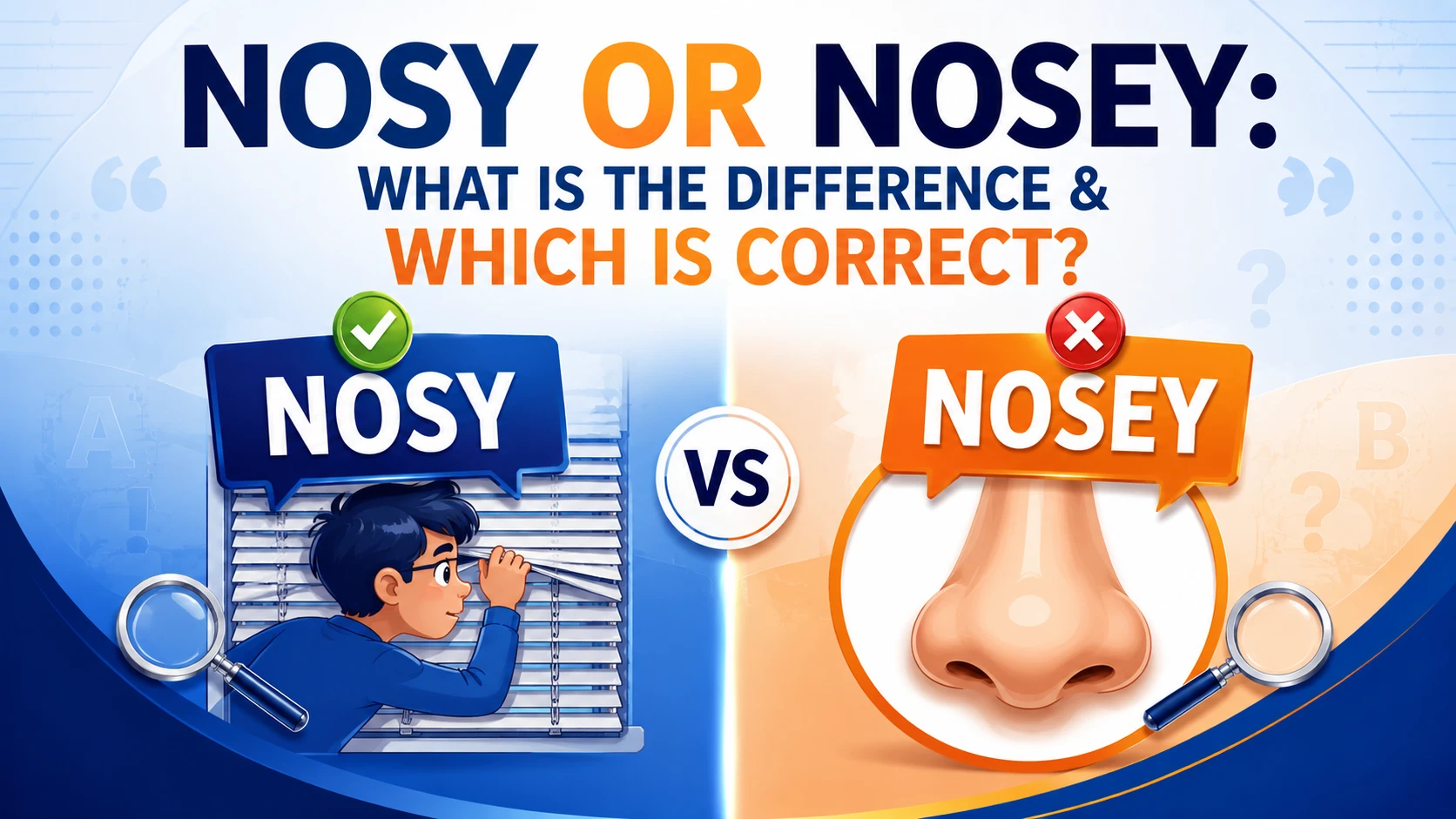
Nosy or nosey is a spelling question that surprises many English learners and even native speakers. Since both versions appear in books, newspapers, online articles, and everyday conversations, it’s natural to wonder whether one is incorrect or if they’re simply regional variations. Choosing the wrong spelling may not change your meaning, but it can affect how polished and professional your writing appears, especially in academic, business, or published content. Understanding the distinction helps you write with greater confidence and avoid unnecessary corrections.
Although nosy and nosey carry the same meaning, they are not equally preferred. Modern dictionaries recognize both spellings, yet nosy has become the dominant choice in most contemporary English, particularly in American usage. Nosey survives as an accepted alternative, appearing more often in some British publications and informal writing. This difference makes the topic more nuanced than a simple “right versus wrong” spelling debate, which is why many writers search for a clear explanation.
In this guide, you’ll learn which spelling is standard, why two versions exist, how dictionaries and style guides treat them, where each spelling is most appropriate, and practical ways to remember the preferred form. You’ll also see comparison tables, real-world examples, common mistakes, grammar tips, and expert recommendations that make the distinction easy to understand. Whether you’re writing an essay, preparing professional documents, or simply improving your English, this article will help you choose the right spelling with confidence.
Quick Answer: Which Is Correct—Nosy or Nosey?
If you’re looking for the short answer, here it is:
- Nosy is the preferred and more widely used spelling in modern English.
- Nosey is also recognized by many dictionaries, but it is considered a less common variant.
- For school assignments, professional communication, formal writing, and most online content, nosy is usually the safer choice.
Quick Comparison
| Feature | Nosy | Nosey |
| Correct spelling | ✅ Yes | ✅ Yes (variant) |
| Most common today | ✅ Yes | Less common |
| Preferred in formal writing | ✅ Yes | Usually no |
| Meaning | An overly curious person | Same meaning |
| Suitable for exams | ✅ Recommended | Usually avoid unless following a style guide |
Key Takeaway: If you’re unsure which spelling to use, choose nosy. It’s the spelling most readers expect to see.
What Do “Nosy” and “Nosey” Mean?
Both words describe someone who is excessively curious about other people’s private affairs. The term often has a mildly negative tone because it suggests asking intrusive questions or interfering in matters that don’t concern you.
Examples include:
- A neighbor constantly asking about your visitors.
- A coworker trying to learn everyone’s salary.
- Someone reading messages that weren’t meant for them.
Although the meaning remains identical regardless of spelling, the context determines whether the word sounds playful or critical.
For example:
- “My little brother is nosy and always opens my drawers.”
- “Don’t be so nosy—it’s a private conversation.”
Sometimes the word is used humorously among friends, while in professional settings it can sound insulting if directed at someone personally.
Why Do People Confuse Nosy and Nosey?
The confusion isn’t caused by grammar rules alone. Instead, several language habits encourage writers to alternate between the two spellings.
Both Spellings Exist
Unlike obvious misspellings such as useage or happend, nosey isn’t entirely wrong. Because dictionaries acknowledge it as a variant, people naturally assume both spellings are equally common.
That isn’t the case.
Modern published English overwhelmingly favors nosy, making it the spelling readers encounter most frequently.
The Word “Nose” Influences Spelling
Many people assume the adjective should contain the full noun nose because the word originally referred to someone who “sticks their nose into other people’s business.”
That assumption seems logical:
- nose → nosey
However, English spelling doesn’t always preserve the original form. Over time, usage standardized nosy as the preferred spelling despite its connection to nose.
Regional Preferences
Another reason for confusion is that different English-speaking regions have historically shown different preferences.
Some British publications have accepted nosey, while American English overwhelmingly favors nosy. Because online readers encounter content from around the world, both spellings appear regularly.
Spell Checkers and Autocorrect
Digital writing tools don’t always settle the debate.
Some spell checkers recognize both forms without correction, while others recommend nosy depending on the selected language settings.
As a result, writers often assume whichever spelling appears on their screen must be universally preferred.
The Definition of “Nosy”
Nosy is an adjective describing a person who shows too much interest in other people’s private matters.
Typical characteristics include:
- Asking overly personal questions.
- Listening to conversations not intended for them.
- Reading private messages.
- Constantly seeking information about others.
- Becoming involved in issues that don’t concern them.
The adjective usually expresses mild criticism rather than serious accusation.
Examples
- My nosy neighbor always watches who visits our house.
- The reporter asked several nosy questions about her personal life.
- Children are naturally curious, but they shouldn’t become too nosy.
Notice that the word focuses on excessive curiosity rather than healthy interest.
The Definition of “Nosey”
Nosey carries exactly the same meaning as nosy.
It also describes someone who is overly inquisitive or intrusive.
Examples include:
- She can be a little nosey about other people’s relationships.
- The children became nosey when they heard unexpected visitors.
Although these sentences are grammatically acceptable, many editors would replace nosey with nosy to match current editorial standards.
That’s why most style-conscious writers prefer nosy, even though dictionaries recognize nosey as an alternative spelling.
Nosy vs. Nosey: Side-by-Side Comparison
Understanding the differences becomes much easier when everything is viewed together.
| Aspect | Nosy | Nosey |
| Meaning | Overly curious | Same meaning |
| Part of speech | Adjective | Adjective |
| Dictionary status | Standard spelling | Accepted variant |
| Modern popularity | Very common | Less common |
| Professional writing | Strongly recommended | Less preferred |
| Academic writing | Recommended | Better avoided |
| Everyday conversation | Common | Occasionally seen |
| Risk of appearing incorrect | Very low | Slightly higher |
The important point is that the distinction is based on preference rather than meaning. Readers understand both spellings, but one simply aligns better with modern usage.
Where Did the Word Come From?
The history of the word explains why two spellings developed.
The adjective originated from the noun nose, reflecting the old expression “to stick one’s nose into other people’s business.” Over time, English speakers created an adjective describing people who habitually behaved this way.
As pronunciation evolved, writers experimented with different spellings.
Eventually:
- Nosy became the dominant simplified spelling.
- Nosey remained as an alternative form.
English contains many similar examples where spelling gradually shifted toward simpler forms through common usage rather than strict grammatical rules.
Because language develops through widespread adoption, nosy eventually became the preferred choice in dictionaries, educational materials, journalism, and professional publishing.
Is One Spelling More Common Today?
Yes.
Modern English strongly favors nosy across newspapers, magazines, educational resources, dictionaries, business communication, and online publications.
You’ll especially notice nosy in:
- News articles
- Academic writing
- School textbooks
- Professional blogs
- Corporate communication
- Style guides
Meanwhile, nosey appears mostly in:
- Informal writing
- Older publications
- Personal blogs
- Some British sources
- Fiction aiming to reflect conversational language
This difference explains why teachers and editors usually recommend nosy unless you’re intentionally preserving a particular regional style.
When Should You Use “Nosy”?
Choose nosy whenever you want your writing to appear clear, professional, and consistent with modern English conventions.
It is the best option for:
- Academic essays
- Business emails
- Professional reports
- Journalism
- Website content
- Books
- Social media posts
- Everyday writing
Examples
- Don’t be nosy about other people’s finances.
- Our nosy neighbor notices every visitor.
- Journalists should avoid asking unnecessarily nosy questions.
- Being curious is healthy, but being nosy often invades privacy.
Because this spelling is widely recognized, readers are unlikely to question it regardless of where they live.
When Is “Nosey” Acceptable?
Although nosy is generally the better choice, nosey isn’t automatically incorrect.
You may encounter or intentionally use nosey in specific situations, such as:
Regional Writing
Some British publications and regional writers continue using nosey as an accepted spelling variant.
Fictional Dialogue
Authors sometimes preserve a character’s dialect or speaking style by choosing the spelling that feels most authentic.
Example:
“Stop being so nosey, will you?” the grandmother laughed.
Personal Preference
Some individuals simply prefer the traditional spelling because it more obviously reflects the word nose.
Even so, consistency matters. If you choose nosey, avoid switching between both spellings within the same document.
When Should You Avoid Using “Nosey”?
While nosey is recognized by several dictionaries as a variant spelling, it is not the best choice in every situation. If your goal is to write in a way that looks polished, professional, and widely accepted, nosy should almost always be your default.
Avoid nosey in contexts where consistency and standard spelling matter.
Academic Writing
Schools, colleges, and universities generally expect students to use the most widely accepted spelling of words.
Instead of writing:
The article criticized the nosey reporters.
Write:
The article criticized the nosy reporters.
Using the preferred spelling reduces the chance of corrections from teachers or editors.
Business Communication
Professional emails, reports, proposals, and workplace documents should follow modern standard English whenever possible.
For example:
✅ The client asked several nosy questions about our pricing.
Using nosey isn’t necessarily wrong, but it may distract readers who expect the standard spelling.
Professional Publishing
Editors usually standardize spelling throughout newspapers, magazines, websites, and books. Since nosy is far more common, publishers typically choose it unless maintaining a specific regional style.
Grammar Guide: How to Use “Nosy” Correctly
Understanding the grammar is just as important as choosing the right spelling.
“Nosy” Is an Adjective
The word nosy describes a person, behavior, question, or attitude.
Examples:
- My coworker is nosy.
- She asked a nosy question.
- Their nosy behavior annoyed everyone.
- Stop being so nosy.
Since it functions as an adjective, it usually appears:
- Before a noun
- After a linking verb
Examples:
- A nosy neighbor.
- He seems nosy.
Common Sentence Patterns
Here are some natural ways English speakers use the word.
| Sentence Pattern | Example |
| Adjective + noun | A nosy reporter |
| Be + adjective | She is nosy. |
| Too + adjective | You’re too nosy. |
| Rather + adjective | He’s rather nosy. |
| Extremely + adjective | They became extremely nosy. |
Notice that nosy behaves like adjectives such as:
- curious
- rude
- friendly
- polite
- helpful
Comparative and Superlative Forms
Like many short adjectives ending in -y, nosy changes naturally.
| Form | Example |
| Positive | nosy |
| Comparative | nosier |
| Superlative | nosiest |
Examples:
- My younger brother is nosier than I am.
- She’s the nosiest person in the office.
These forms follow normal English adjective rules.
Common Mistakes Writers Make
Even though the spelling question seems simple, several mistakes appear repeatedly in everyday writing.
Mistake 1: Assuming “Nosey” Is Always Wrong
Many learners believe nosey is simply a misspelling.
In reality:
- Nosy is preferred.
- Nosey is an accepted variant.
The difference is one of convention rather than meaning.
Mistake 2: Switching Between Spellings
Some writers use both spellings in the same article.
Example:
- The nosy neighbor…
- The nosey woman…
This inconsistency makes writing appear unedited.
Choose one spelling and use it throughout the document.
Mistake 3: Confusing “Nosy” with “Curious”
These words overlap but aren’t identical.
| Curious | Nosy |
| Neutral or positive | Often negative |
| Wants to learn | Invades privacy |
| Encourages discovery | Crosses personal boundaries |
For example:
A scientist is curious.
A neighbor reading your mail is nosy.
Understanding this distinction helps you communicate more precisely.
Mistake 4: Using It in Formal Descriptions
Calling someone nosy in professional writing can sound judgmental.
Instead of writing:
The employee was nosy.
A report might say:
The employee repeatedly sought confidential information unrelated to their responsibilities.
Choosing a more neutral language often produces clearer communication.
Practical Examples in Everyday English
Seeing words used naturally is one of the fastest ways to remember them.
Everyday Conversation
- Don’t be so nosy.
- Why are you asking such nosy questions?
- My aunt can be a little nosy, but she means well.
- That’s none of your business—stop being nosy.
School
- The teacher reminded students not to ask nosy questions about classmates.
- Some children become nosy when new students arrive.
Workplace
- A nosy coworker kept asking about everyone’s salary.
- Managers should discourage nosy discussions about confidential information.
Social Media
- People can become surprisingly nosy online.
- Avoid sharing personal details if you don’t want nosy strangers commenting.
Family
- Grandma wasn’t trying to be nosy; she was simply concerned.
- My little sister is incredibly nosy whenever guests visit.
Nosy vs. Curious: Understanding the Difference
Many English learners mistakenly use these words interchangeably, but they express different attitudes.
| Feature | Curious | Nosy |
| Meaning | Wants to learn | Wants private information |
| Tone | Usually positive | Usually negative |
| Motivation | Interest or learning | Personal interference |
| Social perception | Appreciated | Often criticized |
| Example | Curious student | Nosy neighbor |
Curious Example
The children were curious about how airplanes fly.
Learning something new is positive.
Nosy Example
The neighbors were nosy about the family’s financial situation.
Here, curiosity becomes intrusive because it concerns private matters.
Expert Tip: If someone’s questions make another person uncomfortable, nosy is usually the better word. If the interest is educational or harmless, choose curiosity instead.
Expressions and Idioms Related to “Nosy”
English contains several colorful expressions that convey a similar idea.
Stick Your Nose Into Someone Else’s Business
Meaning:
To interfere in matters that don’t concern you.
Example:
He always sticks his nose into other people’s problems.
Prying Into Someone’s Life
Meaning:
Trying too hard to discover private information.
Example:
Reporters shouldn’t pry into someone’s personal relationships without a good reason.
Be In Someone’s Business
Meaning:
Constantly involving yourself in another person’s affairs.
Example:
Stop being in everyone else’s business.
Snooping Around
Meaning:
Secretly searching for information.
Example:
Someone had been snooping around my office.
Although these expressions differ slightly in tone, they all relate to the behavior described by nosy.
Simple Memory Tricks to Remember the Preferred Spelling
Many learners struggle because being nosey seems more logical. Fortunately, a few memory techniques make the preferred spelling much easier to recall.
Trick 1: Think Shorter Is Standard
The modern spelling is shorter.
- Nosy ✅
- Nosey ❌ (less preferred)
Whenever you’re unsure, choose the shorter version.
Trick 2: Remember Professional Writing
Ask yourself:
“Which spelling would I use in a business email?”
The answer is almost always nosy.
Trick 3: Associate It with Common Adjectives
Think of similar adjectives ending in -y:
- messy
- noisy
- happy
- funny
- nosy
This visual pattern helps reinforce the standard spelling.
Decision Guide: Which Spelling Should You Choose?
If you’re still uncertain, this checklist provides a quick answer.
| Situation | Recommended Choice |
| School assignment | Nosy |
| College essay | Nosy |
| Professional email | Nosy |
| Website article | Nosy |
| Book manuscript | Nosy |
| Journalism | Nosy |
| Informal personal message | Either (prefer nosy) |
| Regional British style | Either, depending on house style |
For most writers, the simplest rule is also the safest:
Choose “nosy” unless you have a specific reason to use “nosey.”
Practice Quiz: Test Your Understanding
Fill in each blank with nosy or nosey based on standard modern English.
- My ______ neighbor knows everyone’s schedule.
- Stop asking such ______ questions.
- The reporter became too ______ during the interview.
- She isn’t curious—she’s simply ______.
- Editors generally recommend the spelling ______.
Take a moment to answer before checking below.
Answers
- nosy
- nosy
- nosy
- nosy
- nosy
Although nosey can sometimes be acceptable, nosy is the preferred answer in each example because it reflects current standard English usage.
Real-World Examples of “Nosy” and “Nosey”
Understanding a spelling rule is useful, but seeing it applied in different situations makes it much easier to remember. The examples below demonstrate how nosy is used in modern English and when nosey may occasionally appear.
Examples Using “Nosy” (Preferred Spelling)
These examples reflect the spelling you’ll encounter most often in books, news articles, workplaces, and educational materials.
- My nosy neighbor always knows who’s coming and going.
- Please don’t ask such nosy questions during the interview.
- The children became nosy after hearing the adults whispering.
- A nosy coworker kept checking everyone’s calendar.
- She apologized for being nosy about my personal life.
- Reporters should avoid appearing nosy when discussing sensitive topics.
- His nosy attitude often made people uncomfortable.
- Being nosy can damage trust in friendships.
Examples Using “Nosey” (Variant Spelling)
These sentences are grammatically acceptable because nosey is a recognized variant, though it is less common.
- My aunt can be a little nosey, but she’s kindhearted.
- The nosey neighbors watched every visitor.
- Stop being so nosey and let them handle it.
- The novel describes a nosey landlady who knows everyone’s secrets.
If you’re writing for a broad audience, replacing nosey with nosy is usually the better editorial decision.
Mini Case Studies: Choosing the Right Spelling
The following scenarios illustrate how context influences the best spelling choice.
Case Study 1: A College Essay
A student writes:
My nosey classmates kept asking personal questions.
The professor doesn’t mark it incorrect, but suggests changing it to nosy because it follows the preferred modern spelling.
Best choice: Nosy
Case Study 2: A Business Newsletter
A company’s communications team is preparing a monthly newsletter.
To maintain consistency with standard business English, the editor replaces every instance of nosey with nosy before publication.
Best choice: Nosy
Case Study 3: A British Novel
A novelist wants dialogue to reflect a regional voice.
One character says:
“You’re such a nosey old woman.”
Because the dialogue reflects a particular dialect and tone, the spelling feels authentic.
Best choice: Either spelling may work, depending on the author’s stylistic preference.
Expert Tips for Using “Nosy” Naturally
Writers don’t just choose the correct spelling—they also know when and how to use the word effectively.
Consider the Tone
The adjective usually has a negative or teasing tone. Before using it, think about whether a softer word might fit your message better.
Instead of:
My manager is nosy.
You might write:
My manager is very interested in everyone’s work.
This alternative sounds more neutral and professional.
Reserve It for Genuine Intrusiveness
Someone asking one personal question isn’t automatically nosy.
The word works best when someone repeatedly invades another person’s privacy or ignores social boundaries.
For example:
- Asking where someone lives once is usually normal.
- Repeatedly questioning someone’s finances or relationships can seem nosy.
Context matters more than the number of questions.
Match Your Audience
If you’re writing for:
- Students
- Professionals
- International readers
- Website visitors
choose nosy to ensure your writing aligns with current standard English.
Consistency builds credibility.
Common Myths About “Nosy” and “Nosey”
Several misconceptions continue to circulate online. Let’s separate fact from fiction.
| Myth | Reality |
| Nosey is always wrong. | It is an accepted variant but less common. |
| Nosy is only American English. | It is widely accepted in both American and British English. |
| Both spellings are equally common. | Modern English strongly favors nosy. |
| The meanings are different. | They mean exactly the same thing. |
| Editors don’t care which one you use. | Most editors prefer nosy for consistency. |
Understanding these facts helps you avoid unnecessary confusion.
Best Practices for Writers and English Learners
Whether you’re learning English or refining your professional writing, these habits will help you use the word confidently.
Do
- Use nosy in formal and informal writing.
- Stay consistent throughout a document.
- Consider the tone before describing someone as nosy.
- Use the word only when excessive curiosity is involved.
- Check your organization’s style guide if writing professionally.
Don’t
- Assume nosey is the preferred spelling.
- Switch between both spellings in one piece of writing.
- Confuse nosy with curious.
- Use the adjective casually in professional evaluations where more neutral wording may be appropriate.
Following these practices will make your writing more accurate and polished.
Quick Reference Checklist
Before you publish or submit your writing, ask yourself these questions.
- ✔ Did I use nosy instead of nosey unless I had a stylistic reason?
- ✔ Does the word describe someone who is excessively interested in private matters?
- ✔ Would curiosity be a better choice if the interest is harmless?
- ✔ Is the spelling consistent throughout the document?
- ✔ Does the tone fit the audience and purpose?
If you answered “yes” to each question, you’ve likely used the word correctly.
Summary Table
| Question | Answer |
| Which spelling is preferred? | Nosy |
| Is nosey incorrect? | No, it’s an accepted variant. |
| Do both words have different meanings? | No, they mean the same thing. |
| Which spelling should students use? | Nosy |
| Which spelling do editors usually recommend? | Nosy |
| Can nosey appear in fiction? | Yes, especially for regional or conversational style. |
| Is nosy formal? | It is acceptable in formal writing, though the meaning itself remains informal or conversational. |
Conclusion
Choosing between nosy and nosey is much simpler once you understand how modern English treats the two spellings. While both forms share the same meaning and are recognized by several dictionaries, nosy is the preferred spelling in contemporary English and the one you’ll see most often in academic writing, professional communication, journalism, and online publications. Nosey remains an accepted variant, but it’s less common and is usually reserved for informal or stylistic purposes. One final actionable tip: whenever you’re unsure, default to nosy to ensure your writing meets current editorial expectations. A common mistake to avoid is assuming that nosey is the standard spelling simply because it’s derived from nose. By choosing the preferred form consistently and using it in the right context, you’ll write with greater clarity, confidence, and professionalism.
FAQs
Q1. Is nosey considered an incorrect spelling?
Not necessarily. Nosey is an accepted variant spelling found in several dictionaries. However, nosy is the preferred and more widely used form in modern English. If you’re writing for school, work, or publication, nosy is generally the better choice.
Q2. Why is nosy more common than nosey?
Language changes over time, and usage determines which spellings become standard. Although nosey reflects the noun nose, nosy gradually became the dominant spelling in modern dictionaries, style guides, and published writing, making it the preferred option for most contexts.
Q3. Should I use nosy or nosey in formal writing?
Use nosy in formal writing whenever possible. It is the spelling most editors, teachers, and publishers expect to see. While nosey isn’t technically wrong, choosing nosy helps maintain a professional and consistent writing style.
Q4. Do nosy and nosey have different meanings?
No. Nosy and nosey mean exactly the same thing: someone who is overly interested in other people’s private affairs. The only real difference is spelling preference, not definition, pronunciation, or grammatical function.
Q5. How can I easily remember the correct spelling?
A simple trick is to remember that the shorter spelling is the standard one. Think of other common adjectives ending in -y, such as messy, funny, and noisy. Following the same pattern makes nosy easier to recall whenever you’re writing.