

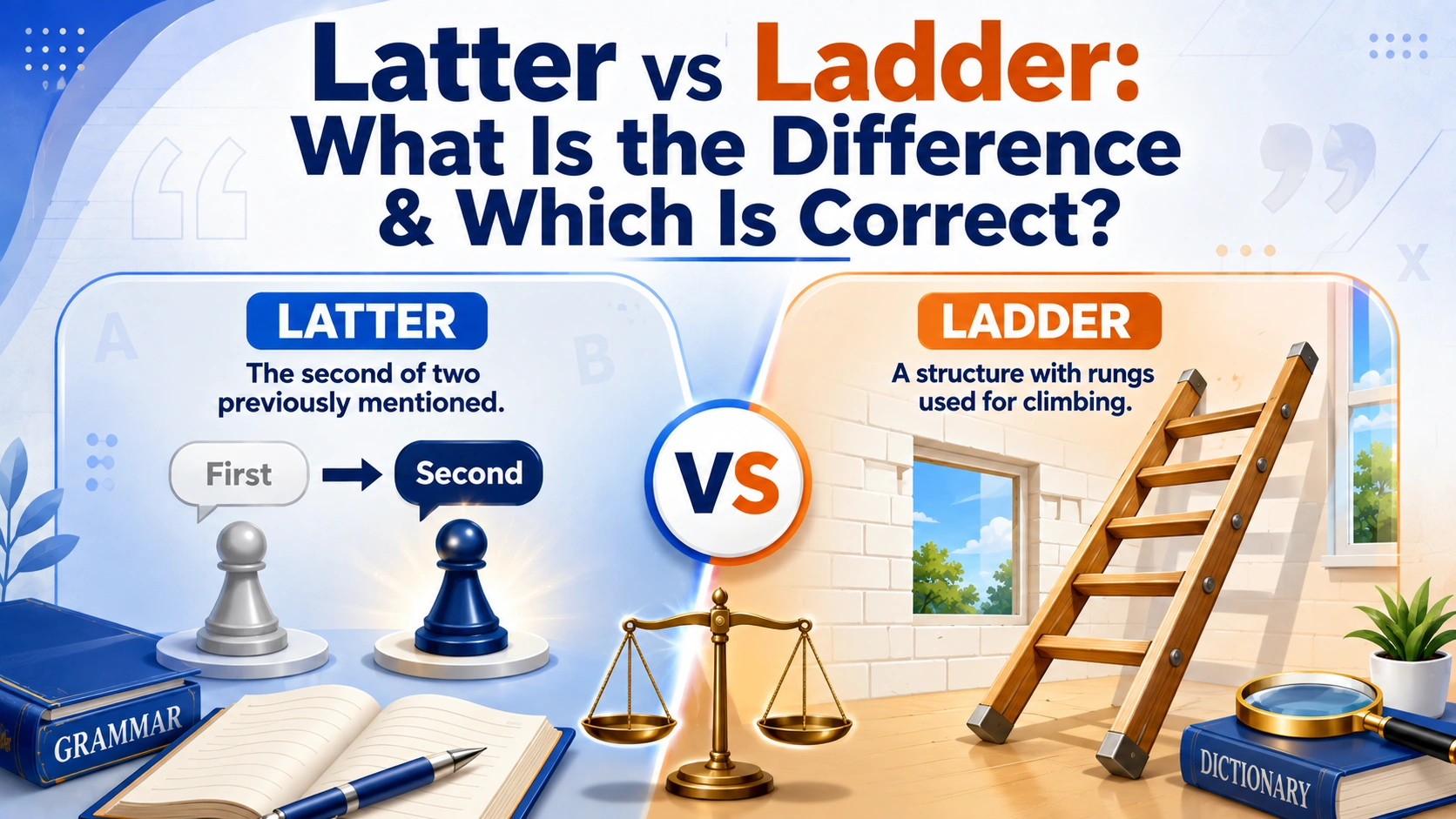
Latter vs ladder is a classic English word pair that can cause confusion because the two words look and sound remarkably similar, yet they refer to completely different ideas. Latter is mainly used to identify the second of two previously mentioned people, things, or choices, while ladder usually refers to a physical structure used for climbing. The distinction becomes much easier once you connect each spelling to its meaning rather than trying to remember the words by sound alone. Both the latter and ladder are correct English words; the question is which one fits your sentence.
The confusion becomes more interesting because the latter has more than one legitimate use. Besides identifying the second item in a comparison, it can describe something that occurs toward the end of a period or stage, as in “the latter part of the year.” By contrast, ladder can be literal or figurative: you can climb a ladder, but you can also climb the career ladder or social ladder. Understanding these additional meanings prevents mistakes that a simple spelling trick cannot always catch.
This guide explains latter vs ladder from every angle that matters to an English learner or careful writer: meaning, grammar, pronunciation, sentence patterns, formal usage, figurative expressions, common mistakes, and the relationship between former and latter. You will also learn why “latter” is sometimes used with more than two items even though many style guides recommend restricting it to two, and why directly naming an item can sometimes be clearer than using former or latter. By the end, choosing between these two words should feel almost automatic.
Latter vs Ladder: Quick Answer
The shortest answer is:
- Latter refers to the second of two things or people already mentioned, or to a later/end part of a period.
- Ladder is primarily a structure with rungs or steps used for climbing, and it can also describe a progression or hierarchy.
- Latter is associated with later or toward the end.
- Ladder is associated with rungs, climbing, and upward progress.
Consider these two sentences:
I was offered tea or coffee, and I chose the latter.
Here, the latter means coffee, because coffee was the second option mentioned.
I used a ladder to reach the roof.
Here, ladder means the physical climbing equipment.
Quick comparison
| Word | Main meaning | Typical use | Example |
| latter | Second of two mentioned items; later/end part | Comparisons, formal writing, time periods | “I prefer the latter option.” |
| ladder | Climbing structure; figurative progression | Physical objects, careers, rankings | “She climbed the ladder.” |
So, neither word is more correct than the other. They are different words with different meanings.
What Does “Latter” Mean?
Latter has two closely related major uses. The first is about position in a comparison or sequence; the second is about time or being near the end of something.
Latter Meaning: The Second of Two Things
The most familiar meaning of the latter is the second of two people, things, groups, or choices that have already been mentioned.
For example:
We can travel by train or bus. I prefer the latter.
Two options appear in the sentence:
- train
- bus
Therefore, the latter = bus.
This is why the latter is particularly useful in formal and academic writing. Instead of repeating “bus,” a writer can use the latter as a compact reference. Cambridge gives the same basic meaning: the latter refers to the second of two previously mentioned people, things, or groups.
Latter as an Adjective
Latter can come before a noun:
- the latter option
- the latter example
- the latter point
- the latter proposal
- the latter approach
For example:
The first proposal would cost less, but the latter proposal would be easier to implement.
Here, the latter identifies the second proposal.
In many cases, however, English simply uses the latter without repeating the noun:
The first proposal would cost less, but the latter would be easier to implement.
Latter as “Nearer the End”
A separate but related meaning is near or toward the end of a period, event, or process.
Examples include:
- the latter half of the year
- the latter part of the book
- the latter stages of the competition
- the latter years of his career
- during the latter part of the century
For example:
The project became much more difficult in the latter stages.
Here, the latter does not mean “the second of two things.” It means the later or concluding part of the project. Cambridge and Oxford both recognize this time-related meaning.
Latter Does Not Simply Mean “Last” in Every Situation
This distinction is important.
Latter and last sometimes overlap in meaning, but they are not interchangeable in every sentence.
Compare:
The latter part of the movie was slower.
This means the part toward the end of the movie.
But:
She finished last in the race.
Here, last refers to the final position, not merely a later part of a period.
A good writer therefore checks the relationship between the words rather than treating latter as a universal synonym for last.
What Does “Ladder” Mean?
Ladder has a completely different meaning.
The ordinary noun refers to a structure consisting of two long sides connected by rungs or steps, allowing someone to climb upward or downward. Dictionaries also recognize figurative uses involving advancement and hierarchy.
Ladder as a Physical Object
The most common meaning is literal:
He leaned the ladder against the wall.
Please hold the ladder while I climb.
The painter left his ladder outside.
A ladder can be made from different materials and designed for different purposes, but the defining idea is the same: it provides a series of steps or rungs for climbing.
Ladder in Figurative Language
English also uses ladder metaphorically to describe progression through levels.
Common expressions include:
- career ladder
- corporate ladder
- social ladder
- ladder of success
- political ladder
For example:
She worked hard to move up the corporate ladder.
Nobody is necessarily climbing a physical object. The ladder represents successive levels of status or advancement.
This figurative meaning explains why ladder can appear in business, education, politics, sports, and other contexts where people move from one level to another.
Ladder as a Verb
Ladder can also function as a verb, although this use is considerably less common for ordinary learners.
The verb can describe climbing by means of a ladder or furnishing something with a ladder. Some dictionaries also record specialized uses, including figurative progression.
For everyday English, however, learners will encounter ladder as a noun far more often.
Latter vs Ladder: The Main Difference
The easiest way to separate the words is to focus on what each one points to.
The latter points backward in a sentence. It normally asks you to look at something that has already been mentioned and identify the second item.
Ladder points to a thing or concept. It normally names a physical object or a metaphorical system of levels.
| Feature | Latter | Ladder |
| Core idea | Second/later/end | Climbing/progression |
| Common grammatical role | Adjective or noun/pronominal use | Noun; sometimes verb |
| Refers to previous information? | Usually, when meaning “second mentioned” | No |
| Physical object? | No | Yes |
| Used figuratively? | Yes, for later stages/periods | Yes, for advancement/hierarchy |
| Typical phrase | “the latter option” | “the career ladder” |
| Key memory | later | rungs |
A Useful Test
Ask yourself:
Am I identifying the second of two previously mentioned choices?
If yes, the latter is probably correct.
Am I talking about something people climb, or a system of levels someone moves through?
If yes, ladder is probably correct.
Latter vs Ladder Examples
Examples of “Latter”
We discussed the budget and the schedule. The latter needs more attention.
The latter = schedule.
She could study biology or chemistry. She chose the latter.
The latter = chemistry.
The latter part of the report contains the recommendations.
Here, the latter means the part toward the end.
Between the two designs, I prefer the latter.
The latter = the second design.
Examples of “Ladder”
The technician climbed the ladder.
We need a taller ladder to reach the upper shelf.
He hopes to climb the career ladder.
The team is moving up the league ladder.
The first two examples involve a literal object. The final two use ladder metaphorically to describe progress through levels.
Former vs Latter: The Pair You Should Know
If you want to master the latter, learn the former at the same time.
The basic relationship is:
Former = first
Latter = second
Suppose you write:
Maria and Aisha applied for the position. The former had more experience, while the latter had stronger technical skills.
- former = Maria
- latter = Aisha
This is one reason the latter is especially common in formal prose. It lets a writer refer back to two previously mentioned subjects without repeating their names.
The F–L Memory Trick
A simple mnemonic is:
- F = Former = First
- L = Latter = Later/second
It is not a complete explanation of every meaning of these words, but it is an effective quick reminder.
Why “Former and Latter” Can Sometimes Be a Bad Choice
Being grammatically correct does not automatically make a sentence easy to read.
Consider:
The committee reviewed the proposal from the finance department and the proposal from the technology department before consulting the external auditors, who had previously advised the former on a related matter.
Which proposal does the former identify?
A reader has to work backward.
That is the central weakness of former/latter constructions: they can force readers to search through earlier text.
Merriam-Webster notes that although former and latter are widely used, they can become a nuisance when the reference is difficult to follow. In some situations, repeating the noun is actually clearer.
Expert tip: Use former and latter when the reference is immediate and unmistakable. If a reader has to stop and count or reread, name the item instead.
Can “Latter” Refer to More Than Two Things?
This is one of the more interesting points that many simplified grammar explanations leave out.
The traditional learner rule is:
Use former and latter for two things.
That remains the safest advice when you are learning English or writing for maximum clarity.
However, actual English usage is more complicated. Merriam-Webster records the latter as referring not only to the second of two but also, in some usage, to the last of several things. Oxford likewise records a use in which the latter can refer to the last item in a list.
For example:
The company operates in London, Paris, and Rome. The latter is its newest office.
This usage exists.
But many learner-oriented style recommendations prefer:
The company operates in London, Paris, and Rome. Rome is its newest office.
or:
The company operates in London, Paris, and Rome. The last of these is its newest office.
Collins specifically recommends restricting former and latter to two items for learners and using first or last with larger lists.
What Should You Do?
For clear modern writing, especially academic, business, or instructional writing:
- Use former/latter primarily with two items.
- For three or more items, prefer first, last, final, or the item’s name.
- If you use the latter with a larger set, make sure the reference is completely unambiguous.
This is a good example of the difference between what English speakers actually use and what produces the clearest prose.
Latter vs Last vs Later vs Latest
These words are easy to mix up because they share related meanings.
| Word | Main idea | Example |
| latter | Second mentioned or toward the end | “I prefer the latter option.” |
| last | Final in a sequence | “She was the last speaker.” |
| later | At a subsequent time | “I will call you later.” |
| latest | Most recent | “This is the latest version.” |
Latter vs Later
These are especially important to distinguish.
Later usually describes time:
We can discuss it later.
Latter usually identifies a second-mentioned item or describes a later part:
The latter option is cheaper.
A useful memory connection is that latter is historically related to “later”, which helps explain why the words have overlapping ideas of sequence and time. Oxford traces latter to Old English lætra, a comparative form related to late.
Latter vs Latest
The latest report was published yesterday.
This means the most recent report.
Of the two reports, I preferred the latter.
This means the second report mentioned.
The words answer different questions:
- latest → Which one is most recent?
- latter → Which one was mentioned second?
Why Do People Confuse Latter and Ladder?
Similar Spelling
Both words begin with “latt-/ladd-” and contain doubled consonants. For someone learning English, that visual similarity is enough to create spelling errors.
Similar Pronunciation
The words can sound close, particularly when spoken quickly or heard without enough context. Their pronunciation also varies somewhat between British and American English. Cambridge gives latter as approximately /ˈlæt.ə/ in British English and /ˈlæt̬.ɚ/ in American English.
That means spelling cannot always be inferred confidently from sound.
Typing Errors
Because the words are close in appearance, a writer may type:
“I chose the ladder.”
when they intended:
“I chose the latter.”
The sentence may still look superficially plausible until the reader considers the meaning.
The Real Solution: Context
Trying to hear the difference perfectly is less useful than asking what the sentence means.
If someone climbs it, it is probably a ladder.
If someone chooses the second of two previously mentioned options, it is probably the latter.
Common Mistakes With Latter and Ladder
Mistake 1: Using “Ladder” for the Second Choice
Incorrect:
We can take the train or the bus. I prefer the ladder.
Correct:
We can take the train or the bus. I prefer the latter.
The intended meaning is “the second option.”
Mistake 2: Using “Latter” for Climbing Equipment
Incorrect:
He carried a latter to the roof.
Correct:
He carried a ladder to the roof.
Here, the word names a physical object.
Mistake 3: Assuming “Latter” Always Means “Last”
Incorrect reasoning:
There are four options, so the latter automatically means option four.
That is not the clearest approach. Although dictionaries document broader uses of the latter, the safest learner practice is to use last or the item’s name when dealing with several choices.
Mistake 4: Using “The Latter” Before Mentioning the Choices
Consider:
I prefer the latter between tea and coffee.
This is awkward because the reader has not yet encountered the two choices.
Clearer:
Between tea and coffee, I prefer the latter.
Or even more naturally:
Between tea and coffee, I prefer coffee.
Mistake 5: Making the Reference Too Distant
If the reader has to search through several sentences to discover what the latter means, the construction has stopped being helpful.
Instead of:
Several proposals were discussed across the meeting. After additional revisions and objections, the latter was eventually accepted.
Name the proposal if there is any realistic possibility of ambiguity.
When “Latter” Is the Better Choice
Using the latter has a genuine benefit: economy.
Compare:
The first proposal focuses on reducing costs, while the second proposal focuses on improving customer service.
with:
The first proposal focuses on reducing costs, while the latter focuses on improving customer service.
The second version avoids repetition.
This is particularly useful when:
- two items have long names;
- the two choices were just mentioned;
- the relationship is obvious;
- the writing is formal;
- repetition would make the sentence cumbersome.
When Not to Use It
Avoid latter when:
- the reference is unclear;
- several possible antecedents appear nearby;
- the reader must reread the paragraph;
- you are writing very conversational prose;
- simply naming the item would be clearer.
In ordinary conversation, speakers often just repeat the noun:
“Do you want tea or coffee?”
“Coffee.”
That is usually more natural than:
“I prefer the latter.”
The latter is grammatical, but it sounds more formal.
When “Ladder” Is the Right Choice
Use ladder whenever the sentence involves a literal climbing structure:
The ladder is against the wall.
It is also appropriate when discussing a figurative hierarchy:
He hopes to move up the corporate ladder.
The player is climbing the rankings ladder.
The underlying idea is movement through levels.
That gives ladder a useful semantic pattern:
rungs → levels → upward progress
Once you recognize that pattern, many figurative uses become intuitive.
Latter vs Ladder: Practical Decision Guide
When you are unsure, use this sequence.
| Question | If yes, choose |
| Am I talking about a physical climbing structure? | ladder |
| Am I describing a hierarchy or progression through levels? | ladder |
| Am I identifying the second of two things already mentioned? | latter |
| Am I describing the later/end portion of a period? | latter |
| Am I referring to the most recent thing? | Usually latest/recent, depending on context |
| Am I identifying the final item in a long list? | Usually last/final for clarity |
The 5-Second Test
Try replacing the word mentally.
If you can say:
“the second one”
then the latter may be correct.
If you can say:
“the thing with rungs”
Then the ladder is correct.
If neither replacement makes sense, look at the wider sentence rather than guessing from spelling.
Real-World Examples of Latter vs Ladder
Academic Writing
The study examines online learning and classroom instruction. The latter remains more common in the surveyed schools.
Here, the latter means classroom instruction.
Business Writing
The company considered expanding its offices or hiring remote workers. The latter would require less investment.
Here, the latter means hiring remote workers.
Time Period
Sales increased sharply during the latter half of the year.
Here, latter means the later part of the year.
Literal Object
The maintenance worker brought a ladder to inspect the ceiling.
Here, the ladder is a physical object.
Career
She hopes to move higher on the career ladder.
Here, the ladder is metaphorical.
Sports or Rankings
The club has steadily climbed the league ladder.
The ladder represents ranked levels.
A Simple Latter vs Ladder Memory Trick
Use two images in your mind.
Latter → Later
Think:
latter → later → second/later
If the word is connected to which one came later, think latter.
tea → coffee
coffee is mentioned later → latter
Ladder → Rungs
Think of the rungs on a ladder.
climb → rungs → ladder
This is more reliable than trying to remember whether one word has a particular vowel or consonant.
Memory shortcut:
Latter = later one.
Ladder = the one with rungs.
Practice Quiz: Latter or Ladder?
Choose latter or ladder in each sentence.
- We discussed two solutions, and I preferred the ______.
- The worker climbed the ______ carefully.
- The ______ stages of the project required more testing.
- She hopes to climb the corporate ______.
- Between the two designs, the ______ is easier to manufacture.
- We need a longer ______ to reach the upper floor.
- The ______ half of the book contains the main argument.
- The company offered training or financial assistance; he selected the ______.
Answers
- latter — the second solution.
- ladder — a climbing structure.
- latter — the later stages.
- ladder — a metaphorical hierarchy.
- latter — the second design.
- ladder — physical climbing equipment.
- latter — the later half.
- latter — the second choice.
The important point is that context determines the answer. The spelling should follow the meaning, not the other way around.
A Note on British and American English
There is no major British-versus-American spelling difference between latter and ladder. Both forms are standard in both varieties of English.
Pronunciation can vary slightly by accent. Cambridge gives British latter as /ˈlæt.ər/ and American latter as /ˈlæt̬.ɚ/, illustrating a difference in the pronunciation of the middle consonant and ending.
The meanings also remain broadly consistent:
- latter → second mentioned / later or toward the end
- ladder → climbing structure / hierarchy
So you do not need to memorize separate British and American spellings.
Is “Latter” Formal English?
Yes, the latter is perfectly standard English, but it can sound more formal than simply repeating the noun.
This is especially noticeable in conversation.
Formal:
The two proposals have different costs. I prefer the latter.
More conversational:
The two proposals have different costs. I prefer the second one.
Or simply:
I prefer the second proposal.
Neither style is wrong. The best choice depends on your audience and the surrounding sentence.
For academic, analytical, legal, technical, and professional writing, the latter can be useful because it reduces repetition. But clarity should always come before elegance.
Should You Always Use “Latter” Instead of Repeating the Noun?
No.
This is one of the most useful writing lessons in the entire topic.
Suppose your sentence is:
The environmental policy and the transportation policy were discussed at length, and the latter received additional funding.
That is easy to understand.
But imagine several paragraphs separate the original mention from the latter. At that point, repeating the noun may be much easier for the reader.
Good writing is not about using the most sophisticated word available. It is about making the intended meaning easy to recover.
A useful rule is:
Use “latter” when it saves repetition without creating uncertainty.
If it creates uncertainty, repeat the noun.
Common Misconceptions
“Latter” and “ladder” are different spellings of the same word.
False. They are separate words with unrelated core meanings.
“Latter” always means the final item in a list.
False. Its most common reference meaning is the second of two previously mentioned items, although dictionaries document broader uses.
“Latter” only refers to objects.
False. It can refer to people, groups, choices, ideas, and other previously mentioned entities.
“Ladder” is only used literally.
False. Career ladder, corporate ladder, and social ladder are common figurative patterns.
“Latter” and “later” are completely unrelated.
False. They are historically related, and their meanings overlap around the idea of something occurring later or nearer the end.
Latter vs Ladder: Final Comparison
| If you mean… | Use | Example |
| The second of two mentioned choices | latter | “I chose the latter.” |
| The second of two mentioned people | latter | “The latter was more experienced.” |
| A later part of a period | latter | “In the latter part of the year…” |
| A physical climbing structure | ladder | “He climbed the ladder.” |
| Career advancement | ladder | “She moved up the career ladder.” |
| A hierarchy or series of levels | ladder | “They are near the top of the ladder.” |
| The final item in a long list | Usually last/final | “The last option was the cheapest.” |
| Something most recently occurring | Usually latest/recent | “The latest report…” |
Conclusion:
Latter and ladder are both correct words, but they solve entirely different language problems. Use latter when you mean the second of two previously mentioned people, things, or choices, or when you mean a later part of a period. Use ladder for a physical climbing structure and for figurative ideas involving levels, advancement, or hierarchy. The safest approach is to identify the meaning first and choose the spelling second.One final actionable tip: whenever you see the latter, look backward and ask, “What is the second item I just mentioned?” If there is no clear answer, rewrite the sentence. A common mistake to avoid is treating latter as a fancy synonym for last; its reference is more specific, and clarity matters more than sounding formal. Once you connect ladder with later and ladder with rungs, the distinction becomes easy to remember and much harder to confuse.
FAQs
Q1. Is “latter” the same as “second”?
Not always, but they often overlap. Latter commonly means the second of two things already mentioned, whereas second can identify an item without requiring a previous reference. For example, “the latter option” looks backward; “the second option” simply identifies position.
Q2. Does “latter” mean “last”?
Sometimes the meanings overlap, but they are not identical. Latter can describe something near the end of a period and can refer to the last-mentioned item in some usage. For maximum clarity, use the last for the final position in a longer sequence.
Q3. Is “the latter” formal?
Yes, the latter is somewhat formal, particularly when it means “the second of two previously mentioned things.” It is common in academic and professional writing, but casual speakers often prefer the second one or simply repeat the noun.
Q4. Can “latter” describe a period of time?
Yes. The latter can describe a part of a period that is closer to its end: “the latter half of the century,” “the latter stages of the process,” or “the latter part of the evening.” In these examples, it does not mean “the second of two choices.”
Q5. What is the easiest way to remember latter and ladder?
Associate latter with later and ladder with rungs. If you are identifying the latter or second-mentioned choice, think latter. If you are describing something people climb or a hierarchy with levels, think ladder. Context should confirm your choice.