

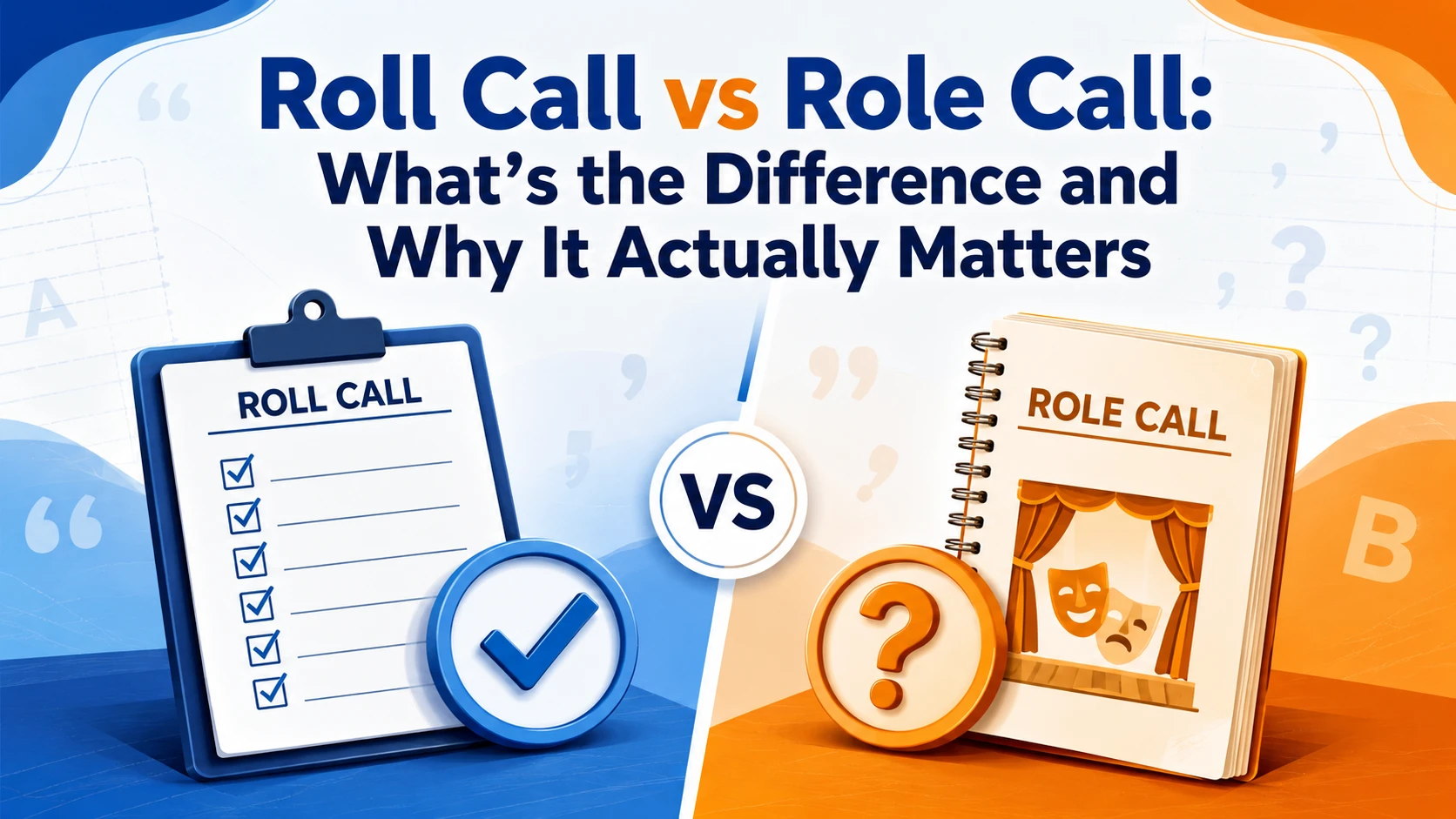
Roll call vs role call is one of those English word pairs that causes confusion because both phrases sound exactly alike when spoken. If you’ve ever paused while writing an email, school assignment, meeting agenda, or social media post wondering which spelling is correct, you’re not alone. Despite their identical pronunciation, these expressions have very different meanings, and choosing the wrong one can make an otherwise polished piece of writing look careless. The good news is that the distinction is much simpler than many people think once you understand the meaning behind each word.
The confusion exists because roll and role are perfect homophones—they’re pronounced the same but have unrelated definitions. English contains many similar pairs, such as principal and principle or complement and compliment, which often lead to spelling mistakes. Modern tools like autocorrect, voice typing, and speech-to-text software don’t always catch these errors because both words are legitimate English terms. As a result, many writers accidentally replace roll call with role call, especially when they rely on pronunciation instead of meaning.
This guide explains the difference between roll call and role call in plain English, including their definitions, origins, grammar, real-world usage, and common mistakes. You’ll learn why “roll call” is the correct phrase for attendance, when “role call” can actually be grammatically correct, how dictionaries and style guides treat each expression, and practical memory techniques that make choosing the right phrase effortless. By the end, you’ll know exactly which phrase belongs in classrooms, workplaces, military settings, theaters, and everyday conversations.
Roll Call vs Role Call: The Quick Answer
If you’re looking for the short answer, here it is:
- ✅ Roll call is the correct expression when referring to taking attendance, checking who’s present, or reading a list of names.
- ❌ Role call is not the correct phrase for attendance.
- ✅ Role call can occasionally be correct only when referring to roles, characters, or assigned responsibilities, not attendance.
The Difference at a Glance
| Feature | Roll Call | Role Call |
| Primary meaning | Checking attendance by reading names | Referring to roles or responsibilities (rare as a phrase) |
| Standard English expression | ✅ Yes | ❌ Not for attendance |
| Common context | Schools, meetings, military, legislatures | Theater, training, discussions about roles |
| Dictionary-recognized idiom | ✅ Yes | ❌ No established idiomatic meaning |
| Recommended for attendance | ✅ Always | ❌ Never |
Key Takeaway: If someone is checking who is present, the correct phrase is always roll call.
Why People Confuse “Roll Call” and “Role Call”
Understanding the source of the confusion makes the correct choice much easier to remember.
They’re Perfect Homophones
The biggest reason people mix these phrases up is simple: roll and role sound identical.
For example, when someone says:
“We’ll do a roll call before the meeting.”
there’s no way to know which spelling they mean unless you see it written.
Because English spelling doesn’t always match pronunciation, homophones regularly create mistakes in writing even among fluent speakers.
Examples of similar homophone pairs include:
- role / roll
- right / write
- there / their / they’re
- brake / break
- allowed / aloud
Like these examples, the correct spelling depends entirely on meaning, not pronunciation.
Why “Role” Feels Like It Should Be Correct
Many writers instinctively choose roles because they’re thinking about people rather than lists.
They reason that:
- every student has a role
- every employee has a role
- every actor has a role
So “role call” appears logical.
However, attendance isn’t about someone’s function or responsibility—it’s about checking whether their name appears on a list.
That’s why the first word is roll, not role.
Technology Doesn’t Always Catch the Error
Grammar tools have improved significantly, but homophones remain challenging.
Because roll and role are both correctly spelled English words:
- spell check often accepts both
- voice typing usually chooses one automatically
- predictive text may suggest the wrong version
- search engines understand either phrase
This means writers still need to understand the meaning instead of relying entirely on software.
Even Native Speakers Make This Mistake
This isn’t only an ESL learner problem.
Native speakers frequently write:
- ❌ role call meeting
- ❌ morning role call
- ❌ teacher did role call
The mistake appears regularly in:
- social media posts
- online forums
- informal emails
- student assignments
Editors often correct this error because it affects credibility despite being easy to fix.
What Does “Roll Call” Mean?
Once you understand where the phrase comes from, remembering it becomes much easier.
Definition of Roll Call
A roll call is the process of reading a list of names to confirm who is present.
During a roll call, a person in charge calls each name, and individuals respond to indicate attendance.
The phrase commonly refers to:
- taking attendance
- checking participation
- confirming presence
- verifying personnel before an activity begins
Examples:
- The teacher conducted a roll call before class.
- Officers attended the morning roll call.
- A roll call was completed before the conference started.
The Origin of the Term
The phrase dates back centuries.
Historically, names weren’t stored digitally. Instead, organizations kept names on a rolled sheet of paper, known as a roll.
Examples included:
- military rolls
- tax rolls
- membership rolls
- court rolls
- parish rolls
During attendance, someone literally called names from the roll.
Over time:
call the roll
became
roll call
Even though paper scrolls are rarely used today, the expression has remained unchanged.
Did You Know? The word roll in roll call originally referred to a rolled-up register of names, not to rolling an object across the floor.
Why It’s Called a “Roll”
Modern readers often assume “roll” refers to movement.
In reality, the historical meaning is completely different.
Here, roll means:
- an official register
- a roster
- a written list of names
You’ll still encounter this older meaning in expressions such as:
- electoral roll
- payroll
- honor roll
- military roll
Understanding this historical definition explains why roll call is the only accepted expression for attendance.
Roll Call as a Noun and a Verb
The expression works in two ways.
As a noun:
- Morning roll call starts at 8:00.
- The roll call took only five minutes.
As part of a verb phrase:
- The instructor called the roll.
- The supervisor conducted a roll call.
Although both forms are correct, roll call as a noun is far more common in modern English.
When and Where “Roll Call” Is Used
Roll call appears in many professional and everyday situations where confirming attendance or accountability is important.
Schools, Colleges, and Universities
This is where most people first encounter the phrase.
Teachers perform roll call to:
- record attendance
- identify absent students
- meet administrative requirements
- ensure student safety
Example:
The professor completed a roll call before beginning the lecture.
Business Meetings and Workplace Attendance
Many organizations use roll call at the beginning of meetings, especially when attendance affects decision-making or compliance.
Examples include:
- daily team briefings
- remote staff meetings
- construction site safety meetings
- project kickoffs
- shift changes
Example:
The manager began the meeting with a quick roll call to confirm everyone had joined.
Military Roll Calls
Roll call has long been part of military tradition.
Military personnel use it to:
- verify attendance
- assign duties
- communicate orders
- inspect readiness
- ensure accountability
Depending on the branch or country, multiple roll calls may occur throughout the day.
Government and Legislative Voting
Many legislatures use a roll call vote, where each member’s name is called individually before recording their vote.
Unlike a voice vote, this method creates a public record showing exactly how every representative voted.
Examples include:
- parliamentary sessions
- city council meetings
- legislative assemblies
- committee hearings
Conferences, Clubs, and Public Events
Organizers often perform a roll call to confirm registered participants before an event begins.
Examples include:
- volunteer organizations
- nonprofit meetings
- sports teams
- training workshops
- certification programs
In these situations, roll call helps organizers ensure everyone expected has arrived.
Emergency Preparedness and Safety Checks
During emergencies, roll call becomes more than an administrative task—it becomes a safety measure.
Organizations perform roll calls:
- after fire drills
- during evacuations
- following natural disasters
- at outdoor expeditions
- on school field trips
The goal is simple: verify that every person is accounted for before proceeding.
Expert Tip: Whenever the purpose is checking attendance or confirming presence, roll call is the correct expression regardless of whether it’s used in a classroom, boardroom, military base, or emergency situation.
What Does “Role Call” Actually Mean?
After learning why roll call is the standard phrase for attendance, the next question naturally follows:
Does “role call” mean anything at all?
The answer is yes—but not in the way most people think.
Unlike roll call, role call is not an established English expression found in dictionaries as an idiom for taking attendance. Instead, it’s simply a combination of two ordinary words that may occasionally appear together in very specific contexts. Understanding this distinction helps you avoid one of the most common homophone mistakes in English.
Why “Role Call” Isn’t an Established English Idiom
In modern English, roll call is a fixed expression (also called an idiom or lexical phrase). Native speakers immediately associate it with checking attendance by reading names from a list.
By contrast, role call has no widely recognized dictionary meaning.
If you write:
- ❌ The teacher started class with a role call.
- ❌ The manager conducted a role call.
- ❌ The army held a morning role call.
Most readers will assume it’s a spelling mistake rather than a deliberate word choice.
That’s because role refers to:
- a character in a play or film
- a person’s job or responsibility
- a function within a team or organization
None of these meanings relate to attendance.
Key Point: Role call is not a synonym for roll call. If you’re talking about checking who’s present, roll call is always the correct expression.
Situations Where the Two Words Can Legitimately Appear Together
Although role call isn’t an idiomatic phrase, there are situations where the words role and call naturally appear side by side because each word keeps its own independent meaning.
Theater and Film Productions
Directors often gather actors to discuss the roles they’ll perform.
Examples:
- The director held a call to discuss every role before rehearsals.
- Actors attended a meeting where each role was called and assigned.
- The casting team reviewed every role before the first rehearsal.
Notice that these examples aren’t using role call as a fixed phrase for attendance. Instead, they’re talking about roles.
Team-Building Activities
Leadership workshops sometimes involve assigning responsibilities.
Example:
During the project kickoff, the facilitator asked everyone to describe their role before assigning tasks.
Here, the discussion centers on responsibilities—not attendance.
Training Sessions and Simulations
Professional training programs often clarify individual duties.
Examples:
- Each participant explained their role during the emergency response exercise.
- The instructor reviewed every team member’s role before the simulation began.
Again, the conversation concerns roles, not a roll call.
Why It Shouldn’t Replace “Roll Call” for Attendance
Because role is a familiar word in workplaces and education, many writers accidentally substitute it for roll.
For example:
Incorrect
- We’ll begin with a role call.
- Please complete the morning role call.
- The teacher finished the roll call quickly.
Correct
- We’ll begin with a roll call.
- Please complete the morning roll call.
- The teacher finished the roll call quickly.
This mistake happens because people write according to pronunciation instead of meaning.
Professional editors immediately recognize the difference because roll call has centuries of established usage.
Roll Call vs Role Call: Side-by-Side Comparison
The quickest way to remember the distinction is to compare the two phrases directly.
| Feature | Roll Call | Role Call |
| Primary meaning | Reading names to confirm attendance | Referring to roles or responsibilities (not an established idiom) |
| Standard English phrase | ✅ Yes | ❌ No |
| Used in schools | ✅ Frequently | ❌ Incorrect |
| Used in business meetings | ✅ Frequently | ❌ Incorrect for attendance |
| Used in military settings | ✅ Yes | ❌ Incorrect |
| Refers to job responsibilities | ❌ No | ✅ Only if discussing someone’s role |
| Dictionary-recognized expression | ✅ Yes | ❌ No |
| Recommended for formal writing | ✅ Always | ❌ Only when literally discussing roles |
Expert Insight: If replacing role with responsibility changes the meaning appropriately, you’re probably talking about a person’s function. If you’re checking who’s present, the word must be rolled.
Roll vs Role: Understanding the Two Words Before Comparing the Phrases
The confusion disappears once you understand the meanings of the individual words.
Meaning of “Roll”
The word roll has several meanings in English.
It can refer to:
- moving by turning over
- a rounded piece of food
- a list or register of names
- an official record
Examples:
- The ball began to roll downhill.
- She ate a bread roll with dinner.
- His name appears on the electoral roll.
- The teacher checked the class roll.
The last meaning is where roll call comes from.
Meaning of “Role”
A role refers to the function, position, or character someone performs.
Examples:
- She accepted the lead role in the movie.
- Every employee has an important role.
- Parents play a significant role in education.
- His leadership role expanded after the promotion.
Unlike roll, role never refers to attendance lists.
Other Common Expressions Using Each Word
Learning familiar expressions strengthens your understanding.
Common Expressions with “Roll”
- roll call
- payroll
- honor roll
- roll number
- electoral roll
- roll of members
Common Expressions with “Role”
- leadership role
- supporting role
- job role
- key role
- role model
- role-playing
Recognizing these natural collocations makes it much easier to choose the correct spelling automatically.
Roll Model vs Role Model
One of the funniest homophone mistakes is writing:
❌ roll model
The correct expression is:
✅ role model
A role model is someone whose behavior or achievements inspire others.
Example:
Marie Curie remains a role model for many aspiring scientists.
Roll Over vs Take on a Role
These similar-looking expressions have completely unrelated meanings.
Roll over
- The dog rolled over.
- Roll over the document carefully.
Take on a role
- She took on a leadership role.
- He accepted the role of project manager.
Although the words sound alike, they’re never interchangeable.
Real-Life Examples That Make the Difference Obvious
Seeing these expressions in context removes any remaining confusion.
In a Classroom
Correct:
The teacher completed a roll call before starting the lesson.
Incorrect:
The teacher completed the roll call before starting the lesson.
The teacher isn’t discussing classroom responsibilities—they’re checking attendance.
In the Workplace
Correct:
The supervisor began the morning meeting with a quick roll call.
Later in the meeting:
Everyone discussed their individual roles on the new project.
Notice that both words appear in the same situation but with different meanings.
In the Military
Military organizations traditionally conduct roll calls to confirm personnel before issuing instructions.
Example:
Soldiers assembled for the morning roll call at sunrise.
Here, replacing roll with role would be incorrect because attendance—not responsibilities—is being verified.
In Government and Public Meetings
Legislative bodies often use roll call votes, where each member’s name is read individually before recording their vote.
Example:
The bill passed after a recorded roll call vote.
This term is widely used in parliamentary procedure and government documentation.
In Theater
This is one of the few contexts where discussions about roles naturally occur.
Example:
Before rehearsals, the director reviewed every actor’s role.
However:
The stage manager still conducted a roll call to confirm everyone had arrived.
The first sentence concerns characters; the second concerns attendance.
On Social Media
Homophone mistakes appear surprisingly often online.
Examples of incorrect posts:
- ❌ Morning role call!
- ❌ Time for role call everyone!
- ❌ Teacher just finished role call.
Correct versions:
- ✅ Morning roll call!
- ✅ Time for roll call, everyone!
- ✅ The teacher just finished roll call.
Understanding this difference helps your writing appear more polished, whether you’re posting online or writing professionally.
How to Use “Roll Call” Correctly in Sentences
Knowing that roll call is the correct expression is only the first step. To write naturally, it’s also helpful to understand how the phrase is commonly used in different sentence structures. Whether you’re preparing a meeting agenda, writing a school report, or documenting an official procedure, these patterns will help you use roll call confidently.
Sentence Patterns You’ll See Most Often
The phrase roll call usually appears as a noun.
Here are some of the most common patterns:
Conduct + roll call
- The instructor conducted a roll call before the exam.
- The supervisor conducted a roll call at the beginning of the shift.
Take + roll call
- The teacher took roll calls every morning.
- Security officers took roll calls after the evacuation.
Begin with + roll call
- The meeting began with a roll call.
- Every committee session starts with a roll call.
During + roll call
- Several announcements were made during roll call.
- Students asked questions during roll calls.
These structures appear frequently in educational, business, military, and government settings.
Formal Writing Examples
Professional documents often use roll call because it’s clear and widely understood.
Examples:
- Roll call will begin promptly at 9:00 a.m.
- All committee members must be present for roll call.
- Attendance will be verified through roll call before voting begins.
- Employees who miss roll calls should notify their supervisor immediately.
These sentences sound appropriate in reports, policy manuals, and official notices.
Informal Conversation Examples
In everyday speech, the phrase becomes more conversational.
Examples:
- Did they already do roll calls?
- I arrived just after the roll call.
- Don’t be late or you’ll miss the roll call.
- Roll call only takes a few minutes.
Although the tone is casual, the meaning remains the same.
Questions and Commands Using Roll Call
You’ll also see the phrase used in instructions.
Examples:
- Please remain quiet during roll call.
- Has anyone missed a roll call?
- Who is responsible for today’s roll call?
- Let’s finish the roll call before we begin.
Using the phrase this way makes instructions direct and easy to understand.
When “Role Call” Can Be Grammatically Correct
By now, it’s clear that role call isn’t the correct phrase for attendance. However, that doesn’t mean the words role and call can never appear together.
The difference is that they aren’t functioning as a fixed expression.
As Two Separate Words with Independent Meanings
Sometimes one word modifies the other naturally.
For example:
- The manager called everyone together to discuss each person’s role.
- After the emergency drill, there was a call to review every team member’s role.
- The workshop included a discussion about leadership roles before the final call for volunteers.
Here, role keeps its normal meaning, while call refers to a meeting, request, or announcement.
Examples That Are Actually Correct
These examples are grammatically accurate because they’re discussing responsibilities.
- The director scheduled a call to review every actor’s role.
- During the planning session, each leadership role was discussed.
- The facilitator made a call for volunteers to take on new roles.
- The committee clarified everyone’s role before assigning tasks.
Notice that none of these examples use role call as a replacement for roll call.
Examples That Look Right but Are Wrong
The following sentences contain the common spelling mistake.
❌ The principal completed role call.
✅ The principal completed roll call.
❌ The meeting started with role call.
✅ The meeting started with roll call.
❌ The soldiers gathered for morning role call.
✅ The soldiers gathered for morning roll call.
Whenever attendance is involved, roll call is always the correct choice.
Common Mistakes Writers Make
Homophone errors are easy to make because they aren’t pronunciation mistakes—they’re meaning mistakes. Recognizing the most common errors helps you avoid them before they reach your readers.
Using “Role Call” Instead of “Roll Call”
This is by far the most frequent mistake.
Incorrect:
- The teacher finished the roll call.
- We started the meeting with a roll call.
Correct:
- The teacher finished the roll call.
- We started the meeting with a roll call.
Remember that attendance is based on a roll, not a role.
Assuming Pronunciation Determines Spelling
English contains many words that sound identical but carry different meanings.
For example:
- role / roll
- sight / site
- flower / flour
- peace / piece
Choosing the correct spelling always depends on context rather than pronunciation.
Copying Incorrect Usage from Social Media
Social media platforms contain countless spelling mistakes.
Many users write:
- Morning role call!
- Time for a roll call!
- Classroom role call.
Because these posts receive likes and shares, learners sometimes assume they’re correct.
They’re not.
Popularity doesn’t make a spelling accurate.
Ignoring Historical Meaning
Some writers wonder why the phrase isn’t called role call since people have roles.
The answer lies in history.
The expression originated from calling names from a roll, or written register.
Understanding this historical background makes the spelling much easier to remember.
Expert Tip: If you’re unsure which spelling to choose, ask yourself one question: Am I checking attendance or discussing responsibilities? The answer usually makes the correct word obvious.
A Simple Memory Trick You’ll Actually Remember
Memorizing grammar rules isn’t always practical. Fortunately, this pair can be remembered with a few easy associations.
Think of an Old Rolled-Up List
Imagine a long paper scroll with names written on it.
Someone unrolls it and begins reading names aloud.
That’s literally where roll call comes from.
Picture this image whenever you hear the phrase, and the correct spelling becomes much easier to recall.
Associate “Role” with Jobs and Characters
Think of a role whenever someone has a function.
Examples:
- job role
- leadership role
- acting role
- supporting role
- management role
If you’re talking about responsibilities, role is correct.
If you’re checking attendance, it isn’t.
A Three-Second Decision Rule
Before writing, ask yourself:
Question 1
Am I talking about who’s present?
✅ Use roll call.
Question 2
Am I talking about someone’s job, responsibility, or character?
✅ Use role.
This quick check prevents almost every mistake.
Similar Homophones That Cause the Same Kind of Confusion
Once you understand why roll call and role call differ, you’ll notice similar spelling traps throughout English.
Role Model vs Roll Model
Correct:
She’s a wonderful role model for young athletes.
Incorrect:
She’s a wonderful role model.
A role model is someone whose behavior inspires others.
Principal vs Principle
Principal
- school principal
- main or most important
Principle
- moral rule
- guiding belief
Examples:
- The principal welcomed new students.
- Honesty is an important principle.
Stationary vs Stationery
Stationary
Means not moving.
Stationery
Means writing materials such as paper and envelopes.
Complement vs Compliment
Complement
Something that completes or enhances another thing.
Compliment
Praise or admiration.
Examples:
- The sauce complements the meal.
- Thank you for the compliment.
Peak vs Peek vs Pique
These three words are another frequent source of confusion.
| Word | Meaning | Example |
| Peak | Highest point | She reached the peak of the mountain. |
| Peek | Quick look | He took a peek inside the room. |
| Pique | Stimulate or arouse | The article piqued my curiosity. |
Recognizing these patterns helps you become a more careful and confident writer.
Practice Exercises to Test Your Understanding
Test yourself before moving on.
Choose the Correct Phrase
Select the correct answer.
- The teacher completed ______ before the lesson began.
- a) role call
- b) roll call
- The director discussed every actor’s ______.
- a) roll
- b) role
- Soldiers assembled for the morning ______.
- a) roll call
- b) role call
Fill in the Blank
Complete the sentences.
- The manager began the meeting with __________.
- Every employee understands their __________ within the company.
- Students responded as the teacher completed __________.
Correct the Mistake
Rewrite these sentences correctly.
- The professor started class with a roll call.
- Morning role call begins at seven.
- We discussed everyone’s role in the project.
Rewrite Using the Correct Word
Change the incorrect word without altering the meaning.
- The supervisor finished the roll call quickly.
- Every actor accepted an important role.
- The army completed role calls before training.
Answer Key with Explanations
Choose the Correct Phrase
- b) roll call — Attendance is being checked.
- b) role — The discussion concerns acting characters.
- a) roll call — Military attendance uses roll call.
Corrected Sentences
- The professor started class with a roll call.
- Morning roll call begins at seven.
- We discussed everyone’s role in the project.
Expert Tips for Choosing the Right Phrase Every Time
Match the Phrase to the Situation
Before writing, identify the context.
- Attendance → roll call
- Responsibility → role
- Character in a play → role
- Register of names → roll
Context matters more than pronunciation.
Proofread Homophones Separately
Spell check won’t always catch correctly spelled but incorrectly chosen words.
During proofreading, specifically look for homophones like:
- role/roll
- there/their/they’re
- your/you’re
This simple editing habit catches mistakes many automated tools miss.
Learn Common Collocations
English becomes easier when you learn words in natural combinations.
Examples include:
Roll
- roll call
- payroll
- honor roll
- electoral roll
Role
- key role
- leadership role
- supporting role
- role model
Learning these combinations improves both accuracy and fluency.
Read High-Quality Writing Regularly
Books, newspapers, academic journals, and reputable publications consistently use standard English.
The more often you encounter roll call in authentic contexts, the more natural the correct spelling becomes. Reading also reinforces other commonly confused word pairs without requiring deliberate memorization.
Conclusion
Understanding the difference between roll call and role call is easier once you know what each word actually means. Roll call is the established expression for checking attendance by reading a list of names, while role call refers only to a call or discussion about someone’s role in a specific context, such as theater, training, or team responsibilities. Because the two phrases sound identical, they’re often confused in speech, voice typing, and casual writing, but they are not interchangeable.Choosing the correct phrase makes your communication clearer and more professional, whether you’re writing an email, creating school materials, preparing business documents, or publishing online content. One final actionable tip: whenever you’re talking about attendance, imagine a roll of names being read aloud—that simple mental image will point you to roll call every time. A common mistake to avoid is replacing roll call with role call simply because you’re thinking about people rather than a list. Remembering the meaning behind each word is far more effective than relying on spelling alone.
FAQs
Q1. Is “role call” ever grammatically correct?
Yes, role call can be correct, but only in specific contexts where role means a person’s function or character. For example, a theater director might hold a role call to assign parts, or a manager might organize a discussion about team roles. It should not be used to mean attendance.
Q2. Why do so many people confuse “roll call” and “role call”?
The confusion happens because the two phrases are homophones—they sound exactly the same but have different meanings and spellings. Voice-to-text tools, autocorrect, and unfamiliarity with the historical meaning of roll call also contribute to this common writing mistake.
Q3. What does “roll” mean in “roll call”?
In roll call, the word roll originally referred to a rolled-up list or register of names. During a roll call, someone reads that list aloud to confirm attendance. The phrase has retained this historical meaning even though modern attendance records are usually digital.
Q4. Can I use “roll call” outside schools and the military?
Absolutely. Roll call is widely used in business meetings, conferences, clubs, volunteer organizations, government sessions, emergency response teams, and online classes. Any situation where attendance is officially checked can involve a roll call.
Q5. How can I remember the difference between roll call and role call?
A simple memory trick is to associate roll with a roll or list of names and role with a job, character, or responsibility. If you’re checking who is present, choose roll call. If you’re discussing what someone does, roll call may be appropriate depending on the context.