

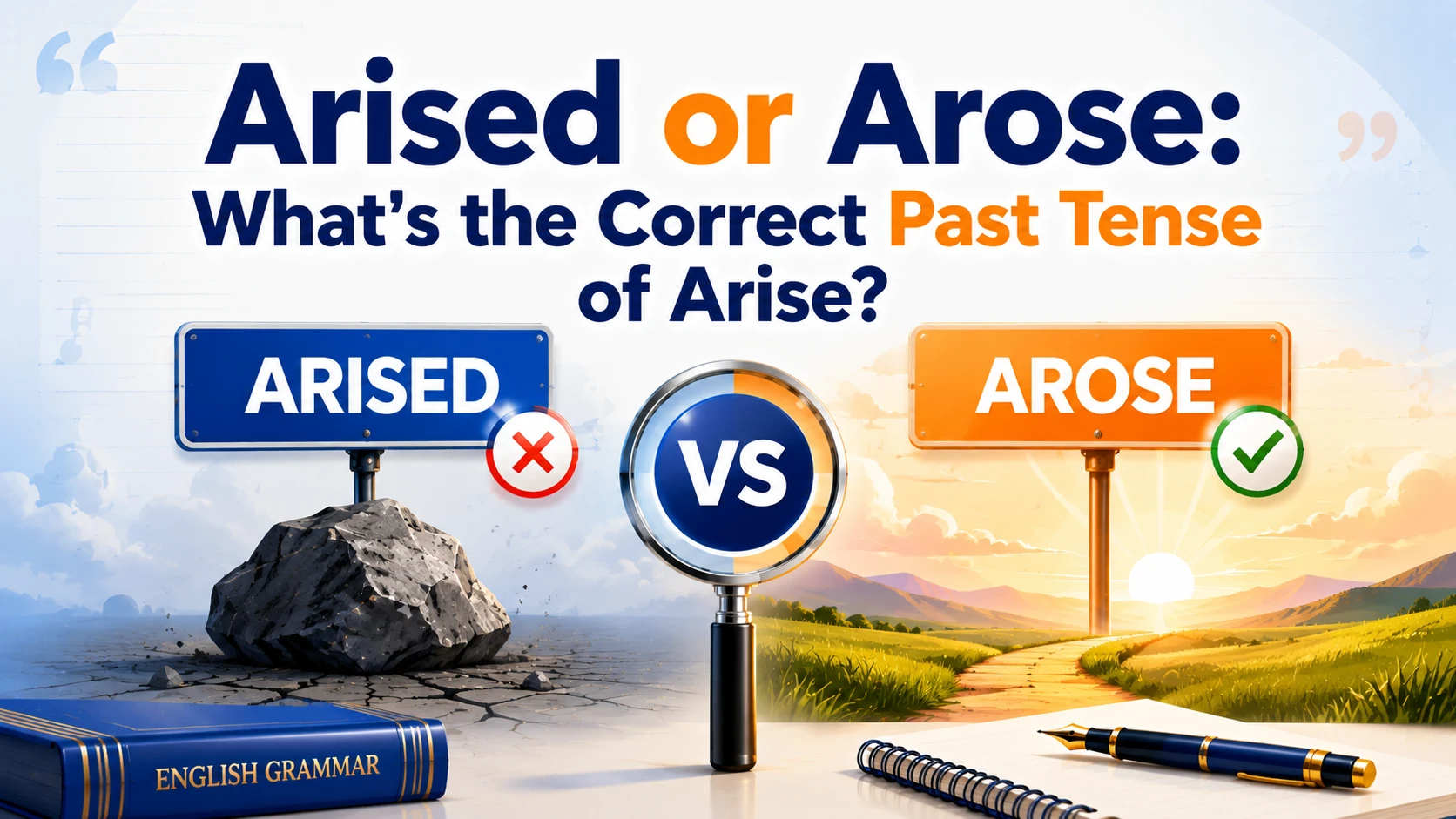
Arose is the correct past tense of arise, while arised is not accepted in standard English. The confusion comes from a familiar spelling rule: most regular verbs form their past tense by adding -ed. However, arise is an irregular verb, so its spelling changes instead of following that pattern. Learning the difference between arise, arose, and arisen will help you choose the correct form when describing problems, opportunities, questions, disagreements, and other situations that develop or occur.
Although arised might seem grammatically reasonable, it is not the standard past-tense form. The correct choice depends on how you construct your sentence and which tense you need. For example, you would say, “A problem arose during the meeting,” but “A problem has arisen since yesterday.” Both sentences describe something that happened, yet they use different verb forms because their grammatical structures are different.
In this guide, you’ll learn the meaning of arise, why arose replaces arised, and how to use arisen correctly in perfect tenses. We’ll also explore the difference between arise and rise, examine common sentence patterns, and look at practical examples from everyday conversations, academic writing, and professional communication. By understanding the complete verb pattern, you’ll be able to avoid common mistakes and use all three forms naturally and confidently.
Quick Answer: Is It Arised or Arose?
The correct simple past tense of arise is arose, not arised. Arise is an irregular verb, which means it does not form its past tense by adding the regular -ed ending.
Here is the correct verb pattern:
| Verb Form | Correct Word | Example |
| Base form | Arise | Problems arise unexpectedly. |
| Third-person singular | Arises | A question arises during the discussion. |
| Simple past | Arose | A disagreement arose yesterday. |
| Past participle | Arisen | A new problem has arisen. |
| Present participle | Arising | New challenges are arising. |
Remember: Use arose for a completed past action and arisen with helping verbs such as has, have, and had.
Why Is Arised Incorrect?
The confusion occurs because English has two main categories of verbs:
- Regular verbs: Form their simple past by adding -ed or -d, such as walk → walked and arrive → arrived.
- Irregular verbs: Change their spelling or follow other established patterns, such as go → went and speak → spoke.
Arise belongs to the second category. Its established forms are arise, arose, and arisen.
Compare these sentences:
❌ The problem arised during the meeting.
✅ The problem arose during the meeting.
Why: Arise is irregular, so its simple past form is arose rather than arised.
What Does Arise Mean?
Arise is an irregular verb that generally means to happen, occur, develop, emerge, or come into existence. It can describe something that begins naturally or unexpectedly rather than something deliberately created.
For example:
- Several questions arise during the training session.
- Unexpected difficulties arise when the system becomes outdated.
- New opportunities arise when businesses expand.
- A disagreement arose between the two departments.
The verb also has a more literal meaning: to get up, stand, or rise from a sitting or lying position. This use is less common in everyday conversation and may sound formal or literary.
Common Situations Where Arise Is Used
Arise frequently appears with nouns describing events, developments, problems, and opportunities.
| Common Combination | Meaning | Example |
| Problems arise | Difficulties occur | Problems arise when communication breaks down. |
| Questions arise | Questions develop or emerge | Several questions arose after the lecture. |
| Issues arise | Complications occur | Technical issues may arise during installation. |
| Opportunities arise | Chances become available | New opportunities arise through networking. |
| Concerns arise | Worries or doubts develop | Concerns arose after the announcement. |
| Conflicts arise | Disagreements develop | Conflicts arose over the proposed changes. |
| Doubts arise | Uncertainty develops | Doubts arose about the accuracy of the report. |
| Difficulties arise | Challenges occur | Difficulties arose during the construction work. |
These natural word combinations are called collocations. Learning them helps you use arise and its other forms more naturally.
Literal and Figurative Meanings of Arise
Although arise most commonly describes situations that occur or develop, it can also refer to physical movement.
| Literal Use | Figurative Use |
| To get out of bed | To develop |
| To stand up | To occur |
| To rise from a seat | To come into existence |
| To get to one’s feet | To emerge from a situation |
Literal example:
The king arose from his throne.
Figurative examples:
- A serious disagreement arose during the negotiations.
- Several opportunities have arisen since the company expanded.
In modern business, academic, and everyday writing, the figurative meaning is particularly common.
The Three Main Forms of Arise: Arise, Arose, and Arisen
The easiest way to master this irregular verb is to learn its three principal forms together:
Arise → Arose → Arisen
Each form serves a different grammatical purpose.
1. Arise: The Base and Present Form
Arise is the base form of the verb. It appears in the present simple, infinitives, and constructions involving modal verbs.
Examples:
- Problems often arise without warning.
- New questions arise during scientific research.
- Unexpected expenses may arise throughout the project.
- We need to understand why these difficulties arise.
- What happens if another disagreement arises?
Use arise when discussing general situations, recurring events, possibilities, or something that may happen in the future.
2. Arose: The Simple Past Tense
Arose is the correct simple past tense of arise. Use it when describing something that happened or developed in the past.
Examples:
- A disagreement arose during the meeting.
- Several concerns arose after the announcement.
- An unexpected opportunity arose last year.
- A technical problem arose shortly after installation.
- The misunderstanding arose from poor communication.
Notice that arose does not need a helping verb in these simple past constructions.
3. Arisen: The Past Participle
Arisen is the past participle of arise. It is commonly used with helping verbs to form perfect tenses.
Examples:
- A problem has arisen.
- Several questions have arisen since the discussion.
- New difficulties had arisen before the deadline.
- Similar concerns have arisen in previous investigations.
- Additional opportunities will have arisen by next year.
Arisen also appears in certain participial constructions, such as:
- The issues arising from the agreement require attention.
- The problems that have arisen since the merger remain unresolved.
The first example uses the present participle arising, while the second uses the past participle arisen with have.
Complete Conjugation Table
| Grammatical Form | Verb | Example |
| Base form | Arise | New problems arise every day. |
| Third-person singular | Arises | A new concern arises. |
| Simple past | Arose | A concern arose yesterday. |
| Past participle | Arisen | A concern has arisen. |
| Present participle | Arising | New concerns are arising. |
| Infinitive | To arise | Problems are likely to arise. |
Grammar tip: Memorize all three principal forms rather than learning only the past tense. This makes it easier to recognize the correct form when constructing different sentences.
Arose vs. Arisen: What’s the Difference?
Although arose and arisen come from the same verb, they are not interchangeable. The difference is grammatical: arose is the simple past form, whereas arisen is the past participle.
When to Use Arose
Use arose when describing a completed event in the simple past tense.
Examples:
- A financial problem arose last month.
- Several questions arose during the interview.
- An unexpected disagreement arose between the partners.
- A new opportunity arose after the conference.
The sentence can stand independently without a perfect-tense helping verb.
When to Use Arisen
Use arisen with an appropriate auxiliary verb to form perfect constructions.
| Helping Verb | Example | Tense |
| Has | A problem has arisen. | Present perfect |
| Have | Several issues have arisen. | Present perfect |
| Had | A disagreement had arisen. | Past perfect |
| Will have | New challenges will have arisen. | Future perfect |
| May have | A misunderstanding may have arisen. | Modal perfect |
The important point is that the helping verb determines the grammatical construction, while arisen supplies the past participle.
Arose vs. Arisen in Example Sentences
| Arose | Arisen |
| A problem arose yesterday. | A problem has arisen recently. |
| Several questions arose during the lecture. | Several questions have arisen since the lecture. |
| A disagreement arose last week. | A disagreement had arisen before the meeting. |
| New opportunities arose in the past. | New opportunities have arisen this year. |
Compare the time references carefully. The simple past usually places an event in a completed past period, while the perfect forms connect a past event or situation to another time.
An Easy Way to Remember the Difference
Use this simple pattern:
- Yesterday or last week: Arose.
- Has or have: Arisen.
- Had: Arisen.
- Will have: Arisen.
For example:
- A problem arose yesterday.
- A problem has arisen today.
- A problem had arisen before we arrived.
This is a useful shortcut, although you should always consider the complete sentence rather than relying on one time expression alone.
Why Do People Confuse Arised and Arose?
The main reason is that regular past-tense formation is taught early in English learning. Students become familiar with adding -ed to verbs and naturally apply the same pattern to unfamiliar words.
For example:
| Base Verb | Regular Past Form |
| Walk | Walked |
| Open | Opened |
| Finish | Finished |
| Answer | Answered |
| Complete | Completed |
However, irregular verbs follow their own established forms.
| Base Verb | Simple Past | Past Participle |
| Arise | Arose | Arisen |
| Begin | Began | Begun |
| Drink | Drank | Drunk |
| Sing | Sang | Sung |
| Speak | Spoke | Spoken |
| Break | Broke | Broken |
| Choose | Chose | Chosen |
Some irregular verbs change their internal vowel, while others change more substantially. These forms generally need to be learned through practice and exposure.
Why the -Ed Rule Does Not Work for Every Verb
English developed through several historical stages, and its verbs preserve different patterns inherited from earlier forms of the language.
Regular verbs generally follow a predictable spelling pattern. Irregular verbs, however, retain older conjugation patterns or other established forms.
That is why we say:
- Begin → began, not beginned.
- Speak → spoke, not speaked.
- Choose → chose, not choosed.
- Arise → arose, not arised.
The most reliable approach is to recognize irregular verbs individually rather than assume that every verb follows the same rule.
Arise vs. Rise: What’s the Difference?
Another common source of confusion is the difference between arise and rise. Both verbs are irregular, and both can describe something moving upward or becoming more noticeable. However, their usual meanings and grammatical applications differ.
Meaning of Arise
Arise generally means to occur, develop, emerge, or come into existence.
Examples:
- Several problems arose during the project.
- Questions have arisen about the decision.
- New opportunities arise when circumstances change.
Meaning of Rise
Rise generally means to move upward, increase, or get up from a sitting or lying position.
Examples:
- The sun rises in the east.
- Prices rose significantly last year.
- The temperature has risen overnight.
- She rises early every morning.
Arise vs. Rise: Comparison Table
| Feature | Arise | Rise |
| Main meaning | To occur or develop | To move upward or increase |
| Simple present | Arise | Rise |
| Simple past | Arose | Rose |
| Past participle | Arisen | Risen |
| Common subjects | Problems, questions, opportunities | Prices, temperatures, people, the sun |
| Example | A problem arose. | Prices rose. |
Which Verb Should You Choose?
Choose arise when something happens, develops, or comes into existence.
Choose rise when something moves upward, increases, or gets up.
Compare:
- Several questions arose during the discussion.
- The temperature rose during the afternoon.
The first sentence describes questions developing. The second describes an increase in temperature.
How to Use Arose Naturally in Different Contexts

Understanding the grammatical form is essential, but choosing natural sentence patterns makes your writing clearer and more fluent.
Workplace and Business Communication
Arose is useful when explaining how an issue, disagreement, or opportunity developed.
Examples:
- A scheduling conflict arose before the client meeting.
- Several concerns arose during the planning process.
- A disagreement arose over the contract terms.
- An unexpected opportunity arose after the presentation.
For present or continuing relevance, use arisen:
- Several concerns have arisen since the policy changed.
- A new issue has arisen that requires immediate attention.
Academic and Research Writing
In academic writing, arise frequently describes questions, challenges, and concerns that emerge during investigation or analysis.
Examples:
- Several research questions arose during the initial investigation.
- Ethical concerns have arisen regarding the methodology.
- Additional difficulties may arise when the sample size is reduced.
- Similar questions have arisen in previous studies.
The verb is useful because it describes developments without suggesting that someone deliberately created them.
Everyday Conversations
Although arise can sound slightly more formal than expressions such as come up or happen, it is perfectly natural in ordinary conversation.
Examples:
- Something important arose while you were away.
- If any problems arise, give me a call.
- No major difficulties have arisen so far.
- A question arose when I read the instructions.
In casual speech, you may prefer come up or happen, depending on the situation. Both can be more conversational alternatives.
News and Legal Writing
Arose is also common in news reports and legal discussions because it provides a concise way to describe how disputes, concerns, and questions developed.
Examples:
- Questions arose after officials released the report.
- A legal dispute arose over the ownership of the property.
- Concerns arose following the announcement.
- The disagreement arose from different interpretations of the agreement.
Common Sentence Patterns with Arise and Arose
Learning recurring sentence structures can help you use the verb accurately without constructing every sentence from scratch.
| Sentence Pattern | Purpose | Example |
| Subject + arise | Describe a general occurrence | Problems arise unexpectedly. |
| Subject + arose + yesterday/last week | Describe a past event | A disagreement arose yesterday. |
| Subject + arise from + cause | Explain the source | The confusion arose from poor communication. |
| Subject + arose during + event | Identify when something happened | Questions arose during the interview. |
| Subject + has/have arisen | Describe a past development connected to the present | Several concerns have arisen. |
| If + subject + arises | Describe a possible future situation | If a problem arises, contact us. |
Arise From
Use arise from when explaining the source or cause of a situation.
Examples:
- The disagreement arose from a misunderstanding.
- The delay arose from technical difficulties.
- Several concerns arose from the proposed changes.
Arise During
Use arise during when identifying the event or period in which something occurred.
Examples:
- Questions arose during the presentation.
- Several problems arose during construction.
- A disagreement arose during the negotiations.
There Arose
The construction there arose is a formal or literary way of introducing a situation or event.
Examples:
- There arose a serious dispute between the two parties.
- There arose an unexpected difficulty during the negotiations.
- There arose considerable public concern about the decision.
This construction is grammatically correct, but ordinary contemporary writing often sounds more natural with a direct subject:
A serious dispute arose between the two parties.
Common Mistakes to Avoid
Even after learning that arose is correct, writers sometimes make other mistakes involving this verb. Understanding the following distinctions will help you avoid them.
Using Arised Instead of Arose
❌ The issue arised after the announcement.
✅ The issue arose after the announcement.
Why: Arise is irregular and forms its simple past as arose.
Using Arisen Without the Required Verb Structure
❌ Several problems arisen during the meeting.
✅ Several problems arose during the meeting.
✅ Several problems have arisen during the meeting.
Why: In the first incorrect sentence, arisen has no auxiliary verb to form a complete finite perfect construction. Use arose for the simple past or have arisen for the present perfect.
Confusing Arose With Rose
❌ Several questions rose during the discussion.
✅ Several questions arose during the discussion.
Why: Questions generally arise when they develop or occur. Rose is normally used for upward movement or increases.
Choosing the Wrong Tense
❌ Several concerns arose since Monday.
✅ Several concerns have arisen since Monday.
Why: When describing developments continuing into the present, the present perfect is generally appropriate. Arose is more suitable when referring to a completed past period.
Using Arise Instead of Arises
❌ A new problem arise whenever the system restarts.
✅ A new problem arises whenever the system restarts.
Why: In the present simple, a singular third-person subject requires arises.
Common Expressions Using Arise, Arose, and Arisen

Certain expressions appear frequently in professional and everyday English. Learning them as complete phrases can improve your vocabulary and sentence construction.
If the Need Arises
This expression means if something becomes necessary.
Examples:
- If the need arises, we can arrange another meeting.
- Additional support will be provided if the need arises.
- Contact the manager if the need arises.
If Any Issues Arise
This phrase is commonly used in customer service, workplace communication, and instructions.
Examples:
- If any issues arise, please contact technical support.
- Let us know if any concerns arise.
- If further difficulties arise, we will review the procedure.
Problems Have Arisen
This construction indicates that difficulties have developed and are relevant to the present situation.
Examples:
- Several problems have arisen since the software update.
- Unexpected complications have arisen during the project.
- New concerns have arisen regarding the agreement.
Questions Have Arisen
This phrase is particularly useful in academic, professional, and analytical writing.
Examples:
- Several questions have arisen from the research.
- Important questions have arisen about the proposed changes.
- New questions have arisen following the investigation.
Opportunities Have Arisen
Arise does not describe only negative situations. It can also refer to positive developments.
Examples:
- Several opportunities have arisen this year.
- New career opportunities have arisen through professional networking.
- An exciting opportunity arose during the conference.
Practice Exercises: Test Your Understanding
Try these questions to check whether you can distinguish arise, arose, and arisen correctly.
Choose the Correct Verb Form
Select the appropriate answer for each sentence.
1. A misunderstanding ______ during the meeting.
- a) arised
- b) arose
- c) arisen
2. Several concerns have ______ since the announcement.
- a) arose
- b) arisen
- c) arised
3. New opportunities often ______ unexpectedly.
- a) arise
- b) arose
- c) arisen
4. A serious disagreement ______ last week.
- a) arise
- b) arises
- c) arose
5. Similar problems may have ______ before.
- a) arise
- b) arisen
- c) arose
Fill in the Blanks
Complete each sentence using the correct form of arise.
- A legal dispute ______ after the agreement was signed.
- If any questions ______, please contact your instructor.
- Several difficulties have ______ since Monday.
- Unexpected expenses often ______ during construction.
- A new opportunity ______ during last year’s conference.
Correct the Mistakes
Rewrite the following sentences using standard English.
- The issue arised yesterday.
- Several concerns arisen during the meeting.
- New opportunities arised quickly.
- A question arise during every session.
- Several problems have arose since Monday.
Answer Key and Explanations
Multiple-choice answers:
- b) arose — The sentence describes a completed past event.
- b) arisen — Have requires the past participle.
- a) arise — The sentence describes a general occurrence.
- c) arose — Last week indicates a completed past period.
- b) arisen — May have is followed by a past participle.
Fill-in-the-blank answers:
- A legal dispute arose after the agreement was signed.
- If any questions arise, please contact your instructor.
- Several difficulties have arisen since Monday.
- Unexpected expenses often arise during construction.
- A new opportunity arose during last year’s conference.
Corrected sentences:
- The issue arose yesterday.
- Several concerns arose during the meeting.
- New opportunities arose quickly.
- A question arises during every session.
- Several problems have arisen since Monday.
Memory Tricks for Remembering the Correct Forms
Irregular verbs are easier to remember when you learn their patterns and use them in meaningful sentences.
Memorize the Three-Part Sequence
The most reliable memory technique is to learn the forms together:
ARISE → AROSE → ARISEN
Repeat the sequence whenever you practice irregular verbs. This prevents you from relying on the regular -ed rule.
Compare It With Similar Irregular Verbs
You can also remember arise by comparing it with other verbs that change their internal vowel.
| Base Form | Simple Past | Past Participle |
| Arise | Arose | Arisen |
| Drive | Drove | Driven |
| Write | Wrote | Written |
| Speak | Spoke | Spoken |
| Break | Broke | Broken |
| Choose | Chose | Chosen |
These verbs do not all follow exactly the same pattern, but learning their three forms together helps reinforce irregular verb vocabulary.
Use a Quick Tense Check
Before writing, ask yourself:
- Am I describing something generally? Use arise.
- Am I describing a completed past event? Use arose.
- Am I forming a perfect tense? Use arisen with the appropriate helping verb.
Final Writing Checklist
Before submitting an assignment, email, or report, check that:
- You have used arose for the simple past.
- You have avoided arised in standard English.
- You have used arisen in the appropriate participial construction.
- Your helping verbs agree with the intended tense.
- You have distinguished arise from rise.
- Your sentence communicates the intended meaning clearly.
Conclusion
Choosing between arised and arose is straightforward once you understand that arise is an irregular verb. Its correct principal forms are arise, arose, and arisen. Use arose when describing a completed past event, and use arisen with the appropriate helping verb when forming perfect tenses. Remember that rise is a related but different verb, usually describing upward movement or an increase. One final actionable tip: memorize the complete sequence rather than trying to apply the regular -ed rule whenever you encounter arise. A common mistake to avoid is using arised simply because it resembles other past-tense verbs. A little practice with realistic sentences will make the correct forms feel natural in both everyday and professional writing.
FAQs
Q1. Is arised ever correct in English?
Arised is not an accepted past-tense form in standard modern English. Although you might encounter it in learner writing or nonstandard usage, it should be avoided in formal, academic, and professional communication. The correct simple past is arose, and the past participle is arisen.
Q2. Why is the past tense of arise arose instead of arised?
Arise is an irregular verb, meaning it does not follow the usual pattern of adding -ed to form the simple past. Its established forms developed through older English verb patterns. Therefore, the correct sequence is arise, arose, and arisen rather than arise, arised, and arised.
Q3. What is the difference between arose and arisen?
Arose is the simple past tense, as in “A problem arose yesterday.” Arisen is the past participle, as in “A problem has arisen.” The choice depends on the grammatical construction, particularly whether you need a simple past or a perfect tense.
Q4. Can I use arose in formal and academic writing?
Yes. Arose is appropriate in academic papers, business reports, legal documents, and professional communication. Writers frequently use it to explain how questions, difficulties, concerns, and disagreements developed. It offers a concise, neutral alternative to expressions such as came up or happened.
Q5. What are the three forms of arise?
The three principal forms are arise (base form), arose (simple past), and arisen (past participle). For example, “Problems arise regularly,” “A problem arose yesterday,” and “Several problems have arisen.” Learning this sequence together is the easiest way to remember the correct forms.