

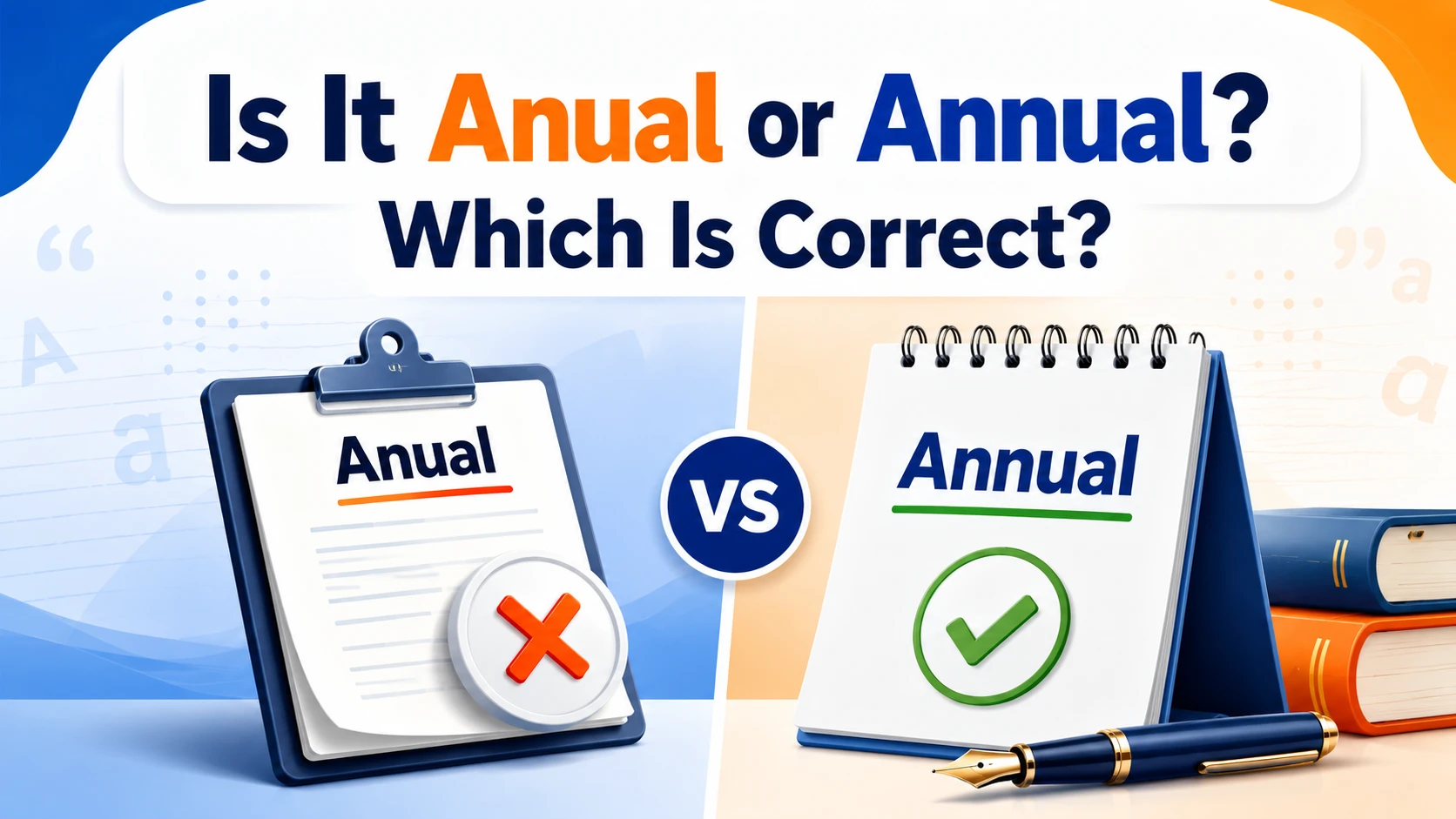
Anual or annual is one of the most common spelling questions in English, especially among students, professionals, and English learners. Because both words look nearly identical and sound almost the same when spoken, it’s easy to assume they’re interchangeable. In reality, only annual is recognized as a correct English word, while anual is simply a misspelling. Using the wrong spelling in an email, report, resume, or academic paper can make an otherwise polished piece of writing appear careless.
The confusion usually stems from English spelling rather than grammar. Many people naturally omit one of the two n’s because they pronounce the word quickly, making the double consonant difficult to notice. Others are influenced by languages such as Spanish or Portuguese, where anual is the correct spelling. Understanding this difference helps you avoid a mistake that spell checkers sometimes miss and that editors immediately recognize.
This guide explains why “annual” is the correct spelling, what it means, how to use it correctly in sentences, why anual is incorrect in English, and how to remember the proper spelling permanently. You’ll also find practical examples, comparison tables, common collocations, grammar tips, and real-world usage that will help you use annual confidently in every context.
Quick Answer: Is It “Anual” or “Annual”?
If you only need the answer, here it is:
- ✅ Annual is the correct spelling in English.
- ❌ Anual is a spelling mistake in English.
- ✅ Annual means happening once every year or lasting for one year.
The Correct Form at a Glance
| Word | Correct in English? | Meaning |
| Annual | ✅ Yes | Happening every year; yearly |
| Anual | ❌ No | Incorrect English spelling |
Examples
Correct:
- The company released its annual report yesterday.
- We hold an annual conference every October.
- She receives an annual performance review.
Incorrect:
- The company released its anual report yesterday.
- We hold an anual conference every October.
Key Takeaway: If you’re writing in English, annual is always the correct choice.
What Does “Annual” Mean?
The adjective annual describes something that occurs once every year or relates to a period of one year. It is commonly used in business, education, healthcare, finance, science, government, and everyday communication.
Common Meanings of “Annual”
Depending on the context, annual can mean:
- Happening every year
- Lasting for one year
- Calculated over a year
- Published once a year
Although these meanings vary slightly, they all revolve around the concept of a yearly cycle.
Common Contexts Where “Annual” Is Used
Business and Finance
Companies use annual to describe reports, budgets, profits, salaries, and shareholder meetings.
Examples:
- The board approved the annual budget.
- Investors reviewed the annual financial report.
- Employees receive an annual bonus based on performance.
Education
Schools and universities frequently use the word when referring to recurring events.
Examples:
- Our annual sports day takes place in April.
- The school published its annual magazine.
- Parents attended the annual awards ceremony.
Healthcare
Medical professionals often recommend yearly examinations.
Examples:
- Schedule your annual checkup.
- She completed her annual health screening.
- Many employers provide an annual medical examination.
Government and Organizations
Government agencies and nonprofit organizations regularly publish yearly documents.
Examples:
- The department released its annual report.
- The organization held its annual general meeting.
Common Collocations with “Annual”
Some combinations appear so frequently that they have become standard English expressions.
Common collocations include:
- annual report
- annual meeting
- annual leave
- annual conference
- annual salary
- annual budget
- annual subscription
- annual review
- annual rainfall
- annual festival
Learning these collocations makes your English sound more natural because native speakers use them regularly.
Is “Anual” Ever a Correct English Word?
One of the biggest misconceptions is that anual might be an alternative spelling, similar to differences like color and colour.
It isn’t.
Unlike many regional spelling variations, anual is not accepted in standard English.
Why “Anual” Appears So Often
Despite being incorrect, you’ll find anual surprisingly often online.
This usually happens because of:
- Fast typing
- Missing one of the double n’s
- Pronunciation that doesn’t clearly emphasize both letters
- Lack of proofreading
- Influence from other languages
Even experienced writers occasionally make this mistake when typing quickly.
Do Dictionaries Recognize “Anual”?
Major English dictionaries—including those used by schools, publishers, and professional editors—recognize annual as the correct spelling.
Anual does not appear as a standard English word. If it appears at all, it is usually listed only as:
- a common misspelling
- an alternate spelling in another language
- a search correction
When Might You Legitimately See “Anual”?
Although incorrect in English, anual is perfectly correct in some other languages.
Spanish
In Spanish:
- informe anual = annual report
- reunión anual = annual meeting
Portuguese
Portuguese also uses anual as the standard spelling.
This explains why multilingual writers sometimes transfer the spelling into English unintentionally.
Expert Tip: If you’re writing in English, never rely on spellings you’ve learned in another language. Always check whether the English version follows different spelling conventions.
Annual vs. Anual: Side-by-Side Comparison
The easiest way to understand the difference is through a direct comparison.
| Feature | Annual | Anual |
| Correct English spelling | ✅ Yes | ❌ No |
| Found in English dictionaries | ✅ Yes | ❌ No |
| Professional writing | ✅ Yes | ❌ No |
| Academic writing | ✅ Yes | ❌ No |
| Business communication | ✅ Yes | ❌ No |
| Means “every year” | ✅ Yes | ❌ Intended meaning only |
The Real Difference
There isn’t a difference in meaning because anual isn’t actually an English word.
The comparison is really between:
- the correct spelling (annual)
- a common spelling mistake (anual)
Whenever you intend to describe something that happens every year, annual is the only acceptable choice.
Why Does “Annual” Have Two Ns?
Many people wonder why English uses two Ns when the pronunciation doesn’t strongly emphasize them.
The answer lies in the word’s history.
The Latin Origin
The word annual comes from the Latin word annus, meaning year.
As the word entered English through Old French and Middle English, it retained the double n found in its original root.
This is why English preserves the spelling:
- annus
- annual
- anniversary
- annuity
Notice that these related words also contain double Ns.
Why the Spelling Feels Confusing
English pronunciation often simplifies double consonants.
For example:
- annual
- dinner
- tunnel
- manner
Although they contain double letters, they aren’t pronounced with a long pause between the consonants.
Because we don’t hear both n’s clearly, many writers accidentally remove one while typing.
Related Words That Reinforce the Pattern
Once you recognize the family of words built from the same root, remembering the spelling becomes easier.
Examples include:
- annual
- annually
- anniversary
- annuity
- perennial
Seeing these related words together helps reinforce the double-n pattern instead of memorizing annuals in isolation.
How to Use “Annual” Correctly in Sentences
Knowing that annual is the correct spelling is only part of the picture. To write naturally and confidently, you also need to understand how the word functions in a sentence and the situations where native English speakers commonly use it.
In most cases, annual is an adjective that describes a noun. It tells readers that something happens once every year, lasts for one year, or relates to a yearly cycle.
Referring to Events That Happen Every Year
The most common use of annual is to describe recurring events.
Examples:
- The city hosts an annual food festival every summer.
- Our school organizes an annual science fair.
- The company holds an annual shareholders’ meeting each April.
- They celebrate an annual family reunion during the holidays.
In each example, the annual tells us that the event takes place once every year.
Referring to Reports, Publications, and Reviews
Businesses, organizations, and institutions frequently use annual when discussing documents published once a year.
Examples:
- The nonprofit released its annual report.
- The university published its annual research review.
- Investors carefully examined the company’s annual financial statements.
- Employees receive an annual performance review.
Using annual immediately tells readers that these documents are produced yearly rather than monthly or quarterly.
Describing Payments, Salaries, and Subscriptions
The word also appears in financial contexts to describe amounts calculated over a year.
Examples:
- Her annual salary increased after the promotion.
- The club charges an annual membership fee.
- We renewed our annual software subscription.
- The insurance company bills customers on an annual basis.
Here, annual refers to something that covers or is measured over a one-year period.
Using “Annual” as an Adjective and a Noun
Most of the time, annual functions as an adjective.
Examples:
- annual conference
- annual budget
- annual leave
- annual income
However, annual can also function as a noun in specific contexts.
Examples:
- This magazine has become a popular annual.
- Gardeners planted colorful annuals alongside the walkway.
In gardening, an annual is a plant that completes its life cycle within a single growing season.
Expert Tip: Unless you’re discussing plants or yearly publications, you’ll almost always use annual as an adjective.
Common Words and Phrases That Use “Annual”
One of the easiest ways to master a word is to learn the expressions native speakers use most often. Instead of memorizing isolated definitions, familiarize yourself with common collocations.
Annual Meeting
A meeting held once every year.
Example:
- The board approved several new policies during the annual meeting.
Annual Report
A detailed report summarizing a company’s activities and financial performance over the past year.
Example:
- Investors reviewed the annual report before making decisions.
Annual Leave
Paid vacation that employees receive each year.
Example:
- She plans to use her annual leave in December.
Annual Salary
The total amount a person earns in one year.
Example:
- His annual salary includes bonuses and performance incentives.
Annual Conference
A conference organized every year.
Example:
- Researchers presented their findings at the annual conference.
Annual Budget
A financial plan covering one fiscal year.
Example:
- The council approved the annual budget unanimously.
Annual Checkup
A routine medical examination is recommended once each year.
Example:
- My doctor advised scheduling an annual checkup.
Annual Rainfall
The total amount of rain received in one year.
Example:
- The region experiences high annual rainfall.
Annual Subscription
A membership or service paid for every year.
Example:
- I renewed my annual subscription before it expired.
Annual vs. Yearly: Are They Always Interchangeable?
Many people wonder whether annual and yearly mean exactly the same thing. In most situations, they do. Both describe something that happens once every year.
However, there are subtle differences in tone and style.
Similarities Between Annual and Yearly
Both words can describe recurring yearly events.
Examples:
- annual conference
- yearly conference
- annual inspection
- yearly inspection
Both versions are grammatically correct.
Differences in Tone
Although the meanings overlap, annual generally sounds more formal and professional.
| Annual | Yearly |
| More formal | More conversational |
| Common in business writing | Common in everyday speech |
| Frequently used in official documents | Frequently used in casual conversation |
For example:
Formal:
- The organization released its annual report.
Casual:
- We take a yearly vacation together.
Both are correct, but annual is usually preferred in reports, contracts, business communication, and academic writing.
Which One Should You Choose?
Choose annual when writing:
- Business documents
- Academic papers
- Professional emails
- Government reports
- Financial statements
Choose yearly when speaking casually or writing informally.
Grammar and Sentence Placement
Understanding the grammar behind annual helps you use it naturally instead of simply memorizing examples.
Is “Annual” an Adjective or a Noun?
Most often, annual is an adjective.
Examples:
- annual budget
- annual meeting
- annual review
In specialized contexts, particularly gardening and publishing, it can also function as a noun.
Examples:
- These annuals bloom throughout the summer.
- The children’s Christmas annual sold thousands of copies.
Where Does “Annual” Usually Appear?
As an adjective, annual normally comes before the noun it modifies.
Examples:
- annual conference
- annual report
- annual examination
This position is far more common than placing it elsewhere in the sentence.
Annual vs. Annually
Many learners also confuse annual with annually.
The difference is grammatical.
| Word | Part of Speech | Example |
| Annual | Adjective | Annual budget |
| Annually | Adverb | The budget is reviewed annually. |
Examples:
Correct:
- We conduct an annual audit.
- We audit our accounts annually.
Incorrect:
- We conduct an annual audit.
- We review the annual.
Whenever you’re describing how often an action happens, use annually. When describing a noun, use annual.
Why Writers Misspell “Annual” as “Anual”
If annuals are so common, why do thousands of people still write anual?
The answer lies in the way English spelling works.
Double-Letter Mistakes Are Extremely Common
English contains many words with doubled consonants that writers accidentally simplify.
Examples include:
- accommodation
- necessary
- occurrence
- millennium
- committee
Because we don’t strongly pronounce both letters, it’s easy to leave one out.
Fast Typing Leads to Errors
Many spelling mistakes happen simply because people type quickly.
When writing emails or reports, fingers often skip one n, producing:
- anual
instead of:
- annual
Other Languages Influence the Spelling
Spanish and Portuguese both use anual as the standard spelling.
Multilingual writers naturally transfer familiar spelling patterns into English, especially if they switch between languages regularly.
Spell Checkers Aren’t Perfect
Modern grammar tools catch most spelling mistakes, but they aren’t foolproof.
If a document isn’t being checked with English language settings, or if a custom dictionary accepts the misspelling, anual may slip through unnoticed.
Proofreading Tip: Before submitting important documents, search your file for “anual.” Replacing every instance with annual takes only seconds and prevents an obvious spelling mistake.
Similar Double-Letter Words That Cause Confusion
The misspelling anual isn’t unique. English contains many words with double letters that writers frequently simplify by mistake. Recognizing these patterns makes it easier to remember the correct spelling of annual and improves your spelling overall.
Annual vs. Annually
Although these words share the same root, they perform different grammatical functions.
- Annual is an adjective that describes a noun.
- Annually is an adverb that describes how often an action happens.
Examples:
- The company publishes an annual report.
- The company publishes its report annually.
Accommodation vs. Accomodation
Many writers accidentally omit one m or one c.
Correct:
- accommodation
Incorrect:
- accomodation
Necessary vs. Necesary
This is another common double-letter error.
Correct:
- necessary
Incorrect:
- necesary
Occasion vs. Ocassion
Because of pronunciation, writers sometimes switch or remove letters.
Correct:
- occasion
Incorrect:
- ocassion
Millennium vs. Millenium
The correct spelling contains two n’s and two l’s.
Correct:
- millennium
Incorrect:
- millenium
Expert Tip: When you learn a new English word with double letters, memorize its spelling alongside a sentence instead of as an isolated word. Context helps your brain retain the correct form more effectively.
Real-Life Examples Across Different Contexts
Seeing annual used in everyday situations reinforces both its spelling and meaning. Below are examples from common contexts where the word appears naturally.
Workplace Communication
Professional communication often uses annual to describe recurring reviews, meetings, and plans.
Examples:
- Employees completed their annual performance reviews this week.
- The CEO presented the annual business strategy.
- Our annual planning meeting is scheduled for next month.
Academic Writing
Schools, colleges, and universities regularly use the word in formal documents.
Examples:
- The university published its annual research report.
- Students participated in the annual science exhibition.
- The scholarship committee meets on an annual basis.
Business and Finance
The word frequently appears in financial reports and corporate documents.
Examples:
- Revenue increased in the latest annual report.
- The company announced its annual dividend.
- Investors attended the annual shareholders’ meeting.
Healthcare
Medical professionals often recommend yearly preventive care.
Examples:
- Don’t forget your annual physical examination.
- She booked her annual dental checkup.
- Many insurance plans cover an annual wellness visit.
News and Media
Journalists commonly use annual when reporting recurring events.
Examples:
- Thousands attended the city’s annual marathon.
- The museum unveiled its annual cultural festival.
- Officials released the annual climate report.
Everyday Conversation
The word is equally common in informal situations.
Examples:
- We take an annual family vacation every July.
- Our neighborhood hosts an annual barbecue.
- My subscription renews on an annual basis.
Common Mistakes to Avoid
Most mistakes involving annual are spelling errors rather than grammar problems. Fortunately, they’re easy to avoid once you know what to watch for.
Writing “Anual” Instead of “Annual”
This is by far the most common mistake.
❌ The company released its anual report.
✅ The company released its annual report.
Always remember that an annual contains two Ns.
Confusing Annual with Annually
Many learners use these words interchangeably, even though they have different grammatical roles.
Incorrect:
- We hold an annual meeting.
Correct:
- We hold an annual meeting.
- We meet annually.
Using Annual for Events That Don’t Happen Every Year
The adjective annual specifically refers to something that occurs once every year.
Incorrect:
- We have an annual staff meeting every month.
Correct:
- We have a monthly staff meeting.
- We have an annual staff meeting each January.
Forgetting the Second “N”
This small typing error can make professional writing look careless.
Before sending important documents, quickly search your work for anual. It takes only a few seconds to correct.
A Simple Memory Trick You’ll Actually Remember
Instead of memorizing a spelling rule, use an image that sticks in your mind.
Think of the Word “Anniversary”
Both annual and anniversary come from the same Latin root meaning year.
Since anniversary clearly has two n’s, it’s easier to remember that annual does too.
The “Two Ns for Every New Year” Trick
Imagine each New Year bringing two Ns with it.
Annual → Two Ns → Every New Year
It’s simple, visual, and surprisingly effective.
A Five-Second Proofreading Habit
Before submitting anything important, ask yourself:
- Does this event happen every year?
- Did I write annual with two n’s?
- Did I accidentally type anual?
Building this habit eliminates one of the most common spelling mistakes in English.
Quick Reference Cheat Sheet
| If you mean… | Use |
| Happening every year | Annual |
| Every year (adverb) | Annually |
| Informal alternative | Yearly |
| “Anual” in English | ❌ Incorrect spelling |
Quick Decision Guide
- Talking about a yearly event? → Annual
- Describing how often something happens? → Annually
- Writing in English? → Never use anual.
Practice Exercises
Choose the Correct Spelling
Select the correct answer.
- The company published its ______ report.
- a) anual
- b) annual
- We attend the ______ conference every June.
- a) annual
- b) anual
- My gym membership renews on an ______ basis.
- a) annual
- b) anual
Fill in the Blanks
Complete the sentences.
- Our ______ meeting begins next Monday.
- She scheduled her ______ health checkup.
- The university released its ______ financial report.
Correct the Spelling Mistakes
Rewrite the following correctly.
- The anual budget was approved yesterday.
- We organize an anual charity event.
- His anual salary increased this year.
✅ Rewrite Using the Correct Form
Rewrite each sentence naturally.
- We meet every year.
- The report is published every year.
- The subscription renews every year.
Answer Key with Explanations
Choose the Correct Spelling
- b) annual
- a) annual
- a) annual
Fill in the Blanks
- annual
- annual
- annual
Correct the Spelling Mistakes
- The annual budget was approved yesterday.
- We organize an annual charity event.
- His annual salary increased this year.
Possible Rewrites
- We hold an annual meeting.
- The company publishes an annual report.
- The subscription renews annually.
Conclusion
Choosing between anual and annual is straightforward once you understand that annual is the only correct English spelling. Whether you’re referring to an annual report, annual meeting, annual salary, or annual checkup, the word always contains two Ns. The misspelling anual usually results from fast typing, pronunciation, or influence from other languages, but it isn’t accepted in standard English. Developing the habit of checking common double-letter words will improve the accuracy and professionalism of your writing. One final actionable tip: associate annual with anniversary—both come from the idea of a year and both use double n. A common mistake to avoid is confusing annual with annually or dropping one of the two Ns during proofreading. Master this small spelling rule, and you’ll eliminate an error that stands out immediately to readers and editors alike.
FAQs
Q1. Is “anual” ever correct in English?
No. Anual is not recognized as a correct English word. The accepted spelling is annual, which means something that happens once every year or lasts for one year. Although anual is correct in languages like Spanish and Portuguese, it should never be used in English writing.
Q2. Why does “annual” have two Ns?
Annual comes from the Latin word annus, meaning “year.” English retained the double n from its historical origin, which is why the correct spelling includes two Ns even though everyday pronunciation doesn’t strongly emphasize both letters.
Q3. What’s the difference between “annual” and “annually”?
Annual is an adjective that describes a noun, such as annual meeting or annual report. Annually is an adverb that describes how often something happens, as in “The conference is held annually.”
Q4. Can “annual” be used as a noun?
Yes, although it’s less common. In gardening, an annual is a plant that completes its life cycle within one growing season. The word can also refer to a publication released once each year, such as a school or holiday annual.
Q5. How can I remember the correct spelling of “annual”?
A useful memory trick is to connect annual with anniversary. Both words relate to years and both contain two Ns. Another simple reminder is: “Every New Year brings two Ns to the annual.” Repeating this association makes the spelling much easier to remember.