

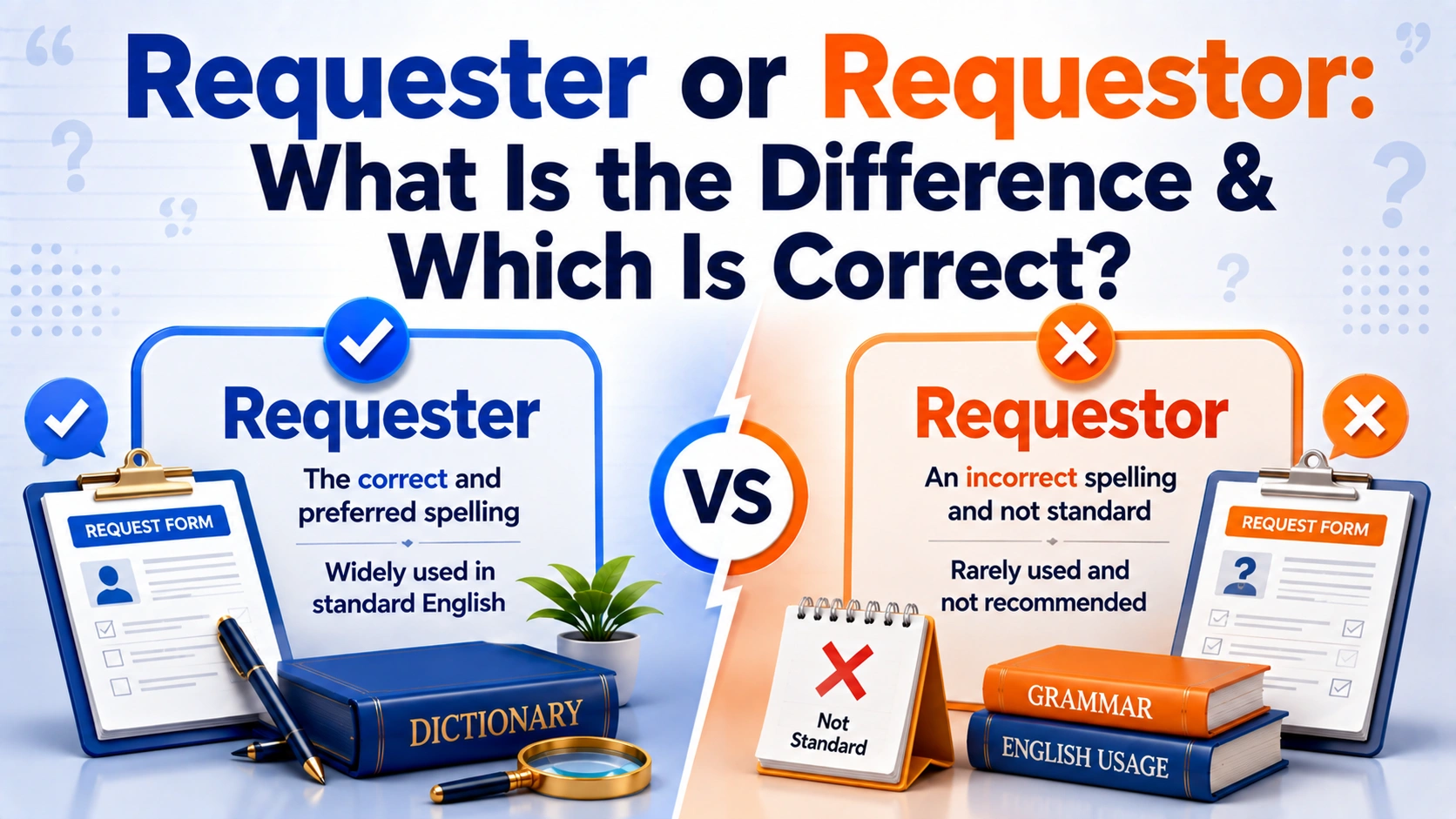
Requester or requestor is one of those English spelling questions that catches even experienced writers off guard. Both words refer to a person who makes a request, and both appear in dictionaries, government forms, and workplace documents. Yet if you’ve worked with legal paperwork, IT ticketing systems, procurement software, or customer service platforms, you’ve probably noticed that one spelling seems more common in some places while the other dominates elsewhere. That naturally raises an important question: Are they interchangeable, or is one actually more correct than the other?
The answer isn’t as simple as choosing one spelling over the other. Unlike many grammar debates where one form is clearly wrong, requester and requestor are both legitimate English words. However, they differ in frequency, context, professional preference, and industry usage. Understanding these differences matters because choosing the expected spelling can improve clarity, maintain consistency, and make your writing appear more polished. Whether you’re drafting a business email, creating technical documentation, writing legal content, or optimising a website for search engines, selecting the right form helps you communicate more effectively.
This guide explores requester vs requestor from every practical angle. You’ll learn what each word means, why two spellings exist, how dictionaries treat them, and whether British and American English have different preferences. We’ll also examine why requestor remains common in enterprise software, while requester dominates general writing. Along the way, you’ll find comparison tables, real-world examples, grammar insights, and expert recommendations that remove any uncertainty. By the end, you’ll know exactly which spelling to use—and when an exception genuinely makes sense.
Quick Answer: Is It “Requester” or “Requestor”?
The short answer is that both requester and requestor are correct English words, but they are not equally common.
For most everyday, academic, business, and professional writing, requester is the preferred spelling. It is the form readers are most familiar with, appears more frequently in modern English, and is commonly recommended in style-conscious writing.
The spelling requestor is also recognised, but it is used far more often in technical systems, enterprise software, procurement platforms, legal documents, and certain organisational workflows. In these specialised environments, changing the spelling may actually create inconsistency.
The Answer at a Glance
| Question | Answer |
| Are both spellings correct? | ✅ Yes |
| Do they have different meanings? | ❌ No |
| Which spelling is more common? | ✅ Requester |
| Which spelling is better for general writing? | ✅ Requester |
| Where is the requestor commonly used? | IT systems, procurement, legal and enterprise software |
| Which spelling should most writers choose? | ✅ Requester |
Quick Examples
Correct in general writing:
- The requester asked for additional information.
- Every requester must complete the application form.
- Please contact the original requester before making changes.
Correct in technical contexts:
- The requestor approved the purchase request in the ERP system.
- The IT portal automatically notifies the requestor when the ticket is resolved.
Key Takeaway: If you’re writing for a broad audience, requester is usually the safest and most natural choice. If you’re working within software or documentation that consistently uses requestor, follow the established terminology.
Requester vs Requestor at a Glance
Although the two spellings look different, their meanings are essentially identical. The main distinction lies in usage rather than definition.
The following comparison highlights the differences that matter most.
| Feature | Requester | Requestor |
| Meaning | Person making a request | Person making a request |
| Dictionary status | Standard and widely used | Recognised variant |
| Pronunciation | Same | Same |
| Everyday writing | ✅ Preferred | ⚠️ Less common |
| Academic writing | ✅ Preferred | Rare |
| Business communication | ✅ Common | Occasional |
| Legal and government documents | Common | Sometimes used |
| Enterprise software | Common | ✅ Frequently used |
| IT service management | Used | ✅ Very common |
| Best choice for most writers | ✅ Yes | Only when context requires |
Pronunciation
There is no pronunciation difference between the two spellings.
Both are typically pronounced the same way, so the distinction exists only in writing.
Which Form Will Readers Expect?
Most readers outside specialised industries naturally expect requester because it follows the standard English pattern used in many similar nouns:
- reader
- writer
- employer
- designer
- requester
By contrast, requestor tends to stand out because the -or ending is less common for words formed from everyday verbs.
What Does “Requester” Mean?
A requester is a person or organisation that asks for something.
The request may involve information, services, approval, payment, access, assistance, or any other action expected from another person or organisation.
The word functions as a regular noun and is suitable for almost every type of writing.
Definition
Requester (noun):
A person, customer, employee, organisation, or system that makes a request.
Unlike some technical terminology, the meaning is immediately clear to most English speakers, making it the preferred choice in general communication.
How It Functions in a Sentence
The word usually identifies who initiated the request.
Examples:
- The requester submitted the application yesterday.
- Each requester will receive a confirmation email.
- The support team contacted the requester for additional details.
- If the requester withdraws the application, the review process will stop.
In every example, the requester identifies the individual who asked for something.
Business Communication
Businesses regularly use requesters in emails, reports, customer service interactions, and approval workflows.
Examples:
- The requester will be notified once the order is approved.
- Managers should respond to the requester within two business days.
- The finance department requires additional information from the requester.
Because it sounds natural and familiar, the requester fits comfortably into professional communication.
Customer Support
Support teams often distinguish between the requester and the person assigned to resolve the issue.
Examples:
- The requester may reopen the ticket if the issue continues.
- An automated email has been sent to the requester.
- Please verify the identity of the requester before processing the account change.
This wording is common in help centres, support portals, and customer service documentation.
Government and Public Services
Government agencies frequently refer to citizens as requesters when they ask for records, permits, licences, or official documents.
Examples:
- The requester must provide valid identification.
- Every requester has the right to appeal the decision.
- Processing times vary depending on the request submitted by the requester.
Using a requester helps keep official documents clear and consistent.
Academic Writing
Universities and researchers also use the term when discussing applications, data access, ethics reviews, or administrative procedures.
Examples:
- The requester must complete the ethics declaration.
- Researchers should inform the requester of any delays.
- Each requester received written confirmation.
Academic writing generally favours requesters because it aligns with standard English word formation.
What Does “Requestor” Mean?
Requestor has the same basic meaning as requester: a person or organisation that makes a request.
The difference is not what it means, but where it is commonly used.
While many general readers rarely encounter the spelling, professionals working in IT, procurement, finance, and enterprise software may see it every day.
Definition
Requestor (noun):
A person, department, organisation, or system that submits or initiates a request.
The definition is effectively identical to requester, and most dictionaries treat the two words as variants.
Why This Spelling Exists
The -or ending appears in many English nouns, especially those with historical roots in Latin or words that became established through legal and administrative usage.
Examples include:
- creditor
- grantor
- lessor
- donor
Over time, some organisations adopted requests to match this pattern, particularly in technical and administrative systems.
The result is a recognised spelling that survives largely because of institutional and industry preferences rather than any difference in meaning.
IT Service Management (ITSM)
Many IT service management platforms use requestor as a standard field label.
For example, a help desk system may include fields such as:
- Requestor
- Approver
- Technician
- Assignee
Employees become familiar with this terminology because it appears throughout the software interface.
Procurement Systems
Procurement platforms often identify the employee initiating a purchase as the requestor.
Examples:
- The requestor submitted the purchase order.
- The requestor must approve any budget changes.
- Finance will notify the requestor once payment is authorised.
Changing the spelling within an established system could create inconsistency, which is why many organisations retain it.
Enterprise Software
Large business applications frequently standardise terminology across thousands of screens and reports.
As a result, users may regularly encounter labels such as:
- Requestor Name
- Requestor Department
- Requestor Approval
- Requestor Details
Even though requester is more common in general English, keeping requestor inside the software ensures consistency with the application’s design and documentation.
Expert Insight: The choice between requester and requestor is rarely about grammar. In most cases, it’s about audience expectations and consistency. For general writing, requester is usually the better choice. For software, legal documents, or internal systems that already use a requestor, matching the existing terminology is often the most professional approach.
Requester vs Requestor: Is There Any Difference in Meaning?
One of the biggest misconceptions surrounding requester and requestor is that they refer to different types of people or different kinds of requests. In reality, there is no difference in meaning. Both words describe the person, organisation, or system that initiates a request. Whether someone is asking for information, approval, technical support, or a service, either spelling identifies the same role.
The distinction lies in usage, convention, and audience expectations, not in grammar or definition. Understanding this prevents writers from overthinking a choice that is often determined by context rather than correctness.
Why the Meanings Are Identical
Both words function as agent nouns, meaning they identify the person who performs an action—in this case, making a request.
Examples:
- The requester submitted the reimbursement form.
- The requestor submitted the reimbursement form.
The meaning of both sentences is exactly the same. The only noticeable difference is the spelling.
Unlike pairs such as:
- affect vs effect
- accept vs except
- borrower vs lender
there is no change in meaning between requester and requestor.
The Difference Is Preference, Not Definition
In modern English, spelling choices often evolve because one version becomes more familiar than another. That is exactly what happened here.
Over time:
- Requester became the preferred spelling in general English, education, publishing, journalism, and business communication.
- Requestor remained common in specialised industries, especially where software vendors or organisations standardised the term years ago.
This explains why two professionals working in different industries may naturally choose different spellings while referring to the same person.
When the Spelling Can Affect Professionalism
Although both spellings are legitimate, choosing the unexpected one can distract readers.
Imagine a marketing article written for a broad audience that repeatedly uses a requestor. Many readers may assume it’s a typo because they’re unfamiliar with the spelling.
Now imagine an IT administrator editing documentation for a ticketing platform that labels every form field as Requestor. Replacing every occurrence with Requester would make the documentation inconsistent with the software interface.
Expert Insight: Professional writing isn’t just about grammatical correctness—it’s also about matching your readers’ expectations. The spelling your audience expects is usually the best choice.
Why Do Two Spellings Exist?
Many English spelling differences have historical roots, and requester versus requestor is no exception.
To understand why both forms exist, it helps to look at how English creates nouns that identify people who perform actions.
The History of the Suffixes -er and -or
English forms thousands of agent nouns by adding endings such as:
- -er
- -or
Examples include:
| Base Word | Common Agent Noun |
| teach | teacher |
| read | reader |
| write | writer |
| design | designer |
| request | requester |
However, English also contains many nouns ending in -or, including:
- actor
- creator
- donor
- creditor
- grantor
These endings entered English through different historical influences, particularly Latin and French.
As the language developed, some words settled on -er, while others retained -or.
How English Borrowed Both Endings
Unlike languages with highly regular spelling systems, English developed by borrowing vocabulary from multiple sources.
As a result:
- Germanic roots often produced -er endings.
- Latin-derived words frequently retained -or.
Over time, not every word followed a predictable pattern.
That’s why English includes:
- employer
- inventor
- educator
- translator
Each reflects its own historical development rather than a universal rule.
Why Modern English Usually Prefers -er
Today, -er is the default ending for newly formed agent nouns.
When people encounter a new verb, they naturally expect the person performing that action to end in -er.
For example:
- stream → streamer
- blog → blogger
- scan → scanner
Following this pattern, requester feels more natural to modern readers.
That familiarity explains why it became the dominant spelling outside specialised industries.
Similar Word Pairs with Competing Endings
English contains several words where different endings coexist.
Examples include:
| Preferred Form | Less Common or Context-Specific Form |
| adviser | advisor |
| requester | requestor |
| judgement (UK variant) | judgment (preferred in many legal contexts) |
These examples remind us that spelling choices often depend on history, convention, and audience, not simply grammar.
Which Spelling Do Dictionaries Recommend?
When uncertainty arises, dictionaries provide the most reliable starting point.
Although individual dictionaries may vary slightly in presentation, they generally agree on one important point:
Requester is the primary and more common spelling.
Dictionary Comparison
Most modern dictionaries:
- define requester as the standard entry
- recognise requestor as a variant or alternative spelling
- indicate no difference in meaning
This tells us that requestor is not an error, but it is less common.
Which Spelling Appears First?
Lexicographers typically list the form readers are most likely to encounter first.
That is usually:
Requester
The ordering reflects actual language use rather than personal preference.
Is “Requestor” Grammatically Correct?
Yes.
The requestor is grammatically correct.
The question isn’t whether it is acceptable.
The better question is:
Will your audience expect it?
For most readers, requester feels more natural because it follows modern English spelling conventions.
British English vs American English Usage
Unlike words such as:
- colour / color
- organise / organize
- travelling / traveling
There is no significant British-versus-American divide between requester and requestor.
Both varieties overwhelmingly favour requesters in general writing.
Preferred Spelling in British English
British publications, universities, government agencies, and businesses generally use:
Requester
Examples include:
- requester information
- requester details
- requester responsibilities
This aligns with broader British usage of -er agent nouns.
Preferred Spelling in American English
American English also overwhelmingly uses:
Requester
You’ll commonly encounter it in:
- business communication
- educational writing
- journalism
- customer support
- public-sector documents
The idea that requestor is the American spelling is a myth.
Is There a Regional Difference?
Not really.
The difference is industry-based, not country-based.
Whether you’re writing for readers in:
- the United Kingdom
- the United States
- Canada
- Australia
- New Zealand
Requester will usually be recognised as the standard spelling.
Which Spelling Is Understood Internationally?
For international audiences, requesters are generally the safest option.
Because it appears more frequently in books, websites, and professional publications, readers recognise it immediately regardless of location.
Which Spelling Should You Use?
Choosing between requester and requestor becomes much easier once you consider your audience.
The right choice isn’t determined by grammar alone—it’s determined by context.
For Business Writing
Use a requester.
It looks natural, professional, and aligns with the expectations of most readers.
Examples:
- requester information
- requester approval
- requester details
For Academic Papers
Universities and scholarly publications generally favour requesters because it follows standard English usage.
Unless a style guide specifies otherwise, this is the recommended choice.
For Websites and Blogs
For general audiences—and particularly for SEO content—requester is the stronger option.
It matches the wording most readers naturally search for and expect to see.
For Legal Writing
Legal documents may use either spelling depending on established templates or institutional style.
If you’re preparing new legal content, consistency matters more than personal preference.
When editing existing contracts, preserve the terminology already used throughout the document.
bFor Software Interfaces and Technical Documentation
This is where requestor remains genuinely common.
If an application labels a field as:
- Requestor Name
- Requestor ID
- Requestor Approval
your documentation should usually retain that spelling to match the interface exactly.
Changing it could confuse users who are trying to follow instructions.
Why Many Software Platforms Use “Requestor”
Many people first encounter requests while working with enterprise software rather than traditional writing.
That isn’t accidental.
Enterprise Software Conventions
Large software systems often establish terminology during development and retain it for years—even decades.
Changing interface labels later can affect:
- documentation
- user training
- integrations
- databases
- translations
As a result, legacy terminology often remains unchanged.
IT Ticketing Systems and Workflow Tools
Help desk platforms frequently include fields such as:
- Requestor
- Assignee
- Approver
- Technician
Employees become accustomed to this vocabulary through daily use, even if they would naturally write requests elsewhere.
Why Companies Keep Legacy Terminology
Updating thousands of interface labels, reports, API fields, and training manuals simply to modernise a spelling is rarely worthwhile.
Consistency across systems usually outweighs linguistic preference.
Should You Copy Software Labels in Your Writing?
Yes—when referring to the software itself.
If the button says Requestor, your documentation should also say Requestor.
If you’re writing a general article about English grammar or workplace communication, a requester is usually the better choice.
Expert Recommendation: Let your audience guide your decision. Use requester for general communication, education, and publishing. Use requestor when matching established terminology in software, legal documents, or organisational systems where consistency is essential.
Requester vs Requestor: Real-World Examples
Knowing the definitions is helpful, but seeing each word in realistic situations makes the difference much easier to understand. Although requester and requestor share the same meaning, the surrounding context often determines which spelling feels more natural.
Email Examples
For everyday business emails, a requester is usually the preferred choice.
Examples:
- The requester has approved the updated proposal.
- Please contact the requester before closing this support ticket.
- Our team will notify the requester once the document is ready.
- The requester asked for an extension until Friday.
These examples follow standard business English and are suitable for most workplaces.
HR and Workplace Examples
Human resources departments frequently process requests related to leave, benefits, payroll, and employment records.
Examples:
- The requester must attach supporting documents.
- Managers should respond to the requester within three business days.
- HR will contact the requester if additional information is required.
Because HR communication is intended for a broad audience, requester is generally the better choice.
Customer Service Examples
Support teams often distinguish between the person requesting help and the employee handling the issue.
Examples:
- Every requester receives a confirmation email.
- The support representative updated the requester on the progress.
- The requester confirmed that the issue had been resolved.
IT Help Desk Examples
Many ticketing platforms and enterprise applications use requestor as part of their interface.
Examples:
- The requestor created the incident ticket.
- Notify the requestor when the request is approved.
- Only the requestor can reopen a closed service request.
- The requestor selected the incorrect department.
Here, matching the software’s terminology is more important than choosing the more common spelling.
Government Forms and Procurement Examples
Official documents may use either spelling depending on the agency or organisation.
Examples include:
- The requester must submit identification before processing begins.
- The requestor is responsible for verifying vendor information.
- The agency will notify the requester of its decision within 30 days.
The wording usually reflects the organisation’s internal style guide rather than a grammatical rule.
Common Grammar and Spelling Mistakes
Even experienced writers sometimes make incorrect assumptions about these two words. Avoiding a few common mistakes will make your writing more consistent and professional.
Mistake 1: Assuming One Word Is Incorrect
Some writers believe requestor is simply a misspelling.
It isn’t.
Both spellings are recognised English words.
The difference is usage frequency, not grammatical correctness.
Mistake 2: Mixing Both Spellings in the Same Document
Consistency matters.
For example:
❌ The requester submitted the application. Later, the requestor approved additional information.
Although technically understandable, alternating between spellings can make writing appear inconsistent.
Choose one form and use it throughout the document unless you are quoting software labels or official terminology.
Mistake 3: Copying Software Terminology Everywhere
Many professionals become accustomed to seeing requestor inside enterprise systems.
That doesn’t mean it belongs in every report, article, or email.
Outside specialised software environments, requesters generally read more naturally.
Mistake 4: Assuming “-or” Always Sounds More Formal
Some writers believe the requestor looks more legal or authoritative.
In reality, most editors simply choose the spelling that best fits the audience.
Professional writing values clarity more than unusual spelling.
Similar Word Pairs That Cause Confusion
Requester and requestor aren’t the only English words with competing spellings or endings.
Understanding similar examples helps you recognise broader spelling patterns.
| Word Pair | Preferred General Usage | Notes |
| Adviser vs Advisor | Adviser (many style guides) | An advisor is also common in business. |
| Judgment vs Judgement | Judgment (legal and US English) | Judgement remains common in British English. |
| Canceled vs Cancelled | Depends on regional English | The US generally prefers canceled; the UK prefers cancelled. |
| Requester vs Requestor | Requester | Requestor remain common in technical systems. |
| Focused vs Focussed | Focused | Focussed appears less often today. |
The lesson is simple: English spelling often reflects convention rather than strict rules.
How to Remember the Correct Spelling
If you only remember one guideline, remember this:
For almost all general writing, choose requester.
A Simple Memory Trick
Think about familiar words:
- reader
- writer
- speaker
- teacher
Most everyday agent nouns end in -er.
Following the same pattern makes the requester easier to remember.
Easy Proofreading Tips
Before publishing or sending your document, ask yourself:
- Who is my audience?
- Am I writing for the general public or a specialised system?
- Have I used the same spelling consistently?
- Does the terminology match any software I’m referring to?
These quick checks eliminate most spelling inconsistencies.
When to Ignore Autocorrect Suggestions
Some writing tools may suggest changing one spelling to the other.
Always consider context before accepting the suggestion.
If your company software consistently uses requestor, keeping that spelling is usually the right decision.
Quick Decision Guide
| Situation | Recommended Choice | Why |
| Blog articles | Requester | Matches reader expectations. |
| Business emails | Requester | Standard professional English. |
| Academic writing | Requester | Preferred in formal publications. |
| Customer support documentation | Requester | Clear and widely recognised. |
| Software interface labels | Requestor | Matches existing application terminology. |
| IT ticketing systems | Requestor | Industry convention. |
| Legal templates | Follow the existing style | Consistency is more important. |
| Internal company documents | Follow your organisation’s style guide | Maintain uniform terminology. |
Quick Practice Quiz
Choose the Correct Spelling
- The ______ submitted a request for additional funding.
- Please notify the ______ when the support ticket is resolved.
- Our ERP software automatically emails the ______ after approval.
- The university contacted the ______ regarding missing documents.
- The IT portal displays the ______ name on every ticket.
Answers
- Requester
- Requester
- Requestor (if matching the software interface)
- Requester
- Requestor (when referring to the software label)
Cheat Sheet: Requester or Requestor?
One-Minute Summary
- Both spellings are correct.
- Requester is the preferred spelling for most writing.
- Requestor is common in enterprise software and IT systems.
- The meaning is exactly the same.
- Choose the spelling your audience expects.
Do’s
- Use requester in business writing.
- Use requester in blogs and articles.
- Follow software terminology when documentation already uses a requestor.
- Stay consistent throughout your document.
Don’ts
- Don’t assume requestor is incorrect.
- Don’t switch between spellings randomly.
- Don’t replace official software labels simply because another spelling is more common.
Conclusion:
Choosing between requester and requestor is less about grammar and more about using the right spelling for the right audience. Both words are valid, and both describe the person who makes a request. However, requester has become the preferred choice in modern English because it follows familiar word-formation patterns and appears more often in business communication, education, publishing, and everyday writing. Requestor continues to serve an important role in technical systems, legal templates, and enterprise software where consistency is essential. One final actionable tip: always match your spelling to your audience and, when applicable, your organisation’s style guide. A common mistake to avoid is switching between both spellings within the same document, as this can make otherwise professional writing appear inconsistent and less polished.
FAQs
Q1. Is requestor a real English word?
Yes. Requestor is a recognised English noun meaning a person who makes a request. Although it appears less frequently than requester, many dictionaries accept it, and it remains widely used in IT systems, procurement software, and organisational workflows.
Q2. Why is requester more common than requestor?
Requester follows the standard English pattern for forming agent nouns with the -er suffix. Because it sounds more familiar to most readers, publishers, businesses, universities, and professional writers generally prefer it in everyday communication.
Q3. Do requester and requestor mean exactly the same thing?
Yes. Their definitions are identical. Both refer to the person or organisation making a request. The difference lies in usage and convention, not in meaning or grammatical function.
Q4. Which spelling should I use in professional writing?
For most professional documents, reports, emails, websites, and academic work, requester is the safest and most widely accepted choice. Use requestor only when matching established terminology in software, legal documents, or your organisation’s style guide.
Q5. Why do many IT systems use a requestor?
Many enterprise platforms adopted requestor years ago and retained it for consistency across interfaces, databases, reports, and documentation. Updating thousands of labels simply to modernise the spelling would often create unnecessary confusion and additional maintenance.