

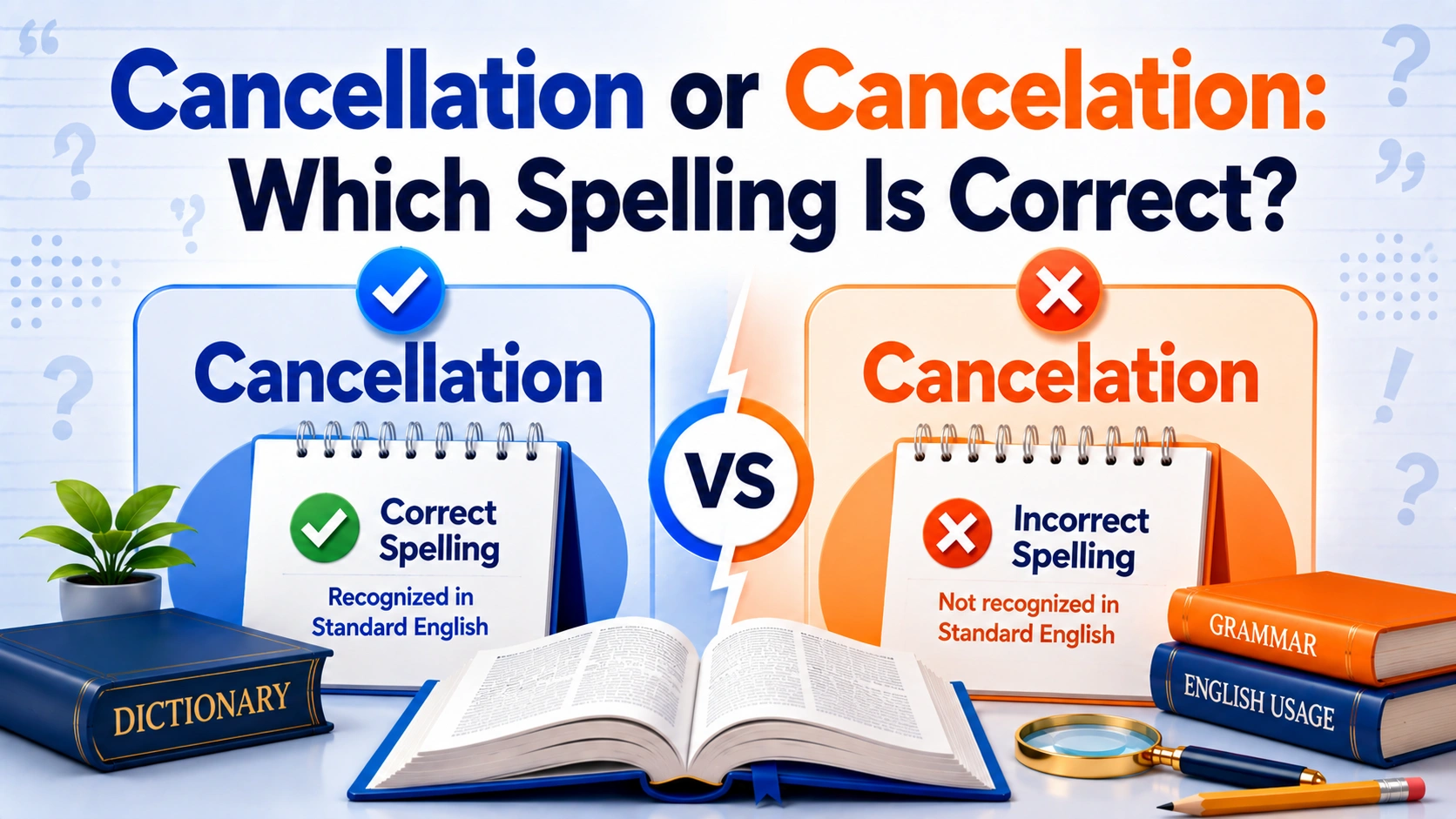
Cancellation or cancelation is one of the most searched spelling questions in English, and for good reason. At first glance, both words appear logical because they come from the verb cancel. Yet when you read newspapers, airline policies, business contracts, or academic papers, you’ll notice that one spelling overwhelmingly dominates. This leaves many writers wondering whether the other version is simply less common or completely wrong. If you’ve ever paused before typing the word in an email or document, you’re certainly not alone.
The confusion becomes even greater because English already contains several regional spelling differences, such as colour versus color or travelling versus traveling. Many people assume cancellation and cancelation follow the same pattern. In reality, the answer is more nuanced. While both spellings have appeared in English, they are not equally accepted, and knowing which one to use can make your writing look more polished, professional, and credible. Understanding the reasoning behind the spelling also helps you avoid similar mistakes with related words.
This guide explains everything you need to know about cancellation vs cancelation. You’ll learn which spelling dictionaries recommend, whether British and American English differ, why the noun is usually written with a double l, and how professional editors approach the issue. You’ll also find comparison tables, practical examples, expert writing tips, and easy memory tricks that make the correct spelling effortless to remember. By the end, you’ll know exactly which version to use in every situation.
Quick Answer: Is It “Cancellation” or “Cancelation”?
The safest and most widely accepted spelling is cancellation.
Although cancelation appears in a small number of dictionaries as a recognised variant, it is far less common and is generally avoided by professional writers, publishers, educators, and editors. In everyday, academic, legal, and business writing, cancellation is the preferred choice.
Here’s the answer at a glance.
| Feature | Cancellation | Cancelation |
| Standard spelling | ✅ Yes | ⚠️ Rare variant |
| Widely used worldwide | ✅ Yes | ❌ No |
| Preferred by editors | ✅ Yes | ❌ Rarely |
| Suitable for academic writing | ✅ Yes | ⚠️ Generally avoided |
| Common in business documents | ✅ Yes | ❌ Rare |
| Best choice for most writers | ✅ Yes | ❌ No |
Correct Examples
- Your cancellation request has been processed.
- The airline announced the cancellation of several flights.
- We received confirmation of the subscription cancellation.
Less Common Variant
- The cancelation of the meeting surprised everyone.
Although this sentence isn’t necessarily considered incorrect by every dictionary, most readers expect cancellation, making it the better option.
Key Takeaway: If you want writing that looks natural, professional, and universally accepted, choose cancellation every time.
Why There Are Two Spellings
Many spelling questions have a straightforward answer: one version is correct, and the other is simply wrong. Cancellation and cancelation are different because history has left us with two recognised forms, although one has become overwhelmingly dominant.
Understanding why requires a closer look at how English forms nouns from verbs.
The Word Comes from the Verb “Cancel”
Both spellings originate from the verb cancel, meaning to call something off, invalidate it, or decide it will no longer happen.
Examples include:
- cancel an appointment
- cancel a subscription
- cancel a booking
- cancel a cheque
- cancel a flight
When English turns many verbs into nouns by adding -ation, spelling changes sometimes occur. The challenge lies in deciding whether the final consonant should be doubled before adding the suffix.
Why the Double L Appears
The preferred noun cancellation contains a double l because English generally preserves the doubled consonant found in related forms such as:
- cancelled
- cancelling
- cancellation
This creates a consistent family of spellings.
Compare these examples:
| Verb | Preferred Derived Form |
| cancel | cancelled |
| cancel | cancelling |
| cancel | cancellation |
Keeping the double l makes the relationship between these words immediately recognisable.
Why “Cancelation” Still Exists
The spelling cancelation developed through a process called spelling simplification, where one of the repeated letters is removed.
English contains many examples of simplified spellings that eventually became accepted. However, in this case, cancelation never replaced cancellation as the dominant form.
Today it survives mainly because:
- a few dictionaries list it as an acceptable variant
- older publications occasionally used it
- some writers naturally assume only one l is needed after the verb cancel
Despite this history, modern published English strongly favours cancellation.
Expert Insight: Just because a dictionary records a spelling doesn’t mean it’s the best choice. Dictionaries describe language as it exists, while professional style guides recommend the forms that readers expect most often.
Is “Cancellation” or “Cancelation” Correct?
The short answer is that both spellings have historical legitimacy, but they are not equally recommended.
For most people, the practical question isn’t whether cancelation exists. It’s whether they should actually use it.
In almost every situation, the answer is no.
What Major Dictionaries Say
Leading English dictionaries generally agree on two important points:
- Cancellation is the primary spelling.
- Cancelation is listed, if at all, as a secondary or variant spelling.
This distinction matters because primary entries reflect the form readers are most likely to encounter in books, newspapers, educational materials, and professional writing.
Which Spelling Do Professional Editors Prefer?
Editors value consistency and reader expectations.
Whether editing:
- books
- newspapers
- magazines
- websites
- business reports
- academic journals
they almost always standardise the spelling to cancellation.
Using the dominant form avoids distracting readers who may interpret the rarer spelling as an error.
Should You Ever Choose “Cancelation”?
There are very few situations where choosing cancelation offers any advantage.
You might encounter it when:
- quoting an original historical source
- reproducing official wording exactly as published
- following an organisation’s established house style
Outside these rare circumstances, cancellation remains the clearer and more professional option.
Cancellation vs Cancelation: Side-by-Side Comparison
Although the difference is only one letter, the two spellings differ significantly in acceptance, frequency, and practical use.
The table below highlights the distinctions that matter most.
| Feature | Cancellation | Cancelation |
| Dictionary status | Primary spelling | Secondary or variant spelling |
| Frequency of use | Extremely common | Rare |
| Professional writing | Recommended | Usually avoided |
| Academic writing | Preferred | Rarely used |
| Business communication | Standard choice | Not recommended |
| Legal documents | Preferred | Uncommon |
| Reader familiarity | Very high | Low |
| Risk of appearing incorrect | Very low | Relatively high |
Which One Should You Use?
If your goal is clear, professional communication, the decision is simple.
Choose cancellation when writing:
- emails
- contracts
- reports
- university assignments
- websites
- books
- blog articles
- customer service messages
- official notices
Using the standard spelling removes uncertainty and ensures your writing meets readers’ expectations.
Why Consistency Matters
Imagine reading a company policy that alternates between:
- cancellation policy
- cancelation policy
- cancellation fee
- cancelation request
Even if both spellings are technically recognised, the inconsistency appears unprofessional.
Professional writers choose one standard form and use it consistently throughout every document.
Writing Tip: Consistency is one of the easiest ways to improve credibility. Once you’ve chosen cancellation, keep that spelling throughout the entire piece rather than switching between variants.
British English vs American English: Is There a Difference?
One of the main reasons people search for cancellation or cancelation is the belief that the spelling depends on whether you’re using British or American English. That’s a reasonable assumption because many English words differ across regions—for example, colour and color, organise and organize, or travelling and traveling.
In this case, however, the situation is different.
British English Preference
In British English, cancellation is the standard and overwhelmingly preferred spelling.
You’ll see it used in:
- Government documents
- Newspapers
- Universities
- Business contracts
- Airline and railway policies
- Publishing houses
Examples:
- Flight cancellation due to severe weather.
- Please submit your cancellation request in writing.
- The event cancellation was announced yesterday.
If you’re writing for a UK audience, cancellation should always be your choice.
American English Preference
American English also strongly prefers cancellation.
This surprises many writers because American English often simplifies spellings by removing doubled letters, as seen in:
- travelled → traveled
- travelling → traveling
- labelled → labeled
Because of this pattern, some people assume the noun should become cancelation.
In reality, cancellation remains the dominant spelling in American books, newspapers, universities, government publications, and corporate writing.
Why the Confusion Exists
The confusion comes from mixing two different spelling rules.
American English commonly simplifies verb forms such as:
- cancelled → canceled
- cancelling → canceling
However, the noun overwhelmingly remains:
- cancellation ✅
rather than
- cancelation ⚠️
This inconsistency feels unusual, but it’s simply how modern English evolved.
Expert Tip: Don’t assume every American spelling removes doubled letters. Always check the specific word rather than applying a general rule.
Consistency Matters More Than Regional Preference
Whether you write in British English or American English, consistency is far more important than chasing rare spelling variants.
For almost every audience worldwide, cancellation is the safest, clearest, and most familiar choice.
The Grammar Behind “Cancellation”
Understanding the grammar makes the spelling much easier to remember.
Rather than memorising the word, it’s more useful to understand how English forms nouns from verbs.
How the Noun Is Formed
The noun comes from the verb:
cancel
plus the suffix:
-ation
Together they create:
cancellation
Although this seems straightforward, English often adjusts spelling when suffixes are added.
Examples include:
- educate → education
- inform → information
- celebrate → celebration
- cancel → cancellation
The resulting spelling reflects long-established conventions rather than a single universal rule.
Why the Double L Appears
The double l helps preserve consistency across the word family.
Consider these related forms:
| Word Form | Preferred Spelling |
| Verb | cancel |
| Past tense (BrE) | cancelled |
| Present participle (BrE) | cancelling |
| Noun | cancellation |
Keeping the double l in the noun creates a recognisable pattern.
Although American English simplifies canceled and canceling, it still overwhelmingly keeps cancellation.
Similar English Patterns
Many English words behave in similar ways.
Some double letters.
Some don’t.
That is why relying on analogy alone can be misleading.
Compare these examples:
| Base Word | Derived Form |
| permit | permission |
| admit | admission |
| cancel | cancellation |
| refer | referral |
Each follows its own historical spelling pattern.
Professional editors know that consulting reliable dictionaries is often more effective than trying to predict spelling from general rules.
When to Use “Cancellation”
The word appears in almost every area of modern life.
Understanding its most common contexts helps you use it naturally and confidently.
Business Communication
Businesses regularly use cancellation when referring to products, services, subscriptions, and appointments.
Examples:
- Cancellation requests must be submitted before Friday.
- Your cancellation has been confirmed.
- A cancellation fee may apply.
Using the standard spelling helps maintain professionalism and avoids distracting clients.
Travel and Hospitality
Airlines, hotels, tour operators, and booking platforms frequently use the term.
Examples:
- Flight cancellation
- Hotel cancellation policy
- Cancellation insurance
- Free cancellation available
If you’ve ever booked accommodation online, you’ve probably seen this spelling dozens of times.
Banking and Financial Services
Financial institutions also rely on the word in customer agreements.
Examples include:
- card cancellation
- policy cancellation
- account cancellation
- automatic payment cancellation
Accuracy is particularly important in legal and financial documents because even minor spelling inconsistencies can affect professionalism.
Academic and Professional Writing
Researchers, universities, and employers prefer cancellation because it follows the standard spelling recognised by readers.
Examples:
- cancellation of classes
- cancellation notice
- contract cancellation
Using uncommon variants offers no practical benefit in these settings.
Is There Any Situation Where “Cancelation” Is Better?
Most writers will never need to use cancelation.
However, understanding why it still appears occasionally provides useful context.
Historical Usage
Older publications sometimes used cancelation, especially during periods when English spelling was less standardised.
Before modern dictionaries and editorial conventions became widely adopted, variation was much more common.
That historical usage explains why some reference works still acknowledge the spelling today.
Rare Dictionary Recognition
A few dictionaries list cancelation as an acceptable variant.
This doesn’t necessarily mean it’s recommended.
Instead, it reflects the descriptive role of dictionaries—they record words that people have used, even if those words are uncommon.
Editors and publishers, on the other hand, generally recommend the spelling readers expect most often.
When You Might Keep It
There are a few situations where preserving cancelation makes sense.
For example:
- quoting historical documents
- reproducing official forms exactly
- maintaining the original wording of a legal record
- citing published material verbatim
Outside those circumstances, changing the spelling to cancellation usually improves clarity and consistency.
Common Mistakes Writers Make
The spelling itself isn’t the only issue.
Several related mistakes appear regularly in professional writing.
Mistake 1: Assuming “Cancelation” Is the American Spelling
This is probably the biggest misconception.
Although American English simplifies many words, cancellation remains the preferred noun.
Don’t confuse it with:
- canceled
- canceling
Those simplified verb forms do not automatically change the noun.
Mistake 2: Mixing Spellings
Some documents contain both:
- cancellation
- cancelation
This inconsistency immediately catches an editor’s attention.
Choose one spelling—and unless you have a compelling reason otherwise, make it cancellation.
Mistake 3: Confusing Related Word Forms
Many writers accidentally mix different spelling conventions.
For example:
- canceled (AmE)
- cancelled (BrE)
- cancellation (preferred in both)
Understanding the entire word family helps prevent these errors.
Cancellation, Cancelled, Canceled, and Cancelling: Understanding the Whole Word Family
This is where many learners become confused.
The noun doesn’t always follow the same pattern as every verb form.
The table below makes the differences easy to understand.
| Word | British English | American English |
| Verb | cancel | cancel |
| Past tense | cancelled | canceled |
| Present participle | cancelling | canceling |
| Noun | cancellation | cancellation |
Notice something important:
Although American English simplifies canceled and canceling, it still overwhelmingly uses cancellation.
That’s why assuming cancelation must be the American version leads to mistakes.
Expert Writing Tip: Learn related words as a family rather than individually. Understanding how cancel, canceled/cancelled, canceling/cancelling, and cancellation fit together makes the spelling much easier to remember and apply consistently.
Real-World Examples of Correct Usage
Understanding a spelling rule is useful, but applying it confidently in everyday writing is what really matters. The following examples show how cancellation appears naturally in different contexts. Notice that the spelling remains the same regardless of the type of document.
Emails
Professional emails often use cancellation when referring to appointments, meetings, or subscriptions.
Examples:
- Your cancellation request has been received and is being processed.
- We apologise for the cancellation of tomorrow’s meeting.
- Please contact us if you wish to discuss your membership cancellation.
These examples reflect the wording commonly found in business correspondence.
Customer Service Messages
Companies use cancellation to communicate clearly with customers.
Examples:
- Your order has been successfully cancelled, and a cancellation confirmation has been emailed to you.
- There is no cancellation fee if you cancel within 14 days.
- Your subscription cancellation will take effect at the end of the current billing cycle.
Using the standard spelling builds trust and maintains a professional image.
Airline and Hotel Policies
Travel companies use the word frequently because cancellations are part of everyday operations.
Examples:
- Free cancellation is available up to 48 hours before arrival.
- Flight cancellation insurance is strongly recommended.
- In the event of a weather-related cancellation, passengers will be offered alternative travel arrangements.
If you browse booking websites, you’ll almost always see cancellation, not cancelation.
News Headlines
Journalists prefer concise, familiar language.
Examples:
- Concert Cancellation Leaves Thousands Disappointed
- School Cancellation Announced Due to Heavy Snow
- Airline Issues Statement After Flight Cancellation
Because newspapers follow strict editorial standards, their spelling choices reinforce accepted usage.
Everyday Conversations
Although people don’t always think about spelling while speaking, the written form still matters in text messages, social media posts, and personal notes.
Examples:
- The cancellation was disappointing, but we’ll reschedule.
- Thanks for letting me know about the appointment cancellation.
- I received a cancellation notice this morning.
Whether you’re writing casually or professionally, cancellation remains the natural choice.
Words Commonly Confused with “Cancellation”
Several words have related meanings but are not interchangeable. Choosing the wrong one can subtly change the meaning of your sentence.
Cancellation vs Termination
A cancellation usually prevents something from happening or ends an agreement before completion.
A termination generally refers to bringing an agreement, employment, or legal arrangement to an end.
Examples:
- Flight cancellation due to bad weather.
- Employment termination following a contract review.
Cancellation vs Revocation
A revocation means officially withdrawing a legal right, permission, or authority.
Examples:
- Revocation of a licence.
- Cancellation of a reservation.
Although both involve ending something, they apply in different situations.
Cancellation vs Withdrawal
A withdrawal often refers to removing an application, participation, or funds.
Examples:
- Withdrawal from a university course.
- Cancellation of an insurance policy.
One concerns stepping back voluntarily; the other usually concerns ending an arrangement.
Cancellation vs Postponement
These two are frequently confused.
A cancellation means the event will not happen.
A postponement means it will happen later.
Examples:
- The concert’s cancellation disappointed fans because no new date was announced.
- The concert’s postponement means tickets remain valid for the rescheduled performance.
Understanding this distinction helps you communicate accurately.
How to Remember the Correct Spelling
Even experienced writers occasionally hesitate over words with double letters. Fortunately, a few simple techniques make cancellation much easier to remember.
A Simple Memory Trick
Think of the pattern:
cancel → cancelled → cancelling → cancellation
Three related words contain a double l, so the noun naturally follows the same family.
Proofreading Tips
Before sending an important document:
- Search for cancelation using your document’s Find feature.
- Replace it with cancellation if consistency is your goal.
- Read headings separately, as spelling mistakes often hide there.
- Don’t rely solely on autocorrect.
A quick review takes seconds but can prevent embarrassing errors.
Mnemonics That Actually Work
One useful mnemonic is:
Double the “L” for the Lasting noun.
Because cancellation is the lasting record or result of cancelling something, remember the double l.
Another approach is to associate it with common phrases you’ve probably seen hundreds of times:
- cancellation policy
- cancellation fee
- cancellation notice
- cancellation request
Repeated exposure reinforces the correct spelling naturally.
What Major Dictionaries and Style Guides Recommend
When uncertainty arises, authoritative references provide the most reliable guidance.
Dictionary Preferences
Most respected dictionaries present cancellation as the primary spelling. Some also acknowledge cancelation as a less common variant, but they consistently indicate that cancellation is the standard form readers are most likely to encounter.
Editorial Style Guidance
Professional publishers, universities, newspapers, and businesses generally standardise documents using cancellation.
Editors do this because:
- readers recognise it immediately
- it avoids unnecessary distraction
- it creates consistency across publications
If you’re writing for a broad audience, following the dominant convention is the safest approach.
Why Consistency Matters
Even if a rare spelling exists, switching between variants in the same document creates confusion.
Professional writing values consistency as much as correctness.
Expert Recommendation: Unless you’re reproducing a historical quotation or following a specific house style, use cancellation consistently throughout your writing.
Quick Practice Quiz
Test your understanding with these short exercises.
1. Choose the correct spelling.
The airline announced the flight _______.
a) cancelation
b) cancellation
Answer: b) cancellation
2. Fill in the blank.
Your membership _______ has been confirmed.
Answer: cancellation
3. Which sentence is correct?
a) The cancelation fee is non-refundable.
b) The cancellation fee is non-refundable.
Answer: b) The cancellation fee is non-refundable.
4. Which word means delaying an event rather than ending it?
a) Cancellation
b) Postponement
Answer: b) Postponement
5. True or False
American English generally prefers cancelation.
Answer: False. American English overwhelmingly prefers cancellation as the standard noun.
Cheat Sheet: Cancellation or Cancelation?
Use this quick reference whenever you’re unsure.
| Situation | Best Choice |
| Business emails | ✅ Cancellation |
| Academic writing | ✅ Cancellation |
| Legal documents | ✅ Cancellation |
| Airline or hotel bookings | ✅ Cancellation |
| Historical quotation | ⚠️ Keep the original spelling if required |
| Everyday writing | ✅ Cancellation |
Do
- Use cancellation in almost all writing.
- Stay consistent throughout your document.
- Check official style guides if writing for a specific organisation.
- Proofread for uncommon spelling variants.
Don’t
- Assume cancelation is the American spelling.
- Mix both spellings in the same article.
- Depend entirely on spell check.
- Change quotations from original historical sources.
Key Takeaways
Before you leave, remember these essential points:
- Cancellation is the preferred and standard spelling in both British and American English.
- Cancelation exists as a rare variant but is seldom recommended for modern writing.
- Professional editors, publishers, and businesses overwhelmingly choose cancellation.
- Learning the entire cancel word family makes the spelling easier to remember.
- Consistent spelling improves clarity, credibility, and professionalism.
Conclusion
The debate over cancellation or cancelation isn’t simply about counting letters—it’s about choosing the spelling your readers immediately recognise and trust. While cancelation has historical roots and appears as a variant in a few references, cancellation has become the clear standard across modern English. Whether you’re writing a business email, travel policy, legal document, academic paper, or blog post, using the preferred spelling improves clarity and professionalism.One final actionable tip: if you ever hesitate, remember the familiar phrases “cancellation policy” and “cancellation fee.” Seeing these expressions regularly will reinforce the correct spelling naturally. A common mistake to avoid is assuming that because American English uses canceled and canceling, it must also prefer cancelation. It doesn’t. Choosing cancellation consistently is the simplest way to write with confidence and credibility
FAQs
Q1. Is cancelation a real word?
Yes, cancelation appears as a rare variant in some dictionaries. However, cancellation is the standard spelling used in modern English. If you’re writing for work, school, publishing, or online readers, cancellation is the safer and more widely accepted choice.
Q2. Why is cancellation spelled with two Ls?
The noun follows the established spelling pattern of the cancel word family. Although American English simplifies some related verb forms, the noun has traditionally retained the double l, making cancellation the dominant spelling across major English-speaking countries.
Q3. Which spelling should I use in American English?
Even in American English, cancellation is overwhelmingly preferred. While you may write canceled and canceling, the noun remains cancellation in newspapers, universities, businesses, and most professional publications.
Q4. Why do some spell checkers accept cancelation?
Some spell checkers include recognised but uncommon variants from dictionary databases. Acceptance by software doesn’t necessarily mean a spelling is the best editorial choice. For professional writing, cancellation remains the recommended form because it’s the one readers expect.
Q5. Does choosing the wrong spelling affect credibility?
In many cases, yes. Although some readers may recognise cancelation, others may assume it’s a typo. Using cancellation demonstrates familiarity with standard written English and helps your work appear polished, consistent, and professionally edited.