

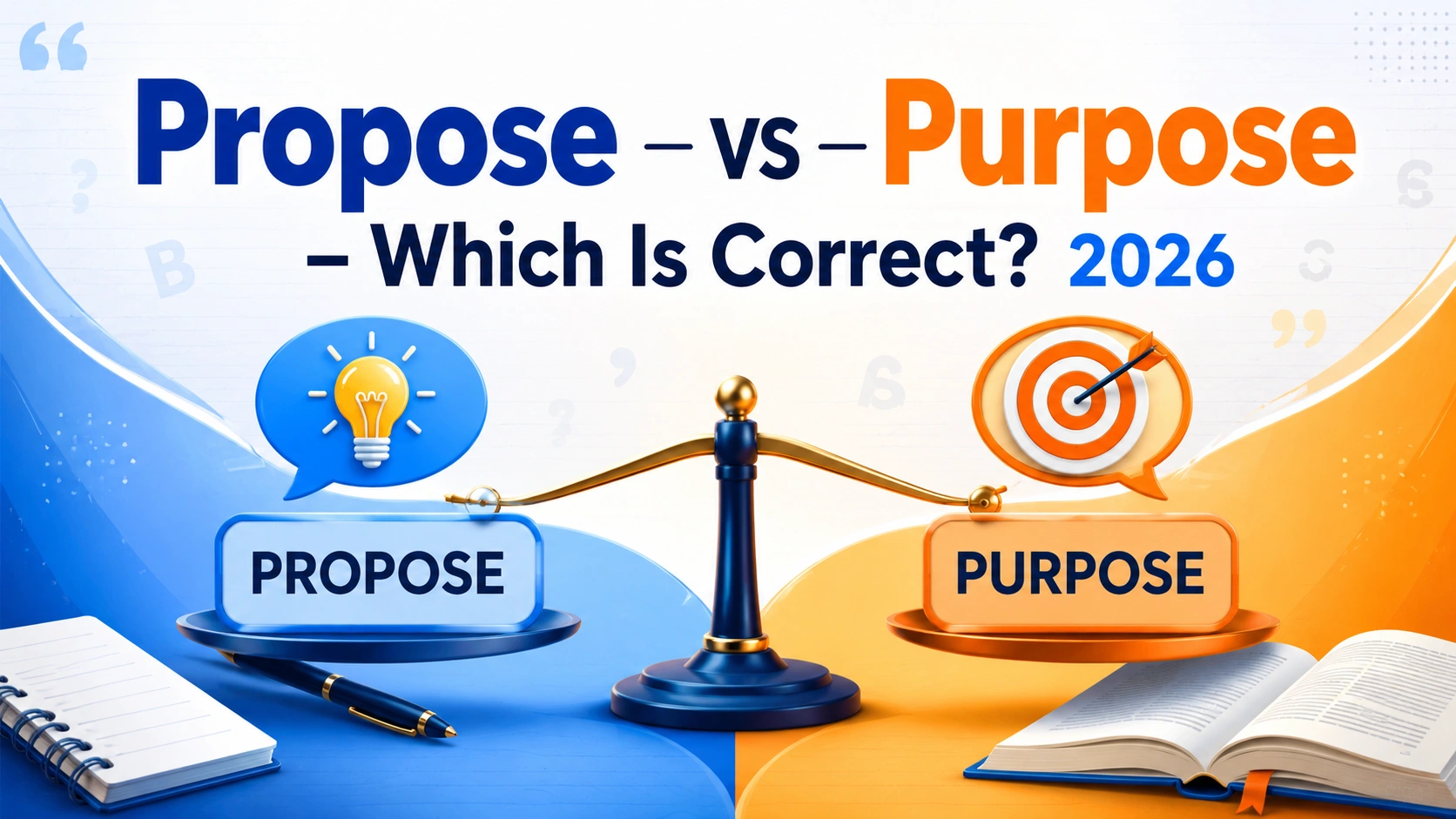
Propose and purpose are both correct English words, but they do very different jobs in a sentence. Their similar spelling can make them look interchangeable, yet propose is primarily a verb for suggesting, putting forward, or intending something, while purpose is usually a noun for the reason, aim, or intended use of something. The distinction becomes especially important in writing because replacing one with the other can change both the grammar and the meaning. Once you understand the basic action-versus-reason distinction, the confusion becomes much easier to avoid.
There is another reason this pair deserves a closer look: propose has several common meanings, and not all of them involve marriage. You can propose a solution, propose a change, propose a theory, propose a toast, or propose to someone. Purpose, meanwhile, can describe why something exists, what it is intended to accomplish, or the goal behind an action. It also appears in familiar expressions such as “on purpose,” “for this purpose,” and “sense of purpose.” Understanding these patterns is more useful than memorizing a single spelling trick.
This guide explains propose vs purpose from the ground up, including definitions, grammatical roles, pronunciation, word forms, real-world examples, common errors, related words such as proposal, and the less common verb use of purpose. You will also see how the words behave in professional, academic, everyday, and personal contexts. The goal is not merely to tell you which word is correct, but to show you why it is correct, when an alternative might be better, and how to choose confidently when writing your own sentences.
Quick Answer: Propose vs Purpose
The short answer is simple:
- Propose = to suggest, put forward, recommend, or intend something; it can also mean to ask someone to marry you.
- Purpose = the reason, aim, goal, or intended use of something.
- Proposal = a noun referring to a plan, suggestion, or formal offer that has been put forward.
The easiest practical test is:
If you mean “suggest,” use propose. If you mean “reason” or “aim,” use purpose.
For example:
- The manager proposed a new schedule.
- The purpose of the new schedule is to reduce delays.
- The manager submitted a proposal for changing the schedule.
Both propose and purpose are standard English words. Neither is a misspelling of the other. The issue is meaning and grammatical function, not choosing one universally “correct” spelling. Merriam-Webster defines propose as a verb involving putting forward a plan or intention and also records its marriage and toast-related meanings. Cambridge likewise identifies propose as a verb meaning to suggest a plan or action and, in formal usage, to intend to do something.
Propose vs Purpose at a Glance
| Feature | Propose | Purpose |
| Usual part of speech | Verb | Noun |
| Basic idea | Suggest or put forward | Reason, aim, or intended use |
| Common question | What does someone suggest? | Why is something done? |
| Example | They proposed a solution. | The purpose is to solve the problem. |
| Marriage meaning | Yes | No |
| Can you describe an intention? | Yes, especially formally | Yes, as a noun |
| Related word | Proposal | Purposeful, purposefully |
What Does “Propose” Mean?
Propose is primarily a verb. Its central idea is that someone puts something forward for consideration, acceptance, discussion, or action.
Merriam-Webster includes meanings such as forming or putting forward a plan or intention, setting something before the mind for consideration, recommending someone for a position, and offering a toast.
Propose Means “Suggest” or “Put Forward”
This is the most useful meaning for ordinary writing.
When you propose an idea, you are presenting it as something other people should consider.
Examples:
- The committee proposed a new environmental policy.
- Maya proposed a different solution to the problem.
- The researchers proposed a new explanation for the results.
- I would like to propose a change to the schedule.
Notice the grammatical pattern:
propose + noun
propose an idea
propose a plan
propose a solution
propose a change
propose a theory
propose a policy
The person does the proposing; the thing being presented is the object.
Propose Can Mean “Recommend”
In formal settings, propose can carry the sense of recommending something for consideration.
For example:
The board proposed three candidates for membership.
This is slightly more formal than simply saying:
The board suggested three candidates.
The two verbs overlap, but propose often sounds more deliberate or formal when an idea, plan, policy, or candidate is formally put forward.
Propose Can Refer to Marriage
One of the most familiar meanings of propose is to ask someone to marry you.
Examples:
- He proposed to her during their vacation.
- She said yes when he proposed.
- He decided to propose marriage.
This meaning is grammatically different from proposing a plan. In:
The team proposed a new plan.
proposed means suggested.
In:
He proposed to his partner.
proposed means asked for marriage.
Cambridge specifically distinguishes the marriage construction proposed to someone from the suggestion meaning.
Propose Can Mean “Intend” in Formal English
There is a less obvious use that sometimes causes confusion.
In formal English, propose to do something can mean intend to do something.
For example:
I do not propose to discuss the issue further.
This means:
I do not intend to discuss the issue further.
Cambridge labels this use as formal and gives examples involving how someone proposes to complete or tackle something.
This does not mean that propose and purpose become interchangeable. The grammatical structure and context tell you which word is appropriate.
What Does “Purpose” Mean?
Purpose is most commonly a noun. It refers to the reason something is done, the aim behind an action, or the intended use of something.
Cambridge defines purpose around why someone does something or why something exists, while Merriam-Webster includes meanings involving reason, intention, aim, determination, and goal.
Purpose Means “Reason”
When someone asks:
What is the purpose of this meeting?
They are asking:
Why is this meeting being held?
Examples:
- The purpose of the meeting is to review the budget.
- The purpose of this tool is to simplify data entry.
- What is the purpose of this rule?
- The primary purpose of the experiment is to test the hypothesis.
This is the most important distinction to remember:
Purpose answers “why?”
✅Purpose Can Mean “Aim” or “Goal”
Purpose can also refer to something a person intends to achieve.
For example:
Her purpose was to improve access to education.
Here, purpose means something close to aim or intention.
It can also describe a broader personal or organizational goal:
- a shared purpose
- a sense of purpose
- a common purpose
- a higher purpose
- a clear purpose
Merriam-Webster also recognizes purpose in the sense of determination or resolve, as in acting or writing with purpose.
Purpose Can Describe Intended Use
A thing can have a purpose even when nobody is actively suggesting anything.
For example:
The purpose of a key is to open or lock something.
The purpose of the training session is to teach employees how to use the software.
This is why purpose frequently appears with words such as function, use, aim, reason, and objective.
Purpose in “On Purpose”
The expression on purpose means intentionally.
For example:
I didn’t break it on purpose.
Here, purpose is part of a fixed expression meaning that the action was deliberate.
It is not related to the verb propose.
Propose vs Purpose: The Core Difference
The most reliable distinction is:
Propose is something you do. Purpose is something something has.
Compare:
The scientist proposed a new theory.
The scientist performed an action: putting forward a theory.
Now compare:
The purpose of the theory is to explain the observed behavior.
The sentence identifies the theory’s reason or intended function.
Action vs Reason
| If you are talking about… | Use | Example |
| Suggesting an idea | propose | She proposed an alternative. |
| Putting forward a plan | propose | They proposed a new strategy. |
| Asking someone to marry you | propose | He proposed to her. |
| Intending to do something formally | propose | We propose to begin tomorrow. |
| The reason something exists | purpose | What is the purpose of the device? |
| An intended goal | purpose | The purpose is to improve access. |
| Intended use | purpose | The tool has several purposes. |
| Intentional action | on purpose | He did it on purpose. |
A useful mental shortcut is:
Propose = put forward.
Purpose = why.
That distinction handles the overwhelming majority of everyday cases.
Propose vs Purpose: Grammar and Word Forms
Understanding the word families makes the difference even clearer.
Forms of “Propose”
| Form | Word | Example |
| Base verb | propose | They propose a new plan. |
| Third-person singular | proposes | She proposes several changes. |
| Past tense | proposed | The committee proposed a solution. |
| Present participle | proposing | They are proposing reforms. |
| Noun | proposal | We received a proposal. |
| Adjective | proposed | The proposed changes were discussed. |
The noun proposal is especially important because writers sometimes try to use purpose where proposal is actually intended.
Compare:
The company submitted a proposal for the new project.
versus:
The purpose of the project is to reduce costs.
A proposal is the plan or suggestion put forward. A purpose is the reason or aim behind it.
Forms of “Purpose”
| Form | Word | Example |
| Noun | purpose | What is its purpose? |
| Plural noun | purposes | The tool serves several purposes. |
| Verb | purpose | The structure was purposed for a specific use. |
| Adjective | purposeful | She took a purposeful approach. |
| Adverb | purposefully | He acted purposefully. |
The noun is overwhelmingly the form most learners encounter.
The verb purpose exists, but it is relatively uncommon. Merriam-Webster defines it as “to propose as an aim to oneself” and records the verb as established English usage.
How to Use “Propose” Correctly
The grammar surrounding the proposal depends on what you mean.
Propose + Noun
This is one of the most common structures.
The engineers proposed a solution.
She proposed a new schedule.
The researchers proposed a hypothesis.
The noun identifies what is being put forward.
Propose + -ing
English can also use the propose + gerund/-ing form.
They proposed building a new facility.
She proposed changing the meeting time.
This construction is particularly natural when the proposed action itself is the focus.
Propose + That-Clause
Another common formal structure is:
They proposed that the meeting be postponed.
or:
She proposed that we wait until Friday.
This pattern is useful in professional, academic, and formal writing.
Propose to + Verb
When propose means intend, it can be followed by a to-infinitive:
We propose to begin the project next month.
How do you propose to solve the problem?
The second example can also carry the sense of asking what method someone intends to use.
Propose to + Person
When discussing marriage:
He proposed to her.
Do not confuse this with:
He proposed a new plan.
The first refers to marriage; the second refers to suggesting an idea.
How to Use “Purpose” Correctly
The Purpose of + Noun
This is probably the most useful pattern for learners.
- The purpose of the meeting is to discuss the budget.
- The purpose of the machine is to remove excess moisture.
- The purpose of the law is to protect consumers.
The structure is:
the purpose of + noun
Purpose + of + Activity
You can also describe the reason behind an activity:
The purpose of the exercise is to develop critical-thinking skills.
The purpose of the discussion is to identify possible solutions.
This construction is common in educational and professional writing because it states an objective clearly.
✅For the Purpose of
For the purpose of means for a particular reason or intended use.
For example:
The information was collected for the purpose of evaluating the program.
This phrase is grammatical but relatively formal. In ordinary writing, a simpler construction may often be clearer:
The information was collected to evaluate the program.
Expert tip: Do not automatically make your writing more formal by replacing every to + verb construction with for the purpose of + -ing. Clarity usually matters more than unnecessary formality.
Serve a Purpose
Another common expression is:
The old system still serves a useful purpose.
Here, purpose refers to a useful function or role.
Cambridge specifically serves a purpose among its usage examples.
Real-Life Examples of Propose vs Purpose
Everyday Conversation
Propose:
I propose that we order dinner now.
Purpose:
What’s the purpose of this button?
The first person is making a suggestion. The second person is asking about function.
Workplace Example
Imagine a team discussing a new project.
The project manager proposed a revised timeline.
Then someone asks:
What is the purpose of the revised timeline?
These sentences work together naturally because the words describe two different parts of the same situation.
Propose describes the action of putting the timeline forward.
Purpose describes why the timeline exists.
Academic Example
The researchers proposed a new explanation for the results.
The purpose of the study was to examine how the variables interact.
Academic writing uses both words frequently, but for different reasons. Propose introduces a theory, explanation, method, or hypothesis; purpose identifies the objective of a study or investigation.
Personal Example
She proposed a plan for the trip.
The purpose of the trip was to visit her relatives.
Again, one word describes what was suggested, while the other explains why something was done.
Common Mistakes With Propose and Purpose
Mistake 1: “I Purpose a New Idea”
❌ I purpose a new idea.
If you mean suggest, the correct sentence is:
✅ I propose a new idea.
The mistake happens because purpose sounds similar to propose, but it does not normally mean “suggest” in modern everyday English.
Mistake 2: “The Propose of the Meeting”
❌ The propose of the meeting is to discuss the budget.
✅ The purpose of the meeting is to discuss the budget.
Here, the sentence asks for the reason or objective, so purpose is the correct noun.
Mistake 3: Confusing “Proposal” With “Purpose”
Consider:
❌ The committee submitted a purpose for the new policy.
If the committee submitted a formal plan, the appropriate word is:
✅ The committee submitted a proposal for the new policy.
But if you are explaining why the policy exists:
✅ The purpose of the new policy is to improve safety.
Mistake 4: Thinking “Propose” Only Means Marriage
This is one of the most common misunderstandings.
The scientists proposed a theory.
The council proposed a new regulation.
She proposed an alternative approach.
None of these has anything to do with marriage. The suggestion/plan meaning is extremely common in formal and everyday English.
Mistake 5: Treating “Purpose” as Only a Goal
Purpose can mean more than an abstract goal.
It can refer to:
- a reason
- an aim
- an intended use
- a function
- determination or resolve
- a person’s broader sense of direction
So:
What is the purpose of this tool?
is about use, while:
She has a strong sense of purpose.
is about meaning, direction, or determination.
Propose vs Purpose vs Proposal
These three words are worth learning together because they frequently appear in the same kinds of sentences.
| Word | Part of Speech | Meaning | Example |
| Propose | Verb | Suggest or put forward | They proposed a new policy. |
| Proposal | Noun | A suggested plan or formal offer | Their proposal was accepted. |
| Purpose | Noun | Reason, aim, or intended use | The purpose is to improve safety. |
Consider this complete example:
The committee proposed a new recycling program. Its proposal explains how the program would operate. The purpose of the program is to reduce waste.
This is the distinction in action:
propose → proposal → purpose
The committee proposes something.
The suggested plan is a proposal.
The reason for the plan is its purpose.
Propose vs Purpose in Professional and Academic Writing
These words are especially important in formal writing because precision matters.
When Professionals Use “Propose”
Use propose when presenting something for consideration:
- a policy
- a strategy
- a solution
- a recommendation
- a change
- a theory
- a research explanation
- a candidate
- a course of action
For example:
We propose three changes to the current procedure.
This signals that the writer is putting forward an option, not necessarily saying that it has already been approved.
When Professionals Use “Purpose”
Use purpose when explaining why something exists or is being done:
The purpose of this procedure is to ensure consistent results.
This wording is useful because it separates objective from method.
A procedure tells readers what to do.
Its purpose tells them why they are doing it.
That distinction can make technical and workplace documentation considerably easier to understand.
A Useful Professional Writing Pattern
A particularly clear structure is:
We propose X because the purpose is Y.
For example:
We propose a revised training schedule because the purpose of the change is to give new employees more time for practical instruction.
This sentence makes the relationship between proposal and purpose explicit.
Propose and Purpose: British vs American English
There is no British-versus-American spelling rule that makes one of these words correct and the other incorrect.
Propose is standard in both British and American English.
Purpose is also standard in both varieties.
The main difference learners may notice is pronunciation, particularly because vowel sounds can vary between accents. Cambridge gives British and American pronunciations for purpose and similarly records pronunciation information for propose.
So if you are writing for a British audience, you do not switch propose to purpose, or vice versa. The correct choice still depends on meaning and grammar.
Where Did Propose and Purpose Come From?
Their similar appearance is not completely accidental. Both words have historical connections involving French and Latin forms, although their modern meanings and grammatical roles have developed in different directions.
Propose entered English through Middle English from Anglo-French forms connected with Latin proponere, broadly associated with putting something forward. Merriam-Webster records its first known English use in the 14th century.
Purpose also has a Middle English history, developing through Anglo-French purpose. Merriam-Webster records the noun and verb as dating to the 14th century.
The historical relationship helps explain why the words can look related, but etymology should not be used as a shortcut for modern grammar. Today’s writer should choose based on current meaning, syntax, and context.
How to Remember the Difference
Remember: Propose = Put Forward
Imagine someone placing an idea on the table for everyone to consider.
- propose a plan
- propose a solution
- propose a change
If the sentence could be used to suggest, propose is often the right choice.
Remember: Purpose = Why?
Ask yourself:
Why is this being done?
The answer is the purpose.
The purpose of the meeting is to make a decision.
The purpose of the device is to measure temperature.
The Three-Word Memory Trick
Keep these together:
Propose = suggest
Proposal = suggested plan
Purpose = reason or aim
This is more reliable than trying to remember the spelling letter by letter.
When Another Word May Be Better
Knowing the difference between propose and purpose is useful, but good writing also means choosing the most precise word.
Propose vs Suggest
Suggest is often more natural in casual conversation:
I suggest taking the earlier train.
Propose can sound more formal or deliberate:
I propose that we adopt the revised schedule.
Neither is universally better. The context determines the best choice.
Purpose vs Reason
These words overlap, but reason can be broader.
The reason I left early was the traffic.
The purpose of the meeting was to discuss the project.
Reason commonly explains why something happened. Purpose often focuses on an intended aim or function.
Purpose vs Goal
A goal is usually something you are trying to achieve.
A purpose can be the broader reason behind an action, system, activity, or organization.
For example:
Our goal is to finish the project by June.
The purpose of the project is to improve customer access.
The two ideas can overlap, but they are not identical.
Propose vs Recommend
Recommend often suggests that the speaker believes an option is particularly suitable.
I recommend the second option.
Propose emphasizes putting an option forward for consideration.
I propose the second option.
The distinction is subtle, so context and tone matter.
A Practical Decision Guide
When you are unsure which word belongs in your sentence, use this sequence:
- Am I suggesting or putting something forward?
→ Use propose. - Am I asking why something exists or is being done?
→ Use purpose. - Am I talking about the plan that was suggested?
→ Use a proposal. - Am I talking about someone’s marriage offer?
→ Use propose. - Am I describing something done intentionally?
→ Consider on purpose. - Am I using “propose to + verb” in a formal context to mean intend?
→ Propose can be correct.
Quick Decision Table
| What you mean | Best choice | Example |
| Suggest an idea | propose | She proposed an idea. |
| Suggest a solution | propose | They proposed a solution. |
| Ask someone to marry you | propose | He proposed to her. |
| Intend to do something formally | propose | They propose to continue. |
| Explain why something exists | purpose | What is the purpose? |
| Explain intended use | purpose | The tool has a practical purpose. |
| Describe the suggested plan | proposal | The proposal was approved. |
| Say something was intentional | on purpose | She did it on purpose. |
Practice: Propose or Purpose?
Choose the word that best completes each sentence.
- The committee ______ a new approach to the problem.
- What is the ______ of this device?
- The researchers ______ a different explanation.
- The main ______ of the meeting is to review the results.
- He decided to ______ to his partner.
- The company submitted a detailed ______.
- The training program has a very specific ______.
- They ______ to introduce the changes next year.
Answers
- proposed — the committee suggested an approach.
- purpose — the sentence asks about the device’s intended function.
- proposed — the researchers put an explanation forward.
- purpose — this refers to the meeting’s aim.
- propose — this is the marriage meaning.
- proposal — this is the noun for a suggested plan.
- purpose — the sentence describes intended function.
- propose — in this formal construction, it means intend.
The important lesson is not simply memorizing these answers. Look at the role the word plays in the sentence. That approach continues to work even when you encounter a sentence you have never seen before.
Common Misconceptions About Propose and Purpose
“Propose Is Only a Marriage Word”
False. Marriage has only one meaning. In professional, academic, governmental, and everyday contexts, common means suggest or put forward.
“Purpose Is Always About a Person’s Life Goal”
False. Purpose can refer to the function of an object, reason for an activity, aim of a project, intended use, or broader personal direction.
“Purpose and Propose Are Just Different Spellings”
False. They are separate words with different grammatical functions and meanings.
“Purpose Cannot Be a Verb”
Not quite. Purpose does have a verb form, although it is uncommon compared with the noun. Merriam-Webster records the verb meaning of proposing an aim to oneself.
“Propose and Purpose Are Never Related in Meaning”
That is too absolute. Both can occur around concepts such as intention, aims, and plans, and their historical development has connections. But their modern grammatical behavior is distinct, so they should not normally be substituted for each other.
Conclusion:
The difference between propose and purpose becomes much clearer when you stop treating them as spelling alternatives and look at what the sentence is actually doing. Propose normally describes an action: someone suggests, recommends, puts forward, or formally intends something. Purpose normally names the reason, aim, or intended use behind something. The proposal completes the picture by naming the plan or suggestion that has been put forward.One final actionable tip: whenever you hesitate, replace the word mentally with “suggest” or “why.” If “suggest” fits, you probably need to propose; if “why” or “aim” fits, the purpose is likely right. A common mistake to avoid is assuming that the proposal only relates to marriage. In professional and academic writing, its “put forward” meaning is extremely useful. Master that distinction, and this confusing pair becomes surprisingly easy to handle.
FAQs
Q1. Is “propose” or “purpose” correct?
Both are correct words, but they are used differently. Propose is primarily a verb meaning to suggest, put forward, or intend something, while purpose is usually a noun meaning a reason, aim, or intended use. The correct choice depends on what your sentence means.
Q2. Can “purpose” mean “propose”?
Not in ordinary modern usage. Purpose has a rare verb use, but it does not normally mean “suggest” in everyday writing. If you want to say that someone suggested an idea or plan, propose is the appropriate verb. Merriam-Webster records purpose as a verb with a specialized meaning related to setting an aim.
Q3. What is the difference between “propose” and “proposal”?
Propose is a verb, while proposal is a noun. You can propose a plan, and the plan itself can be called a proposal. For example, “They proposed a new policy” describes the action, while “Their proposal was approved” describes the plan that was put forward.
Q4. Is “propose to” grammatically correct?
Yes, but its meaning depends on what follows. Proposing to someone commonly refers to asking that person to marry you. Propose to do something can mean intending to do it, particularly in formal English. Cambridge documents both constructions.
Q5. How can I remember propose vs purpose easily?
Use the “suggest versus why” test. If you mean suggest or put forward, choose propose. ✅If you mean reason, aim, or intended use, choose purpose. If you mean the suggested plan itself, use proposal. This three-way distinction handles most confusing cases.