

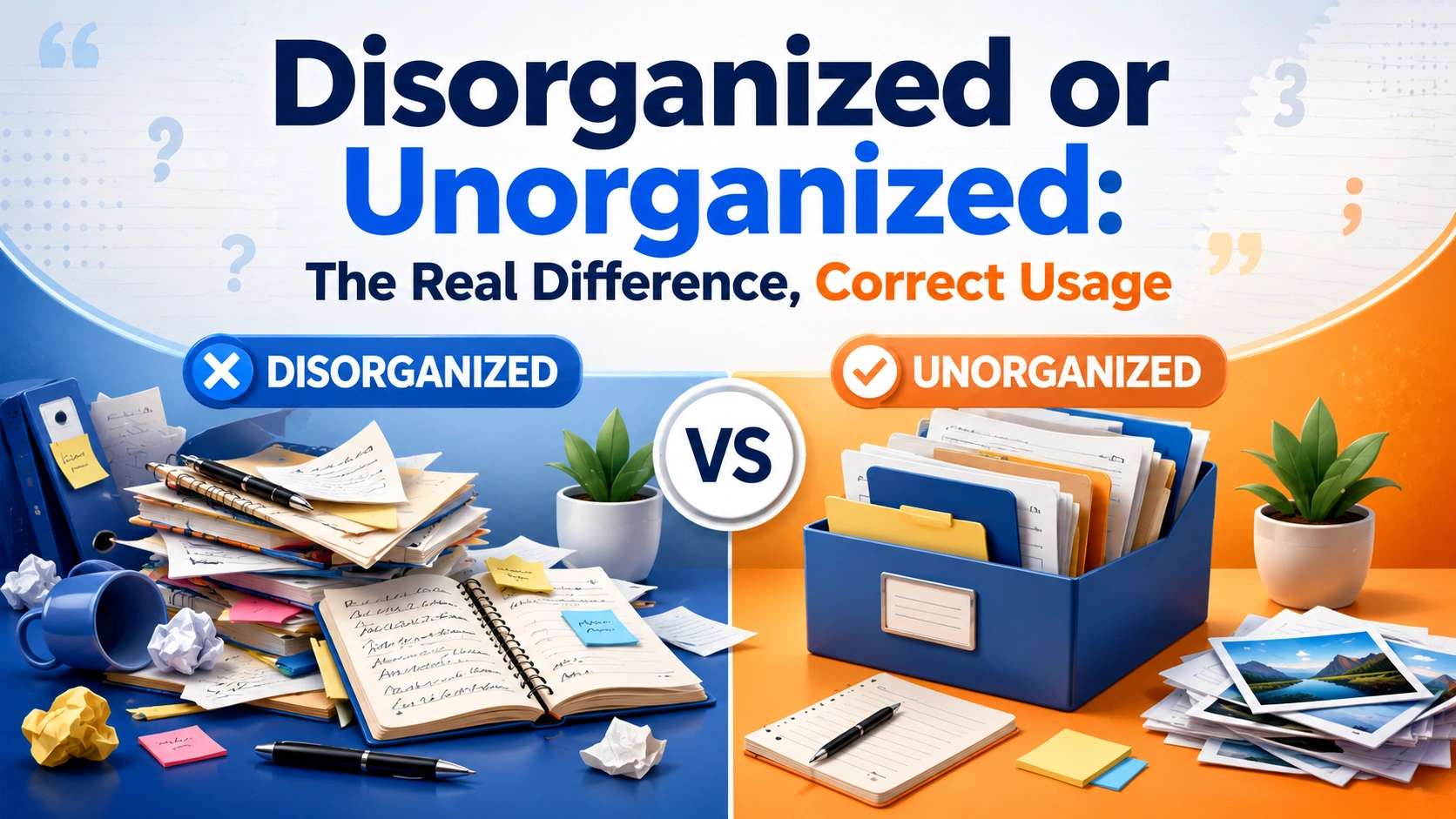
Disorganized or unorganized can both describe something that lacks order, which is why choosing between them is not always straightforward. In everyday English, the two adjectives sometimes overlap, but they do not always create exactly the same impression. Disorganized commonly suggests that something is poorly arranged, badly planned, or lacking an effective system, while unorganized can more literally mean that something has not been organized. The distinction becomes especially useful when you are describing people, files, schedules, events, data, or work processes, because the word you choose can affect both precision and tone.
The important point is that there is no reliable rule saying that “disorganized” always means chaotic and “unorganized” always means temporarily unfinished. Real English is more flexible. Major dictionaries recognize overlap between the two, while also giving unorganized meanings that disorganized does not necessarily have. Oxford, for example, lists unorganized as meaning “not having been organized” and also notes that disorganized is more frequent for the meaning “badly planned” or “not able to plan or organize well.”
This guide explains what each word means, where the meanings overlap, how their tone differs, and which one sounds most natural in different situations. You will also see examples involving workplaces, schools, homes, digital files, data, and people, plus the British spelling disorganised/unorganised, common mistakes, useful alternatives, and a practical decision test. By the end, you should be able to choose the more precise word without relying on an oversimplified memory trick.
Quick Answer: Disorganized vs Unorganized
Both disorganized and unorganized are legitimate English words. The difference is usually one of meaning, emphasis, and context, rather than simple correctness.
Disorganized generally describes something that lacks order, coherence, or effective planning. It can describe a person who has difficulty planning, a meeting that is badly managed, a room in disorder, or a system that does not function in an orderly way. Merriam-Webster defines it as lacking coherence, system, or a central guiding organization.
Unorganized can also describe a lack of organization, but it has an especially useful literal sense: not organized or not brought into an ordered whole. It can therefore be appropriate for things that simply have not been arranged or classified. Merriam-Webster gives examples such as unorganized photos and also records a separate meaning for workers who are not represented by a labor union.
Is “disorganized” or “unorganized” correct?
Both are correct. However, disorganized is generally the more frequent choice when you mean badly planned, poorly arranged, or not good at organizing. Oxford explicitly identifies unorganized as less frequent for this overlapping sense.
The simplest difference
A useful starting point is:
- Disorganized → lacking effective order or planning.
- Unorganized → not organized or not yet arranged into an organized whole.
That is a useful distinction, but it is not absolute. In many ordinary sentences, either adjective may work.
Quick examples
- The meeting was disorganized. → The planning or management was poor.
- The files are disorganized. → The files are difficult to navigate or poorly arranged.
- The photos are unorganized. → The photos have not been arranged into an organized collection.
- She is disorganized. → She has difficulty planning or organizing things.
- The data is unorganized. → The data has not been organized into a useful structure.
Key takeaway: Choose disorganized when the problem is poor order, planning, or organization; choose unorganized when you specifically mean that something lacks organization or has not been organized.
Disorganized vs Unorganized: What Is the Actual Difference?
The safest way to understand the difference is to avoid treating the prefixes as if they create perfectly opposite meanings.
Disorganized usually emphasizes disorder or poor arrangement
Disorganized often focuses on the condition or performance of an existing system. Something may have a structure, plan, or intended arrangement, but that structure is ineffective, confused, or poorly maintained.
For example:
The department became disorganized after several employees left.
The sentence suggests more than simply “not organized.” It implies that the department’s normal organization has become ineffective.
The same idea works with behavior:
Marcus is disorganized and often forgets where he put important documents.
Here, the adjective describes a person’s habit of managing things, not merely the physical condition of a desk.
Unorganized usually emphasizes a lack of organization
Unorganized can carry a more literal “not organized” meaning. This makes it particularly natural when something has not been sorted, classified, grouped, or arranged.
For example:
The photographs were still unorganized after the trip.
The focus is on the state of the photographs: they have not been put into an organized system.
Oxford specifically distinguishes this sense with examples such as unorganized data.
Why the distinction is about emphasis, not two completely separate meanings
The overlap is important. Merriam-Webster’s thesaurus actually lists unorganized among the synonyms of disorganized, while its entry for unorganized includes “not organized” and related senses.
So, avoid writing a rule such as:
“Disorganized means chaotic, while unorganized only means not starting.”
That is too rigid for real English.
Instead, think in terms of what the speaker wants to emphasize.
When context makes either word possible
Consider:
The files are disorganized.
This could mean the files are poorly arranged, difficult to navigate, or mixed up.
Now compare:
The files are unorganized.
This can simply mean they have not been organized.
Both can be understandable. The first often gives a stronger impression of poor organization, while the second can sound more descriptive and literal.
What Does “Disorganized” Mean?
Disorganized is an adjective used for people, objects, activities, systems, and situations that lack effective order or planning.
Cambridge gives two particularly useful senses: something can be badly planned and without order, or a person can be not good at planning or organizing things.
Definition and core meaning
The central idea is poor organization.
Examples:
- The project became disorganized.
- His notes are disorganized.
- The office looks disorganized.
- The conference was disorganized.
- She is extremely disorganized.
Notice how naturally the word works with both things and people.
Disorganized for things, systems, and information
You can describe a physical or abstract system as disorganized when its components are difficult to understand, locate, or manage.
The filing system is disorganized.
The report contains several disorganized sections.
Their digital folders are completely disorganized.
The word can therefore refer to more than visible mess. A room can look tidy yet still have a disorganized storage system if items are difficult to locate.
Disorganized for people and behavior
This is one area where disorganized is especially common.
She is very disorganized at work.
This can imply problems with planning, deadlines, priorities, or keeping track of information.
It is worth remembering that calling someone disorganized can sound like a judgment about their habits or abilities. In professional or educational settings, describing the specific behavior is often more constructive.
Instead of:
You are disorganized.
consider:
The project files need a clearer structure.
The second sentence identifies the problem without turning it into a personal label.
Disorganized for events, plans, and processes
This is another strong use.
The conference was disorganized because the schedule kept changing.
The event became disorganized when several volunteers arrived late.
Here, disorganized naturally communicates poor coordination and planning. Cambridge uses a conference example to illustrate this sense.
What Does “Unorganized” Mean?
Unorganized is also an adjective, but its meaning deserves special attention because it has more than one dictionary sense.
Definition and core meaning
At its broadest, unorganized means not organized or not brought into an ordered whole. Merriam-Webster gives “not organized” as its primary sense and includes examples involving unorganized photographs.
Unorganized as “not organized”
This literal interpretation makes unorganized useful for materials that have not been sorted or structured.
The survey responses are still unorganized.
I have a folder full of unorganized photographs.
The research notes remain unorganized.
In these cases, the speaker may simply be describing the current state of the material.
Unorganized groups, activities, and arrangements
The word can also describe groups or activities without formal organization.
For example:
The children formed an unorganized group and started playing.
Depending on context, this can suggest a group without a formal structure rather than a group that was previously well organized and has fallen into disorder.
An important additional meaning: workers without a union
There is a specialized meaning that is easy to miss in basic explanations of this word.
Unorganized workers can mean workers who are not represented by a labor union or another organization. Oxford and Merriam-Webster both record this sense.
This meaning has nothing to do with a messy desk or poor planning.
That is an excellent example of why you should not assume that the prefix un- tells you everything about a word’s modern meaning.
Disorganized vs Unorganized: Side-by-Side Comparison
| Feature | Disorganized | Unorganized |
| Basic meaning | Lacking order, coherence, or effective organization | Not organized or not brought into an organized whole |
| Common use with people | Very common | Possible, but generally less frequent for this sense |
| Common use with things | Very common | Very common when emphasizing lack of organization |
| Planning | Strongly associated with poor planning | Possible, but less strongly associated |
| Tone | Can sound more critical | Can sound more neutral in some contexts |
| Data/files | Natural | Natural, especially when simply not organized |
| Events/processes | Very natural | Possible, depending on meaning |
| Labor terminology | Not the relevant term | “Unorganized workers” has a specialized union-related meaning |
| Always interchangeable? | No | No |
Where the meanings overlap
There are plenty of sentences where changing one word does not radically change the meaning:
The documents are disorganized.
The documents are unorganized.
Both can tell the reader that the documents lack useful organization.
The first may suggest poor arrangement or disorder, while the second may emphasize that the documents have not been organized.
Where substituting one for the other changes the tone
Compare:
The manager is disorganized.
with:
The manager is unorganized.
The first is considerably more established and natural when describing a person’s planning habits. Oxford specifically notes unorganized as less frequent for the “badly planned/not able to organize well” sense.
Is “Disorganized” Stronger Than “Unorganized”?
Often, yes in practical effect, but not as a strict dictionary rule.
Why speakers may perceive a difference in tone
When you call something disorganized, readers may imagine an organization that is not functioning properly.
When you call something unorganized, readers may instead imagine something that simply lacks an organized structure.
That difference can make unorganized sound softer in some contexts.
When “disorganized” suggests an existing system that is poorly managed
The customer records are disorganized.
This sounds as though the records exist within a system, but the system is not working well.
When “unorganized” simply describes a lack of organization
The customer records are unorganized.
This can focus more neutrally on the fact that the records have not been arranged.
Why tone depends on the sentence and context
There is no universal “severity scale.” A sentence such as “an unorganized campaign” can still be quite negative, while “a slightly disorganized desk” may be relatively mild.
The surrounding words matter.
Compare:
- slightly disorganized
- completely disorganized
- still unorganized
- poorly organized
- somewhat unorganized
The modifiers can change the impression substantially.
How to Use “Disorganized” Correctly
Common sentence patterns
Disorganized + noun
She submitted a disorganized report.
Be + disorganized
The office is disorganized.
Seem + disorganized
The process seems disorganized.
Become + disorganized
The team became disorganized after the schedule changed.
“Disorganized” before a noun
Use it directly before the noun it describes:
- disorganized notes
- disorganized files
- disorganized thinking
- disorganized office
- disorganized schedule
- disorganized team
Examples from everyday and professional English
My desk gets disorganized during busy weeks.
The meeting felt disorganized from the beginning.
The company needs to fix its disorganized filing process.
His presentation was informative but somewhat disorganized.
The adjective works naturally for physical disorder, planning problems, and structural problems.
How to Use “Unorganized” Correctly
Common sentence patterns
Unorganized + noun
We found several unorganized folders.
Remain unorganized
The records remained unorganized for months.
Leave something unorganized
Don’t leave the files unorganized.
Examples from everyday and professional English
The photographs are still unorganized.
We inherited a large collection of unorganized documents.
The data was unorganized and difficult to analyze.
Several workers remained unorganized rather than belonging to a union.
That last example demonstrates the specialized labor sense recorded by major dictionaries.
Can You Say “An Unorganized Person”?
Yes, “an unorganized person” is grammatically possible.
The more important question is whether it sounds natural for your intended meaning.
If you mean that someone is poor at planning or managing tasks, a disorganized person is generally the more established choice.
She is a disorganized person.
sounds more idiomatic than:
She is an unorganized person.
However, unorganized can make sense if you are emphasizing that the person’s activities or resources simply have not been organized.
More tactful alternatives
In workplace or school feedback, consider describing the observable behavior:
- needs a clearer system
- needs better time management
- has difficulty prioritizing tasks
- would benefit from a more structured approach
- should organize the materials more clearly
This is often more useful than attaching a broad label to a person.
Disorganized vs Unorganized in Different Contexts
At work
Disorganized is especially natural for people, meetings, workflows, and management:
The project became disorganized after the deadline changed.
Unorganized works well when emphasizing materials that have not been arranged:
The archived documents are still unorganized.
More professional alternatives
Instead of calling an employee “disorganized,” specify the issue:
The project files need a consistent naming system.
That gives the person something concrete to improve.
In school and education
The student’s notes are disorganized.
This suggests poor arrangement or structure.
The student’s research materials are unorganized.
This can simply mean they have not yet been sorted.
A useful distinction
When giving feedback, describe the work rather than defining the student.
“Your sources need to be grouped by topic.”
is more actionable than:
“You are disorganized.”
At home
Both words can describe household items:
The kitchen drawer is disorganized.
The photographs are unorganized.
The first emphasizes the drawer’s disorder; the second can emphasize that the photographs have not been sorted.
In business and project management
Disorganized is particularly useful for processes:
The onboarding process is disorganized.
Unorganized may be better when referring to material awaiting classification:
The customer survey data is unorganized.
In digital spaces
Digital organization creates many natural examples:
My desktop is disorganized.
The downloads folder is full of unorganized files.
Her inbox has become disorganized.
We have years of unorganized photos stored on the drive.
Here, either word can work, but the intended emphasis should guide the choice.
Disorganized vs Unorganized: Examples That Show the Difference
| Situation | Disorganized | Unorganized | What changes? |
| Files | The files are disorganized. | The files are unorganized. | Poor arrangement vs lack of organization |
| Notes | Her notes are disorganized. | Her notes are unorganized. | Disorder/structure vs not arranged |
| Person | He is disorganized. | He is unorganized. | First is more natural for poor planning |
| Event | The event was disorganized. | The event was unorganized. | Poor coordination vs lack of organization |
| Data | The data is disorganized. | The data is unorganized. | Poor structure vs not organized |
| Photos | The photos are disorganized. | The photos are unorganized. | Both possible; second can stress lack of sorting |
Same situation, different emphasis
Imagine 500 photographs sitting in one folder.
The photographs are unorganized.
The straightforward interpretation is that nobody has sorted them.
Now imagine those photographs have already been placed into several folders, but the folders contain duplicates, inconsistent names, and misplaced files.
The photographs are disorganized.
Now the issue is the quality of the organization itself.
That is the most useful practical distinction to remember.
Common Mistakes With Disorganized and Unorganized
Mistake 1: Assuming only one word is grammatically correct
This is probably the most common error.
Incorrect assumption: “Unorganized is wrong; only disorganized is real English.”
Better understanding: Both words are established adjectives. Dictionaries record both, although disorganized is more frequent for the sense of being badly planned or poor at organizing.
Mistake 2: Treating the words as perfect synonyms
They overlap, but context can favor one.
If you are describing a person’s planning ability, disorganized is usually the natural choice.
If you are describing data that has not yet been arranged, unorganized can be particularly clear.
Mistake 3: Assuming “unorganized” always means temporary
It can suggest something has not yet been organized, but that is not an absolute grammatical rule.
Mistake 4: Assuming “disorganized” always means complete chaos
It does not.
Something can be slightly disorganized, somewhat disorganized, or poorly organized without being chaotic.
Mistake 5: Using “disorganized” when a neutral description is better
Calling a colleague “disorganized” may sound personal.
If the real issue is a folder structure, say:
The folder structure needs improvement.
That is more precise.
Mistake 6: Confusing “unorganized” with “unorganised”
Both spellings are legitimate according to English variety.
- unorganized → American English spelling
- unorganised → common British English spelling
The same pattern applies to disorganized/disorganised.
Mistake 7: Assuming the prefix gives a complete definition
English prefixes are useful clues, but they are not mathematical formulas. Unorganized has specialized meanings that cannot be predicted simply by thinking “un- means not.”
Disorganized, Unorganized, and Unorganised: Spelling Explained
Is “unorganised” correct?
Yes. Unorganised is the British English spelling of unorganized. Oxford explicitly lists “British English also unorganised.”
Is “disorganised” correct?
Yes. Disorganised is the usual British spelling, while disorganized is standard in American English. Cambridge marks disorganized with “UK usually disorganised.”
American English spelling
American English generally uses:
- organized
- disorganized
- unorganized
- organization
- disorganization
British English spelling
British English commonly uses:
- organised
- disorganised
- unorganised
- organisation
- disorganisation
Why the spelling changes from “-ize” to “-ise”
This is primarily a regional spelling convention, not a difference in meaning.
The important point is consistency. If your publication follows British English, use the appropriate -ise forms consistently. If it follows American English, use -ize.
Does the spelling difference change the meaning?
No.
Disorganized and disorganised mean the same thing.
Unorganized and unorganised mean the same thing.
The difference is spelling convention.
American English vs British English
The vocabulary distinction itself is not a simple case of “Americans say one word and Britons say the other.”
Oxford’s American dictionary identifies disorganized as the standard form and notes unorganized as less frequent for the overlapping sense. Its British-oriented entry likewise recognizes both disorganized and unorganized.
Disorganized vs disorganised
| Variety | Common spelling |
| American English | disorganized |
| British English | disorganised |
| Meaning | Essentially the same |
Unorganized vs unorganised
| Variety | Common spelling |
| American English | unorganized |
| British English | unorganised |
| Meaning | Essentially the same |
Does either variety prefer “disorganized” over “unorganized”?
For the overlapping meaning of poor planning or poor organization, disorganized is well established in both varieties and is identified by Oxford as more frequent than unorganized for that sense.
Disorganized vs Unorganized vs Unsystematic vs Disorderly
Sometimes neither word is the most precise choice.
When “disorganized” is the best choice
Use disorganized when the problem involves disorder, poor planning, ineffective arrangement, or difficulty maintaining a system.
The department has become disorganized.
When “unorganized” is the best choice
Use unorganized when you want to emphasize that something has not been organized.
The raw data is unorganized.
When “unsystematic” is more precise
Use unsystematic when there is no consistent method or system.
The researcher used an unsystematic approach.
When “disorderly” is more appropriate
Disorderly emphasizes a lack of order, especially in physical or behavioral contexts.
The documents were left in a disorderly pile.
When “messy,” “chaotic,” or “unstructured” works better
These words carry different shades:
- Messy → untidy or dirty-looking
- Chaotic → extremely confused or uncontrolled
- Unstructured → lacking a clear structure
- Unsystematic → lacking a consistent method
- Disorganized → lacking effective organization
- Unorganized → not organized
Expert tip: Don’t choose between disorganized and unorganized simply because they are the two words in the question. First decide what condition you actually want to describe.
Choosing the Right Word in Professional Writing
Professional writing rewards precision over intensity.
When “disorganized” may sound too personal
Consider:
The employee is disorganized.
This evaluates the person.
A more useful version might be:
The project documentation is difficult to navigate because the files lack a consistent structure.
The second sentence identifies a specific problem that can be fixed.
When “unorganized” may be too vague
The information is unorganized.
This is understandable, but a reader may reasonably ask: What is wrong with the organization?
If you know the problem, be specific:
The information has not been grouped by customer, date, or product category.
Diplomatic alternatives for workplace feedback
| Instead of saying… | Consider saying… |
| You are disorganized. | Your workflow could use a clearer structure. |
| The team is disorganized. | The team’s responsibilities need clearer coordination. |
| These files are disorganized. | These files need a consistent naming and filing system. |
| The report is disorganized. | The report would be clearer if its sections followed a logical sequence. |
This approach is not merely “softer.” It is more actionable.
How to Describe a Person Without Sounding Unnecessarily Critical
“Disorganized employee” vs neutral alternatives
A label can hide the actual problem.
Does the person:
- Miss deadlines?
- lose documents?
- change priorities frequently?
- fail to keep records?
- struggle with scheduling?
- communicate information in an unclear order?
Those are different problems and deserve different descriptions.
Describing behavior rather than labeling the person
Instead of:
Amir is disorganized.
Try:
Amir sometimes has difficulty keeping project deadlines and files in a consistent system.
The second version tells the reader what happened.
Better alternatives
Depending on the situation:
- needs better prioritization
- needs a clearer filing system
- has an inconsistent workflow
- needs stronger time-management habits
- would benefit from a more structured process
This is especially valuable in performance reviews, teacher feedback, recommendation letters, and professional emails.
Word Formation: How “Un-” and “Dis-” Work
What the prefix “un-” generally communicates
In many English words, un- expresses negation or absence:
- unhappy
- unfair
- unfinished
- unprepared
- unorganized
But individual words can develop specialized meanings.
What the prefix “dis-” can communicate
Dis- can express separation, reversal, negation, or lack of a particular condition, depending on the word:
- disagree
- disconnect
- disapprove
- disorganize
Why English prefixes do not always create perfectly predictable meanings
You cannot reliably define every word by splitting it into its prefix and root.
For example, unorganized has a specialized labor-related sense referring to workers without union representation.
Other examples of un- and dis- words
The same lesson applies elsewhere:
- unstructured / disorganized
- unfinished / disrupted
- unclear / disconnected
Prefixes can provide clues, but dictionary meaning and actual usage ultimately matter more.
Grammar and Word Forms You Should Know
| Word | Part of speech | Example |
| organize | verb | We need to organize the files. |
| organized | adjective | The files are organized. |
| disorganize | verb | The interruption could disorganize the schedule. |
| disorganized | adjective | The schedule became disorganized. |
| disorganization | noun | The disorganization caused delays. |
| unorganized | adjective | The data remains unorganized. |
| organization | noun | The organization needs a new system. |
Merriam-Webster defines disorganize as a verb meaning to destroy or interrupt an orderly structure or function, which helps explain why disorganized can imply a breakdown in an existing arrangement.
Disorganized, disorganize, and disorganization
These belong to the same word family:
organize → disorganize → disorganized → disorganization
Unorganized, organize, and organization
The relationship is slightly different:
organize → organized / unorganized → organization
The negative prefix does not turn unorganized into a verb. “Unorganize” is not the normal verb you should use in standard English.
Common adjective patterns
Both disorganized and unorganized can appear after linking verbs:
The files are disorganized.
The records remain unorganized.
They can also appear before nouns:
a disorganized office
an unorganized collection
Pronunciation Guide
How to pronounce “disorganized”
Cambridge gives the pronunciation approximately as:
/dɪˈsɔːr.ɡə.naɪzd/ in US English, with a corresponding British pronunciation.
The main stress falls on the syllable associated with OR:
dis-OR-ga-nized
How to pronounce “unorganized”
Oxford gives pronunciations approximately as:
/ʌnˈɔːɡənaɪzd/ and the corresponding American pronunciation.
The stress likewise falls on the OR portion:
un-OR-ga-nized
Stress and syllable patterns
Both words contain several syllables, so avoid trying to pronounce every syllable with equal force. The central stressed portion makes the words easier to recognize in conversation.
A Practical Decision Guide: Which Word Should You Use?
When you are stuck, do not ask only, “Which word is correct?”
Ask:
What exactly am I trying to say about the organization?
Use “disorganized” when you want to emphasize disorder or poor organization
Examples:
- a disorganized meeting
- a disorganized workflow
- a disorganized person
- a disorganized office
- a disorganized schedule
Use “unorganized” when you simply need to describe something as not organized
Examples:
- unorganized data
- unorganized photographs
- unorganized documents
- unorganized materials
Remember that these are preferences based on meaning and natural usage, not absolute grammatical laws.
Use another adjective when neither word is precise enough
If you mean:
- no clear system → unsystematic
- no clear structure → unstructured
- untidy → messy
- extremely confused → chaotic
- poorly arranged → disorganized
A five-second decision test
Ask yourself:
- Is the issue poor planning or ineffective organization?
→ Disorganized is usually a strong choice. - Has something simply not been organized yet?
→ Unorganized may be clearer. - Am I describing a person?
→ Disorganized is generally more natural. - Am I describing raw material such as photos or data?
→ Either may work; choose based on whether you mean poor organization or simply lack of organization. - Is there a more precise adjective?
→ Use it.
Memory Trick: Disorganized or Unorganized?
A simple memory aid is:
Disorganized = disorder or poor organization.
Unorganized = not organized.
For example:
The manager is disorganized because she repeatedly loses track of deadlines.
The photographs are unorganized because nobody has sorted them yet.
But treat this as a memory aid, not a law. Actual English usage is more flexible than the trick.
Conclusion:
Choosing between disorganized and unorganized is less about memorizing a rigid rule and more about identifying the exact idea you want to communicate. Disorganized is usually the stronger, more natural choice for poor planning, ineffective systems, disorder, or someone who struggles to organize. Unorganized is often useful when something simply has not been organized, particularly materials such as data, photographs, or documents. The two can overlap, so context matters more than an artificial “chaos versus temporary” rule. One final actionable tip: before choosing, replace the adjective mentally with “poorly organized” or “not organized” and see which meaning fits better. A common mistake to avoid is assuming that one word is always correct and the other is always wrong. Good English depends on precision, context, and natural usage.
FAQs
Q1. Is “disorganized” or “unorganized” correct?
Both are correct English adjectives. Disorganized is generally more common when describing poor planning, poor organization, or someone who struggles to organize things. Unorganized is also standard and is especially clear when something simply has not been organized.
Q2. What is the main difference between disorganized and unorganized?
Disorganized often emphasizes poor order, planning, or organization, while unorganized can emphasize the absence of organization itself. However, the meanings overlap considerably. The right choice depends on the specific context and intended emphasis, not an absolute grammatical rule.
Q3. Is “unorganized person” grammatically correct?
Yes, “unorganized person” is grammatically possible, but disorganized person is generally more natural when describing someone who struggles with planning or organization. If you are giving professional feedback, describing the person’s specific behavior is usually clearer and more constructive.
Q4. Is “disorganized” more negative than “unorganized”?
It can sound more critical, especially when describing a person, because disorganized commonly suggests poor planning or ineffective habits. However, neither word has a fixed level of negativity. Modifiers such as “slightly,” “extremely,” or “completely” can change the tone significantly.
Q5. Are disorganized and unorganized interchangeable?
Sometimes, but not always. They overlap when describing a lack of order, but unorganized also has specialized meanings, including workers without union representation. For people who have difficulty planning, disorganized is usually the more idiomatic choice.