

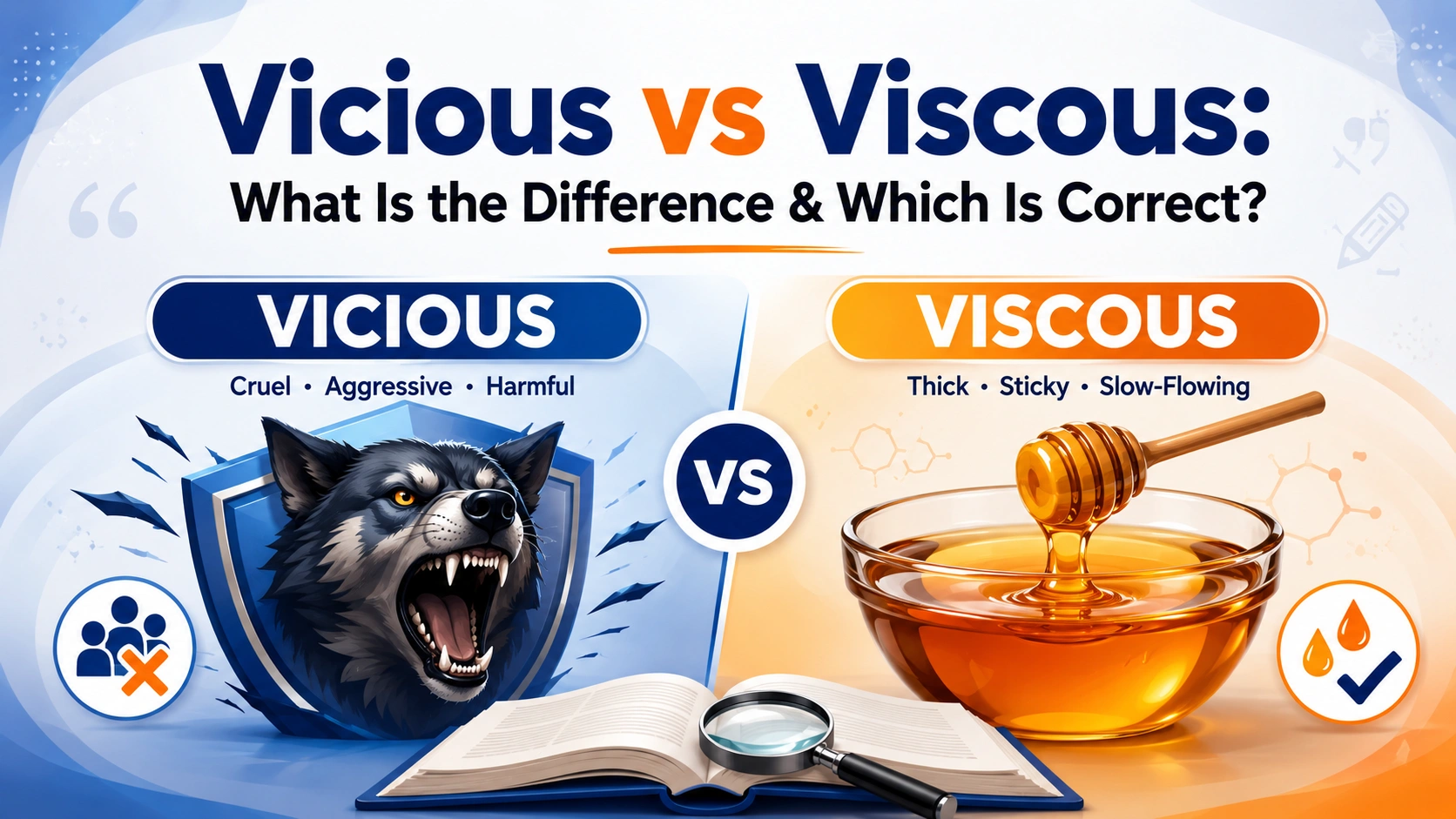
Vicious vs viscous is a classic English word pair that causes confusion because the two adjectives look remarkably similar but describe completely different things. Vicious usually relates to cruelty, aggression, violence, or something harmful, while viscous describes a substance that flows slowly because it has relatively high resistance to flow.
That one-letter difference changes the meaning completely. You might describe a dog as vicious, but a thick stream of honey as viscous. A person can make a vicious remark, whereas a scientist might measure the viscosity of an oil. Understanding this distinction is especially useful because a spelling mistake can turn an otherwise clear sentence into something unintentionally strange.
The good news is that you do not need to memorize complicated rules. Once you connect vicious with harmful or aggressive behavior and viscous with viscosity and slow-flowing liquids, the difference becomes much easier to recognize. This guide explains both words in detail, shows how they work grammatically, explores pronunciation and word origins, and gives you a practical method for choosing the right word every time.
Quick Answer: Vicious vs Viscous
Both vicious and viscous are correctly spelled English words. They are not different spellings of the same word and cannot normally be substituted for one another.
| Word | Meaning | Usually Describes | Example |
| Vicious | Cruel, violent, aggressive, or harmful | People, animals, actions, remarks, situations, cycles | The dog became vicious when threatened. |
| Viscous | Thick and resistant to flowing | Liquids, fluids, and other substances | Honey is more viscous than water. |
The fastest way to remember the difference
Vicious = harmful or aggressive.
Viscous = thick or slow-flowing.
Another useful connection is:
viscous → viscosity → fluid flow
If the sentence is about behavior, cruelty, aggression, or something harmful, choose vicious. If it is about the physical flow of a liquid or substance, choose viscous.
Are “vicious” and “viscous” the same?
No. Their similar spelling is the main source of confusion, but their meanings are unrelated in modern English.
- A vicious attack = a cruel, violent, or aggressive attack.
- A viscous liquid = a thick liquid that flows relatively slowly.
- Vicious criticism = harsh or cruel criticism.
- Viscous oil = oil with relatively high resistance to flow.
So, when someone asks “Which is correct: vicious or viscous?”, the answer is: both are correct, but the correct choice depends entirely on what you mean.
What Does Vicious Mean?
Vicious is an adjective used when something is cruel, violent, aggressive, malicious, or seriously harmful. It can describe a person, animal, action, statement, situation, or process.
The exact shade of meaning depends on context.
For example:
- The attacker made a vicious threat.
- The animal gave a vicious growl.
- She faced vicious criticism online.
- The two teams had a vicious rivalry.
- They became trapped in a vicious cycle.
Notice that vicious does not always mean physically violent. It can describe words, attitudes, criticism, competition, or situations that are unusually harsh or damaging.
Vicious as “cruel or violent”
This is the meaning people most commonly associate with the word.
Examples:
- The police warned residents about a vicious animal.
- The character is portrayed as a vicious enemy.
- The attack was particularly vicious.
- He delivered a vicious blow during the fight.
- The argument turned vicious.
Here, the word communicates serious aggression or cruelty, not simply ordinary unpleasantness.
Vicious as “harsh or malicious”
Vicious can also describe behavior that is verbally or emotionally harmful.
Consider:
The article received vicious criticism.
This does not necessarily mean anyone became physically violent. It suggests the criticism was extremely harsh, hostile, or cruel.
Other examples include:
- a vicious insult
- a vicious rumor
- a vicious comment
- a vicious attack on someone’s reputation
- vicious criticism
The important point is that vicious can be figurative.
Vicious as “severe or destructive”
In some contexts, vicious means unusually intense or damaging.
For example:
The region was hit by a vicious storm.
Here, vicious emphasizes the storm’s severity rather than suggesting that the weather has a personality or intention.
Similarly:
- a vicious headache
- a vicious competition
- a vicious economic downturn
The meaning is determined by the noun being modified and the surrounding context.
Common Expressions With Vicious
Some combinations are especially common in English.
| Expression | Meaning |
| vicious attack | An extremely aggressive or violent attack |
| vicious animal | An animal that is dangerously aggressive |
| vicious person | Someone cruel or aggressively harmful |
| vicious criticism | Extremely harsh or hostile criticism |
| vicious rumor | A particularly harmful or malicious rumor |
| vicious cycle | A self-reinforcing situation in which one problem causes another |
| vicious circle | A situation that continually reinforces itself negatively |
| vicious argument | An intensely hostile argument |
| vicious fight | A violent or extremely aggressive fight |
One particularly important expression is vicious cycle, because it is sometimes confused with the completely different word viscous.
What Does Viscous Mean?
Viscous is an adjective that describes a fluid or substance that resists flowing.
In everyday language, people often explain viscous as meaning thick, sticky, or syrup-like. That is useful for beginners, but the scientific idea is more precise: viscosity refers to a fluid’s resistance to flow or deformation.
For example, water flows easily, while honey flows much more slowly. Honey therefore has a much higher viscosity than water under comparable conditions.
Everyday examples of viscous substances
Common examples include:
- honey
- syrup
- molasses
- some oils
- thick sauces
- gels
- certain creams
- some industrial fluids
For example:
The honey was too viscous to pour quickly.
The word works because the sentence concerns the physical flow of the substance.
Viscous in science
In scientific and technical writing, viscous has a specific physical meaning.
A fluid’s viscosity describes how strongly it resists flow. A fluid with relatively high viscosity generally flows less readily than one with low viscosity.
A simple comparison:
Water → relatively low viscosity → flows easily
Honey → relatively high viscosity → flows slowly
This is why viscous is common in subjects such as:
- physics
- chemistry
- engineering
- fluid mechanics
- materials science
- food science
- medicine and biology
The everyday word thick can sometimes communicate a similar idea, but it is not always technically interchangeable with viscous.
Why “thick” and “viscous” are not perfect synonyms
Calling something “thick” is often a description of its appearance or consistency.
Calling something “viscous” focuses on its resistance to flow.
That distinction matters in technical contexts. A professional may choose viscous because it communicates a measurable physical property rather than a vague impression.
For everyday conversation:
This sauce is very thick.
For a technical discussion:
The sauce has a relatively high viscosity.
Both may be understandable, but they serve different purposes.
Viscous vs Vicious: The Main Differences
The easiest way to understand these words is to compare what each one describes.
| Feature | Vicious | Viscous |
| Basic meaning | Cruel, aggressive, violent, harmful | Resistant to flow |
| Main association | Behavior or harmful intensity | Fluid properties |
| Common subjects | People, animals, attacks, criticism, situations | Liquids, fluids, substances |
| Scientific use | Limited | Very common |
| Related noun | Viciousness | Viscosity |
| Related adverb | Viciously | Viscously |
| Example | It was a vicious attack. | The fluid is highly viscous. |
| Memory connection | Violence/harm | Viscosity/flow |
Both words are adjectives
Grammatically, vicious and viscous are both adjectives.
They can appear before nouns:
a vicious dog
a viscous liquid
They can also appear after linking verbs:
The dog became vicious.
The liquid is viscous.
The grammatical structure is similar; the meaning is what separates them.
Vicious vs Viscous Examples in Real Sentences
Seeing the words in realistic contexts is often more useful than memorizing dictionary definitions.
Examples of “vicious”
1. Animal behavior
The shelter described the dog as potentially vicious.
The word refers to dangerous or aggressive behavior.
2. Verbal behavior
The politician faced vicious criticism after the announcement.
Here, vicious means exceptionally harsh or hostile.
3. A harmful situation
The family found themselves caught in a vicious cycle of debt and financial stress.
This is figurative rather than physical.
4. A severe event
A vicious storm damaged several buildings.
The adjective emphasizes the storm’s destructive intensity.
5. Hostile competition
The companies became involved in a vicious battle for market share.
The competition is described metaphorically as aggressive and damaging.
Examples of “viscous”
1. Honey
Honey is considerably more viscous than water.
2. Oil
The engine requires oil with suitable viscosity for its operating conditions.
3. Laboratory work
The researchers measured how the viscous solution behaved under different conditions.
4. Food
The mixture becomes more viscous as it cools.
5. Industrial materials
The machine is designed to handle highly viscous fluids.
In every case, viscous concerns physical flow, not cruelty or aggression.
Paired Examples: See the Difference Instantly
These pairs make the contrast especially clear.
| Vicious | Viscous |
| The dog looked vicious. | The honey looked viscous. |
| The attack was vicious. | The liquid was viscous. |
| She made a vicious comment. | The syrup was highly viscous. |
| They entered a vicious cycle. | The engineer tested the viscous fluid. |
| The storm was vicious. | The oil became more viscous. |
A useful test is to ask:
Could I reasonably replace the word with “cruel,” “aggressive,” or “harmful”?
If yes, vicious is probably correct.
Or ask:
Could I reasonably replace it with “thick,” “sticky,” or “resistant to flow”?
If yes, viscous is probably the correct choice.
Why Do People Confuse Vicious and Viscous?
The confusion is understandable. The words share several visual features:
- both begin with vis-
- both contain ci/c sounds
- both have similar letter patterns
- both are adjectives
- both can be unfamiliar to English learners
But their pronunciation actually provides an important clue.
The middle consonant sound is different enough to distinguish them when spoken carefully.
Vicious pronunciation
Vicious is commonly pronounced approximately:
VISH-us
IPA: /ˈvɪʃəs/
The middle sound is the “sh” sound.
Viscous pronunciation
Viscous is commonly pronounced approximately:
VIS-kus
IPA: /ˈvɪskəs/
The middle consonant is a “k” sound.
So you can use pronunciation as a second memory aid:
vicious → “vish-us”
viscous → “vis-kus”
The words may look similar on the page, but they do not sound identical.
Vicious vs Viscous: Word Origins
Their similar spelling does not mean they developed from the same modern meaning.
Origin of vicious
Vicious ultimately relates to the idea of vice, fault, or moral corruption. Its history can be traced through French to Latin vitiosus, meaning something like faulty, defective, or corrupt.
Over time, its meanings developed into the modern senses involving cruelty, aggression, harmful behavior, and destructive intensity.
This historical connection helps explain why vicious has a strong association with wrongdoing or harmful behavior.
Origin of viscous
Viscous comes from Latin viscosus, meaning sticky, and is related to viscum, associated with a sticky substance.
Its modern scientific meaning developed around the physical property now called viscosity.
That gives you a useful word-family connection:
viscous → viscosity
The two words may resemble one another, but their histories point in different directions.
Vicious Cycle vs Viscous Cycle: The Special Case
One of the most common mistakes is writing “viscous cycle” when the intended expression is “vicious cycle.”
The correct idiom is:
vicious cycle
It describes a situation in which one negative condition contributes to another, which then reinforces the original problem.
For example:
Poor sleep can contribute to low concentration, which can make studying harder and create a vicious cycle.
The word vicious works because the cycle is harmful or self-reinforcing in a negative way.
You may also encounter:
vicious circle
This has a closely related meaning.
A vicious cycle, by contrast, would normally make sense only if you were literally discussing a cycle involving something viscous—for example, in a specialized technical context. It is not the standard idiom for a self-reinforcing problem.
Easy rule
Negative repeating problem → vicious cycle
Physical property of a fluid → viscous
Common Mistakes With Vicious and Viscous
Mistake 1: “A viscous attack”
Incorrect when you mean a cruel or violent attack.
❌ The victim suffered a viscous attack.
✅ The victim suffered a vicious attack.
An attack is about aggressive or harmful behavior, so vicious is the correct word.
Mistake 2: “Vicious liquid”
Usually incorrect when you mean a thick liquid.
❌ The experiment used a vicious liquid.
✅ The experiment used a viscous liquid.
A liquid can have high viscosity, so viscous fits.
Mistake 3: “A viscous cycle”
❌ They were trapped in a viscous cycle of debt.
✅ They were trapped in a vicious cycle of debt.
The expression concerns a harmful self-reinforcing situation, not fluid flow.
Mistake 4: Assuming “viscous” means “evil”
It does not.
Viscous is not a moral judgment. It describes a physical property.
Mistake 5: Assuming “vicious” only means physically violent
It does not.
You can have vicious criticism, a vicious rumor, or a vicious cycle without describing physical violence.
Vicious and Viscous Synonyms
Knowing the closest alternatives can make the distinction even clearer.
Synonyms for vicious
Depending on context, possible alternatives include:
- cruel
- brutal
- aggressive
- ferocious
- malicious
- hostile
- savage
- harsh
- destructive
- fierce
However, these are not interchangeable in every sentence.
For example, vicious cycles cannot always be replaced naturally by brutal cycles. The expression is established as an idiom, so context matters.
Synonyms for viscous
Depending on context, alternatives include:
- thick
- sticky
- syrupy
- slow-flowing
- resistant to flow
Again, precision matters.
Thick is a broad everyday description, whereas viscous can communicate a specific physical property.
Vicious vs Viscous in Different Contexts
The right word becomes much easier to select when you identify the subject of the sentence.
| Context | Likely Word | Example |
| Animal behavior | Vicious | The animal appeared vicious. |
| Personal behavior | Vicious | He made a vicious remark. |
| Criticism | Vicious | The review was vicious. |
| Negative repeating situation | Vicious | It became a vicious cycle. |
| Weather or destructive force | Vicious | A vicious storm hit the coast. |
| Cooking | Viscous | The sauce became more viscous. |
| Chemistry | Viscous | The solution is highly viscous. |
| Engineering | Viscous | The pump handles viscous fluids. |
| Oil and lubricants | Viscous | The oil is relatively viscous. |
| Fluid mechanics | Viscous | The model accounts for viscous effects. |
In everyday writing
For general readers, viciousness tends to be associated with people, animals, behavior, conflict, or harmful situations.
Viscous appears more often when discussing food, liquids, science, engineering, or material properties.
In academic writing
The distinction becomes particularly important in scientific writing.
A researcher might write:
The fluid becomes increasingly viscous as the temperature decreases.
Using vicious here would completely change the meaning and produce an obvious error.
In literature and journalism
Vicious is much more common when writers want to emphasize cruelty, hostility, intensity, or destruction.
For example:
The novel portrays the conflict as a vicious struggle for power.
This is a figurative use and has nothing to do with viscosity.
A Simple Memory Trick for Vicious vs Viscous
Try these three associations.
1. Vicious = violence
Both ideas involve harm, aggression, or cruelty.
Vicious → violence
They do not have the same spelling, but the association is easy to remember.
2. Viscous = viscosity
This is the strongest technical memory aid.
Viscous → viscosity
If you’re discussing how easily something flows, you’re almost certainly in the viscous family.
3. Use the “attack or syrup?” test
When you hesitate, ask:
Is it an attack, argument, animal, criticism, or harmful situation?
→ Vicious
Is it honey, syrup, oil, sauce, or another slow-flowing substance?
→ Viscous
This simple contrast works surprisingly well.
Attack = vicious. Syrup = viscous.
How to Choose the Correct Word in Seconds
You can make the decision using three steps.
Step 1: Identify what the adjective describes
Look at the noun.
If it is a person, animal, attack, comment, criticism, storm, or harmful situation, consider it vicious.
If it is a liquid, fluid, solution, oil, sauce, or substance, consider viscous.
Step 2: Replace the word mentally
Try one of these substitutions:
Vicious:
- cruel
- aggressive
- violent
- harmful
- harsh
Viscous:
- thick
- sticky
- slow-flowing
- resistant to flow
If the replacement makes sense, you’ve probably found the right word.
Step 3: Check the word family
This is particularly useful when you’re writing technical material.
If the sentence relates to viscosity, use viscous.
If it relates to vice, cruelty, aggression, or harmful behavior, use vicious.
Quick decision guide
| If you’re describing… | Choose |
| A cruel person | Vicious |
| An aggressive animal | Vicious |
| A hostile comment | Vicious |
| A destructive storm | Vicious |
| A harmful cycle | Vicious |
| Honey’s flow | Viscous |
| Thick oil | Viscous |
| A laboratory fluid | Viscous |
| A slow-flowing solution | Viscous |
| A substance with high viscosity | Viscous |
Practice: Vicious or Viscous?
Choose the correct word in each sentence.
- The reporter described the attack as particularly ________.
- The laboratory tested a highly ________ fluid.
- The two sides became involved in a ________ argument.
- Honey is more ________ than water.
- The students were caught in a ________ cycle of procrastination.
- The engineer needed equipment capable of pumping ________ oil.
- The article contained a ________ personal criticism.
- The sauce became increasingly ________ as it cooled.
- The animal was considered too ________ to approach safely.
- The researchers measured the liquid’s ________.
Answers
- vicious
- viscous
- vicious
- viscous
- vicious
- viscous
- vicious
- viscous
- vicious
- viscosity
Notice that the final answer is viscosity, not viciousness, because the sentence concerns the physical property of a fluid.
Related Word Forms You Should Know
Learning the word families prevents confusion in more advanced writing.
| Base Word | Related Forms | Meaning |
| Vicious | viciously, viciousness | Cruel, aggressive, harmful |
| Viscous | viscosity, viscously | Resistant to flow |
Viciousness
Viciousness is the noun form referring to the quality of being vicious.
The story emphasized the viciousness of the conflict.
Viciously
Viciously is the adverb.
The two sides criticized each other viciously.
Viscosity
Viscosity is the noun referring to a fluid’s resistance to flow.
The viscosity of the oil changes with temperature.
Viscously
Viscously is an adverb, although it is less common in everyday English.
The material flowed viscously through the narrow opening.
The forms viciousness and viscosity provide another strong clue: they belong to completely different semantic families.
Is There a British or American Difference?
Unlike some English word pairs that have different British and American spellings, vicious and viscous are spelled the same in standard British and American English.
There is therefore no standard regional spelling choice such as one form for American English and another for British English.
The important distinction is meaning, not geography.
Whether you are writing for readers in the United States, the United Kingdom, Canada, Australia, or elsewhere, the same basic rule applies:
- vicious → cruel, aggressive, harmful
- viscous → resistant to flow
Expert Tips for Avoiding the Confusion
If you regularly mix up these words, focus on meaning rather than spelling.
Build associations instead of memorizing letters
Rather than trying to remember whether the word contains -ci- or -sc-, connect each word to a familiar concept:
Vicious → violence
Viscous → viscosity
Meaning-based memory is generally more reliable than repeatedly checking individual letters.
Pay attention to the noun
The noun often gives away the answer.
Compare:
vicious criticism
and
viscous substance
If you identify the thing being described before choosing the adjective, the correct spelling becomes much easier.
Be especially careful with “cycle”
The phrase vicious cycle is worth memorizing as a fixed expression.
Whenever you mean a negative chain of events that reinforces itself, vicious cycle is the normal choice.
Use “viscous” precisely in technical writing
In casual conversation, calling something “thick” may be perfectly adequate. In scientific or engineering contexts, viscous is often preferable when the actual property of flow resistance matters.
That small distinction can make technical writing considerably more precise.
Conclusion:
The difference between vicious and viscous becomes straightforward once you stop treating them as a spelling problem and start treating them as two separate vocabulary concepts. Vicious belongs to the world of cruelty, aggression, hostility, severity, and harmful behavior. Viscous belongs to the world of fluids, viscosity, and resistance to flow. Their similar appearance is misleading, but their meanings, pronunciations, and word families give you several reliable ways to distinguish them.One final actionable tip: when you’re unsure, identify the noun first and ask whether you’re describing harmful behavior or fluid movement. That usually settles the choice immediately.A common mistake to avoid: never write a vicious cycle when you mean the established expression vicious cycle. Remember: vicious hurts; viscous flows slowly. Once that distinction becomes automatic, this confusing pair is unlikely to trouble your writing again.
FAQs
Q1. What is the difference between vicious and viscous?
Vicious means cruel, aggressive, violent, harsh, or harmful. Viscous describes a substance that resists flowing and is often perceived as thick or sticky. For example, a vicious attack involves aggression, while a viscous liquid flows slowly. They are separate words with different meanings.
Q2. Is honey vicious or viscous?
Honey is viscous, because it has relatively high resistance to flow compared with liquids such as water. You can therefore describe honey as a viscous liquid. Calling honey “vicious” would normally be incorrect unless the word were being used in an unusual metaphorical context.
Q3. Is it a “vicious cycle” or “viscous cycle”?
The standard expression for a harmful self-reinforcing situation is “vicious cycle.” For example, financial difficulties can create a vicious cycle in which one problem contributes to another. Viscous belongs to the vocabulary of fluid properties and is not the normal word in this idiom.
Q4. Can vicious mean something other than violent?
Yes. Vicious can describe harsh criticism, malicious remarks, damaging rumors, destructive competition, severe weather, or other harmful situations. Its broader meaning is connected with cruelty, hostility, severity, or harmful intensity, so it does not necessarily imply physical violence.
Q5. How can I remember vicious vs viscous?
Use two strong associations: vicious → violence or harmful behavior, and viscous → viscosity or fluid flow. Then apply the “attack or syrup?” test. An attack can be vicious; syrup can be viscous. This gives you a quick practical distinction when writing or speaking.