

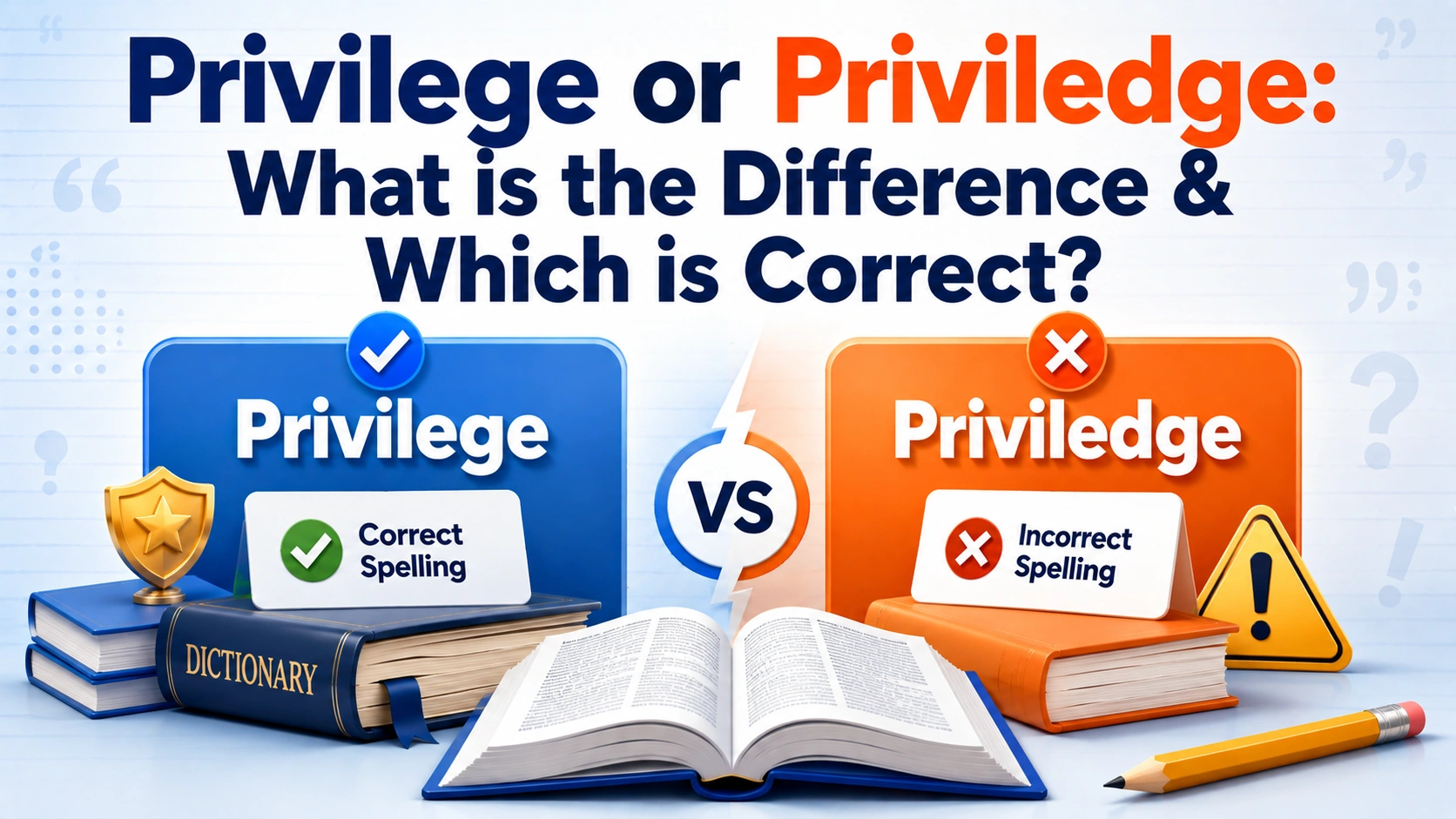
Privilege or priviledge is one of the most commonly confused spelling pairs in English. Whether you’re writing an academic paper, preparing a business email, updating a résumé, or publishing online content, using the correct spelling matters. At first glance, the two words look almost identical, making it easy to assume both are acceptable. In reality, only one spelling is recognized as standard English, while the other is simply a frequent misspelling. Understanding the difference helps you avoid embarrassing writing mistakes and communicate more confidently.3
Spelling errors involving common words often happen because English doesn’t always follow predictable patterns. Words like receive, separate, necessary, and privilege are notorious for confusing even experienced writers. The mistake usually comes from writing the word the way it sounds rather than the way it is actually spelled. Since privilege appears regularly in education, law, business, politics, technology, and everyday conversations, knowing the correct spelling is essential for anyone who writes in English.
In this complete guide, you’ll learn which spelling is correct, why people mistakenly write “priviledge,” what privilege really means, how dictionaries treat the word, where it’s commonly used, and practical strategies for remembering the correct spelling forever. You’ll also find comparison tables, real-world examples, grammar guidance, expert writing tips, and common mistakes to avoid so you can use privilege accurately and confidently in every situation.
Quick Answer: Should You Write “Privilege” or “Priviledge”?
If you’re looking for the short answer, here it is:
- ✅ Privilege is the correct spelling.
- ❌ Priviledge is incorrect and is not recognized as a standard English word.
- Privilege can function as both a noun and a verb.
- In every type of writing—including academic papers, business communication, journalism, and professional documents—you should always write with privilege.
Key Takeaway: If you ever have to choose between privilege and priviledge, always choose privilege. The spelling priviledge is simply a common misspelling.
Privilege vs. Priviledge at a Glance
| Feature | Privilege | Priviledge |
| Correct spelling | ✅ Yes | ❌ No |
| Recognized by dictionaries | ✅ Yes | ❌ No |
| Accepted in academic writing | ✅ Yes | ❌ No |
| Used in professional writing | ✅ Yes | ❌ No |
| Common misspelling | ❌ No | ✅ Yes |
| Can be used as a noun | ✅ Yes | ❌ No |
| Can be used as a verb | ✅ Yes | ❌ No |
| Recommended for all writing | ✅ Always | ❌ Never |
The Short Answer
The difference is simple:
- Privilege is the only correct spelling.
- Priviledge is a spelling error caused by confusing the ending -lege with -ledge.
Unlike spelling pairs such as gray/grey or judgment/judgement, where both versions may be acceptable depending on context or regional usage, privilege has only one standard spelling in modern English.
What Does “Privilege” Mean?
The word privilege has several closely related meanings, but they all revolve around the idea of a special right, benefit, opportunity, or advantage that is not available to everyone.
Depending on the context, it can describe a legal right, a social advantage, an honor, or even the act of granting special permission.
Definition
As a noun, privilege generally means:
A special right, advantage, immunity, or opportunity given to a person or group.
As a verb, privilege means:
To grant someone special rights or advantages beyond what others receive.
Both uses are widely accepted in modern English.
Privilege as a Noun
This is by far the most common use of the word.
Examples include:
- It was a privilege to meet the award-winning scientist.
- Access to confidential records is a staff privilege.
- Voting is considered both a right and a civic privilege.
- She regarded teaching children as a true privilege.
- Members enjoy several exclusive privileges.
In each sentence, privilege refers to a benefit, honor, or special right.
Privilege as a Verb
Although less common, privilege can also be used as a verb.
Examples:
- The policy should not privilege one group over another.
- The system unintentionally privileges experienced applicants.
- Good leadership avoids privileging personal interests over fairness.
In these examples, the verb means to give preference or special advantages.
What Does “Priviledge” Mean?
The answer is straightforward:
It doesn’t have an accepted meaning in standard English.
Priviledge is not recognized as a correct spelling by major English dictionaries. It isn’t a separate word with a different definition, nor is it an accepted regional or historical variant.
Instead, it is simply a misspelling of privilege.
Is “Priviledge” a Real Word?
No.
You’ll occasionally encounter priviledge in:
- social media posts
- emails
- student assignments
- blog comments
- online forums
- informal writing
However, its appearance doesn’t make it correct. It simply reflects one of the most common spelling mistakes English learners and native speakers alike make.
If you type priviledge into many writing tools, spell checkers, or search engines, you’ll usually receive a suggestion to replace it with privilege.
Why Do So Many People Spell It “Priviledge”?
The confusion comes from pronunciation.
When spoken naturally, the final syllables of privilege sound similar to words ending in -ledge, leading many writers to assume the spelling follows the same pattern.
For example, people subconsciously compare it with words like:
- knowledge
- acknowledge
- college
- pledge
As a result, they mistakenly insert a d, producing priviledge.
English spelling often preserves historical word forms rather than matching pronunciation exactly, which explains why this error is so widespread.
Privilege vs. Priviledge: What’s the Actual Difference?
Although these two spellings differ by only one letter, their status in English is completely different.
| Feature | Privilege | Priviledge |
| Standard English word | ✅ Yes | ❌ No |
| Dictionary entry | ✅ Yes | ❌ No |
| Accepted by editors | ✅ Yes | ❌ No |
| Suitable for exams | ✅ Yes | ❌ No |
| Appropriate in business writing | ✅ Yes | ❌ No |
| Professional recommendation | ✅ Always use | ❌ Avoid completely |
The important point is that this isn’t a comparison between two valid spellings. Unlike pairs such as advisor/adviser or canceled/cancelled, privilege has only one accepted spelling.
Why Is “Privilege” Spelled This Way?
The spelling becomes much easier to remember when you understand its history.
The word privilege comes from the Latin privilegium, which combined:
- privus — meaning individual or private
- lex (legis) — meaning law
Originally, the word referred to a law applying to a specific individual rather than to everyone. Over time, the meaning broadened to include any special right, exemption, honor, or advantage.
Because the modern spelling developed from this historical form, the ending -lege has remained part of the word, even though many people expect it to end in -ledge based on pronunciation.
Understanding this origin makes it easier to remember that privilege is the correct spelling—not priviledge.
What Does “Priviledge” Mean?
If you’ve searched for “priviledge”, you’re not alone. Thousands of people type this spelling every month because it’s an easy mistake to make. However, there’s one important fact to remember:
Priviledge is not a correct English word. It is simply a misspelling of “privilege.”
Unlike some spelling pairs where both versions are accepted (such as gray and grey), privilege has only one correct spelling in standard English. You’ll never find priviledge listed as the preferred spelling in reputable dictionaries, style guides, or grammar references.
Is “Priviledge” a Real Word?
No.
Priviledge does not exist as a separate word with its own meaning. Instead, it is a spelling error caused by confusing the placement of the letters e and i near the end of the word.
Here’s a quick comparison:
| Word | Correct? | Dictionary Recognition | Meaning |
| Privilege | ✅ Yes | Yes | A special right, advantage, honor, or benefit |
| Priviledge | ❌ No | No | Misspelling of privilege |
Whenever you write priviledge, spell-check software will usually suggest privilege instead.
Why Do People Spell “Privilege” as “Priviledge”?
The misspelling isn’t random. Several factors make privilege one of the more commonly misspelled English words.
The “-ledge” Pattern Confuses Writers
Many English words end with -ledge, including:
- knowledge
- acknowledge
- sledge
Because these words are familiar, people naturally assume privilege follows the same pattern and accidentally write privilege.
The problem is that privilege belongs to a different spelling pattern altogether.
Pronunciation Doesn’t Reveal the Correct Spelling
When spoken aloud, privilege sounds something like:
“PRIV-uh-lij”
The middle vowel isn’t strongly pronounced, making it difficult to hear whether the correct sequence is:
- …lege ✅
- …ledge ❌
As a result, many writers rely on pronunciation instead of memorizing the spelling.
Typing Quickly Increases Errors
Fast typing often leads to letter transposition.
For example:
Correct:
privilege
Common typo:
priviledge
Because both versions look similar, writers sometimes overlook the mistake unless they proofread carefully.
Similar-Looking English Words
English contains many words ending in:
- -edge
- -idge
- -ege
Examples include:
- knowledge
- college
- bridge
- cartridge
These familiar patterns encourage writers to incorrectly insert d into privilege.
Privilege vs. Priviledge: What’s the Actual Difference?
The comparison is surprisingly simple.
There is no difference in meaning, because only one spelling is legitimate.
| Feature | Privilege | Priviledge |
| Correct English spelling | ✅ Yes | ❌ No |
| Dictionary entry | ✅ Yes | ❌ No |
| Accepted in academic writing | ✅ Yes | ❌ Never |
| Used in professional writing | ✅ Yes | ❌ No |
| Meaning | Special right, benefit, or honor | None |
| Recommended spelling | ✅ Always | ❌ Never |
Unlike pairs such as advisor/adviser or judgment/judgement, where both forms may be acceptable depending on style or region, privilege has only one standard spelling.
Spelling Difference
At first glance, the two words seem almost identical.
Correct:
privilege
Incorrect:
priviledge
The mistake occurs because writers insert an extra d before g.
Think of it this way:
- privi + lege ✅
- privi + ledge ❌
That single added letter changes the word from correct English into a misspelling.
Meaning Difference
There isn’t one.
Only privilege carries meaning.
It can refer to:
- a special right
- an honor
- an opportunity
- a legal protection
- a social advantage
Examples:
- It was a privilege to meet the author.
- Voting is considered both a right and a privilege in many societies.
- Client-attorney privilege protects confidential communication.
Because priviledge isn’t a recognized word, it has no independent definition.
Dictionary Recognition
Major dictionaries—including Merriam-Webster, Cambridge, Oxford, and Collins—list privilege as the correct spelling.
They do not recognize priviledge as a standard English word.
If you search for priviledge, many dictionaries automatically redirect you to privilege, indicating that you’ve entered a misspelling.
This is an important distinction.
Some spelling variants receive full dictionary entries because they’re accepted alternatives. Priviledge does not.
Which Version Do Readers Expect?
Modern readers overwhelmingly expect to see:
privilege
Using the correct spelling improves:
- credibility
- readability
- professionalism
- trust
Imagine these two sentences:
✅ Receiving this award is a great privilege.
❌ Receiving this award is a great priviledge.
Even though readers understand the intended meaning, the second sentence immediately signals a spelling mistake.
Which Looks More Professional?
In professional communication, spelling matters.
Whether you’re writing:
- resumes
- business emails
- academic essays
- legal documents
- reports
- marketing copy
- blog articles
always use:
✅ privilege
Using priviledge can:
- distract readers
- reduce credibility
- create an unprofessional impression
- weaken confidence in your writing
Professional editors would always correct priviledge to privilege before publication.
Why Does the Correct Spelling Look Unusual?
One reason this word causes confusion is that its spelling doesn’t perfectly match pronunciation.
English contains many words with historical spellings that have been preserved for centuries.
Examples include:
- business
- lieutenant
- restaurant
- privilege
These words reflect the language’s historical development rather than purely phonetic spelling.
Because of that, privilege is a word best learned through familiarity rather than pronunciation alone.
The Origin of “Privilege”
Understanding where the word comes from makes its spelling easier to remember.
Privilege traces its roots back to the Latin word privilegium, which referred to a law applying to a specific person rather than everyone.
The Latin term combines:
- privus meaning individual or private
- lex (legis) meaning law
As the word passed through Old French into Middle English, its spelling gradually evolved into the modern English privilege.
Notice that the historical root connects to leg-, not ledge.
That history explains why the correct spelling ends in -lege, even though many English speakers instinctively expect -ledge.
How the Misspelling Developed
Unlike accepted spelling variants, priviledge didn’t evolve through regional usage or dictionary acceptance.
Instead, it developed because of predictable spelling patterns.
People often:
- hear the word before seeing it written
- assume it follows familiar -ledge endings
- type quickly without proofreading
- rely on pronunciation instead of memory
Over time, these repeated mistakes made priviledge one of the most common English spelling errors—but not a correct alternative.
Why Spell-Check Usually Catches It
Modern spell-check tools compare typed words against extensive dictionaries.
Since priviledge isn’t recognized as standard English, software typically flags it immediately and suggests:
privilege
While spell-check is helpful, it’s still good practice to know the correct spelling yourself, especially when writing by hand or taking exams where automatic correction isn’t available.
When to Use Privilege and When to Avoid Priviledge
Now that you understand the meaning of privilege and why priviledge appears so often as a typo, the next step is knowing exactly when to use the correct spelling in real writing. Whether you’re writing an essay, business email, legal document, social media post, or blog article, choosing the correct form improves your credibility and prevents distracting spelling errors.
Use Privilege When…
Privilege is the correct spelling in every standard variety of English. It can function as both a noun and a verb, making it useful in many different contexts.
Use privilege when referring to:
- A special right or advantage
- An honor or opportunity
- A benefit available only to certain people
- Legal or professional confidentiality
- The verb meaning “to grant a special advantage”
Here are some common situations where privilege is the correct choice.
In Academic Writing
Educational writing often discusses social, historical, economic, or political privilege.
Examples:
- Students examined the concept of privilege in modern society.
- The essay explored economic privilege across generations.
- Understanding educational privilege helps explain unequal opportunities.
Academic style guides and dictionaries consistently recognize only privilege.
In Professional Communication
Business writing frequently uses privilege to express appreciation or describe exclusive opportunities.
Examples:
- It was a privilege to work with your team.
- We appreciate the privilege of serving our customers.
- She considers mentoring young employees a privilege.
This usage sounds respectful and professional.
In Legal and Medical Contexts
Certain technical expressions use privilege in a very specific legal sense.
Examples include:
- Attorney-client privilege
- Executive privilege
- Parliamentary privilege
- Doctor-patient privilege (depending on jurisdiction)
Changing the spelling in these expressions creates an obvious error.
As a Verb
Many learners don’t realize privilege can also be a verb.
Examples:
- The company should not privilege one supplier over another.
- The policy appears to privilege experienced applicants.
- Good teachers never privilege one student unfairly.
Although the verb is less common than the noun, it is fully correct.
In Everyday Conversation
You’ll hear privilege used naturally in daily speech.
Examples:
- It was a privilege to meet her.
- Thank you for the privilege of being here.
- Owning this historic home is a real privilege.
- Having supportive parents is a privilege many people value.
Regardless of the situation, the spelling never changes.
When NOT to Use Privilege
Although privilege is always the correct spelling, writers sometimes misuse the word itself by choosing it when another term would communicate their meaning more clearly.
Here are the most common situations to avoid.
Don’t Use Privilege When You Simply Mean “Opportunity”
Sometimes opportunity is the better choice.
Less natural:
- I had the privilege to apply for the internship.
More natural:
- I had the opportunity to apply for the internship.
When no special honor or distinction exists, opportunity often fits better.
Don’t Confuse It with Similar Words
Privilege isn’t interchangeable with words like:
- right
- permission
- advantage
- benefit
- authority
Each has a different meaning.
Example:
Wrong word choice:
- Every citizen has the privilege to vote.
More accurate:
- Every citizen has the right to vote.
Choosing the precise word strengthens your writing.
Don’t Overuse the Word
Using privilege repeatedly can make your writing sound repetitive.
Instead of writing:
It was a privilege to attend. It was also a privilege to meet everyone. Working there was another privilege.
Vary your language with alternatives such as:
- honor
- opportunity
- pleasure
- benefit
- distinction
This improves readability without changing your message.
Never Use Priviledge
This rule is simple:
❌ Priviledge should never appear in standard English writing.
Unlike words that have accepted spelling variants (such as gray/grey or judgment/judgement), priviledge has no legitimate use.
Examples of incorrect spelling:
- ❌ It was a priviledge to meet you.
- ❌ Employee priviledges are listed here.
- ❌ Social priviledge affects education.
- ❌ Priviledge comes with responsibility.
Correct versions:
- ✅ It was a privilege to meet you.
- ✅ Employee privileges are listed here.
- ✅ Social privilege affects education.
- ✅ Privilege comes with responsibility.
If you encounter priviledge in a document, it should be corrected.
A Quick Decision Guide
If you’re unsure which spelling belongs in your sentence, this simple guide can help.
| If you want to write about… | Correct Choice |
| A special advantage | ✅ Privilege |
| An honor | ✅ Privilege |
| A legal protection | ✅ Privilege |
| Exclusive access | ✅ Privilege |
| A benefit | ✅ Privilege |
| The misspelled version | ❌ Priviledge |
The rule is easy to remember:
If you’re writing in English, choose “privilege.” There are no exceptions where “priviledge” is correct.
Real-World Practical Examples
Seeing the correct spelling used naturally makes it much easier to remember.
Education
- Attending the scholarship program was a privilege.
- Every student should value the privilege of learning.
- Access to quality education is a privilege in many parts of the world.
Workplace
- It has been a privilege working with this team.
- Managers should never privilege one employee unfairly.
- Employee discounts are considered a workplace privilege.
Law
- The judge discussed attorney-client privilege.
- Parliamentary privilege protects certain official statements.
- Legal privilege prevents confidential communications from being disclosed in some situations.
Healthcare
- Doctors must respect patient confidentiality and professional privilege where applicable.
- Medical professionals treat access to sensitive information as a serious responsibility rather than a privilege.
Everyday Conversation
- It’s a privilege to be invited.
- Thank you for the privilege of your friendship.
- Spending time with family is a privilege many people cherish.
Media and Journalism
- The article explored wealth and social privilege.
- Journalists discussed educational privilege in urban communities.
- Public debate often focuses on privilege and equal opportunity.
Business and Marketing
- Premium members enjoy exclusive privileges.
- Customers receive loyalty privileges after joining the program.
- The company considers customer trust a privilege rather than an entitlement.
Common Mistakes to Avoid
Many spelling mistakes happen because people write words exactly as they hear them. Here are the biggest pitfalls.
Mistake 1: Writing Priviledge
This is the most common error.
❌ She felt it was a priviledge.
✅ She felt it was a privilege.
Mistake 2: Forgetting the Second i
Many people accidentally write:
- privlege
- privelege
- privlidge
All are incorrect.
Always remember:
P-R-I-V-I-L-E-G-E
Mistake 3: Pronouncing Before Spelling
English pronunciation doesn’t always match spelling.
Because the middle vowel is unstressed, many writers assume the spelling should match the way it sounds.
Instead of trusting pronunciation, memorize the standard spelling.
Mistake 4: Depending Entirely on AutoCorrect
Spell-check tools catch many mistakes, but not all writing software is equally reliable.
Developing the habit of recognizing privilege yourself is more dependable than relying solely on technology.
Easy Memory Tricks
A few simple techniques make this word much easier to remember.
Think: “Privilege Contains Two I’s Before the L”
Spell it slowly:
P R I V I L E G E
Those two i letters come before l, not after it.
Remember the Ending
Many people confuse -lege and -ledge.
The correct ending is:
-lege
Not:
- ❌ -ledge
- ❌ -lidge
Associate It with Familiar Words
Notice these correctly spelled endings:
- college
- knowledge
- privilege
While the pronunciation differs, seeing -lege repeatedly helps reinforce the correct spelling.
Read It Often
The more often you encounter privilege in books, newspapers, websites, and professional writing, the more natural the spelling becomes.
Frequent exposure is one of the most effective ways to eliminate this common spelling mistake permanently.
Conclusion
Choosing between privilege and priviledge is much simpler once you know the rule: privilege is the only correct spelling in modern English, while priviledge is simply a common misspelling that should never appear in formal or professional writing. Whether you’re writing an academic essay, a business email, a legal document, or a social media post, using the correct spelling strengthens your credibility and helps readers focus on your message rather than your mistakes. Remember that privilege can function as both a noun and a verb, making it a versatile word across many contexts. One final actionable tip: add privilege to your personal spell-check dictionary or vocabulary practice list if you frequently mistype it. A common mistake to avoid is assuming that priviledge is an accepted British or American variant—it isn’t. Mastering this spelling is a small change that makes your writing look noticeably more polished and professional.
FAQs
Q1. Is privilege or priviledge the correct spelling?
Privilege is the only correct spelling recognized by standard English dictionaries. Priviledge is a spelling error and should not be used in academic writing, business communication, legal documents, or published content. Whenever you’re unsure, always choose privilege.
Q2. Why do so many people spell privilege as priviledge?
The mistake usually happens because people expect the word to follow a more familiar spelling pattern with -ledge, similar to words like knowledge. However, privilege follows its own historical spelling, so remembering the correct letter order is essential.
Q3. Can privilege be used as both a noun and a verb?
Yes. Privilege functions as both a noun and a verb. As a noun, it means a special right, benefit, or advantage. As a verb, it means to give someone special treatment or advantages over others.
Q4. Is priviledge ever acceptable in British English or any other variety of English?
No. Priviledge is not an accepted spelling in British English, American English, Canadian English, Australian English, or any other standard variety of English. The correct spelling is a privilege worldwide.
Q5. How can I remember the correct spelling of privilege?
A simple memory trick is to focus on the ending “-lege”, not “-ledge.” Repeating the phrase “Privilege ends with -lege” while proofreading can reinforce the correct spelling. Reading and writing the word regularly also helps build long-term spelling accuracy.