

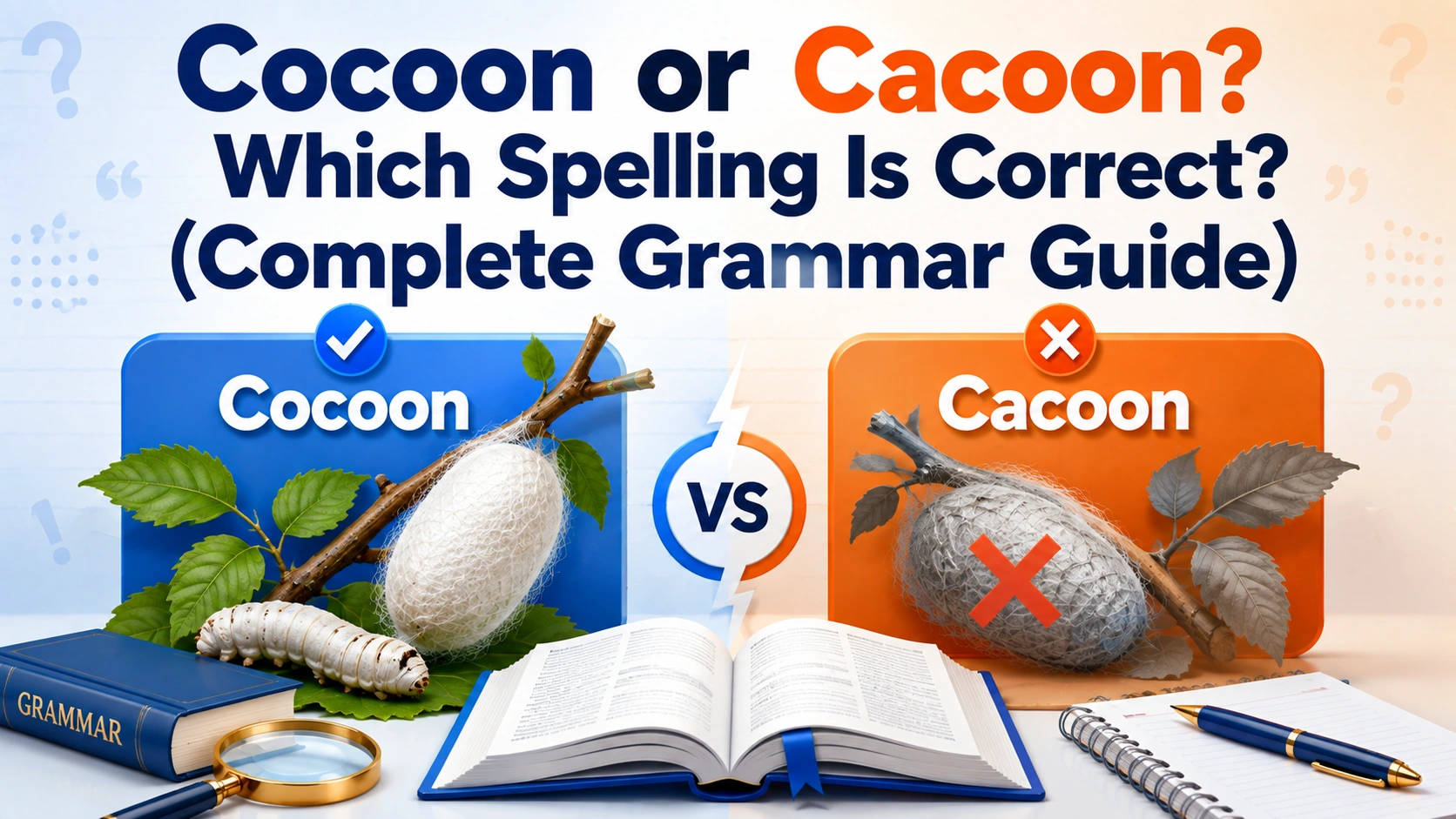
Cocoon or cacoon is one of those spelling questions that seems simple until you stop and think about it. The two words sound nearly identical when spoken, which leads many people to assume both spellings are acceptable. In reality, only one belongs in standard English. Whether you’re writing a school assignment, preparing professional documents, publishing a blog post, or simply trying to improve your English, using the correct spelling helps your writing appear more accurate, credible, and polished. Even a single spelling mistake can distract readers and weaken the overall quality of your work.
English spelling can be unpredictable, especially when pronunciation doesn’t perfectly match written forms. That’s one reason cocoon is frequently misspelled as cacoon. Many learners rely on phonetics, while others type quickly without noticing the error. Search engines, grammar tools, and spell-checkers have made spelling easier, but they don’t eliminate every mistake. Understanding why this confusion happens makes it much easier to remember the correct spelling and avoid repeating the same error in future writing.
This complete grammar guide explains everything you need to know about cocoon and cacoon. You’ll discover which spelling dictionaries recognize, what the word actually means, why so many people misspell it, how it is used in biology and everyday English, and practical techniques for remembering the correct form. Along the way, you’ll find comparison tables, real-world examples, grammar guidance, and expert recommendations designed to help you write with confidence in any situation.
Quick Answer: Is It “Cocoon” or “Cacoon”?
If you’re looking for the short answer, here it is:
- ✅ Cocoon is the only correct spelling in standard English.
- ❌ Cacoon is a misspelling and should not be used in formal or informal writing.
- ✅ Cocoon appears in major dictionaries, educational resources, scientific literature, and professional publications.
- ✅ Whether you’re writing about insects, personal growth, design, or business, cocoon is always the correct choice.
Key Takeaway: If you remember only one thing from this guide, remember this: Always write cocoon, never cacoon.
Cocoon vs. Cacoon at a Glance
| Feature | Cocoon | Cacoon |
| Correct English spelling | ✅ Yes | ❌ No |
| Recognized by dictionaries | ✅ Yes | ❌ No |
| Used in academic writing | ✅ Yes | ❌ Never |
| Accepted in professional writing | ✅ Yes | ❌ No |
| Common in biology | ✅ Yes | ❌ No |
| Used in everyday English | ✅ Yes | ❌ No |
| Recommended for SEO and publishing | ✅ Yes | ❌ No |
| Meaning | Protective case spun by certain insects; also used figuratively | None (misspelling) |
What Does “Cocoon” Mean?
The word cocoon has both a literal meaning and a figurative one. Although most people first encounter it in science classes, its use has expanded into everyday language, business writing, psychology, architecture, and even marketing.
At its core, a cocoon represents protection, development, and transformation—ideas that explain why the word has become such a powerful metaphor beyond biology.
Literal Meaning in Biology
In biology, a cocoon is a protective covering spun by the larvae of certain insects, particularly moths and some other species, before they transform into adults.
Inside the cocoon, the insect undergoes important developmental changes while remaining protected from environmental hazards and predators.
Examples:
- The caterpillar spun a cocoon before becoming a moth.
- Scientists carefully observed the insect emerging from its cocoon.
- The silk cocoon shielded the developing insect during metamorphosis.
The cocoon serves several important biological purposes:
- Protects the developing insect
- Reduces exposure to predators
- Helps maintain suitable environmental conditions
- Supports the process of metamorphosis
Figurative Meaning in Everyday English
Over time, cocoon has developed a broader figurative meaning. Today, people often use it to describe a place or state that feels safe, comfortable, private, or emotionally secure.
Rather than referring to insects, the word symbolizes shelter from stress or the outside world.
Examples:
- She spent the weekend cocooned at home with a good book.
- The luxury hotel created a peaceful cocoon away from the busy city.
- After a difficult week, he preferred the cocoon of his quiet apartment.
In these examples, cocoon suggests:
- Safety
- Comfort
- Warmth
- Privacy
- Emotional protection
This figurative meaning has become increasingly common in modern English and is widely understood by readers.
Cocoon in Modern Industries
Because the word naturally conveys protection and comfort, many industries use cocoon as descriptive language.
Fashion and Lifestyle
Fashion writers often describe oversized clothing, blankets, or winter garments as creating a cocoon-like feeling.
Examples:
- The oversized coat wraps you in a cozy cocoon.
- Soft fabrics create a cocoon of warmth during winter.
Interior Design
Interior designers frequently use the word to describe relaxing, enclosed spaces.
Examples include:
- Cocoon chairs
- Cocoon beds
- Cocoon reading corners
- Cocoon-inspired lighting
Wellness and Hospitality
Hotels, spas, and wellness centers often describe their services using the idea of a cocoon to communicate relaxation and escape.
Examples:
- A cocoon-like spa experience
- Private wellness cocoon
- A cocoon of tranquility
Business and Marketing
Marketing professionals use cocoon metaphorically to suggest products that provide comfort, security, or protection.
For example:
- Noise-canceling headphones create a cocoon of sound.
- Luxury bedding surrounds you in a cocoon of comfort.
- Modern vehicles offer a cocoon of safety for passengers.
These uses show how the word has evolved beyond biology while maintaining its central idea of protection and enclosure.
Is “Cacoon” a Real Word?
Many people assume that cacoon might simply be an alternative spelling, much like gray and grey or advisor and adviser. That isn’t the case.
Cacoon is not a recognized English word.
Major dictionaries, educational references, and professional style guides list cocoon as the correct spelling. The version with an “a” is treated as a spelling error rather than an accepted variation.
This distinction is important because English does allow many legitimate spelling variants—but cacoon isn’t one of them.
Why People Think “Cacoon” Is Correct
The mistake usually happens because people write the word exactly as they hear it.
Several factors contribute to the confusion:
- English pronunciation doesn’t always match spelling.
- Double vowels can be difficult to remember.
- Similar-sounding words create uncertainty.
- Fast typing often leads to accidental vowel substitutions.
Unlike genuine spelling variants, however, cacoon has never become part of standard English usage.
Can “Cacoon” Ever Be Used?
There are only a few situations where you might intentionally write cacoon:
- When discussing common spelling mistakes
- When quoting someone’s original text
- When teaching spelling or grammar
- When analyzing search queries that contain misspellings
Outside these contexts, you should always replace cacoon with cocoon.
Why Do So Many People Misspell “Cocoon”?
Understanding the cause of the mistake makes it much easier to remember the correct spelling.
Pronunciation Doesn’t Reveal the Spelling
Unlike words that sound exactly as they are written, cocoon doesn’t clearly signal that the first vowel should be “o.”
As a result, many learners instinctively type:
❌ cacoon
instead of:
✅ cocoon
Similar Sound Patterns Create Confusion
English contains many words ending in -oon, including:
- balloon
- cartoon
- raccoon
- monsoon
Although these words share similar sounds, their spelling patterns differ. Writers sometimes mix these patterns and accidentally substitute the wrong vowel when spelling cocoon.
Reading Less Than Listening
People who hear the word regularly but rarely see it written are more likely to rely on pronunciation instead of visual memory.
This explains why learners who read books, articles, and educational materials frequently tend to master the spelling more quickly than those who encounter the word mostly through conversation.
Typing Quickly Increases Errors
Simple keyboard mistakes also play a role. Since A and O are both common vowels, a quick typing error can easily transform cocoon into cacoon, especially if the writer doesn’t proofread carefully before publishing or submitting the text.
Expert Tip: Don’t try to spell cocoon by sounding it out. Instead, memorize its visual pattern—co + coon. Building a strong visual memory is far more reliable than relying on pronunciation alone.
Why “Cocoon” Is the Only Correct Spelling
Although cocoon and cacoon may sound similar when spoken, they are not equally acceptable in written English. Cocoon is the standard spelling recognized by dictionaries, educational institutions, publishers, and professional editors. Cacoon, on the other hand, is simply a spelling error that results from phonetic guessing rather than established English usage.
Unlike word pairs such as gray/grey or advisor/adviser, where both spellings are legitimate, cocoon has no accepted alternative spelling. This means that regardless of whether you’re writing a scientific paper, a business report, a blog article, or a social media post, cocoon is always the correct choice.
For most writers, the simplest rule is this:
If you’re referring to the protective case made by certain insects—or using the word metaphorically—always spell it “cocoon.”
Dictionary Recognition
One of the easiest ways to determine whether a spelling is correct is to check authoritative dictionaries.
Major English dictionaries consistently recognize cocoon as the correct spelling. They define it both as a biological term and as a figurative expression referring to safety, comfort, or isolation.
By contrast, cacoon is not listed as a standard English word. If it appears anywhere, it is usually identified as a common misspelling or presented only in discussions about spelling mistakes.
This widespread agreement among dictionaries leaves very little room for confusion.
Is “Cacoon” Ever Accepted?
Many spelling questions have answers that depend on regional English or stylistic preference.
This isn’t one of them.
You should not use cacoon in:
- Academic writing
- School assignments
- Business emails
- Professional reports
- Books
- Newspapers
- Magazine articles
- Blog posts
- Product descriptions
- Marketing materials
The only situations where cacoon may appear intentionally are:
- Explaining common spelling mistakes
- Quoting someone’s original wording
- Teaching spelling lessons
- Discussing search queries that contain misspellings
Outside those contexts, replacing cacoon with cocoon is always the correct editorial decision.
Cocoon vs. Cacoon: What’s the Difference?
At first glance, the two words seem nearly identical. Their pronunciation is almost the same, and only one letter differs.
However, that single letter makes all the difference.
The distinction isn’t about meaning, grammar, or regional preference—it’s about correct versus incorrect spelling.
| Feature | Cocoon | Cacoon |
| Correct English spelling | ✅ Yes | ❌ No |
| Dictionary entry | ✅ Yes | ❌ No |
| Meaning | Protective case; figurative shelter | None |
| Used by professional writers | ✅ Yes | ❌ Never |
| Accepted in education | ✅ Yes | ❌ No |
| Safe for publishing | ✅ Yes | ❌ No |
Spelling Difference
The difference is simply one vowel.
✅ Cocoon
❌ Cacoon
Although the pronunciation changes very little, English spelling isn’t always phonetic. Many correct spellings must simply be learned through repeated reading and use.
Meaning Difference
There is no difference in meaning, because cacoon has no accepted meaning in English.
Only cocoons carry recognized definitions.
It can refer to:
- A protective silk case made by certain insects.
- A safe or comfortable place.
- A period of personal growth or transformation.
Since cacoon isn’t a legitimate English word, it doesn’t introduce an alternative meaning or usage.
Grammar Difference
From a grammatical perspective, cocoon functions as both a noun and, in some contexts, part of a verb phrase.
As a noun
Examples:
- The butterfly emerged from its cocoon.
- The child built a cocoon of blankets.
Related verb form
Although cocoon itself remains a noun, English commonly uses cocooned as a verb.
Examples:
- She cocooned herself indoors during the storm.
- The hotel cocooned guests from the busy city outside.
Because cacoon isn’t a recognized word, it has no accepted grammatical function.
The Origin and Evolution of the Word “Cocoon”
Understanding where a word comes from often makes its spelling easier to remember.
The history of cocoons stretches back several centuries and is closely connected to the study of insects and silk production.
Rather than appearing randomly in English, the word developed gradually through European languages before becoming part of modern vocabulary.
Etymology of “Cocoon”
The English word cocoon ultimately traces its roots to French, where cocon referred to the silky case spun by silkworms.
As silk production became more widespread across Europe, English adopted the word while modifying its spelling to fit English pronunciation and writing conventions.
Over time, cocoon became the standard English form and has remained unchanged ever since.
This long history explains why the spelling is firmly established today.
From Biology to Everyday Language
Originally, cocoon belonged almost exclusively to biology.
Scientists used it to describe the protective covering spun by insects before metamorphosis.
Eventually, writers recognized that the image of a cocoon symbolized much more than insect development.
Today, people use the word metaphorically to describe:
- Emotional security
- Personal growth
- Recovery
- Privacy
- Isolation
- Comfort
- Transformation
Examples include:
- A cocoon of peace
- A cocoon of warmth
- Cocoon yourself from stress
- A creative cocoon
These figurative uses have become just as common as the biological meaning.
Why the Spelling Never Changed
English spelling often evolves over time, but cocoon has remained remarkably stable.
Several factors contributed to this consistency:
- Scientific literature standardized the spelling.
- Dictionaries adopted one accepted form.
- Publishers followed established editorial rules.
- Schools taught the same spelling for generations.
As a result, no accepted alternative such as cacoon ever developed.
How “Cocoon” Is Used in Modern English
Although many people associate cocoon with butterflies and moths, the word now appears in a surprisingly wide range of subjects.
Understanding these different contexts helps writers recognize the flexibility of the word while using it correctly.
Biology and Environmental Science
This remains the word’s most literal and traditional use.
Examples:
- The caterpillar remained inside its cocoon for several weeks.
- Researchers examined the cocoon before the insect emerged.
- Every cocoon protects the developing insect during metamorphosis.
In scientific writing, precision matters, making the correct spelling especially important.
Literature and Creative Writing
Authors frequently use cocoon as a metaphor for emotional or personal transformation.
Examples:
- Grief became a cocoon from which she slowly emerged.
- His quiet apartment formed a cocoon against the noisy city.
- The retreat offered a cocoon where creativity could flourish.
The imagery suggests change, protection, and renewal without directly referring to insects.
Lifestyle and Wellness
Modern lifestyle publications often describe comforting spaces or experiences as cocoon-like.
Examples include:
- Cocoon-style chairs
- Cocoon sleeping pods
- Cocoon meditation rooms
- Cocoon wellness retreats
The word instantly communicates warmth, privacy, and relaxation.
Business and Marketing
Businesses also borrow the metaphor because it creates positive emotional associations.
Examples:
- The vehicle creates a cocoon of safety.
- Premium headphones provide a cocoon of immersive sound.
- Luxury bedding surrounds customers in a cocoon of comfort.
These expressions emphasize protection and comfort rather than the literal biological meaning.
Expert Insight: Learning how cocoon functions across science, literature, design, and marketing not only strengthens your vocabulary but also reinforces the correct spelling. The more often you encounter the word in different contexts, the less likely you are to confuse it with the incorrect form cacoon.
Why Correct Spelling Matters in Professional Writing
Spelling mistakes do more than break grammar rules—they influence how readers perceive your credibility. Whether you’re writing an email, publishing a blog, creating educational materials, or listing products online, correct spelling demonstrates attention to detail and professionalism.
Using cacoon instead of cocoon may seem like a minor error, but readers often associate spelling mistakes with rushed work or unreliable information. In academic and business settings, even a single misspelling can distract your audience from the message you’re trying to communicate.
Professionals consistently use cocoon because it:
- Improves readability
- Matches dictionary standards
- Builds reader trust
- Prevents unnecessary confusion
- Reflects careful proofreading
For anyone who writes regularly, choosing the correct spelling is a simple way to strengthen both clarity and credibility.
Cocoon in Different Contexts
One reason cocoon is such a useful word is its versatility. While its original meaning comes from biology, it now appears across many industries and forms of writing.
Understanding these contexts helps you use the word naturally.
Biology and Nature
Scientists use cocoons to describe the protective covering spun by certain insects before metamorphosis.
Examples:
- The moth remained inside its cocoon throughout the winter.
- Researchers examined several cocoons collected from the forest.
- The larva spun a cocoon before transforming into an adult.
Literature and Creative Writing
Authors often use cocoon as a metaphor for emotional growth, healing, or isolation.
Examples:
- She retreated into a cocoon of silence after the loss.
- His study became a cocoon where ideas could develop.
- The novel describes personal transformation as emerging from a cocoon.
Here, the word creates vivid imagery rather than describing an actual insect.
Business and Marketing
Marketing frequently uses cocoons to evoke comfort and security.
Examples:
- The luxury mattress creates a cocoon of comfort.
- Noise-canceling headphones surround listeners in a cocoon of sound.
- The new SUV offers a cocoon of safety for families.
These expressions help products feel warm, protective, and inviting.
Lifestyle and Wellness
The wellness industry regularly borrows the word to describe relaxing environments.
Examples include:
- Cocoon therapy
- Cocoon meditation rooms
- Cocoon sleeping pods
- Cocoon-inspired interiors
The emphasis remains the same—protection, comfort, and restoration.
Common Mistakes Writers Make
Although the spelling rule itself is straightforward, writers still make several recurring mistakes. Recognizing these errors makes them much easier to avoid.
Mistake 1: Writing “Cacoon” Because It Sounds Right
The most common mistake is assuming pronunciation determines spelling.
Incorrect:
❌ The butterfly came out of its cacoon.
Correct:
✅ The butterfly came out of its cocoon.
Always remember that English spelling isn’t purely phonetic.
Mistake 2: Assuming “Cacoon” Is an Alternative Spelling
Some English words have multiple accepted spellings.
Examples include:
- Gray / Grey
- Adviser / Advisor
- Judgment / Judgement
Many people mistakenly assume cocoons follow the same pattern.
It doesn’t.
Only cocoons are correct.
Mistake 3: Ignoring Spell-Check Warnings
Some writers overlook spelling suggestions or assume unusual words must simply be unfamiliar.
Instead of dismissing spell-check, verify the spelling in a reliable dictionary whenever you’re uncertain.
Mistake 4: Copying Misspellings from the Internet
Not everything online is accurate.
Search queries, forum posts, and social media comments often contain spelling errors.
Before repeating unfamiliar spellings, confirm them using trusted references.
Mistake 5: Forgetting to Proofread
Even experienced writers occasionally type cacoon accidentally.
A careful proofreading session often catches small mistakes before publication.
Easy Memory Tricks to Remember “Cocoon”
Spelling becomes much easier when you connect words with memorable patterns rather than trying to memorize individual letters.
Here are several techniques that work well.
Think of “Two O’s for the Protective Home”
Visualize the word like this:
Co + coon
Notice the repeated “co” pattern.
The two O’s help create the image of a protective enclosure surrounding the insect.
Connect It with Familiar Words
Compare cocoon with correctly spelled words such as:
- balloon
- cartoon
- raccoon
Although each begins differently, they all end with the familiar -oon pattern.
This makes the cocoon easier to recognize visually.
Picture the Shape
Imagine a rounded silk cocoon.
The two O’s resemble its rounded shape.
This visual association helps reinforce the correct spelling every time you write the word.
Read It More Often
Visual memory is stronger than phonetic guessing.
The more often you read books, articles, magazines, and educational materials containing cocoon, the more naturally the spelling becomes fixed in your memory.
Expert Tip: Don’t memorize the incorrect spelling. Repeatedly seeing cacoon can actually reinforce the mistake. Instead, focus only on reading and writing cocoon until it becomes automatic.
Which Spelling Should You Use? (Decision Guide)
If you’re still unsure which spelling belongs in a particular situation, this simple guide removes any uncertainty.
| If you’re writing… | Use |
| School assignments | ✅ Cocoon |
| Academic papers | ✅ Cocoon |
| Business emails | ✅ Cocoon |
| Scientific writing | ✅ Cocoon |
| Books and articles | ✅ Cocoon |
| Blog posts | ✅ Cocoon |
| Marketing content | ✅ Cocoon |
| Social media posts | ✅ Cocoon |
| Everyday messages | ✅ Cocoon |
There are no standard situations where cacoon is the recommended spelling.
The only exceptions are when you’re:
- Explaining spelling mistakes
- Quoting someone else’s original text
- Teaching grammar or proofreading
- Discussing common search misspellings
For every other purpose, cocoon is the correct and recommended choice.
Real-World Examples of “Cocoon”
Seeing words used in authentic situations helps reinforce both spelling and meaning.
Biology Examples
- The silkworm remained inside its cocoon until development was complete.
- Every cocoon protected the insect during metamorphosis.
- Scientists collected several cocoons for laboratory observation.
Everyday Conversation
- I wrapped myself in a cocoon of blankets during the storm.
- The cabin felt like a peaceful cocoon in the mountains.
- She spent the weekend cocooned indoors reading novels.
Business Examples
- The product creates a cocoon of comfort for travelers.
- Designers wanted customers to experience a cocoon of privacy.
- The premium vehicle offers a cocoon of protection on long journeys.
Creative Writing Examples
- Fear became a cocoon that prevented him from growing.
- Hope slowly emerged from its cocoon after years of uncertainty.
- The forest surrounded them like a living cocoon of silence.
These examples demonstrate how cocoon functions naturally across scientific, professional, and creative writing while always maintaining its correct spelling.
Conclusion
Choosing between cocoon and cacoon is much simpler once you understand the spelling rule. Cocoon is the only correct spelling recognized in standard English, while cacoon is a common misspelling that appears because of pronunciation, typing errors, or unfamiliarity with the word. Whether you’re writing about insects, personal growth, architecture, travel, or business strategy, using the correct spelling strengthens your credibility and helps readers understand your message immediately. One final actionable tip: if you’re ever unsure, remember that a cocoon contains two “o”s, just like the enclosed, protective shape it describes. A common mistake to avoid is assuming that a frequently seen misspelling becomes acceptable through repeated use—it doesn’t. By choosing cocoon consistently, you’ll produce writing that is accurate, professional, and trustworthy in every context.
FAQs
Q1. Is cacoon a real English word?
No. Cacoon is not a recognized English word and does not appear as a standard entry in major dictionaries. It is simply a common misspelling of cocoon, often caused by pronunciation or typing mistakes. In all formal and informal writing, cocoon is the correct choice.
Q2. Can cocoon be used as both a noun and a verb?
Yes. Cocoon functions as both a noun and a verb. As a noun, it refers to the protective case made by certain insects. As a verb, it means to wrap, shelter, or isolate someone or something in a protective environment, either literally or figuratively.
Q3. Why do so many people misspell cocoon as cacoon?
The mistake usually happens because English pronunciation doesn’t always reflect spelling perfectly. Since the first syllable sounds like “kuh,” some writers incorrectly replace the first o with a. Fast typing, limited exposure to the word, and phonetic guessing also contribute to the error.
Q4. Is cocoon only used in biology?
No. While the biological meaning is the original one, cocoon is widely used in business, psychology, technology, interior design, travel, and everyday conversation. It often symbolizes protection, comfort, transformation, privacy, or personal development, making it a versatile word in modern English.
Q5. Does using cacoon affect SEO or professional credibility?
Yes, it can. Search engines understand many spelling variations, but publishing content with cacoon instead of cocoon may reduce reader trust and make your writing appear less polished. For blogs, academic work, marketing materials, and business communication, consistently using cocoon demonstrates greater professionalism and accuracy.