

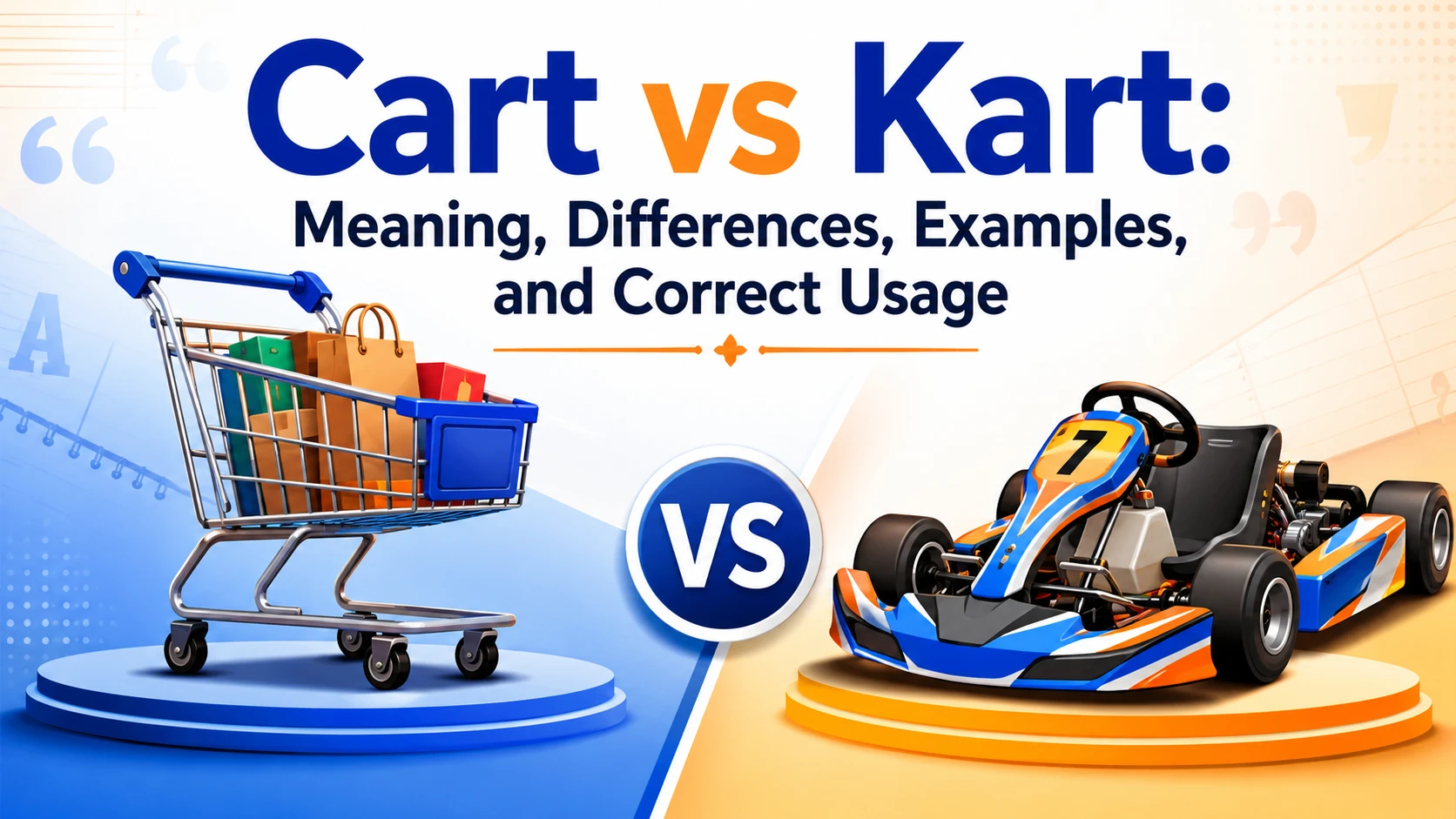
Cart vs kart may look like a simple spelling question, but the two words represent entirely different ideas. One refers to a vehicle or container used to carry goods, while the other belongs to the world of motorsports and recreational racing. Because they sound identical, many people assume the words are interchangeable—or that one is simply a misspelling of the other. In reality, choosing the wrong term can make professional writing look careless, create confusion in communication, and even change the meaning of a sentence entirely. Understanding the difference is both a language skill and a context skill.
English contains countless homophones—words that sound alike but have different meanings—and cart and kart are a perfect example. A shopper fills a shopping cart, a golfer drives a golf cart, and a racer competes in a go-kart. Yet search engines regularly receive queries asking which spelling is correct. That confusion often comes from pronunciation, branding, and the fact that modern English freely adopts alternative spellings in specific industries. Learning the distinction isn’t just about memorizing definitions; it’s about recognizing how language evolves and how context determines meaning.
This guide goes far beyond a basic dictionary definition. You’ll learn the exact meaning of cart vs kart, their historical origins, where each word is used today, why people confuse them, common mistakes to avoid, and practical memory tricks that make the difference impossible to forget. You’ll also see real examples, industry-specific usage, and expert recommendations so you can confidently choose the correct word in every situation.
Cart vs Kart at a Glance
If you only need the quick answer, here it is:
- Cart refers to a vehicle, container, or device used for carrying people or goods.
- Kart refers primarily to a small racing vehicle, especially a go-kart.
- They are not interchangeable.
- Neither spelling is more modern or more correct than the other—they simply mean different things.
Quick Comparison Table
| Feature | Cart | Kart |
| Primary meaning | Carries goods or people | Small racing vehicle |
| Standard English word | ✅ Yes | ✅ Yes |
| Used in shopping | ✅ Yes | ❌ No |
| Used in motorsports | Rarely | ✅ Yes |
| Found in dictionaries | ✅ Yes | ✅ Yes |
| Example | Shopping cart | Go-kart |
Key takeaway: If something transports groceries, luggage, supplies, or equipment, it’s almost certainly a cart. If it races around a track, it’s usually a kart.
What Does “Cart” Mean?
A cart is a vehicle, container, or wheeled device designed to transport goods, materials, or people.
Historically, carts were simple two-wheeled vehicles pulled by animals. Today, the meaning has expanded dramatically. Modern English uses carts for everything from supermarket baskets to golf vehicles and industrial transport equipment.
Standard Dictionary Definition
Most major dictionaries define a cart as:
A vehicle or container used for carrying or transporting items.
That broad definition explains why the word appears in so many different industries.
Common Types of Carts
Shopping Cart
A shopping cart is the wheeled basket customers use in stores to carry products while shopping.
Example:
- She pushed her cart through the grocery aisle.
- My online cart still has three items waiting for checkout.
Interestingly, e-commerce borrowed the physical shopping cart concept to create the familiar digital shopping cart.
Golf Cart
A golf cart is a small motorized vehicle used to transport players and equipment around a golf course.
Example:
- We rented a golf cart for the back nine.
Although a golf cart has an engine, it is still called a cart because its primary purpose is transportation rather than racing.
Utility Cart
Utility carts appear in warehouses, hospitals, hotels, and factories.
Examples include:
- Medical carts
- Tool carts
- Service carts
- Warehouse carts
- Food carts
Their shared purpose is moving equipment efficiently.
Handcart and Animal Cart
These are among the oldest meanings of the word.
Examples:
- Horse cart
- Ox cart
- Handcart
- Farm cart
Many cultures still use traditional carts for agriculture and transportation.
Examples of “Cart” in Sentences
- The mechanic rolled the toolbox across the garage using a cart.
- We filled our shopping cart before heading to checkout.
- The farmer transported hay in a wooden cart.
- The hotel staff used a luggage cart.
What Does “Kart” Mean?
A kart is a small, low-to-the-ground motor vehicle designed primarily for racing or recreational driving.
Unlike cart, the word kart has a much narrower meaning. In standard English, it is strongly associated with go-karts and kart racing.
Dictionary Definition
Most dictionaries define a kart as:
A small motorized racing vehicle used in recreational or competitive driving.
The term almost always appears as:
- Go-kart
- Kart racing
- Kart track
- Kart championship
- Racing kart
What Is a Go-Kart?
A go-kart is a compact open-wheel vehicle designed for speed and maneuverability.
Some are recreational vehicles used at family entertainment centers, while others are sophisticated racing machines capable of impressive speeds.
Many professional Formula One drivers—including several world champions—began their careers in kart racing.
Recreational Karts vs Racing Karts
| Type | Recreational Kart | Racing Kart |
| Purpose | Fun and entertainment | Competitive racing |
| Speed | Lower | Much faster |
| Safety features | Beginner-friendly | Racing-focused |
| Typical location | Indoor or outdoor tracks | Professional circuits |
| Driver experience | Beginners | Experienced racers |
Examples of “Kart” in Sentences
We raced go-karts during our vacation.
She won her first kart championship at age twelve.
Professional drivers often start with kart racing.
The kart track hosts regional competitions every summer.
Cart vs Kart: What’s the Difference?
The biggest difference lies in purpose.
A cart is designed to carry.
A kart is designed to drive or race.
Side-by-Side Comparison
| Category | Cart | Kart |
| Transportation | Yes | Limited |
| Racing | No | Yes |
| Carrying goods | Yes | No |
| Shopping | Yes | No |
| Sports | Rarely | Yes |
| Industrial use | Yes | No |
| Recreational driving | No | Yes |
Another easy way to think about it:
- Cart = cargo
- Kart = competition
That memory trick works surprisingly well because both words begin with the same sound but lead to entirely different functions.
Is “Kart” Just an Alternative Spelling of “Cart”?
No.
This is one of the most common misconceptions.
Unlike words such as travelling/traveling or labelled/labeled, cart and kart are not regional spelling variations.
They are separate words with separate meanings.
Incorrect Usage
- I put my groceries in the shopping kart.
- The hotel employee brought a luggage kart.
- Please return your kart after checking out.
Correct Usage
- I put my groceries in the shopping cart.
- The hotel employee brought a luggage cart.
- We rented go-karts at the race track.
Professional, academic, and business writing should always treat them as distinct words.
Why Do People Confuse Cart and Kart?
The confusion is understandable because several factors work against learners.
They Sound Exactly the Same
Cart and kart are pronounced identically in standard English.
Because English spelling isn’t fully phonetic, many people rely on sound rather than meaning when choosing a spelling.
Branding Influences Perception
Businesses often use kart in company names because it feels sporty, memorable, or visually distinctive.
Examples include:
- Racing centers
- Entertainment venues
- Go-kart manufacturers
- Motorsport organizations
Seeing these brand names repeatedly can make people believe kart is a modern replacement for cart.
Context Isn’t Always Obvious
Consider this sentence:
We rented one for the afternoon.
Without context, you don’t know whether the speaker means:
- A golf cart
- A luggage cart
- A utility cart
- A go-kart
Context determines which word is correct.
Expert Insight: Professionals Focus on Function First
Editors, technical writers, and experienced communicators rarely ask:
“Which spelling looks right?”
Instead, they ask:
“What does the object actually do?”
If it carries, use a cart.
If it races, use a kart.
That single question eliminates nearly every mistake.
The History and Origin of Cart and Kart
Although cart and kart sound identical today, they come from different stages of language development. One has existed for centuries as a practical term for transporting goods, while the other emerged much later to describe a completely new type of vehicle. Understanding their origins makes it easier to remember why the words have different spellings and meanings.
The Etymology of “Cart”
The word cart has deep historical roots. It entered English through Old Norse and Germanic languages, where similar words referred to wheeled vehicles used for carrying heavy loads. Long before motor vehicles existed, carts were essential for agriculture, trade, and travel.
Farmers used wooden carts to transport crops, merchants moved goods between towns, and builders relied on carts to haul construction materials. Because these vehicles played such an important role in everyday life, the word gradually expanded to describe almost any wheeled carrier.
Over time, technological advances changed the design of carts, but not their primary purpose. Whether pulled by horses or powered by electricity, a cart is still fundamentally intended to move people, goods, or equipment from one place to another.
How “Kart” Entered the English Language
Unlike cart, kart is a relatively modern word.
It became popular during the mid-20th century as small recreational racing vehicles gained popularity. Manufacturers intentionally chose the spelling kart instead of cart to create a distinct identity for the new sport.
The altered spelling helped separate racing vehicles from traditional utility carts. As go-kart racing expanded worldwide, the word kart became the accepted industry standard.
Today, organizations, racing clubs, and manufacturers consistently use kart when referring to competitive or recreational racing vehicles.
Why the Spelling Changed
The spelling wasn’t the result of a grammar rule—it was a branding and marketing decision.
Changing C to K made the word:
- More distinctive
- Easier to trademark
- More visually memorable
- Closely associated with motorsports
This isn’t unusual in English. Many industries intentionally create unique spellings to establish a recognizable identity without changing pronunciation.
Expert Insight: The word kart is considered a standard English word today, but its spelling originated from commercial and recreational use rather than traditional language evolution.
Cart and Kart in Different Contexts
One of the easiest ways to master these words is by seeing how they’re used across different industries. Context often determines the correct spelling long before grammar does.
Transportation
In transportation, cart refers to vehicles designed for carrying people or cargo rather than speed.
Examples include:
- Airport luggage carts
- Golf carts
- Farm carts
- Utility carts
- Handcarts
Even when powered by electricity or gasoline, these vehicles remain carts because transportation—not racing—is their primary function.
Retail and E-Commerce
Retail is one of the most common places you’ll encounter the word cart.
Examples include:
- Shopping cart
- Grocery cart
- Shopping trolley (in some regions)
- Online shopping cart
- Abandoned cart
The term “shopping cart” has become so common that even people who rarely visit physical stores instantly recognize it online.
For example:
- Add the item to your cart.
- Your cart is currently empty.
- Complete your purchase before your cart expires.
Notice that shopping kart is never considered correct in standard English.
Sports and Motorsports
This is where kart dominates.
Competitive karting is often the first step toward professional motorsports. Many elite drivers begin racing karts years before moving into higher racing categories.
Common terms include:
- Go-kart
- Racing kart
- Kart chassis
- Kart engine
- Kart championship
- Kart circuit
Because the sport has its own terminology, replacing kart with cart would sound incorrect to enthusiasts and professionals alike.
Gaming and Entertainment
Millions of people recognize kart through video games rather than real-life racing.
Popular games featuring karts have introduced the word to generations of players.
Examples include:
- Kart racing games
- Arcade kart racers
- Multiplayer kart competitions
In entertainment, kart immediately signals racing, speed, and competition.
Business and Logistics
Businesses rely heavily on different types of carts.
Examples include:
- Inventory carts
- Mail carts
- Tool carts
- Janitorial carts
- Medical carts
- Warehouse carts
Each serves a practical transportation function, reinforcing the original meaning of the word.
Common Phrases and Expressions Using “Cart”
The word cart appears in numerous everyday expressions, while kart rarely extends beyond racing terminology.
Understanding these phrases helps you recognize natural English usage.
Put the Cart Before the Horse
This well-known idiom means to do things in the wrong order.
Example:
Launching a product before testing it is like putting the cart before the horse.
The expression dates back centuries and remains widely used in business, education, and everyday conversation.
Shopping Cart
One of the most frequently used modern expressions.
It refers to:
- A physical grocery cart
- An online checkout system
Both meanings emphasize carrying items until they’re ready for purchase.
Cart Away
The phrase cart away means to remove or transport something, usually in large quantities.
Examples:
- Workers carted away the debris.
- The old furniture was carted away after the renovation.
Food Cart
Food carts are common in cities worldwide.
Unlike food trucks, food carts are generally smaller and often moved manually or towed into position.
Cartload
A cartload refers to the amount that fits inside a cart.
Example:
We planted a cartload of flowers this spring.
Although less common in everyday conversation, the expression still appears in literature and descriptive writing.
Common Mistakes and Misconceptions
Many errors involving cart and kart don’t come from poor grammar—they come from incorrect assumptions.
Understanding these mistakes helps you avoid them permanently.
Mistake 1: Assuming Kart Is a Modern Spelling of Cart
Some people believe kart is simply a newer or trendier version of cart.
It isn’t.
Both words are correct, but they refer to different things.
Mistake 2: Using Kart in Retail
Incorrect:
- Shopping kart
- Grocery kart
- Online kart
Correct:
- Shopping cart
- Grocery cart
- Online shopping cart
Retail, e-commerce, and logistics consistently use carts.
Mistake 3: Writing Go-Cart Instead of Go-Kart
Although you’ll occasionally see go-cart, especially in informal writing, go-kart is overwhelmingly preferred in dictionaries, motorsports, manufacturers’ materials, and professional publications.
When writing formally, go-kart is the safer choice.
Mistake 4: Letting Pronunciation Decide the Spelling
Because both words sound identical, many writers simply choose whichever spelling looks familiar.
A better approach is to identify the object’s purpose first.
Ask yourself:
- Does it carry goods?
- Or is it built for racing?
Answering that question almost always leads to the correct spelling.
How to Remember the Difference Between Cart and Kart
Memorization becomes much easier when you connect each word to a visual image instead of relying on spelling alone.
Memory Trick #1: Think About the Function
Ask:
Does it carry?
→ Cart
Does it race?
→ Kart
This simple question works in nearly every situation.
Memory Trick #2: Associate the First Letter
Many learners remember:
- C = Carry
- K = Karting
Even though it’s a simplified association, it’s surprisingly effective.
Memory Trick #3: Picture the Scene
Imagine two images:
Cart
- Grocery store
- Warehouse
- Golf course
- Farm
Kart
- Race track
- Helmet
- Checkered flag
- Speed
Visual memory often lasts much longer than memorized spelling rules.
Pro Tip: When proofreading, don’t focus only on the word itself. Picture the object in your mind. If you imagine groceries, luggage, or equipment, write a cart. If you picture a race track, write kart.
Cart vs Kart Examples in Real-Life Sentences
Seeing both words in realistic contexts reinforces the difference far better than definitions alone.
Everyday Conversations
- Please return the shopping cart after unloading your groceries.
- The children couldn’t wait to ride the go-karts.
- Our hotel provided a luggage cart.
- They spent the afternoon racing karts.
Business and Professional Writing
- Warehouse employees use rolling carts to transport inventory.
- Add the selected products to your online cart before checkout.
- The company sponsored a regional kart racing event.
- Maintenance crews pushed equipment carts across the factory floor.
Academic Writing
- Early agricultural societies depended heavily on animal-drawn carts.
- Kart racing is widely recognized as a developmental stage for aspiring professional drivers.
Sports and Recreation
- She purchased a lightweight racing kart for national competitions.
- Visitors can rent go-karts at the adventure park.
- The maintenance team transported supplies using a utility cart.
- Every competitor inspected their kart before the race began.
Similar Word Pairs That Cause Confusion
Cart and kart aren’t the only English words that confuse writers. Similar spellings, overlapping meanings, and regional vocabulary often lead people to choose the wrong word. Understanding these related terms helps you avoid mistakes beyond this single comparison.
Cart vs Trolley
Although these words sometimes describe similar objects, they aren’t always interchangeable.
In American English, a shopping cart is the wheeled basket customers push through a supermarket.
In British English, the same object is often called a shopping trolley.
However, trolley can also refer to:
- A streetcar or tram
- A serving trolley in hotels or restaurants
- Medical or utility trolleys
| Word | Common Usage | Example |
| Cart | American English retail and transportation | Shopping cart |
| Trolley | British English retail and transport | Shopping trolley |
Expert Tip: If you’re writing for an international audience, shopping cart is generally the more universally understood term.
Kart vs Car
Because both are motorized vehicles, beginners occasionally confuse kart with car, especially in children’s books or casual writing.
The distinction is straightforward:
| Feature | Kart | Car |
| Purpose | Racing or recreation | Road transportation |
| Registration required | Usually no | Yes |
| Road legal | Generally no | Yes |
| Driver protection | Minimal | Extensive |
A kart is not simply a small car. It is a specialized vehicle designed for controlled tracks rather than public roads.
Cart vs Buggy
Depending on the country, buggy can have several meanings.
It may refer to:
- A baby stroller
- A shopping cart
- A lightweight horse-drawn carriage
- An off-road recreational vehicle
Because of these regional differences, using a cart often creates less ambiguity.
Other Frequently Confused English Word Pairs
If you’re interested in improving your grammar further, you may also encounter these commonly confused words:
- Affect vs Effect
- Principal vs Principle
- Stationary vs Stationery
- Complement vs Compliment
- Lose vs Loose
- Then vs Than
Many of these mistakes arise for the same reason as cart vs kart—the words look or sound similar but have different meanings and uses.
Conclusion
Understanding cart vs kart becomes much easier once you focus on purpose rather than pronunciation. A cart is built to carry people, goods, or equipment, while a kart is designed for recreation or racing. Although the words sound exactly alike, they belong to different contexts and should never be treated as interchangeable. By recognizing where each term is commonly used—from shopping carts and golf carts to go-karts and kart racing—you can write with greater precision and confidence. One final actionable tip: whenever you’re unsure, ask yourself what the object is meant to do. If it transports cargo, choose cart; if it races around a track, choose kart. A common mistake to avoid is assuming that kart is simply a modern spelling of cart. It isn’t. Choosing the correct word shows attention to detail and helps your writing remain clear, accurate, and professional.
FAQs
Q1. Is “kart” a real word?
Yes. Kart is a fully recognized English word found in major dictionaries. It specifically refers to a small motorized racing vehicle, usually a go-kart. While its spelling originated through motorsports rather than traditional language evolution, it is now the accepted standard in recreational and competitive racing.
Q2. Why is it called a go-kart instead of a go-cart?
The spelling go-kart became the industry standard as the sport developed. Manufacturers and racing organizations adopted karts to distinguish racing vehicles from traditional carts, helping create a unique identity for the sport that continues today.
Q3. Can “cart” and “kart” ever mean the same thing?
No. Although they sound identical, they describe different objects. A cart is designed primarily to carry goods or people, while a kart is built for recreational or competitive driving. Their meanings do not overlap in standard English.
Q4. Is “shopping kart” ever correct?
No. Shopping cart is the correct expression in standard English. Whether you’re referring to a physical supermarket cart or an online checkout system, kart is considered a spelling error in this context.
Q5. Why do some businesses use “kart” in their company name?
Many companies choose kart because it feels energetic, memorable, and closely associated with racing or recreation. In branding, creative spellings often help businesses stand out, but that doesn’t change the standard meanings of cart and kart in everyday English.