

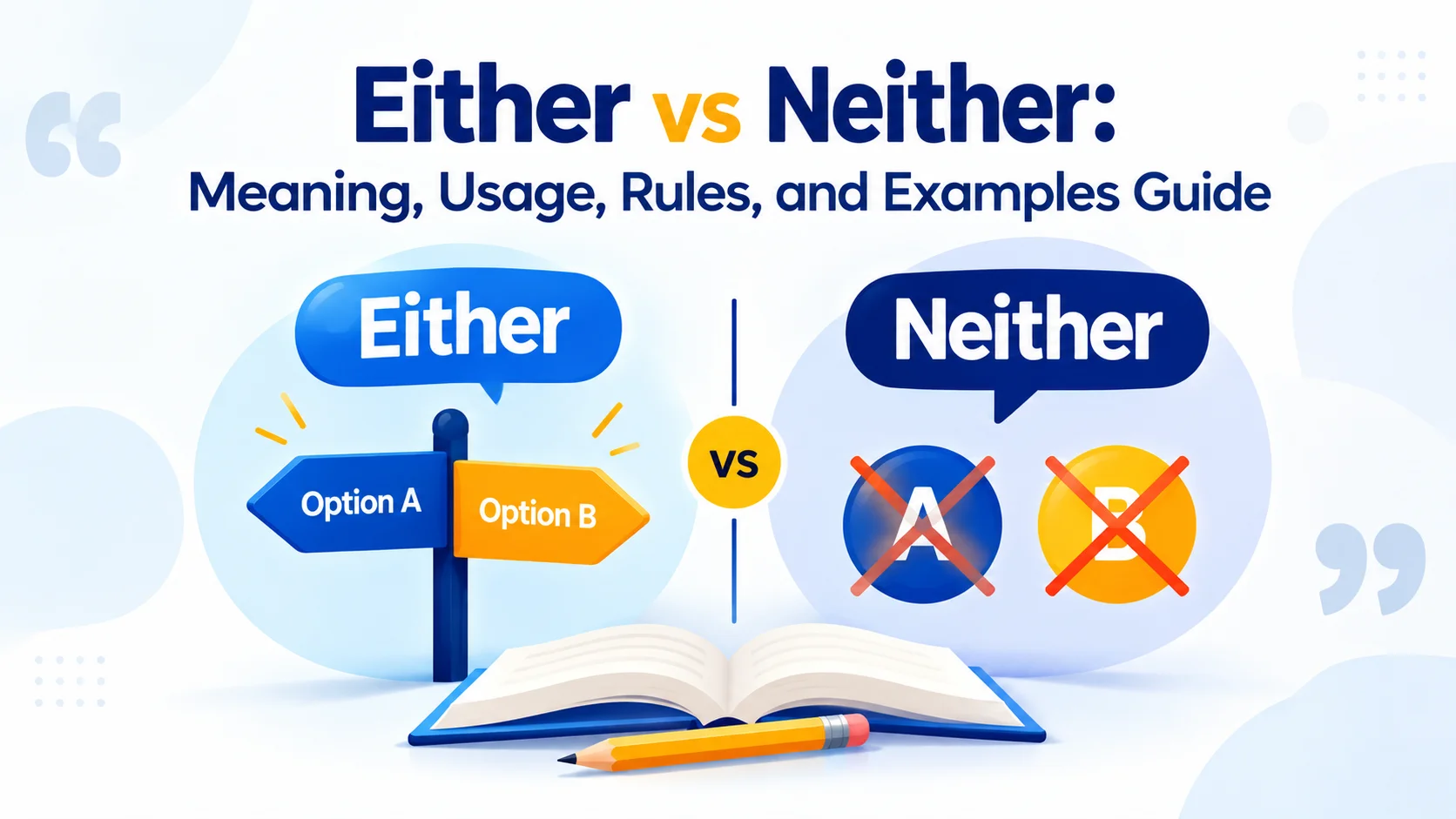
The difference between either vs neither comes down to what you want to say about two options: either generally allows one choice or the other, while neither excludes both. Although the distinction sounds simple, these words become confusing when they appear in negative sentences, paired conjunctions, or expressions such as neither do I and I don’t either. Choosing the wrong construction can change your meaning or make a sentence sound unnatural. The good news is that a few reliable rules can help you recognize when to use either, when to use neither, and how to form each expression correctly.
Both words appear in everyday conversation, academic writing, business emails, and formal documents. You might use either when offering someone two meeting times, or neither when explaining that both proposals have failed. The challenge is that these words perform several grammatical jobs: they can act as determiners, pronouns, adverbs, and parts of conjunction pairs. Their meanings also overlap in certain negative sentences. Understanding their grammatical roles—not just memorizing definitions—makes it easier to choose the right word and avoid mistakes such as I don’t like neither option in standard formal English.
This guide explains the meaning, spelling, pronunciation, and grammar rules for either and neither, with clear examples you can apply immediately. You’ll learn how either … or differs from neither … nor, when to use either of and neither of, and how subject–verb agreement works in these constructions. We’ll also examine common conversational responses, including Me neither, Neither do I, and I don’t either. By the end, you’ll have a practical way to decide which expression fits your sentence, whether you’re writing a school assignment, preparing a professional message, or speaking naturally.
Either vs Neither: The Quick Answer
Either generally refers to one of two options, either of which may be acceptable. Neither means one and not the other.
- Either: Either answer is acceptable.
- Neither: Neither answer is acceptable.
- Either … or: You can either call me or send an email.
- Neither … nor: Neither the manager nor the assistant was available.
- Not … either: I don’t want either option.
The main difference is that either presents an available choice, while neither rules out both choices. However, either can also appear in negative sentences, where it often means “also” or indicates that neither option applies.
| Expression | Meaning | Example |
| Either | One of two possibilities | Either route will get us there. |
| Neither | Not one and not the other | Neither route is open. |
| Either … or | Presents alternatives | Either we leave now or we miss the train. |
| Neither … nor | Excludes both alternatives | Neither Mia nor Leo attended. |
| Not … either | Adds a negative statement | I don’t want to go either. |
What Do Either and Neither Mean?
What Does Either Mean?
Either commonly refers to one of two people, things, or possibilities. Depending on the sentence, it can indicate a choice between alternatives or mean that each of two options is considered individually.
Consider these examples:
- Either candidate could win the election.
- You can sit on either side of the table.
- Either of these keys should open the door.
- I don’t want to go either.
In the first three examples, either identifies one or both possible choices as relevant. In the last example, it appears in a negative sentence and means “also not.”
The exact meaning depends on the construction. When you see either … or, expect alternatives. When either appears at the end of a negative statement, it usually adds another negative point.
What Does Neither Mean?
Neither means one and not the other. It excludes both members of a pair without requiring a separate note.
For example:
- Neither answer is correct.
- Neither of the buses arrived on time.
- Neither Sam nor Priya knew about the change.
- “I don’t enjoy crowded places.” “Neither do I.”
In the first three examples, neither rules out both possibilities. In the end, the speaker agrees with a negative statement.
A useful distinction is that neither already carries negative meaning. That’s why standard formal English normally avoids adding another negative word to the same construction, as in I don’t like neither option.
Why Either and Neither Are Not Always Direct Opposites
The words contrast most clearly when discussing two options:
- Either plan works: Both plans are acceptable alternatives; you can choose one.
- Neither plan works: Both plans are unacceptable.
But compare these sentences:
- I don’t like either plan.
- I like neither plan.
Both normally communicate that the speaker likes neither option. The grammatical structures differ, but the intended meaning is essentially the same.
This is important because either does not always create a positive sentence, and neither does not always appear alongside nor. Learn the entire expression rather than deciding based on one word alone.
How to Use Either Correctly
Either as a Determiner
A determiner comes before a noun and helps identify it. When either refers to one of two alternatives, it usually precedes a singular countable noun.
Examples:
- Either answer is acceptable.
- You can take either road.
- Either applicant may request an interview.
- Either option has advantages.
Notice the singular nouns: answer, road, applicant, and option. In standard usage, either in this construction normally takes a singular noun and a singular verb.
Practical tip: If you’re choosing between two individual items, try either + singular noun. If you’re talking about a larger group, consider whether any is more appropriate.
Either as a Pronoun
A pronoun replaces a noun or noun phrase. Either can stand alone when the two options are already clear.
Examples:
- Which dessert would you prefer? Either is fine.
- We have two meeting rooms. Either will work.
- Either of them can help you.
- I checked both answers, and either could be correct.
The expression either of is especially common when the following words identify a pair or a known group.
Examples:
- Either of the proposals is worth considering.
- Either of us can present the report.
- Either of those jackets would suit the occasion.
In formal writing, singular verb agreement is generally the safest choice when either functions as the subject. The details of the agreement are discussed later.
Either as an Adverb in Negative Sentences
At the end of a negative sentence, either can mean “also not.” This usage is common in ordinary conversation and writing.
Examples:
- I don’t watch that show either.
- She wasn’t invited, and I wasn’t invited either.
- He can’t drive, and his brother can’t either.
- We haven’t received the documents either.
Here, either does not offer a choice. It adds a second negative statement.
Compare:
- You can choose either color. — A choice is available.
- I don’t like either color. — Neither color appeals to me.
The position of the word and the presence of a negative verb help you identify the intended meaning.
Either … Or: Presenting Two Alternatives
The paired conjunction either … or connects two alternatives. It can join nouns, phrases, verbs, or clauses.
Examples:
- You can have either tea or coffee.
- We can either walk or take a taxi.
- Either the train is delayed or we have missed it.
- Either Ava will lead the meeting or Ben will.
Try to maintain parallel structure, meaning that the connected elements follow matching grammatical patterns.
Less balanced: You can either walk to school or take the bus.
Better: You can either walk to school or take the bus.
Both alternatives now use the same verb form, making the sentence easier to read.
When the two alternatives are full clauses, punctuation depends on their structure and length. If each clause could stand alone, a comma may help separate them, particularly in longer sentences.
Either of: Rules and Examples
Use either of + a determiner or pronoun + plural noun/pronoun when referring to one member of a pair.
Correct examples include:
- Either of the answers is acceptable.
- Either of these routes should work.
- Either of them can explain the process.
- Either of my parents can collect me.
The noun after of is plural because the phrase refers to a set of two, but the subject either is traditionally treated as singular in formal English.
Avoid writing either an answer or either of the answers. Use the plural noun after of: either of the answers.
How to Use Neither Correctly
Neither as a Determiner
Use neither + singular countable noun when ruling out both members of a pair.
Examples:
- Neither answer is correct.
- Neither candidate has accepted the offer.
- Neither route looks safe.
- Neither explanation addresses the main issue.
In these sentences, neither indicates that both alternatives fail to meet the relevant condition.
Because the construction is already negative, you normally don’t need to add not. Write Neither answer is correct, rather than Neither answer is not correct, if you mean that both answers are incorrect.
Neither as a Pronoun
Neither can replace two previously mentioned options, allowing you to avoid repeating the nouns.
Examples:
- I tried both solutions, but neither worked.
- Which of the two shirts do you prefer? Neither.
- We considered the proposals. Neither was suitable.
- Neither of them knows the full story.
The reader must be able to identify the two options from the context. If the options are unclear, name them first.
Neither … Nor: Excluding Both Alternatives
The paired conjunction neither … nor connects two things that are both excluded.
Examples:
- Neither the manager nor the assistant was available.
- The hotel was neither cheap nor convenient.
- Neither Emma nor Daniel submitted the form.
- The explanation was neither clear nor convincing.
Like either … or, this construction benefits from parallel structure.
Less balanced: The candidate was neither experienced nor had the necessary qualifications.
More balanced: The candidate was neither experienced nor qualified.
You can also connect complete clauses, though the sentence may need careful wording to remain clear:
- Neither did the company explain the delay, nor did it offer a new deadline.
For long or complicated sentences, consider rewriting the construction so that the relationship between the two negative ideas is easy to follow.
Neither of: Rules and Examples
Use neither of + a determiner or pronoun + plural noun/pronoun to exclude both members of a pair.
Examples:
- Neither of the answers is correct.
- Neither of the applicants has the required experience.
- Neither of us wants to leave early.
- Neither of those explanations makes sense.
In formal edited English, a singular verb is the traditional choice because neither is the grammatical subject. In everyday speech, plural agreement sometimes occurs when the speaker is thinking of the two people or things in the following phrase.
For a school assignment, report, or formal email, prefer singular agreement unless your style guide or the sentence’s structure indicates otherwise.
Neither at the Beginning of a Sentence
When neither introduces a negative statement with an auxiliary verb, English often uses subject–auxiliary inversion. In simple terms, the auxiliary comes before the subject.
Examples:
- Neither do I.
- Neither can she attend.
- Neither have we received a reply.
- Neither did the team expect such a result.
This structure commonly appears when agreeing with a negative statement:
“I haven’t seen the new film.”
“Neither have I.”
However, inversion isn’t required every time neither appears at the beginning of a sentence. Compare:
- Neither answer is correct.
- Neither of the options seems suitable.
These sentences follow ordinary subject–verb order because neither is part of the subject rather than an introductory negative adverb requiring inversion.
Either vs Neither in Negative Sentences
Negative sentences are one of the main reasons these words get confused. The key is to recognize whether the sentence uses not … either or neither.
Why “I Don’t Like Either” Can Be Correct
These two sentences usually express the same idea:
- I don’t like either restaurant.
- I like neither restaurant.
Both mean that neither restaurant appeals to the speaker. The first uses not with either; the second uses neither directly.
The same contrast works in other contexts:
- She didn’t choose either option.
- She chose neither option.
Both are standard constructions. Choose the version that fits the rhythm and tone of the surrounding sentence.
Why “I Don’t Like Neither” Is Usually Avoided in Standard Formal English
In standard formal English, combining don’t and neither in this way creates a double negative that can obscure the intended meaning.
Instead of:
- I don’t like neither option.
Write either:
- I don’t like either option.
- I like neither option.
There is an important linguistic nuance: some English dialects use negative concord, in which multiple negative forms reinforce one negative meaning. That is a legitimate feature of those dialects, not random grammatical confusion. However, for formal academic and professional writing, use one of the standard alternatives above.
Either vs Neither When Agreeing With Someone
When someone makes a negative statement, you can agree using neither, nor, or a negative sentence ending in either.
| Conversation | Natural response |
| “I don’t eat meat.” | “Neither do I.” |
| “I can’t attend.” | “I can’t either.” |
| “I haven’t finished.” | “Nor have I.” |
| “I wasn’t invited.” | “Me neither.” |
Me neither is common in informal conversation. It is a short response that means “I don’t either” or “Neither do I,” depending on the original statement.
Me either is also heard in some varieties of informal English, particularly in American conversation, but Me neither is the more widely taught conventional response to a negative statement. In formal writing, use a complete construction such as Neither do I.
Either vs Neither: Subject–Verb Agreement Rules
Subject–verb agreement depends on the grammatical subject, not simply on whether the sentence mentions two people or things.
Does Either Take a Singular or Plural Verb?
When either is the subject or determiner in a standard construction, singular agreement is normally used.
- Either answer is acceptable.
- Either of the proposals has merit.
- Either of the children is welcome to join us.
The noun after of may be plural, but the subject is either. This is why Either of the proposals have merit is often edited to Either of the proposals has merit in formal writing.
Does Neither Take a Singular or Plural Verb?
The traditional formal rule also treats neither as singular when it refers to two items.
- Neither answer is correct.
- Neither of the applicants has replied.
- Neither of them wants to leave.
Plural verbs do occur after neither in informal speech, especially when the speaker focuses on the plural group. However, singular agreement is the safer option for formal prose.
Either … Or neither … Nor With Different Subjects
When a paired conjunction connects subjects with different grammatical numbers, traditional guidance often recommends making the verb agree with the nearer subject.
Examples:
- Either the teachers or the principal is attending.
- Either the principal or the teachers are attending.
- Neither the assistant nor the managers are available.
- Neither the managers nor the assistant are available.
Although these sentences follow the proximity pattern, repeated changes in number can sound awkward. In professional writing, it is often better to revise the sentence to avoid the problem.
For example:
Instead of: Neither the assistant nor the managers are available.
Consider: The assistant and the managers are both unavailable.
The revised sentence is direct and removes any potential distraction over agreement.
A Quick Verb-Agreement Checklist
Before finalizing a sentence with either or neither:
- Identify the actual grammatical subject.
- Check whether either or neither is used alone, with of, or in a paired conjunction.
- Use singular agreement for either of and neither of in formal writing.
- If the paired construction connects subjects of different numbers, check the proximity rule.
- Rewrite the sentence if the agreement sounds awkward or makes the meaning difficult to follow.
Either vs Neither in Everyday Conversation
Using Either to Offer Choices
Either is useful when both options are acceptable or when the listener can select one.
- Either Friday or Saturday works for me.
- You can use either entrance.
- We could meet either before lunch or after work.
It can also show that the choice doesn’t matter to the speaker:
“Would you prefer the window seat or the aisle seat?”
“Either is fine.”
The answer doesn’t mean the speaker wants both seats. It means either individual option is acceptable.
Using Neither to Express Exclusion
Use neither when both alternatives are ruled out.
- Neither Friday nor Saturday works for me.
- Neither entrance is open.
- Neither of those suggestions solves the problem.
This distinction is especially useful when making plans. If one time is acceptable, either may fit. If both times are unsuitable, neither is the clearer choice.
“Neither Do I,” “Me Neither,” and “Nor Do I”
All three can express agreement with a negative statement, but they differ in style and structure.
- Neither do I: Standard and suitable for many formal or neutral situations.
- Nor do I: Also grammatical, often slightly more formal or emphatic.
- Me neither: Informal and natural in conversation.
Examples:
“I don’t understand the instructions.”
“Neither do I.”
“I haven’t received the package.”
“Nor have I.”
“I don’t want to go out tonight.”
“Me neither.”
Match the response to the auxiliary verb in the original statement when using inversion. For example, I can’t swim. Neither can I, nor can I.
Is “Either Do I” Correct?
In standard English, it is not the usual way to agree with a negative statement. Use neither do I, nor do I, or I don’t either instead.
- “I don’t drink coffee.” — “Neither do I.”
- “I don’t drink coffee.” — “I don’t either.”
- “I can’t drive.” — “Neither can I.”
- “I haven’t finished.” — “I haven’t either.”
The correct response depends on the original verb and auxiliary. Keeping the structure parallel makes the exchange sound natural.
Common Either vs Neither Mistakes and How to Fix Them
Mistake 1: Using Neither When You Mean One of Two
Incorrect for a choice: Neither route will get us there; choose one.
If one of the routes will work, write: Either route will get us there.
Use neither only when both routes are being excluded.
Mistake 2: Mixing Up Either … Or neither … Nor
Use either … or to present alternatives:
- Either we leave now or we wait until tomorrow.
Use neither … nor to exclude both:
- Neither the bus nor the train is running.
Changing the paired words changes the meaning, so check whether the sentence offers a choice or rules out both possibilities.
Mistake 3: Adding an Unnecessary Negative
In standard formal English, I don’t need either one. Choose:
- I don’t need either one.
- I need neither one.
The first construction uses neither. The second uses neither without another negative.
Mistake 4: Using the Wrong Verb After Either of or Neither of
For formal writing, prefer:
- Either of the options is suitable.
- Neither of the candidates has responded.
The plural nouns after of can make a plural verb tempting, but traditional agreement follows either or neither.
Mistake 5: Using “Me Either” in Formal Writing
Although Me either occurs in informal speech, it is not the best choice for a formal report or professional email.
Instead, use Neither do I, Nor do I, or I don’t either, depending on the original statement.
Either vs Neither Examples in Real-Life Contexts
The following examples show how the choice changes according to the situation.
At a Restaurant
- Either table is fine. — Both tables are acceptable; choose one.
- Neither dish appeals to me. — I don’t want either dish.
- I don’t want either dessert. — Both desserts are unwanted.
At Work
- Either proposal could meet the deadline. — Both are possible options.
- Neither department has approved the request. — Both departments have not approved it.
- Neither the director nor the assistant was available. — Both people were unavailable.
At School
- Either answer could earn full credit. — Both answers may be acceptable.
- Neither explanation addresses the question. — Both explanations fail to address it.
- You can submit either a printed copy or a digital file. — Two submission methods are offered.
In Everyday Conversation and Text Messages
- “Which day should we meet?” — “Either day works.”
- “Can you do Monday or Tuesday?” — “Neither works for me.”
- “I don’t know the answer.” — “Me neither.”
- “I don’t have the notes either.” — The speaker also lacks the notes.
In Travel and Planning
- Either train gets you there before noon. — Both trains meet the requirement.
- Neither route avoids the roadworks. — Both routes encounter roadworks.
- You can enter through either gate. — Both gates are possible entrances.
Either vs Neither: Pronunciation and Word Origins
How to Pronounce Either and Neither
Both either and neither have two widely accepted pronunciation patterns in English. The first vowel may sound like the vowel in see or like the vowel in eye, depending on the speaker and variety of English.
Common pronunciations include:
- Either: /ˈiːðər/ or /ˈaɪðər/
- Neither: /ˈniːðər/ or /ˈnaɪðər/
The final consonant in both words is the voiced “th” sound, as in this, not the unvoiced sound in think. Pronunciation varies by region and individual preference; neither common pattern is universally the only correct one.
Word Origins and Related Expressions
Either and neither have long histories in English, with forms that developed from older expressions referring to alternatives and negation. For everyday writing, their current grammatical functions are more useful than memorizing their etymology.
Related expressions include:
- Either way: Whichever of the two possibilities happens.
- Neither here nor there: Not relevant to the main point.
- Neither fish nor fowl: Difficult to classify as one thing or another.
These expressions should be learned as complete phrases because their meanings are not always obvious from the individual words.
Either vs Neither: Quick Decision Guide
Use this table when you need to choose quickly while writing.
| What you want to say | Best construction | Example |
| One of two choices is acceptable | Either + singular noun | Either seat is available. |
| Both choices are unacceptable | Neither + singular noun | Neither seat is available. |
| Present two alternatives | Either … or | Either call me or send a text. |
| Exclude two alternatives | Neither … nor | Neither Alex nor Kim replied. |
| Agree with a negative statement | Neither + auxiliary + subject | “I can’t go.” “Neither can I.” |
| Add a negative point | Negative verb + either | I can’t go either. |
| Refer to one member of a pair | Either of + plural noun/pronoun | Either of them is suitable. |
| Exclude both members of a pair | Neither of + plural noun/pronoun | Neither of them is suitable. |
A Four-Step Self-Check
Before choosing either or neither, ask yourself:
- Are there two alternatives? If not, consider whether any, none, or another word would be clearer.
- Am I allowing a choice or excluding both choices? Use either for an available alternative and neither to rule out both.
- Is the sentence already negative? If it is, either may be the right word; avoid an unintended double negative in standard formal English.
- Does the verb agree with the subject? Pay particular attention to either of, neither of, and paired conjunctions.
Conclusion:
Understanding either vs neither becomes much easier when you focus on the relationship between the options. Use either to present or allow a choice, and neither to exclude both possibilities. Remember the paired forms either … or and neither … nor, and distinguish them from not … either, which commonly appears in negative sentences. In formal writing, pay attention to singular agreement after either of and neither of, and keep paired constructions grammatically balanced. One final actionable tip: when editing a sentence, underline the two alternatives and state your intended meaning in plain language before choosing the construction. A common mistake to avoid is adding not to a sentence that already uses neither in standard formal English. Clear choices make clear sentences.
FAQs
Q1. What Is the Main Difference Between Either and Neither?
Either usually refers to one of two alternatives, while neither means not one and not the other. For example, “Either route is suitable” allows a choice; “Neither route is suitable” rejects both. The surrounding sentence determines the exact meaning.
Q2. Is It “Either Is” or “Either Are”?
In a sentence such as “Either answer ___ correct,” use is because either refers to one answer at a time. In paired constructions such as either … or, however, the verb depends on the subjects and the sentence structure.
Q3. Should I Say “Me Neither” or “Me Either”?
Me neither is a common informal response to a negative statement, as in “I don’t like olives.” “Me either” is also used in some varieties of informal English. In formal writing, prefer a complete construction such as Neither do I or I don’t either.
Q4. Is “Neither of Them Are” Grammatically Correct?
Traditional formal grammar favors “Neither of them is” because neither is treated as singular. However, plural agreement—“Neither of them are”—is common in informal English. For academic or professional writing, singular agreement is generally the safer choice.
Q5. Can Either and Neither Be Used With More Than Two Options?
Traditionally, either and neither refer to two alternatives. In modern usage, speakers sometimes use them with larger sets, but any and none are often clearer when discussing more than two choices. For example, “None of the five routes is open” avoids ambiguity.