

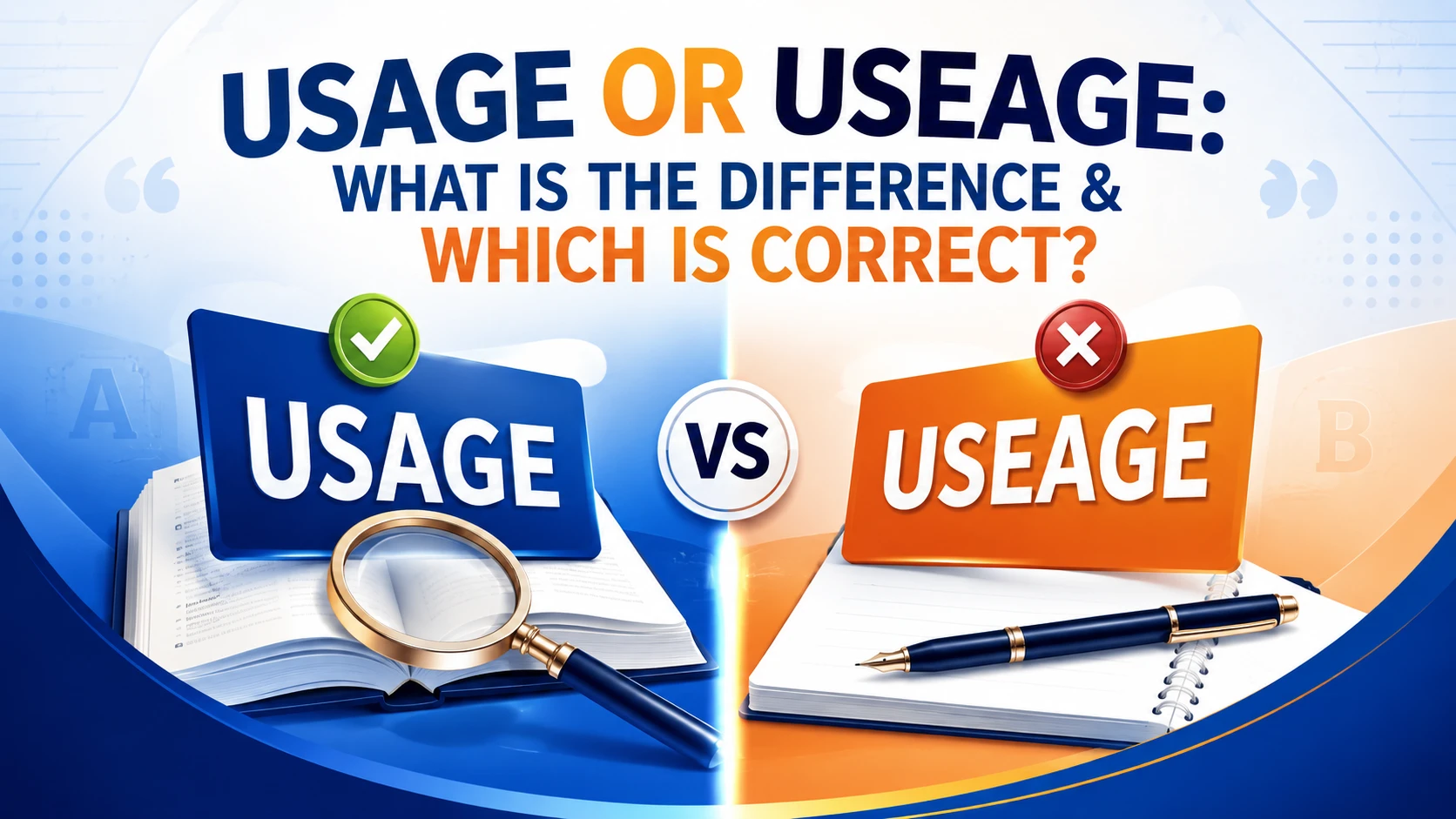
Usage or useage is a spelling question that confuses thousands of English learners, students, and even experienced writers because both words look believable at first glance. Since many English nouns ending in -age retain the letter e from their base words, it’s easy to assume that use becomes useage. In reality, standard English follows a different rule. Usage is the only correct spelling recognized by dictionaries, style guides, and educational institutions, while useage is simply a common misspelling that should be avoided in both formal and informal writing. Knowing the difference helps you write with greater confidence and credibility.
Correct spelling matters more than many people realize. Whether you’re preparing a business report, writing an academic essay, composing an email, or publishing online content, small spelling mistakes can affect how readers perceive your professionalism. Words like usage appear frequently in discussions about grammar, technology, data, utilities, and language itself, making them important additions to your vocabulary. Fortunately, once you understand the spelling rule behind usage, you’ll find it much easier to remember and avoid repeating the same mistake.
This comprehensive guide explains why usage is correct and useage is not, explores the meaning of the word in different contexts, and shows you how to use it naturally in sentences. You’ll also learn the spelling rule behind the word, discover common collocations, compare usage with use, review practical examples, and pick up simple memory tricks that make the correct spelling stick. By the end of this article, you’ll know exactly when and how to use it with confidence.
Quick Answer: Is It “Usage” or “Useage”?
If you only need the short answer, here it is:
- ✅ Usage is the correct spelling.
- ❌ Useage is incorrect and isn’t recognized in standard English.
- ✅ Usage refers to the way something is used or the accepted way language is written or spoken.
The Correct Spelling at a Glance
| Word | Correct? | Meaning |
| Usage | ✅ Yes | The act, manner, or practice of using something |
| Useage | ❌ No | Incorrect spelling of usage |
One-Sentence Rule to Remember
Whenever you’re referring to the way something is used, always write usage, never useage.
Why “Useage” Is a Common Misspelling
Although useage is incorrect, it’s easy to understand why people write it. English spelling contains many patterns that seem inconsistent, and learners often apply familiar rules where they don’t actually belong.
How English Spelling Patterns Cause Confusion
Many English words ending in -age appear to preserve the spelling of the original word.
For example:
- Acre → Acreage
- Marry → Marriage
- Cover → Coverage
Because of these examples, many writers naturally assume:
- Use → Useage
However, English doesn’t form every noun in the same way. Usage developed differently, and the silent e is dropped before adding -age.
Why Adding an Extra “E” Seems Logical
The mistake isn’t random—it follows a pattern that feels reasonable.
Most learners think:
- The base word is use
- Therefore the noun should be use + age
Instead, English forms the word as:
- Use → Usage
This isn’t unusual. English contains many words whose spelling changes slightly when suffixes are added.
Understanding that usage is an established dictionary word—not simply use plus another ending—helps explain why the extra e disappears.
Typing Habits, Autocorrect, and Phonetic Spelling
Modern technology also contributes to the confusion.
People often:
- type quickly without proofreading
- rely on pronunciation rather than spelling
- ignore spell-check warnings
- assume the computer will fix mistakes automatically
Because usage and useage sound almost identical, many writers never notice the spelling error until someone points it out.
Expert Tip: If you’re unsure about a word, verify it with a reputable dictionary instead of relying entirely on spellcheck. Some writing platforms may fail to catch uncommon misspellings or names.
What Does “Usage” Mean?
Understanding the meaning of usage makes it easier to recognize when the word belongs in a sentence.
Definition of Usage
Usage refers to:
- the way something is used
- an accepted method or practice
- established language conventions
- the amount of something that has been used
Depending on the context, the meaning changes slightly, but the core idea remains the same: usage describes use in practice rather than the action itself.
Different Meanings of Usage in English
The word appears across many fields, each with a slightly different emphasis.
General Use or Practice
Here, usage refers to how something is commonly or regularly used.
Examples:
- Proper tool usage improves workplace safety.
- Water usage increases during the summer.
- Responsible internet usage is encouraged.
Language and Grammar Usage
In grammar, usage refers to accepted language conventions rather than strict grammatical rules.
Examples:
- Modern English usage changes over time.
- Dictionary editors monitor changes in word usage.
- Formal usage differs from conversational English.
This meaning is especially common in style guides, dictionaries, and educational resources.
Technical or Product Usage
Technology companies frequently use usage to describe how customers interact with products or services.
Examples:
- Check your monthly data usage.
- Battery usage has increased since the update.
- The software tracks employee system usage.
You’ll also encounter the term in utility bills, mobile apps, analytics dashboards, and subscription services.
Common Synonyms and When to Use Them
Although usage is often the best choice, several related words may fit better depending on the situation.
| Word | Best Used When |
| Usage | Referring to the way something is used |
| Use | Referring to the act of using something |
| Practice | Referring to established habits or customs |
| Application | Referring to practical implementation |
| Consumption | Referring to resources like electricity, water, or fuel |
| Utilization | Referring to efficient or purposeful use |
Choosing the right synonym improves clarity and helps avoid repetition in your writing.
Is “Useage” Ever a Correct Word?
One of the most common questions learners ask is whether useage might be accepted in certain countries, dialects, or informal situations.
The answer is simple:
No.
Why Dictionaries Reject “Useage”
Major English dictionaries—including those published by Oxford, Cambridge, Merriam-Webster, and Collins—recognize only usage.
The spelling useage doesn’t appear as an accepted variant because it has never become part of standard English.
Instead, dictionaries typically classify it as:
- a spelling mistake
- a learner error
- a typographical error
This means it shouldn’t appear in essays, reports, articles, emails, or professional documents.
Historical and Regional Perspective
Unlike some spelling differences—such as color and colour or organize and organise—there is no regional variation between usage and useage.
Whether you’re writing:
- American English
- British English
- Canadian English
- Australian English
The correct spelling remains in usage.
There is no dialect where useage is considered standard.
When You Might Still Encounter “Useage”
Although it’s incorrect, you may still see useage in places such as:
- student assignments
- social media posts
- online discussion forums
- rough drafts
- search engine queries
Its appearance doesn’t make it correct—it simply reflects one of the internet’s most common spelling mistakes.
For that reason, many grammar websites discuss useage specifically to help learners find the correct spelling.
Usage vs. Useage: Side-by-Side Comparison
Sometimes a direct comparison makes the difference immediately clear.
| Feature | Usage | Useage |
| Correct English spelling | ✅ Yes | ❌ No |
| Found in dictionaries | ✅ Yes | ❌ No |
| Appropriate for formal writing | ✅ Yes | ❌ No |
| Used in academic writing | ✅ Yes | ❌ No |
| Recommended by style guides | ✅ Yes | ❌ No |
| Meaning | Refers to the way something is used | No accepted meaning |
At first glance, the extra e may seem harmless, but it immediately signals a spelling mistake to editors, teachers, employers, and native speakers.
Using usage consistently helps your writing appear polished, accurate, and professional.
Why “Useage” Is Incorrect (And Why So Many People Write It)
If you’ve ever typed useage and watched your spell checker underline it in red, you’re not alone. This is one of the most common English spelling mistakes because it seems to follow a logical pattern. Many words ending in -age, such as marriage, baggage, and postage, lead learners to assume that use should become useage. In reality, English follows a different spelling rule for this particular word.
Understanding why the mistake happens makes it much easier to avoid—not only with usage, but with many other commonly misspelled words.
The Spelling Rule Behind “Usage”
The noun usage is formed from the verb use, but English drops the silent e before adding the suffix -age.
The correct transformation is:
- Use → Usage ✅
- Use → Useage ❌
This isn’t an arbitrary exception. English often removes a final silent e when adding a suffix that begins with a vowel.
Examples include:
| Base Word | Correct Derived Word | Incorrect Form |
| Use | Usage | Useage |
| Acre | Acreage | ❌ Acreeage |
| Store | Storage | ❌ Storeage |
Notice that although acreage and storage contain -age, they follow their own historical spelling patterns. With usage, the accepted spelling has always been u-s-a-g-e.
Expert Tip: Instead of thinking “use + age,” remember that usage is its own dictionary word, not simply two parts joined together.
Why People Commonly Misspell “Usage”
Several factors contribute to this error, especially for English learners and even native speakers.
The Pronunciation Doesn’t Reveal the Spelling
Both usage and incorrect useage are usually pronounced the same way. Because English spelling isn’t always phonetic, many people insert an extra e simply because it “looks right.”
For example:
- ❌ The software’s useage is increasing.
- ✅ The software’s usage is increasing.
Since pronunciation offers no clue, memorizing the correct spelling becomes essential.
Influence of Similar “-age” Words
English contains many words ending in -age:
- baggage
- package
- shortage
- mileage
- postage
Seeing these familiar spellings often leads writers to assume that useage follows the same pattern.
However, usage developed differently and has never included the extra e in standard English dictionaries.
Typing Habits and Autocorrect Errors
Fast typing is another common cause. Because use ends with e, many people instinctively keep the letter before adding -age, producing useage without thinking.
Fortunately, most modern spell checkers recognize this mistake, but it’s still common in:
- Student essays
- Business emails
- Blog posts
- Social media captions
- Online forums
Learning the correct spelling helps you catch the error before software does.
Usage vs. Use: Don’t Confuse These Words
Although usage comes from use, the two words are not interchangeable. One is primarily a noun referring to the way something is used, while the other can function as both a noun and a verb.
Meaning of “Use”
Use generally means:
- to employ something for a purpose (verb)
- the act or purpose of using something (noun)
Examples:
- Please use the correct password.
- This tool has many practical uses.
- You can use this guide as a reference.
Meaning of “Usage”
Usage refers to:
- the way language is used
- the frequency or pattern of using something
- established customs or accepted practices
Examples:
- Correct grammar usage improves communication.
- Mobile data usage increased last month.
- Dictionary usage notes explain regional differences.
Although related, usage often emphasizes patterns, conventions, or statistics, rather than simply using an object.
Usage vs. Use: Side-by-Side Comparison
| Feature | Use | Usage |
| Part of speech | Verb and noun | Noun only |
| Primary meaning | To employ or utilize something | The manner, frequency, or practice of using something |
| Common contexts | Everyday actions | Grammar, technology, business, analytics |
| Refers to action? | Yes | Usually no |
| Correct spelling | ✅ Use | ✅ Usage |
Quick Rule
Ask yourself:
- Am I talking about doing something? → Use
- Am I talking about how something is used or how often it’s used? → Usage
Examples:
- I use this application every day.
- My monthly usage has doubled.
This simple distinction prevents another mistake that often accompanies the misspelling useage.
Common Contexts Where “Usage” Is Used Correctly
The word usage appears in many fields beyond grammar. Understanding these contexts helps you recognize when it’s the right choice and prevents confusion with use.
Grammar and Language Usage
In English, usage often refers to the accepted way words, phrases, or grammatical structures are used by speakers and writers.
Examples:
- Correct usage improves the clarity of your writing.
- Modern dictionaries include usage notes for difficult words.
- Teachers often explain proper usage alongside grammar rules.
This meaning is especially common in style guides, dictionaries, editing, and language-learning resources.
Technology and Software
Technology companies frequently use usage to describe how people interact with products or services.
Examples:
- Your monthly data usage is displayed in the app.
- Battery usage increased after the latest update.
- Website usage statistics help businesses understand customer behavior.
Here, usage refers to patterns or amounts of use rather than the act itself.
Business and Analytics
Businesses rely on usage metrics to measure customer engagement and product performance.
Examples:
- Customer usage has increased by 20% this quarter.
- The report includes detailed software usage statistics.
- High usage often indicates customer satisfaction.
In analytics, the term usually refers to measurable activity over time.
Everyday Communication
Although usage sounds slightly more formal than use, it still appears in everyday situations.
Examples:
- Reduce your water usage to lower utility bills.
- The owner’s manual explains safe equipment usage.
- Electricity usage tends to rise during the summer.
Common Mistakes to Avoid
Even after learning the correct spelling, writers sometimes make other mistakes involving usage. Knowing these pitfalls will help you write with greater confidence.
Writing “Useage”
This is the most frequent error.
❌ Incorrect:
- The phone’s useage has doubled this month.
- Proper useage is important.
✅ Correct:
- The phone’s usage has doubled this month.
- Proper usage is important.
Remember: usage never contains an extra e.
Using “Usage” When “Use” Is Better
Sometimes writers choose usage when the simpler word use is more natural.
Less natural:
- The usage of this tool is easy.
Better:
- The use of this tool is easy.
Natural:
- This tool is easy to use.
Choosing the appropriate word improves readability and creates smoother sentences.
Assuming “Usage” Always Means Grammar
Many learners first encounter usage in English classes, but the word has a much broader meaning.
It can refer to:
- language conventions
- technology statistics
- customer behavior
- utility consumption
- accepted customs
- industry practices
Recognizing these meanings helps you understand the word in different contexts.
Practical Sentence Patterns You Can Use
Learning common sentence structures makes it easier to use usage naturally.
Usage + of + Noun
Examples:
- The usage of renewable energy is increasing.
- The usage of artificial intelligence continues to expand.
- Proper usage of medical equipment improves safety.
Adjective + Usage
Examples:
- correct usage
- proper usage
- daily usage
- heavy usage
- excessive usage
- responsible usage
These combinations appear frequently in both formal and informal writing.
Usage + Statistics/Data
Examples:
- The report includes usage statistics.
- Monthly usage data revealed seasonal trends.
- Website usage analytics identified popular pages.
These collocations are common in business reports, software dashboards, and research papers.
Quick Checklist Before You Write
Before using usage, ask yourself these questions:
- ✅ Did I spell it usage, not useage?
- ✅ Am I referring to a pattern, practice, or frequency rather than simply using something?
- ✅ Would use sound more natural in this sentence?
- ✅ Does the sentence read smoothly when spoken aloud?
If you answered “yes” to these questions, you’ve probably chosen the correct word.
Pro Tip: When proofreading, search your document for useage. If it appears even once, replace it with usage. This quick check catches one of the most common spelling mistakes in English.
Practice Exercises
Test your understanding with these short activities.
Choose the Correct Word
Select the correct answer.
- Proper ______ of punctuation improves readability.
- a) useage
- b) usage
- My mobile data ______ increased this month.
- a) usage
- b) useage
- Please ______ the correct password.
- a) usage
- b) use
Fill in the Blanks
Complete each sentence with use, usage, or used.
- The software’s ______ has grown significantly.
- Please ______ the instructions carefully.
- Proper dictionary ______ helps language learners.
- We ______ the new system yesterday.
Correct the Mistakes
Rewrite each sentence correctly.
- The company’s useage increased last year.
- Proper useage of grammar is essential.
- Mobile useage is highest on weekends.
Rewrite Using the Correct Word
Change the sentences where necessary.
- The useage of electric vehicles is increasing.
- I use this application every day.
- Good language use is supported by correct usage.
Answer Key
Choose the Correct Word
- b) usage
- a) usage
- b) use
Fill in the Blanks
- usage
- use
- usage
- used
Correct the Mistakes
- The company’s usage increased last year.
- Proper usage of grammar is essential.
- Mobile usage is highest on weekends.
Rewritten Sentences
- The usage of electric vehicles is increasing.
- I use this application every day.
- Good language use is supported by correct usage.
Expert Tips for Remembering the Correct Spelling
- Associate “usage” with dictionaries. If you’re discussing grammar, language, statistics, or patterns, the word is almost always usage.
- Don’t rely entirely on pronunciation. Since usage and the incorrect useage sound nearly identical, spelling must be learned visually.
- Read high-quality writing regularly. Books, newspapers, and reputable websites reinforce correct spelling through repeated exposure.
- Build a personal list of commonly misspelled words. Adding usage to that list helps eliminate the mistake permanently.
- Proofread carefully before publishing. A quick spelling review can prevent small errors that reduce your writing’s credibility.
Conclusion
Choosing between usage and useage is much simpler once you understand the spelling rule. Usage is the only correct spelling in standard English, while useage is a common misspelling that should be avoided in academic, professional, and everyday writing. Beyond spelling, it’s also important to recognize when usage is more appropriate than use, especially when referring to language conventions, patterns of use, or statistical data. Building this distinction into your writing will make your communication clearer and more polished. One final actionable tip: whenever you’re unsure, remember that every major English dictionary lists usage—never useage. A common mistake to avoid is assuming the extra e belongs because the base word is used. Trust the established spelling, and you’ll avoid one of the most frequent English writing errors.
FAQs
Q1. Is useage ever a correct spelling in English?
No. Useage is not recognized in standard English and does not appear as an accepted spelling in reputable dictionaries. Whether you’re writing an essay, business email, or social media post, usage is always the correct form.
Q2. Why do so many people write useage instead of usage?
The mistake usually happens because the base word use ends with the letter e, leading writers to assume it should remain when adding -age. However, English spelling rules form the noun as usage, making useage an incorrect but understandable error.
Q3. What’s the difference between use and usage?
Although they’re related, use and usage serve different purposes. Use generally refers to employing something or the act of using it, while usage describes the manner, frequency, or accepted practice of using something, especially in language, technology, and business contexts.
Q4. Is usage only used in grammar and language studies?
No. While language usage is a common expression, the word also appears in many other fields. You’ll frequently encounter usage in software analytics, utility bills, business reports, telecommunications, and consumer research to describe patterns or levels of use.
Q5. How can I remember the correct spelling of usage?
A simple memory trick is to think of usage as a dictionary word, not as “use + age.” Reading the sequence use → usage several times and noticing the correct spelling in books, articles, and websites will help reinforce it naturally and reduce future spelling mistakes.