

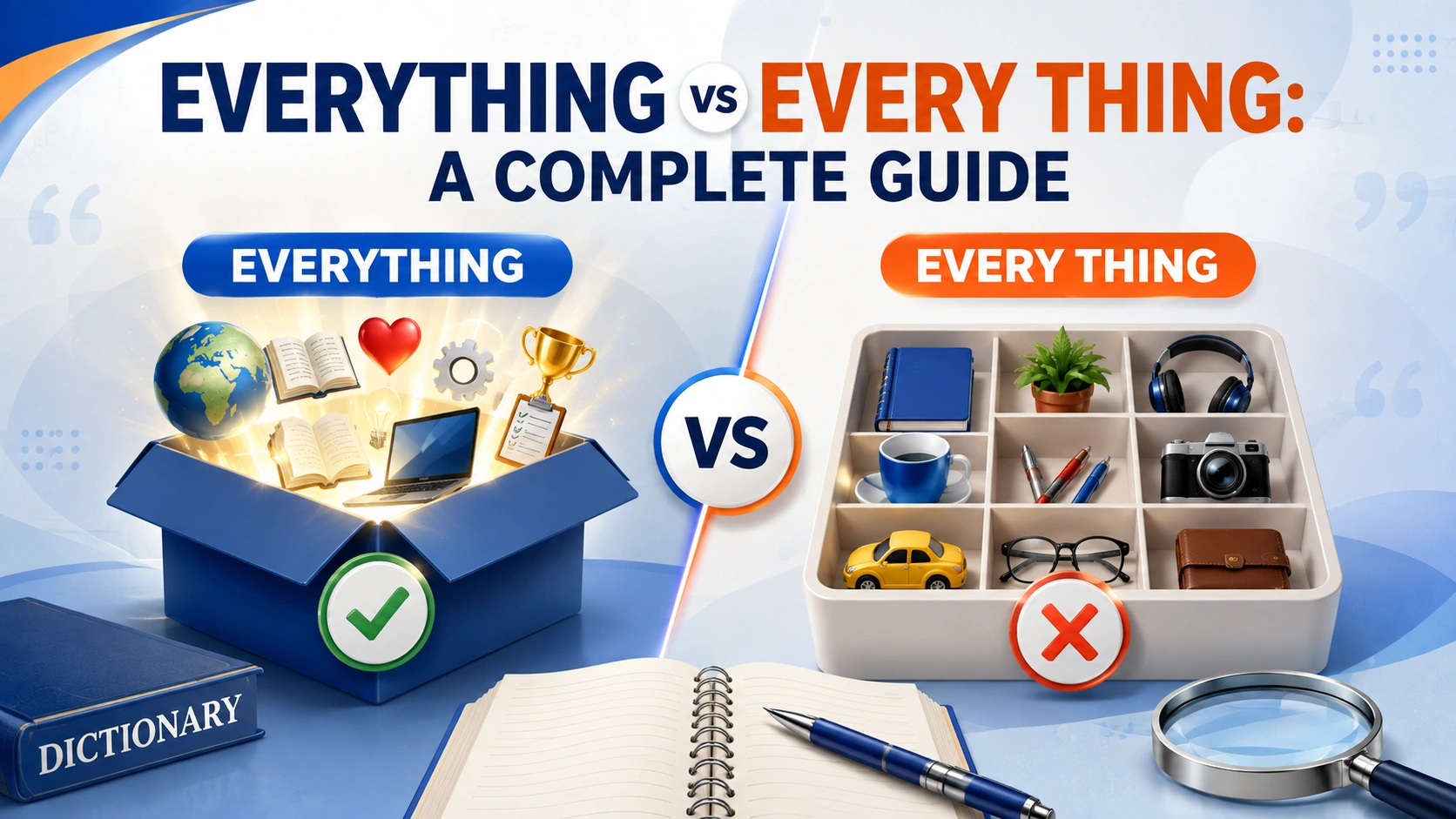
Everything vs every thing can look like a simple spelling question, but the difference is actually grammatical. In most sentences, everything is the correct form because it is an indefinite pronoun meaning “all things” or “all that exists or is relevant.” For example, Everything is ready and I remember everything using the standard one-word form. The two-word combination every thing is possible, but it has a different structure: every function is a determiner modifying the noun thing. That distinction explains why the two forms are not interchangeable simply because they sound identical.
The confusion usually begins because every and thing are both ordinary English words that can appear separately. Learners may therefore assume that everything is just a shortened version of everything. Historically and grammatically, however, modern English treats everything as a single indefinite pronoun in its ordinary “all things” meaning. Meanwhile, every thing is a noun phrase in which everything emphasizes individual items. The difference can be subtle, especially because both expressions can refer to multiple objects in meaning while still following different grammatical patterns.
The good news is that you rarely need to hesitate over this choice. In everyday English, everything is overwhelmingly the natural form when you mean “all things.” The two-word form deserves attention mainly when the thing is being treated as a separate noun and every modifies it directly. This guide explains the grammar behind that distinction, shows how verb agreement works, compares everything with all things, anything, and something, and examines common mistakes. You will also see practical examples that make it easier to recognize which construction fits a sentence.
Quick Answer: Everything or Every Thing?
Everything is the standard one-word form when you mean “all things,” “all that is relevant,” or “the whole situation.”
- ✅ Everything is ready.
- ✅ I packed everything.
- ✅ She knows everything about the project.
Every thing can be grammatically possible when every directly modifies the noun thing, meaning each individual thing.
- ✅ Every thing in the collection was examined separately.
- More natural in many contexts: Every single thing in the collection was examined separately.
The crucial point is that everything is not simply an alternative spelling of everything.
| Form | Grammatical role | Basic meaning | Typical use |
| everything | Indefinite pronoun | all things | Normal everyday English |
| every thing | Determiner + noun | each individual thing | Special or deliberately emphatic contexts |
| every single thing | Determiner + noun phrase | each and every individual thing | Strong emphasis |
| all things | Determiner + plural noun | all things collectively | Formal, literary, or specific contexts |
Rule of thumb: If you can replace the expression with “all things”, use everything in most ordinary sentences.
What Does “Everything” Mean?
Everything is an indefinite pronoun. It refers broadly to all things, all relevant items, or the complete set of things being discussed.
For example:
- Everything is fine.
- I checked everything.
- Everything on the list has been completed.
- She told me everything.
In these sentences, everything does not need another noun immediately after it. It already performs the job of a noun phrase.
Everything can refer to more than physical objects
One useful point for learners is that everything does not necessarily mean every physical object.
It can refer to:
- Objects: Everything in the box is mine.
- Events: Everything happened so quickly.
- Information: He explained everything.
- Circumstances: Everything has changed.
- Activities: Everything we planned was canceled.
- General situations: Everything seems complicated today.
So the meaning is broader than simply “every object.”
Everything usually has a comprehensive meaning
When someone says:
“I packed everything.”
The natural interpretation is that they packed all the relevant things.
That does not necessarily mean literally every object in the universe. Context determines the set being discussed.
For instance:
“I packed everything for the trip.”
means everything necessary or relevant to the trip, not every possession the speaker owns.
That contextual flexibility is one reason everything is so useful in everyday English.
Why “Everything” Is Usually One Word
English contains many indefinite pronouns formed from combinations such as:
- every + one → everyone
- every + body → everybody
- every + thing → everything
- some + thing → something
- any + thing → anything
- no + thing → nothing
These words have developed as established grammatical forms rather than being treated as ordinary adjective-plus-noun combinations.
Compare:
Everyone is here.
with:
Every person is here.
Everyone is a pronoun, while every person is a determiner plus noun phrase.
The same structural distinction applies to:
Everything is ready.
versus:
Every item is ready.
This is why writing everything when you simply mean everything is generally considered incorrect or unnatural in standard modern usage.
Is “everythings” correct?
No. Everythings is not the standard plural form of everything.
Because everything is already an indefinite pronoun referring to an indefinite collection of things, it does not normally take a plural -s ending.
For example:
- ❌ I need to remember everythings.
- ✅ I need to remember everything.
If you need to talk about separate items, use an appropriate plural noun:
- I need to remember all the things.
- I need to remember all the details.
- I need to remember every item.
When Can “Every Thing” Be Two Words?
This is where the explanation becomes more interesting.
Every thing can occur when every is functioning as a determiner and thing is genuinely being used as the noun.
The meaning is closer to “each individual thing.”
For example:
Everything in the laboratory was inspected separately.
Here, the writer is emphasizing individual things rather than simply referring to the entire collection as one conceptual whole.
However, modern English often has more natural alternatives:
Every single thing in the laboratory was inspected separately.
or:
Every item in the laboratory was inspected separately.
This is why everything is much less common than everything.
The easiest test
Ask yourself:
Am I using “thing” as a separate noun and deliberately emphasizing each individual item?
If the answer is no, you almost certainly want everything.
Compare:
Everything was inspected.
This gives a broad, collective idea.
Every single thing was inspected separately.
This emphasizes individual items.
The distinction is not always dramatic, but the grammatical structure is different.
Why “every thing” can sound unnatural
Native English speakers generally expect everything when the intended meaning is simply “all things.”
So a sentence such as:
Everything was ready.
may sound unusual if there is no reason to separate the words.
A reader may wonder whether the writer intended a special emphasis or simply made a spacing error.
For ordinary prose, everything is usually the cleaner and more idiomatic choice.
Everything vs Every Thing: The Grammar Behind the Difference
The most useful way to understand this pair is to stop thinking about spelling and look at grammatical function.
Everything is an indefinite pronoun
An indefinite pronoun stands in for a noun or noun phrase without identifying a particular person or thing.
Examples include:
- everyone
- someone
- anyone
- nobody
- something
- anything
- nothing
- everything
Thus:
Everything is ready.
contains one pronoun, everything, functioning as the subject.
You do not need to add another noun after it.
Every thing is a determiner plus noun
In:
Everything in the room was labeled.
every modifies the thing, and thing is the head noun.
The structure is therefore different:
every + thing
This resembles:
- every book
- every student
- every question
- every item
- every detail
The word thing happens to be the noun being modified.
“All” and “every” do not work identically
Another source of confusion is that all and every express related ideas but have different grammatical behavior.
Compare:
All the books are useful.
with:
Every book is useful.
All normally works with plural or uncountable nouns, whereas every is normally used with a singular countable noun.
Likewise:
Everything is useful.
uses a singular-form verb even though its meaning covers a collection of things.
That grammatical behavior is worth remembering.
Does “Everything” Take a Singular or Plural Verb?
Everything takes a singular verb.
This is one of the most common grammar mistakes associated with the word.
Correct:
- ✅ Everything is ready.
- ✅ Everything looks different.
- ✅ Everything has changed.
- ✅ Everything seems fine.
Incorrect:
- ❌ Everything are ready.
- ❌ Everything look different.
- ❌ Everything have changed.
- ❌ Everything seem fine.
Why does “everything” take a singular verb?
Although everything can refer to many things, it is grammatically treated as a singular indefinite pronoun.
This is similar to:
- Everyone is here.
- Everybody has a ticket.
- Something seems wrong.
- Nothing was damaged.
- Everything looks fine.
The number of real-world objects does not determine the verb. The grammatical form of the pronoun does.
A useful memory trick
Think:
Everything = it
If you can mentally substitute it, a singular verb becomes easier to recognize.
Everything is ready.
→ It is ready.
Everything has changed.
→ It has changed.
This is not a perfect substitution for every sentence, but it is a useful grammar check.
How to Use “Everything” in Different Sentence Positions
Everything as the subject
When everything performs the action or occupies the subject position, use a singular verb.
- Everything looks better now.
- Everything depends on the weather.
- Everything was prepared before noon.
Everything as the object
Everything can also receive the action of the verb.
I checked everything.
She remembers everything.
We discussed everything yesterday.
There is no special verb-agreement issue here because everything is functioning as the object.
Everything after a preposition
You can also use everything after prepositions:
He knows everything about computers.
She worried about everything.
We prepared for everything.
Everything with “else”
Everything else means all the remaining relevant things.
I’ve finished everything else.
Everything else can wait.
Notice that else does not turn everything into a plural expression.
Everything with adjectives
English commonly places certain adjectives after everything:
Everything possible was done.
She tried everything available.
We considered everything necessary for the project.
The adjective or participial phrase follows everything rather than preceding it.
✅Everything in Questions and Negative Sentences
Everything in questions
Everything can appear naturally in questions:
Did you pack everything?
Have you checked everything?
Does everything look okay?
Is everything ready for the meeting?
The meaning depends on the context and the speaker’s assumptions.
For example:
Did you remember everything?
usually means “Did you remember all the relevant things?”
It does not normally mean “Did you remember every object that exists?”
“Not everything” does not mean “nothing”
This distinction is extremely important.
Not everything is expensive.
means some things are not expensive or it is not true that everything is expensive.
It does not mean:
Nothing is expensive.
Compare:
| Sentence | Meaning |
| Everything is expensive. | All relevant things are expensive. |
| Not everything is expensive. | At least some relevant things are not expensive. |
| Nothing is expensive. | No relevant thing is expensive. |
| Something is expensive. | At least one relevant thing is expensive. |
A common mistake is to treat not everything as if it means nothing. It does not.
Why this matters in real communication
Consider:
“Did you like everything about the movie?”
A reply of:
“Not everything.”
does not mean the person disliked the entire movie. It means some aspects were liked and some were not.
This small grammatical distinction can completely change the intended meaning.
Everything vs Every Thing: Examples Side by Side
| Intended idea | Better wording | Why |
| All relevant things | Everything is ready. | Everything is the indefinite pronoun |
| All information | Tell me everything. | Refers broadly to all relevant information |
| Each individual item | Every item was checked. | Every modifies the noun item |
| Strong individual emphasis | Every single thing was checked. | Highlights each thing separately |
| Unusual noun phrase | Everything in the display was inspected. | Thing is intentionally a separate noun |
Compare these two sentences
Everything in the box was damaged.
This treats the contents as a complete set.
Every single thing in the box was damaged.
This strongly emphasizes that each individual item was damaged.
The second sentence is not merely a different spelling of the first. It deliberately creates stronger distributive emphasis.
✅Everything vs All Things
Everything and all things are closely related, but they do not always sound equally natural.
✅Everything
Everything is the normal choice in everyday conversation:
Everything is fine.
I told her everything.
Everything we need is here.
✅All things
- All things are grammatically correct but often sounds more formal, literary, philosophical, or context-specific.
- All things considered, we made the right decision.
- All things being equal, the cheaper option is preferable.
The phrase all things considered is particularly common as a fixed expression.
| Expression | Typical tone | Example |
| everything | Everyday, natural | Everything is ready. |
| all things | Formal/literary or specific | All things considered, we should wait. |
| every thing | Uncommon, individual emphasis | Everything was inspected separately. |
| every single thing | Strong emphasis | She remembered every single thing. |
Everything vs Something vs Anything vs Nothing
These indefinite pronouns form a useful semantic group. Learning them together can prevent several common mistakes.
| Word | Basic meaning | Example |
| everything | all relevant things | Everything is ready. |
| something | an unspecified thing | Something is wrong. |
| anything | any thing at all, often in questions/negatives | Did you find anything? |
| nothing | no thing | Nothing happened. |
Everything vs something
Everything is working.
means all relevant parts or things are working.
Something is working.
means at least one unspecified thing is working.
Everything vs anything
You can choose anything.
means any option is possible.
You can choose everything.
means you can choose all the available options.
These are not interchangeable.
Everything vs nothing
Everything changed.
means all relevant things have changed.
Nothing changed.
means no relevant thing changed.
The contrast is complete: one includes the entire relevant set, while the other excludes it.
Common Mistakes With “Everything”
Mistake 1: Writing “every thing” when you mean “everything”
❌ Every thing is ready.
✅ Everything is ready.
Why: The intended meaning is “all things,” so the indefinite pronoun everything is the natural form.
Mistake 2: Using a plural verb
❌ Everything are finished.
✅ Everything is finished.
Why: Everything is grammatically singular.
Mistake 3: Writing “everythings”
❌ She knows everythings.
✅ She knows everything.
Why: Everything does not normally form a plural by adding -s.
Mistake 4: Assuming every thing is always wrong
❌ Every thing is incorrect in every context.
This is too absolute.
Why: A two-word construction can be grammatically possible when every deliberately modifies the noun thing. It is simply much less common than everything.
Mistake 5: Confusing “not everything” with “nothing”
❌ Treating not everything as meaning nothing.
Compare:
Not everything was broken.
Some things were broken, but others were not.
Nothing was broken.
No relevant things were broken.
Mistake 6: Using “every thing” for emphasis when “every single thing” would be clearer
A writer may intend strong individual emphasis but produce an awkward sentence:
Everything in the room was examined.
Often, this is clearer:
Every single thing in the room was examined.
Or, if precision matters more than emphasis:
Every item in the room was examined.
A Practical Decision Guide
When you are unsure whether to write everything or every thing, use this checklist.
| Question | If the answer is “yes” | Choose |
| Do you mean “all things”? | Broad collective meaning | Everything |
| Can the word stand alone as the subject or object? | Pronoun function | Everything |
| Are you deliberately referring to each individual thing? | Individual/distributive meaning | Every thing or, often better, every single thing |
| Does a specific noun naturally follow every? | Determiner + noun structure | Every + noun |
| Are you writing ordinary modern prose? | No special emphasis needed | Usually everything |
| Are you adding strong emphasis? | Each item matters individually | Every single thing may be clearer |
The “all things” test
Replace the expression with all things.
If the sentence still expresses the intended idea, everything is usually the right choice.
Everything is ready.
→ All things are ready.
The second version is less natural in ordinary conversation, but the meaning of the relationship is clear.
Now consider:
Everything in the museum was cataloged individually.
The writer’s focus is on individual items. A better modern phrasing would often be:
Every single thing in the museum was cataloged individually.
or:
Every item in the museum was cataloged individually.
Why People Confuse “Everything” and “Every Thing”
The confusion is understandable because everything sounds exactly like the sequence “every thing.”
English has many words whose spelling cannot be predicted simply from how they sound. Compound words and established pronouns are especially likely to cause problems for learners.
There is also a meaning overlap.
Both forms can relate to the idea of each or all things, but grammar determines which construction is appropriate.
The safest approach is therefore not to ask:
“Which spelling looks right?”
Instead, ask:
“What grammatical job is this expression performing?”
If it is standing alone as a pronoun meaning “all things,” use everything.
If every is functioning as a determiner modifying a separately meaningful noun thing, a two-word construction may be possible.
Does British English Use “Every Thing” Differently?
There is no major British-versus-American spelling difference comparable to pairs such as colour/color or centre/center.
Everything is standard in both British and American English.
The two-word every thing is not a British spelling of everything, nor is everything an American-only form.
Regional English therefore does not provide a useful reason to choose one over the other.
The real distinction is grammatical and contextual, not geographical.
How “Everything” Behaves in Formal and Informal English
Unlike many slang expressions, everything is completely normal in both informal and formal English.
You can use it in:
Everyday conversation
Everything is okay.
School writing
Everything in the experiment was recorded carefully.
Business communication
Everything required for the meeting has been prepared.
Formal prose
Everything depends on how the evidence is interpreted.
The word itself does not make writing informal. What matters is the surrounding vocabulary and sentence structure.
When “all things” may be preferable
In some formal or established expressions, all things sounds more appropriate:
All things considered, the proposal is reasonable.
Replacing it mechanically with everything would change the expression:
Everything considered, the proposal is reasonable.
This can be grammatical in some contexts, but all things considered is the established idiomatic phrase.
Related Patterns: Everyone, Everybody, Everything, and More
Understanding everything becomes easier when you recognize the broader pattern.
Every + one → everyone
Everyone is welcome.
Not:
❌ Every one is welcome when the intended meaning is “all people.”
However, every one can sometimes occur when one is a separate noun or pronoun and the writer emphasizes individual members:
Every one of the students received a certificate.
Here, every one means each individual person in the group.
Every + body → everybody
Everybody knows that.
Again, it is an established indefinite pronoun.
Every + thing → everything
Everything is ready.
The same basic pattern explains the one-word form.
This comparison gives you a broader grammar principle: do not automatically separate an established indefinite pronoun simply because its component words exist independently elsewhere.
Memory Tricks for Remembering the Difference
Trick 1: Think “all things”
If your intended meaning is all things, choose:
everything
Trick 2: Check the verb
If you write everything, remember:
Everything is, not everything is.
Trick 3: Look for deliberate individual emphasis
If you mean:
each individual thing
consider:
every single thing
rather than forcing the uncommon two-word form.
Trick 4: Remember the pronoun family
Think:
someone → something → somewhere
everyone → everything → everywhere
anyone → anything → anywhere
no one → nothing → nowhere
The patterns help reinforce standard one-word forms.
Practice: Choose the Correct Form
Complete each sentence with everything, every thing, or another suitable expression.
- ________ is ready for the presentation.
- I told him ________ I knew.
- ________ item in the archive was given a separate number.
- She checked ________ twice before leaving.
- ________ single thing on the list had been completed.
- ________ are expensive.
- ________ was damaged in the accident.
- ________ in the collection was photographed individually.
Answers
- Everything
Everything is ready for the presentation. - everything
I told him everything I knew. - Every
Every item in the archive was given a separate number. - everything
She checked everything twice before leaving. - Every
Every single thing on the list had been completed. - Everything is required, not everything is.
Everything is expensive. - Everything
Everything was damaged in the accident. - Every thing can be grammatically interpreted as a determiner plus noun, but every single thing or every item is generally clearer in modern prose:
Every item in the collection was photographed individually.
The exercise illustrates an important point: sometimes the best answer is not simply choosing between two spellings. Rephrasing the sentence can produce clearer English.
Final Comparison: Everything vs Every Thing
| Point | Everything | Every Thing |
| Standard spelling for “all things” | ✅ Yes | ❌ No |
| Indefinite pronoun | ✅ Yes | ❌ No |
| Determiner + noun | ❌ No | ✅ Yes |
| Common in everyday English | ✅ Very common | ❌ Uncommon |
| Takes a singular verb | ✅ Yes | The noun thing is singular |
| Can refer to a whole relevant set | ✅ Yes | Less natural for this purpose |
| Can emphasize individual things | Sometimes, depending on context | ✅ Yes, although every single thing is often clearer |
| British/American spelling difference | None | None |
| Recommended default | Everything | Use only when the separate noun structure is genuinely intended |
Conclusion:
The difference between everything vs every thing is mainly a matter of grammar, not pronunciation. When you mean “all things” or the complete set of relevant things, everything is the standard one-word indefinite pronoun. It can function as a subject or object and takes a singular verb, as in Everything is ready. The two-word form every thing can occur when every separately modifies the noun thing, particularly when individual items are being emphasized, although every single thing or every item is often more natural. One final actionable tip: test your sentence by asking whether you mean “all things” or “each individual thing.” A common mistake to avoid is treating every thing as merely an alternative spelling of everything. In standard everyday English, choose the form that matches the grammar and intended meaning.
FAQs
Q1. Is “every thing” ever grammatically correct?
Yes, although it is uncommon in modern everyday English. Every thing can be grammatical when every function as a determiner modifies the separate noun thing. Writers often prefer every single thing or every item when they want to emphasize individual objects because those alternatives sound clearer and more natural.
Q2. Why is “everything” followed by a singular verb?
Everything is grammatically a singular indefinite pronoun. Although it can refer to many objects or circumstances, it takes singular verb forms: everything is, everything was, and everything has. Its grammatical number does not change simply because its meaning covers multiple things.
Q3. Is “everythings” a correct plural form?
No. Everythings is not standard English. Everything already functions as an indefinite pronoun referring to an entire relevant set, so it does not normally receive a plural -s ending. If you need to identify separate objects, use a plural noun such as things, items, details, or objects.
Q4. Is “everything” the same as “all things”?
They are closely related, but their style and grammatical behavior differ. Everything is the natural everyday indefinite pronoun, while all things is a plural noun phrase that can sound more formal, literary, or idiomatic in expressions such as “all things considered.” Context determines which sounds best.
Q5. What is an easy way to remember everything vs every thing?
Use the “all things” test. If you mean the whole relevant set, write everything: Everything is ready. If you genuinely mean each individual thing, use every thing, although every single thing or every item is often clearer. Also remember: everything takes a singular verb.