

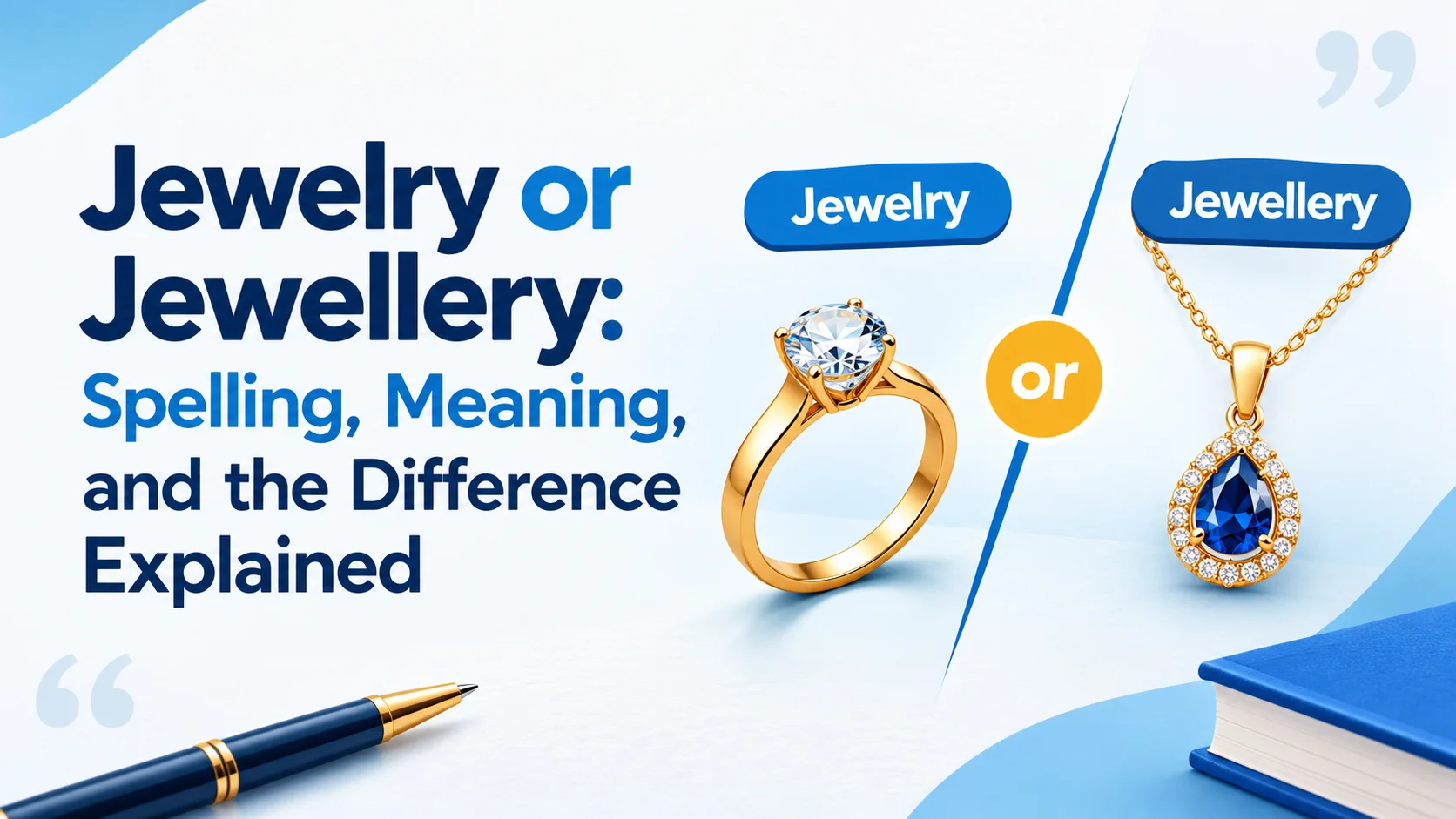
Jewelry or jewellery is a common spelling dilemma because both forms are correct, yet choosing the wrong one for your audience can make otherwise polished writing look inconsistent. The difference is not about the items themselves, their quality, or how they are worn. It comes down to regional English spelling conventions. American English generally uses jewelry, while British English uses jewellery. If you are writing a school assignment, editing a business document, naming an online store, or publishing an article, knowing which version to use will help you communicate more naturally and professionally.
The distinction becomes especially useful when you write for readers in different countries. A US customer is more likely to encounter a jewelry store, while a customer in the UK or Australia will commonly see jewellery in product descriptions and shop names. Neither spelling is more sophisticated, formal, or grammatically correct than the other. Each belongs to a recognized English variety. The important thing is to understand your audience and apply the appropriate convention consistently, rather than switching spellings simply because both appear in search results or online dictionaries.
In this guide, you will learn the difference between jewelry and jewellery, what both words mean, how they are pronounced, and why their spellings developed differently. You will also see practical sentence examples, discover the related forms jeweler and jeweller, and learn how to choose the right spelling for academic writing, business communication, and SEO content. Special attention is given to situations where regional preferences are less straightforward, including Canadian English and international websites. By the end, you will have a simple, reliable way to make the right choice without second-guessing yourself.
Jewelry vs. Jewellery: The Quick Answer
The simplest rule is to match the spelling to the English variety you are using. Cambridge Dictionary identifies jewelry as the US spelling and jewellery as the usual UK spelling.
| Feature | Jewelry | Jewellery |
| Main spelling convention | American English | British English |
| Meaning | Decorative items worn on the body | Same meaning |
| Example | She bought a gold jewelry set. | She bought a gold jewellery set. |
| Related person | Jeweler | Jeweller |
| Common retail phrase | Jewelry store | Jewellery shop |
| Correctness | Correct in its regional context | Correct in its regional context |
One small improvement makes the example sentences more natural: English speakers generally say “a set of jewelry” or “a jewelry set” in American English and “a set of jewellery” or “a jewellery set” in British English. The main point remains unchanged: the spelling differs, but the meaning does not.
Jewelry Is the Standard American English Spelling
In the United States, jewelry is the conventional spelling. You will encounter it in newspapers, product descriptions, shopping categories, advertising, and everyday writing.
Examples:
- The store specializes in handmade jewelry.
- She inherited a collection of antique jewelry.
- The jewelry designer created a necklace for the exhibition.
- Please keep your valuable jewelry in a secure place.
If you are writing for an American audience, use jewelry and maintain the same convention in related words, such as jeweler and jeweled.
Jewellery Is the Standard British English Spelling
In British English, jewellery is the conventional form. The same spelling is commonly used in Australian, New Zealand, and several other varieties of English.
Examples:
- The shop sells handmade jewellery.
- She inherited a collection of antique jewellery.
- The jewellery designer created a necklace for the exhibition.
- Please keep your valuable jewellery in a secure place.
For British-oriented writing, use jewellery alongside related forms such as jeweller and jewelled.
Are Both Spellings Grammatically Correct?
Yes. Both spellings are accepted English variants. The choice is a matter of regional spelling convention, not grammar.
A British writer who uses jewellery in a UK publication is following standard practice. An American writer who uses jewelry in a US publication is doing the same.
However, consistency matters. If a report begins with jewelry and later switches to jewellery without a reason, readers may assume the text has not been carefully edited. Neither spelling is wrong by itself; the unexplained change is the problem.
What Is the Difference Between Jewelry and Jewellery?
Both words describe decorative objects worn on the body, including rings, necklaces, bracelets, earrings, brooches, and other ornaments. They can refer to expensive pieces made with gold, silver, or precious stones, as well as affordable accessories made from glass, beads, or other materials.
The distinction is entirely about how the word is written in different varieties of English.
Do Jewelry and Jewellery Mean the Same Thing?
Yes. Neither spelling indicates a particular material, design, price, or level of craftsmanship.
For example, consider a silver bracelet with a small gemstone. An American retailer might describe it as a piece of jewelry, while a British retailer might call it a piece of jewellery. Both descriptions refer to the same kind of item.
The same principle applies to:
- Fine jewelry/jewellery: Often refers to pieces made with precious metals or gemstones.
- Costume jewelry/jewellery: Usually refers to decorative accessories made from less expensive materials.
- Antique jewelry/jewellery: Refers to older decorative pieces, with the precise age criteria depending on the context.
- Handmade jewelry/jewellery: Describes pieces made by hand.
These expressions retain their meanings regardless of the spelling convention.
Is There a Difference in Pronunciation?
Usually, no meaningful difference distinguishes the two spellings. Both are commonly pronounced with sounds resembling JOO-uhl-ree or JOOL-ree, depending on the speaker’s accent and speaking style. Cambridge Dictionary provides pronunciation guides for both forms.
Some speakers pronounce the word with a more noticeable middle vowel, while others compress the sounds into a shorter pronunciation.
The important point for learners is that the extra letters in jewellery do not require an extra syllable.
Do not try to pronounce every written letter separately. Listen to speakers of the English variety you are learning, and use a dictionary’s audio pronunciation when you need confirmation.
Is Jewelry or Jewellery a Noun?
Both are nouns. More specifically, they are generally treated as uncountable nouns when referring to jewelry or jewellery collectively.
That is why these sentences are natural:
- She owns some beautiful jewelry.
- He bought a piece of jewellery.
- The museum displays historical jewelry.
- The shop sells handmade jewellery.
When referring to individual objects, use a countable noun such as ring, bracelet, or necklace, or use the expression piece of jewelry/jewellery.
Can You Say “A Jewelry” or “A Jewellery”?
Usually, no—not when you mean one decorative item.
Because jewelry and jewellery are normally uncountable, the following constructions sound unnatural in standard English:
- “I bought jewelry.”
- “She gave me jewellery.”
Use one of these alternatives instead:
- “I bought a piece of jewelry.”
- “She gave me a piece of jewellery.”
- “I bought a ring.”
- “She gave me a necklace.”
The distinction is useful because it involves grammar, not merely spelling. Changing jewelry to jewellery does not change how the noun behaves in a sentence.
Jewelry vs. Jewellery in American, British, and Other English Varieties
The most reliable way to choose between the spellings is to identify the English variety required by your audience or publication.
| Region or context | Recommended spelling | Practical guidance |
| United States | Jewelry | Use standard US spelling. |
| United Kingdom | Jewellery | Follow British spelling conventions. |
| Australia | Jewellery | Use the usual Australian form. |
| New Zealand | Jewellery | Use the usual New Zealand form. |
| Canada | Jewellery or jewelry | Both are accepted; Canadian government writing guidance prefers the double-l forms. |
| International publication | Depends on house style | Select a consistent convention or localize content by market. |
The Canadian guidance is particularly useful because it shows why a simple rule based on geography can sometimes be misleading: Canada’s Language Portal states that Canadian writers prefer the double-l forms but accept both spellings.
American English: Jewelry
American English generally uses the shorter spelling. This convention also appears in related words:
- Jewelry
- Jeweler
- Jeweled
- Jeweling
For a US product page, a natural heading would be “Handmade Jewelry for Everyday Wear.”
Using jewellery instead would not make the page incomprehensible, but it would depart from the usual American spelling convention.
British English: Jewellery
British English generally uses the longer spelling and corresponding forms:
- Jewellery
- Jeweller
- Jewelled
- Jewelling
For a UK product page, “Handmade Jewellery for Everyday Wear” would be the natural choice.
A writer should not assume that every word with an additional l follows exactly the same rule. English spelling contains several historical patterns, so each word should be checked when uncertain.
Australian and New Zealand English: Jewellery
Australian and New Zealand English generally follow the jewellery spelling.
For instance, an Australian retailer might write, “Our jewellery collection features locally designed silver earrings.”
The practical advice is straightforward: if your readers are primarily in Australia or New Zealand, use jewellery unless a company style guide or established brand name specifies otherwise.
Canadian English: Jewelry or Jewellery?
Canadian English can be confusing because its spelling conventions draw on both British and American usage.
For this particular word, the Canadian government’s Language Portal explicitly accepts both jewelry and jewellery, while indicating a preference for double-l forms.
If you are writing for a Canadian school, publisher, business, or government organization, follow its style guide. If no guidance exists, choose one form and use it consistently.
Which Spelling Should International Websites Use?
There is no single spelling strategy that works best for every international website. The right approach depends on the intended audience and how the site is organized.
Consider a retailer selling products in the United States and the United Kingdom. It could use:
- A US product page titled “Gold Jewelry Collection.”
- A UK product page titled “Gold Jewellery Collection.”
This makes the language feel natural to each audience while preserving the same product information.
If the website has only one general English version, select a consistent house style. Do not alternate spellings merely to include more keywords. The goal is to make the page clear and trustworthy, not to force every spelling variant into the text.
Why Are There Two Spellings of Jewelry?
The difference reflects the history of English spelling. Over centuries, words developed through different linguistic influences, and spelling conventions gradually became more standardized in different regions.
Where Does the Word Jewelry Come From?
The word is connected to jewel, which refers to a precious or decorative stone or an ornament. Historical forms of jewelry developed from earlier English and Anglo-French usage. Dictionary sources trace the word to forms associated with jewel and the suffix -ery.
This history helps explain why the words look similar. Jewelry and jewellery are not separate words that happen to describe the same objects; they are regional spellings of the same noun.
Why Does British English Include an Extra “L”?
British and American English developed different spelling preferences for a number of words. Some familiar examples include:
- Color / colour
- Favorite / favourite
- Traveling / travelling
- Jewelry / jewellery
These pairs are useful illustrations, but they should not be treated as a single universal formula. English spelling has several patterns, and the differences depend on individual word histories and established conventions.
For jewelry/jewellery, the most useful approach is to learn the standard form for your intended variety of English rather than trying to derive it from a broad spelling rule.
Did Noah Webster Influence American Spelling?
Yes. Noah Webster helped promote and popularize several American spelling conventions through his dictionaries and educational publications. His work contributed to the development of a more distinct American written standard.
However, it would be an oversimplification to attribute every difference between American and British spelling to Webster alone. Regional usage evolved over time through dictionaries, publishers, schools, and everyday writing.
For practical purposes, you do not need to know the entire history to spell the word correctly. Understanding that the variants are regional forms is enough for most writing tasks.
Jewelry or Jewellery in Real-Life Sentences
Examples are often the fastest way to understand how a spelling choice works. The sentences below show each form in natural contexts.
Examples Using Jewelry in American English
- The boutique sells handmade jewelry from independent designers.
- She wore a silver necklace with matching jewelry.
- The jewelry designer presented a new collection at the exhibition.
- He keeps his valuable jewelry in a small locked box.
- The store offers repairs for damaged jewelry.
- Her grandmother gave her a beautiful piece of jewelry.
Examples Using Jewellery in British English
- The boutique sells handmade jewellery from independent designers.
- She wore a silver necklace with matching jewellery.
- The jewellery designer presented a new collection at the exhibition.
- He keeps his valuable jewellery in a small locked box.
- The shop offers repairs for damaged jewellery.
- Her grandmother gave her a beautiful piece of jewellery.
Notice that the meaning and grammatical structure remain the same. Only the regional spelling changes.
Before-and-After Examples for Editing
Suppose you are editing a product description for a British retailer:
Before: Our jewelry collection includes necklaces, rings, and bracelets.
After: Our jewellery collection includes necklaces, rings, and bracelets.
The revised sentence follows British spelling conventions without changing its message.
Now consider an American publication:
Before: The exhibition showcases antique jewellery from several European collections.
After: The exhibition showcases antique jewelry from several European collections.
The appropriate edit depends on the publication’s style, not on whether the original spelling is universally wrong.
Common Jewelry and Jewellery Spelling Mistakes
Most errors arise from mixing regional conventions, misunderstanding noun usage, or trusting automated spelling suggestions without checking the language settings.
Mixing Jewelry and Jewellery in the Same Document
Inconsistent spelling can distract readers and make professional writing look insufficiently edited.
For example:
Our jewellery collection includes necklaces and rings. We also offer custom jewelry design.
Both spellings are valid, but the unexplained switch is inconsistent.
A better British English version would use jewellery throughout. A US version would use jewelry throughout.
There are exceptions. An article comparing regional English, a direct quotation, or an official business name may legitimately preserve different spellings.
Confusing Jewelry With Jeweler or Jewellery With Jeweller
The regional differences extend to the person who makes, repairs, or sells jewelry.
- American English: jewelry, jeweler
- British English: jewellery, jeweller
Examples:
- US: “The jeweler repaired my gold necklace.”
- UK: “The jeweller repaired my gold necklace.”
The word jewel itself is spelled the same way in both varieties.
Assuming Jewellery Is More Formal Than Jewelry
The longer spelling does not make jewellery more elegant, sophisticated, or professional. Similarly, jewelry is not an informal shortcut.
The choice depends on regional convention. A formal British report would normally use jewellery, while a formal American report would normally use jewelry.
Trusting Spell-Check Without Checking Language Settings
A spelling checker may flag a valid word if the document is configured for another English variety.
For example, a document set to US English may suggest replacing jewellery with jewelry. That suggestion is appropriate if you are standardizing an American document, but not necessarily if you are editing a British publication.
Practical tip: Before accepting spelling corrections, check whether your software is set to American, British, Canadian, or another relevant English variety.
Related Words: Jewelry, Jewellery, Jeweler, and Jeweller
Related terms matter because consistent spelling involves more than one word. A writer who uses jewellery but repeatedly writes jeweler may unintentionally mix British and American conventions.
| American English | British English | Meaning |
| Jewelry | Jewellery | Decorative items worn on the body |
| Jeweler | Jeweller | A person who makes, sells, or repairs jewelry |
| Jeweled | Jewelled | Decorated with jewels |
| Jeweling | Jewelling | The act or process of adding jewels, in relevant contexts |
| Jewelry store | Jewellery shop (common) | A retail business selling jewelry |
The Canadian government’s writing guidance also recognizes the one-l and two-l forms in these related words and recommends consistency within the same text.
Jewelry vs. Jeweler
Jewelry refers to the objects, while a jeweler is the person who works with them.
For example:
- “The jewelry was displayed in a glass case.”
- “The jeweler repaired the damaged clasp.”
The British equivalents are jewellery and jeweller.
Jewelry Store vs. Jewellery Shop
American businesses commonly use the phrase jewelry store. In British English, jewellery shop is common, although jewellery store is also understandable and used.
This distinction is partly about vocabulary preference, not just spelling. Shop and store are themselves regional usage choices, so there is no need to force a strict one-to-one equivalence.
Jewelry-Making and Jewellery Design
Longer expressions should follow the same regional convention as the main word.
Examples include:
- American English: jewelry making, jewelry design, jewelry repair.
- British English: jewellery making, jewellery design, jewellery repair.
In headings, image descriptions, category names, and product copy, apply the same standard you use in the body text.
Which Spelling Should You Use in Different Situations?
The right choice becomes easier when you consider the purpose of the document and the people who will read it.
| Situation | Best practice |
| US school assignment | Use jewelry unless instructed otherwise. |
| UK school assignment | Use jewellery. |
| Professional report | Follow the organization’s style guide. |
| US e-commerce website | Prefer jewelry in US-targeted content. |
| UK e-commerce website | Prefer jewellery in UK-targeted content. |
| Canadian publication | Check the house style; both forms are accepted. |
| International website | Choose a consistent convention or localize regional pages. |
| Quotation or official brand name | Preserve the original spelling when required. |
For School Assignments and Academic Writing
Follow your teacher’s instructions, the institution’s writing guidelines, or the required style guide. If no variety is specified, check the spelling conventions used in the rest of your assignment.
Consistency is especially important in longer academic work, where a single regional spelling should normally be used throughout the text.
For Business Writing and Professional Documents
Companies often establish a house style to keep reports, marketing materials, and customer communications consistent.
If you are editing a document for someone else, do not automatically replace every unfamiliar spelling. First determine whether it reflects the client’s chosen English variety.
For E-Commerce Stores and Product Descriptions
A retailer should use language familiar to its intended market. Regional spelling can make product descriptions feel more natural and reduce unnecessary confusion.
For example, a US category might be called “Gold Jewelry,” while a UK version might use “Gold Jewellery.”
Keep the product title, category, page copy, and relevant metadata aligned with the same language convention.
For SEO Content and Search Keywords
When writing about jewelry or jewellery, choose the primary spelling based on your target audience and the language variety of the page.
Useful practices include:
- Use the relevant regional spelling in the title and main headings.
- Write naturally rather than repeating both forms in every paragraph.
- Include the alternate spelling when it genuinely helps explain the difference.
- Keep regional landing pages consistent with their intended audiences.
- Avoid changing a valid spelling simply because an automated tool flags it.
SEO insight: A useful article answers the reader’s question clearly. Repeating jewelry or jewellery unnaturally throughout the page adds little value; explaining the regional distinction and giving practical examples is more helpful.
For International or Mixed-Audience Publications
If your readers come from several countries, decide whether your publication uses one main English variety or offers localized versions.
A single article can use one consistent spelling while explaining the alternative near the beginning. If you publish separate regional pages, each can follow its own conventions.
Preserve original spelling in quotations and official names when accuracy requires it, even if those forms differ from your house style.
How to Remember the Difference Between Jewelry and Jewellery
A short memory aid is often enough:
- US = jewelry: The shorter spelling is standard in American English.
- UK = jewellery: The longer spelling is standard in British English.
Then check the related words. If you choose jewelry, you will generally use jeweler and jeweled. If you choose jewellery, you will generally use jeweller and jewelled.
The final check is your audience. A British writer does not need to correct an American source merely because it uses jewelry. The goal is not to make every English text follow the same spelling system; it is to use the appropriate system consistently.
Conclusion:
The difference between jewelry and jewellery is simple once you recognize that English has regional spelling conventions. Jewelry is the standard American form, while jewellery is the standard British form and is also common in several other English varieties. Both words have the same meaning, and neither is inherently more correct or professional.When writing for a particular audience, use its preferred spelling and check any relevant style guide. For international content, decide whether one consistent convention or separate localized pages will serve readers better. One final actionable tip: check your document’s language settings before running a spelling review. A common mistake to avoid is treating a legitimate regional spelling as an error or switching between variants without a clear reason. Good writing is not about forcing English into one universal form; it is about choosing the right form for your readers and using it confidently.
FAQs
Q1. Is “Jewelery” Ever the Correct Spelling?
In standard modern English, the usual forms are jewelry in American English and jewellery in British English. Jewelery is generally considered a misspelling. If a spelling checker suggests it, verify the dictionary entry rather than assuming that every variation is accepted.
Q2. Is “Jewelry” Countable or Uncountable?
Jewelry is generally uncountable when it refers to decorative items collectively. You would normally say “some jewelry” or “a piece of jewelry,” not “three jewelries.” To count individual items, name them directly: three rings, two bracelets, or four necklaces.
Q3. Should Product Names Keep Their Original Regional Spelling?
Yes, when the spelling forms part of an official product name, registered brand name, or direct quotation, preserve it as appropriate. Editorial consistency should not override accuracy. In surrounding descriptive text, however, follow the spelling convention chosen for the publication or localized website.
Q4. Does “Jewellery” Include Costume Jewelry?
Yes. Jewellery is a broad term for decorative items worn on the body; it does not require every piece to contain precious metals or genuine gemstones. Costume jewellery can be made from materials such as glass, beads, and inexpensive metals. The American equivalent is costume jewelry.
Q5. Which Spelling Should English Learners Memorize?
Start with the spelling used in the variety of English you are studying. If you are learning American English, memorize jewelry; if you are learning British English, memorize jewellery. Learn the corresponding forms jeweler/jeweller together so that the spelling pattern becomes easier to recognize.