

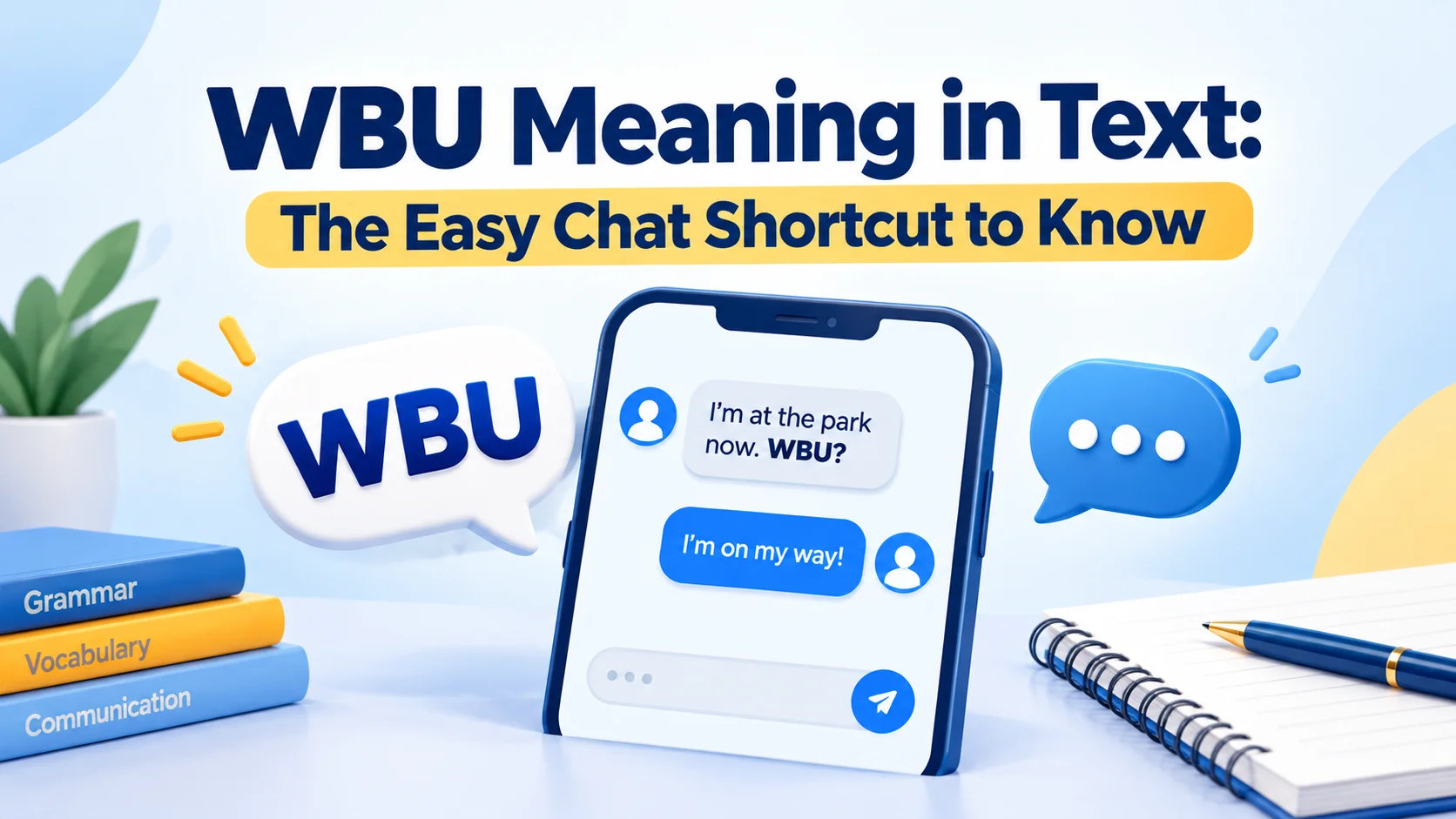
WBU meaning in text is “What About You?” People use this common texting abbreviation to return a question, invite someone to share their opinion, or keep a conversation going without typing the full phrase. You might see it after someone tells you about their day, shares a preference, or answers a question about their plans. Although WBU is short, its meaning depends on the conversation around it. Understanding when to use it, how to reply naturally, and when a more complete sentence works better can help you communicate confidently in text messages, social media chats, and everyday online conversations.
Texting abbreviations save time, but they can also leave room for misunderstanding. If a friend texts, “I’m watching a movie, wbu?” they probably want to know what you are doing. If someone asks, “I love comedy films, wbu?” they are asking about your taste in movies instead. In both cases, WBU invites you to contribute something about yourself. It is generally casual and friendly, although the surrounding words, punctuation, and relationship between the people can affect how it sounds. Recognizing these small differences helps you understand the message without reading too much into it.
In this guide, you will learn the meaning of WBU in texting, how people use it in different situations, and how to respond without making the conversation awkward. You will also discover the difference between WBU, HBU, WYD, and similar abbreviations, along with examples for friends, group chats, social media, and professional communication. We will look at whether WBU can sound rude or flirty, when it is better to write the complete phrase, and what to do if the abbreviation appears in an unfamiliar context. By the end, you should be able to recognize and use WBU naturally.
What Does WBU Mean in Text?
WBU stands for “What About You?” It is an informal abbreviation commonly used in text messages, instant messaging, and online conversations.
People generally use it to return a question to someone who has just shared information or expressed an opinion.
For example:
Alex: “I’m going to the library after school. WBU?”
Sam: “I’m heading home.”
Alex shares a plan and then asks Sam about theirs. Instead of typing “What about you?”, Alex uses the shorter WBU.
The abbreviation can refer to many things, including:
- Activities: “I’m playing football later. WBU?”
- Preferences: “I prefer tea. WBU?”
- Feelings: “I’m feeling much better today, wbu?”
- Plans: “We’re meeting at six. WBU?”
- Opinions: “I think the new movie was great. WBU?”
The key is that WBU usually asks the other person to share a comparable answer. The exact information it requests comes from the preceding message.
Is WBU an Acronym or Texting Abbreviation?
WBU is best described as an initialism or texting abbreviation. Its letters represent the first letters of “What,” “About,” and “You.”
In everyday conversation, people usually say the complete phrase aloud rather than pronounce the letters W-B-U. The abbreviation is primarily useful in written digital communication, where speed and convenience often matter.
You may see it written as WBU, wbu, or occasionally with punctuation, such as “Wbu?” These variations normally carry the same meaning. Capitalization does not usually change the message.
Why Do People Say WBU Instead of “What About You?”
The main reason is convenience. WBU communicates a familiar question in just three letters, making it easy to type during quick exchanges.
However, its usefulness goes beyond saving a few keystrokes.
It Makes Conversations More Balanced
Imagine a friend asks how your weekend went. You tell them about a football match you watched and then ask, “WBU?”
You have answered their question while giving them an opportunity to talk about their own experience. This creates a natural back-and-forth rather than allowing one person to dominate the conversation.
It Shows Interest in the Other Person
WBU can signal that you are interested in someone else’s answer, experience, or opinion.
For example:
You: “I really enjoyed the school trip.”
Friend: “Nice! WBU about the museum visit?”
The wording is a little awkward because “WBU about” repeats the idea in the abbreviation. A more natural message would be “I really enjoyed the school trip. WBU?” or “What did you think about the museum?”
This illustrates an important point: shorter is not always clearer. Use WBU when the intended question is obvious.
It Fits the Rhythm of Casual Messaging
People often send messages in short bursts rather than writing complete paragraphs. WBU fits that style, especially when both participants already understand the topic.
Still, the abbreviation is optional. Typing “What about you?” can feel warmer, more deliberate, or simply easier to understand when the conversation is complicated.
WBU Examples in Text Messages and Online Chats
The meaning of WBU stays broadly consistent across platforms, but the situation determines what the sender wants to know.
| Situation | Example message | What WBU asks |
| Daily activities | “Just finished my homework, wbu?” | What are you doing? |
| Feelings | “I’m excited for tomorrow. WBU?” | How do you feel? |
| Food preferences | “I love pizza. WBU?” | What food do you like? |
| Weekend plans | “We might go shopping. WBU?” | What are your plans? |
| Opinions | “I think the ending was confusing. WBU?” | What do you think? |
| School or work | “I finished my assignment. WBU?” | Have you finished yours? |
Notice that WBU does not have one fixed follow-up question. It borrows its subject from the conversation.
WBU in a Conversation Between Friends
Mia: “I’m staying home tonight.”
Noah: “Same here, probably watching a series. WBU tomorrow?”
Mia: “I might visit my cousins.”
Here, WBU helps Noah ask about Mia’s plans. In more natural wording, he could also say, “What about tomorrow?” The best choice depends on whether the conversation is already casual and abbreviated.
WBU When Getting to Know Someone
Riya: “I like reading mystery novels. WBU?”
Zara: “I’m more into fantasy books.”
The abbreviation invites the other person to share a preference. It can help a new conversation move beyond basic introductions, but it does not automatically indicate romantic interest.
WBU in WhatsApp and Private Messages
Message: “I’m free after 4 p.m. WBU?”
The sender wants to know whether the other person is also available. Depending on the context, this could help arrange a meeting or simply compare schedules.
WBU on Instagram, Snapchat, and TikTok
WBU may appear in direct messages, comments, or replies when users exchange opinions, plans, and personal preferences.
For example:
Comment: “This song has been on repeat all day. WBU?”
The commenter is likely asking whether the other person also enjoys the song or has been listening to it.
On any platform, read the surrounding message before deciding what WBU refers to. Social media does not give the abbreviation a completely different meaning.
What Does WBU Mean in Different Situations?
The relationship between the sender and receiver can influence how WBU feels, even though the basic definition remains the same.
WBU Between Friends
Among friends, WBU is usually a straightforward way to answer a question.
Example: “I’m ordering noodles for dinner. WBU?”
The sender might be asking what you plan to eat. If you are close friends, the abbreviation will usually feel ordinary rather than formal or distant.
WBU in a Conversation With Someone You Like
When someone you like uses WBU, it may show that they want to keep talking. However, the abbreviation itself is not proof of flirting or romantic interest.
Consider these messages:
- “I like horror movies, wbu?” — asks about your taste in films.
- “I had fun talking to you today. WBU?” — asks how you feel about the conversation.
The second message has a more personal context, but the meaning comes from the complete sentence, not the three-letter abbreviation alone.
WBU in Family or Group Chats
In family chats, WBU can help people exchange updates quickly.
Example: “We’re having lunch at Grandma’s on Sunday. WBU?”
The message could be asking about the recipient’s plans or whether they can attend, depending on the preceding discussion.
In group chats, the sender may not be addressing everyone equally. If the intended recipient is unclear, a direct question such as “What about you, Sara?” can prevent confusion.
WBU at Work or in Professional Messages
WBU may appear between colleagues who communicate informally, particularly in quick team chats.
For example:
“I’m available for the meeting at 2. WBU?”
This is understandable, but it may be too casual for a client, a formal email, or a conversation with someone who expects professional language.
A clearer alternative is:
“I’m available for the meeting at 2 p.m. Are you available then as well?”
Choose wording according to the relationship, workplace culture, and importance of the message.
Does WBU Sound Friendly, Rude, or Flirty?
WBU is not inherently rude or flirty. It is a neutral, informal question that can sound different depending on the conversation.
When WBU Sounds Friendly
A friendly exchange often includes a clear answer, a related question, or an encouraging comment.
Example:
“I had a great time at the concert! WBU?”
The sender shares an experience and invites you to share yours. This is a normal way to maintain a conversation.
Can WBU Sound Flirty?
It can appear in flirtatious conversations, but it does not create a flirtatious meaning on its own.
For instance, someone might write, “I was thinking about our conversation earlier. WBU?” Whether this is flirtatious depends on the relationship and the broader exchange.
Avoid assuming someone has romantic feelings simply because they use WBU or ask you a personal question. Look at the overall conversation rather than treating one abbreviation as a reliable signal.
Why a Short WBU Message Might Seem Rude
Sometimes a very brief reply can feel abrupt, especially after someone has shared something important. However, brevity alone does not establish that the sender is annoyed.
Possible explanations include:
- The sender is busy and typing quickly.
- Both people normally use short messages.
- The sender expects a simple answer.
- The previous message already provides enough context.
- The sender prefers a more detailed conversation but has not expressed it clearly.
If the tone genuinely matters, ask a calm follow-up rather than guessing. For example, “Did you mean you wanted to know my plans for tonight?” is more reliable than assuming the sender is upset.
How Punctuation and Emojis Affect the Tone
Compare these messages:
- “WBU?” — a simple, direct question.
- “WBU 😊” — may feel warmer or more encouraging.
- “WBU??” — may suggest urgency, surprise, or impatience, depending on context.
- “And why?” — a casual way to return a question.
These are possible interpretations, not universal rules. Different people use punctuation and emojis differently, so context matters more than any single symbol.
How to Reply When Someone Texts You WBU
The easiest way to reply is to identify the topic of the message, answer that topic, and add a follow-up if you want the conversation to continue.
Simple and Casual Replies to WBU
If someone asks what you are doing, you can answer directly:
Message: “I’m watching a documentary, wbu?”
Possible replies:
- “Just listening to music.”
- “Doing my homework.”
- “Not much, just relaxing.”
- “I’m out with my family.”
If the original topic is your opinion or preference, respond to that instead. For example, if someone says, “I prefer summer, ebu?”, you might answer, “I like spring more.”
Replies That Keep the Conversation Going
A useful reply often gives the other person something new to respond to.
Message: “I love mystery books. WBU?”
Basic reply: “Same.”
More engaging reply: “I like mystery books too. Have you read any good ones lately?”
The second reply shares a preference and opens another conversational path. You do not need to ask for a follow-up every time, but it helps when you want to continue chatting.
Funny Replies to WBU
Humor works when it fits the relationship and the topic.
If a friend asks, “I’m doing absolutely nothing, wbu?”, you could respond:
- “Professional relaxing over here too.”
- “Trying to decide what to do with my free time.”
- “Currently negotiating with my homework.”
Keep jokes relevant to the conversation. A funny reply is less useful if it avoids a serious question or makes the other person feel ignored.
Replies When You Do Not Want to Share Much
You are not required to reveal personal information just because someone asks WBU.
Depending on the context, you can say:
- “Nothing much right now.”
- “Just having a quiet day.”
- “I’m keeping busy, thanks.”
- “I’d rather not get into that at the moment.”
If the question concerns something private, a polite boundary is appropriate. WBU is an invitation to answer, not an obligation to disclose information.
A Quick Method for Choosing Your Reply
Use this simple three-step approach:
- Look back: Identify what the sender shared or asked about.
- Answer the matching topic: Talk about your own activity, feeling, plan, or opinion.
- Choose the level of detail: Give a short answer for casual chat or a fuller response when the topic deserves it.
This method works whether the message arrives by SMS, WhatsApp, Instagram, or another messaging service.
WBU vs. HBU vs. WYD: What Is the Difference?
WBU is often confused with other texting abbreviations because they appear in similar conversations. The important distinction is what each one asks.
| Abbreviation | Full form | Main purpose | Example |
| WBU | What About You? | Returns a question or asks for your perspective | “I like action movies. WBU?” |
| HBU | How About You? | Offers a similar invitation to respond | “I’m free on Saturday. HBU?” |
| WYD | What Are You Doing? | Asks what someone is doing | “WYD tonight?” |
| WYA | Where Are You At? | Asks where someone is | “WYA? We’re outside.” |
| HRU | How Are You? | Asks how someone is feeling or doing | “Hey, HRU?” |
WBU vs. HBU
WBU and HBU are very similar. Both can return a question or invite someone to share a comparable answer.
For example:
- “I’m going to the park. WBU?”
- “I’m going to the park. HBU?”
Both ask about the other person’s plans. In many casual conversations, the difference is too small to matter.
A subtle distinction is that “what about you?” often points back to the same subject, while “how about you?” can also suggest an alternative or proposal. In everyday texting, however, their meanings frequently overlap.
WBU vs. WYD
WYD asks what someone is doing. WBU asks about the other person in relation to the existing topic.
Compare:
“WYD?” — The sender wants to know what you are doing.
“I’m studying for my test. WBU?” — The sender wants to know what you are doing in response to their own update.
The phrases can overlap when the conversation is about activities, but they are not interchangeable in every situation.
WBU vs. WYA and HRU
WYA focuses on location, while HRU focuses on how someone is doing. WBU is broader because it depends on the preceding topic.
For example, if someone says, “I’m feeling better today,” a WBU response may invite you to share how you feel. If they say, “I’m at the mall,” WBU may invite you to share where you are or what you are doing.
The context supplies the missing question. That is why reading the full exchange is more useful than memorizing abbreviations in isolation.
Common Mistakes to Avoid When Using WBU
Although WBU is simple, a few mistakes can make messages confusing or poorly suited to the situation.
Assuming WBU Always Asks What Someone Is Doing
WBU does not automatically mean “What are you doing?” That is closer to WYD.
If someone says, “I think the book was excellent, wbu?”, they want your opinion of the book, not a report on your current activity.
Using WBU Without a Clear Topic
A message such as “WBU?” can be confusing if the conversation has several possible topics or has been inactive for a long time.
Instead, make the reference clear:
- “I’m free this afternoon. WBU?”
- “I enjoyed the film. What did you think?”
- “I’m planning to study tonight. What about you?”
The longer alternatives are sometimes better because they reduce ambiguity.
Treating Every Short Message as Rude
People have different texting habits. One person may send full sentences, while another uses abbreviations throughout the day.
Do not assume a sender is angry, uninterested, or dismissive based solely on “wbu.” Consider their usual communication style and the surrounding messages before drawing conclusions.
Using WBU in Formal Communication
WBU is an informal internet language. It may be perfectly acceptable in a relaxed team chat but less suitable in a job application, formal email, academic request, or message to an unfamiliar professional contact.
When in doubt, write the complete phrase or formulate the question more precisely.
Adding Redundant Words
Avoid constructions such as “What about you, WBU?” unless you have a specific reason to repeat the phrase. WBU already stands for “What About You?”
Choose either the abbreviation or the complete wording to keep the message natural.
Is WBU Appropriate for Everyone and Every Platform?
WBU is generally suitable for informal digital conversations when the people involved understand common texting abbreviations.
It can be useful with friends, classmates, relatives, and colleagues who regularly communicate casually. But a person’s age, background, language familiarity, and communication preferences can affect how readily they recognize it.
| Communication setting | Is WBU suitable? | Better approach when uncertain |
| Friends and familiar contacts | Usually | Use WBU naturally if both people understand it. |
| Family group chats | Often | Use the full phrase if some members may not recognize it. |
| Social media DMs | Usually | Follow the other person’s communication style. |
| School-related messages | Depends | Use complete wording for teachers or important requests. |
| Workplace instant messaging | Depends on workplace culture | Use a clear, professional question. |
| Formal emails or applications | Generally not recommended | Write “What about you?” or a more specific question. |
| Important or sensitive conversations | Usually better to avoid shorthand | Use clear wording that communicates care and intent. |
Should You Write WBU or “What About You?”
Use WBU when the exchange is casual and the topic is obvious. Choose the complete phrase when clarity, warmth, or professionalism matters more than speed.
For example:
Casual: “I’m free after school, wbu?”
Clearer and more formal: “I’m available after school. What about you?”
Professional: “I’m available after 3 p.m. Would that time work for you as well?”
The goal is not to avoid abbreviations altogether. It is to choose language that suits the reader and the purpose of the message.
Other Meanings of WBU
In everyday texting, WBU most commonly means “What About You?” However, abbreviations can have other meanings in specialized communities, organizations, or technical settings.
If you encounter WBU in a document, a workplace system, or a conversation unrelated to personal messaging, do not automatically assume the texting definition applies. Look at the surrounding words and subject matter.
For example, an organization might use the same letters as an internal abbreviation or name. That does not change the ordinary texting meaning; it simply means the context is different.
When the intended meaning remains unclear, ask the sender what they mean. A short clarification is more reliable than guessing based on the letters alone.
Conclusion:
Knowing the WBU meaning in text makes everyday digital conversations easier to follow. The abbreviation stands for “What About You?” and usually invites someone to share a similar experience, preference, feeling, or plan. Its meaning is simple, but the surrounding conversation determines the exact question being asked.Use WBU when you are chatting casually with people who understand the abbreviation. Choose HBU when “How About You?” fits the sentence, and remember that WYD asks what someone is doing rather than simply returning an existing question. One final actionable tip: before replying to WBU, look at the message immediately before it so you can answer the intended topic. A common mistake to avoid is assuming that a short message automatically signals rudeness or flirting. Digital communication works best when you combine familiar shortcuts with clear, considerate wording. The best message is the one your reader understands as you intended.
FAQs
Q1. What does WBU mean from a girl or a boy?
WBU means “What About You?” regardless of who sends it. A girl or boy may use it to ask about your plans, preferences, feelings, or opinion. The abbreviation alone does not reveal romantic interest; interpret it through the conversation and the person’s broader communication.
Q2. Is WBU the same as HBU?
Yes, WBU and HBU have very similar meanings in casual texting. WBU stands for “What About You?” while HBU means “How About You?” Both commonly invite the other person to answer a similar question. The more natural choice depends on the sentence and conversational context.
Q3. What does WBU mean on Snapchat?
On Snapchat, WBU usually means “What About You?” Someone might use it in a Snap reply or direct message to ask about your plans, mood, or preferences. Its meaning is not unique to Snapchat, so read the preceding message to understand what information the sender wants.
Q4. Can WBU mean “What About Us”?
In ordinary texting, WBU most commonly stands for “What About You?”, not “What About Us.” A person asking about a shared relationship or situation would normally write “What about us?” in full. If WBU appears in an unusual context, ask for clarification rather than assuming an alternative meaning.
Q5. Is WBU rude or disrespectful to use?
WBU is not inherently rude. It is a casual abbreviation that usually helps people exchange information quickly. However, it may seem too informal in professional communication or feel abrupt during a serious discussion. When clarity and tone matter, write the complete question instead of relying on shorthand.