

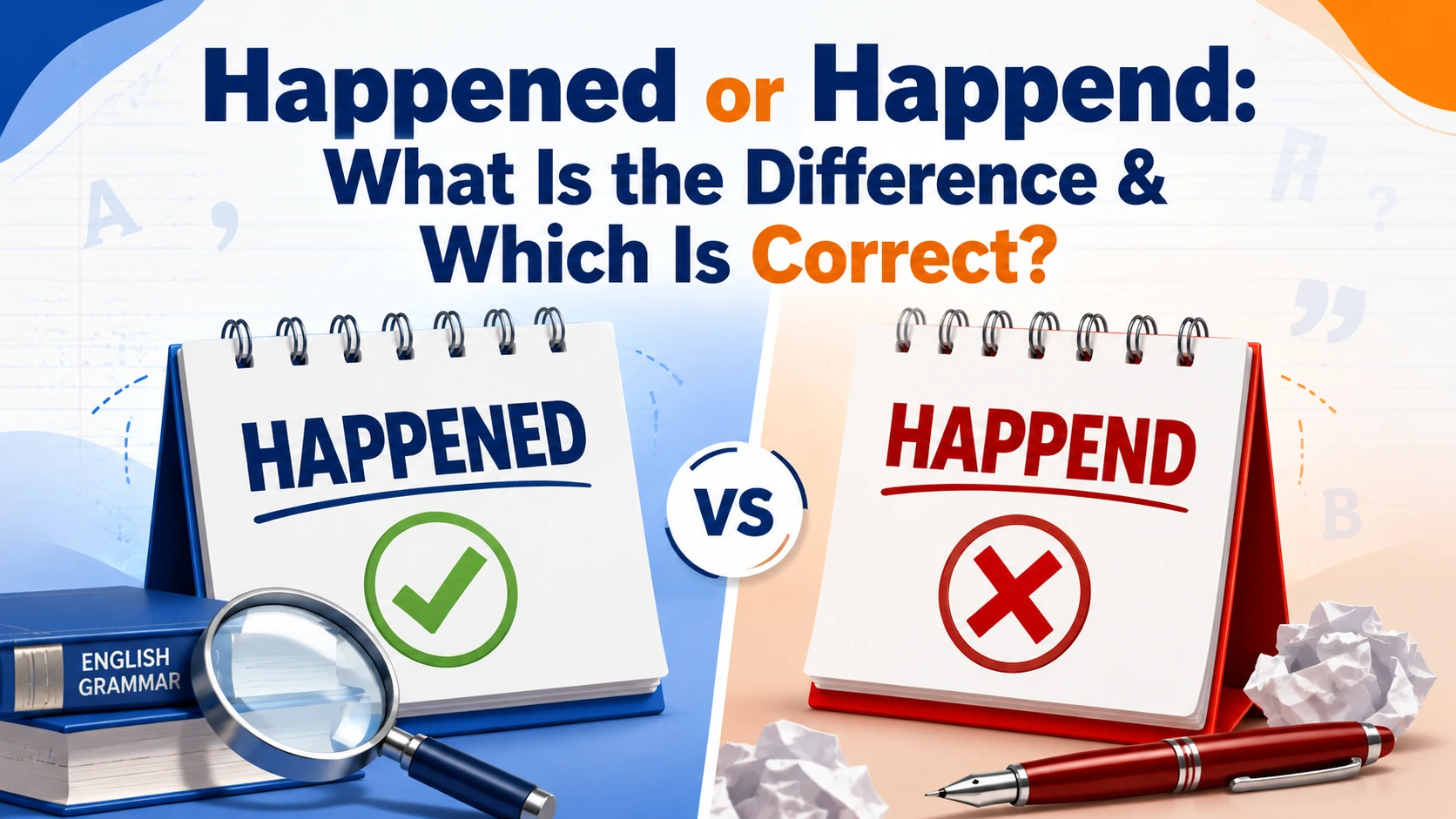
Happened or happend is one of the most common spelling dilemmas in English because the two words look almost identical at first glance. If you’ve ever paused before typing happened, you’re not alone. Many English learners, students, and even native speakers occasionally wonder whether the word needs the extra “e” before the final -ed. The confusion usually comes from pronunciation—both spellings sound nearly the same when spoken quickly. However, only one is recognized as correct in standard English, and using the wrong version can make otherwise polished writing appear careless.
Correct spelling matters more than many people realize. Whether you’re writing an email, submitting an academic assignment, publishing a blog post, or updating a professional résumé, small spelling mistakes can influence how readers perceive your credibility. “Happened” is a high-frequency verb that appears in everyday conversations, news reports, books, and business communication, so getting it right is essential. Understanding why the correct spelling works—not simply memorizing it—also helps you avoid similar mistakes with other English verbs.
This guide explains the difference between happened and happend, why one is correct and the other isn’t, and how the spelling follows standard English grammar rules. You’ll also learn practical memory techniques, real-world usage examples, common learner mistakes, sentence patterns, and proofreading tips that make the correct spelling much easier to remember. By the end, you’ll know exactly which spelling belongs in every context and feel confident using it in both formal and everyday writing.
Quick Answer: Is It “Happened” or “Happend”?
The short answer is simple:
- ✅ Happened is the correct spelling.
- ❌ Happend is a spelling mistake and isn’t recognized in standard English.
- ✅ Happened is the simple past tense and past participle of the verb happen.
If you’re referring to something that occurred in the past, happened is always the word you should use.
Key Takeaway: Whenever you write about an event that occurred previously, use happened—never happend.
The Correct Form at a Glance
| Word | Correct? | Meaning | Example |
| Happened | ✅ Yes | Past tense of happen | The accident happened yesterday. |
| Happend | ❌ No | Not a standard English word | ✗ The accident happend yesterday. |
What Does “Happened” Mean?
Definition of “Happened”
The word happened is the past tense and past participle of the verb happen. It means to occur, take place, come about, or unfold at a particular time.
Unlike many verbs that describe deliberate actions, happen often refers to events that occur naturally, unexpectedly, or without planning.
Examples:
- The meeting happened earlier than expected.
- A strange noise happened while we were sleeping.
- The incident happened during the weekend.
Although the situations differ, happened always refers to an event that has already taken place.
When to Use “Happened” in Everyday English
You’ll use happened whenever you’re talking about completed events.
Common situations include:
- describing personal experiences
- discussing historical events
- reporting news
- telling stories
- explaining accidents
- recalling conversations
- writing emails
- answering questions
For example:
- What happened after the meeting?
- Nothing unusual happened today.
- The mistake happened because of human error.
- The celebration happened last Friday.
Because it’s such a versatile verb, happened appears in both casual and professional communication.
Common Contexts Where “Happened” Appears
Certain types of writing rely on what happens more frequently than others.
Conversations
People naturally use happened when talking about recent events.
Examples:
- What happened at school today?
- I can’t believe that happened!
- Tell me what happened next.
Academic Writing
Researchers often describe previous observations or events.
Examples:
- The error happened during data collection.
- The experiment happened under controlled conditions.
Business Communication
Professionals use the word to explain completed situations objectively.
Examples:
- The delay happened because of shipping issues.
- The outage happened overnight.
News Reporting
Journalists regularly describe completed events using happened.
Examples:
- The accident happened early Tuesday morning.
- The announcement happened after months of negotiations.
Is “Happend” Ever a Correct Word?
Many learners assume happend might be an accepted alternative spelling, especially because English contains many irregular spellings. Fortunately, this question has a clear answer.
Why It Appears So Frequently Online
If you search online, you’ll find thousands of examples of happend.
However, most of them come from:
- typing mistakes
- learner errors
- social media posts
- unedited comments
- informal messages
Popularity doesn’t make a spelling correct. Incorrect spellings often spread simply because people copy what they’ve seen elsewhere.
Why Dictionaries Don’t Recognize It
Major English dictionaries consistently recognize only what happened.
The spelling happend doesn’t appear as a valid English word because it doesn’t follow the standard spelling of the verb happen.
The base verb is:
happen
When adding -ed, English keeps the final silent e, producing:
happen + ed = happened
There is no spelling rule that removes the e before adding -ed in this case.
Should You Ever Use “Happend”?
The simple answer is no.
Whether you’re writing:
- academic essays
- business reports
- emails
- social media captions
- website content
- resumes
- professional documents
the correct spelling always happens.
Using happend may:
- reduce your credibility
- distract readers
- create a poor first impression
- signal weak proofreading
Even if spell-check occasionally overlooks the typo, human readers usually notice it immediately.
Happened vs. Happend: Side-by-Side Comparison
Because the spellings differ by only one letter, they’re easy to confuse. A direct comparison makes the distinction much clearer.
| Feature | Happened | Happend |
| Correct English spelling | ✅ Yes | ❌ No |
| Found in dictionaries | ✅ Yes | ❌ No |
| Past tense of happen | ✅ Yes | ❌ No |
| Appropriate in formal writing | ✅ Yes | ❌ Never |
| Appropriate in academic writing | ✅ Yes | ❌ Never |
| Recommended for learners | ✅ Always | ❌ Avoid |
Spelling
The only accepted spelling includes the sequence:
…ened
Not:
…end
That single missing e changes a correct English word into a spelling mistake.
Meaning
Only what happened carries meaning.
It refers to something that:
- occurred
- took place
- unfolded
- came about
Since happend isn’t a real word, it has no independent meaning.
Grammar
Grammatically, happened functions as both:
- the simple past tense
- the past participle
Examples:
- The accident happened yesterday.
- It has happened before.
By contrast, happend has no grammatical role in standard English.
Pronunciation
One reason learners make this mistake is pronunciation.
When spoken naturally, many native speakers pronounce happened quickly, making the middle vowel sound less obvious.
Because of this, listeners sometimes assume the spelling should be happend.
English spelling, however, isn’t always a perfect reflection of pronunciation.
Acceptance in Formal and Informal Writing
Whether you’re writing casually or professionally, the rule never changes.
| Writing Context | Happened | Happend |
| School essays | ✅ | ❌ |
| Business emails | ✅ | ❌ |
| Blog articles | ✅ | ❌ |
| Social media | ✅ | ❌ |
| Job applications | ✅ | ❌ |
| Published writing | ✅ | ❌ |
Expert Tip: If you’re ever unsure, think of the base verb happen first. Since the original word ends in -en, the past tense naturally becomes happened, not happend.
Why People Misspell “Happened” as “Happend”
Spelling mistakes rarely happen randomly. Most follow predictable patterns, and happend is no exception. Understanding why the error occurs makes it much easier to avoid.
Dropping the Silent Letter
Many English words contain silent letters that aren’t strongly pronounced.
Because the second e in happened is subtle in speech, some writers accidentally leave it out.
Compare:
- written: happened
- mistaken spelling: happend
Your ears don’t always provide enough information to spell every word correctly, which is why relying on pronunciation alone can be misleading.
Confusion with the “-ed” Ending
Another common cause is misunderstanding how English forms the past tense.
Many learners think the process works like this:
happen → happend
In reality, the spelling preserves the original base word:
happen → happened
The extra e isn’t added randomly—it remains part of the original word structure.
Fast Typing and Autocorrect Errors
Modern technology also contributes to this mistake.
When typing quickly:
- letters may be skipped
- fingers may hit adjacent keys
- autocorrect may fail to detect the typo if it resembles another valid pattern
That’s why proofreading remains essential, even when using grammar software.
Common Mistakes Made by English Learners
People learning English often generalize spelling rules from simpler verbs.
For example:
- clean → cleaned
- paint → painted
- work → worked
When they happen, they may incorrectly simplify the spelling to happend.
The solution isn’t memorization alone—it’s recognizing the complete spelling of the base verb before adding the past-tense ending.
The Grammar Behind “Happened”
Knowing that the correct spelling is useful, but understanding why it’s correct makes the rule much easier to remember. English spelling follows recognizable patterns, and happens to be a good example of how regular verbs form their past tense without changing their core structure.
Base Verb: Happen
Every verb begins with a base form, which is the version you’ll find in a dictionary.
For this word, the base verb is:
Happen
It means:
- to occur
- to take place
- to come about
- to unfold unexpectedly
Examples:
- Strange things happen sometimes.
- Good ideas often happen during conversations.
- Accidents can happen to anyone.
- Opportunities happen when preparation meets timing.
Whenever you’re talking about the present, habitual actions, or future possibilities, what happens remains unchanged.
Why the Past Tense Becomes “Happened”
Unlike irregular verbs such as go → went or write → wrote, happen is a regular verb.
Regular verbs create the past tense by adding -ed.
Because happen already ends with the letter n, the correct transformation is:
happen → happened
Notice that the spelling of the original word stays intact.
It does not become:
❌ happend
The missing e breaks the spelling of the original verb and creates a word that doesn’t exist in standard English.
How Regular Verbs Form the Past Tense
Most English verbs follow predictable spelling patterns.
Here are a few examples:
| Base Verb | Past Tense |
| Walk | Walked |
| Clean | Cleaned |
| Finish | Finished |
| Open | Opened |
| Happen | Happened |
Once you recognize happen as a regular verb, the correct spelling becomes much easier to remember.
Verb Forms of Happen
Learning every form of the verb helps you avoid mistakes in different tenses.
| Verb Form | Word | Example |
| Base Form | Happen | Things happen for a reason. |
| Third-Person Singular | Happens | It happens every year. |
| Present Participle | Happening | The meeting is happening now. |
| Simple Past | Happened | The meeting happened yesterday. |
| Past Participle | Happened | It has happened before. |
Expert Tip: Unlike irregular verbs, regular verbs usually keep the same spelling pattern throughout every tense. Memorizing the complete verb family helps reinforce the correct spelling naturally.
How to Use “Happened” Correctly in Sentences
Even though happened is a common word, many learners struggle with where it belongs in a sentence. Understanding a few simple sentence patterns will help you use it naturally in both speech and writing.
Talking About Past Events
The most common use of happened is to describe events that have already taken place.
Examples:
- The accident happened late last night.
- Something unexpected happened during the interview.
- The celebration happened last weekend.
- A misunderstanding happened between the two teams.
These sentences describe completed actions, making the simple past tense the correct choice.
Asking Questions with “Happened”
Questions about past events often include what happened.
Examples:
- What happened yesterday?
- What happened after the meeting?
- When did the accident happen?
- Why did this happen?
Notice an important grammar rule.
After did, always use the base verb:
✅ What did happen?
❌ What did happened?
The helping verb already shows the past tense, so happen stays in its base form.
Negative Sentences Using “Happen”
Negative sentences follow the same rule.
Correct:
- It didn’t happen.
- Nothing happened yesterday.
- The meeting didn’t happen because of the weather.
- That never happened.
Incorrect:
- It didn’t happen.
Again, did already mark the sentence as past tense.
Common Sentence Patterns
Learning common structures is often easier than memorizing isolated examples.
Subject + Happened + Time
Examples:
- The meeting happened yesterday.
- The incident happened last week.
- The accident happened this morning.
Subject + Happened + Place
Examples:
- The collision happened near the bridge.
- The discussion happened in my office.
- The event happened at school.
Subject + Happened + Because + Reason
Examples:
- The delay happened because of heavy traffic.
- The mistake happened because of poor communication.
- The confusion happened because everyone received different instructions.
These sentence patterns appear frequently in everyday English and professional writing.
Real-Life Examples of “Happened” in Different Situations
Seeing grammar in authentic situations makes it easier to remember. The following examples show how happened naturally appears across different types of communication.
Everyday Conversations
In daily speech, events often introduce stories or explain recent events.
Examples:
- I can’t believe that happened.
- What happened while I was away?
- Nothing exciting happened today.
- That has never happened before.
These expressions are among the most frequently spoken English phrases.
School and Academic Writing
Students regularly use what happened when describing historical events, experiments, or observations.
Examples:
- The earthquake happened in the early morning.
- The error happened during the experiment.
- The discussion happened after the presentation.
- The discovery happened by accident.
Using the correct spelling is especially important in graded assignments.
Workplace Emails
Business writing values clarity and accuracy.
Examples:
- The issue happened after the software update.
- The delay happened because of supplier shortages.
- The misunderstanding happened during the client meeting.
- The outage happened overnight.
Professional documents lose credibility when common words are misspelled, so proofreading is essential.
News Headlines
Journalists frequently use happened when reporting completed events.
Examples:
- Fire Happened Late Sunday Night
- The Incident Happened Near Downtown
- What Happened During the Debate?
Although headlines are often shortened for style, the spelling of happened never changes.
Storytelling and Creative Writing
Narratives depend heavily on past-tense verbs.
Examples:
- Something unusual happened when the lights went out.
- Nothing happened for several hours.
- What happened next surprised everyone.
- The unexpected happened just before sunrise.
Writers often repeat happened naturally because stories revolve around events unfolding over time.
Common Expressions That Use “Happened”
Many native speakers don’t think about grammar rules—they remember complete expressions instead. Learning these common phrases helps your English sound more natural.
What Happened?
Probably the most common expression using the word.
Examples:
- What happened here?
- Tell me what happened.
- What happened after lunch?
This phrase appears constantly in conversation, journalism, and storytelling.
It Happened Again
Used when an event repeats unexpectedly.
Examples:
- The same mistake happened again.
- It happened again this morning.
- I can’t believe it happened again.
This phrase often expresses frustration or surprise.
Things Happen
A common idiom used to acknowledge that unexpected events are part of life.
Examples:
- Don’t worry—things happen.
- Mistakes happen to everyone.
- Sometimes things just happen.
The expression is often used to comfort someone after a disappointment.
Accidents Happen
This familiar saying reminds people that mistakes are sometimes unavoidable.
Examples:
- Don’t blame yourself. Accidents happen.
- Even experienced workers make mistakes because accidents happen.
The phrase emphasizes understanding rather than criticism.
As It Happened
A slightly more formal expression meaning by coincidence or as events unfolded.
Examples:
- As it happened, I already had the documents.
- As it happened, they arrived at the same time.
- As it happened, the manager was available.
You’ll encounter this expression frequently in books, newspapers, and formal writing.
Common Mistakes to Avoid
Most spelling and grammar errors involving what happened are predictable. Once you know them, they’re surprisingly easy to avoid.
Writing “Happend” Instead of “Happened”
This is the most frequent mistake.
Incorrect:
- The meeting happend yesterday.
Correct:
- The meeting happened yesterday.
Whenever you write the word, mentally picture the base verb first.
Confusing “Happened” with “Happen”
Some learners accidentally use the present tense when referring to the past.
Incorrect:
- The accident happened yesterday.
Correct:
- The accident happened yesterday.
Always check whether the action occurred in the past.
Using the Wrong Tense After “Did”
This grammar mistake appears very often.
Incorrect:
- What happened?
Correct:
- What happened?
Remember:
After did, the main verb returns to its base form.
Forgetting the Double “P”
Some writers focus so much on the ending that they accidentally misspell the middle of the word.
Incorrect:
- Hapened
Correct:
- Happened
The base word happen always contains two p’s.
Quick Reminder: Think of the word in two parts—happen + ed. Keeping the base verb intact automatically gives you the correct spelling.
Common Mistakes People Make with “Happened”
Misspelling happened as happend is one of the most frequent spelling errors in English. Although the two words look similar, only happened is recognized in standard English. The mistake usually occurs because English spelling rules don’t always match pronunciation, and many writers accidentally drop the second e before adding -ed.
Understanding why this error happens makes it much easier to avoid, especially in academic writing, business communication, emails, and everyday conversations.
Dropping the Second “E”
The most common mistake is removing the e after it happens.
Incorrect:
- Something happend yesterday.
- What happend to your phone?
- I don’t know what happend after lunch.
Correct:
- Something happened yesterday.
- What happened to your phone?
- I don’t know what happened after lunch.
The base verb is happen, not happn. When forming the past tense, English doubles the final n and adds -ed, resulting in happened.
Quick Tip: Think of it as happen + ed = happened. Don’t remove any letters from the base word.
Forgetting to Double the Final “N”
Another common spelling error is writing happened with only one n.
Incorrect:
- What hapened yesterday?
- Nothing important hapened.
Correct:
- What happened yesterday?
- Nothing important happened.
The verb happen follows the common spelling pattern where the final consonant is doubled before adding -ed.
Compare these examples:
| Base Verb | Past Tense |
| Stop | Stopped |
| Plan | Planned |
| Occur | Occurred |
| Happen | Happened |
Learning this pattern helps with many other English verbs as well.
Confusing Past and Present Forms
Some learners accidentally use happened when they actually need the present tense to happen or happens.
Incorrect:
- Strange things happen every weekend.
- Why does this happen?
Correct:
- Strange things happen every weekend.
- Why does this happen?
Remember:
- Happen = present tense
- Happens = third-person singular present
- Happened = simple past tense
Always check whether you’re talking about the present or the past before choosing the verb form.
Using “Happend” Because It Sounds Correct
English pronunciation often hides certain letters, making happend seem reasonable when spoken aloud.
For example:
- happened
- opened
- listened
Because the extra e isn’t strongly pronounced, many people spell the word exactly as they hear it.
This is especially common among:
- English learners
- Young students
- Fast typists
- People relying on pronunciation instead of spelling patterns
The best solution is repeated exposure through reading and writing.
Practical Examples in Different Contexts
Seeing things used naturally in different situations helps reinforce the correct spelling and grammar.
Everyday Conversations
Most daily conversations use happened to ask about or describe past events.
Examples:
- What happened after I left?
- Nothing unusual happened today.
- Something funny happened at work.
- I can’t believe that actually happened.
These short expressions appear constantly in spoken English.
Academic Writing
In essays and research papers, what happened describes completed events, observations, or historical developments.
Examples:
- The experiment happened under controlled conditions.
- Several significant changes happened during the nineteenth century.
- The incident happened before the survey began.
Academic writing often prefers more precise verbs such as occurred, took place, or developed, but happened is still grammatically correct when appropriate.
Business Communication
Professional writing frequently happens when discussing completed events objectively.
Examples:
- A technical issue happened during the software update.
- The delay happened because of severe weather.
- The misunderstanding happened after the policy changed.
- An unexpected error happened during processing.
In formal reports, alternatives like occurred, arose, or took place may sound more polished, depending on the context.
News and Media
Journalists used to report factual events clearly.
Examples:
- The accident happened late Friday evening.
- The announcement happened shortly after the meeting.
- The incident happened near the city center.
- Nobody expected what happened next.
The word is straightforward, neutral, and easily understood by readers.
Common Expressions with “Happened”
Learning complete expressions is often more useful than memorizing isolated words.
What Happened?
Perhaps the most common question in English.
Examples:
- What happened?
- What happened yesterday?
- Tell me what happened.
It Happened By Accident
Used when something was unintentional.
Examples:
- It happened by accident.
- The mistake happened by accident.
It Just Happened
Often used when something wasn’t planned.
Examples:
- We didn’t organize it—it just happened naturally.
- Our friendship simply happened over time.
Nothing Happened
A very common response when no significant event occurred.
Examples:
- Relax. Nothing happened.
- Nothing unusual happened today.
The Worst Happened
This expression refers to an unfortunate event becoming reality.
Examples:
- Everyone feared the worst, and eventually the worst happened.
- Emergency plans were ready in case the worst happened.
These expressions appear frequently in novels, newspapers, conversations, and films.
Memory Tricks to Never Misspell “Happened”
Simple memory techniques make the correct spelling much easier to recall.
Remember the Base Word First
Start with the base verb:
Happen
Now simply add the past-tense ending while keeping the original spelling pattern:
Happen → Happened
Avoid trying to spell it from pronunciation alone.
Think: Two Ps, Two Ns
A quick visual reminder is:
- Ha + pp + e + nn + ed
Notice:
- Two P’s
- Two N’s
- Keep the E
This pattern immediately separates happened from incorrect spellings like happend or hapened.
Read Before You Write
The more often you read correctly written English, the more natural the spelling becomes.
Pay attention to words like:
- happened
- opened
- planned
- stopped
- listened
Repeated exposure helps your brain recognize the correct spelling automatically.
Quick Checklist Before You Write
Before submitting an email, assignment, or report, ask yourself:
- ✅ Did I write happened, not happend?
- ✅ Did I keep the second e?
- ✅ Did I double the final n?
- ✅ Am I talking about something that already occurred?
- ✅ Does the verb tense match the rest of the sentence?
A five-second proofreading check can eliminate one of the most common English spelling mistakes.
Practice Exercises
Test your understanding before moving on.
Choose the Correct Spelling
- Something ______ during the meeting.
a) happend
b) happened
- What ______ yesterday?
a) happened
b) happend
- Nothing unusual ______ last night.
a) happened
b) happend
Fill in the Blank
Complete the sentences with the correct word.
- I don’t know what ______ after school.
- The accident ______ early this morning.
- Something unexpected ______ during the presentation.
Correct the Mistake
Rewrite these sentences correctly.
- What happend yesterday?
- Nothing happend after dinner.
- The meeting happend online.
Answer Key
Choose the Correct Spelling
- b) happened
- a) happened
- a) happened
Fill in the Blank
- I don’t know what happened after school.
- The accident happened early this morning.
- Something unexpected happened during the presentation.
Corrected Sentences
- What happened yesterday?
- Nothing happened after dinner.
- The meeting happened online.
Conclusion
Choosing between happened and happend is simpler once you understand the correct spelling rule. Happened is the only accepted spelling in standard English, while happend is a common misspelling that should be avoided in academic, professional, and everyday writing. Remember that happened is the simple past tense of happen, used to describe events or situations that have already occurred. Building the habit of checking your spelling, learning common verb patterns, and proofreading your work will help you avoid this error consistently. One final actionable tip: whenever you’re unsure, think of the base verb happen and then add -ed while keeping the double n. A common mistake to avoid is spelling the word based only on how it sounds rather than following its correct spelling pattern. Mastering this small detail will make your writing clearer, more polished, and more credible.
FAQs
Q1. Is “happend” a correct English word?
No. Happend is not recognized in standard English dictionaries and is considered a spelling mistake. The correct past tense and past participle of happen is happened, which should be used in both formal and informal writing.
Q2. Why do people often misspell “happened” as “happend”?
Many people rely on pronunciation when spelling. Because the second e in happens isn’t strongly emphasized when spoken, writers sometimes omit it accidentally. Learning the base verb happen makes the correct spelling much easier to remember.
Q3. Is “happened” the past tense of “happen”?
Yes. Happened is both the simple past tense and the past participle of happen. It describes an event that already occurred, such as “The meeting happened yesterday” or “It has happened before.”
Q4. Can I use “happened” in formal and academic writing?
Absolutely. Happened is grammatically correct in reports, essays, business communication, and academic papers. In some formal contexts, writers may choose alternatives like occurred, took place, or transpired, but what happened remains perfectly acceptable when it fits the tone.
Q5. What’s the easiest way to remember the correct spelling of “happened”?
Start with the base verb happen, then add -ed without removing any letters. A useful memory trick is to remember “two Ps, two Ns, and keep the E.” Reading the word regularly in books, articles, and emails also reinforces the correct spelling naturally.