

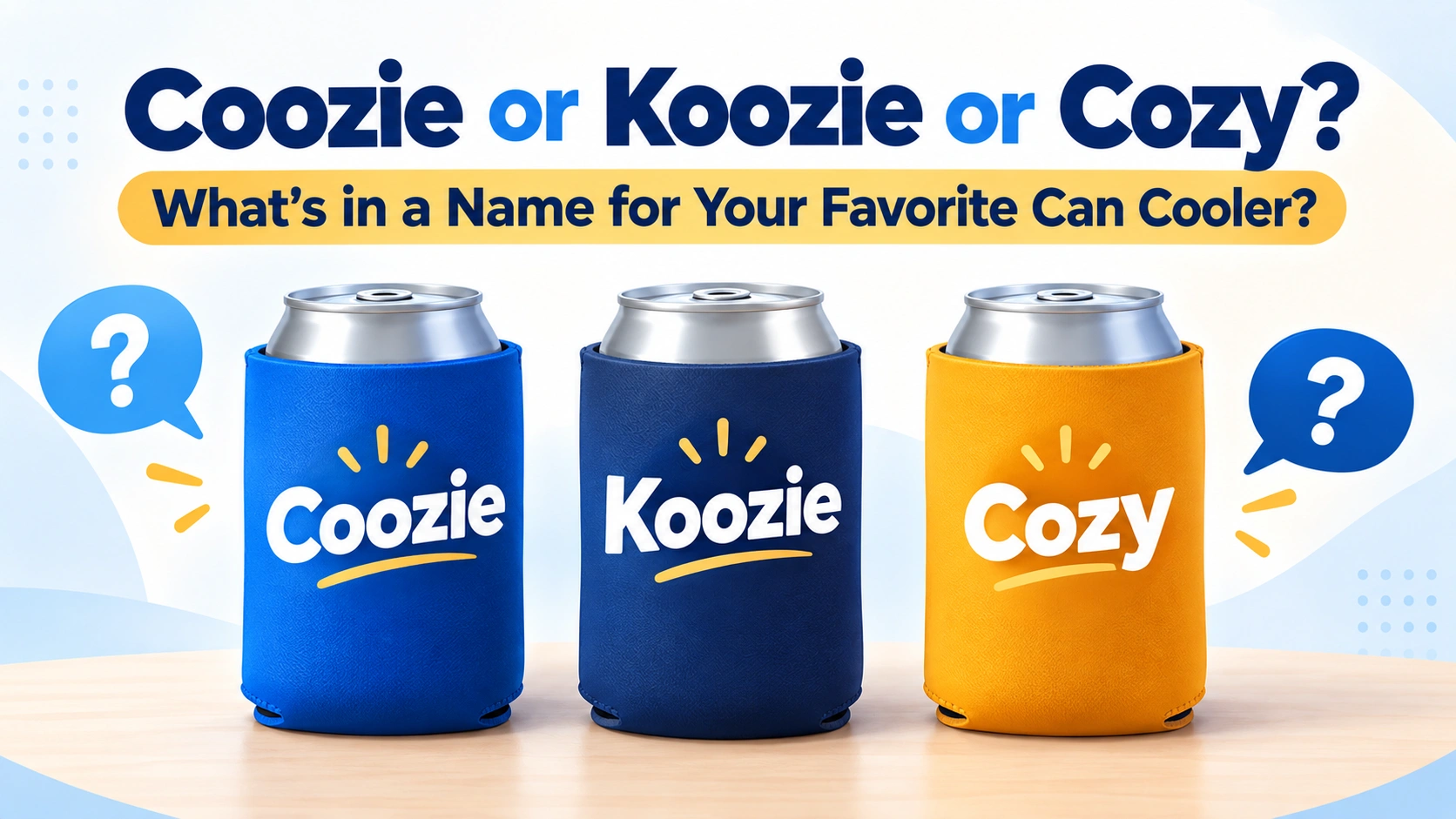
Coozie or Koozie or Cozy—if you have ever searched for the right name for that insulated sleeve around a cold drink can, you have probably encountered all three spellings. The confusion is understandable: Koozie is an established brand name, coozie appears as an informal alternative, and cozy is already a familiar English word with a completely different everyday meaning. They can sound similar when spoken, which makes the spelling question even trickier.
The object itself is simple: an insulated sleeve that fits around a can or bottle to help it stay cold and make it easier to hold. But the vocabulary surrounding it is surprisingly complicated. Depending on where you live, what you are reading, and whether you are talking about a specific brand or the product category generally, you may see Koozie, coozie, can cooler, drink sleeve, beverage insulator, stubby holder, and other regional terms.
So which word should you actually use? The answer depends on what you mean. Koozie has a documented trademark history, while can cooler is the clearest generic description. Coozie is widely recognizable as an alternative spelling, while cozy is better treated as a separate English word rather than simply another spelling of the product. Understanding that distinction makes the terminology much easier to navigate.
Quick Answer: Coozie, Koozie, or Cozy?
If you need the shortest possible answer, here it is:
- Koozie® is the established trademarked brand spelling associated with insulated beverage coolers.
- coozie is a commonly encountered alternative spelling used for the same general type of product.
- cozy is an ordinary English word meaning comfortable, snug, or pleasantly warm; it is not the clearest spelling for the drink-cooler product.
- Can cooler is usually the safest and clearest generic term when you are not referring to a particular brand.
The distinction becomes especially important in commercial writing. Koozie Group’s own brand guidelines instruct users to treat Koozie as a trademark and use it adjectivally with branded products—for example, “Koozie® can coolers”—rather than using “Koozies” as the generic name for every drink cooler.
For ordinary conversation, however, people commonly understand phrases such as “Put your can in a koozie.” Language in everyday use is often less precise than trademark terminology.
Practical rule: If you mean the product category, a cooler is the clearest choice. If you mean the branded product, Koozie® is the appropriate brand spelling.
What Is a Koozie?
A Koozie is a sleeve designed to insulate a beverage container. It typically fits around a can or bottle and provides a layer between the container and the surrounding air.
The basic purpose is straightforward: slow heat transfer so a chilled drink can remain cold for longer. The sleeve also makes a cold or wet container more comfortable to hold and can reduce condensation getting onto your hands or nearby surfaces.
Modern drink coolers can be made from several materials, including:
- Foam
- Neoprene
- Fabric
- Rubber-like insulating materials
- Other synthetic insulating materials
They also come in different shapes. Some are designed specifically for standard cans, while others accommodate bottles, slim cans, or differently sized containers.
What does a can cooler actually do?
A can cooler does not actively refrigerate a drink. Instead, its insulating material slows the movement of heat between the surrounding environment and the cold container.
That distinction matters. A sleeve can help a chilled drink stay cooler for longer, but it cannot turn a room-temperature drink into a cold one.
The same principle explains why a well-designed cooler sleeve can be useful outdoors, at picnics, during sporting events, or simply around the house.
Koozie, Coozie, or Cozy: Are They Different Products?
Usually, Koozie and coozie are used for the same general type of object: an insulated sleeve for a beverage container.
The spelling, however, tells you something about the word’s status.
| Term | Typical meaning | Main issue |
| Koozie® | A branded beverage-insulating product | Trademarked brand name |
| coozie | Informal/alternative name for a drink cooler | Common usage varies |
| cozy | Comfortable, snug, or pleasantly warm | Ordinary English word; not the clearest product term |
| can cooler | Generic insulated sleeve for a can | Clear and brand-neutral |
| drink sleeve | Broader sleeve for a beverage container | Useful when the container may vary |
The important point is that spelling does not necessarily indicate a physical difference. A product called a coozie may perform exactly the same function as something another person calls a koozie.
The more meaningful distinction is often between brand terminology and generic terminology.
Where Did the Word “Koozie” Come From?
The history of Koozie is more specific than the everyday use of the word might suggest.
According to the Koozie brand’s own published history, the brand began with Radio Cap Corporation (RCC), a company that originally specialized in baseball caps. RCC registered a trademark for the KOOZIE name in 1980 and introduced a Styrofoam can cooler in 1982.
There is also earlier documented trademark history. A World Intellectual Property Organization decision records that the KOOZIE mark was originally registered in the United States in December 1980 for insulated containers for beverage cans. That original registration was later cancelled in 2001 when it was not renewed, although subsequent KOOZIE trademark registrations followed.
That history helps explain why the word feels simultaneously like a brand name and a generic everyday noun.
Why the spelling looks unusual
“Koozie” is not a normal English word built from familiar spelling rules. Its unusual spelling helped make it distinctive as a brand.
Interestingly, modern dictionary and linguistic sources recognize the word in broader usage. Cambridge defines Koozie as a brand name for a sleeve covering a drink bottle or can, while noting koozie as an alternative form.
That is a useful distinction: a word can develop widespread everyday usage without losing its original trademark history.
Is “Koozie” a Trademark?
Yes. KOOZIE is a registered trademark associated with Scribe Opco, Inc., doing business as Koozie Group, and trademark records show active registrations for the mark. For example, a KOOZIE registration covering insulated containers for beverage cans was registered in 2007 and is recorded as renewed.
A separate KOOZIE registration was also registered in 2019 for the stylized wording of the mark.
This does not mean ordinary speakers are forbidden from saying “koozie.” Trademark law and ordinary language are different things.
It does mean that businesses should be careful when deciding whether Koozie is being used as:
- A reference to a specific branded product, or
- A generic name for an entire category of products.
Koozie Group’s current brand standards make this distinction particularly clear. They instruct users to write Koozie® as a trademark and recommend generic terms such as can coolers for non-Koozie products.
Why businesses should care
Suppose an online store sells several manufacturers’ insulated can sleeves.
Calling the entire category “Koozies” may be understandable to shoppers, but it can blur the distinction between a brand and a generic product category.
A more precise product page might say:
Custom Can Coolers
Then, if genuine branded products are being sold:
Koozie® Can Coolers
That approach is clearer for both readers and businesses.
When Should You Use “Koozie”?
Use Koozie® when you are intentionally referring to the trademarked brand or a genuine Koozie-branded product.
For example:
- “The company ordered Koozie® can coolers for its promotional event.”
- “This product is a Koozie® branded beverage cooler.”
- “Koozie® offers several styles of drink-related promotional products.”
For ordinary conversation, you will also encounter lowercase or pluralized forms such as “koozie” and “koozies.” That reflects everyday usage, but it is not necessarily the preferred way to present the trademark in formal commercial copy.
Expert tip
If you are writing for a business, do not automatically replace every occurrence of “can cooler” with “Koozie.” First determine whether you are talking about the brand or the product category.
That one distinction eliminates most of the terminology problem.
When Do People Use “Coozie”?
Coozie is a familiar alternative spelling for the insulated drink sleeve.
Cambridge specifically lists “coozie” as an alternative form when defining Koozie.
You may therefore encounter sentences such as:
- “I brought a coozie for my cold drink.”
- “They handed out custom koozies at the event.”
- “The store sells neoprene koozies.”
In informal writing, readers generally understand what the writer means.
The complication is that coozie does not carry the same trademark presentation as Koozie®. If you are writing a product catalog, advertising copy, or business website, cooler may be a cleaner generic term.
What About “Cozy”?
This is where the three-way comparison becomes especially important.
Cozy is an established English adjective meaning comfortable, warm, snug, or pleasant. It can also function as a noun in some contexts, such as a protective covering or decorative cover, depending on the object and regional usage.
But if you write:
“I bought a cozy for my soda can.”
Many readers may not immediately interpret “cozy” as the standard name of an insulated can cooler.
The word has a much broader meaning.
Cozy can still describe a drink sleeve
There is nothing wrong with using cozy as an adjective:
“The sleeve gives the can a cozy fit.”
Here, “cozy” describes the comfort or snugness of the fit.
It is different from using “cozy” as the specific product name.
So, if your goal is maximum clarity, write:
“I bought a can cooler.”
rather than:
“I bought a cozy.”
How Do You Pronounce “Koozie”?
Koozie is commonly pronounced /ˈkuːzi/, essentially two syllables with the stress on the first. Cambridge gives the same pronunciation for the word in both its US and UK dictionary entries.
That pronunciation helps explain part of the spelling confusion.
When people hear the word rather than see it written, there is no obvious way to know whether the writer intends:
- Koozie
- coozie
- another informal spelling
English has many words whose pronunciation provides little help with spelling. This is one of those cases.
Why Are There So Many Spellings?
The spelling variation is not mysterious once you look at how words spread through everyday speech.
1. The original spelling is unusual
Koozie does not look like a conventional English word, so people naturally experiment with spellings that seem intuitive.
2. The word is often learned by ear
Someone may hear another person say the word long before seeing it written.
3. Everyday language separates itself from trademark language
A branded term can become widely understood as a description for a whole class of products.
4. Different regions develop their own terminology
In Australia, for example, stubby holder is a familiar term for a similar beverage insulator. Other English-speaking communities use expressions such as can cooler, drink sleeve, or bottle cooler.
5. Search behavior reinforces variation
Once several spellings become established online, people continue encountering all of them. That makes each spelling more familiar and can perpetuate the variation.
How Did Koozies Become So Popular?
The product succeeded because it combines simple engineering with practical everyday usefulness.
An insulated sleeve is inexpensive to produce, easy to customize, lightweight, reusable, and useful at social or outdoor events. Those qualities made beverage coolers especially attractive as promotional merchandise.
The Koozie brand itself developed beyond basic can coolers into other promotional products and cooler formats. The company’s published history notes expansion into drinkware, additional can-cooler styles, cooler bags, outdoor products, travel accessories, and business accessories.
The promotional-products industry played an important role in making customized beverage sleeves familiar. A company can print a logo, event name, slogan, or design on a relatively small surface, turning an ordinary practical item into branded merchandise.
What Makes a Good Can Cooler?
Not every can cooler performs exactly the same way. If you are choosing one rather than simply asking what to call it, several characteristics matter.
Insulation
The material should provide enough insulation to slow heat transfer.
Fit
A sleeve that is too loose may be awkward to hold. One that is too tight may be difficult to put on or remove.
Material
Common materials include foam and neoprene. Neoprene versions tend to be flexible and durable, while foam designs can be lightweight and inexpensive.
Condensation control
A good sleeve can make a cold, wet container more comfortable to handle and reduce moisture transferring to your hands.
Portability
Collapsible designs are useful when the sleeve needs to fit into a bag or drawer.
Customization
For events and promotional use, printing quality and durability matter as much as insulation.
Buying tip: Match the sleeve to the container size first. A beautifully printed cooler is not very useful if it does not fit the can or bottle you intend to use.
Types of Koozies and Can Coolers
The category is broader than the classic foam sleeve many people picture.
| Type | Best suited for | Main advantage | Potential limitation |
| Foam can cooler | Standard cans | Lightweight and inexpensive | Less structured |
| Neoprene cooler | Regular everyday use | Flexible and durable | Often costs more |
| Slim-can cooler | Slim beverage cans | Snug fit | Not suitable for wider cans |
| Bottle cooler | Bottled drinks | Designed around bottle shapes | Less versatile for cans |
| Collapsible cooler | Travel and storage | Easy to pack away | May provide less structure |
| Custom can cooler | Events and promotion | Highly personalizable | Printing quality varies |
| Zippered/adjustable cooler | Multiple container types | Versatile fit | More complex design |
The term Koozie should not be used as though every one of these products is automatically a Koozie-branded item. Can cooler remains the useful generic category name.
Koozie vs. Can Cooler: Which Term Is Better?
There is no single winner because the terms serve different purposes.
| Situation | Best term | Why |
| Referring to the specific brand | Koozie® | Identifies the trademark |
| Describing the product generally | Can cooler | Clear and brand-neutral |
| Casual conversation | koozie/coozie | Widely understood |
| Explaining the product to beginners | Can cooler | Immediately understandable |
| Commercial product catalog | Can cooler or exact brand name | Avoids unnecessary ambiguity |
| Writing about trademark history | Koozie® | Historically and legally relevant |
| Describing a broader beverage sleeve | Drink sleeve | Works across container types |
This is one of those cases where precision beats popularity.
A reader may know exactly what a “koozie” is, but “can cooler” tells someone who has never heard the term what the product actually does.
How to Choose the Right Term for Your Audience
For casual readers
You can mention koozie because it is familiar and recognizable.
A useful first reference might be:
“A can cooler, often called a koozie, is an insulated sleeve designed to help keep a drink cold.”
That gives the reader both the familiar term and the generic explanation.
For product descriptions
Prefer a cooler, bottle cooler, or another precise generic description unless the item is actually Koozie-branded.
For SEO content
Do not force every spelling into every paragraph. A better approach is to establish the terminology once and then use natural variations where they genuinely help.
For example:
- Primary term: can cooler
- Related term: Koozie
- Alternative spelling: coozie
- Related concepts: drink sleeve, beverage insulator, insulated can holder
Search-friendly writing should still sound like something a human would actually read.
For educational writing
Define the distinction directly:
“Koozie is a trademarked brand name, while can cooler is a generic description of the product.”
That sentence does more useful work than repeating all three spellings throughout the article.
Common Misconceptions About Koozies and Coozies
Myth 1: “Coozie” is simply a misspelling
Not necessarily. Coozie is an established alternative form in dictionary and real-world usage, although its status differs from the Koozie trademark. Cambridge explicitly lists it as an alternative.
Myth 2: “Cozy” is always the correct spelling
No. Cozy is a normal English word, but it is not the clearest name for the modern can-cooler product.
Myth 3: Every can cooler is a Koozie
This is the biggest terminology mistake in commercial writing. Koozie® identifies a brand, whereas “can cooler” describes the product category.
Myth 4: Different spellings mean different products
Usually not. A Koozie and a coozie can refer to essentially the same kind of insulated sleeve.
Myth 5: Trademark status determines everyday speech
It does not. People may use a trademarked word casually in ways that differ from how the trademark owner wants it presented commercially.
Common Usage Mistakes
Using “cozy” when you mean “can cooler”
This creates unnecessary ambiguity because cozy already has a well-established meaning.
Treating “Koozie” as a generic noun in commercial copy
If you sell multiple brands, a cooler is generally clearer than calling every product a Koozie.
Assuming “coozie” is universally preferred
It is recognizable, but spelling preferences vary. There is no need to pretend that everyday usage is perfectly uniform.
Ignoring the brand distinction
If you are discussing trademark history or genuine Koozie products, the capitalized Koozie® form matters.
Overcorrecting casual speakers
In ordinary conversation, correcting someone every time they say “koozie” or “coozie” misses the point. The distinction matters most when precision, branding, or commercial usage is involved.
Koozie, Coozie, or Can Cooler? A Simple Decision Guide
Use this checklist:
Are you talking about a specific brand?
→ Use Koozie®.
Are you describing the product category?
→ Use a cooler.
Are you writing casually and your audience already knows the term?
→ koozie or coozie may be understood.
Are you writing for an international or unfamiliar audience?
→ Introduce the term as a can cooler or insulated drink sleeve.
Are you selling non-branded products?
→ Prefer a cooler, drink sleeve, or another generic product description.
Are you describing comfort rather than naming the product?
→ Use cozy in its ordinary English sense.
This decision process is much more useful than memorizing a simplistic “one spelling is correct” rule.
Real-Life Examples of the Terms in Context
At a picnic
“I packed a couple of can coolers for our drinks.”
This is clear and completely brand-neutral.
In casual conversation
“Did you bring a koozie for your can?”
The meaning is immediately recognizable to many speakers.
In a product catalog
“Custom neoprene can coolers with full-color printing.”
This is more precise than labeling an entire category “Koozies.”
In branded merchandise
“Koozie® branded can coolers are available in several styles.”
Here, the trademark is being used to identify the brand.
When describing comfort
“The insulated sleeve provides a cozy, snug fit.”
Here, cozy is simply an adjective. It is not the product name.
Why the Trademark History Matters
The story behind Koozie illustrates a broader feature of language: brand names can become so familiar that people begin using them as ordinary category labels.
That creates a tension between two systems.
The first is everyday language, where speakers want the quickest and most recognizable word.
The second is trademark usage, where a brand owner wants its distinctive mark to remain associated with its particular goods or services.
KOOZIE’s history includes both successful brand development and disputes concerning how the name should be used. The World Intellectual Property Organization documented the brand’s trademark history, while industry reporting has also described disputes over whether “Koozie” had become generic in everyday usage.
The lesson is not that one side of the debate is automatically right. The useful lesson for writers is simpler: ordinary usage and legal trademark status are not the same question.
What Should You Call One in Your Own Writing?
If you are unsure, can cooler is the safest general-purpose choice.
It immediately communicates what the object is, does not depend on a trademark, and works for foam, neoprene, collapsible, customized, and other varieties.
- Use Koozie® when the brand itself is relevant.
- Use coozie when discussing the alternative spelling or reflecting informal usage.
- Use cozy when you actually mean comfortable, snug, or pleasantly warm.
The following formula works well for most explanatory articles:
“A can cooler, often called a koozie or coozie, is an insulated sleeve designed to help keep a beverage container cold.”
After defining the terms once, there is no need to keep repeating all three spellings.
Conclusion:
The coozie vs. Koozie vs. cozy question looks like a simple spelling puzzle, but the real issue is the difference between brand name, everyday usage, and generic terminology. Koozie® has a documented trademark history and remains a recognizable brand associated with insulated beverage products. Coozie is a familiar alternative form, while cozy is an ordinary English word that should not normally be substituted for the product name. When clarity matters most, can cooler is the straightforward generic choice.One final actionable tip: decide first whether you are naming a brand or a product category, then choose your terminology accordingly. A common mistake to avoid is treating every insulated drink sleeve as a Koozie simply because that word is familiar. The best writing does not merely use the most popular term—it uses the most accurate term for the context.
FAQs
Q1. Is Koozie or coozie the correct spelling?
Koozie is the established trademark spelling associated with the Koozie brand, while coozie is a recognized alternative form used in general English. For a generic product, can cooler is the clearest choice. Cambridge lists coozie as an alternative to Koozie.
Q2. Is a Koozie the same thing as a can cooler?
Usually, yes in everyday conversation. A Koozie® is a branded type of insulated beverage sleeve, while a can cooler is a generic product description. Therefore, every Koozie can cooler fits the broader category, but not every can cooler is necessarily a Koozie-branded product.
Q3. Why is it called a Koozie?
The name originated as a brand name, rather than as a conventional English word. Radio Cap Corporation registered the KOOZIE trademark in 1980 and introduced a Styrofoam can cooler in 1982. The brand subsequently expanded into additional beverage and promotional products.
Q4. Is “cozy” another spelling of “koozie”?
Not in the ordinary sense. Cozy is an established English word meaning comfortable, snug, or pleasantly warm. Although historical and linguistic connections between forms of the words are sometimes discussed, modern readers generally recognize “cozy” as a separate everyday word rather than the clearest name for a can cooler.
Q5. What is the best generic name for a Koozie?
Can cooler is one of the clearest generic terms because it immediately tells readers what the product is. Depending on the container, bottle cooler, drink sleeve, beverage insulator, or insulated can holder may also be appropriate. Use Koozie® when the specific trademarked brand is intended.