

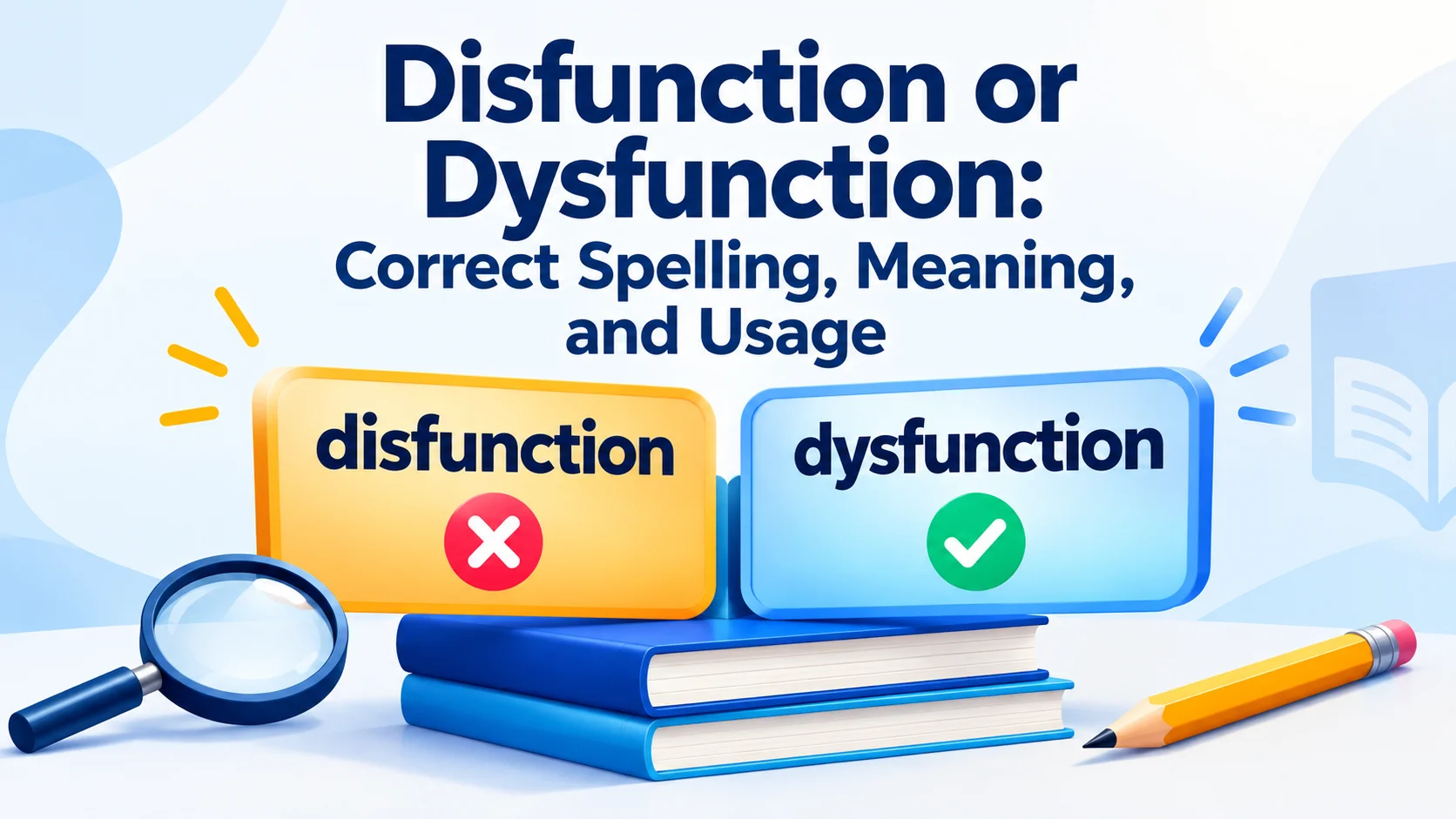
The correct spelling in standard modern English is dysfunction, not disfunction. Although the two forms look almost identical, only dysfunction is the accepted choice for ordinary writing when describing impaired, abnormal, or ineffective functioning. The distinction matters because a single letter can affect the credibility of an otherwise well-written sentence, particularly in academic, medical, and professional contexts. Whether you encountered the word in a report, an article about relationships, or a discussion of technology, understanding its spelling and meaning will help you use it with greater confidence and precision.
The confusion becomes easier to understand when you look at how English builds words. The prefix dys- appears in terms associated with difficulty, impairment, or abnormal functioning, while dis- has several other uses, including negation, separation, and reversal. Because both prefixes occur frequently in English, writers sometimes substitute one for the other. However, prefixes cannot always be exchanged according to a simple rule. This guide explains why dysfunction is the standard form, how it differs from related words, and what its spelling reveals about the structure of English vocabulary.
Correct spelling is only the beginning. You also need to know when dysfunction is the most appropriate word, how to form its adjective, and whether it means the same thing as malfunction, disorder, or disability. Those distinctions become especially important when discussing health, family relationships, workplaces, and technical systems. In the sections below, you will find clear definitions, natural sentence examples, practical comparisons, and straightforward ways to remember the correct spelling. By the end, you should be able to recognize the error, explain the difference, and choose the most precise word for your intended meaning.
Disfunction or Dysfunction: Which Spelling Is Correct?
Dysfunction is the preferred spelling in contemporary English. It is the form used in established dictionary definitions and is the safest choice for school assignments, articles, business documents, and formal communication. The word refers to impaired or abnormal functioning, whether in a bodily process, a relationship, or a system.
Compare these examples:
- Standard: Poor communication contributed to dysfunction within the department.
- Not recommended: Poor communication contributed to disfunction within the department.
- Standard: The examination revealed evidence of thyroid dysfunction.
- Not recommended: The examination revealed evidence of thyroid disfunction.
There is a small but important qualification: disfunction has been recorded as a less common spelling variant in some references. Therefore, calling it an entirely invented word would be too absolute. Nevertheless, dysfunction is the conventional form to use in modern standard writing.
Dysfunction vs. Disfunction at a Glance
| Feature | Dysfunction | Disfunction |
| Spelling status | Standard and widely established | Less common variant recorded in some references |
| Meaning | Impaired or abnormal functioning | Intended to express the same basic meaning |
| Preferred in formal writing | Yes | Generally avoid |
| Common related adjective | Dysfunctional | Dysfunctional is generally not recommended |
| Best practical choice | Use this form | Replace with dysfunction in ordinary writing |
Quick rule: When you mean impaired or ineffective functioning, write dysfunction.
What Does Dysfunction Mean?
Dysfunction is a noun describing a condition in which something does not work as it should. It can refer to a physical process, an organ, a machine, a relationship, or an organization.
The central idea is impaired functioning, not necessarily complete failure. A system might still operate while producing unreliable results. Similarly, a team may continue completing its work even though poor communication and unclear responsibilities make the process ineffective.
The word’s meaning changes slightly with context, but its underlying idea remains consistent.
Dysfunction in Medical and Biological Contexts
In medicine, dysfunction describes impaired functioning of a bodily organ, process, or system. Examples include:
- Thyroid dysfunction: The thyroid gland is not functioning normally.
- Kidney dysfunction: Kidney function is impaired.
- Cognitive dysfunction: One or more aspects of cognitive functioning are affected.
- Cardiac dysfunction: The heart’s functioning is impaired.
The term alone does not establish a particular diagnosis, cause, or level of severity. Those details require additional clinical information.
For instance, the sentence “The tests indicated kidney dysfunction” identifies a problem with functioning without specifying its cause or the appropriate treatment.
This distinction is important in professional writing: use dysfunction to describe impaired function, but do not treat it as a complete medical explanation.
Dysfunction in Relationships and Families
In social and interpersonal contexts, dysfunction refers to patterns of interaction that interfere with healthy or effective relationships.
Examples include:
- Repeated misunderstandings created dysfunction within the team.
- The counselor helped the family recognize unproductive communication patterns.
- Their inability to discuss disagreements contributed to relationship dysfunction.
The word should be used thoughtfully. Every disagreement, difficult conversation, or family conflict does not automatically constitute dysfunction. The term is more appropriate when recurring patterns substantially interfere with how a relationship operates.
Whenever possible, describe the actual behavior rather than relying on a broad label. “The team avoids discussing problems until deadlines are missed” gives readers more useful information than simply calling the team dysfunctional.
Dysfunction in Organizations, Technology, and Social Systems
The same concept applies outside medicine and personal relationships.
In an organization, dysfunction might involve unclear responsibilities, conflicting instructions, or a decision-making process that repeatedly stalls. In technology, it may describe impaired operation within a system or component.
Consider these examples:
- The company addressed organizational dysfunction by clarifying reporting responsibilities.
- Software dysfunction prevented the team from completing automated tests.
- The report examined dysfunction in the public service delivery system.
In each case, the word identifies a problem in how something operates. It does not necessarily mean that the entire organization or system has stopped working.
Why Is Dysfunction Spelled With “Dys-” Instead of “Dis-“?
The spelling reflects the established word form and its history. The prefix dys- comes from Greek and is associated with difficulty, impairment, abnormality, or something working poorly.
The prefix dis-, by contrast, appears in English words expressing ideas such as negation, separation, reversal, or opposition. Its exact function depends on the word.
Because both prefixes are common, it is understandable that writers sometimes confuse them. However, English does not allow us to replace one prefix with another whenever the resulting word seems logical.
What Does the Prefix “Dys-” Mean?
The prefix dys- appears in several English words associated with impaired, difficult, or abnormal functioning.
| Word | General meaning |
| Dysfunction | Impaired or abnormal functioning |
| Dyslexia | A learning difference that can affect reading and related language skills |
| Dyspepsia | Indigestion or discomfort associated with digestion |
| Dysphagia | Difficulty swallowing |
| Dysfunctional | Not functioning normally or effectively |
These words do not all describe the same kind of problem. The shared prefix is a useful clue to their meaning, not a substitute for learning each word’s definition.
How Is “Dis-” Different From “Dys-“?
The prefix dis- occurs in familiar words such as disagree, disconnect, and disapprove.
- Disagree: To have a different opinion.
- Disconnect: To separate or break a connection.
- Disapprove: To regard something unfavorably.
These examples illustrate why dis- feels like a natural choice to many writers. However, the fact that it is appropriate in those words does not make it the preferred spelling in dysfunction.
A useful distinction is that dys- is associated with impaired functioning in this word, while dis- performs different roles in other established words. Neither prefix can be applied mechanically to every English root.
Why “Disfunction” Looks Right but Usually Isn’t the Best Choice
There are two main reasons for the confusion.
First, the prefixes look and sound similar. Someone writing quickly may spell the word according to the familiar pattern in dislike or disconnect.
Second, English spelling contains historical irregularities and less common variants. The existence of a variant does not mean that all spellings are equally suitable in present-day professional writing.
The practical solution is straightforward: remember the standard word family—dysfunction, dysfunctional, dysfunctions—and check a reliable dictionary when you are uncertain.
Is “Disfunction” Ever Correct?
The answer requires more nuance than a simple yes or no.
Disfunction is recorded as a less common variant in some references, but dysfunction remains the standard choice for general contemporary writing. If you encounter dysfunction in an older publication, a quotation, or a specialized source, its presence does not automatically mean the text is wrong in every possible context.
For most writing tasks, however, there is little reason to choose the less familiar variant. Readers are more likely to expect dysfunction, and using the established form avoids unnecessary distraction.
Follow these guidelines:
- Schoolwork and examinations: Use dysfunction.
- Professional reports and articles: Use dysfunction.
- Medical and scientific writing: Follow the established terminology used by the relevant field.
- Historical quotations: Preserve the original wording when accurate quotation is required.
- Editing someone else’s work: Correct dysfunction to dysfunction unless there is a specific reason to retain the original spelling.
The key distinction is between a spelling that has appeared in usage and the spelling that is most appropriate for your audience.
How to Use Dysfunction Correctly in a Sentence
Dysfunction is a noun. It can function as the subject or object of a sentence, follow a preposition, or appear as part of a longer noun phrase.
Here are several natural sentence patterns:
- Dysfunction + verb: “Dysfunction affected the team’s decision-making.”
- Verb + dysfunction: “The review identified dysfunction in the approval process.”
- Adjective + dysfunction: “The report described serious organizational dysfunction.”
- Dysfunction + prepositional phrase: “The researchers investigated dysfunction within the system.”
The word is often used with in, within, of, and between, depending on the intended meaning.
For example, “dysfunction in the system” identifies where the problem exists, while “dysfunction between departments” emphasizes difficulties in their interactions.
Examples of Dysfunction in Everyday English
- The group addressed its communication dysfunction before starting the next project.
- Unclear expectations created dysfunction between the two departments.
- The manager recognized that repeated delays reflected a deeper organizational problem.
- The article explored how family dysfunction can affect communication patterns.
These examples show how the noun can describe problems in relationships and group processes without necessarily referring to a medical condition.
Examples of Dysfunction in Medical and Scientific Writing
- The clinician investigated possible thyroid dysfunction.
- The study examined cognitive dysfunction following an illness.
- Researchers explored how the disruption of a biological process could contribute to cellular dysfunction.
These sentences use the term descriptively. They do not claim that every instance of dysfunction has the same cause or consequence.
Examples of Dysfunction in Business and Technology
- The audit revealed dysfunction in the company’s purchasing process.
- Repeated software errors exposed a problem in the system’s operation.
- The team reduced organizational dysfunction by clarifying who was responsible for each decision.
- A lack of coordination contributed to dysfunction across the project.
In business writing, specificity is particularly useful. If the problem is missed deadlines, unclear ownership, or poor communication, name it when possible. The word dysfunction can summarize the broader issue, but it should not obscure the details.
Incorrect vs. Correct Spelling in Context
| Nonstandard spelling | Preferred spelling | Why |
| The team discussed organizational dysfunction. | The team discussed organizational dysfunction. | Uses the conventional noun spelling |
| The report identified cognitive dysfunction. | The report identified cognitive dysfunction. | Uses the established term |
| Their dysfunctional process caused delays. | Their dysfunctional process caused delays. | Uses the standard adjective |
| The study examined system dysfunctions. | The study examined system dysfunctions. | Uses the conventional plural form |
Dysfunction, Dysfunctional, and Dysfunctionality: What’s the Difference?
These words belong to the same word family, but they have different grammatical roles. Choosing the right form makes sentences more natural and precise.
| Word | Part of speech | Meaning | Example |
| Dysfunction | Noun | Impaired or abnormal functioning | The audit identified dysfunction. |
| Dysfunctional | Adjective | Not functioning normally or effectively | The team used a dysfunctional process. |
| Dysfunctionality | Noun | The quality or condition of being dysfunctional | The report examined the dysfunctionality of the process. |
| Dysfunctions | Plural noun | Multiple instances or forms of impaired functioning | The study explored several dysfunctions. |
Dysfunction as a Noun
Use dysfunction when naming the problem or condition itself.
- “The investigation uncovered dysfunction in the department.”
- “The treatment team assessed the patient’s symptoms and possible organ dysfunction.”
Depending on context, the noun can be used as a countable or uncountable noun. For example, a dysfunction can refer to a particular problem, while organizational dysfunction often describes a broader condition.
Dysfunctional as an Adjective
Use dysfunctional to describe something that is not operating or behaving normally.
- “The company replaced its dysfunctional approval process.”
- “They wanted to change an unhealthy pattern of communication.”
- “The technician investigated a dysfunctional component.”
Notice the grammatical difference:
- The dysfunction affected the process.
- The process was dysfunctional.
The first sentence names the problem; the second describes the process.
Is “Disfunctional” Correct?
In ordinary contemporary writing, dysfunctional is the form to use. It is the established adjective related to dysfunction. The spelling dysfunctional is generally best avoided.
Remember the connection:
dysfunction → dysfunctional
The prefix remains dys- in both words. Do not change it simply because you are turning the noun into an adjective.
When Is “Dysfunctionality” Useful?
Dysfunctionality is a valid noun, but it can sound unnecessarily abstract in everyday prose.
For example:
- Wordier: “The dysfunctionality of the approval process delayed the project.”
- Clearer: “The dysfunctional approval process delayed the project.”
- Also clear: “Problems with the approval process delayed the project.”
The longer noun may be suitable when discussing the general quality or condition of a system in technical analysis. In most general writing, dysfunction or a more specific description is easier to read.
Dysfunction vs. Malfunction vs. Disorder
These words overlap, but they are not interchangeable in every situation. The right choice depends on what kind of problem you want to describe.
| Word | Main emphasis | Typical use | Example |
| Dysfunction | Impaired or abnormal functioning | Bodies, relationships, organizations, systems | The team experienced organizational dysfunction. |
| Malfunction | A fault or failure in operation | Machines, devices, equipment, technical systems | A sensor malfunction interrupted the test. |
| Disorder | A condition or disruption; in medicine, a recognized category of condition | Health, psychology, arrangements, social order | The specialist evaluated the suspected disorder. |
| Disruption | An interruption or disturbance | Services, schedules, processes, normal activity | The storm caused disruption to transport services. |
| Inefficiency | Failure to use time or resources effectively | Workflows, organizations, procedures | Inefficiency increased the project’s cost. |
Dysfunction vs. Malfunction
Dysfunction generally emphasizes impaired functioning. Malfunction often emphasizes a fault in the operation of a machine, device, or component.
For example:
- “The company experienced dysfunction in its decision-making process.”
- “A malfunction in the printer prevented it from producing documents.”
The terms can overlap in technical contexts. A system may experience dysfunction because one of its components malfunctions. The distinction is one of emphasis, not an absolute rule.
Dysfunction vs. Disorder
Disorder has several meanings, including a disturbance of normal arrangement and a recognized medical or psychological condition. Dysfunction specifically emphasizes impaired functioning.
A condition described as a disorder may involve dysfunction, but the words do not mean the same thing. Likewise, describing a process as dysfunctional does not establish that a person has a medical or psychological disorder.
Use the term that accurately reflects the evidence and context.
Dysfunction vs. Disability
A disability concerns an impairment or the interaction between a person’s condition and barriers in their environment. Dysfunction refers to impaired functioning in a particular context.
These terms should not be treated as synonyms. A disability does not automatically mean that a person, their abilities, or their life is dysfunctional. When discussing people, choose precise and respectful language that reflects the situation rather than making broad assumptions.
Common Grammar and Usage Mistakes With Dysfunction
Even when writers know the correct spelling, they can still use the word imprecisely. The following checks help improve both accuracy and clarity.
1. Writing “Disfunction” or “Disfunctional”
The easiest error to fix is the prefix.
- Prefer dysfunction, not dysfunction.
- Prefer dysfunctional, not dysfunctional.
A spellchecker may catch these errors, but it is useful to recognize the correct word family yourself.
2. Confusing the Noun and Adjective
Do not use the noun where an adjective is needed.
- Awkward: “The dysfunctional process delayed the project.”
- Correct: “The dysfunctional process delayed the project.”
- Also correct: “The dysfunction in the process delayed the project.”
The first corrected sentence describes the process. The second identifies a problem within it.
3. Using Dysfunction When a More Precise Word Is Needed
A broad term can make writing less informative if a more specific word is available.
✅If a device suddenly stops working, malfunction may be clearer. If a meeting is interrupted, disruption may fit better. If a process wastes time through unnecessary steps, inefficiency may explain the problem more accurately.
Practical editing tip: Ask yourself what is actually going wrong. If you can name the problem directly, do so. Use dysfunction when you need to describe the broader condition of impaired functioning.
4. Treating Every Conflict as Dysfunction
Disagreement is not automatically dysfunctional. A team can debate an idea productively, and family members can disagree while maintaining healthy relationships.
The term is more appropriate when recurring patterns interfere with normal or effective functioning. In sensitive contexts, describing specific actions—such as avoiding difficult conversations or repeatedly ignoring agreed procedures—is usually more informative than applying a sweeping label.
How to Remember the Correct Spelling of Dysfunction
The simplest way to remember the word is to learn it as part of a family rather than trying to reconstruct it each time.
Keep these three forms together:
- Dysfunction — noun
- Dysfunctional — adjective
- Dysfunctions — plural noun
You can also connect dys- with familiar terms such as dyslexia and dysphagia. This does not mean the words share identical definitions; it simply helps you recognize the established prefix.
Before submitting an assignment or publishing an article, use this quick checklist:
- Am I referring to impaired or ineffective functioning?
- Have I spelled the noun dysfunction?
- If I need an adjective, have I written dysfunctional?
- Would malfunction, disorder, disruption, or another term be more precise?
- Have I avoided making unsupported medical or personal judgments?
A short final review is often enough to catch the error.
Conclusion:
When deciding between disfunction or dysfunction, choose dysfunction for standard contemporary writing. It is the established spelling for impaired or abnormal functioning, while disfunction is a less common variant that most writers do not need to use. Understanding the related adjective dysfunctional also helps prevent errors when describing a process, relationship, or system. Just as importantly, spelling is only one part of word choice: malfunction, disorder, disruption, and inefficiency each convey a different emphasis. One final actionable tip: save dysfunction and dysfunctional together in your personal spelling list so you can check both forms quickly. A common mistake to avoid is assuming that a familiar prefix must be correct simply because it looks logical. Good writing depends on established usage and precise meaning, not guesswork.
FAQs
Q1. Is “disfunction” listed in any English dictionaries?
Yes, some references record disfunction as a less common variant of dysfunction. However, dysfunction remains the preferred spelling for contemporary standard writing. If you are unsure which form to use in an essay, article, or professional report, choose dysfunction.
Q2. Is dysfunction countable or uncountable?
It can be both, depending on the sentence. Dysfunction is often uncountable when describing a general condition, as in “organizational dysfunction.” It can also be countable when referring to a specific problem, as in “a dysfunction affecting the system.” Context determines the natural choice.
Q3. What is the plural of dysfunction?
The standard plural is dysfunctions. For example, “The study examined several dysfunctions affecting the system.” However, when discussing impaired functioning generally, the singular uncountable form may sound more natural: “The report explored dysfunction within the organization.”
Q4. How do you pronounce dysfunction?
In common English pronunciation, dysfunction is pronounced approximately dis-FUNK-shun, with the main stress on funk. The initial sound resembles “dis,” which helps explain why some writers mistakenly spell the word dysfunction. Pronunciation can guide recognition, but it does not always reveal the correct spelling.
Q5. Can dysfunction describe a machine or computer system?
Yes. Dysfunction can describe impaired operation in a technical system, although malfunction may be more precise when referring to a specific mechanical or electronic fault. For example, a malfunctioning sensor might contribute to dysfunction across a larger automated system.