

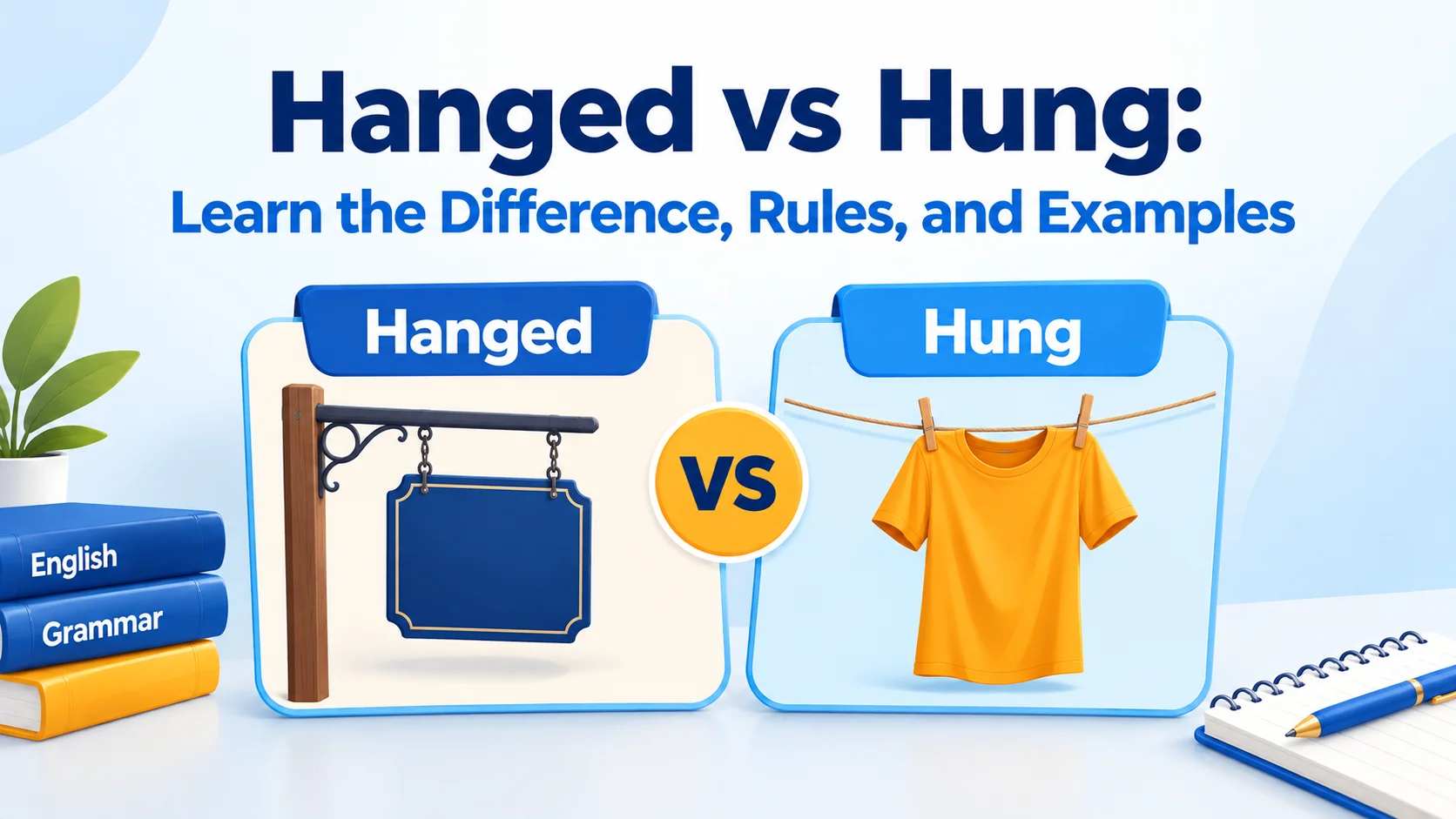
Hanged vs. hung is a common grammar puzzle because both words are past-tense forms of the verb hang, yet they are not used in exactly the same situations. The basic rule is straightforward: hung is used when something is suspended, attached, or displayed, while hanged is traditionally used when referring to execution by hanging. For example, you would say, “She hung the painting on the wall,” but “The historical record states that the prisoner was hanged.” Understanding this distinction helps you choose the right word without second-guessing yourself.
The confusion comes from the fact that English irregular verbs do not always follow predictable patterns. Most verbs form their past tense by adding -ed, but hang has two established past forms depending on its meaning. Both hung and hanged can function as past tense verbs and past participles, so grammar alone does not determine which one belongs in a sentence. The intended meaning matters most. Once you recognize whether hang refers to suspension or execution, you can apply the correct form in everyday conversation, academic assignments, professional writing, and historical accounts.
In this guide, you will learn when to use hanged or hung, how their grammatical forms work, and why the distinction matters in formal writing. You will also find practical sentence examples, comparison tables, common mistakes, and answers to frequently asked questions. Beyond memorizing a rule, you will discover how to apply it in different sentence structures, including questions, passive constructions, and perfect tenses. Whether you are editing an article, writing an essay, or simply checking a sentence, this guide will help you make a confident, accurate choice.
Hanged vs. Hung: The Difference at a Glance
The difference between hanged and hung depends on the meaning of the verb hang, not simply on whether you are using British or American English.
- Hung: The usual past tense and past participle when something is suspended, attached, or displayed.
- Hanged: The traditional past tense and past participle when hang refers to execution by hanging.
Consider these examples:
- The gallery hung the photographs in chronological order.
- The historical account states that the prisoner was hanged.
Both sentences use a correct past-tense form of hang. The difference lies in what the verb describes.
| Feature | Hung | Hanged |
| Main use | Suspending, attaching, or displaying something | Execution by hanging |
| Grammatical role | Simple past and past participle | Simple past and past participle |
| Example | He hung his jacket by the door. | The prisoner was hanged. |
| Common context | Home, work, decoration, figurative expressions | Historical, legal, or literary accounts of execution |
| Present participle | Hanging | Hanging |
| Base verb | Hang | Hang |
Quick rule: If you mean that someone placed or suspended an object, use hung. If you mean execution by hanging, use hanged in standard conventional usage.
What Does Hung Mean?
Hung is the usual past tense and past participle of hang when the verb means to suspend something, attach it, display it, or leave it hanging in a particular position.
The word appears in many everyday situations. You might hang a picture, hang a coat on a hook, hang curtains across a window, or hang decorations for a celebration. In each case, the past-tense form is hung.
When to Use Hung for Objects and Decorations
Use hung when describing something that has been placed in a suspended or displayed position.
Examples:
- We hung the new curtains before moving into the house.
- She hung her coat on the hook near the entrance.
- The museum hung the painting beside the main staircase.
- They hung colorful lanterns across the garden.
- He had hung the sign above the doorway before the shop opened.
These sentences describe ordinary acts of suspension or display. Using hanged in these contexts would generally be incorrect in standard contemporary English.
The rule also applies when the object is large or fixed in place. A company may have a banner hung outside its headquarters, or a school may hang a notice on a bulletin board. The size of the object does not affect the choice of verb.
When Hung Describes a State or Position
Hung can also appear when the focus is on an object’s position rather than the action of placing it there.
Examples:
- The painting hung above the fireplace for decades.
- A heavy curtain hung across the doorway.
- The old sign had hung outside the building for years.
- The decorations were hung from the ceiling.
In the first three examples, hung is part of the verb phrase describing the object’s position over time. In the last example, it is a past participle used in a passive construction.
This distinction can help when editing: the verb may describe an action, a continuing state, or the result of an earlier action, but ordinary suspension still calls for hung.
Hung in Figurative Expressions
English also uses hung in expressions that do not involve a physical object hanging from something.
| Expression | Meaning | Example |
| Hung in the balance | Remained uncertain | The project’s future hung in the balance. |
| Hung on every word | Listened with intense attention | The audience hung on every word of the speaker’s story. |
| Hung up on something | Became overly preoccupied with it | He was still hung up on a minor disagreement. |
| Left hanging | Left without an answer or resolution | The unexpected ending left readers hanging. |
These expressions are established parts of English usage. Do not replace hung with hanged simply because an expression contains the verb hang. Its meaning and conventional phrasing determine the correct form.
What Does Hanged Mean?
Hanged is the traditional past tense and past participle of hang when the verb refers to execution by hanging. It is used in historical records, legal descriptions, biographies, and fiction that discusses this form of execution.
For example:
- The historical record states that the prisoner was hanged.
- The novel describes a character who was hanged after the trial.
- According to the account, the sentence was carried out and the condemned man was hanged.
The word has a specific meaning in these examples. It does not simply describe a person or object suspended from a rope or other support; it refers to execution.
How to Use Hanged in a Sentence
Hanged can appear in active sentences, where the subject performs the action, and passive sentences, where the subject receives the action.
Active voice:
- The authorities hanged the condemned man.
- The historical account says the regime hanged several prisoners.
Passive voice:
- The condemned man was hanged.
- The prisoners had been hanged, according to the historical record.
In both structures, hanged is appropriate because the intended meaning is execution by hanging.
When writing about historical events, choose wording carefully. The distinction may affect the precision and tone of an account, particularly when the sentence concerns legal punishment or a person’s death.
Why Hanged Is Used for Execution
English has preserved a special past form for this meaning of hang. Although hung is the normal form in most other contexts, hanged remains the conventional choice for execution.
This is an example of how the meaning of a verb can influence its grammatical form. English contains other irregular verbs with special forms or patterns, so it is not unusual for a verb’s history and usage to resist a simple rule.
For learners, the practical lesson is more important than memorizing the historical development: use hanged for execution and hung for ordinary suspension.
Hanged in Historical and Literary Writing
The distinction is particularly useful in writing about history, law, and literature.
Suppose you are writing a biography about a person who was executed by hanging. The sentence “He was hanged in the eighteenth century” follows the conventional usage. By contrast, “His portrait was hung in the museum” describes the display of an object.
When quoting a historical source, preserve the source’s wording accurately. If a source uses a different form, do not silently alter a direct quotation merely to make it conform to the modern rule. Instead, distinguish the source’s wording from your own narration.
Is It Correct to Say Someone Was Hung or Hanged?
When referring specifically to execution by hanging, “was hanged” is the conventional form in standard English. “Was hung” is normally understood as describing suspension, attachment, or display, so it is not the recommended choice when precision matters.
Compare these sentences:
- The painting was hung in the entrance hall.
- The prisoner was hanged, according to the historical record.
The difference is not caused by the passive voice. Both sentences are passive constructions, but the meaning of the verb determines which participle is appropriate.
You may encounter hang ups in some historical texts, informal speech, or nonstandard usage when discussing execution. The existence of such examples does not erase the conventional distinction. In formal writing, choose hanged for the execution-related meaning unless you are reproducing a source’s wording or following a specific editorial convention.
A useful editing question is: What does the sentence say happened? If it describes an object being suspended, choose hung. If it describes a person being executed by hanging, choose hanged.
Hanged vs. Hung: Examples in Real Sentences
Examples are especially useful because the two forms look similar and share the same base verb. The following comparisons show how context changes the correct choice.
Everyday Examples Using Hung
- She hung the family photograph beside the front door.
- The workers hung a banner across the stage.
- I hung my wet coat near the heater.
- They had hung the decorations before the guests arrived.
- The old clock hung crookedly on the wall.
- The company hung its new sign above the entrance.
- He hung the towel on the rack after showering.
In each example, hang refers to suspension, placement, or display.
Examples Using Hanged
- The historical document says the prisoner was hanged.
- The biography explains that the individual was hanged following a trial.
- The account records that the condemned man had been hanged.
- The novel states that the character was hanged for treason.
These examples use the conventional form for execution. They are phrased neutrally because the purpose is to illustrate grammar, not to describe the act itself.
Paired Examples That Clarify the Difference
| Sentence | Correct form | Why? |
| She ___ the portrait above the desk. | Hung | The portrait is being displayed. |
| The prisoner was ___, according to the record. | Hanged | The sentence refers to execution. |
| We had ___ the curtains before the guests arrived. | Hung | Curtains are being suspended. |
| The historical account says the condemned man was ___. | Hanged | The verb refers to execution. |
| The school ___ the students’ artwork in the corridor. | Hung | The artwork is being displayed. |
| The biography reports that the person was ___. | Hanged | The context is execution. |
When the context is clear, the correct form is usually easy to identify. If a sentence is ambiguous, add enough detail to show what hang means rather than relying on the reader to guess.
The Grammar of Hang, Hung, and Hanged
To use these words confidently, it helps to understand how they function in different verb forms. Hang is the base form, while hung and hanged are alternative past forms used according to meaning.
Hang, Hung, and Hanged: Verb Forms Compared
| Verb form | Ordinary suspension | Execution by hanging |
| Base form | hang | hang |
| Simple past | hung | hanged |
| Past participle | hung | hanged |
| Present participle | hanging | hanging |
| Third-person singular | hangs | hangs |
The table shows why the distinction can be confusing: the base verb and present participle are the same in both meanings. The difference becomes visible in the simple past and past participle.
Examples:
- Present: She hangs the picture carefully.
- Past: She hung the picture yesterday.
- Present participle: She is hanging the picture now.
- Present perfect: She has hung the picture already.
For the execution-related meaning:
- Present: The verb hang appears in discussions of historical practice.
- Past: The historical account says the authorities hanged the prisoner.
- Present participle: The narrative describes the act of hanging in general terms.
- Past perfect: The record states that the prisoner had been hanged.
How to Use Hung and Hanged in Perfect Tenses
The past participle appears with auxiliary verbs such as has, have, and had. The auxiliary does not decide whether to use hung or hanged. The intended meaning does.
Examples:
- The gallery has hung the new collection.
- We had hung the curtains before the room was painted.
- The historical record says the prisoner had been hanged.
- The condemned man was hanged, according to the account.
The key is to identify the meaning of hang first, then choose the appropriate past participle.
Why “Did He Hung the Picture?” Is Incorrect
In questions and negative statements formed with did, English uses the base form of the main verb.
Incorrect: Did she hung the picture?
Correct: Did she hang the picture?
Likewise:
- Incorrect: They did not hung the banner.
- Correct: They did not hang the banner.
This rule applies to both meanings of hang. For example, a question about the execution-related meaning would also use the base form after: “Did the authorities hang the prisoner?” The past form is not needed because it already marks the past tense.
Common Mistakes When Choosing Between Hanged and Hung
Knowing the rule is one thing; applying it consistently is another. These are the errors most likely to appear in everyday writing.
Mistake 1: Using Hung for Every Meaning of Hang
Some writers assume that hung is always the correct past tense because it is the form they encounter most often.
Incorrect for the conventional execution meaning: The prisoner was hung.
Preferred in standard usage: The prisoner was hanged.
Use hanged when the sentence specifically refers to execution by hanging.
Mistake 2: Using Hanged for Ordinary Objects
The reverse error occurs when a writer treats hanged as a more formal version of hung.
Incorrect: She hanged the picture in the hallway.
Correct: She hung the picture in the hallway.
Hanged is not a general-purpose alternative for ordinary suspension. Using it for a picture, curtain, sign, or coat can make the sentence sound incorrect or suggest a meaning the writer did not intend.
Mistake 3: Confusing Verb Form and Verb Meaning
Writers sometimes focus on whether a sentence is past tense or passive rather than considering what the verb means.
For example, both “The painting was hung” and “The prisoner was hanged” use passive constructions. The grammatical structure is similar, but the participles differ because the meanings differ.
Practical tip: Determine the action first, then choose the verb form. Do not choose hung or hanged solely because the sentence contains was, had, or been.
Mistake 4: Using the Past Form After Did
Remember that it takes the base form hang, not hung or hanged.
- Correct: Did they hang the decorations?
- Correct: Did the authorities hang the condemned person?
- Incorrect: Did they hung the decorations?
The base form follows did in both cases. The meaning of the sentence still determines which past form would be used in a statement.
A Simple Way to Remember Hanged vs. Hung
If you struggle to remember the distinction, use this two-part check:
- Is something being suspended, attached, or displayed? Use hung.
- Does the sentence refer to execution by hanging? Use hanged.
A short memory aid can help:
- Hung a picture.
- Hanged a condemned person.
Then check the grammar of the complete sentence. If you are asking a question with did, use hang: “Did she hang the picture?” If you are writing in the perfect tense, choose the participle that matches the meaning: “She has hung the picture” or “The historical record says he had been hanged.”
This approach is more reliable than trying to memorize every possible sentence. Once you identify the meaning, the conventional form follows naturally.
Conclusion:
The difference between hanged vs. hung becomes manageable when you focus on what the verb describes. Use hung for ordinary suspension, attachment, or display, and use hanged for execution by hanging in conventional standard usage. The same distinction applies whether you are writing a simple sentence, a formal report, or a historical account. One final actionable tip: when proofreading, identify the action in every sentence containing hang before checking its tense or structure. A common mistake to avoid is assuming that one form is always correct or that the distinction depends on national variety. Meaning determines the choice. Once you make that your first check, you can use both forms accurately and write with greater confidence.
FAQs
Q1. Is hanged or hung correct in British English?
Both forms are used in British English, but their conventional meanings differ. Hung is the normal form for suspension or display, while hanged is traditionally used for execution by hanging. The distinction is based on meaning, not a simple British-versus-American spelling difference.
Q2. Can you say “hung” when talking about a historical execution?
You may encounter hung in historical sources or informal usage, but hanged is the conventional form in standard English when referring to execution. In formal historical writing, use hanged unless you are quoting a source or following a clearly established editorial convention.
Q3. Is “hanged” a regular or irregular verb form?
Hanged is an irregular past form of hang in its execution-related sense. The ordinary suspension meaning usually hangs. Because the same base verb has two established past forms, it is best to learn the distinction by meaning rather than treating one form as a regular alternative to the other.
Q4. What is the present tense of hanged and hung?
The base form is hang in both meanings, and the present-tense forms include hang and hangs. The present participle is hanging. The difference between hung and hanged becomes relevant in the simple past and past participle, depending on whether the verb means suspension or execution.
Q5. Should I change “hung” to “hanged” when editing a quotation?
Not automatically. A direct quotation should preserve the original source’s wording unless you clearly indicate an editorial change. In your own narration, use hanged for the conventional execution-related meaning and hung for ordinary suspension. This keeps your writing accurate without misrepresenting historical material.